
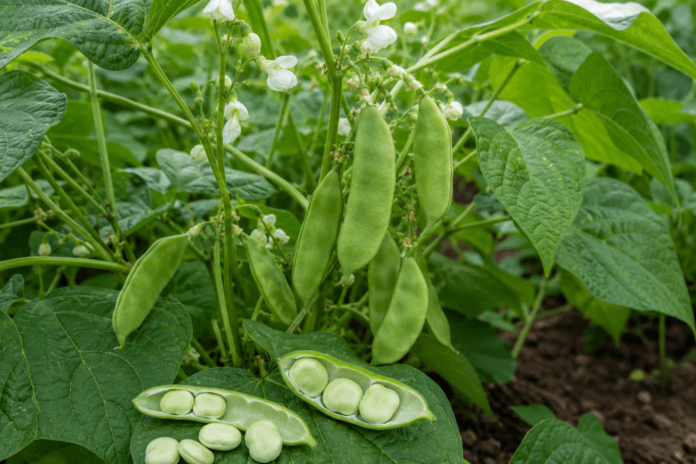
Basic Information
Plant Name: Fabaceae (Leguminosae)
Plant Family: Fabaceae (Leguminosae)
Scientific Name: Phaseolus lunatus
Beans are in the family Fabaceae (Leguminosae). Man has cultivated edible beans for thousands of years. They are widely planted and useful for home gardens. Early varieties were tough and required string removal and long cooking to soften them. Before the late 19th century, most beans were raised for shelled, dried beans, not fresh green beans.
For some time, the lima bean was believed to originate in Brazil, but new evidence points to Guatemala. Wild primitive lima beans and diverse cultivated forms have been found there.
As Native Americans migrated, they took their bean varieties with them. Remains show that they took them through Mexico into the American Southwest, then eastward to spread from Florida to Virginia. Various types of lima beans were grown by different tribes. They ranged from the present small types used by the Hopi Indians in the Southwest to the Sieva type found in the East.
From Guatemala, they were also carried through Central America into Peru, where they developed large-seeded, large-podded types in the warm coastal areas. The name, lima bean, came from Lima, Peru. Early European explorers discovered the bean there. Seeds have been discovered in Peruvian tombs.
The originals were also carried eastward through the West Indies then southto the mainland of South America. Although the beans came from the same parentage, the beans that developed in this area will develop cyanide under certain conditions, unlike the other limas. Fortunately, the Carribean Lima beans are small and round and do not look much like Lima Beans at all.
Although most of the lima beans commonly grown in the United States are green, there is a wide diversity of colors, shapes and sizes.
When the white man arrived in the Americas, they discovered that the native tribes grew them almost as universally as maize and provided an important supplement to their diets. While maize has a high starch content, it is low in proteins – Lima Beans are high in proteins. Between the two, they supplied most of the proteins required for good health among Central American Indian tribes that ate little, or no meat.
Because beans dry so well, they are easy to transport and store. Merchants, explorers, and slavers, favored them and began stocking them as ships’ provisions in the early days of American exploration. They carried them to the far corners of the earth.
Of course they took them to Europe where they originated and the first record of them there is in 1591. They were not as important as common snap beans in Europe because they require warm weather to grow well. By the late 1700s lima beans were written about in records all over the world.
The original lima beans grew on vines but after 1875, a dwarf mutant bush variety became popular as someone realized its potential use.
Planting Lima Beans
Planting Information
| Seeding Rate Per Foot | 8 oz. per 100 ft of row 3 to 6 seeds per foot |
| Seeds Per Ounce | 25 to 75 |
| Space Between Plants | Bush: 3″ |
| Planting Depth | 1″ |
| Plant Height | Tall |
| Plant Types | Pole or Bush Thin or thick seeded |
| Favorite Varieties | Fordhook 242, Kingston |
| Seed Viability (Years) | 3 years |
| Seed Germination | 75° F |
| Germination Time | 31 days at 59° F 18 days at 68° F 7 days at 77° F 7 days at 86° F |
Planting Instructions
Planting depth should be 1 to 1 1/2 inches deep when moisture levels are sufficient and the soil temperatures are approximately 65° F, but it is best to check the local area conditions. Use high quality, certified seed that has been treated with pesticides to avoid problems with fungi, bacteria, insects, and seed-borne pathogens.
Place traditional rows as follows: plant seeds two to three inches apart with rows 18 to 24 inches apart or plant in rows 13 inches apart with four inches between plants.
Only high quality, certified seed that has been treated with pesticides should be used to avoid problems with fungi, bacteria, insects, and seed-borne pathogens.
Bush Type: Traditional Rows: plant seeds 3 to 6 inches apart in rows 18 to 24 inches apart or plant in rows 12 inches apart with four inches between plants.
Wide Rows and containers: plant seeds about 6 inches apart
Pole Type: sow seeds 3″ to 6″ apart with 24″ to 36″ between trellises. Plant so 2 to 3 rows climb up the same trellis system. This reduces labor required for building supports and decreases space required for production.
For hills, sow seeds 3″ to 6″ apart in a circle and place poles teepee-style around the circle.
Grow & Care – Lima Beans
Fast Facts
| Light Requirements | Full sun |
| Temperature Adaptations | Tender: plant between average date of last spring frost (about when the first apples bloom) and July 15. |
| Acidity (pH) Tolerance | 6.8 – 5.5 |
| Salinity (Ec) Tolerance | 1.0 |
| How Pollinated | Self pollinating |
| Growth Habits | Annual |
Additional Information
Fertilizer Requirements
Beans grow best in fertile soils. In marginal or average soils, band 1.5 pounds of balanced all-purpose fertilizer (20-20-20) for every 100 feet of row when planting. Place two inches to the side and two inches below the seed so that it does not damage the seed.
Avoid adding further nitrogen because beans and other legumes have nitrogen fixing nodules on their roots and fix their own once established. Excess nitrogen delays flowering and encourage excess vine growth.
Water Utilization
Lima Beans require an average amount of water, but do best in a well-drained soil. Water frequently to avoid water deficiency during bloom/fruiting period. Root systems are shallow and plants wilt easily during hot summer weather. If Lima Bean plants are allowed to dry out, they may drop their flowers.
Plant Development and Care
Beans have four stages of development: germination and establishment, rapid vegetative growth, flowering and pod development, and pod fill and maturation. During germination and establishment phase, the seedling emerges and three nodes are visible on the main stem. During rapid vegetative growth, branches develop in leaf axes at each node and a new node develops every three days. During flowering, the blossoms appear at the nodes and pods grow 5 to 6 inches long.
Beans grow best in well-drained silty loam soils. They are very sensitive to excess water which will injure bean plants and encourage disease. Organic matter can be added to improve some types of soil.
Bean seeds rot in cool, wet soils. Plant in moist, warm soil to hasten germination. Use high quality, certified seed that has been treated with pesticides to avoid problems with fungi, bacteria, insects, and seed-borne pathogens. Remove and dispose of diseased plants to avoid spreading diseases.
Beans are extremely sensitive to saline conditions so the soil and irrigation water should be managed properly to avoid salt accumulation. A high salt content in the soil will cause some damage to the plants and possibly reduce yields.
Germination Time (Days)
31 days at 59° F
18 days at 68° F
7 days at 77° F
7 days at 86° F
Seed Germination and Temperature Range
75° F
Common Fertilizer Deficiencies
Zinc (Zn) Beans are sensitive to zinc deficiencies. They generally occur in soils where the topsoil has been removed, soils low in organic matter, or soils with a pH greater than 7.0.
Harvesting Lima Beans
Fast Facts
| Planting to Harvest | Bush lima beans: 65 to 78 days Pole lima beans: 78 to 88 days |
| Average Yield | 10 pounds per 10 feet of row |
| Recommended planting for a family of five | 100 feet |
| Recommended Uses | Boil, braise-stew, bake, pressure cook, or microwave |
Additional Information
Harvest Recommendations
Bush lima beans develop more quickly than pole lima beans and may be harvested more quickly. Pick when bean pods become full and lumpy but are still green.
They can be picked when less mature for more tender eating.
Storage and Preservation Methods
Lima beans should always be shelled before cooking. Squeeze the bean on the pod seam with your thumb. Beans should pop out easily.
Best when canned or frozen but can be stored fresh up to a week in a cool, moist place. Can also be dried.
Lima Beans – Diseases, Pests and Problems
Basic Information
Problem: Cutworms
Affected Area: Root
Description: Cuts off young plant just above the soil; no other damage apparent. Lives in soil around roots.
Control: If troubled, place cardboard collars around seedlings. Extend collar 1″ below soil and 1″ above the soil.
Problem: Mexican Bean Beetle
Affected Area: Stem and Leaf
Description: Yellow with black markings about 1/3 inch long with spines; said to resemble a pincushion. Eats the surface at the leaf blade leaving leaf veins. Larvae and egg clusters on underside of leaf
Control: Hand pick when small. Crush eggs. Clean up debris in the fall * Rotenone, Pyrethrum and Sevin are registered for use. Sevin can be used to day of harvest. Allow at least 1 day between Rotenone application and harvest. * Pesticide use and recommendations for various areas are constantly changing. Check with your County agent for current recommendations.
Problem: Aphids
Affected Area: Stem and Leaf
Description: Small Insects found on new stems and the underside of the leaf. Usually green. They suck fluids from the plant leaving a honey dew substance behind. Leaves turn pale yellow.
Control: Insecticidal soaps, a strong stream of water, and most registered insecticides. * Pesticide use and recommendations for various areas are constantly changing. Check with your County agent for current recommendations.
