

Note: This article contains affiliate links. If you click on these links and make a purchase, I may earn a small commission at no extra cost to you. This helps support my research and content. Read my full affiliate disclosure here.
If your yard has low water pressure, a standard sprinkler can spray unevenly, waste water, or barely reach planting beds. Choosing a tripod garden sprinkler designed for low-pressure conditions makes a real difference in coverage, distribution, and water use. This guide shortlists six tripod options that perform well when household or irrigation pressure is limited. We focus on how far they spray at reduced flow, how evenly they cover turf and beds, and how easy they are to adjust and set up in an active garden. Read on to understand the practical tradeoffs and which features will matter most for your layout and hose setup.
Top Picks at a Glance
| Best Overall The best all-around choice for most situations | IrrStpro Green Zinc Alloy Tripod Impact Garden Sprinkler |  |
| Best Value The sweet spot between price and what you get | RESTMO Adjustable Metal Tripod Impact Sprinkler |  |
| Best Budget The cheapest option that still gets the job done reliably | SOLSTICE GARDEN 360° Metal Spot Impact Sprinkler (2-Pack) |  |
| Highest Rated A top-rated pick with lots of positive feedback | ARICOR Impact Sprinkler on Tripod Base with Brass Head |  |
| Most Popular A crowd favorite that many people choose with confidence | Hourleey Brass Impact Sprinkler with Adjustable Tripod Base |  |
| Best Seller A high-volume bestseller chosen again and again | Biswing Impact Sprinkler Head with Adjustable Tripod Base |  |
IrrStpro Green Zinc Alloy Tripod Impact Garden Sprinkler
| Material Type | Brass, Metal |
|---|---|
| Maximum Pressure | 80 psi |
| Inlet Connection Size | 0.75 inches |
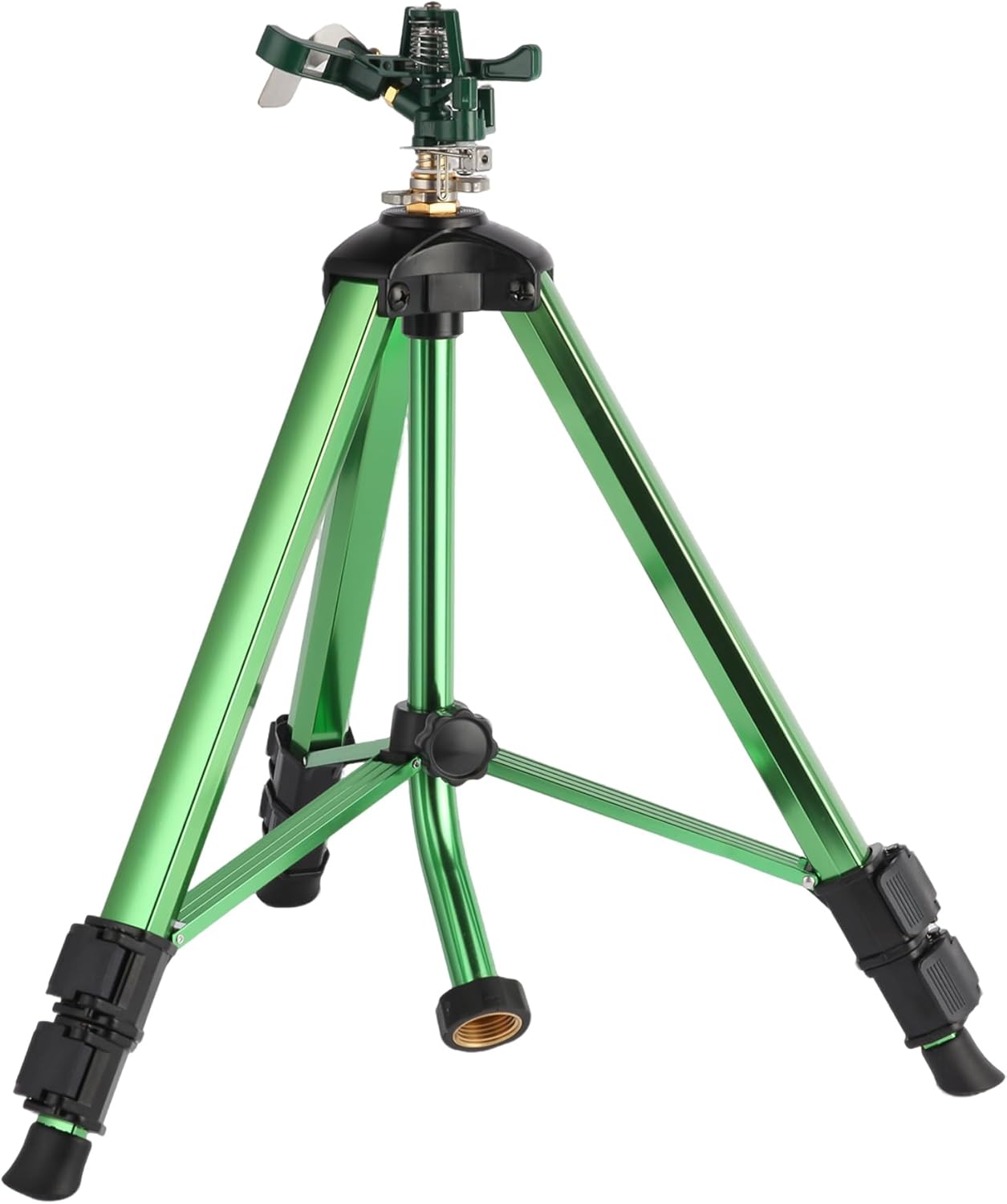
This IrrStpro tripod impact sprinkler pairs a heavy-duty zinc alloy "water bird" head with a green-coated adjustable tripod to deliver wide, even coverage for lawns and beds. It mounts to standard 3/4-inch hoses and includes a rubber filter O-ring to reduce debris clogs. The head rotates through a selectable spray arc and reaches roughly 35 to 85 feet in diameter depending on water pressure, while the tripod legs extend and lock to set a comfortable working height. It is built to resist rust and is suited to low-pressure systems, operating effectively in the 15 to 65 psi range, so it will work where water pressure is limited. Practical benefits include simple setup, stable placement on uneven ground, and easy arc and distance adjustments for different garden zones. Limits are the mechanical nature of an impact head which can require occasional cleaning and adjustment, and the distance varies with supply pressure so coverage should be checked before leaving it unattended.
Best for: Gardeners who want a robust, adjustable sprinkler that gives even 360 degree coverage on lawns and beds and performs well with modest household water pressure.
Less Ideal for: People who need precision zone-by-zone watering with programmable timing or who require fixed small-spot coverage for container plants.
- Durable zinc alloy and metal construction resists rust for outdoor longevity
- Adjustable tripod legs with locking clips for stable, customizable height
- Works at low pressures (15–65 psi) so it performs on weaker garden water supplies
- 360 degree rotation with adjustable arc and distance for flexible coverage
- Spray distance varies significantly with supply pressure and may be shorter than advertised at very low pressure
- Impact head can require occasional cleaning or maintenance to keep spray consistent
Verdict: Choose this tripod impact sprinkler if you need a sturdy, low-pressure-capable sprinkler that gives adjustable 360 degree coverage across medium to large lawns.
RESTMO Adjustable Metal Tripod Impact Sprinkler

| Material Type | Metal |
|---|---|
| Maximum Pressure | 80 psi |
| Item Type Name | lawn-and-garden-above-ground-sprinklers |
| Item Highlight | 360° Rotating & Tripod 3-Height (16"-29"-37") |
This RESTMO tripod impact sprinkler combines a durable all-metal sprinkler head with a three-height tripod to give reliable, wide-area coverage for lawns, gardens, and small agricultural plots. It connects to a standard garden hose and is engineered to run between 20 and 80 psi, so it can operate at relatively low household pressures while still producing an adjustable full-circle or partial-arc spray. The zinc impact head and metal tripod are rust-resistant and stand up to seasonal outdoor use, and the quick-lock legs let you raise the head for taller plantings or lower it for compact areas. Practical features include simple arc adjustment, stable footing on uneven ground, and a claimed coverage up to about 6,200 sq ft for reducing the need to move the sprinkler repeatedly. Important limitations are that effective coverage and spray distance depend on your actual water pressure and hose flow, and heavy-metal parts make it sturdy but less portable than plastic alternatives.
Best for: Buyers who want a durable, no-frills sprinkler that minimizes hands-on repositioning and works acceptably on modest domestic water pressure for watering lawns, flower beds, or small crops.
Less Ideal for: Those who need ultra-compact, lightweight portable sprinklers for frequent transport or people with very low household water flow who require a product specifically rated for micro-pressure systems.
- All-metal impact head and tripod for long-term outdoor durability
- Adjustable tripod height with quick-lock legs for flexible spray angle
- 360° rotation with partial-arc adjustment for targeted watering
- Operates across a wide pressure range (20–80 psi) suitable for lower-pressure systems
- Stable tripod base that works on uneven ground to reduce repositioning
- Actual spray distance and uniformity depend heavily on available water pressure and hose flow
- Heavier metal construction is less convenient to carry or store compared with lightweight plastic models
Verdict: A rugged metal tripod impact sprinkler that gives flexible full-circle or partial-arc coverage and performs well at modest residential water pressures.
SOLSTICE GARDEN 360° Metal Spot Impact Sprinkler (2-Pack)

| Material Type | Metal |
|---|---|
| Maximum Pressure | 80 psi |
| Inlet Connection Size | 0.75 inches |
| Number of Packs | 2 |
This two-pack of SOLSTICE GARDEN metal impact sprinklers is built for everyday lawn and garden use where water pressure is modest. Each unit mounts on a standard hose and produces a true 360-degree circular spray that you control by changing water pressure; the listing states it operates from about 15 to 80 psi and can reach up to roughly 30 feet at higher pressure. The solid alloy construction and polished finish give better rust resistance than many plastic heads and the rubber O-ring on the 3/4-inch inlet helps prevent leaks. In practice these work well for small yards, flower beds, patios, or greenhouse benches where a gentle, rain-like flow is preferred to avoid soil displacement. Limitations to note are that distance is pressure-dependent so coverage shrinks under low supply, and because these are spot/impact heads they are best used as individual fixtures or paired on tripods rather than full in-ground rotor systems. The two-pack is convenient for spreading coverage without buying extras, but you will still need to position them carefully for even watering in irregular spaces.
Best for: Practical gardeners who need an affordable, durable sprinkler to cover small lawns, beds, or patios when water pressure is limited and prefer simple, easy-to-move sprinklers.
Less Ideal for: Large irregular lawns that require programmed in-ground systems or users who need motorized oscillation and precise automatic zone control.
- Durable metal alloy construction resists rust better than typical plastic heads
- Full 360-degree spray pattern for even circular coverage
- Works at low-to-moderate pressures (15–80 psi) so usable with weaker water supplies
- Standard 3/4-inch hose fitting with rubber O-ring provides a secure, leak-resistant connection
- Sold as a two-pack for easy multi-point coverage without extra purchases
- Range and spray diameter are dependent on water pressure so distance is limited on very low-pressure systems
- Not a pop-up or in-ground rotor so requires tripod/stand or flat placement and manual positioning
Verdict: A rugged, budget-friendly metal 360° impact sprinkler pair that reliably waters small areas even with modest water pressure.
ARICOR Impact Sprinkler on Tripod Base with Brass Head

| Maximum Pressure | 80 psi |
|---|---|
| Inlet Connection Size | 19.05 millimeters |
This tripod impact sprinkler is built around a corrosion-resistant brass impulse head mounted on an adjustable tripod, designed for dependable, large-area watering. The brass head lets you set arc from 30 degrees to full 360 degrees and adjust distance and spray pattern for either a fine mist or a direct jet, making it useful for lawns, flower beds, and cooling outdoor spaces. Quick-release flip locks provide tool-free height changes to three preset levels and ground spikes anchor the legs so the unit stays stable even at higher water pressures. A 3/4 inch inlet includes an integrated filter and seal ring to reduce debris-related clogs and minimize leaks at the hose connection. Practical benefits are straightforward: durable metal components for longer service life, easily configurable coverage, and firm footing on uneven ground. Limitations are that the unit is a single-station sprinkler so it does not replace a timed multi-zone irrigation system and the tripod requires soil anchoring for best stability on hard surfaces.
Best for: Buyers who want a rugged, low-maintenance sprinkler for reliably watering large lawns or garden areas and who prioritize long-term performance over automation.
Less Ideal for: Homeowners seeking fully automated multi-zone irrigation or a sprinkler that stands securely on concrete without additional anchoring should consider other options.
- Corrosion-resistant brass impact head for durability and consistent spray
- Adjustable arc and distance up to 86 ft for precise coverage control
- Tool-free height adjustments with quick-release flip leg locks
- Integrated inlet filter and seal ring to reduce nozzle clogs and leaks
- Tripod with ground spikes and central stabilizer for secure setup on uneven terrain
- Single-station sprinkler that cannot replace a multi-zone automatic system
- Requires soil anchoring for maximum stability on hard or paved surfaces
Verdict: Choose this tripod impact sprinkler if you need a tough, adjustable, and clog-resistant unit that reliably covers large outdoor areas.
Hourleey Brass Impact Sprinkler with Adjustable Tripod Base

| Coverage radius | 20-35 FT |
|---|---|
| Connector | 3/4 inch US standard |
| Rotation | 0-360 degree |
| Max water pressure | 80 PSI |
This Hourleey impact sprinkler pairs a heavy brass sprinkler head with an adjustable tripod base to deliver flexible, reliable irrigation for lawns and garden beds. The head rotates freely from 0 to 360 degrees and has multiple nozzle adjustments to control spray distance and pattern, which makes it useful for spot watering or covering larger areas up to roughly a 20–35 foot radius depending on water pressure. The tripod extends from about 16 to 27 inches and locks in place, so you can raise the spray above low plants or lower it for shrubs and flower beds. A rubber filter O-ring helps keep debris out of the nozzle and the 3/4 inch standard connector fits most US garden hoses for quick setup. Construction uses brass for the head and alloy components for the stand, which improves corrosion resistance versus typical plastic sprinklers. The unit is practical for routine lawn watering but depends on your household water pressure for maximum reach and uses some plastic parts at the tripod joints that are less heavy duty than the brass head.
Best for: A homeowner who wants a reliable, easy-to-use sprinkler for regular lawn and garden watering and prefers durable metal components over all-plastic designs.
Less Ideal for: Gardeners who need precise low-pressure irrigation solutions or those seeking a fully commercial-grade metal stand for heavy daily use.
- Brass impact head offers durability and better corrosion resistance than plastic heads
- Adjustable 0–360 degree rotation and multiple nozzle settings for customizable coverage
- Tripod height adjusts to position spray above plants or lower for targeted watering
- 3/4 inch standard hose connector and rubber filter O-ring reduce nozzle clogging
- Spray distance depends heavily on water pressure and may not reach the advertised maximum with low household pressure
- Some tripod components use plastic or alloy parts that are less robust than the brass head
Verdict: A sturdy brass-headed impact sprinkler on an adjustable tripod that gives dependable, customizable coverage for typical home lawns and gardens.
Biswing Impact Sprinkler Head with Adjustable Tripod Base

| Material Type | Metal |
|---|---|
| Maximum Pressure | 60 psi |
| Inlet Connection Size | 0.75 inches |
This Biswing unit pairs a metal impact sprinkler head with a height‑adjustable tripod to deliver flexible, large‑area irrigation for lawns, gardens, and patios. Set the quick‑release legs to any position between low and high, tighten the knob to stabilize the tripod, attach a standard hose to the goose‑neck connector and flip the wire arm to open full 360° rotation or limit the arc. The solid alloy construction and rubber‑sealed connector with a filter washer reduce clogging and give the setup a durable feel for season‑to‑season use. It covers roughly a 20–35 ft radius depending on water pressure and works across a wide recommended pressure range. Expect occasional maintenance: mineral buildup or debris can bind the trip mechanism or nozzle so periodic cleaning may be needed. The tripod is stable when legs are spread but can still tip if not on level ground or under strong wind. For someone who wants a rugged, adjustable sprinkler that reaches large areas, this is a practical, no‑frills option.
Best for: A practical buyer who wants a durable, adjustable sprinkler to cover medium to large lawns or garden beds with minimal fuss and easy setup and maintenance.
Less Ideal for: Not the best choice for very small, irregularly shaped beds where precise, low‑flow watering is required or for users who cannot perform occasional simple maintenance.
- Solid alloy metal construction for durability and season‑to‑season use
- Adjustable tripod height (16–37 inches) and quick‑release leg clips for fast setup
- Goose‑neck hose connector with rubber O‑ring and filter washer reduces nozzle clogging
- Impact head that rotates nearly 360° and allows arc adjustment for targeted or full‑circle coverage
- Works across a broad pressure range (recommended 20–60 psi) to suit different water supplies
- Requires periodic cleaning to remove mineral deposits and debris that can jam the trip mechanism or nozzle
- Tripod can be unstable on uneven ground or in windy conditions without extra weighting
Verdict: A sturdy, adjustable metal impact sprinkler on a tripod that delivers wide coverage and reliable performance for practical garden and lawn irrigation.
Choosing the Right Tripod Garden Sprinkler for Low Water Pressure: Key Factors to Consider
Spray Reach And Flow Sensitivity
Distance and sensitivity to flow determine whether a sprinkler will actually reach the turf or beds you need watered. With low water pressure, small reductions in flow can sharply reduce reach. Look for heads and nozzles that are engineered to maintain a stable pattern at lower psi or that include step-wise flow controls. A tripod raises the head and often improves reach, but the mechanism that adjusts spray distance is what matters most.
If you have long runs or large lawns, prioritize sprinklers that offer a longer maximum reach at reduced flow rates. If your garden is compact, a unit with tighter, easily narrowed patterns will conserve water while providing adequate distribution.
Pattern Shape And Coverage Control
Even watering depends on being able to shape the spray to the area. Tripod sprinklers vary from full-circle, half-circle, to adjustable sector patterns. On low pressure, some patterns break up or spray with heavier droplets that cause puddling. Choose models with coarse-to-fine adjustment or multiple nozzle options so you can switch to a pattern that holds together at lower flow.
Coverage control also includes oscillation or intermittent sweep features. Those can improve uniformity at the cost of slower application. Consider how long you will need to run the sprinkler to hit target soak depths when the pattern is less vigorous.
Water Efficiency And Run Time
With constrained pressure, water efficiency matters because you may compensate by running sprinklers longer. Units that concentrate spray into consistent droplet sizes and minimize mist reduce evaporation and runoff. Features like low-flow nozzles or adjustable flow restrictors let you balance reach with water use.
Also think about scheduling: longer run times can saturate soils near the sprinkler while leaving outer zones dry if distribution is uneven. Choose a tripod and head combination that delivers predictable application rates at the lower flows available to you.
Tripod Height And Stability
Raising a sprinkler on a tripod improves line of sight over taller plants and lawn undulations, but a tall setup can be unstable in wind or on uneven ground. Look for tripods with broad leg spans, secure leg locks, and stakes or footplates to anchor them. The ability to set height in fine increments helps tune reach without excessive flow.
Consider the surfaces where you will place the tripod. Soft soil allows deeper staking for stability; hardscape may require weight or a low center of gravity. Stability is also important to prevent the head from tipping and changing the spray pattern during a run.
Durability And Outdoor Weathering
Materials and build quality affect how long the sprinkler will resist sun, freeze-thaw cycles, and knocks from garden activity. Metal fittings at the hose connection, UV-resistant plastics for the head, and corrosion-resistant screws extend service life. Avoid thin plastics around moving parts that control pattern or flow.
Also check how easily replacement parts like nozzles or seals can be sourced. A unit that allows you to change a worn nozzle or O-ring without replacing the whole head reduces long-term cost and downtime.
User Controls And Hose Compatibility
Controls should be intuitive and usable with wet or gloved hands. Flow knobs, pattern stops, and quick-angle adjustments are helpful when tuning a sprinkler under low pressure. Confirm the hose connection type matches common garden fittings and that the swivel or coupling does not leak under weak flow.
Some tripods include adapters for multiple hose sizes or built-in shutoff valves. Those small conveniences save time and reduce the need to bend down repeatedly, which matters when you are fine-tuning placement across multiple zones.
How Low Pressure Changes Sprinkler Behavior
Low pressure alters droplet size, trajectory, and pattern stability. Instead of a fine mist or steady fan, you may get larger droplets that fall sooner, creating concentrated wet spots near the base and leaving distant areas dry. The tripod height and nozzle type both influence whether the stream will carry far enough to be useful.
Understanding those effects helps you choose a unit that compensates for limited flow. Expect slower application rates and plan for longer run times or multiple positions to achieve even coverage across a lawn or bed.
- Reduced pressure often reduces spray arc and distance more than it reduces volume.
- Larger droplets from low-pressure operation increase runoff risk on slopes.
- Raising the head helps reach but cannot fully replace needed flow adjustments.
Placement Tips For Even Coverage
Position the tripod so that its strongest spray points toward the center of the area you want to water. If coverage is uneven, move the tripod to overlapping positions rather than relying on one long run. Shorter burst times in multiple spots often beat a single long run with patchy distribution.
Level ground and stable footing keep the sprinkler aligned. For irregular beds or narrow strips, set the tripod low and narrow the pattern instead of stretching reach and creating blow-by onto walkways.
- Use overlapping passes to smooth out dry spots.
- Avoid pointing the sprinkler directly at structures where runoff could pool.
- Stake or weight the tripod if wind is common in your area.
Adjusting Spray To Match Plant Needs
Different plants and soils need different application rates. Lawns generally need shallow, frequent applications, while shrubs and vegetable beds benefit from deeper, less frequent soaking. Low-pressure sprinklers deliver lower inches per hour, so lengthen runs for beds that need deeper penetration and shorten them for turf to avoid saturation.
Fine-tune pattern and flow controls so the outer edge of the spray receives similar volume to the center. If the outer area stays dry, either shorten the radius or relocate the tripod closer and make overlapping passes.
- Match run times to soaking depth rather than a fixed schedule.
- Use a simple catch-can test to measure application uniformity under your conditions.
- Rotate sprinkler positions during the season as plants grow and shade patterns change.
Maintaining Your Tripod Sprinkler
Regular maintenance keeps low-pressure performance consistent. Flush the head and nozzles occasionally to remove sediment that can block small orifices and change spray patterns. Inspect seals and hose washers for signs of wear and replace them to prevent slow leaks that further reduce effective pressure.
Store the unit out of UV exposure in winter or when not in use to prevent brittle plastics and corrosion on metal fittings. Lubricate moving parts sparingly with a silicone-safe product if the manufacturer allows it.
- Clean or replace clogged nozzles to restore even spray.
- Check tripod leg locks and tighten any loose fasteners.
- Drain water from fittings before freezing temperatures to avoid splits.
When To Consider Supplemental Pressure Options
If your property consistently falls below the minimum pressure needed for reliable coverage, supplemental options like a small booster pump or a dedicated higher-pressure irrigation line may be worth considering. Those solutions increase complexity but can enable finer nozzles and broader coverage without long run times.
For many gardeners, moving sprinklers to overlapping positions and using low-flow nozzles is sufficient. Reserve pressure upgrades for large properties or landscapes with long hose runs and multiple watering zones where frequent repositioning is impractical.
- A booster pump can restore desired reach but adds cost and maintenance.
- Evaluate whether repositioning and scheduling changes can meet needs before adding equipment.
- Consider water source constraints and local regulations before installing pumps.
How We Chose the Best Tripod Garden Sprinkler for Low Water Pressure
We selected products that demonstrably adapt to lower available flow and still deliver usable coverage. Key editorial filters included spray performance at reduced pressure, adjustability of pattern and reach, tripod stability and height range, water-efficiency features, and durability of materials for outdoor exposure. We prioritized units that allow incremental flow control so gardeners can tune spray distance without needing a pressure booster. Coverage uniformity across typical yard and bed shapes was a major factor, measured by how well the spray pattern can be narrowed, widened, or oscillated under weaker flow. Practical handling matters too: easy setup, reliable hose fittings, and tripod legs that stay put on grass and soil were required. Products lacking any meaningful low-pressure adjustment or made from thin, easily-brittle plastics were excluded. We also excluded specialty irrigation heads that require pressurized supplies or separate pumps, focusing on standalone tripod sprinklers intended for household hoses and modest municipal pressure.
FAQ
Will a tripod sprinkler work with a weak garden hose supply?
Often yes. Tripods raise the head and can improve reach, but success depends on nozzle design and flow control. Look for units rated to hold pattern at lower flow and expect slower application rates.
How can I measure whether a sprinkler covers evenly at my pressure?
Use small catch containers placed in a grid across the target area and run the sprinkler for a set time. Compare collected volumes to spot uneven distribution and adjust position, pattern, or run time accordingly.
Are low-flow nozzles better for gardens with low pressure?
Low-flow nozzles can improve water use and pattern stability by producing consistent droplet sizes under reduced pressure. They often perform better than trying to force a high-flow pattern at weak pressure.
How should I position a tripod on a slope or uneven ground?
Anchor the tripod with stakes or use additional weight on the base to prevent tipping. Place it level or slightly uphill of the area to reduce runoff and keep the spray aimed across contours rather than straight down the slope.
Can I use multiple tripods to water a larger yard with low pressure?
You can, but running multiple sprinklers from the same weak supply may reduce each head's performance. Stagger runs or move a single tripod between positions to preserve reach and pattern quality.
Final Verdict
Choosing the right tripod garden sprinkler for low water pressure means balancing reach, pattern control, and run time. Prioritize heads and nozzles that maintain a coherent pattern at reduced flow, a tripod with stable height adjustment, and materials that withstand outdoor use. Plan to use overlapping positions or longer runs rather than forcing distant coverage from a single spot. With the right features and placement, a tripod sprinkler can make a weak supply work effectively for lawns and beds.
