

Note: This article contains affiliate links. If you click on these links and make a purchase, I may earn a small commission at no extra cost to you. This helps support my research and content. Read my full affiliate disclosure here.
When you need fast, even weed control across a lawn without hauling a heavy sprayer, a hose end applicator is a timesaver. The right hose end lawn weed killer lets you treat dandelions, clover, and other broadleaf invaders with minimal mixing and consistent spray patterns, so you do less walking back and forth and reduce waste. This guide covers five top options that made our shortlist for common lawn situations and explains the practical tradeoffs gardeners face. We looked at coverage consistency, nozzle control, and safety features to help you pick a solution that fits your lawn size and tolerance for drift. Read on to see how these products behave in real yards and which features matter most for reliable, targeted weed control.
Top Picks at a Glance
| Best Overall The best all-around choice for most situations | BioAdvanced Season-Long Weed Control for Lawns, Ready-to-Spray (29 oz) |  |
| Best Value The sweet spot between price and what you get | Ortho WeedClear Ready-To-Spray Lawn Weed Killer, 32 fl. oz. |  |
| Best Budget The cheapest option that still gets the job done reliably | Spectracide Weed Stop for Lawns Concentrate, 32 oz Ready-to-Spray |  |
| Highest Rated A top-rated pick with lots of positive feedback | Ortho Outdoor Bug and Weed Killer Bundle, Hose‑End Ready‑to‑Spray |  |
| Most Popular A crowd favorite that many people choose with confidence | Scotts Liquid Turf Builder Plus 2 Weed Control, Ready‑to‑Spray, 32 fl. oz. |  |
BioAdvanced Season-Long Weed Control for Lawns, Ready-to-Spray (29 oz)
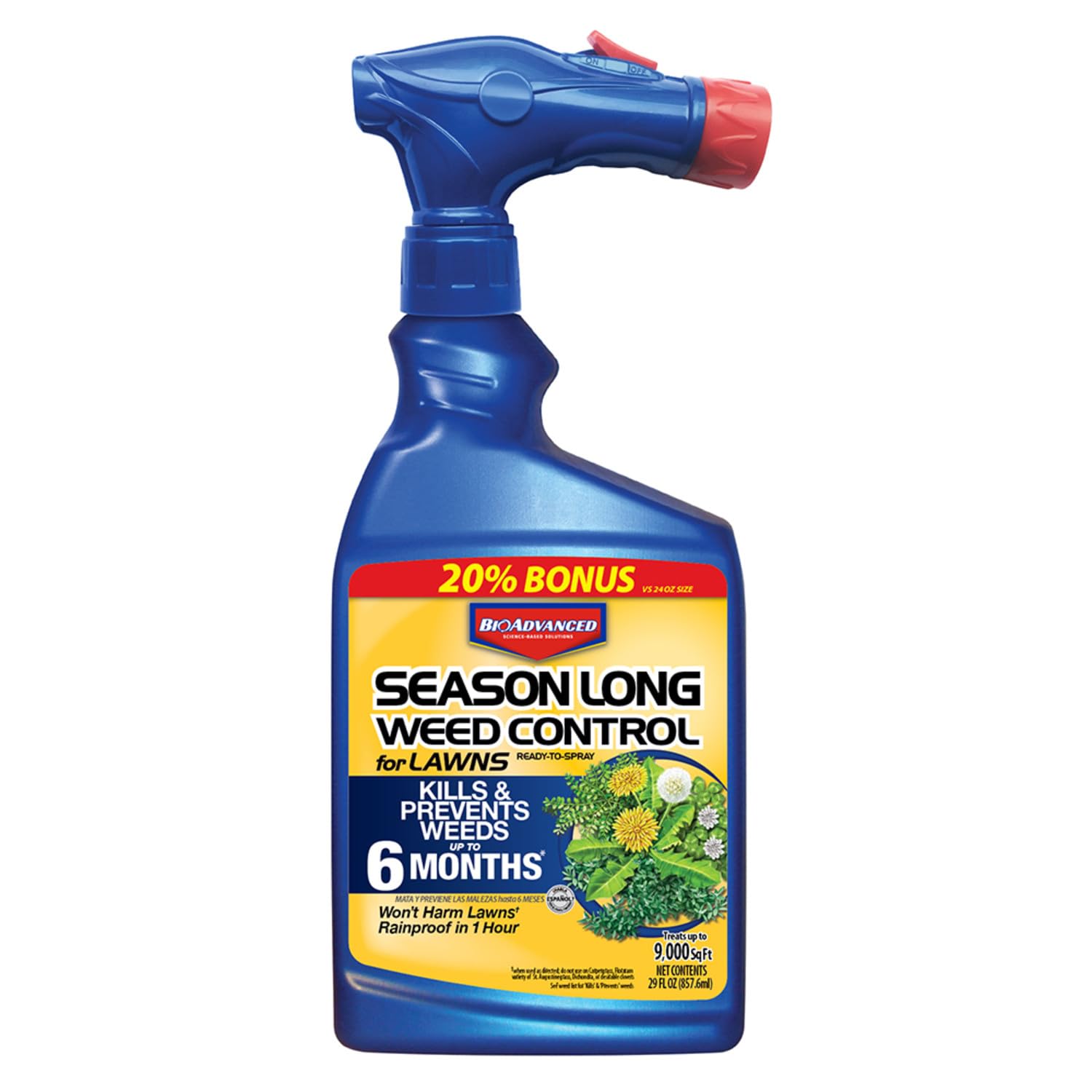
| Unit Count | 29 Fluid Ounces |
|---|---|
| Item Form | Oil |
| Coverage | 9000 square feet |
| Active Ingredients | 2,4-D dimethylamine Salt |
This ready-to-spray BioAdvanced formula combines post-emergent control with pre-emergent protection to kill listed broadleaf weeds and block new ones for up to six months. You apply it to established lawns between 50 and 90°F; the bottle covers up to 9,000 sq ft and becomes rainproof in about an hour, so light showers shortly after application are less likely to reduce effectiveness. The product lists common targets such as dandelion, clover, and dollarweed and uses active ingredients including 2,4-D dimethylamine salt and isoxaben. Practical benefits include the convenience of a pre-mixed sprayer for quick treatment and seasonal flexibility from spring through fall. Limitations to note are the regional restriction on sales in New York and the need to follow specific dilution rates for northern versus southern turf in some instructions, which can affect treated area calculations. As with all herbicides, avoid contact with skin and eyes and keep children and pets off treated areas until safe per label directions.
Best for: Homeowners who want a straightforward, seasonal treatment to both eliminate visible broadleaf weeds and reduce future emergence with minimal mixing or repeated applications.
Less Ideal for: Those seeking an organic or non-chemical weed control method or people who need a product labeled for use in New York should look for alternatives.
- 2-in-1 formula kills existing broadleaf weeds and prevents listed weeds for up to six months
- Ready-to-spray bottle simplifies application for large lawns without measuring or mixing
- Rainproof in one hour, reducing loss of effectiveness from short-term rain
- Covers up to 9,000 square feet, suitable for mid to large lawns
- Not approved for sale in New York which limits availability in that state
- Contains strong active ingredients requiring careful handling and following label safety instructions
Verdict: A convenient ready-to-spray formula that removes common broadleaf weeds and provides up to six months of prevention for homeowners who want low-effort seasonal control.
Ortho WeedClear Ready-To-Spray Lawn Weed Killer, 32 fl. oz.

| Item Form | Liquid |
|---|---|
| Coverage | 16000 square_feet |
| Liquid Volume | 32 fluid ounces |
| Active Ingredients | Herbicide |
Ortho WeedClear Ready-To-Spray is a hose-attach liquid herbicide designed to kill common broadleaf lawn weeds, including clover and dandelions, down to the root. You use it by connecting the bottle to a garden hose, switching the sprayer on, and sweeping the spray over affected areas; the formula produces visible results within hours and becomes rainproof about an hour after drying. Notable features include a three-ingredient herbicide blend targeted at turf weeds and a coverage claim that one 32 fl. oz. bottle treats up to 16,000 sq. ft. (Southern lawns) or 8,000 sq. ft. (Northern lawns). The ready-to-use hose connection and fast activity make spot treatments and larger-area applications straightforward for typical homeowners. Limitations to keep in mind are that it targets broadleaf weeds rather than grassy weeds and it must be used when weeds are actively growing for best results, so timing matters. Follow label directions closely to protect desirable grass and to know when people and pets can safely re-enter treated areas.
Best for: Homeowners who want a simple, fast way to remove clover and other broadleaf weeds from established lawns without complex mixing or equipment.
Less Ideal for: People seeking a product to control grassy weeds or those who need season-long residual prevention should consider other specialized products.
- Ready-to-spray hose connection makes application quick and easy for homeowners
- Kills over 250 common broadleaf weeds, including clover and dandelions, down to the root
- Visible results in hours and becomes rainproof about one hour after drying
- One 32 fl. oz. bottle covers a large area (up to 16,000 sq. ft. for Southern lawns)
- Formulation is for broadleaf weeds only and will not control grassy weeds
- Effectiveness depends on applying when weeds are actively growing, so seasonal timing is required
Verdict: Choose this ready-to-spray bottle if you want a fast, easy way to kill clover and other broadleaf weeds in your lawn with minimal prep.
Spectracide Weed Stop for Lawns Concentrate, 32 oz Ready-to-Spray

| Coverage | 8,000 square feet |
|---|---|
| Liquid Volume | 32 fluid ounces |
| Item Form | Liquid |
| Active Ingredients | 2,4-D, Mecoprop-P, Dicamba, Sulfentrazone |
Spectracide Weed Stop for Lawns is a hose-attach ready-to-spray concentrate designed to control broadleaf weeds across common turf types. It kills by contact and down to the root, listing over 460 weeds such as clover, dandelion and chickweed, and promises visible browning in around three hours. The QuickFlip sprayer makes treatment fast for larger yards and the formula is labeled for use on bluegrass, fescue, Bermuda and perennial rye, though you should avoid zoysiagrass coming out of dormancy and not spray above 90°F. Practical benefits include quick application without mixing and one-hour rainproofing so treatments are less weather-dependent. Important limitations are temperature restrictions for safe use, the need to keep people and pets off the lawn until dry, and the usual reseeding wait time of three to four weeks. For homeowners focused on routine clover control, this product offers a straightforward, time-saving option, but follow label directions closely to protect desirable turf and nearby plants.
Best for: Homeowners who want an inexpensive, no-mix solution to knock back clover and other broadleaf weeds quickly across a typical lawn and value fast application.
Less Ideal for: Gardens that need constant reseeding, very young lawns or yards with delicate ornamentals close to treatment areas should consider more targeted options.
- Ready-to-spray QuickFlip hose attachment speeds up application for medium to large lawns
- Kills broadleaf weeds including clover, dandelion and chickweed with visible results in about three hours
- Rainproof in one hour which reduces the chance of losing treatment to light rain
- Works on a variety of common turf types when used as directed
- Should not be applied when daytime temperatures exceed 90°F which limits use in hot weather
- Requires waiting 3–4 weeks before reseeding treated areas
Verdict: A convenient ready-to-spray concentrate that quickly controls clover and other broadleaf weeds for budget-minded homeowners who want fast, low-effort treatments.
Ortho Outdoor Bug and Weed Killer Bundle, Hose‑End Ready‑to‑Spray

| Unit Count | 64 Fluid Ounces |
|---|---|
| Number of Packs | 2 |
| Item Form | Liquid |
| Coverage | 5300 square foot |
| Active Ingredients | 2,4-D; Quinclorac; Dicamba; Bifenthrin; Zeta‑Cypermethrin |
This Ortho bundle pairs a WeedClear lawn weed killer with a Home Defense insect killer in two 32 oz. ready‑to‑spray hose‑end bottles for straightforward lawn care. You attach a garden hose, flip the on switch and spray per the label to treat broadleaf and grassy weeds plus common lawn and perimeter insects like fleas, ticks and mosquitoes. The weed formula targets more than 200 listed weeds and is formulated to kill to the root while being safe on a variety of turfgrasses when used as directed. The insect product gives perimeter and landscape coverage and can be applied to ornamentals and listed edible trees. The practical benefit is convenience: measured mixing and metering are handled by the bottle so treatments are fast and repeatable across mid‑sized yards. Important limitations are that it is a chemical control requiring careful adherence to label directions, protective equipment and attention to treated plants and nearby edible crops, and repeated applications may be needed for long‑term control of some pests and weeds.
Best for: Homeowners who want a dependable, no‑fuss chemical solution to quickly tackle both lawn weeds and perimeter insects across a mid‑sized yard and value predictable, hose‑end application.
Less Ideal for: People who prefer organic, nonchemical methods, have very small urban yards where concentrated spot treatments are enough, or who need product certified for use around all edible crops without restrictions.
- Ready‑to‑spray hose‑end bottles simplify application with no mixing required
- Two products cover both weeds and a broad range of lawn insects in one purchase
- Each bottle treats roughly 5,000 sq ft, suitable for mid‑sized lawns
- Formulated to kill listed weeds to the root and safe on common turfgrasses when used as directed
- Contains multiple broad‑spectrum pesticides that require careful handling and strict label compliance
- Not an organic solution and may be unsuitable near sensitive plants or within certain vegetable gardens
Verdict: Choose this bundle when you want a reliable, ready‑to‑spray hose‑end solution that treats both weeds and common lawn insects across a medium‑sized yard with minimal setup.
Scotts Liquid Turf Builder Plus 2 Weed Control, Ready‑to‑Spray, 32 fl. oz.

| Liquid Volume | 32 fluid ounces |
|---|---|
| Coverage | 6000 square_feet (warm-season); 4000 square_feet (cool-season) |
| Item Form | Spray |
| Active Ingredients | Nitrogen |
This ready-to-spray bottle combines a quick nitrogen boost with broadleaf weed control for an easy lawn maintenance step. You attach the hose, spray evenly across the lawn when weeds are actively growing, then avoid watering for 48 hours so the product can work. The formula lists a 25-0-2 NPK balance and targets common weeds such as dandelions, clover, chickweed, and ground ivy, making it useful for both warm- and cool-season grasses. Coverage is generous for a single 32 fl. oz. bottle: up to 6,000 sq ft on warm-season lawns and 4,000 sq ft on cool-season lawns. Practical benefits include fast visible weed curl within days and no need for separate fertilizer and weed-killer steps, which simplifies care for homeowners who want predictable results. Limitations to note are the restricted list of safe grass types and the need to avoid application above 85°F or watering for two days, plus some stubborn weeds may require a repeat treatment in 3 to 4 weeks.
Best for: Homeowners who want a simple, low‑effort way to feed their lawn and control common broadleaf weeds without separate products and who prefer predictable, do‑it‑yourself lawn care steps.
Less Ideal for: Gardens with mixed planting beds or users who need a product safe around vegetables and ornamentals should choose a different targeted solution.
- Hose-end ready-to-spray design requires no measuring or mixing
- Combines fertilizer and weed control in one application
- Covers large areas per bottle for typical home lawns
- Works on a wide range of warm- and cool-season turf grasses
- Visible weed decline within a few days for many common broadleaf weeds
- Not safe for use on garden beds or non-listed plants
- May cause temporary injury on some bermudagrass varieties and is restricted to listed grasses
- Stubborn weeds may require a second application within a month
Verdict: A single ready-to-spray bottle that simplifies feeding and broadleaf weed control for risk-averse homeowners who want dependable, low-effort lawn results.
Choosing the Right Hose End Lawn Weed Killer: Key Factors to Consider
Application Accuracy
How precisely the unit applies the herbicide matters because over-application can damage turf and under-application leaves weeds to recover. Look for hose end models with clear dilution markings and consistent flow that maintain their mix ratio across a range of water pressures. A consistent pattern helps you overlap passes without creating streaks or uneven kills.
In practice, accuracy affects whether you can treat narrow strips near ornamental beds without causing collateral damage. Coarser droplets reduce drift and concentrate product where you spray, while very fine misting can move off-target on windy days.
Adjustable Concentration
Adjustable concentration settings let you vary strength for spot treatments, large infestations, or delicate grassy areas. This flexibility is useful because different weeds and growth stages often require different rates to be effective. Clear, incremental settings are better than vague low-medium-high scales because they make dosing more repeatable.
A reliable metering system keeps the herbicide-to-water ratio stable even when water pressure fluctuates. If the unit lacks precise adjustment, expect uneven results or the need to mix separate batches in a bucket for control.
Spray Control and Nozzle Options
Nozzle design determines droplet size and spray pattern, both of which influence drift and coverage. For lawn weed control, wide fan settings are efficient for large areas, while narrow or stream modes let you target individual weeds along edges. Multiple nozzle options or an adjustable nozzle let you switch between tasks without changing equipment.
A shut-off or lockable trigger reduces hand fatigue and prevents accidental discharge when moving between zones. Ideally the nozzle resists clogging from thicker formulations so you do not interrupt work to clean the tip.
Build Quality and Hose Connection
Durable materials and a secure hose connection matter for long-term use on a yard. A tight-fitting connector prevents leaks that waste product and reduce effective concentration. Metal or reinforced plastic fittings withstand garden wear better than thin molded parts and reduce the risk of split connectors during winter storage.
Ergonomics also affect how long you can use the applicator. A comfortable grip and balanced weight make it easier to treat larger lawns without arm strain. Consider how easily replacement parts like seals and nozzles can be sourced if you expect frequent use.
Formulation Compatibility and Plant Safety
Not all hose end units handle every herbicide formulation equally. Some formulations are thicker or include additives that can clog narrow passages. Verify that the applicator is compatible with the kinds of lawn weed killers you intend to use, including selective broadleaf formulas and water-soluble concentrates.
Plant safety depends on precise application and timing. A unit that helps you target only the weeds reduces collateral injury to grass, ornamentals, and nearby desirable plants. Also consider whether the applicator minimizes drift and splash onto sensitive areas, such as flower beds or vegetable patches.
Cleanup and Storage
Rinsing and storing the applicator properly preserves its metering accuracy and prevents cross-contamination between products. Look for units that are easy to disassemble for flushing and that do not trap residual chemical in hidden cavities. Simple parts that reassemble quickly reduce the risk of user error during cleanup.
Compact storage or a design that detaches cleanly from the hose makes seasonal storage easier. Units that come with a protective cover or that resist corrosion will last longer in garden environments where they may be stored in sheds or garages.
When a Hose End Applicator Makes Sense
Hose end applicators are best when you need fast, low-effort coverage and you are treating broadleaf weeds across established turf. They are ideal for homeowners who want to avoid mixing concentrate in a pump sprayer yet still require better control than a simple watering-can pour.
These units shine on medium to large lawns where walking with a hand sprayer would be tedious. They are less suitable for tiny lawns where precision spot treatment with a wand might be easier or for situations that demand very high-precision application near sensitive plantings.
- Good for treating widespread broadleaf weeds
- Saves time on medium to large lawns
- Not ideal for fine-edge work next to ornamentals
Timing Treatments for Best Results
Apply broadleaf weed killers when target plants are actively growing and temperatures are mild. Early morning or late afternoon on calm days reduces drift and helps droplets settle. Avoid applications immediately before heavy rain because runoff will reduce effectiveness.
For some tough perennials, repeat applications spaced a few weeks apart improve control. Read the product label for recommended re-treatment intervals and watch for signs of leaf yellowing before deciding on a second pass.
- Choose calm, mild-weather windows
- Avoid rain in the 24 hours after application
- Consider follow-up treatments for persistent weeds
Application Technique to Minimize Turf Stress
Keep the nozzle height consistent and move at a steady pace to avoid streaks. Overlapping passes slightly ensures full coverage without concentrating product in one line. Use coarse spray settings when possible to limit drift and deposit product on the leaves where it is needed.
Rinse the applicator thoroughly after treating problem areas to prevent accidental application to lawn sections where you do not want herbicide. If you need to switch products, flush the unit with clean water and run it until the water is clear.
- Maintain steady speed and consistent nozzle distance
- Overlap passes minimally to ensure even coverage
- Flush unit between different formulations
Safety Around Kids, Pets, and Garden Beds
Restrict access to treated areas until the product label indicates it is safe for foot traffic or pets. Place barriers or temporary warnings if small children or pets are likely to enter the yard while treatment dries. Follow the label for reentry intervals to protect vulnerable household members.
Avoid spraying toward garden beds, water features, or vegetable patches. If drift is a concern, choose a coarser droplet size and work on calm days to keep herbicide on-target. Store treated clothing separately and wash hands thoroughly after handling the applicator.
- Follow label reentry intervals
- Use coarse droplets to limit drift toward beds
- Keep children and pets away until area is safe
Maintaining Metering Accuracy Over Time
Regular maintenance keeps dilution control reliable. Inspect O-rings and seals periodically for cracking and replace them when they show wear. Clean the intake and nozzle orifices to remove residue that can alter flow and change the effective concentration delivered to the lawn.
If your water pressure varies seasonally, test the applicator on a noncritical patch of turf to confirm the mix ratio before treating the whole lawn. Consistent maintenance prevents surprises and keeps application results repeatable.
- Check seals and O-rings annually
- Clean nozzles after each use
- Test on a small area if water pressure changes
How We Chose the Best Hose End Lawn Weed Killer
We shortlisted Hose End Lawn Weed Killers that deliver consistent spray patterns and reliable dilution control for typical lawn sizes. Our editorial filters favored products that make accurate application possible across varied lawn conditions, including adjustable concentration settings and nozzles that produce coarse droplets to limit drift. Key evaluation criteria included application accuracy, ease of setup and cleanup, nozzle and spray control, and plant safety features such as targeted formulations and lockable triggers. We also considered build quality of the hose attachment and how easily the unit connects to standard garden hoses. Usability in the field was prioritized over marketing claims, with emphasis on the actual handling during spot and perimeter treatments. We excluded any items that require separate pump sprayers, granular spreaders, or specialist commercial equipment since the focus is homeowner-friendly hose end application. Products that lacked clear dilution markings or had poor customer-reported durability were not considered for the final list.
FAQ
Can I use a hose end applicator with all lawn weed killer formulations?
It often depends on the formulation. Many water-soluble concentrates work with hose end units, but thicker or oil-based products may clog passages. Check the label and the applicator's compatibility statements before use.
How soon can I mow after applying a hose end weed killer?
Mowing intervals vary by product, but usually waiting 24 to 48 hours is recommended to let the herbicide dry and be absorbed. Consult the product label for specific timing to avoid reducing effectiveness.
Will a hose end applicator cause damage to nearby plants?
Drift and overspray are the main risks. Using coarse droplets, spraying on calm days, and maintaining a consistent nozzle distance reduce the chance of damage to nearby ornamentals and vegetables.
What do I do if my applicator starts leaking or loses pressure?
Inspect hose connections, O-rings, and seals for wear or debris. Tighten fittings and replace worn seals. Cleaning clogged nozzles can also restore pressure and proper spray patterns.
How often should I reapply to control stubborn broadleaf weeds?
Reapplication intervals depend on the herbicide and the weed species. Often a follow-up treatment after two to four weeks helps control persistent plants. Always follow label guidance for maximum allowed applications.
Final Verdict
When choosing a Hose End Lawn Weed Killer, prioritize consistent application accuracy and reliable metering so you deliver the right dose across the whole lawn. Balance adjustable concentration and spray control against build quality and ease of cleanup to match your lawn size and comfort with maintenance. For most homeowners, a unit that produces coarse droplets, has clear dilution markings, and is easy to flush will produce the best results with the least risk to turf and nearby plantings.
