

Note: This article contains affiliate links. If you click on these links and make a purchase, I may earn a small commission at no extra cost to you. This helps support my research and content. Read my full affiliate disclosure here.
If you tend warm-season turf in the South, weed control needs a different approach than cool-season lawns. Southern lawns often face persistent broadleaf weeds and grassy invaders that tolerate heat and summer stress, and the wrong treatment can scorch desirable turf. This guide covers seven top lawn weed killer options shortlisted for southern lawns. We explain the characteristics that matter, why timing and turf type change your choices, and how each pick was evaluated for effectiveness and turf safety. Read on to match a product profile to the conditions in your yard.
Top Picks at a Glance
| Best Overall The best all-around choice for most situations | Southern Ag Atrazine St. Augustine Weed Killer, 32 oz |  |
| Best Quality Built to a higher standard if you want something more solid | Spectracide Large Plot Weed Stop for Lawns Concentrate, 1 Gal |  |
| Best Value The sweet spot between price and what you get | Ortho WeedClear Lawn Weed Killer Concentrate (32 fl. oz.) |  |
| Best Budget The cheapest option that still gets the job done reliably | BioAdvanced Lawn Weed Killer Concentrate, Broadleaf Formula, 32 oz |  |
| Highest Rated A top-rated pick with lots of positive feedback | Southern Ag Amine 2,4-D Liquid Weed Killer, 32 oz |  |
| Most Popular A crowd favorite that many people choose with confidence | Ortho WeedClear Ready-To-Spray Lawn Weed Killer, 32 fl. oz. |  |
| Best Seller A high-volume bestseller chosen again and again | Scotts Liquid Turf Builder Plus 2 Weed Control, Ready‑to‑Spray, 32 fl. oz. |  |
Southern Ag Atrazine St. Augustine Weed Killer, 32 oz
| Unit Count | 32 Fluid Ounces |
|---|---|
| Item Form | Spray |
| Coverage | 3,720 square_feet |
| Item Type Name | Specialty Herbicide |
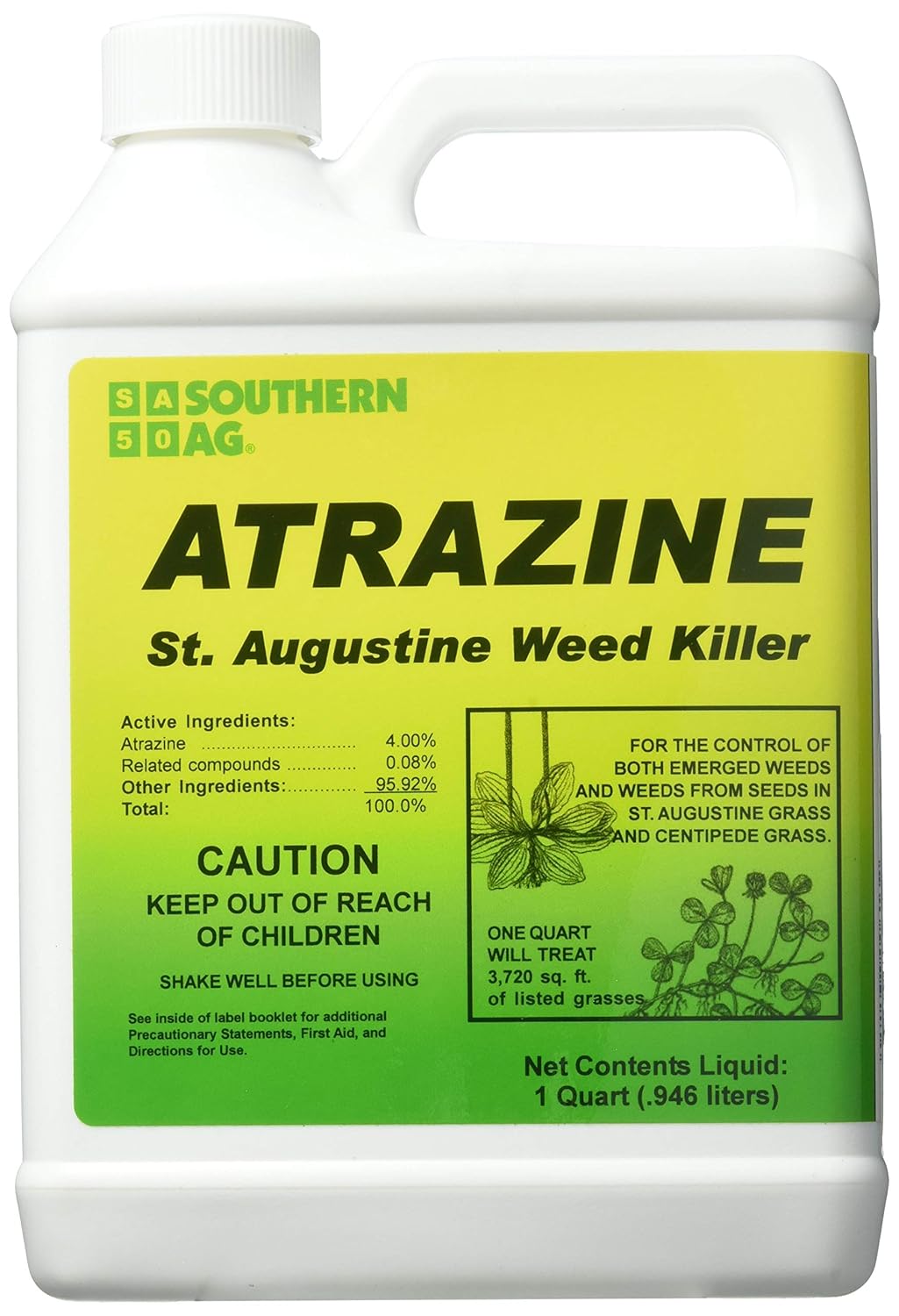
Southern Ag Atrazine is a concentrated liquid herbicide made specifically for St. Augustine and centipede grasses. It is mixed into spray and applied across the lawn to suppress crabgrass and remove many common broadleaf and grassy weeds; one quart claims coverage of roughly 3,720 square feet when diluted at the recommended rate. The product is intended for targeted seasonal use, with best results from early spring applications and careful, overlap-free spraying. Practical benefits include a focused label for the two grass types and a coverage rate that stretches a single bottle across a medium-sized yard, which helps keep costs down. Important limitations are that it is a chemical herbicide requiring careful handling and strict label following, it is not recommended for hose-end sprayers, and it is not a fertilizer so it will not improve turf nutrition or overall lawn health by itself. Use protective gear and avoid off-target drift to protect desirable plants.
Best for: Buyers who need an affordable, targeted weed control for St. Augustine or centipede lawns and want a product that covers a medium-sized yard without repeated purchases.
Less Ideal for: Homeowners seeking an all-in-one lawn treatment for nutrition or for use on other grass types should choose a different product or combine this with appropriate fertilization.
- Formulated specifically for St. Augustine and centipede lawns for targeted control
- Concentrated formula with coverage up to about 3,720 sq ft per quart
- Controls a range of broadleaf and some grassy weeds including suppression of crabgrass
- Practical application instructions for spot or broadcast spray use in early spring
- Chemical herbicide that requires protective handling and careful application
- Not a fertilizer so it does not provide nutrients or improve turf vigor
Verdict: A cost-effective, concentrated herbicide for homeowners who need focused weed control on St. Augustine or centipede lawns.
Spectracide Large Plot Weed Stop for Lawns Concentrate, 1 Gal

| Unit Count | 128 Fluid Ounces |
|---|---|
| Item Form | Liquid |
| Coverage | 32000 square feet |
Spectracide Large Plot Weed Stop is a concentrate lawn herbicide you mix with water and apply with a sprayer to control broadleaf weeds across large areas. It targets more than 200 listed weeds, including common offenders like dandelion, chickweed and clover, and is formulated to kill weeds down to the root for visible results in hours. The bottle links to hose-end or tank sprayers and includes settings for concentrate or ready-to-spray use, which makes covering up to tens of thousands of square feet practical for homeowners with large yards. It is rainproof within hours and is labeled for both northern and southern grass types when applied at recommended rates. Important limitations are the temperature window for safe application and safety precautions for people, pets and water features; do not apply when air temperatures exceed 85°F and keep off treated areas until dry. For persistent or isolated tough weeds you may need targeted repeat spot treatments.
Best for: Homeowners who need an effective, large‑area solution for common broadleaf weeds and prefer a concentrated product they can mix and spray themselves.
Less Ideal for: Small-plot gardeners who prefer spot-only, non-chemical methods or anyone who cannot follow temperature and safety application restrictions.
- Concentrate treats large areas—label lists coverage up to 32,000 sq ft for northern grasses
- Kills over 200 listed broadleaf weeds and works down to the root for longer control
- Rainproof within hours so light rain soon after application is less likely to wash it away
- Works with common sprayers and has a built-in hose connector for easier mixing and application
- Must not be applied when air temperatures exceed 85°F to avoid turf damage
- Contains chemicals that require safety precautions and keeping people and pets off treated areas until dry
Verdict: Choose this concentrated sprayer-ready formula if you need a practical, large‑area herbicide that kills common broadleaf weeds down to the root while preserving lawn when used as directed.
Ortho WeedClear Lawn Weed Killer Concentrate (32 fl. oz.)

| Unit Count | 32 Fluid Ounces |
|---|---|
| Item Form | Spray |
| Coverage | 10600 square_feet |
| Active Ingredients | Herbicide |
Ortho WeedClear Concentrate is a liquid herbicide designed for homeowners who want to remove broadleaf weeds from Southern lawns without damaging turf when applied correctly. You mix the concentrate with water and apply it with a tank sprayer or the Ortho Dial N Spray hose-end applicator to actively growing weeds in spring or fall. The formula targets more than 250 common lawn weeds including dandelion, clover, chickweed, and dollarweed and produces visible results in hours. It is labeled for a wide range of Southern grasses and lists coverage estimates that let you plan treatments for medium to large yards. Practical benefits include flexible application options, fast action, and the ability to treat many weed types from a single bottle. Important limitations are the need to follow temperature and timing guidance for best results, potential restrictions for newly seeded or newly sodded areas, and the usual safety precautions to avoid skin and eye contact and to keep people and pets off the lawn until sprays dry.
Best for: Homeowners with Southern lawns who prioritize an efficient, single-product solution to remove a wide range of broadleaf weeds and want to cover medium to large areas without repeated product shopping.
Less Ideal for: People managing newly seeded or freshly sodded turf, or those who prefer non-chemical weed control methods or organic-certified products.
- Concentrated formula treats a large area from one bottle when mixed correctly
- Fast-acting on broadleaf weeds with visible results in hours
- Compatible with tank sprayers and Ortho hose-end applicator for flexible application
- Labeled safe for many Southern turf types when directions are followed
- Requires careful mixing and adherence to temperature/timing directions for reliable control
- Not for use on newly seeded or very recently sodded lawns until label-specified wait times
Verdict: A concentrated, fast-acting weed killer that efficiently clears broadleaf weeds across Southern lawns when applied per label instructions.
BioAdvanced Lawn Weed Killer Concentrate, Broadleaf Formula, 32 oz

| Unit Count | 32 Fluid Ounces |
|---|---|
| Coverage | 16000 square feet |
| Item Form | Spray |
| Active Ingredients | 7.59% 2,4-D; 1.83% Mecoprop-p; 0.84% Dicamba |
This BioAdvanced concentrate is a selective broadleaf herbicide designed for homeowners who need straightforward control of common lawn weeds. Mixed for use with a pump or dial-style hose-end sprayer, a single bottle treats up to 16,000 square feet and targets more than 200 listed weeds such as dandelion, clover, dollarweed, and chickweed. The concentrate contains 2,4-D, Mecoprop-p, and Dicamba active ingredients, which work together to translocate to roots so weeds die instead of returning. It is formulated for both southern and northern turf types and becomes rainproof in about an hour, so treatments are less likely to wash away after light rain. The practical benefits are broad coverage from one bottle and compatibility with common sprayers, making it efficient for larger residential lawns. Limitations to consider are the herbicide chemistry: it is a synthetic selective product that should be applied exactly as directed to avoid damage to sensitive plants and certain grass varieties, and it is not suitable for spot-treatment preferences where non-chemical or organic options are desired.
Best for: Homeowners with larger southern lawns who want an affordable, single-bottle solution to control common broadleaf weeds across many square feet with conventional sprayer equipment.
Less Ideal for: People who prefer organic methods, need spot treatments under sensitive ornamentals, or who have turf varieties specifically excluded from use.
- Concentrated formula treats up to 16,000 sq. ft. from one 32 oz bottle
- Controls over 200 listed broadleaf weeds and works down to the root
- Rainproof in about one hour, reducing the chance of wash-off after light rain
- Compatible with common pump or dial-style hose-end sprayers for easy application
- Contains synthetic herbicides that require careful use to avoid harming desirable plants
- Not suitable for gardeners seeking organic or non-chemical weed control
Verdict: A cost-effective concentrated herbicide that treats large southern lawns and reliably eliminates common broadleaf weeds to the root.
Southern Ag Amine 2,4-D Liquid Weed Killer, 32 oz

| Item Form | Liquid |
|---|---|
| Coverage | 5000 Square Feet |
| Liquid Volume | 32 quarts |
| Active Ingredients | Dimethylamine salt of 2,4-D-Dichlorophenoxyacetic acid |
Southern Ag Amine 2,4-D is a concentrated liquid herbicide formulated to control many broadleaf weeds and woody plants in lawns, pastures, rangeland, ditch banks, fences, and similar non-crop sites. It is mixed with water at modest rates (manufacturer guidance suggests roughly 2 to 3 tablespoons per 1,000 sq ft in typical small-spray mixes) and applied as a coarse, low-pressure spray to reduce drift. The active ingredient is the dimethylamine salt of 2,4-D, a well-established selective herbicide for broadleaf control. Practical benefits are its economical use rate, broad application range, and compatibility with common spray equipment. Limitations include the need to take drift precautions around desirable plants, the potential for injury to broadleaf ornamentals or sensitive crops, and the requirement to follow safety and local use restrictions for synthetic herbicides. This product is a straightforward choice when you need a proven, cost-effective tool to reduce broadleaf weed pressure over larger turf or non-crop areas, provided you apply it carefully and observe label safety directions.
Best for: Gardeners and land managers who prioritize effective, economical broadleaf weed control over larger turf or non-crop areas and who are comfortable following label mixing and application steps.
Less Ideal for: Homeowners with small, diverse ornamental beds or vegetable gardens near the treatment area should avoid this product and consider more targeted or non-chemical options.
- Proven active ingredient for broadleaf weed control
- Concentrated liquid with low recommended use rates for economical coverage
- Suitable for a wide range of non-crop and turf sites
- Designed for coarse, low-pressure spray to limit drift when applied correctly
- Can damage desirable broadleaf plants if spray drifts or is applied incorrectly
- Not suitable for use where 2,4-D-sensitive crops or ornamentals are nearby
- Requires careful handling and adherence to safety directions due to being a synthetic herbicide
Verdict: A concentrated, cost-effective 2,4-D amine concentrate for gardeners and land managers who need reliable broadleaf weed control across turf and non-crop areas.
Ortho WeedClear Ready-To-Spray Lawn Weed Killer, 32 fl. oz.

| Item Form | Liquid |
|---|---|
| Coverage | 16000 square_feet |
| Liquid Volume | 32 fluid ounces |
| Active Ingredients | Herbicide |
Ortho WeedClear Ready-To-Spray is a hose-attach liquid herbicide designed to kill common broadleaf lawn weeds, including clover and dandelions, down to the root. You use it by connecting the bottle to a garden hose, switching the sprayer on, and sweeping the spray over affected areas; the formula produces visible results within hours and becomes rainproof about an hour after drying. Notable features include a three-ingredient herbicide blend targeted at turf weeds and a coverage claim that one 32 fl. oz. bottle treats up to 16,000 sq. ft. (Southern lawns) or 8,000 sq. ft. (Northern lawns). The ready-to-use hose connection and fast activity make spot treatments and larger-area applications straightforward for typical homeowners. Limitations to keep in mind are that it targets broadleaf weeds rather than grassy weeds and it must be used when weeds are actively growing for best results, so timing matters. Follow label directions closely to protect desirable grass and to know when people and pets can safely re-enter treated areas.
Best for: Homeowners who want a simple, fast way to remove clover and other broadleaf weeds from established lawns without complex mixing or equipment.
Less Ideal for: People seeking a product to control grassy weeds or those who need season-long residual prevention should consider other specialized products.
- Ready-to-spray hose connection makes application quick and easy for homeowners
- Kills over 250 common broadleaf weeds, including clover and dandelions, down to the root
- Visible results in hours and becomes rainproof about one hour after drying
- One 32 fl. oz. bottle covers a large area (up to 16,000 sq. ft. for Southern lawns)
- Formulation is for broadleaf weeds only and will not control grassy weeds
- Effectiveness depends on applying when weeds are actively growing, so seasonal timing is required
Verdict: Choose this ready-to-spray bottle if you want a fast, easy way to kill clover and other broadleaf weeds in your lawn with minimal prep.
Scotts Liquid Turf Builder Plus 2 Weed Control, Ready‑to‑Spray, 32 fl. oz.

| Liquid Volume | 32 fluid ounces |
|---|---|
| Coverage | 6000 square_feet (warm-season); 4000 square_feet (cool-season) |
| Item Form | Spray |
| Active Ingredients | Nitrogen |
This ready-to-spray bottle combines a quick nitrogen boost with broadleaf weed control for an easy lawn maintenance step. You attach the hose, spray evenly across the lawn when weeds are actively growing, then avoid watering for 48 hours so the product can work. The formula lists a 25-0-2 NPK balance and targets common weeds such as dandelions, clover, chickweed, and ground ivy, making it useful for both warm- and cool-season grasses. Coverage is generous for a single 32 fl. oz. bottle: up to 6,000 sq ft on warm-season lawns and 4,000 sq ft on cool-season lawns. Practical benefits include fast visible weed curl within days and no need for separate fertilizer and weed-killer steps, which simplifies care for homeowners who want predictable results. Limitations to note are the restricted list of safe grass types and the need to avoid application above 85°F or watering for two days, plus some stubborn weeds may require a repeat treatment in 3 to 4 weeks.
Best for: Homeowners who want a simple, low‑effort way to feed their lawn and control common broadleaf weeds without separate products and who prefer predictable, do‑it‑yourself lawn care steps.
Less Ideal for: Gardens with mixed planting beds or users who need a product safe around vegetables and ornamentals should choose a different targeted solution.
- Hose-end ready-to-spray design requires no measuring or mixing
- Combines fertilizer and weed control in one application
- Covers large areas per bottle for typical home lawns
- Works on a wide range of warm- and cool-season turf grasses
- Visible weed decline within a few days for many common broadleaf weeds
- Not safe for use on garden beds or non-listed plants
- May cause temporary injury on some bermudagrass varieties and is restricted to listed grasses
- Stubborn weeds may require a second application within a month
Verdict: A single ready-to-spray bottle that simplifies feeding and broadleaf weed control for risk-averse homeowners who want dependable, low-effort lawn results.
Choosing the Right Lawn Weed Killer for Southern Lawn: Key Factors to Consider
Active Ingredient and Target Weed Spectrum
Different active ingredients control different groups of weeds. For southern lawns, broadleaf weeds such as clover, spurge, dandelion, and oxalis are common, while certain grassy weeds need distinct herbicides. Knowing whether a formulation targets broadleaf species, grassy weeds, or both determines how useful it will be for your yard.
Active ingredient choice also affects timing and repeat treatments. Some chemistries act quickly but offer little residual control, requiring follow-up applications during peak weed flushes. Others provide longer residual suppression but may be less selective or require careful timing to avoid turf stress.
Turf Type Compatibility
Warm-season turf species like Bermuda, St. Augustine, zoysia, and centipede respond differently to herbicides. A product labeled safe for Bermuda may harm St. Augustine if used incorrectly, so label compatibility is crucial.
Grass maturity at time of application matters too. Newly sprigged or recently overseeded areas are more vulnerable to herbicides. If your lawn has mixed turf species, choose treatments with clear guidance for each grass type or use spot treatments to protect sensitive areas.
Timing and Seasonal Considerations
When you apply a weed killer changes how effective it will be. Many broadleaf herbicides work best during active weed growth in spring and fall. For southern lawns, summer heat can slow herbicide uptake, reducing effectiveness and increasing stresses on turf.
Pre-emergent herbicides prevent seed germination and are best applied before flushes of summer annuals. Post-emergent products are used on established weeds. Understanding the weed life cycle and seasonal growth patterns in your region ensures better results and fewer repeat treatments.
Application Method and Coverage
Application method affects both effectiveness and convenience. Ready-to-use sprays are easy for small patches, while hose-end and concentrated liquids scale better to larger yards. Granular products can be simple to spread but often lack the targeted control of post-emergent sprays.
Coverage accuracy matters. Overlap causes wasted product and increased turf risk. Under-applying reduces control and fosters resistance. Choose an application style that matches the size of your lawn and your comfort level with measuring and mixing.
Turf Safety and Recovery Risk
Gardeners must weigh the potential for turf injury against weed suppression. High temperatures, drought stress, or immature grass increase the chance of scorch or slowed recovery after an herbicide application.
Follow label rates and avoid treating stressed turf. If a product carries higher burn risk for certain warm-season grasses, plan corrective cultural practices such as irrigation and light fertilization to help turf recover after treatment.
Environmental Impact and Reentry Restrictions
Some weed killers have runoff or groundwater concerns and specific reentry intervals for children, pets, or irrigation. Choose products with clear, practical safety instructions that match how your yard is used.
Consider minimizing application before heavy rain and follow label guidance on watering and mowing after treatment. Opting for selective chemistries and spot treatments reduces off-target exposure and environmental load.
Common Southern Lawn Weeds To Watch
Southern lawns share a predictable set of weeds that respond differently to treatments. Broadleaf species such as clover, henbit, chickweed, and dandelion show up in cool windows of spring and fall, while grassy invaders like crabgrass and goosegrass appear with warm-season flushes. Oxalis and spurge tolerate acidic soils and can persist through summer.
- Identify whether the dominant problem is broadleaf or grassy, as that determines herbicide class.
- Look for patterns tied to soil compaction or drainage; many weeds exploit thin zones or compacted strips.
- Spot-check around sidewalks, driveways, and irrigation heads where weeds often start.
Preparing Your Lawn Before Treatment
Good weed control starts with cultural practices. Mow at the height recommended for your turf species, water deeply but infrequently to encourage robust roots, and address thin or bare patches before treatment. Thick, healthy turf competes better and reduces the need for herbicides.
If you are overseeding or repairing bare areas, delay herbicide applications until new turf is established according to label guidance. Also rake away heavy thatch and aerate compacted zones so herbicide can contact weed foliage and roots more effectively.
- Mow to proper height the week before treatment.
- Irrigate lightly if weeds are drought-stressed to improve absorption.
- Delay treatment on newly planted or overseeded areas.
Safety and Yard Use After Application
Check label instructions for reentry times and when it is safe for pets and children to use treated areas. Many selective herbicides allow normal activity after application once the spray has dried, but some have specific waiting periods for play or harvesting turf clippings.
Avoid applying before heavy rain to reduce runoff. Store concentrates securely and keep measuring devices dedicated to lawn products to prevent cross-contamination with food or garden treatments.
- Follow recommended waiting periods for irrigation and mowing.
- Keep pets off freshly treated areas until the product has dried or the label permits.
- Use a dedicated sprayer or clearly mark measuring caps for lawn chemical use.
Combining Chemical Control With Cultural Practices
Herbicides are a tool, not a cure-all. Combining targeted applications with overseeding thin areas, improving soil fertility based on a soil test, and managing irrigation will reduce reliance on repeat chemical treatments. Over time, these practices lower weed seed banks and promote a denser turf canopy.
Rotate control methods when possible. Use spot treatments for isolated patches and reserve broadcast applications for widespread infestations. This reduces chemical load and helps preserve beneficial turf health.
- Perform a soil test to guide fertilization rather than applying routine high nitrogen in summer.
- Use spot treatments for isolated weeds to protect surrounding turf.
- Plan pre-emergent applications in spring for crabgrass and summer annuals.
How We Chose the Best Lawn Weed Killer for Southern Lawn
We focused on products and formulations suited to warm-season grasses common in the southern US and prioritized options that deliver reliable broadleaf control without damaging turf when used per label instructions. Our selection process weighed active ingredient suitability for common southern weeds, label guidance for warm-season species, and versatility across lawn situations such as thin turf, established stands, and high-traffic yards. Concrete evaluation criteria included: speed and spectrum of weed control, labeled safety for warm-season turf, application flexibility across grass types and sizes of lawns, and environmental handling including runoff and reentry guidance. We excluded treatments labeled only for ornamental beds, toxic granular options unsuitable for residential lawns, and products lacking clear application rates for southern turf. Final candidates were those that balanced demonstrable weed knockdown with documented turf safety, clear application instructions, and practical handling features for backyard gardeners.
FAQ
When is the best time to apply weed killer on a southern lawn?
Post-emergent broadleaf herbicides work best when weeds are actively growing, typically in spring and fall. For summer annual grassy weeds, apply pre-emergent products before soil temperatures favor germination and use post-emergent control early in the infestation.
Will a weed killer labeled for lawns harm my warm-season grass?
It depends on the product and the grass species. Some herbicides are formulated or labeled specifically for warm-season turf, while others may damage sensitive types. Always check label compatibility and avoid treating stressed or newly established grass.
Can I water or mow after treating the lawn?
Label instructions vary. Many products allow light watering after the spray has dried, but heavy irrigation can reduce effectiveness or increase runoff. Mowing is usually safe after a day or according to label guidance to avoid removing treated foliage too soon.
How soon will I see results after applying a post-emergent herbicide?
Some weeds show visible wilting within a few days, while full control can take two to four weeks depending on the active ingredient, weed species, and weather. Repeat treatments may be necessary for established or large infestations.
Are spot treatments effective for small patches of weeds?
Yes. Spot treatments minimize chemical use and lower the risk to surrounding turf. They are especially useful for isolated patches, near sensitive plants, or in mixed-species lawns where full lawn treatments could cause harm.
Final Verdict
Choose a lawn weed killer for southern lawns based on the weeds you see, the warm-season turf you grow, and the size of the infestation. Prioritize products with clear label guidance for your grass species and the right active ingredients for the target weeds. Balance control speed with turf safety and combine chemical control with cultural practices to reduce repeat applications and improve long-term lawn health.
