

Note: This article contains affiliate links. If you click on these links and make a purchase, I may earn a small commission at no extra cost to you. This helps support my research and content. Read my full affiliate disclosure here.
Getting seed germination right depends as much on the light you give seedlings as on soil and moisture. The correct grow light reduces leggy sprouts, evens out germination, and helps fragile cotyledons develop into true leaves. This guide covers seven shortlisted grow lights chosen specifically for seed germination in small trays, flats, and domes. We evaluate spectrum options, intensity and coverage, heat output, and ease of setup so you can pick a fixture that fits your space and seed-starting routine. Read on for practical notes that will help you match a light to your indoor seed-starting plan.
Top Picks at a Glance
| Best Overall The best all-around choice for most situations | SOLIGT 60-Cell Seed Starter Kit with Grow Light and Heat Mat |  |
| Best Quality Built to a higher standard if you want something more solid | VIPARSPECTRA P700 70W Dimmable Full Spectrum LED Grow Light |  |
| Best Value The sweet spot between price and what you get | bseah Full Spectrum LED Grow Light for Indoor Plants (2-Tube, 10W) |  |
| Best Budget The cheapest option that still gets the job done reliably | Briignite A19 Full Spectrum LED Grow Light Bulb (2-Pack) |  |
| Highest Rated A top-rated pick with lots of positive feedback | LPMZMBL 36W Full Spectrum Ultra-Thin Grow Light Panel (4-Pack) |  |
| Most Popular A crowd favorite that many people choose with confidence | LEOTER 4-Head LED Grow Light with Full Spectrum, Timer and 10-Level Dimming |  |
| Best Seller A high-volume bestseller chosen again and again | Barrina T5 1ft LED Grow Lights, 5000K Full Spectrum — 4-Pack |  |
SOLIGT 60-Cell Seed Starter Kit with Grow Light and Heat Mat
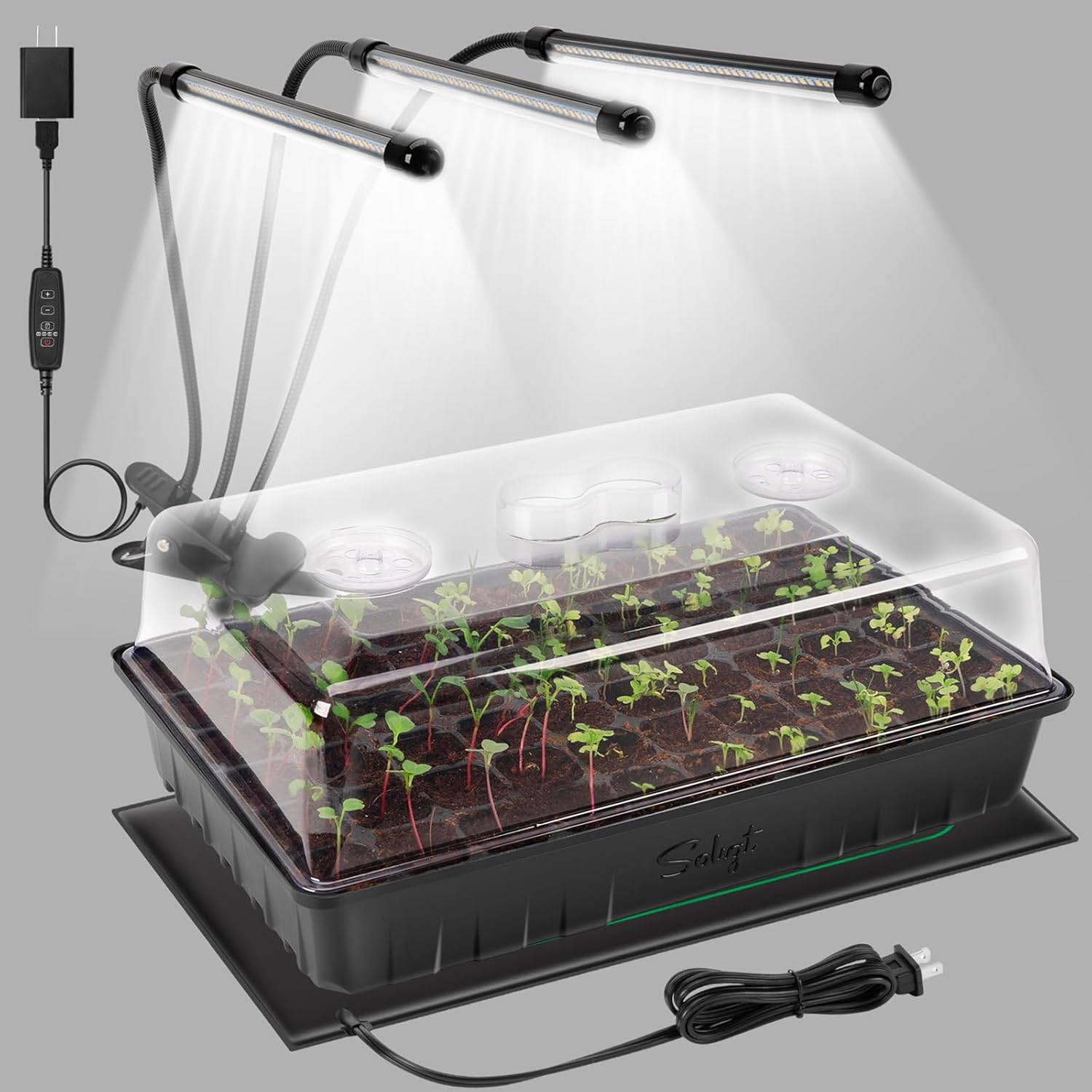
| Included Components | 1020 Seedling heat mat, 4500K grow lights, 60-cell seedling tray, humidity dome, propagation tray |
|---|---|
| Unit Count | 60 Count |
| Other Special Features of the Product | Corded |
| Mounting Type | Tabletop |
| Indoor Outdoor Usage | Indoor |
This SOLIGT kit provides a complete, beginner-friendly setup for indoor seed starting by combining a 60-cell seed tray, tall humidity dome, waterproof heat mat and a flexible full-spectrum grow light. You set seedlings in the 60-cell tray, cover with the adjustable-vent dome to hold humidity, then use the heat mat to give consistent bottom heat for faster, more even germination. The included 4500K LED light has multiple brightness levels, four timer settings and a three-head gooseneck so you can raise or angle light as seedlings grow or remove the dome and continue using the light on its clip or stand. Trays are described as heavy-duty plastic for reuse and the mat is waterproof for easy cleaning. Practical benefits are quicker, more reliable germination, reduced need for separate equipment and versatile light control for different crops. Limitations are that the kit is designed for tabletop indoor use only and the product listing lacks detailed power specs and exact light output numbers so advanced growers who need quantified PPFD or larger capacity may want a dedicated lighting solution.
Best for: Buyers who want a balanced, ready-to-use indoor seed starting system that saves time by combining heat, humidity control and a configurable grow light in one package.
Less Ideal for: Growers needing a high-capacity or commercial setup or those who require precise, measured light intensity for advanced propagation.
- Complete kit includes seed tray, humidity dome, waterproof heat mat and adjustable full-spectrum LED light
- Grow light offers 5 brightness levels and four timer options plus flexible gooseneck and clip or stand mounting
- Waterproof heat mat provides consistent bottom heat for faster, more even germination
- Tall dome with adjustable vents and drainage holes helps control humidity and root health
- Durable, reusable heavy-duty plastic trays suitable for multiple seasons
- Designed for tabletop indoor use only, not suited for larger or outdoor setups
- Light output is described by color temperature and LED count but lacks quantified PPFD or lumen figures for precision growers
Verdict: If you want a single, user-friendly indoor seed starting system that covers heat, humidity and adjustable lighting, this kit gives everything a balanced home gardener needs to get reliable seedlings.
VIPARSPECTRA P700 70W Dimmable Full Spectrum LED Grow Light

| Light Output Maximum | 11000 lumens |
|---|---|
| Light Source Wattage | 70 watts |
| Mounting Type | Hanging Mount |
| Light Source Special Features | Dimmable |
| Number of Light Sources | 216 |
The VIPARSPECTRA P700 is a 70W full spectrum LED grow light built for seed starting and vegetative stages. It uses 216 diodes and a tuned mix of red and white LEDs to deliver high PAR output (advertised 11,000 lumens) across a small footprint roughly suited to a 2×2 ft veg area. The light is fanless and relies on large aluminum heat sinks to keep running temperatures low while the included 4-level dimmer lets you dial intensity for seedlings, clones, or mature veg. Setup is simple with hanging mount hardware included and the unit draws about 0.65 A at 120V so it runs far cooler and uses far less power than a comparable 150W HPS/MH system. For compact tents, shelves, or single-cabinet grows it offers a good balance of light output, spectrum, and efficiency. Limitations are its small coverage area and modest absolute wattage compared with larger fixtures, so gardeners with bigger canopies will want a higher-output model or multiple units.
Best for: Growers who want an efficient, low-heat fixture to run a single tent, shelf, or cabinet and who prioritize electricity savings and adjustable output for seedlings and veg.
Less Ideal for: Commercial growers or hobbyists running multi-plant canopies or larger tents who need wider coverage and higher total light output.
- Full spectrum diode layout optimized for seedlings and vegetative growth
- Low power draw (70W) with high reported lumen/PAR output for energy efficiency
- Fanless design with aluminum heat sinks for quiet, low-heat operation
- Integrated 4-level dimmer for easy intensity adjustment
- Coverage geared to a small 2×2 ft veg area so not ideal for larger grows
- Absolute wattage and diode count are modest compared with larger commercial fixtures
Verdict: A compact, energy-efficient full spectrum LED that delivers strong veg-stage light and adjustable intensity for small tents and cabinets.
bseah Full Spectrum LED Grow Light for Indoor Plants (2-Tube, 10W)

| Wattage | 10 watts |
|---|---|
| Power Source | DC 5V (USB) |
| Number of Light Sources | 2 |
| Control Method | Remote |
This bseah grow light is a tabletop LED lamp designed to help seedlings and young plants get steady light when natural sun is insufficient. It plugs into USB power and uses two tubes of yellow and white full-spectrum LEDs to support germination, vegetative growth, and flowering stages. The flexible metal gooseneck and non-slip base make it easy to position over a tray of seeds or a few small pots, while the remote and on-device controls offer three mode presets plus 10 dimming levels so you can lower intensity for delicate seedlings or boost it for heavier growth. The built-in 3/9/12 hour timer with memory simplifies daily schedules. Practical benefits include long LED life expectancy and a lightweight, desktop setup that fits on a windowsill or seed-starting bench. Limitations are the low 10 watt total output and single light head which mean coverage is limited to a small area and taller seedlings may need the lamp repositioned as they grow. For starting seeds you may need multiple units or supplemental light for larger trays.
Best for: Buyers who want an inexpensive, compact lamp to start small batches of seeds or care for a few seedlings on a windowsill and prefer a simple plug-and-play setup.
Less Ideal for: Gardeners who need to light large seed trays, multiple flats, or quickly grow taller seedlings should look for higher-output fixtures or expand with additional units.
- Full spectrum LED output suitable for seed germination through early growth
- Adjustable gooseneck and non-slip base for precise positioning over seedlings
- Ten dim levels and three mode presets let you tailor light intensity for stages
- Auto 3/9/12 hour timer with memory simplifies daily on/off scheduling
- USB power lets it run from common adapters, power banks, or a computer
- Only 10 watts and two tubes limit coverage to a small seed tray or a few pots
- Not waterproof so it must be kept away from wet benches or high-humidity setups
Verdict: A budget-friendly, easy-to-use USB grow lamp that works well for starting small batches of seeds and supporting early seedling growth.
Briignite A19 Full Spectrum LED Grow Light Bulb (2-Pack)

| Light Type | LED |
|---|---|
| Additional Features | Full Spectrum |
| Bulb Base | E26 |
| Light Output Maximum | 1000 lumens |
| Light Source Operating Life | 30000 hours |
These Briignite A19 grow bulbs are full-spectrum LED replacements that screw into any standard E26 fixture to give indoor plants consistent, natural-looking light. Each bulb outputs about 1000 lumens at roughly 11 to 12 watts, so they act like a 60 to 100 watt incandescent while using far less energy, which is handy for running multiple bulbs on a budget. The 3500–4000K warm daylight color and high CRI make foliage colors appear normal rather than the purple hue of some grow lights, so they work well in living spaces and plant shelves. Built-in features include app control and push-button options and an advertised 25,000 to 30,000 hour operating life. Limitations to note are modest reported PPF compared with purpose-built high‑output grow fixtures and the 180 degree beam, which is better for general room lighting than targeted canopy penetration for dense or tall plants. For small collections, seed starting, or supplementing light in low-light rooms these bulbs are an economical, easy-to-install choice.
Best for: Houseplant owners who need an affordable, plug-and-play light to supplement natural light for a few pots, seedlings, or a small indoor garden while keeping energy costs low.
Less Ideal for: Growers aiming to flower large or dense canopy crops or outfitting multi-tiered grow racks will want higher‑PPF, purpose-built fixtures instead.
- Full spectrum output that looks like natural white light and preserves true foliage color
- Low power draw (around 11–12W) with 1000 lumens brightness for energy-efficient continuous use
- Standard E26 base fits common fixtures for tool-free installation
- High CRI of 90 helps accurate color rendering in living spaces
- Beam angle and lumen-focused design give less concentrated PAR/PPF than dedicated high‑output grow fixtures
- App and push-button controls are basic compared with advanced programmable controllers
Verdict: A low-cost, easy-to-install full-spectrum LED bulb that gives natural-looking light and energy savings for small indoor plant collections.
LPMZMBL 36W Full Spectrum Ultra-Thin Grow Light Panel (4-Pack)

| Wattage | 36 watts |
|---|---|
| Light Output Maximum | 3600 lumens |
| Color Temperature | 6000 Kelvin |
| Number of Light Sources | 768 |
| Beam Angle | 120 degrees |
The LPMZMBL 36W full-spectrum grow panel pack is a compact LED solution for seed germination and early vegetative stages. Each ultra-thin aluminum panel houses a high LED count and produces a broad 6000K-dominant spectrum with supplemental red to support photosynthesis. The lights mount easily with included double-sided tape or zip ties and can be daisy-chained so you can power multiple panels from one source—handy for racks or multi-shelf seed trays. An integrated memory timer offers preset run times (4/8/12/16/20 hours) so seedlings get consistent daily light without manual switching. Low-profile design and aluminum construction deliver effective heat dissipation so you can position panels close to flats without overheating. Important limitations are that the panels are not dimmable and they use a fixed 36W output per panel, so you may need more fixtures for larger areas or deeper canopy coverage. The IP-rated resistance protects against splashes but panels should not be submerged. For reliable, space-efficient seed starting this kit covers small to medium setups well, but commercial growers needing adjustable intensity or wider coverage will want higher-output fixtures.
Best for: Growers who prioritize dependable, low-maintenance lighting for seed trays and small multi-tier setups and want a compact system that runs on a timer and daisy-chains neatly.
Less Ideal for: Large-scale or commercial operations that need adjustable output, high-intensity fixtures, or single-panel coverage for wide benches should consider higher-wattage, dimmable options.
- Full spectrum output with white and red LEDs to support germination and early growth
- Daisy-chain design lets you connect up to multiple panels from one power source for neat multi-shelf setups
- Integrated memory timer with preset runtimes for unattended, consistent daily light
- Aluminum ultra-thin housing provides good heat dissipation and low profile mounting
- Not dimmable so light intensity cannot be adjusted as seedlings mature
- 36W per panel may require multiple units to achieve uniform PPFD across larger racks
Verdict: A reliable, space-saving full-spectrum grow light pack that simplifies consistent seed starting with daisy-chain power and an easy-to-use timer.
LEOTER 4-Head LED Grow Light with Full Spectrum, Timer and 10-Level Dimming

| Light Source Type | LED |
|---|---|
| Number of Light Sources | 80 |
| Wattage | 80 watts |
| Control Method | Remote |
| Mounting Type | Clip On |
The LEOTER 4-head grow light is a USB-powered, clip-on lamp built for indoor plant care that combines full-spectrum and targeted red/blue diodes to support seedlings, vegetative growth and flowering. It uses 80 LEDs arranged across four adjustable heads on flexible goosenecks so you can position light over individual large plants or groupings. Notable features are three spectral modes (red+blue, warm/full spectrum, and combined), a circular memory timer with 3/9/12-hour presets, and ten brightness levels for fine control over intensity. The strong metal clip and flexible necks make it simple to aim light at tall foliage without permanent installation. Practical benefits include reduced need for supplemental natural light, convenient daily scheduling for busy users, and a compact footprint that suits shelves or plant stands. Important limitations are that the unit is described as a clip/desk lamp rather than a wide-panel fixture, so coverage for very large single specimens may require placing heads close to foliage or using multiple units, and the timer resets if unplugged so it needs occasional reprogramming after power loss.
Best for: Buyers who want a controllable, space-efficient grow light to supplement indoor sun for larger houseplants and prefer a proven, feature-rich unit with preset timers and adjustable heads.
Less Ideal for: Growers who need single-fixture coverage for floor-to-ceiling specimens or large multi-plant setups should consider full-size panel fixtures or multiple units instead.
- Full spectrum plus red and blue LEDs (80 total) to support all growth stages
- Ten dimming levels for precise intensity control
- Three timer presets with memory function for hands-off daily scheduling
- Adjustable 4-head design and flexible goosenecks for targeted placement
- Strong metal clip allows mounting on shelves, desks, or plant stands
- Designed as a clip-on lamp so single-unit coverage is limited for very large plants
- Timer settings must be reset after the light is unplugged
Verdict: A versatile, adjustable clip-on grow light that gives busy indoor gardeners precise control over spectrum, intensity and scheduling to boost large plant growth in compact spaces.
Barrina T5 1ft LED Grow Lights, 5000K Full Spectrum — 4-Pack

| Wattage | 5W |
|---|---|
| Color temperature | 5000K |
| Linkable | Link up to 16 lights |
| Control | Separate on/off switches |
The Barrina T5 1ft grow light 4-pack provides straightforward, energy-efficient supplemental lighting for seedlings, vegetative plants, and flowering houseplants. Each slim fixture produces a 5000K full spectrum output at 5W and includes an on/off switch so you can control lights individually or run them together. The lights are plug-and-play and come with power cords, connector cables, clips, double-sided tape, and cable ties for quick installation on shelves, racks, or small indoor shelving units. Because fixtures link up to 16 units, you can scale a multi-shelf setup without extra wiring. Practical benefits include low power draw, compact footprint that fits tight spaces, and a high PPFD-focused output that supports photosynthesis. Limitations are that these are short 1-foot fixtures intended for close-proximity use rather than lighting large rooms, the mounting relies on adhesive and clips rather than a heavy-duty mounting system, and they are not magnetic, which reduces some placement options. For growers who want an easy, modular lighting solution for small indoor setups, these deliver reliable light for everyday use.
Best for: Buyers who want a compact, energy-efficient grow-light system to brighten shelves or small indoor racks and who value easy installation and scalable setups.
Less Ideal for: Growers who need to light large rooms, tall plants, or wide benches should choose longer or higher-output fixtures instead.
- Full-spectrum 5000K output suitable for seedlings through flowering
- Individual on/off switches for each fixture allow flexible light scheduling
- Linkable design supports up to 16 lights for easy expansion
- Low power consumption (5W per 1ft fixture) reduces energy use
- Includes basic installation kit (power cords, connectors, clips, tape, cable ties)
- Short 1ft length limits coverage area per fixture
- Mounting depends on adhesive and clips rather than more secure hardware
- Not magnetic, reducing placement options on metal surfaces
Verdict: A compact, low-energy, and linkable 1ft grow light kit ideal for efficiently lighting shelves and small indoor plant setups.
Choosing the Right Grow Light for Seed Germination: Key Factors to Consider
Spectrum and Color Temperature
Seedlings are highly responsive to light wavelength. Blue-rich light around 4000K to 6500K encourages compact, stocky growth and strong leaf development during germination and the seedling stage. Some fixtures offer adjustable spectrums or combined diodes so you can lean into blue for seedlings and add red later when moving plants toward transplant.
Choosing a light with documented spectral output matters because vague marketing terms do not reveal whether a lamp will prevent leggy seedlings. For the earliest stage, prioritize a steady blue-weighted spectrum and avoid fixtures that only emphasize warm or red tones.
Intensity and Coverage Area
Light intensity determines how close a fixture must be to the tray and whether multiple lights are needed to cover standard starter flats. Low intensity requires placing lights very close, which increases the risk of hot spots or uneven germination. High-intensity fixtures with wide optics can cover more trays with fewer fixtures, but they should still allow dimming to avoid overwhelming newly emerging sprouts.
Look at recommended coverage for typical tray sizes and whether the manufacturer provides PPFD or lux maps. Practical growers choose a fixture that gives even light across the entire tray at an adjustable hanging height so seedlings receive uniform illumination as they expand.
Heat Output and Thermal Control
Heat is a double-edged sword at germination. Gentle warmth can speed emergence, but excess heat will dry the tray surface, stress delicate root tips, and increase disease risk. Grow lights that put out a lot of infrared or concentrate heat in a small area demand greater distance or active cooling.
Opt for fixtures with passive heatsinks or integrated fans when using them close to seedlings or under humidity domes. Fixtures that run cool let you keep the light closer for higher intensity without baking seed trays, reducing watering frequency and keeping the microclimate stable.
Adjustability and Mounting Options
Seedlings need the light moved up as they grow, so mounting flexibility is critical. A fixture that hangs easily with adjustable ratchet hangers, chain, or a telescoping grow light stand saves time and prevents constant repositioning. Some growers prefer lights with multiple hanging points or slim profiles that fit inside low-height shelves and racks.
Also consider dimming controls and the ability to change spectrum or power output. Built-in timers or compatibility with external timers simplifies consistent photoperiods, which is essential for predictable seedling behavior.
Durability and Moisture Resistance
Seed-starting benches are humid places with regular watering and occasional splashes. Fixtures designed with sealed electronics, corrosion-resistant fasteners, and IP-rated housings stand up better to this environment. Plastic housings can warp over time from heat, while well-designed aluminum bodies dissipate heat and resist humidity-related degradation.
Choosing a unit that is serviceable and simple to wipe down keeps your seed-starting area sanitary and reduces failure during a busy planting season.
Energy Use and Long-Term Running Costs
Seed-starting often requires lights running 12 to 18 hours a day for several weeks. Energy-efficient LEDs will cost less to operate and produce less unwanted heat than older fluorescent or incandescent-style options. Check rated wattage, but also look for efficacy data such as micromoles per joule if available.
Lower operating costs matter if you start seeds multiple times per year or run a multi-tier rack. Energy efficiency should be balanced with enough output to provide healthy PPFD levels for germination and early growth.
Setting Light Distance and Timing for Seedlings
Most seedlings do best with a defined photoperiod and a consistent light distance. A typical starting point is keeping the fixture 2 to 6 inches above emerging cotyledons for LED panels with medium intensity, and 6 to 12 inches for higher-output fixtures. Pay attention to manufacturer guidance and watch seedlings: rapid upward stretch signals the need for closer or stronger blue light, while scorched or bleached leaves indicate the light is too intense or too close.
Photoperiods for seed germination depend on species, but 12 to 16 hours of light per day is a common baseline for many vegetables and annuals. Use a timer to automate cycles and avoid stressing plants with irregular on/off schedules during critical early development.
- Start with 12-16 hours of light; adjust based on species needs.
- Raise the fixture gradually as true leaves develop.
- Use a humidity dome with caution if lights are close; remove dome once seedlings show true leaves.
Using Light with Heat Mats and Humidity Domes
Heat mats and domes can speed germination for warmth-loving seeds, but they change the thermal and moisture balance under the light. When using a heat mat, reduce light-to-tray distance or lower intensity to prevent overheating the canopy. Monitor substrate moisture more frequently because mats increase evaporation.
For seeds that germinate faster with warmth, position the heat mat under the tray and keep the light above. Remove the humidity dome as soon as cotyledons open to prevent fungal issues and allow airflow. Combining controlled bottom heat with blue-rich overhead light gives many seeds the best start.
- Use separate timers for heat mats and lights where possible.
- Remove domes quickly once seedlings emerge to reduce damping-off risk.
Fixture Layout for Small Indoor Seed-Raising Areas
Plan your fixture layout to match tray sizes and available bench space. For a single bench, a single wide panel that covers the full width reduces hot and cold spots. For multi-tier racks, thin bar lights or strips that mount under each shelf provide even coverage for each level without interfering with vertical clearance.
Measure coverage before buying and allow for some overlap between fixtures to avoid dark edges. Consider adjustable-height shelving or pulley systems to raise fixtures as seedlings grow without moving the trays.
- Match fixture length to tray width for the most even light.
- Use multiple low-profile bars for multi-tier setups to save headroom.
Common Seedling Problems Related to Lighting
Legginess, pale leaves, and uneven germination are often linked to suboptimal lighting. Insufficient blue light or low intensity makes seedlings reach for light, producing long, weak stems. Too much red or warm-spectrum focused light can encourage stretch in some species as well.
Other issues like leaf scorch or bleaching usually mean the fixture is too intense or too close. If you see these signs, increase distance or reduce run time until plants tolerate higher intensities. Regularly rotating trays and checking light uniformity will reduce patchy growth and allow you to correct problems early.
- Leggy seedlings: increase blue spectrum or overall intensity.
- Pale leaves: assess light duration and nutrient supply as well as spectrum.
- Scorched leaves: lower intensity or raise the fixture height.
Transitioning Seedlings to Natural Light or Grow Rooms
When seedlings develop true leaves and are big enough to handle, gradually acclimate them to brighter light conditions. Move them into a brighter indoor window or an area with stronger fixtures over 5 to 7 days, increasing daily exposure incrementally to avoid shock.
If moving outdoors for hardening off, begin with a few hours of morning light in a sheltered spot and extend exposure daily. Maintain protective measures like wind breaks and shading during midday for the first week to reduce transplant losses.
- Increase light exposure slowly over a week when shifting conditions.
- Keep watering consistent during transitions to avoid wilting stress.
How We Chose the Best Grow Light for Seed Germination
We focused on features that matter to gardeners starting seeds under artificial light. Key evaluation criteria included spectral output and adjustability, because seedlings respond differently to blue and red wavelengths during germination and early leaf development; light intensity and coverage, since uneven or weak light causes stretching; heat management, because excessive heat can dry trays and stress young roots; fixture height and mounting flexibility to follow seedlings as they grow; energy efficiency and run-time costs for multi-week use during planting season; and build quality plus moisture tolerance for use near trays and humidity domes. We excluded fixtures intended only for mature flowering or large-scale commercial operations where growers need multi-hundred-watt arrays. We also filtered out units without basic dimming or height-adjustment options, and units that lack clear spectral specifications. The resulting shortlist favors seed-starting practicality: predictable spectrum, manageable heat, consistent coverage for common tray sizes, and straightforward setup for hobby and small-scale growers.
FAQ
How close should my grow light be to newly germinated seedlings?
Distance depends on the fixture intensity. A medium-output LED panel typically sits 2 to 6 inches above cotyledons, while higher-output units need 6 to 12 inches. Watch seedlings for stretching or bleaching and adjust height accordingly.
Do seeds need a specific color of light to germinate?
Most seeds germinate in darkness or with ambient heat, but once cotyledons emerge they benefit from blue-rich light for compact growth. True germination rates are usually unaffected by spectrum, but seedling quality after emergence is influenced by light color.
Can I use regular household LEDs for seed starting?
Household LEDs may provide some light but often lack the spectrum and intensity seedlings need for healthy, compact growth. Dedicated grow fixtures with a higher proportion of blue light and predictable coverage produce more consistent results.
How long should grow lights run for seedlings?
Common photoperiods for seedlings are 12 to 16 hours per day depending on species. Some gardeners extend to 18 hours for certain crops, but extended lighting can increase water needs and energy use. Use a timer to maintain steady daily cycles.
Will grow lights dry out my seed trays faster?
Yes, stronger lights and lights placed closer to trays increase evaporation. Monitor substrate moisture more often when using higher intensities, and consider using humidity domes during early germination while removing them once true leaves appear.
Are dimming and spectrum controls necessary for seed starting?
Dimming and adjustable spectrum are useful but not strictly required. They provide flexibility to start seeds under gentle conditions and increase intensity as seedlings mature. If you plan to use the fixture for multiple growth stages, these features add long-term utility.
Final Verdict
For seed germination, prioritize a blue-leaning spectrum, adjustable intensity, and low heat output so seedlings emerge quickly and grow compactly. Consider how much coverage you need and whether mounting flexibility or multi-tier use matters for your space. Tradeoffs typically involve intensity versus heat and upfront fixture size versus long-term versatility. Choose a fixture that gives predictable spectrum and even coverage at shallow distances, and plan to raise and dim the light as seedlings develop. Focusing on these practical criteria will help you get stronger, healthier starts and simplify the transition from tray to transplant.
