

Note: This article contains affiliate links. If you click on these links and make a purchase, I may earn a small commission at no extra cost to you. This helps support my research and content. Read my full affiliate disclosure here.
If you grow flowering plants indoors, the right HID grow light makes a big difference in bud set, canopy penetration, and overall yield. You need reliable intensity across the canopy, predictable spectrum during bloom, and a fixture that manages heat so plants stay healthy. This guide shortlists seven top HID grow lights suitable for small to medium indoor gardens and greenhouses. We evaluated options for light output, thermal performance, ease of installation, and longevity so you can pick a unit that fits your space and grow style. Read on for practical notes on setup, lamp maintenance, and what to prioritize for flowering cycles.
Top Picks at a Glance
| Best Overall The best all-around choice for most situations | UltraGrow Classic 1000W DE Double-Ended HID Grow Light System with Dimmable Ballast |  |
| Best Quality Built to a higher standard if you want something more solid | Platinum Horticulture 1000W Double-Ended HPS DE Grow Light Kit (Open Reflector, Dimmable Ballast) |  |
| Best Value The sweet spot between price and what you get | Sylvania MP250/BU-ONLY 250W Metal Halide Bulb (BT28, 4000K) |  |
| Best Budget The cheapest option that still gets the job done reliably | Sylvania Plantastar 400W High Pressure Sodium Grow Light (E39, 2100K) |  |
| Highest Rated A top-rated pick with lots of positive feedback | Vegelumax MH 600W Metal Halide Grow Light Bulb, E39 Base, 6000K |  |
| Most Popular A crowd favorite that many people choose with confidence | GRUOTVSZAK HPS 600W E39 Grow Light Bulb (2-Pack) |  |
| Best Seller A high-volume bestseller chosen again and again | PROTOPIA 1000W Metal Halide Grow Light Bulb (E39, 6000K) |  |
UltraGrow Classic 1000W DE Double-Ended HID Grow Light System with Dimmable Ballast

| Wattage | 1000 watts |
|---|---|
| Light Source Type | High Pressure Sodium |
| Light Source Special Features | Dimmable |
| Mounting Type | Hooks for hanging |
| Specification Met | ETL |
This UltraGrow Classic 1000W DE system is a traditional double-ended HID fixture built for serious indoor growers who want flexible power and strong light output. It pairs a high-pressure sodium-compatible DE lamp with a dimmable ballast that lets you step between 600, 750, 825, 1000 and 1150W operation, so you can tune intensity for veg or flower and manage heat and electricity. The fixture uses a hammered reflective aluminum reflector to maximize usable light and comes with hooks for hanging, a 10 ft power cord and a 240V adapter. Because it runs on standard AC and is ETL listed, installation in a dedicated grow room is straightforward. Expect strong canopy penetration and reliability compared with cheaper single-ended fixtures, but note the unit is relatively heavy and sized for multi-plant setups rather than small cabinets. Also it requires HID bulbs and a ballast-aware workflow, so modern LED-only growers will need to accept the extra maintenance and power draw that HID systems bring.
Best for: Growers who want a reliable, high-output HID fixture with adjustable wattage for mixed veg and flower cycles and who prioritize light intensity and canopy penetration over lowest power draw.
Less Ideal for: Casual hobbyists with very small spaces or those seeking low-maintenance, energy-efficient LED-only setups should consider other options.
- Dimmable ballast with selectable wattage steps (600/750/825/1000/1150W) for flexible light management
- Double-ended HID design and high-reflectivity aluminum reflector for strong canopy penetration
- ETL listed and includes 10 ft power cord plus 240V adapter for straightforward setup
- Constructed from aluminum which helps with heat dissipation and durability
- Heavy, larger fixture better suited to multi-plant rooms than small grow cabinets
- Requires HID bulbs and ballast maintenance and uses significantly more power than LEDs
Verdict: Buy this if you need a high-output, adjustable double-ended HID fixture that prioritizes light intensity and canopy penetration for serious indoor grows.
Platinum Horticulture 1000W Double-Ended HPS DE Grow Light Kit (Open Reflector, Dimmable Ballast)
| Light Type | HPS |
|---|---|
| Wattage | 1000 watts |
| Additional Features | Dimmable |
| Bulb Base | GU24 |
| Indoor Outdoor Usage | Indoor |
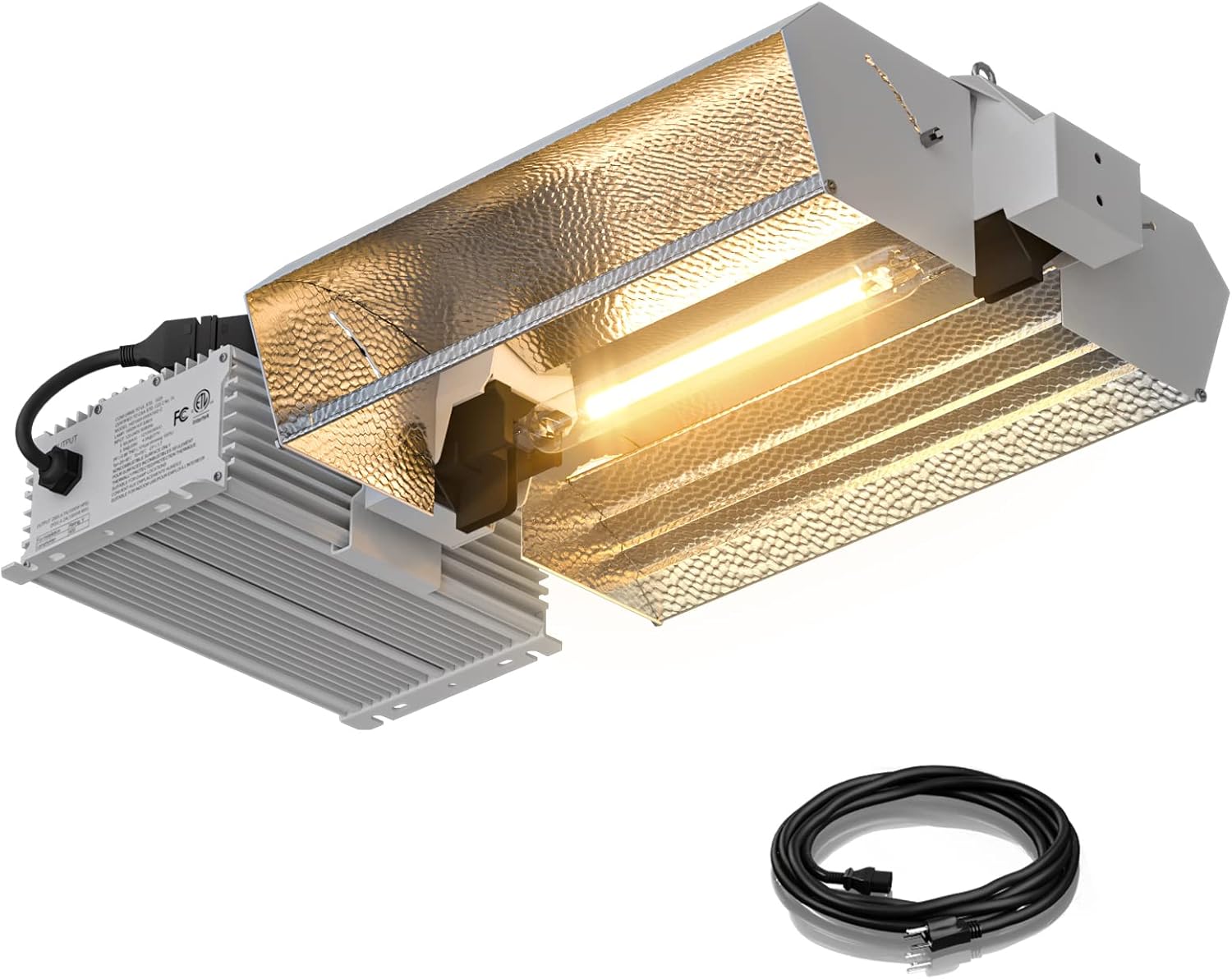
This Platinum Horticulture DE 1000W kit is built for growers who need high PAR output and flexible control over light intensity. It pairs a double-ended HPS-ready reflector with a digital 208–277V ballast that can be dimmed across several power levels, so you can tune output for vegetative or flowering stages. The open European-style hammer-tone aluminum reflector is designed to deliver strong, uniform light to the canopy and can be adjusted for narrow, wide, or fully open distribution. The system ships as a hood plus ballast and cord; the DE lamp is sold separately and accepts industry-standard DE HPS bulbs. Practical benefits include robust PAR for dense canopies, a heavy-duty ballast that supports multiple wattage presets, and simple touch/push control. Limitations are the reliance on a DE HPS bulb rather than including a lamp and the greater heat and electrical demand compared with LED fixtures, which means growers need to plan for ventilation and appropriate 208–277V supply.
Best for: Serious growers prioritizing maximum light output and flexible intensity control for indoor flowering setups who can accommodate the electrical and ventilation needs.
Less Ideal for: Casual hobbyists or small-space growers seeking low-heat, plug-and-play LED solutions; those without access to 208–277V circuits should consider lower-voltage alternatives.
- High PAR output from double-ended HPS compatibility for strong flowering performance
- Dimmable digital ballast with 208–277V support and multiple wattage presets
- Open European aluminum reflector designed for even canopy coverage and adjustable distribution
- Includes ballast, reflector hood, and power cord for a near-complete system setup
- Does not include the DE HPS bulb so lamp must be purchased separately
- Requires high-voltage power and increased ventilation due to heat compared with LED options
Verdict: Buy this kit if you need a high-PAR, dimmable double-ended HPS system to maximize flowering performance in an indoor grow.
Sylvania MP250/BU-ONLY 250W Metal Halide Bulb (BT28, 4000K)

| Light Type | Metal Halide |
|---|---|
| Wattage | 250 |
| Color Temperature | 4000 Kelvin |
| White Brightness | 23000 lumens |
This Sylvania 250W Metal Halide lamp is a high-output HID bulb intended for open-fixture, base-up installations where strong, broad-spectrum light is needed. With a BT28 shape and EX39 (Mogul) base it delivers about 23,000 lumens at a 4000K cool-white color temperature, making it suitable for larger grow rooms or high-ceiling commercial fixtures. The lamp is optimized for fixtures without lenses so you get more usable light and lower maintenance from fewer dirty lenses. Typical use is in professional horticulture or industrial lighting where consistent high lumen output and compatibility with HID ballasts matter. Practical benefits include efficient lumen-per-watt performance compared with halogen and the clear glass that maximizes light delivery. Limitations are that it requires the correct EX39 socket and compatible ballast and is specified for base-up only and open fixtures, so it is not a direct drop-in for standard household sockets or enclosed luminaires.
Best for: Growers and facility managers who prioritize maximizing light output per fixture in larger indoor grow rooms or high-ceiling spaces and who already use HID ballasts and Mogul sockets.
Less Ideal for: Home gardeners with standard medium-base fixtures or growers who need retrofit, enclosed, or vertically oriented fixtures should look for bulbs designed for those conditions or alternative LED grow lamps.
- High output roughly 23,000 lumens suitable for large grow areas or high ceilings
- 4000K cool-white spectrum that supports vegetative growth stages
- Open-fixture rating lets more light reach plants and reduces lens maintenance
- Designed for commercial EX39 (Mogul) sockets and HID ballast systems
- Requires EX39 Mogul base and compatible HID ballast rather than standard household fittings
- Base-up only rating limits mounting orientations and fixture choices
Verdict: Choose this bulb if you need a high-lumen 250W metal halide for open fixtures and already run HID ballasts to maximize light output in larger grow spaces.
Sylvania Plantastar 400W High Pressure Sodium Grow Light (E39, 2100K)

| Light Type | HPS |
|---|---|
| Wattage | 400 watts |
| Bulb Base | E39 |
| Color Temperature | 2100 Kelvin |
| Light Source Operating Life | 24000 hours |
The Sylvania Plantastar 400W HPS lamp is a straightforward HID grow bulb aimed at greenhouse and indoor growers who need strong, proven light output for all growth stages. It delivers high lumen output and a warm 2100K spectrum that supports vegetative and flowering phases and the manufacturer cites about 600 µmol/s of PPF for solid photosynthetic performance. The standard E39 mogul base and ellipsoid shape make it compatible with common HPS fixtures and ballasts, while the long rated life of 24,000 hours reduces how often you replace bulbs. Practical benefits include intense photon flux for larger canopies and a familiar, easy-to-install form factor for growers using HID setups. Trade-offs are the low color rendering index and the warm spectrum that is less balanced than some LEDs for visual plant inspection, plus HPS runs hot and requires compatible ventilation and ballast gear. For buyers prioritizing an established, high-output HID solution on a budget, this bulb gives efficient light and long service life, but it is not as energy-efficient or cool-running as modern LEDs.
Best for: Growers who want a proven, high-output HID bulb to boost yield on a budget and already run HPS fixtures or ballasts in a greenhouse or indoor setup.
Less Ideal for: Growers looking for the highest energy efficiency, low-heat operation, or tunable spectrum should consider LED alternatives instead.
- High light output suitable for larger canopies with 50,000 lumens and 600 µmol/s PPF
- Long rated operating life of 24,000 hours reduces replacement frequency
- Standard E39 mogul base fits common HPS fixtures and ballasts
- Designed for all growth stages from seeding through flowering
- Warm 2100K spectrum and low CRI (22) make plant inspection and color rendering poor
- Generates heat and requires compatible ballast and ventilation compared with LEDs
Verdict: A cost-effective, high-output HPS bulb for growers who want proven HID performance and long service life on a budget.
Vegelumax MH 600W Metal Halide Grow Light Bulb, E39 Base, 6000K
| Wattage | 600 watts |
|---|---|
| Color Temperature | 6000 Kelvin |
| Light Output Maximum | 55000 lumens |
| Light Source Operating Life | 12000 hours |
| Bulb Base | E39 |
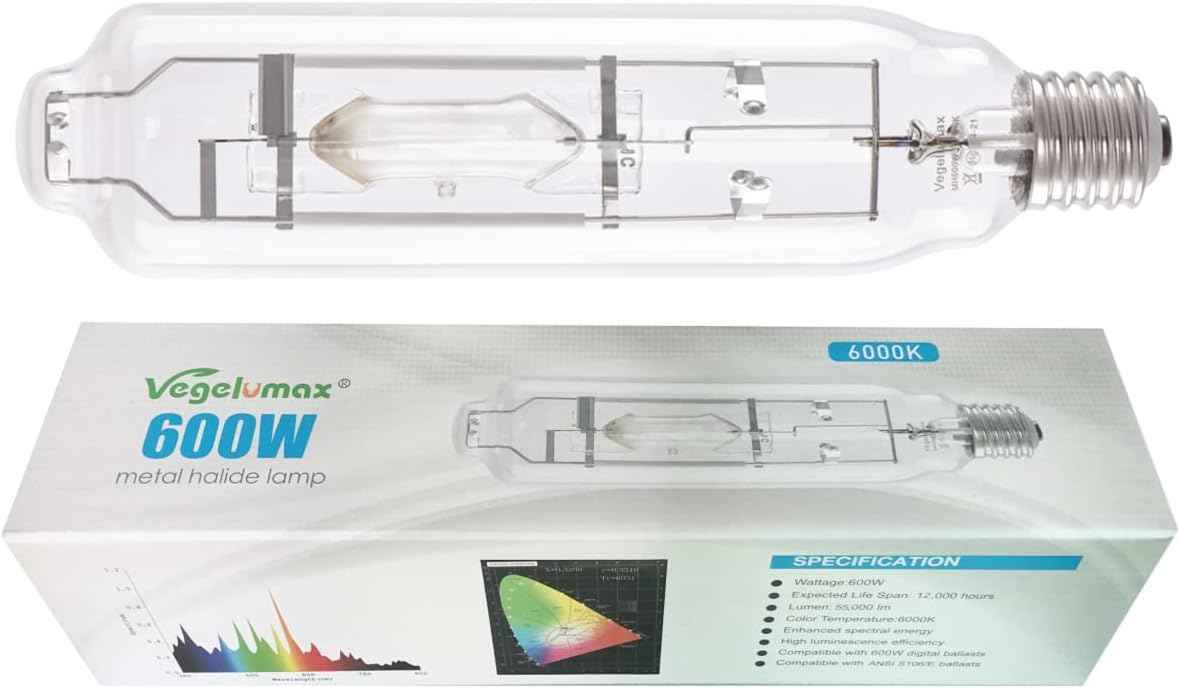
The Vegelumax MH 600W metal halide bulb is a single-ended HID lamp designed for the vegetative stage of indoor horticulture and hydroponics. It produces about 55,000 lumens and a high PAR photon flux that favors leafy, compact growth through an enhanced blue and violet spectrum. Typical use is in open or enclosed fixtures with an E39 socket and compatible MH ballasts; expect a 2–3 minute warm-up to full output and a recommended 5 minute cool-down before restrike. Notable features include broad lumen output, a rated life of roughly 12,000 hours, and compatibility with common magnetic and many electronic ballasts. In practice the bulb gives strong early-stage growth and robust plant structure where a cool, high-PAR spectrum is desired. Important limitations are the high power draw and heat generation inherent to a 600W HID lamp and the need for proper ballast, fixture and eye protection; it also requires more ventilation and electrical capacity than LEDs. For growers prioritizing dependable, proven HID performance in vegetative cycles this bulb delivers consistent output and longevity, but it is not a low-energy or low-heat option.
Best for: Growers who want a reliable, proven HID solution for vigorous vegetative growth and who prioritize steady spectral output and long lamp life over energy minimization.
Less Ideal for: People with limited electrical capacity, small poorly ventilated spaces, or those seeking lower-heat, more energy-efficient lighting should consider other technologies.
- High light output with 55,000 lumens and strong PAR for vegetative growth
- Enhanced blue and violet spectrum optimized for compact, leafy plants
- Rated life around 12,000 hours with low lumen depreciation in early life
- E39 base and compatibility with common MH ballasts simplifies replacement
- Consumes 600 watts and produces significant heat compared with LED alternatives
- Requires compatible ballast, proper fixture, ventilation and eye protection
Verdict: Choose this bulb if you need a durable, high-output metal halide lamp that reliably drives strong vegetative growth in indoor HID setups.
GRUOTVSZAK HPS 600W E39 Grow Light Bulb (2-Pack)

| Light Type | HPS |
|---|---|
| Wattage | 600 watts |
| Bulb Base | E39 |
| Color Temperature | 2000 Kelvin |
| Light Source Operating Life | 28000 hours |
These GRUOTVSZAK HPS 600W E39 bulbs are traditional high-pressure sodium lamps sold as a two-pack and optimized to increase red output for flowering plants. They screw into standard E39 fixtures and are compatible with electronic and magnetic ballasts, so you use them the same way you would other HID grow bulbs: hang the fixture above the canopy, run the lights on your bloom schedule, and allow their warm-up time before switching. Notable features include a red-concentrated spectrum (claims of 20 to 40 percent more red), high PPF/PPF-per-watt performance relative to generic HPS bulbs, and a long rated operating life of about 28,000 hours. Practical benefits are stronger flower-stage light quality that can help bud development and simple retrofitting into existing HPS setups. Important limitations are that these are HPS tubes with long warm-up and restrike times, they emit a strong red/orange cast that is hard to assess visually, and they require ballast and ventilation considerations typical of high-heat, high-wattage HID systems.
Best for: Growers who already run HID fixtures and prioritize maximizing flower-stage red light for bigger blooms while reusing existing ballasts and canopy setups.
Less Ideal for: Small-scale or low-heat setups, growers who prefer instant-on, lower-heat LED solutions, or those wanting neutral white light for plant inspection.
- Red-enhanced spectrum aimed at flowering to concentrate PAR where buds use it most
- Standard E39 base and ballast compatibility for easy retrofit into existing HID setups
- Two-bulb pack provides full replacement pairs for multi-lamp fixtures
- Long rated operating life around 28,000 hours for extended use
- Requires traditional HID ballast and produces significant heat and warm-up delay
- Strong red/orange light makes visual plant inspection and color assessment difficult
Verdict: If you need a drop-in HPS replacement that boosts red-spectrum output for the bloom phase, this 600W E39 two-pack is a straightforward choice.
PROTOPIA 1000W Metal Halide Grow Light Bulb (E39, 6000K)

| Light Type | Metal Halide |
|---|---|
| Wattage | 1000 watts |
| Bulb Base | E39 |
| Color Temperature | 6000 Kelvin |
| Light Source Operating Life | 6000 hours |
This Protopia 1000W metal halide (MH) bulb is designed for large-scale indoor vegetative lighting where high PAR and a cool color temperature help produce compact, vigorous growth. It fits an E39 mogul base and delivers a 6000K white light with a stated 95,000 lumen output and about 6,000 hours operating life, so it is used like a conventional HID lamp in commercial or serious hobby grow setups with compatible ballasts and reflectors. Notable features include pulse-start capability for reliable ignition, enhanced blue/violet spectral content to favor leaf and stem development, and quartz glass construction for stable spectral output. Practical benefits are strong light penetration and a spectrum that reduces excessive stretching during the veg phase, making it useful for growers converting larger tents or rooms to HID lighting. Limitations are typical of 1000W MHs: high power draw and heat output that require robust cooling and ventilation, incompatibility with fixtures not rated for mogul bases or pulse-start lamps, and a finite 6,000-hour lifespan compared with some newer LED options.
Best for: Growers converting medium to large indoor spaces who prioritize proven HID performance and want a strong, cool-spectrum source for vegetative growth rather than the latest LED efficiency.
Less Ideal for: Small-space hobbyists, energy-conscious growers, or those who cannot accommodate the heat, ventilation, and ballast requirements of a 1000W HID system.
- High PAR output and strong lumen rating suited for wide vegetative coverage
- 6000K spectrum with enhanced blue and violet content to promote compact vegetative growth
- Pulse-start capable for consistent ignition and stable spectral performance
- Quartz glass construction for consistent PAR and spectral output
- Very high power consumption and heat output require substantial ventilation and cooling
- Limited 6000-hour rated life compared with many modern LED grow lights
Verdict: Choose this 1000W MH bulb when you need a reliable, high-output cool-spectrum HID light to drive vigorous vegetative growth across a large indoor area.
Choosing the Right Hid Grow Light: Key Factors to Consider
Light Intensity and Canopy Coverage
HID fixtures are chosen for their strong light intensity, but the way that light spreads matters even more. High output at the fixture does not guarantee even canopy penetration; reflector design and lamp positioning determine hot spots and shaded zones. Evaluate published PAR or lumen maps when available and consider how many fixtures you will need to cover your intended grow area without leaving low-light pockets.
Higher intensity improves bud development during bloom but can also require more frequent training and pruning to keep the canopy even. Decide whether you need a single high-intensity unit or multiple smaller fixtures to balance penetration and uniformity.
Heat Output and Ventilation Needs
HID lamps and ballasts produce substantial heat, which affects plant transpiration, humidity, and the risk of heat stress. Effective thermal management reduces the need to constantly raise exhaust rates or move lights farther from the canopy, which would reduce usable PAR at the leaves.
Assess how a fixture vents heat, whether the ballast is remote or integrated, and how that fits your tent or room ventilation. Plan for added air movement and consider reflector designs that keep most heat above the canopy rather than directly on plants.
Lamp Type and Spectrum
HID systems typically use high-pressure sodium (HPS) or metal halide (MH) bulbs, each with different spectral profiles. MH bulbs lean toward blue-rich light useful for vegetative growth, while HPS provides the red and orange spectrum that promotes flowering and bud development.
Many growers run MH during veg and switch to HPS for bloom, so consider whether you need one-purpose bloom fixtures or a system that supports easy lamp swaps. Spectrum impacts stretch, node spacing, and flower density, so match the lamp type to your crop stage and cultivar.
Ballast Type and Reliability
The ballast controls lamp ignition and steady power delivery. Magnetic ballasts are robust and inexpensive but heavier and less efficient. Digital or electronic ballasts are lighter, more energy efficient, and often provide quieter operation and more stable output over time.
Durability matters because ballast failure can mean lost crop time. Check rated operating hours, cooling features, and whether the ballast is easily replaceable or isolated from the lamp to simplify maintenance.
Reflector Design and Mounting Options
The reflector shapes light distribution. Parabolic reflectors concentrate light for deeper penetration while open reflectors improve lateral spread. Your choice affects how close the fixture can be to the canopy and whether you get even coverage across multiple plants.
Mounting hardware and adjustable hangers allow fine-tuning height as plants grow. Consider fixtures with built-in hanging brackets, eyelets, or bracket kits that match your grow space and make routine repositioning simple.
Maintenance and Operating Costs
HID systems require lamp replacements and occasional ballast service. Bulbs lose output over time, and lamp color shifts can affect flowering if not replaced on a schedule. Factor in bulb lifespan, ease of replacement, and whether the fixture design makes swapping bulbs simple and safe.
Also consider energy use and how the fixture integrates with timers and ventilation. While initial cost matters, long-term operating demands on electricity and replacement bulbs will shape the true cost of ownership.
Setting Up HID Fixtures in Small Indoor Gardens
Placement is critical in smaller grows. Position fixtures so the strongest beam covers the main canopy and keep fixtures high enough to avoid heat scorch while low enough to maintain strong PAR at the leaves. If you use a single high-output unit, expect to train plants to form a central canopy; multiple smaller fixtures can simplify even coverage.
Ensure your ventilation system can move the heat generated by both ballast and bulb. In tight tents, use an inline fan and ducting to pull hot air away from the canopy and prevent temperature spikes during lights-on periods.
- Measure canopy temperature and leaf tips after first light cycle
- Use adjustable hangers to change height with plant growth
- Place thermometers at canopy level and at canopy top
Managing Heat Without Sacrificing Light
If heat is a limiting factor, prefer reflector styles that move heat upward and pair fixtures with remote-mounted ballasts when possible. Cooling the ballast or moving it outside the grow tent reduces local temperature but may require longer wiring and secure mounting.
Supplemental airflow across the canopy can mitigate heat pockets. Oscillating clip fans do not lower room temperature but prevent hot air from lingering around leaves and can reduce the chance of localized heat stress.
- Consider venting ballast heat into the exhaust stream
- Balance intake and exhaust CFM to control ambient temperature
Timing and Light Schedules for Flowering
HID lights are commonly used for intensive flowering because HPS output matches the spectrum many flowering crops prefer. Shift the photoperiod and, if you use both MH and HPS, swap bulbs at the start of bloom to provide spectrum and intensity optimized for bud set. Maintain consistent on/off schedules with reliable timers to prevent stress.
Gradual adjustments when changing light intensity help avoid shock. Raise or lower fixtures in small increments and monitor plant response over several days before making further changes.
- Use quality mechanical or electronic timers for consistent photoperiods
- Avoid sudden light interruptions during bloom to prevent stress
Safety and Electrical Considerations
HID systems can draw significant current and run hot. Make sure circuits are rated for continuous load and use dedicated lines if necessary. Keep electrical connections off the grow floor and protected from humidity. Use proper wire gauges and quality-rated plugs to avoid overheating.
Integrate timers, ballasts, and ventilation on separate circuits when possible to distribute load. Regularly inspect for frayed cords, loose connections, and signs of ballast overheating.
- Label circuits and avoid daisy-chaining high-draw devices
- Install GFCI protection in humid environments
When to Consider Alternatives to HID
If heat output or energy consumption is the primary concern, modern LED fixtures can offer comparable canopy PAR with lower thermal load, though they behave differently and may require different mounting and spacing. For very small micro-grows, the convenience of low-heat LED options can outweigh the high initial PAR advantage of HID.
HID remains highly effective where deep canopy penetration is needed and for growers who prefer tried-and-true lamp swapping strategies. Reassess your priorities if ventilation or electrical capacity is constrained.
- Compare total system heat and PAR, not just lamp lumen ratings
- Consider hybrid approaches for large rooms: HID over the center canopy, LEDs at edges
How We Chose the Best Hid Grow Light
We focused on attributes that matter in real indoor flowering grows. Primary evaluation criteria included measured light output and distribution to judge canopy penetration; thermal management, because excessive heat forces canopy management and limits placement; bulb and ballast durability, which affects long-term running costs and downtime; spectrum control for bloom-phase performance; and installation flexibility, including reflector design and mounting options. We relied on manufacturer specifications for lumen and PAR figures, ballast type and rated hours, and heat dissipation design while also weighing user reports about reliability and ease of lamp replacement. Exclusions: we left out low-intensity fixtures and units meant only for vegetative stages; units without compatible ballasts or that required uncommon bulbs were not considered. The end result emphasizes dependable light delivery, safe heat handling, and straightforward maintenance as the deciding factors.
FAQ
How close should I hang an HID lamp to my plants during bloom?
Distance depends on lamp wattage and reflector design. Generally keep high-wattage lamps farther away to avoid heat scorch but close enough to maintain strong PAR. Start conservatively and monitor leaf tips and canopy temperature, adjusting height a few inches at a time.
How often should HID bulbs be replaced for consistent output?
Bulbs gradually lose output and shift spectrum over hundreds to thousands of hours. Many growers replace bloom-phase bulbs after a single full flowering cycle or according to the bulb manufacturer's rated life. Watch for reduced bud density or color shifts as signs it is time to swap.
Can I use the same HID lamp for both veg and bloom?
You can, but lamp type affects plant morphology. Metal halide favors vegetative growth while high-pressure sodium promotes flowering. Some growers keep separate fixtures or swap bulbs to optimize each stage, while others choose a compromise lamp depending on space and budget.
Will an integrated ballast increase my tent temperature significantly?
Integrated ballasts do add heat near the fixture. How much impacts your ventilation needs and how close you can place the lamp to plants. Remote or externally mounted ballasts help reduce localized heat in the tent.
Do reflector shapes really change yields?
Reflector shape influences light distribution and penetration. A reflector that focuses light deeper into the canopy can improve bud development on lower branches, while a wide-spread reflector helps uniformity across many plants. The right shape matches your canopy layout and training style.
Final Verdict
Choose an HID fixture that matches your room size, ventilation capacity, and whether you prioritize deep canopy penetration or uniform coverage. Prioritize reliable PAR delivery, good thermal management, and durable ballast components. Be prepared to manage heat and maintain bulbs on a schedule to preserve spectrum and intensity. With the right balance of output, cooling, and installation flexibility, HID lights remain a strong choice for intensive flowering in indoor gardens.
