

Note: This article contains affiliate links. If you click on these links and make a purchase, I may earn a small commission at no extra cost to you. This helps support my research and content. Read my full affiliate disclosure here.
Picking the right LED grow light under $500 matters because lighting determines how plants photosynthesize, stretch, and produce flowers or fruit. With a modest budget you can still get full-spectrum fixtures, good photon output, and manageable heat if you know which specs to prioritize. This guide shortlists the top options for indoor gardeners working within that price cap and evaluates fixtures for usable light, energy consumption, and thermal behavior. Read on to see which lights earned a place on our list and why they suit different setups from small tents to larger shelves.
Top Picks at a Glance
| Best Overall The best all-around choice for most situations | Spider Farmer SF1000 100W Full Spectrum LED Grow Light |  |
| Best Quality Built to a higher standard if you want something more solid | Spider Farmer G4500 LED Grow Light 320W (App‑Controlled, Dimmable) |  |
| Best Value The sweet spot between price and what you get | Barrina 4ft T8 Full Spectrum LED Grow Light, 6-Pack |  |
| Best Budget The cheapest option that still gets the job done reliably | Briignite A19 Full Spectrum LED Grow Light Bulb (2-Pack) |  |
| Highest Rated A top-rated pick with lots of positive feedback | MEDIC GROW 360W Full-Spectrum LED Grow Light |  |
| Most Popular A crowd favorite that many people choose with confidence | GooingTop HY-021 6000K Full-Spectrum Clip Grow Light |  |
| Best Seller A high-volume bestseller chosen again and again | Aokrean Halo Full-Spectrum LED Grow Light with Base (3-Pack) |  |
Spider Farmer SF1000 100W Full Spectrum LED Grow Light

| Light Source Type | LED |
|---|---|
| Light Output Maximum | 10000 lumens |
| Light Source Wattage | 100 watts |
| Light Source Special Features | Dimmable |
| Specification Met | IP67 |
The Spider Farmer SF1000 is a compact 100W full spectrum LED grow light intended for 2×2 to 3×3 grow spaces and small tents. It uses a high diode count and upgraded LED chips to deliver broad-spectrum output that supports seedlings through flowering, with a dimmer knob to reduce intensity for early stages and ramp up for bloom. The fanless design and thick aluminum heatsink keep operation quiet while providing passive cooling, and the fixture meets IP67 for durable performance. Typical use is ceiling or tent mounting above individual plants or a small canopy where uniform coverage and deeper canopy penetration matter. Notable features include daisy-chain compatibility for linking multiple units under unified dimming, a 0–100% dimmable control, and a driver claimed to offer efficient power delivery. Practical benefits are even light distribution in a small footprint, predictable veg-to-flower capability, and near-silent operation. Limitations are inherent to its class: it is sized for small areas so you will need multiple units for larger tents, and the product description emphasizes specs from manufacturer tests rather than independent third-party PPFD maps.
Best for: Growers who want a quiet, compact full spectrum light for a small tent or single-plant setup and value adjustable intensity for each growth stage.
Less Ideal for: People running larger multi-plant rooms or commercial operations who need higher total output and broader single-fixture coverage.
- Full spectrum output suitable for all growth stages with added red and IR for flowering
- Dimmable 0–100% control lets you tailor light intensity to seedlings, veg, and bloom
- Fanless design with sturdy aluminum heatsink for quiet, low-maintenance operation
- Compact footprint ideal for 2×2 to 3×3 tents and small indoor setups
- Daisy-chain capable so multiple fixtures can be linked and dimmed together
- Coverage and power are intended for small grows so larger areas require multiple units
- Manufacturer gives efficiency and coverage figures without independent third-party PPFD charts
Verdict: A quiet, dimmable 100W full spectrum fixture that is a practical, balanced choice for hobbyists running 2×2 to 3×3 tents.
Spider Farmer G4500 LED Grow Light 320W (App‑Controlled, Dimmable)

| Light Source Type | LED |
|---|---|
| Wattage | 320 watts |
| Light Source Special Features | Dimmable, App-Controlled, Daisy-Chain Function |
| Power Source | Corded Electric |
The Spider Farmer G4500 is a high-efficiency LED grow light built for full-cycle indoor growing in small commercial or serious hobby setups. It delivers 320 watts using high-density Bridgelux diodes and a long bar design that spreads light more evenly across the canopy, making it suited to 2×4 and up to 3×5 coverage areas. The fixture is dimmable from 10 to 100 percent, supports daisy-chaining up to 50 units for synchronized control, and connects to the Spider Farmer app for scheduling and remote brightness adjustments. Practical benefits include strong PPE (listed at 2.85 umol/J in the G series data), low heat output from efficient diodes, and an aluminum housing that helps with passive cooling. The light is aimed at growers who prioritize uniform penetration and programmable control rather than novelty extras. Limitations are typical of high-output fixtures: you will need appropriate ventilation and mounting height to avoid light stress, and the elongated bar requires enough horizontal space in the tent or room. Assembly is not required but plan for cable management and app setup time.
Best for: Growers who want strong, uniform light and programmable control for full-cycle performance in a 2×4 to 3×5 tent or small grow room and who prioritize output and efficiency over minimal footprint.
Less Ideal for: Casual plant owners with a single small shelf or tabletop setup who need a compact, low-intensity lamp rather than a high-output grow fixture.
- High-efficiency Bridgelux diodes with reported PPE of 2.85 umol/J for strong light output per watt
- Elongated bar design for more uniform edge-to-edge canopy coverage over 2×4 to 3×5 areas
- Dimmable 10–100% plus daisy-chain support for synchronized control of multiple units
- App control with scheduling, remote dimming, and sunrise/sunset simulation for hands-off management
- Aluminum housing that helps dissipate heat and supports continuous operation
- Requires adequate ventilation and mounting height to manage intensity and heat in small enclosures
- Large footprint compared with compact panels, so it needs enough horizontal space in the grow area
Verdict: Buy this if you need a high-efficiency, app-controlled LED that delivers uniform, high-output coverage for performance-focused 2×4 to 3×5 indoor grows.
Barrina 4ft T8 Full Spectrum LED Grow Light, 6-Pack

| Wattage | 42 watts |
|---|---|
| Brightness | 2100 lumen |
| Color Temperature | 5000 Kelvin |
| Number of Light Sources | 6 |
| Mounting Type | Ceiling Mount |
The Barrina 4ft T8 full‑spectrum LED set is a plug‑and‑play solution for indoor seedling and vegetative stages. Each 42W fixture delivers about 2100 lumens at 5000K, and the included V‑shaped reflector plus aluminum shell improve light throw and heat dissipation for steady performance. Installation is straightforward with mounting clips, tape and connecting cables and you can link multiple fixtures in series to cover a long seedling bench or a small grow tent. Practical benefits for tomato seedlings include even white-spectrum light that encourages compact, balanced early growth and the ability to run an array without complex wiring. Limits to consider are that these are ceiling/indoor fixtures only and not water resistant, and the units use a fixed push‑button on/off control rather than dimming or spectrum adjustment, so you will need a separate timer or controller for precise photoperiods and intensity tuning.
Best for: Growers who prioritize steady, high‑output lighting arrays for fast, uniform seedling growth and want a straightforward, scalable installation for benches or small grow tents.
Less Ideal for: Home gardeners wanting adjustable spectrum or integrated dimming control, or setups where fixtures may be exposed to moisture or occasional splashing.
- Full spectrum 5000K output suited to seedling and vegetative growth
- Linkable design lets you daisy‑chain multiple fixtures to cover benches or tents
- V‑shaped reflector and aluminum body improve light distribution and heat dissipation
- No built‑in dimming or spectrum control so intensity and photoperiod need external timers or controllers
- Not water resistant, so it must be kept away from humidity and overhead watering
Verdict: A reliable, linkable full‑spectrum T8 array that delivers consistent light intensity for vigorous tomato seedlings when you need scalable, performance‑focused coverage.
Briignite A19 Full Spectrum LED Grow Light Bulb (2-Pack)

| Light Type | LED |
|---|---|
| Additional Features | Full Spectrum |
| Bulb Base | E26 |
| Light Output Maximum | 1000 lumens |
| Light Source Operating Life | 30000 hours |
These Briignite A19 grow bulbs are full-spectrum LED replacements that screw into any standard E26 fixture to give indoor plants consistent, natural-looking light. Each bulb outputs about 1000 lumens at roughly 11 to 12 watts, so they act like a 60 to 100 watt incandescent while using far less energy, which is handy for running multiple bulbs on a budget. The 3500–4000K warm daylight color and high CRI make foliage colors appear normal rather than the purple hue of some grow lights, so they work well in living spaces and plant shelves. Built-in features include app control and push-button options and an advertised 25,000 to 30,000 hour operating life. Limitations to note are modest reported PPF compared with purpose-built high‑output grow fixtures and the 180 degree beam, which is better for general room lighting than targeted canopy penetration for dense or tall plants. For small collections, seed starting, or supplementing light in low-light rooms these bulbs are an economical, easy-to-install choice.
Best for: Houseplant owners who need an affordable, plug-and-play light to supplement natural light for a few pots, seedlings, or a small indoor garden while keeping energy costs low.
Less Ideal for: Growers aiming to flower large or dense canopy crops or outfitting multi-tiered grow racks will want higher‑PPF, purpose-built fixtures instead.
- Full spectrum output that looks like natural white light and preserves true foliage color
- Low power draw (around 11–12W) with 1000 lumens brightness for energy-efficient continuous use
- Standard E26 base fits common fixtures for tool-free installation
- High CRI of 90 helps accurate color rendering in living spaces
- Beam angle and lumen-focused design give less concentrated PAR/PPF than dedicated high‑output grow fixtures
- App and push-button controls are basic compared with advanced programmable controllers
Verdict: A low-cost, easy-to-install full-spectrum LED bulb that gives natural-looking light and energy savings for small indoor plant collections.
MEDIC GROW 360W Full-Spectrum LED Grow Light

| Light Source Wattage | 360 watts |
|---|---|
| Light Source Type | Light Emitting Diode |
| Light Source Special Features | Dimming Daisy-Chain |
| Beam Angle | 120 degrees |
| Material Type | Aluminum |
The MEDIC GROW 360W LED is a three-bar full-spectrum fixture meant for 2×4 ft grow tents, grow rooms, and home hydroponic setups. It supplies white, blue, and red wavelengths in a calibrated mix to support vegetative growth through flowering, and the 120 degree beam angle and 3-bar layout aim to deliver even coverage across the canopy. Practical features include a built-in dimmer for 0–100% output control and daisy-chain support so multiple units can be linked and dimmed together for larger setups. The fanless aluminum bar construction provides passive heat dissipation for quiet, maintenance-free operation and the integrated driver requires no assembly beyond hanging and plugging in. Notable limitations are the absence of listed PPFD maps or exact spectrum numbers and the unit is relatively large, so it is best suited to tents or dedicated grow spaces rather than compact desktops. The 1 year warranty is useful for buyers focused on reliability but longer coverage would be preferable for commercial use.
Best for: Buyers who prioritize a reliable, low-maintenance fixture for a dedicated indoor grow tent or small grow room and want easy dimming and scalable daisy-chain control.
Less Ideal for: Casual hobbyists with only a single small desk plant or growers who need detailed PPFD/spectrum data for precision lighting studies.
- Full-spectrum output with white, blue, and red LEDs for seed-to-flower growth
- Dimmable 0–100% control and daisy-chain support for synchronized multi-light setups
- Fanless aluminum design for quiet operation and passive heat dissipation
- Integrated driver and included hanging hardware for simple plug-and-play installation
- No published PPFD values or detailed spectrum chart to quantify actual light delivery
- Large footprint makes it less suitable for very small or desktop grow sites
Verdict: A reliable, quiet full-spectrum 360W LED that delivers simple plug-and-play performance and scalable dimming for tent and small-room growers.
GooingTop HY-021 6000K Full-Spectrum Clip Grow Light
| Power Source | Corded Electric |
|---|---|
| Color Temperature | 6000 Kelvin |
| Light Output Maximum | 2500 lumens |
| Light Source Special Features | Dimmable |
| Number of Light Sources | 84 |
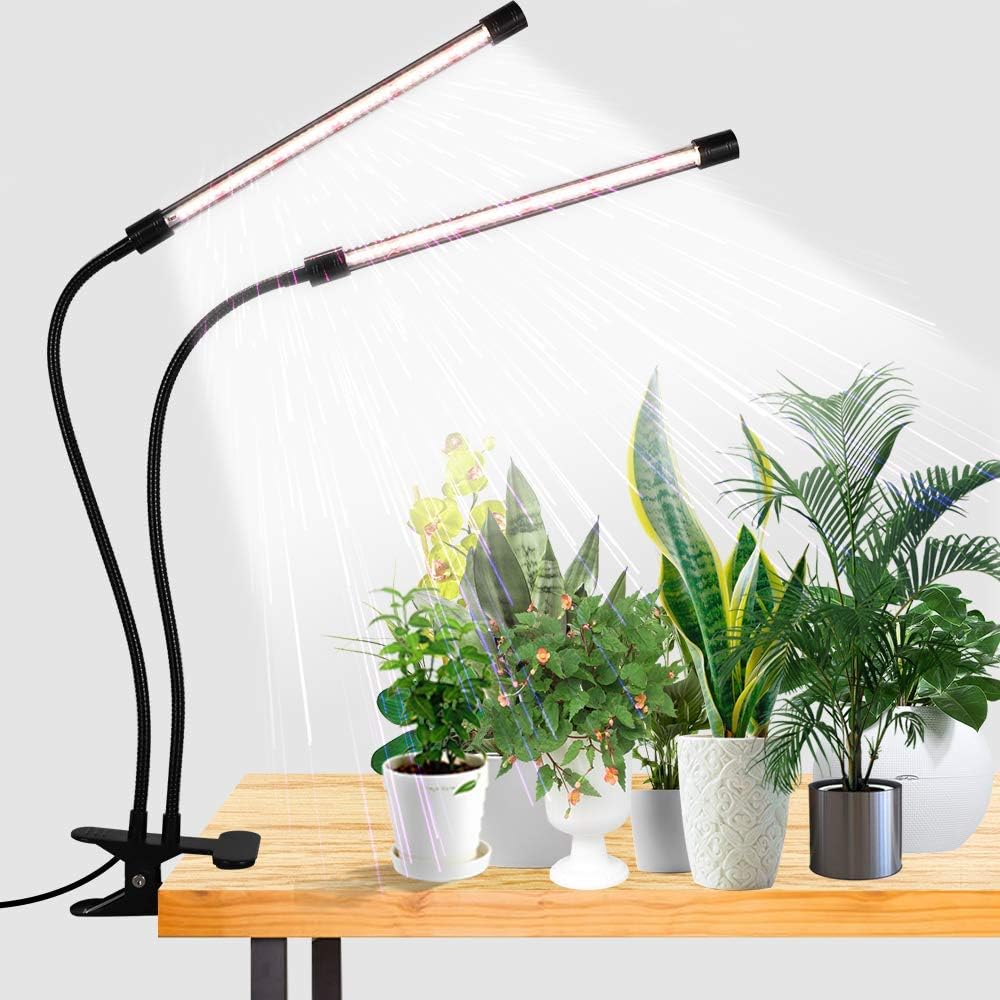
This GooingTop HY-021 is a compact clip-on grow light built for small houseplants, seedlings and shelf gardens. It uses 84 LEDs (white plus deep red) to deliver a 6000K full-spectrum output intended to mimic midday sun, with a high color-rendering output that also makes it pleasant as a reading lamp. Two flexible gooseneck heads and a strong clamp let you aim light precisely over pots and seed trays, while the attached remote provides 50%/100% dim levels and repeating timers at 4, 8 or 12 hours for hands-off scheduling. Practical benefits include low power draw (listed as roughly 10 W LED draw), a claimed 1 to 2 square meter coverage for seedlings, and an included timer that simplifies day/night cycles. Limitations are its design for small setups rather than large grow racks and the clip mounting limits placement compared with freestanding fixtures. The unit also relies on the corded remote instead of a smartphone app and the lifespan claim is typical of LEDs but not independently verifiable from the listing.
Best for: Buyers who want a simple, low-power, plug-and-play grow light to boost seedlings and a few houseplants on a desk or shelf and who value an easy-to-use timer and adjustable brightness.
Less Ideal for: Growers planning multi-shelf installations, larger vegetable grows, or who need networked or app-based control should consider larger bar lights or fixtures designed for commercial racks.
- Full-spectrum 6000K output with added 660 nm red LEDs to support vegetative growth and flowering
- Attached remote with dimming (50%/100%) and repeat timer settings (4/8/12 hours) for easy scheduling
- Flexible dual goosenecks and strong clamp enable precise positioning over small pots and seed trays
- High reported color rendering for comfortable viewing and accurate plant color assessment
- Low electrical draw around 10 W while covering small growing areas
- Clip-mount design and stated 1–2 m² coverage make it better suited to individual plants or small trays rather than large multi-shelf setups
- No smart app or wireless control option; remote is cord-attached which limits placement flexibility
Verdict: A compact, easy-to-use clip grow light that delivers full-spectrum light and convenient timer/dim controls for small indoor plant setups.
Aokrean Halo Full-Spectrum LED Grow Light with Base (3-Pack)

| Light Source Type | LED |
|---|---|
| Number of Light Sources | 48 |
| Wattage | 10 watts |
| Control Method | Touch |
| Power Source | Corded Electric |
This Aokrean Halo grow light is a small, versatile LED solution for indoor plants that offers a lot of convenience in a compact package. Each lamp uses 48 LEDs with a full-spectrum output and three lighting modes plus ten brightness levels, so it can be tuned for seedlings, vegetative growth, or supplemental light for potted houseplants. The lamp can be inserted into soil or mounted on the included base, and the telescoping pole adjusts up to about 26 inches to suit taller pots or change light intensity. Controls are touch-based and include a timer with preset cycles for automated daily on/off. Practical benefits include a neat decorative look, low power draw at 10 watts, and USB/Bluetooth connectivity for modern setups. Limitations are that the base requires the pot to help stabilize the stand and the unit is not water resistant, so it must stay dry and indoors. For balanced buyers looking for adaptable, easy-to-use grow lights for multiple indoor plants, this hits the mark.
Best for: Buyers who want a compact, adjustable grow light that works for seedlings and small to medium houseplants and who value easy controls and automated timers.
Less Ideal for: Growers needing heavy-duty, waterproof fixtures for greenhouse or outdoor use or those who require high-output lighting for large-scale indoor gardens.
- Full-spectrum LED array (48 LEDs) with three lighting modes and 10 brightness levels for flexible plant lighting
- Height-adjustable pole and dual mounting (insert in soil or use the base) to fit a range of pot sizes
- Touch controls with built-in timer options for automatic daily cycles
- Low power consumption (10 watts) and high efficiency for continuous use
- Base stability depends on placing a pot on it so it can be less secure with lighter containers
- Not water resistant so unsuitable for humid or outdoor environments
Verdict: Aokrean's Halo is a space-saving, full-spectrum grow light with adjustable height and timers that makes it easy to give small indoor plants the right light without complex setup.
Choosing the Right LED Grow Light: Key Factors to Consider
Spectrum Quality and Tunability
The light spectrum determines what wavelengths reach your plants and drives photosynthesis and photomorphogenesis. Full-spectrum LEDs that include a mix of blue and red wavelengths support both compact vegetative growth and flowering. Some fixtures add far-red or deep-red diodes to influence flowering triggers and canopy penetration.
Tunability matters when you plan to run different growth stages under the same fixture. A switchable veg/flower mode or dimmable channels lets you emphasize blue light for stocky veg or red for bloom without changing units. For mixed-species racks or layered canopies, the ability to tailor spectrum reduces the need for extra fixtures and can improve uniformity across different plants.
PPFD Distribution and Coverage Area
Photosynthetic photon flux density, or PPFD, measures usable light at canopy level and is the most practical way to estimate whether a fixture will support flowering at a given distance. Look at PPFD maps or manufacturer beam angles to understand how evenly the light spreads across your tent or shelf. A lamp with high center PPFD but steep falloff will create hot spots and weak edges.
Match the light's effective coverage to your grow area rather than relying on stitched-together ratings. Consider mounting height and the plant canopy you expect at full maturity. Fixtures that list both optimal hanging heights and PPFD at those heights make it easier to plan fixture layout and avoid underlit corners.
Energy Efficiency and Operating Costs
Efficiency, measured in micromoles per joule, correlates directly with electrical cost per unit of useful light. Higher efficiency fixtures deliver the same plant-usable photons while drawing less power, which matters over long grow cycles or multiple fixtures.
When shopping under a price cap, aim for fixtures that balance upfront cost and long-term energy use. Also factor in driver type; high-efficiency drivers with proper thermal regulation can extend diodes' useful life and maintain output across seasons, reducing the need for premature replacement.
Thermal Performance and Heat Management
Heat affects plant transpiration, nutrient uptake, and the need for ventilation. A fixture with poor heat dissipation will run hotter, raising canopy temperatures and increasing cooling or exhaust demands. Good LED designs direct heat into heatsinks or include quiet, efficient fans so the unit can deliver rated output without thermal throttling.
Consider your room's existing ventilation and the fixture's placement. Passive-cooled fixtures reduce noise and maintenance but may be limited in maximum output. Active-cooled units can sustain higher photon counts but require fan management and periodic cleaning to avoid dust buildup that impairs cooling.
Fixture Build Quality and Driver Reliability
Solid mechanical construction and a quality driver reduce the risk of electrical faults and premature dimming. Look for robust housings, protected LEDs, and replaceable drivers or serviceable components. Corrosion-resistant materials and sealed electronics are important if your grow space has high humidity.
Driver reliability also affects flicker, dimming smoothness, and the ability to use light controllers or timers. A poorly matched driver can reduce diode lifespan and produce inconsistent output as it ages. For long-term convenience, prioritize units that document driver specs and offer accessible maintenance paths.
Form Factor and Mounting Options
How a fixture mounts and its physical size determine how easily it fits in tents, cabinets, or vertical farms. Slim, linear fixtures can be daisy-chained and arranged in arrays over racks, while single-panel lights are often easier to hang over a central canopy. The actual usable footprint at recommended hang heights is more important than the raw wattage number.
Also check cable length, hanging hardware, and whether the fixture supports daisy-chaining or programmable controllers. These practical details influence installation time, the number of fixtures needed, and how neatly the system integrates into your existing setup.
Matching Fixtures to Grow Space
Calculate your canopy area and decide whether you will prioritize a single high-output panel or multiple smaller fixtures. For small tents or single shelves, a compact panel with concentrated PPFD is often more efficient. For wider benches or multi-tier racks, choose linear bars or multiple panels spaced for even coverage.
Account for mounting height and how much vertical space your plants will need at maturity. If headroom is limited, select fixtures optimized for lower hang heights and check manufacturer PPFD maps for those distances.
- Measure usable canopy in square feet or meters before selecting fixture quantity
- Use PPFD at intended hang height to plan spacing
- Consider linear bars for modular expansion and easier heat distribution
Managing Heat and Ventilation With LEDs
Even efficient LEDs produce heat, and that heat concentrates near the diodes. Plan exhaust and intake to move warm air away from the canopy and the fixtures. Where possible, keep fans and vents at or above canopy level to remove convective heat before it stresses plants.
For tight spaces, passive-cooled fixtures reduce noise and maintenance needs, but active cooling may be necessary for higher-output units. Factor in routine cleaning of fans and heatsinks into maintenance schedules to preserve thermal performance.
- Position intake and exhaust to create gentle airflow over fixtures
- Keep lights at manufacturer-recommended distances to avoid heat buildup
- Clean fan inlets and heatsinks every few months in dusty environments
Estimating Power Needs and Running Costs
Calculate energy use by multiplying fixture wattage by daily runtime and electricity cost. For flowering cycles that run 12 hours per day, small differences in efficiency compound quickly. Use µmol/J ratings when available to compare how much usable light you get per watt.
If you plan multiple fixtures, also size your electrical circuits and check that outlets and cords are rated for continuous loads. Efficient fixtures may require a higher upfront cost but lower monthly operating expenses, which can be preferable under a fixed purchase budget.
- Multiply fixture wattage by hours per day to get daily kWh
- Compare fixtures by µmol/J rather than raw wattage
- Confirm circuit capacity before expanding fixture count
Controls, Timers, and Integration
Simple built-in dimmers or veg/flower switches can replace separate controllers for many growers. If you need advanced scheduling, look for fixtures with daisy-chain control or standard control ports compatible with commercial controllers.
Ease of integration matters when scaling. Lights that support uniform dimming across multiple units reduce complexity when you add panels. Also check whether the fixture retains settings after power loss and whether firmware is user-serviceable for long-term flexibility.
- Prioritize fixtures with reliable dimming and memory for repeated cycles
- Choose standard control protocols if you plan to integrate third-party controllers
- Check cable lengths and connector types for tidy installations
Humidity, Corrosion, and Grow Room Environment
High humidity environments accelerate corrosion and can compromise electronics if fixtures are not adequately sealed. Look for housings and connectors rated for higher humidity or configure your room to reduce prolonged surface condensation on fixtures.
Position fixtures to avoid direct water exposure during foliar sprays and maintain spacing so vents and heatsinks are accessible for inspection. Good environmental management reduces maintenance and extends fixture life.
- Avoid pointing sprinklers or misters directly at fixtures
- Opt for sealed drivers in humid setups
- Inspect for corrosion annually in coastal or humid locations
How We Chose the Best LED Grow Light
We focused on attributes that directly affect plant growth and everyday usability for indoor gardeners shopping under a $500 limit. Criteria included spectral quality and PPFD distribution, which determine how evenly usable light reaches canopy; total photosynthetic photon output and fixture footprint to match tent or bench sizes; energy efficiency measured as micromoles per joule so growers can estimate running costs; thermal management and fan/noise behavior because excess heat forces ventilation upgrades; build durability and driver longevity for multi-season use; and user-friendly controls such as dimming, veg/flower switches, or daisy-chaining. We excluded fixtures clearly aimed at hobby seedlings only or units whose documented output was insufficient for canopy-level flowering in common indoor footprints. We also filtered out lights with unreliable electrical specs or poor safety documentation. The final shortlist balances usable light intensity, spectrum versatility, efficiency, and thermal design to reflect real gardener priorities when spending up to the stated price point.
FAQ
How many watts of LED light do I need per square foot for flowering?
It depends on fixture efficiency and desired PPFD. Rather than raw watts, target a PPFD range appropriate for your crop and growth stage. Use the fixture's µmol/J and wattage to estimate expected canopy PPFD at your hang height.
Can I use a single LED fixture for both veg and flower stages?
Often yes. Many fixtures offer spectrum switches or dimming to shift from blue-dominant veg tones to red-rich bloom spectrums. Ensure the fixture can deliver sufficient PPFD for flowering at your intended hang height and coverage area.
Will LEDs reduce my cooling needs compared with other lamp types?
LEDs are typically more efficient and produce less radiative heat, which lowers total cooling demand. However, high-output LEDs still produce heat that must be managed with ventilation, so plan airflow accordingly.
How high should I hang an LED grow light above the canopy?
Recommended hang height varies by fixture output and beam angle. Check PPFD maps when available. Lower heights increase PPFD but reduce coverage, while higher mounts broaden coverage but lower intensity.
Are warranty and driver replaceability important for LEDs under $500?
Yes. A solid warranty and an accessible driver make it more likely the fixture will remain useful for several seasons. Replaceable drivers reduce the need to discard an otherwise healthy fixture if the electronics fail.
Do I need different lights for seedlings and mature plants?
Seedlings require lower PPFD and often benefit from higher blue ratios to encourage compact growth. Many growers use the same fixture with reduced intensity for seedlings, then raise output as plants mature, which reduces equipment needs.
Final Verdict
Under a $500 cap you can still choose a fixture that offers the spectrum, PPFD, and efficiency needed for productive indoor growing. Prioritize spectrum tunability, verified PPFD coverage for your canopy, and efficiency ratings to balance upfront cost with operating expenses. Consider thermal design and driver reliability to avoid ventilation upgrades and premature failures. With those tradeoffs in mind, match fixture form factor and controls to your space so you get the most consistent light where plants need it.
