

Note: This article contains affiliate links. If you click on these links and make a purchase, I may earn a small commission at no extra cost to you. This helps support my research and content. Read my full affiliate disclosure here.
Picking the right LED grow light matters for plant health, electricity use, and the heat you manage in a small indoor setup. If you need full-cycle light without overspending, the options under $200 can deliver usable spectrum, reasonable PPFD, and manageable heat for seed-to-flower cycles in compact tents and grow cabinets. This guide shortlists the top picks in that price range and explains the practical tradeoffs gardeners face. Below you will find the shortlisted products chosen for real indoor growing conditions, plus clear evaluation criteria like spectrum, output, and thermal behavior to help you decide which light fits your setup.
Top Picks at a Glance
| Best Overall The best all-around choice for most situations | VIPARSPECTRA P1000 100W LED Grow Light (Dimmable, Daisy-Chain) |  |
| Best Value The sweet spot between price and what you get | Spider Farmer SF1000 100W Full Spectrum LED Grow Light |  |
| Best Budget The cheapest option that still gets the job done reliably | Briignite A19 Full Spectrum LED Grow Light Bulb (2-Pack) |  |
| Highest Rated A top-rated pick with lots of positive feedback | Spider Farmer G4500 LED Grow Light 320W (App‑Controlled, Dimmable) |  |
| Most Popular A crowd favorite that many people choose with confidence | GooingTop HY-021 6000K Full-Spectrum Clip Grow Light |  |
| Best Seller A high-volume bestseller chosen again and again | SANSI Full-Spectrum LED Grow Light with Replaceable Bulbs |  |
VIPARSPECTRA P1000 100W LED Grow Light (Dimmable, Daisy-Chain)

| Light Source Type | LED |
|---|---|
| Wattage | 100 watts |
| Color Temperature | 4000 Kelvin |
| Light Source Special Features | Daisy Chain, Dimmable |
| Number of Light Sources | 216 |
The VIPARSPECTRA P1000 is a compact 100W LED grow light intended for seed starting and small grow spaces. It delivers a tailored full spectrum including red, white, and far-red diodes and uses an updated diode layout and aluminum heat sinks for cooler, quieter operation. Typical use is hung above trays or a small tent where its manufacturer-stated coverage fits a roughly 2.5 x 2.5 foot veg area and a smaller flowering footprint at closer hang heights. The built-in dimmer knob lets you fine-tune intensity for delicate seedlings or stronger vegetative light without additional controllers, and the daisy-chain feature supports linking multiple units for expanding bench or vertical setups. Practical benefits include low energy draw compared with older HPS/MH fixtures, a fanless design that reduces noise and maintenance, and a straightforward plug-and-play setup with hangers included. Limitations are its modest single-unit coverage for larger beds and reliance on the supplied dimmer rather than a programmable controller for advanced light schedules and automation.
Best for: Growers who prioritize strong PAR output and energy efficiency for starting seeds and running compact veg cycles and who want a straightforward, tweakable fixture they can scale by adding more units.
Less Ideal for: Gardeners who need wide single-fixture coverage for large grow rooms or who require integrated programmable controls and advanced automation features.
- Full-spectrum diode mix (including 660nm and 730nm) suitable for seedling through bloom stages
- 100W power with low energy consumption compared with equivalent HPS/MH setups
- Dimmable knob for easy intensity control during seed starting and vegetative growth
- Daisy-chainable so multiple fixtures can be linked for larger or vertical setups
- Fanless aluminum heatsink design for quiet, low-maintenance operation
- Coverage is limited per unit so multiple lights are needed for larger trays or tents
- No built-in programmable timer or remote control for automated schedules
Verdict: A compact, energy-efficient 100W full-spectrum grow light that offers precise dimming and daisy-chaining for performance-focused seed starting and small veg setups.
Spider Farmer SF1000 100W Full Spectrum LED Grow Light

| Light Source Type | LED |
|---|---|
| Light Output Maximum | 10000 lumens |
| Light Source Wattage | 100 watts |
| Light Source Special Features | Dimmable |
| Specification Met | IP67 |
The Spider Farmer SF1000 is a compact 100W full spectrum LED grow light intended for 2×2 to 3×3 grow spaces and small tents. It uses a high diode count and upgraded LED chips to deliver broad-spectrum output that supports seedlings through flowering, with a dimmer knob to reduce intensity for early stages and ramp up for bloom. The fanless design and thick aluminum heatsink keep operation quiet while providing passive cooling, and the fixture meets IP67 for durable performance. Typical use is ceiling or tent mounting above individual plants or a small canopy where uniform coverage and deeper canopy penetration matter. Notable features include daisy-chain compatibility for linking multiple units under unified dimming, a 0–100% dimmable control, and a driver claimed to offer efficient power delivery. Practical benefits are even light distribution in a small footprint, predictable veg-to-flower capability, and near-silent operation. Limitations are inherent to its class: it is sized for small areas so you will need multiple units for larger tents, and the product description emphasizes specs from manufacturer tests rather than independent third-party PPFD maps.
Best for: Growers who want a quiet, compact full spectrum light for a small tent or single-plant setup and value adjustable intensity for each growth stage.
Less Ideal for: People running larger multi-plant rooms or commercial operations who need higher total output and broader single-fixture coverage.
- Full spectrum output suitable for all growth stages with added red and IR for flowering
- Dimmable 0–100% control lets you tailor light intensity to seedlings, veg, and bloom
- Fanless design with sturdy aluminum heatsink for quiet, low-maintenance operation
- Compact footprint ideal for 2×2 to 3×3 tents and small indoor setups
- Daisy-chain capable so multiple fixtures can be linked and dimmed together
- Coverage and power are intended for small grows so larger areas require multiple units
- Manufacturer gives efficiency and coverage figures without independent third-party PPFD charts
Verdict: A quiet, dimmable 100W full spectrum fixture that is a practical, balanced choice for hobbyists running 2×2 to 3×3 tents.
Briignite A19 Full Spectrum LED Grow Light Bulb (2-Pack)

| Light Type | LED |
|---|---|
| Additional Features | Full Spectrum |
| Bulb Base | E26 |
| Light Output Maximum | 1000 lumens |
| Light Source Operating Life | 30000 hours |
These Briignite A19 grow bulbs are full-spectrum LED replacements that screw into any standard E26 fixture to give indoor plants consistent, natural-looking light. Each bulb outputs about 1000 lumens at roughly 11 to 12 watts, so they act like a 60 to 100 watt incandescent while using far less energy, which is handy for running multiple bulbs on a budget. The 3500–4000K warm daylight color and high CRI make foliage colors appear normal rather than the purple hue of some grow lights, so they work well in living spaces and plant shelves. Built-in features include app control and push-button options and an advertised 25,000 to 30,000 hour operating life. Limitations to note are modest reported PPF compared with purpose-built high‑output grow fixtures and the 180 degree beam, which is better for general room lighting than targeted canopy penetration for dense or tall plants. For small collections, seed starting, or supplementing light in low-light rooms these bulbs are an economical, easy-to-install choice.
Best for: Houseplant owners who need an affordable, plug-and-play light to supplement natural light for a few pots, seedlings, or a small indoor garden while keeping energy costs low.
Less Ideal for: Growers aiming to flower large or dense canopy crops or outfitting multi-tiered grow racks will want higher‑PPF, purpose-built fixtures instead.
- Full spectrum output that looks like natural white light and preserves true foliage color
- Low power draw (around 11–12W) with 1000 lumens brightness for energy-efficient continuous use
- Standard E26 base fits common fixtures for tool-free installation
- High CRI of 90 helps accurate color rendering in living spaces
- Beam angle and lumen-focused design give less concentrated PAR/PPF than dedicated high‑output grow fixtures
- App and push-button controls are basic compared with advanced programmable controllers
Verdict: A low-cost, easy-to-install full-spectrum LED bulb that gives natural-looking light and energy savings for small indoor plant collections.
Spider Farmer G4500 LED Grow Light 320W (App‑Controlled, Dimmable)

| Light Source Type | LED |
|---|---|
| Wattage | 320 watts |
| Light Source Special Features | Dimmable, App-Controlled, Daisy-Chain Function |
| Power Source | Corded Electric |
The Spider Farmer G4500 is a high-efficiency LED grow light built for full-cycle indoor growing in small commercial or serious hobby setups. It delivers 320 watts using high-density Bridgelux diodes and a long bar design that spreads light more evenly across the canopy, making it suited to 2×4 and up to 3×5 coverage areas. The fixture is dimmable from 10 to 100 percent, supports daisy-chaining up to 50 units for synchronized control, and connects to the Spider Farmer app for scheduling and remote brightness adjustments. Practical benefits include strong PPE (listed at 2.85 umol/J in the G series data), low heat output from efficient diodes, and an aluminum housing that helps with passive cooling. The light is aimed at growers who prioritize uniform penetration and programmable control rather than novelty extras. Limitations are typical of high-output fixtures: you will need appropriate ventilation and mounting height to avoid light stress, and the elongated bar requires enough horizontal space in the tent or room. Assembly is not required but plan for cable management and app setup time.
Best for: Growers who want strong, uniform light and programmable control for full-cycle performance in a 2×4 to 3×5 tent or small grow room and who prioritize output and efficiency over minimal footprint.
Less Ideal for: Casual plant owners with a single small shelf or tabletop setup who need a compact, low-intensity lamp rather than a high-output grow fixture.
- High-efficiency Bridgelux diodes with reported PPE of 2.85 umol/J for strong light output per watt
- Elongated bar design for more uniform edge-to-edge canopy coverage over 2×4 to 3×5 areas
- Dimmable 10–100% plus daisy-chain support for synchronized control of multiple units
- App control with scheduling, remote dimming, and sunrise/sunset simulation for hands-off management
- Aluminum housing that helps dissipate heat and supports continuous operation
- Requires adequate ventilation and mounting height to manage intensity and heat in small enclosures
- Large footprint compared with compact panels, so it needs enough horizontal space in the grow area
Verdict: Buy this if you need a high-efficiency, app-controlled LED that delivers uniform, high-output coverage for performance-focused 2×4 to 3×5 indoor grows.
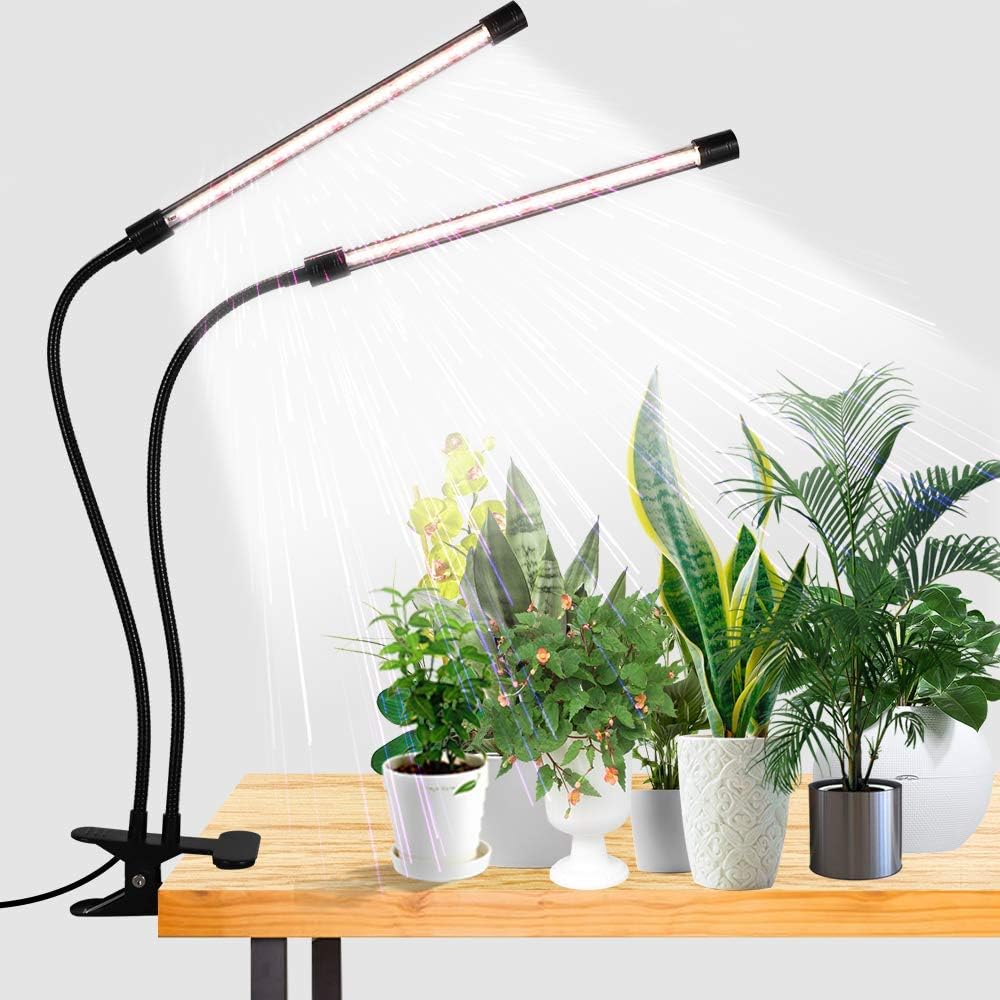
GooingTop HY-021 6000K Full-Spectrum Clip Grow Light
| Power Source | Corded Electric |
|---|---|
| Color Temperature | 6000 Kelvin |
| Light Output Maximum | 2500 lumens |
| Light Source Special Features | Dimmable |
| Number of Light Sources | 84 |
This GooingTop HY-021 is a compact clip-on grow light built for small houseplants, seedlings and shelf gardens. It uses 84 LEDs (white plus deep red) to deliver a 6000K full-spectrum output intended to mimic midday sun, with a high color-rendering output that also makes it pleasant as a reading lamp. Two flexible gooseneck heads and a strong clamp let you aim light precisely over pots and seed trays, while the attached remote provides 50%/100% dim levels and repeating timers at 4, 8 or 12 hours for hands-off scheduling. Practical benefits include low power draw (listed as roughly 10 W LED draw), a claimed 1 to 2 square meter coverage for seedlings, and an included timer that simplifies day/night cycles. Limitations are its design for small setups rather than large grow racks and the clip mounting limits placement compared with freestanding fixtures. The unit also relies on the corded remote instead of a smartphone app and the lifespan claim is typical of LEDs but not independently verifiable from the listing.
Best for: Buyers who want a simple, low-power, plug-and-play grow light to boost seedlings and a few houseplants on a desk or shelf and who value an easy-to-use timer and adjustable brightness.
Less Ideal for: Growers planning multi-shelf installations, larger vegetable grows, or who need networked or app-based control should consider larger bar lights or fixtures designed for commercial racks.
- Full-spectrum 6000K output with added 660 nm red LEDs to support vegetative growth and flowering
- Attached remote with dimming (50%/100%) and repeat timer settings (4/8/12 hours) for easy scheduling
- Flexible dual goosenecks and strong clamp enable precise positioning over small pots and seed trays
- High reported color rendering for comfortable viewing and accurate plant color assessment
- Low electrical draw around 10 W while covering small growing areas
- Clip-mount design and stated 1–2 m² coverage make it better suited to individual plants or small trays rather than large multi-shelf setups
- No smart app or wireless control option; remote is cord-attached which limits placement flexibility
Verdict: A compact, easy-to-use clip grow light that delivers full-spectrum light and convenient timer/dim controls for small indoor plant setups.
SANSI Full-Spectrum LED Grow Light with Replaceable Bulbs

| Spectrum | 380nm–800nm full spectrum |
|---|---|
| Luminous output | 2000 lm |
| Power consumption | 20W |
| Timer | Auto on/off 4/8/12 hrs |
The SANSI full-spectrum LED grow light is designed to provide sunlight-like illumination for indoor plants across all growth stages. It emits light from 380nm to 800nm with a high-lumen white LED output rated at 2000 lm while drawing about 20W, making it suitable for desktop, plant stand, or hanging setups. Notable features include a 3-option auto on/off timer (4, 8, 12 hours on a 24-hour cycle), ETL listing for safety, and user-replaceable bulbs with a lifetime free replacement policy for the bulb. In practice the lower wattage and high PAR claim mean it can boost photosynthesis for herbs, succulents, orchids, and small fruiting plants without large energy usage. The replaceable-bulb design reduces the need to replace the entire fixture if a diode fails, but the product requires attention to the stated 10W per head maximum safety rating when swapping bulbs. This light is straightforward to set up and convenient for someone who wants reliable, energy-efficient supplemental lighting with simple timer control and reassuring safety certifications.
Best for: Buyers who want a dependable, low-energy grow light for small indoor setups and prefer safety-certified products with simple timer controls and serviceable parts.
Less Ideal for: Growers needing high-intensity lighting for large plant racks, commercial seedlings, or tall canopies should consider higher-output fixtures designed for larger areas.
- Full spectrum 380–800nm output supports all growth stages
- Energy-efficient 20W draw with high 2000 lm output
- Built-in 4/8/12-hour auto on/off timer for simple scheduling
- Replaceable bulbs with lifetime free replacement for the bulb
- ETL listed for safety and quality verification
- Maximum safe wattage limit of 10W per head restricts bulb choices
- Not intended for large-scale or high-canopy setups due to modest total output
Verdict: A compact, safety-certified full-spectrum LED that delivers efficient supplemental light and easy scheduling for small indoor plant setups.
Choosing the Right LED Grow Light: Key Factors to Consider
Spectrum and Plant Needs
Spectrum determines how plants use light for photosynthesis, development, and flowering. Full-spectrum fixtures that include blue and red peaks plus a broad white component tend to work across growth stages without the need to swap fixtures. For vegetative growth, blue light helps compact, leafy structure, while red and far-red encourage stretch and flowering. If a light lists only narrow-band red and blue diodes, expect tradeoffs such as weaker leaf color rendering and potential delays in certain growth behaviors.
When shopping under a price cap, check whether the manufacturer provides a spectrum chart or lists peak wavelengths. Lack of that information is a red flag for growers who want predictable results.
Canopy PPFD and Coverage
PPFD, measured in micromoles per square meter per second, indicates how much usable light actually reaches the plant canopy. A fixture with a high listed wattage but poor optics can deliver spotty coverage and low usable light at common hanging heights. Consider how large your intended footprint is and whether the light's stated PPFD or coverage map matches that footprint at 12 to 24 inches above the canopy.
In smaller tents, a single efficient panel can be enough; for wider benches you may need multiple units. Also factor in that PPFD decreases quickly with distance from the diodes, so mounting height and light distribution matter as much as raw power.
Energy Draw and Long-Term Running Cost
Initial purchase price is only part of the cost. Energy draw determines operating expense and how much heat the lights introduce into your space. Under a budget constraint, prioritize fixtures with higher photosynthetic photon efficacy (PPE) or reasonable lumens per watt equivalents. A slightly more efficient unit can save real dollars over a grow cycle, especially under continuous veg or long flower periods.
Look for clear statements on actual power draw rather than nominal 'equivalent' wattage. Fans and drivers also consume power, so factor those into the expected running load.
Thermal Management and Noise
LEDs are efficient but still produce heat that needs to be moved away from the fixtures and canopy. Good thermal design uses large heat sinks, passive fins, or quiet, reliable fans to keep junction temperatures low. Poor cooling reduces diode lifespan and can raise canopy temperature, forcing you to increase ventilation and raise overall energy use.
Also consider fan noise if your grow space is near living areas. Passive-cooled units tend to be silent but may be bulkier. Verify whether fans are user-replaceable and if the fixture includes temperature-based control to slow fans under lighter loads.
Form Factor and Mounting Options
Size and shape affect how the light fits into tents, shelves, or cabinets. Slim panels and bar-style fixtures are easier to hang in tight spaces, while boxy units may need more clearance for airflow. Check mounting points, included hanging kits, or built-in hangers and whether the fixture allows daisy-chaining multiple units for larger footprints.
Also think about serviceability: a fixture that can be opened for driver replacement or has modular LED arrays can extend usable life compared with sealed designs.
Durability and Electronics
Driver quality, soldering, and board protection influence how long a light will last under continuous schedules. Look for features such as constant-current drivers, surge protection, and IP ratings if you plan to work in humid environments. Poorly protected electronics are more vulnerable to humidity and temperature swings common in grow tents.
Warranty terms and the clarity of technical specs help indicate manufacturer confidence. Even on a budget, choose fixtures with documented driver specs and reasonable assurances of support.
Sizing Lights to Tent Footprints
Match a light's coverage map and PPFD numbers to your tent or shelf dimensions rather than relying on nominal wattage. For example, a panel that lists uniform coverage at 2 x 2 feet will behave differently once raised or lowered, so plan for adjustable hanging heights.
If you need full-cycle performance in a small tent, prioritize even distribution over peak output. Multiple smaller panels can often create a more uniform canopy than a single concentrated fixture.
- Measure your active canopy area rather than the physical tent size.
- Account for edge falloff when positioning lights.
- Plan hanging points that allow height adjustment as plants grow.
Heat and Ventilation Strategies
Consider the combined heat load from lights and other equipment. If a fixture runs hot, increase inline ventilation or use a temperature-controlled exhaust to protect the canopy. Passive-cooled fixtures reduce fan maintenance but might still raise ambient temperature in enclosed spaces.
A modest increase in airflow often yields bigger benefits than cutting light time. Manage humidity as well, because higher temperatures can change transpiration and pest vulnerability.
- Place intake and exhaust to draw heat away from the canopy directly.
- Monitor both canopy and room temperatures, not just air temperature at a single point.
Dimming, Sun-Mimic Cycles, and Control
Dimming capability helps tune intensity for seedlings, clones, vegetative growth, and flower without changing distance. Some fixtures include built-in dimmers or programmable controllers to simulate dawn and dusk, which reduces transplant shock and can improve growth rhythms.
Consider whether the light can daisy-chain or integrate with external timers and environmental controllers. Built-in controls reduce setup complexity but be mindful of proprietary connectors that limit compatibility.
- Use dimming to avoid light stress on young plants.
- Prefer standard connectors for easier automation and replacement.
Common Mistakes to Avoid
Buyers often equate higher watt claims with better performance. Without PAR or PPFD data, those claims are meaningless for plant growth. Also avoid fixtures that only advertise 'equivalent' wattages to older technologies without clarifying true power draw and spectrum.
Another common error is ignoring heat management and assuming small enclosures will disperse heat on their own. Combine realistic thermal planning with your fixture choice to prevent heat stress and shortened component life.
- Demand PAR/PPFD or spectrum charts before assuming suitability.
- Plan ventilation as part of the lighting purchase, not an afterthought.
Setting Up for Seedlings to Flower
Start seedlings under lower intensity and gradually increase PPFD as they mature. Use a wider spectral mix during veg for compact growth and then maintain full spectrum with increased red proportion during flower if needed. Hanging height and dimming are the simplest levers to adjust without swapping fixtures.
Rotate or reposition fixtures if you notice uneven stretch or leaf orientation. Good initial placement and small height adjustments over days can prevent large corrective moves later in the cycle.
- Keep seedlings cooler and dimmer than mature plants.
- Raise light gradually to prevent stretch while maintaining canopy density.
How We Chose the Best LED Grow Light
We focused on practical, measurable factors that matter in small-scale indoor growing. Key evaluation criteria included light spectrum and PAR distribution, measured power draw and estimated running cost, actual canopy PPFD or usable output at typical hang heights, thermal management and fan noise under continuous operation, build quality and driver reliability, and ease of mounting and size for common tent footprints. We examined manufacturer specifications for spectrum charts and PAR numbers, verified power draw against listed wattages, and checked reported heat output and cooling design. We prioritized lights that provide usable output across vegetative and flowering phases rather than narrow-spectrum units specialized only for one stage. Units were excluded if they lacked clear PAR or spectrum data, used unlisted or primitive driver electronics, or were only suitable for commercial racks rather than home tents and cabinets. The resulting shortlist favors lights that balance usable light, low running cost, and manageable heat for growers on a budget.
FAQ
How high should I hang an LED Grow Light in a small tent?
Height depends on fixture output and canopy sensitivity. Many panels work well 12 to 24 inches above canopy for vegetative growth; dim or raise for seedlings. Consult the manufacturer's PPFD map and start higher, lowering gradually while watching for light stress.
Will a cheaper LED under $200 run my plants through flowering?
Often yes, but it depends on output and spectrum. Some budget fixtures provide sufficient PPFD and a usable spectrum for small flowering crops. Check for full-spectrum coverage and adequate PPFD at your intended hanging height before committing.
Do LED grow lights save money compared with older technologies?
LEDs typically draw less power for similar usable light, so they reduce electricity costs and heat load. Savings depend on efficacy of the fixture and your grow schedule. Compare actual power draw and PPE figures rather than nominal wattage for a clearer estimate.
Is active fan cooling necessary for indoor LED lights?
Not always. Passive-cooled units can be effective if they have large heat sinks and your ambient temperatures are controlled. Active fans improve cooling in compact fixtures but add noise and a small power draw. Consider the grow space and noise tolerance when choosing.
How important is a spectrum chart when choosing a light?
Very important. A spectrum chart shows whether the fixture supplies blue for veg and red for flower alongside a usable white component. Without it, you cannot judge how the light will influence plant morphology and flowering responses.
Can I use multiple small fixtures instead of one large unit?
Yes. Multiple smaller panels often give more uniform coverage and easier placement across shelves or benches. They also allow you to scale and replace a single unit if needed without redoing the entire setup.
Final Verdict
When shopping for an LED grow light under $200, prioritize usable spectrum, verified canopy PPFD, and efficient thermal design over headline wattage claims. Decide first on the footprint you need to light and then choose a fixture that delivers even coverage and acceptable energy draw for your schedule. Balance tradeoffs between passive cooling and compactness, and favor clear driver specifications and mounting options. With those priorities, you can confidently pick a light that supports seedlings through flower in small tents or cabinets while keeping operating costs and heat manageable.
