

Note: This article contains affiliate links. If you click on these links and make a purchase, I may earn a small commission at no extra cost to you. This helps support my research and content. Read my full affiliate disclosure here.
If you grow plants indoors, the right LED grow light with UV can influence flowering, terpene development, and pest resilience. You want a fixture that delivers usable UV in a controlled dose without adding excessive heat or energy cost. This guide shortlists the top picks for indoor gardeners looking specifically for UV-enhanced LED lighting. Each choice was vetted for spectrum control, energy efficiency, heat management, and build durability to fit common grow tents, shelves, and small rooms. Read on for practical notes on how UV affects plants and which product features matter most.
Top Picks at a Glance
| Best Overall The best all-around choice for most situations | SAYHON SH1200 Dimmable Full Spectrum LED Grow Light with UV & IR |  |
| Best Quality Built to a higher standard if you want something more solid | AGLEX M400 420W Full-Spectrum LED Grow Light with UV & IR, Dimmable, Daisy-Chain |  |
| Best Value The sweet spot between price and what you get | AC Infinity IONBEAM U2 UV LED Grow Light Bars (2-Pack) |  |
| Best Budget The cheapest option that still gets the job done reliably | Juhefa 12×4.7 inch Full-Spectrum LED Grow Light Panel (25W) with IR & UV |  |
| Highest Rated A top-rated pick with lots of positive feedback | Vegelumax VGT300 300W Full-Spectrum LED Grow Light with UV and IR |  |
| Most Popular A crowd favorite that many people choose with confidence | Uallhome 2-Pack Full-Spectrum LED Grow Light Panels (200W, Remote, Plug-In) |  |
SAYHON SH1200 Dimmable Full Spectrum LED Grow Light with UV & IR

| Wattage | 110 watts |
|---|---|
| Light Source Type | LED |
| Dimmable | 5% – 100% adjustable |
| Voltage | 110 volts_of_alternating_current |
The SAYHON SH1200 is a compact full-spectrum LED designed for single-unit coverage in small indoor grow setups. It supplies a broad spectrum including deep red 660nm, white LEDs (2700K and 5000K), plus a separate UV (UVA 390nm) and IR (730nm) supplement bar that you can switch independently to influence flowering and crop quality. The unit is fanless with an aluminum heat sink for passive cooling, claims high energy efficiency (about 2.7 µmol/J) and offers a 5 to 100 percent dimming range to match seedlings through flower. Typical use is hanging over a 2.5–3 x 3 ft area for veg and smaller footprint in flower, or grouping multiple units for larger tents. Practical benefits include quiet operation, low maintenance, and flexible spectrum control for growers who want to tune light without extra fixtures. Important limitations are the single-unit coverage size, meaning multiple fixtures will be necessary for larger gardens, and the dimmer cannot fully switch the unit off. The build is aluminum and intended for indoor mounting only.
Best for: Growers who want a quiet, energy-efficient single fixture with adjustable spectrum and UVA/IR control for small tents or individual plants and who value flexible tuning over raw coverage.
Less Ideal for: Large canopy growers who need wide single-fixture coverage or anyone who wants an integrated on/off dimmer function that fully powers down the lamp.
- Full spectrum including dedicated UVA and IR bars for spectrum tuning
- Dimmable from 5% to 100% to suit all growth stages
- Fanless aluminum heat sink for silent, low-maintenance cooling
- High reported efficacy (~2.7 µmol/J) for efficient light output
- Designed for small coverage areas so multiple units are needed for larger grows
- Dimmer cannot fully turn the unit off
Verdict: Choose the SH1200 if you need a quiet, energy-efficient full-spectrum grow light with separate UV and IR controls for precise tuning in a small indoor space.
AGLEX M400 420W Full-Spectrum LED Grow Light with UV & IR, Dimmable, Daisy-Chain

| Wattage | 420 watts |
|---|---|
| Number of LEDs | 1360 LEDs |
| Max Coverage | 4×5 FT |
| Voltage | 110–277V |
| Dimmable | Yes |
The AGLEX M400 is a high-power, bar-style LED grow light built to deliver strong PPFD across a 4×5 ft canopy while staying energy efficient. It combines a true full spectrum including 405nm UV and 730nm IR plus red and blue diodes to support seedlings, vegetative growth and flowering. The unit is dimmable from 0 to 100% and features a daisy-chain port so multiple fixtures can be linked and controlled together for commercial racks or multi-light tents. Its aluminum, fanless design promises quiet operation and faster passive heat dissipation, and the package includes adjustable rope hangers and a waterproof driver for safer installation. Practical benefits are high light output comparable to much larger HPS systems at roughly half the power draw and straightforward expandability for larger grows. Important limitations are the unit's 420W power draw which requires appropriate electrical planning and the lack of active cooling which may need extra space for ventilation in very dense setups.
Best for: Growers focused on maximizing yield and light performance who need a scalable fixture for tents, racks, or small commercial spaces and prioritize output and spectral completeness.
Less Ideal for: Casual hobbyists who need a low-watt, plug-and-play lamp for a single small pot or growers constrained to limited electrical capacity or tight, unventilated closets.
- Full-spectrum output including UV and IR to support all growth stages
- High PPFD and 420W output that rivals larger HPS systems while using less energy
- Dimmable 0–100% control and daisy-chain connection for scalable installations
- Fanless aluminum housing for quiet operation and passive heat dissipation
- Includes mounting hardware and a waterproof driver for easy setup
- Higher power draw requires suitable electrical supply and planning
- No active fan means ambient ventilation may be needed in very compact or poorly ventilated spaces
Verdict: Buy this if you want a high-output, full-spectrum LED with UV/IR and daisy-chain scalability for performance-driven indoor grows.
AC Infinity IONBEAM U2 UV LED Grow Light Bars (2-Pack)

| Light Source Type | led |
|---|---|
| Light Source Special Features | Dimmable, Scheduled Programming |
| Number of Light Sources | 24 |
| Wattage | 10 watts |
| Power Source | Corded Electric |
The AC Infinity IONBEAM U2 is a 2-pack of compact UV LED bars intended to supplement primary grow lights by adding targeted UVA wavelengths (365 nm and 395 nm). They attach magnetically or by mounting hardware and are controlled through the included digital controller that offers ten intensity levels and daily scheduling, so you can automate short UV cycles during flowering or fruiting without manual intervention. Built from aluminum with an IP65 rating across the series, these bars are designed for indoor grow tents and offer focused UV coverage to help elicit stronger pigment and resin responses in plants. Practical benefits include small form factor for tight spaces, clear scheduling and dimming that make tuning exposure simple, and magnetic mounting for fast repositioning. Important limitations are that these are supplemental UV-only bars so they will not replace a full-spectrum primary light and coverage is limited by the short 11-inch length, requiring multiple bars for larger tents.
Best for: Growers who want to precisely add controlled UV exposure to boost flowering or resin production and prefer automated scheduling and compact fixtures for tent setups.
Less Ideal for: People looking for an all-in-one full-spectrum grow light or those with large canopy areas who need broad coverage from a single fixture.
- Targeted UVA wavelengths (365 nm and 395 nm) aimed at enhancing flowering and fruit expression
- Included digital controller with 10 intensity levels and daily scheduling for automated UV cycles
- Magnetic mounting for quick placement and repositioning inside grow tents
- Aluminum construction suited for indoor grow environments
- Designed only as supplemental UV lighting and not a full-spectrum primary fixture
- Short 11-inch bars provide limited coverage so multiple units are needed for larger grows
Verdict: A compact, schedule-capable UV supplement that makes adding controlled UVA exposure to tent grows simple and repeatable.
Juhefa 12×4.7 inch Full-Spectrum LED Grow Light Panel (25W) with IR & UV

| Light Source Type | LED |
|---|---|
| Wattage | 25 watts |
| Number of Light Sources | 75 |
| Light Source Special Features | UV and IR LEDs |
| Color Temperature | 6000 Kelvin |
This Juhefa grow light is a compact, plug-and-play panel built for small indoor setups and seedlings. It houses 75 LEDs in a mixed spectrum (red, blue, white plus a few UV and IR diodes) and draws 25 watts, so it provides targeted light without a large electricity bill. Typical use is as a hanging or tabletop supplemental light for microgreens, herbs, succulents, and potted seedlings where natural light is weak. The included hanging kit and simple corded power make installation easy, and the plastic/ABS body keeps the unit lightweight while offering basic heat dissipation. The small number of UV and IR LEDs is useful for fuller-spectrum exposure but they are intentionally dim and not a substitute for dedicated UV treatments. Expect good efficiency for vegetative growth and early-stage plants, but limited coverage area for larger plant collections or dense flowering canopies. If you need a compact, low-power panel to boost light for a few pots, this model is convenient and economical; growers needing wide-area or high-intensity bloom lighting should choose a larger fixture.
Best for: Practical home growers who want an inexpensive, low-energy supplemental light for a few seedlings, herbs, or succulents and prioritize easy setup and low running costs.
Less Ideal for: Enthusiasts running large trays, multiple flowering plants, or full grow tents who need high PPFD and broad coverage should look at larger, higher-output fixtures.
- Full-spectrum LED mix (red, blue, white plus IR and UV) gives balanced light for seedlings and vegetative growth
- Low power draw at 25W for energy-efficient supplemental lighting
- Compact panel and included hanging kit make setup quick and space-efficient
- Plastic/ABS body with basic heat dissipation keeps the unit lightweight and easy to handle
- Small number of UV and IR LEDs are dim and provide only minimal UV/IR exposure
- Limited coverage area makes it unsuitable as the sole light for larger or multiple plants
Verdict: A wallet-friendly, energy-efficient small grow panel that adds full-spectrum light and modest UV/IR boost for seedlings and a few indoor plants.
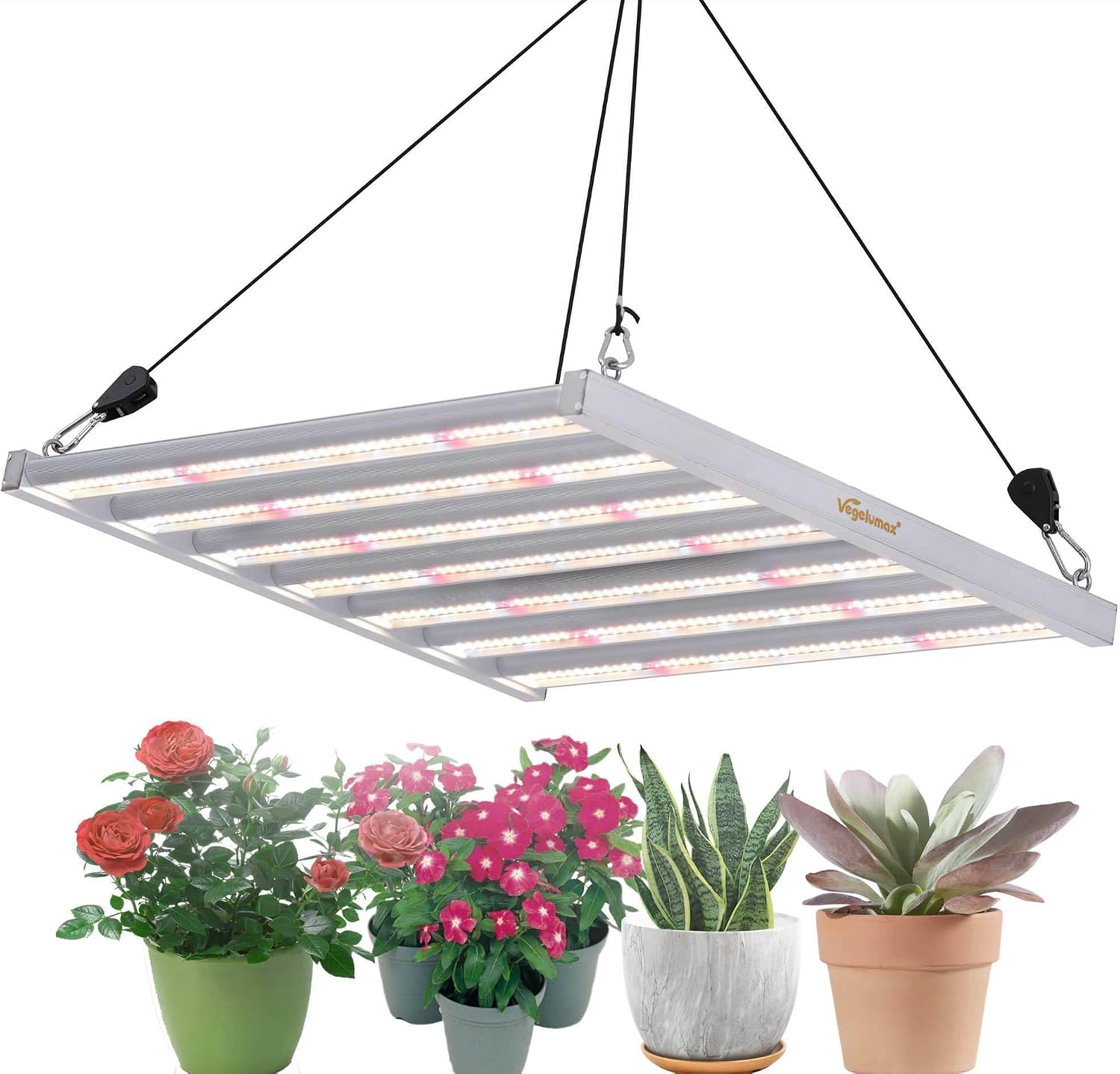
Vegelumax VGT300 300W Full-Spectrum LED Grow Light with UV and IR
| Wattage | 300 watts |
|---|---|
| Number of Light Sources | 300 |
| Is Waterproof | True |
| Control Method | Touch |
| Mounting Type | Hanging |
The Vegelumax VGT300 is a 300W multi-bar LED grow light aimed at indoor growers who want a true full spectrum including UV and IR. It installs as a hanging fixture and is typically used over tents or benches for seedling, veg and bloom stages. The lamp packs 1092 diodes across seven aluminum bars for improved heat dissipation and includes a dimming knob to tune output from 10 to 100 percent for different plant stages. Notable features are the included UV (360–450nm) and IR (760nm) diodes alongside warm white, blue and red LEDs, an IP67 rating for moisture resistance, and an isolated driver for safer operation. In practice that means flexible intensity control, spectrum components that support coloration, node spacing and flowering control, and a design intended to run cooler and quieter without fans. Limitations are that coverage claims depend on hanging height and tent reflectivity and the unit is relatively heavy compared with slim single-bar fixtures, which may affect mounting choices.
Best for: Growers who prioritize a reliable, full-spectrum fixture that can be adjusted across growth stages and will be used in indoor tents or small commercial racks where uptime and spectrum completeness matter.
Less Ideal for: People needing a lightweight, portable clip-on or single-plant lamp or growers who require exact PAR maps and detailed manufacturer distance/coverage charts.
- True full spectrum with UV and IR diodes to support pigmentation, flowering and stem development.
- Dimmable driver (10–100%) lets you match intensity to seedlings, veg and bloom stages.
- Seven-bar aluminum design improves heat dissipation for lower operating temperatures and quiet use.
- IP67 water resistance and an isolated driver increase safety in humid indoor grows.
- Actual effective coverage depends on hanging height and grow-room reflectivity which are not specified.
- Relatively heavy unit may require sturdy hanging hardware or ceiling anchors.
Verdict: Choose the VGT300 when you want a robust, dimmable full-spectrum LED with built-in UV and IR for dependable indoor flowering and veg performance.
Uallhome 2-Pack Full-Spectrum LED Grow Light Panels (200W, Remote, Plug-In)

| Wattage | 200 watts |
|---|---|
| Light Source Type | LED |
| Control Method | Remote |
| Power Source | Corded Electric |
| Indoor Outdoor Usage | Indoor |
These Uallhome panels are a 2-pack of full-spectrum LED grow lights meant to supplement or run a small indoor garden. Each panel produces a mix of UV, blue, red and IR diodes aimed at supporting all growth stages; the listing and manual include recommended hanging heights and daily hours for seedlings, herbs and foliage. The fixtures are fanless and aluminum-bodied, so they run relatively cool and quiet and can be placed nearer plants without excessive heat stress. They are plug-and-play with a 6 ft cord, remote control and a supplied hanging kit for simple installation in a tent or room. Practical strengths are energy efficiency and compactness, which make them useful as primary lights for small 2×2 to 4×4 areas or as supplemental side panels in larger tents. Important limitations are that the unit is not rated waterproof and the warranty listed is short, so protect the fixture from moisture and check longevity expectations for heavier commercial use. Coverage and intensity will depend on mounting height and may require using both panels for uniform lighting over larger benches.
Best for: Buyers who want an easy-to-install, low-noise full-spectrum solution for a small indoor garden or as supplemental lighting in a grow tent and who value energy efficiency and compact fixtures.
Less Ideal for: Commercial growers or anyone needing IP-rated, wet-location fixtures or long factory warranties should consider more robust, purpose-built horticultural fixtures.
- Full-spectrum array including UV and IR to support seedling, veg and bloom stages
- Fanless aluminum design runs cool and quiet for indoor use
- Plug-and-play with remote and hanging kit simplifies setup
- Energy efficient compared with equivalent HID output for smaller grows
- Not water resistant so unsuitable for humid or wet setups without protection
- Manufacturer warranty period is short at 90 days
Verdict: A compact, energy-efficient two-panel full-spectrum LED kit that gives reliable UV-to-IR coverage for small indoor grows or supplemental tent lighting.
Choosing the Right LED Grow Light with UV: Key Factors to Consider
Spectrum Balance and UV Intensity
A balanced spectrum delivers the photons plants use most efficiently for photosynthesis, while added UV acts differently by stimulating protective compounds and sometimes boosting flower and resin development. Look for fixtures that publish both PAR/PPF figures and separate UV output or spectrum charts so you can see how much UVA or UVB is present. Too little UV will be ineffective, while too much can stress delicate seedlings and thin-leaved plants.
Matching the spectral profile to growth stages matters. Use higher blue and full PAR during vegetative growth, then increase red and controlled UV for bloom phases. Fixtures with adjustable or switchable spectrum bands make it easier to dial in the right UV dose without swapping lamps.
Photosynthetic Photon Flux and Energy Efficiency
PPF, measured in micromoles per second, tells you how many photosynthetically useful photons the lamp emits. PPF per watt or system efficacy is how efficiently the fixture converts electricity into those useful photons. For indoor growers, higher efficacy lowers operating costs and reduces the need for excess heat removal.
Compare manufacturer PPF and wattage numbers and prefer lights with transparent testing or third-party measurement. Remember that a high total PPF may be less useful if the canopy coverage is mismatched. Efficacy is particularly important when you run multiple fixtures for larger setups or long photoperiods.
Heat Output and Thermal Management
LEDs still generate heat, and added UV emitters can increase junction temperatures if not cooled properly. Heat management affects both the fixture lifespan and plant health. A light with good passive or active cooling will maintain stable output and reduce the risk of hotspots or canopy burn.
Consider how the fixture will be mounted near your plants. If your space has limited ventilation, prioritize models with lower surface temperatures or efficient heat sinks and well-tested active cooling. Also think about how heat affects humidity and irrigation schedules in your grow area.
Canopy Coverage and Light Distribution
How evenly a light spreads usable photons across the canopy determines how many fixtures you need and how high to hang them. Many fixtures list a recommended hanging height and effective coverage footprint for both veg and bloom. Look for a measured or manufacturer-provided footprint at common hanging heights rather than generic claims.
Even distribution is especially important with UV because localized hotspots can cause uneven stress. For layered or vertical setups, assess whether the beam angle and lensing deliver uniform intensity across multiple levels.
Control Features and Dimming
Dimming and spectrum control let you tailor UV and PAR output across growth stages and reduce intensity for young plants. Built-in dimmers, external controllers, or remote scheduling are practical options depending on your setup. Fine-grain control is useful when experimenting with UV timing and doses.
Also check for compatibility with timers, light controllers, and common dimming protocols. Reliable controls save time and make progressive light strategies realistic in everyday gardening.
Build Quality and Installation Flexibility
A robust housing and reliable mounting hardware keep fixtures stable over long runs. Corrosion-resistant materials, secure hanging points, and easy-access drivers or connectors simplify installation and maintenance. Consider how accessible the driver is for future replacement and whether the fixture has sealed electronics if you work in high-humidity environments.
Cabling length, plug type, and included hardware affect ease of setup. For modular or expandable gardens, look for fixtures designed to daisy-chain power or control signals without complex rewiring.
How UV Affects Plant Growth
Ultraviolet light interacts with plants differently than the photosynthetically active wavelengths. Low doses of UVA can trigger photomorphogenic responses, thicker leaf cuticles, and increased secondary metabolites that influence aroma and pest resistance. Small amounts of UV applied during bloom are commonly used to enhance flower quality in some crops.
UVB has stronger effects and can cause stress at higher doses, so controlled application is important. Gardeners should think of UV as a targeted tool rather than a primary energy source. Timing and intensity are as important as whether a fixture includes UV at all.
- UVA can promote pigment and resin production when used in moderation
- UVB is potent and should be applied cautiously and usually later in the cycle
- UV can increase plant defenses but may reduce growth if overapplied
Setting Up UV Safely in Indoor Gardens
UV can be harmful to skin and eyes, so always follow safe handling recommendations and avoid direct exposure. Use protective eyewear rated for the UV wavelengths emitted and avoid extended presence under active UV in small rooms. Make sure timers and interlocks prevent accidental exposure when you enter the space.
From a plant perspective, introduce UV gradually and monitor for signs of stress such as leaf curling, bleaching, or slowed growth. Start with short UV windows later in the photoperiod and increase exposure based on plant responses.
- Wear appropriate eye protection when working near active UV
- Start with low UV durations and increase gradually
- Monitor plants closely for leaf damage or pigment changes
Placement and Height Recommendations
Hang fixtures at the recommended heights for veg and bloom to maintain the intended intensity and footprint. If a fixture provides both veg and bloom coverage specs, use them as a starting point and adjust based on plant response. Closer placement increases intensity and UV dose but raises the risk of localized stress.
For multi-tier or vertical gardens, check beam angles and consider supplemental side lighting to reduce shadowing. Move lights up as plants mature to preserve canopy uniformity and prevent hotspots directly under the LEDs.
- Follow manufacturer hang heights for specified footprints
- Raise lights as plants grow to avoid burning
- Use side lighting or multiple fixtures for uniform coverage
Integrating UV Into a Light Schedule
Many growers run UV only during the last few weeks of bloom to maximize secondary metabolite production without impairing earlier growth. Others use periodic UV pulses through the cycle to bolster pest resistance. The key is predictable, repeatable timing so you can correlate plant responses with changes to the light recipe.
If your fixture has dimming, consider running UV at reduced intensity for longer windows rather than full intensity for short bursts. That approach often yields gentler responses while still providing the intended stimulus.
- Use UV later in bloom for secondary metabolite gains
- Try reduced-intensity UV over longer periods before increasing dose
- Keep a log of timing and plant responses to refine your schedule
Maintenance and Longevity Considerations
UV emitters and blue-rich diodes can shift output over time. Track hours and keep fixtures clean to maintain consistent spectrum and intensity. Dust and residue on lenses reduce effective UV reaching the canopy more than they reduce visible light, so regular wiping matters.
Inspect cooling fans or heat sinks for dust buildup and ensure drivers remain within their rated temperature range. Replacement parts and accessible drivers extend usable life and simplify upgrades as your garden grows.
- Clean lenses and reflectors regularly to preserve UV output
- Monitor fan function and heat sink condition
- Track operating hours and plan for end-of-life maintenance
How We Chose the Best LED Grow Light with UV
We focused on factors that matter in real indoor gardens: spectral balance, UV integration, energy draw and efficiency, thermal management, and on-install usability. Spectral balance was weighted toward lights that provide a full PAR spectrum for vegetative growth and a measurable, controllable UV output for reproductive and secondary metabolite effects. Energy efficiency and lumen-to-watt or PPF-per-watt performance were used to ensure lights can run through a full cycle without creating excessive utility costs. Thermal design and cooling were assessed to gauge how well a fixture maintains light intensity while protecting nearby plants. Build quality, canopy coverage data, and mounting or dimming options were considered to ensure practical fit in tents, racks, and hobby setups. We excluded fixtures that only advertise UV as a marketing term without technical output data or that lack dimming or spectrum control needed for progressive light recipes. We also filtered out units with insufficient mounting options or poor thermal engineering that would limit usable lifetime. The result is a collection of six LED grow lights with UV that meet real-world needs for indoor gardeners, including clear tradeoffs between output, footprint, and energy use.
FAQ
Do plants need UV to grow indoors?
Plants do not strictly need UV to perform photosynthesis, but small doses of UV can influence morphology and secondary metabolites. Many growers add controlled UV later in the cycle to encourage flowering traits or tougher leaf structure.
Is UV dangerous for people in indoor grow spaces?
Yes, certain UV wavelengths can harm skin and eyes. Use protective eyewear and avoid being in close proximity to active UV sources. Timers and safety interlocks help prevent accidental exposure.
When should I start using UV during a grow cycle?
Many gardeners introduce UV during the late vegetative or bloom phase. Starting with short exposures and low intensity reduces the risk of stress. Observe plant response and adjust timing incrementally.
Can I get UV from standard white LEDs?
Standard white LEDs may emit trace UV but not at levels intended for plant stimulation. Fixtures labeled with dedicated UV diodes or spectrum charts are preferable when you want meaningful UV doses.
Will adding UV increase my electricity cost significantly?
UV diodes add some energy draw, but the relative increase depends on fixture design and run hours. Prioritize efficacy ratings to understand additional operating cost and consider scheduling UV only during targeted windows to limit extra use.
How do I measure UV output for a fixture?
Manufacturers may publish spectral power distribution charts or separate UV output metrics. For precise measurement, use a spectroradiometer that reports UVA and UVB bands. In hobby settings, rely on published data and conservative dosing.
Final Verdict
When choosing an LED grow light with UV, prioritize transparent spectral data, efficiency, and thermal design. Decide how much UV you need based on crop type and whether you plan targeted bloom-phase stimulation or periodic pest-resilience dosing. Expect tradeoffs between footprint, intensity, and heat management. Pick fixtures that let you control spectrum and dim UV output so you can fine-tune exposure and reduce risk. With those priorities in mind, you can select a UV-equipped LED that fits your space and gardening goals.
