

Note: This article contains affiliate links. If you click on these links and make a purchase, I may earn a small commission at no extra cost to you. This helps support my research and content. Read my full affiliate disclosure here.
Dealing with violets in the lawn requires a product that kills the weed without wrecking grass. The right herbicide controls the perennial violet patches, limits reseeding and reduces the need for repeated spot treatments. In this guide we shortlist five top herbicides for violets in lawn and explain how they perform in typical yard and turf conditions. We evaluated products for how effectively they remove violets, how safe they are for common turfgrasses, and how easy they are to apply. Read on for concise guidance on application timing, mixing and follow-up care before the product reviews.
Top Picks at a Glance
| Best Overall The best all-around choice for most situations | Hi-Yield Triclopyr Ester Concentrate, 8 oz |  |
| Best Quality Built to a higher standard if you want something more solid | Quali-Pro 2-D Herbicide (1 Gallon) |  |
| Best Value The sweet spot between price and what you get | T-Zone Turf Herbicide (1 Quart) by PBI Gordon |  |
| Highest Rated A top-rated pick with lots of positive feedback | SPEED ZONE SpeedZone EW Broadleaf Herbicide for Turf, 1 Gallon |  |
| Most Popular A crowd favorite that many people choose with confidence | Syngenta Tenacity Turf Herbicide, 8 oz |  |
Hi-Yield Triclopyr Ester Concentrate, 8 oz

| Unit Count | 8 Ounce |
|---|---|
| Item Form | Liquid |
| Coverage | Broad-leaf weeds including wild violet; suppression of bermudagrass in specified cool-season turfs |
| Active Ingredients | triclopyr |
Hi-Yield Triclopyr Ester is an 8 oz liquid concentrate used to control actively growing broadleaf weeds such as wild violet and oxalis and to suppress certain turf grasses in ornamental lawns. You dilute the concentrate per label directions and apply it with a sprayer to affected areas, keeping people and pets away until dry and avoiding mowing for two days after treatment. Its active ingredient, triclopyr, targets woody plants, vines and persistent broadleaf weeds that many general lawn products miss, making it a good choice for spot treatments and areas with stubborn violets. Important limitations are compatibility and timing: the label specifies use on perennial bluegrass, perennial ryegrass and tall fescue only and warns against application to several warm-season grasses, so correct identification of your turf is essential. Also follow safety and disposal instructions carefully since it is a concentrated herbicide. For homeowners who need a targeted, professional-strength solution for violets and similar weeds, this product is effective when used exactly as directed.
Best for: Homeowners who need a targeted, professional-strength herbicide to remove wild violets and other persistent broadleaf weeds from cool-season ornamental lawns and who are comfortable following label mixing and safety instructions.
Less Ideal for: Owners of warm-season lawns like bermudagrass, bahiagrass, St. Augustine or zoysia should avoid this product and choose a herbicide labeled for those turf types.
- Contains triclopyr, which is effective against woody plants and persistent broadleaf weeds like wild violet
- Concentrated formula allows multiple spot treatments per bottle when diluted correctly
- Clear label directions for application timing and post-application precautions
- Works on cool-season ornamental turfs such as perennial bluegrass, perennial ryegrass and tall fescue
- Not labeled for use on many warm-season grasses so could damage wrong turf types
- Concentrate requires careful dilution and sprayer application which adds setup and safety steps
Verdict: Use this concentrated triclopyr product when you need a targeted, reliable solution for wild violets and other broadleaf weeds in cool-season ornamental lawns.
Quali-Pro 2-D Herbicide (1 Gallon)

| Item Form | Liquid |
|---|---|
| Liquid Volume | 1 gallons |
| Active Ingredients | Triclopyr 33%; Clopyralid 12.1% |
| Coverage | 128 Fl Oz |
Quali-Pro 2-D is a one-gallon liquid herbicide that targets annual and perennial broadleaf weeds such as chickweed, clover, dandelion, plantain, oxalis, smartweed, and wild violet. It is typically mixed and applied to established turf, sod farms, rangeland, roadsides, and other non-crop sites where selective broadleaf control is needed. The active ingredients, triclopyr (33%) and clopyralid (12.1%), provide strong post-emergent control of difficult broadleaf species and persistent problem weeds. In practice it offers effective knockdown of clovers and chickweed when applied at labeled rates and under recommended conditions, making it useful for managers focused on performance. Important limitations are that it is intended for established turf and non-crop areas only and will not control grassy weeds; users must follow label directions for rates, reentry intervals, and tank‑mixing restrictions because clopyralid can persist and affect sensitive broadleaf plants. For someone seeking aggressive, selective broadleaf control in turf and non-crop sites, this product delivers reliable results when used correctly.
Best for: People managing turf, sod farms, large lawns, or non-crop areas who prioritize aggressive, selective control of broadleaf weeds and want a product suited to professional or high-performance use.
Less Ideal for: Home gardeners looking for an all-in-one lawn weedkiller or anyone needing grass weed control should choose a different product tailored to grassy weeds or small-scale spot treatments.
- Contains triclopyr and clopyralid for strong control of tough broadleaf weeds including chickweed
- Available in a concentrated one-gallon liquid that covers large areas when mixed per label
- Labeled for use on a range of non-crop and turf sites so it fits commercial and large-property needs
- Effective against both annual and perennial broadleaf species
- Not labeled for grassy weed control so additional products are needed for grasses
- Contains residual clopyralid which can harm sensitive broadleaf plants and requires careful use and following of label restrictions
Verdict: Choose Quali-Pro 2-D when you need powerful, selective control of chickweed and other persistent broadleaf weeds on established turf and non-crop areas.
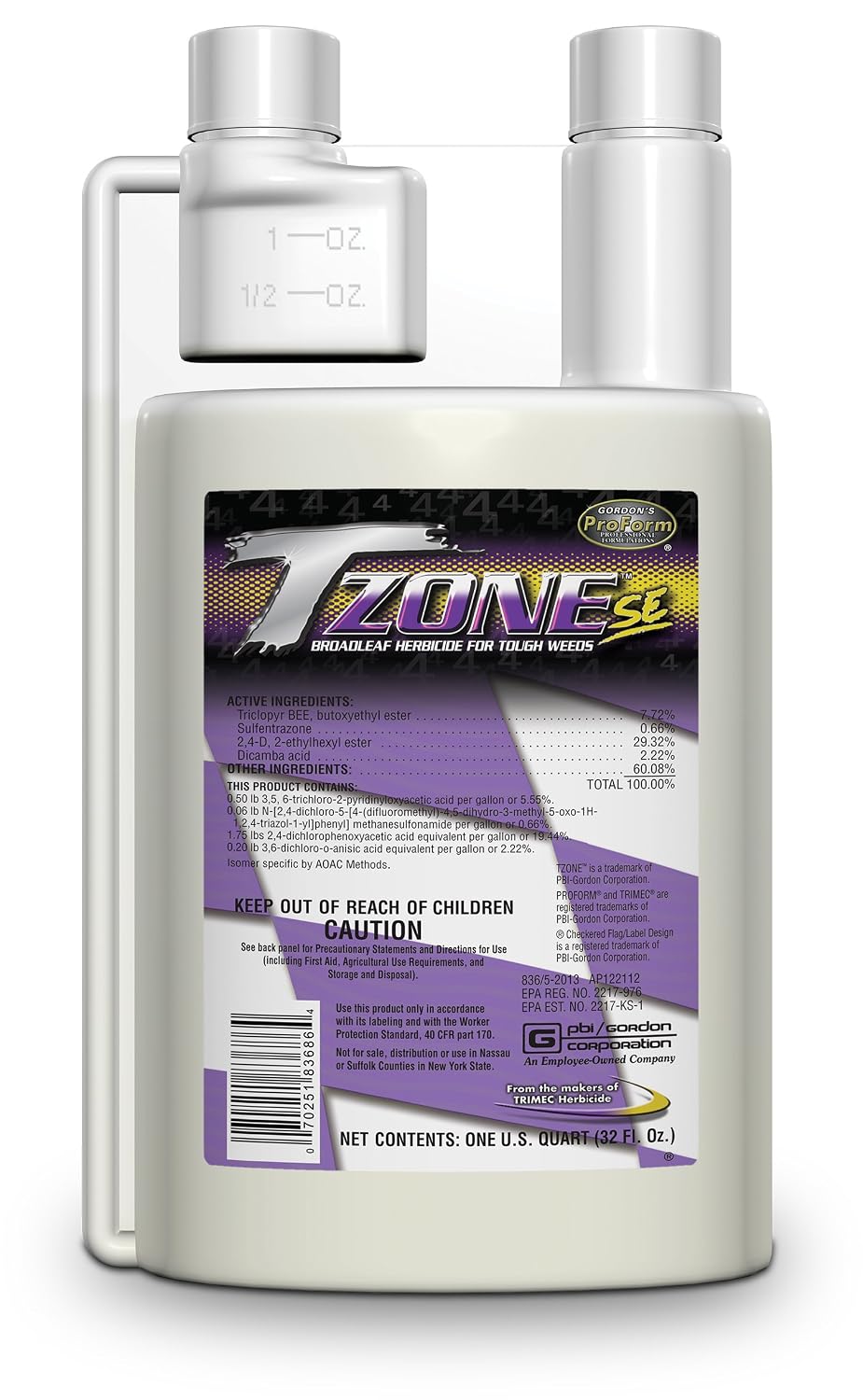
T-Zone Turf Herbicide (1 Quart) by PBI Gordon
| Unit Count | 32 Fluid Ounces |
|---|---|
| Item Form | Liquid |
| Coverage | broad-leaf weeds, grassy weeds |
| Active Ingredients | Dicamba, triclopyr, others |
T-Zone Turf Herbicide is a concentrated liquid formula intended for spot and broadcast treatment of tough broadleaf and grassy weeds in lawns and turf areas. It contains multiple active ingredients including triclopyr and dicamba that give a fast visual response and help suppress difficult targets such as yellow nutsedge and oxalis when used according to label directions. Typical use is mixing to label rates and applying with a handheld sprayer or professional equipment on cool, calm days to avoid off-target movement. Notable features include suitability for residential, commercial, and golf sites and effectiveness at lower temperatures down to about 50°F. Practical benefits are reliable performance on persistent broadleaf weeds and a multi-ingredient formula that reduces the need for repeat applications. Important limitations are the need for protective gear during handling, restrictions and careful timing to prevent damage to desirable plants, and the potential for off‑target drift, so precise application technique is required.
Best for: Buyers who prioritize reliable, professional-strength control of persistent lawn weeds and who are comfortable following label directions and using proper protective equipment. Ideal for property owners or groundskeepers who need a solution that performs in cool weather and on challenging species.
Less Ideal for: Casual gardeners who want an all‑purpose, low‑risk product for mixed plantings or those unwilling to follow pesticide safety practices should consider gentler, selective options.
- Multi‑ingredient formulation targets a broad spectrum of stubborn broadleaf and grassy weeds
- Works in cool conditions (around 50°F) so seasonal timing is more flexible
- Fast visible weed control that can reduce repeat treatments
- Suitable for use on residential, commercial, and golf turf sites
- Contains potent active herbicides that require careful handling and PPE
- Risk of off‑target movement means application must be precise and weather‑aware
Verdict: Choose T-Zone when you need a dependable, professional-strength herbicide to knock back stubborn oxalis and other persistent turf weeds.
SPEED ZONE SpeedZone EW Broadleaf Herbicide for Turf, 1 Gallon

| Unit Count | 128 Fluid Ounces |
|---|---|
| Included Components | 1 Gallon bottle of PBI Gordon SpeedZone EW Broadleaf Herbicide |
| Item Form | Liquid |
| Coverage | Broad-spectrum weed control |
SpeedZone EW is a performance-focused broadleaf turf herbicide sold as a one-gallon liquid intended for use in low-volume and conventional sprayers. It applies as a diluted spray to target weeds in lawns and is engineered with an emulsion-in-water formulation that improves coverage on leaf surfaces for quicker uptake and visible activity within hours. The label lists control of more than 90 broadleaf weeds plus goosegrass and nimblewill, and directions note rain-fast results in 3 to 4 hours and reseeding after one week. Practical benefits include strong, fast knockdown of cool-season weeds and compatibility with standard sprayer setups, making it suitable for spot treatments or larger turf areas. Important limitations are regulatory restrictions in many U.S. states, the need for careful safety handling to avoid skin or eye contact, and the usual caution about using herbicides around desirable plants. Users should follow label directions closely for mixing, application window, and post-application seeding.
Best for: Lawns where fast, performance-oriented control of broadleaf weeds is the priority and the applicator is comfortable using concentrated spray treatments and following label safety and mixing instructions.
Less Ideal for: Homeowners who need a simple, low-risk option for small spot treatments or who live in states where the product is restricted should consider alternative, lower-toxicity or locally approved products.
- EW formulation improves leaf coverage for faster, more complete weed contact
- Visible activity in hours and clover control often within about a week
- Formulated for use in both low-volume and conventional sprayers
- Covers a broad spectrum of common turf broadleaf weeds plus select grassy pests
- Not legal for sale or use in many U.S. states, limiting availability
- Requires careful handling and personal protective equipment due to toxicity
Verdict: Choose SpeedZone EW when you need a fast-acting, sprayer-ready broadleaf herbicide for performance-oriented turf weed control.
Syngenta Tenacity Turf Herbicide, 8 oz

| Unit Count | 8 Fluid Ounces |
|---|---|
| Item Form | Liquid |
| Coverage | 2000 ft^2 per 1sp of product |
| Active Ingredients | Mesotrione |
Tenacity Turf Herbicide is a concentrated mesotrione-based liquid designed for both pre-emergent and post-emergent control of common lawn weeds including crabgrass, clover, chickweed and dandelions. You apply it diluted according to label rates with a handheld or hose-end sprayer to target problem areas or broadcast across the lawn; when used as a pre-emergent it is taken up as weeds emerge and when applied post-emergent it acts systemically for selective control. The product covers a large area per bottle and the active ingredient provides residual control so you can expect longer suppression than a contact-only herbicide. Important practical points are that it is turf-selective so follow the label for grass species and mixing instructions to avoid turf injury, and results can take several days to appear. Also this is a concentrated chemical intended for careful, measured application rather than spot-use by people who prefer non-chemical methods.
Best for: Gardeners focused on strong, reliable crabgrass and broadleaf weed control who are comfortable using concentrated herbicides and following label directions for turf safety.
Less Ideal for: People seeking organic, mechanical, or spot-only solutions or those unwilling to follow detailed mixing and application instructions should consider other options.
- Systemic mesotrione active ingredient controls both pre- and post-emergent weeds
- Selective to turf when used per label, allowing treatment without killing desirable grass species
- Concentrated 8 oz liquid provides wide coverage per bottle
- Provides residual suppression, reducing frequency of repeat applications
- Requires careful mixing and adherence to label for turf safety
- Not a non-chemical or organic option for weed control
Verdict: Choose Tenacity when you want a concentrated, turf-selective herbicide that delivers pre- and post-emergent control of crabgrass and other common lawn weeds.
Choosing the Right Herbicide for Violets in Lawn: Key Factors to Consider
Active Ingredient and Mode of Action
Different active ingredients target broadleaf weeds in different ways. Some herbicides translocate into roots and crowns, which is important for perennials like violets, while contact chemistries only scorch leaves and often require repeated treatments.
Choosing a product with an active ingredient that moves to the plant crown will improve long-term control. Also check for multiple modes of action if you are managing resistant populations or planning integrated control with cultural practices.
Turfgrass Compatibility
Not all herbicides that kill violets are safe on every turf species. Cool-season grasses and warm-season grasses vary in tolerance to certain chemistries, and newly seeded or overseeded lawns are especially vulnerable.
Read label restrictions for grass species, seeding intervals, and any temperature or moisture limitations. If you are unsure of your turf type, identify it before applying a selective herbicide to avoid unintended damage.
Timing and Seasonal Considerations
Application timing affects how well a product controls violets. Early spring, when violets are actively growing, often delivers better translocation into roots. Fall can also be a good season because carbohydrates move to roots, improving uptake for systemic herbicides.
Avoid applications during drought stress or immediately after heavy rain. Labels often specify optimal temperature ranges and recommend waiting periods after irrigation to ensure herbicide uptake.
Application Method and Accuracy
Spot treatment reduces chemical use and limits turf exposure, but requires precise mixing and steady application pressure. Broadcast sprayers cover larger areas but increase the risk of nonselective injury if drift occurs.
Consider whether you need a ready-to-use sprayer, a tank-mix concentrate, or a granular option for ease and accuracy. Equipment calibration and using a shield or nozzle that reduces drift matter when treating near desirable plants.
Residual Effect and Retreatments
Some products leave residual activity that helps prevent reinfestation from emerging violet seedlings. Others act mainly as a contact or systemic treatment with limited soil activity, requiring follow-up applications to catch new growth.
Think about how often you can reapply and whether the label permits multiple treatments in a season. Residual control can reduce labor but may limit follow-up planting or seeding.
Safety, Label Restrictions, and Environmental Considerations
Herbicides vary in user safety requirements and environmental precautions. Read label directions for personal protective equipment, buffer zones near water, and restrictions around desirable ornamentals or vegetable gardens.
Consider the proximity of pollinator forage and follow label guidance on mowing intervals and reentry times to reduce unintended impacts. Proper storage and disposal instructions are also part of safe product use.
When to Treat Violet Patches
Treat violets when they are actively growing and not stressed by drought or extreme heat. Spring green-up and midfall are windows when systemic herbicides are most likely to translocate into roots and crowns.
Avoid treating during drought or immediately after heavy rain. Wait for a calm, dry period to reduce drift and improve uptake. Also consider turf conditions such as recent fertilization or mowing because stressed grass is more susceptible to injury.
- Best uptake: cool, moist mornings with active growth
- Avoid application before heavy rain or irrigation
- Delay treatment on newly seeded areas until label-specified time
Spot Treatment Techniques That Limit Turf Damage
For small patches, use a targeted application method to avoid exposing surrounding grass. A hand-pump sprayer with a pinpoint nozzle or a foam marker can help confine spray to the violet canopy.
Apply when leaf surfaces are dry of dew and use the lowest effective concentration recommended on the label. After treatment, avoid disturbance to the treated area for the amount of time indicated on the label to allow uptake.
- Use shields to reduce drift
- Work from the outside of a patch inward to limit spread
- Calibrate pressure and nozzle type to produce coarse droplets
Managing Violets Without Heavy Reliance on Chemicals
Cultural practices reduce violet pressure over time. Improving turf density through correct mowing height, proper fertilization tailored to your grass type, and overseeding bare spots reduces the open niches violets exploit.
Hand-pulling is effective on small patches if you remove the crown and as much root as possible. Mulching bare soil patches and reducing shade through selective pruning can also make the site less hospitable to violets.
- Mow at the recommended height for your turf species
- Overseed thin areas in appropriate seasons
- Increase sun and airflow where practical
Mixing, Timing, and Following Label Directions
Always follow label mixing rates and timing instructions. Under-dosing reduces control and can encourage re-treatment, while over-dosing raises the risk of turf injury and environmental harm.
Keep accurate records of application dates, weather conditions, and any visible results. This helps you space follow-up treatments appropriately and comply with label reapplication intervals.
- Measure carefully using calibrated cups or scales
- Note weather and turf conditions before application
- Record outcomes to guide future treatments
What To Expect After Treatment
Visible decline in violet foliage can appear within days with contact components, but full death of crowns and roots may take several weeks with systemic products. Be prepared for yellowing or temporary thinning of surrounding grass in some cases.
Plan to monitor the area for regrowth, reseeding, or surviving crowns. Combine treatment with cultural follow-up such as overseeding or spot-sodding to restore turf if necessary.
- Short-term yellowing is common with systemic treatments
- Reseed or patch thin areas after label-specified waiting period
- Expect multiple visits for heavy infestations
How We Chose the Best Herbicide for Violets in Lawn
We selected products that specifically address perennial violets while limiting harm to common turfgrasses. Our editorial filters prioritized demonstrated violet efficacy, low turf phytotoxicity, and flexible application options for spot or broadcast use. Concrete evaluation criteria included active ingredient suitability against violet species, turf safety across cool- and warm-season grasses, documented speed of visible control, and formulation convenience for accurate spot treatments. We also considered label directions for timing and re-treatment intervals, and standard safety precautions for homeowners and landscapers. We excluded generic broad-spectrum herbicides that offer no selective turf options, products lacking clear label instructions for violets, and any formulations intended only for non-lawn areas. The result is a focused list that favors selective chemistry and real-world usability in maintained lawns.
FAQ
Can I use a general broadleaf lawn herbicide to control violets?
Often broadleaf lawn herbicides will affect violets, but not all formulations translocate to the crown. Look for products and active ingredients labeled for perennial violets and turf compatibility to get reliable control with minimal grass injury.
Will treating violets harm my lawn grass?
It depends on the product and your turf species. Selective herbicides formulated for turf and applied per label directions usually minimize damage, but newly seeded grass and certain species may be more sensitive.
How many applications are usually needed to remove violets?
Some infestations respond to a single properly timed systemic application, but perennial crowns often require follow-up treatments. Expect to monitor and possibly retreat within the same season if regrowth occurs.
Is spot treatment better than broadcast spraying?
Spot treatment reduces chemical use and lowers the risk to desirable turf and nearby plants. Broadcast spraying can be appropriate for widespread infestations but requires careful calibration and drift control.
Can I seed or sod over treated areas right away?
Seeding or sodding timelines depend on the herbicide residual and label restrictions. Many selective products require a waiting period before reseeding, so check the label and plan follow-up turf restoration accordingly.
Final Verdict
For violets in lawn, prioritize selective chemistries that translocate to crowns and have clear turfgrass compatibility on the label. Balance speed of visible control with the risk of injuring desirable grass and follow application timing recommendations to improve long-term results. Focus on accurate application, safe handling, and integrating cultural practices like overseeding and correct mowing to reduce recurrence. With attention to product choice and proper follow-up, you can substantially reduce violet pressure while preserving a healthy lawn.
