

Note: This article contains affiliate links. If you click on these links and make a purchase, I may earn a small commission at no extra cost to you. This helps support my research and content. Read my full affiliate disclosure here.
Keeping gravel paths, driveways, and beds free of weeds changes how your outdoor space looks and functions. The right natural weed killer for gravel reduces regrowth without leaving toxic residues that can harm surrounding plants, soil life, or pets. This guide shortlists six top options suited to gravel surfaces and evaluates them on safety, how long they last, and how easy they are to apply. You will find concise explanations of the criteria we used and practical tips for application and pretreatment. Read on to decide which approach best matches your gravel area and maintenance style.
Top Picks at a Glance
| Best Overall The best all-around choice for most situations | Natural Armor Farm & Agricultural Weed Killer, 128 fl oz |  |
| Best Quality Built to a higher standard if you want something more solid | Ortho GroundClear Weed & Grass Killer with Comfort Wand, 1 gal. |  |
| Best Value The sweet spot between price and what you get | Spruce Weed & Grass Killer Refill, Ready-to-Use 64 fl oz |  |
| Best Budget The cheapest option that still gets the job done reliably | Pulverize Weed & Grass Killer, Ready-to-Use 1 Gallon (Messinas) |  |
| Highest Rated A top-rated pick with lots of positive feedback | Natural Elements Ready-to-Use Weed Killer, 4 Gallons |  |
| Most Popular A crowd favorite that many people choose with confidence | Natural Armor Weed & Grass Killer, 1 Gallon (128 oz) |  |
Natural Armor Farm & Agricultural Weed Killer, 128 fl oz

| Item Form | Liquid |
|---|---|
| Unit Count | 128 Fluid Ounces |
| Natural Ingredients | Plant-based |
Natural Armor Farm & Agricultural Weed Killer is a commercial-strength, glyphosate-free liquid designed to knock back unwanted weeds and grasses across large outdoor areas. It is typically used for spot treatments and broad applications on fence lines, gravel lots, pathways, driveways, and other non-crop areas where fast visible results are needed. The formula is marketed for farms, nurseries, ranches, and commercial properties and is intended to be effective when applied on warm, dry, sunny days. Practical benefits include a large 128 fl oz volume that supports treating substantial area without frequent refills and a plant-based active profile for users avoiding glyphosate. Important limitations are that it is non-selective so it will damage desirable vegetation if oversprayed and it is optimized for open, non-crop areas rather than precision applications in planted beds. Users should follow label directions and avoid application where runoff could reach sensitive plants or water sources.
Best for: Buyers who need a powerful, glyphosate-free solution for large outdoor areas and want fast visible control of weeds and grasses across farms, ranches, or commercial properties.
Less Ideal for: Home gardeners who need selective control in flower beds, vegetable plots, or landscaped areas where preserving nearby plants is essential.
- Glyphosate-free plant-based formulation suitable for users avoiding synthetic glyphosate
- Commercial-strength, fast-acting formula for visible results on warm, dry days
- Large 128 fl oz container reduces refill frequency on medium to large jobs
- Intended for use across farms, nurseries, ranches, and commercial properties
- Non-selective action will damage desirable plants if not applied carefully
- Formulation and labeling focus on non-crop areas rather than precise garden or bed use
Verdict: Choose this product when you want a large, glyphosate-free, fast-acting weed killer built for treating extensive non-crop outdoor areas.
Ortho GroundClear Weed & Grass Killer with Comfort Wand, 1 gal.

| Item Form | Spray |
|---|---|
| Coverage | 5120 square feet |
| Unit Count | 128 Fluid Ounces |
| Active Ingredients | Ammonium Nonanoate |
Ortho GroundClear is a one-gallon ready-to-use weed and grass spray designed for spot and surface treatment on driveways, walkways, patios, and landscape beds. The formula absorbs on contact and shows visible browning in about 15 minutes, becoming rainproof roughly two hours after drying, which helps when weather is unpredictable. The included Comfort Wand makes it easy to aim at weeds growing between gravel and pavers without soaking surrounding surfaces. It is OMRI Listed, so it can fit into some organic-minded maintenance routines. Coverage is large for a single container, and the product lists ammonium nonanoate as the active ingredient, which works by contact so small or actively growing weeds are best treated. Because it is a contact herbicide, perennial or well-established weeds may need repeat applications or mechanical removal for full control, and care is required to avoid spray drift onto desirable plants. Follow safety directions and keep pets and children away until treated areas are dry.
Best for: Homeowners who want a practical, hands-on solution to remove weeds from gravel driveways and hardscapes and who prioritize quick, targeted results with minimal setup.
Less Ideal for: People seeking a long-term systemic control for deep-rooted perennial weeds or a total lawn herbicide should consider systemic products or integrated mechanical removal instead.
- Fast visible results on contact, often browning in about 15 minutes.
- Comfort Wand enables precise targeting in gravel joints and along edges.
- Becomes rainproof in approximately 2 hours, reducing loss from unexpected rain.
- OMRI Listed, compatible with some organic production standards.
- Contact-only action means deeper or perennial roots may require multiple applications.
- Spray can damage nearby desired plants if not applied carefully.
Verdict: A fast, ready-to-use contact spray with a comfort wand that makes quick, precise weed control on gravel driveways simple and practical.
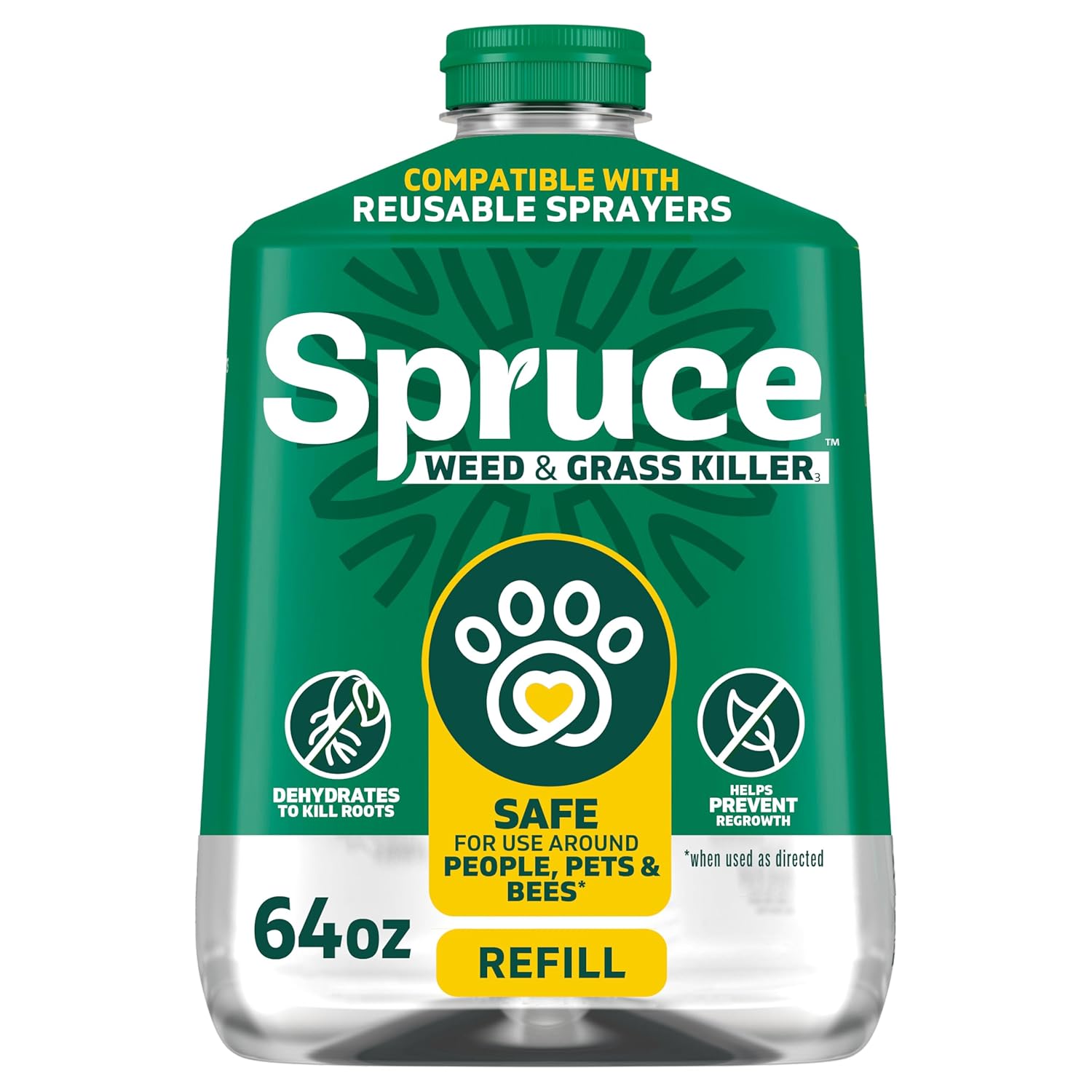
Spruce Weed & Grass Killer Refill, Ready-to-Use 64 fl oz
| Unit Count | 64 Fluid Ounces |
|---|---|
| Item Form | Spray |
| Coverage | 1 bottle treats up to 400 weeds |
| Active Ingredients | Sodium Lauryl Sulfate, Geraniol, Cornmint Oil |
This 64 fl oz Spruce refill is a no-mix replacement for the brand's Snap & Spray system that provides a convenient, ready-to-use weed and grass killer for spot treatments. It works on contact, dehydrating foliage with visible leaf darkening or wilting within an hour and complete plant death often by 24 hours. The formula relies on water, essential oils and sodium lauryl sulfate rather than synthetic herbicides, which makes it suitable for use around people and pets when directions are followed. One bottle is rated to treat up to about 400 weeds and is designed for hard surfaces, mulch beds, driveways and pavers rather than broadcast lawn application. Practical features include a snap-on refill top for the existing spray handle and a fast rainproof window of roughly 10 minutes. Be aware it is non-selective and must be applied carefully to avoid desirable plants, and it is most effective on young or small weeds rather than deep perennial roots where reapplication may be needed.
Best for: Buyers who want a low-fuss, pet-conscious spot weed killer for driveways, pavers and mulch beds and who prioritize convenience and visible speed of action.
Less Ideal for: Homeowners seeking a selective lawn treatment or long-term control of deeply rooted perennials should consider different systemic or professional options.
- Ready-to-use refill eliminates mixing and pouring
- Visible results in about one hour with full effect by 24 hours
- Formulated with water and essential oils for pet- and people-friendly use when directed
- Covers a high estimated count — one bottle treats up to 400 weeds
- Snap-on refill design fits the Spruce Snap & Spray handle for quick replacement
- Non-selective formula will damage desirable plants if oversprayed
- Less effective on large established perennial roots compared with systemic herbicides
Verdict: Choose this refill if you want a fast, ready-to-use, pet-conscious spot treatment that snaps into the Spruce spray handle for effortless weed control on hardscapes and beds.
Pulverize Weed & Grass Killer, Ready-to-Use 1 Gallon (Messinas)

| Unit Count | 128 Fluid Ounces |
|---|---|
| Item Form | Spray |
| Liquid Volume | 1 gallons |
| Active Ingredients | Maleic hydrazide |
| Coverage | Up to 250 sq.ft. (Gallon Ready to Use) |
This ready-to-use Pulverize Weed & Grass Killer is designed for homeowners who need a fast, no-mix solution for weeds on patios, driveways, and garden edges. You spray directly onto foliage and the formula begins drying weeds within hours, making it useful for spot treatments and clearing hardscape cracks. The product is non-selective so it will kill any plant it contacts, and the label highlights control of common annual weeds, moss, algae, and lichens. The formula is described as made from naturally derived ingredients and approved for organic gardening, which reduces concerns about heavy synthetic chemicals and makes it easier to use around family areas once treated surfaces have dried. Important trade-offs are that it will damage desirable plants if oversprayed and that repeat applications every 2 to 3 weeks are recommended for new growth; rain within a few hours can require reapplication. For small to medium problem areas this gallon size gives broad coverage without mixing, but users should follow safety directions to avoid skin or eye contact.
Best for: Homeowners who need an affordable, easy-to-use herbicide for spot-treating driveways, patios, and edges and who prioritize friendlier, naturally derived ingredients around pets.
Less Ideal for: Gardeners wanting a selective lawn-safe product to preserve turf or those who need a systemic, long-term single-application control for deep perennial roots.
- Ready-to-use spray requires no measuring or mixing
- Fast-acting formula shows visible weed dieback within hours
- Naturally derived active ingredient intended for pet- and family-friendlier use once dry
- Effective on a broad range of annual weeds plus moss, algae, and lichens
- Non-selective formula will kill desirable plants if contacted
- May require repeat applications every 2–3 weeks for new growth
Verdict: A convenient, pet-friendlier ready-to-use herbicide for quickly clearing weeds and hardscape growth without mixing.
Natural Elements Ready-to-Use Weed Killer, 4 Gallons

| Item Form | Liquid |
|---|---|
| Coverage | Broad Spectrum Coverage |
| Active Ingredients | Acetic Acid (concentrated vinegar-based formula) |
| Unit Count | 512 Fluid Ounces |
This ready-to-use Natural Elements weed killer uses commercial-grade acetic acid to burn foliage on contact, causing rapid wilting and browning often visible within an hour and substantial dieback within 24 hours. It is typically applied with a garden sprayer directly onto unwanted weeds, driveways, patios, gravel and fence lines where you want vegetation removed rather than saved. The product arrives in four gallons of liquid, so it suits repeated treatments across a medium to large property without mixing. Key features include a concentrated vinegar formula that adheres to leaves and a broad-spectrum label covering grasses, broadleaf weeds, moss and algae. Practical benefits are quick visual results, no complex mixing, and a formula that is described as biodegradable and safe for people and pets after the spray dries. Limitations are that it is a contact herbicide so it does not translocate into roots for long-term control of perennial weeds, will damage desirable turf if misapplied, and the concentrated acetic acid can irritate skin and eyes during handling so protective gear and good ventilation are required.
Best for: Buyers who prioritize a reliable, fast-acting nonselective weed control for hard surfaces, landscaping edges, and repeat spot treatments and who want a ready-to-use product that covers a lot of ground between purchases.
Less Ideal for: Those seeking a systemic long-term solution for deep-rooted perennial weeds or a selective lawn-safe herbicide should consider alternative products.
- Fast contact action with visible wilting within an hour and heavier damage by 24 hours
- Large 4-gallon volume supports multiple treatments without reordering
- Derived from acetic acid so formula breaks down quickly and is described as biodegradable
- Ready-to-use liquid requires no mixing or dilution before application
- Contact-only action does not reliably kill deep-rooted perennials or prevent regrowth
- Will kill grass and desirable plants if sprayed casually near lawns or garden beds
- Concentrated acetic acid can irritate skin and eyes and requires protective handling
Verdict: Choose this product if you need a large-volume, ready-to-use vinegar-based weed killer that delivers fast, reliable contact control across hardscape and landscape areas.
Natural Armor Weed & Grass Killer, 1 Gallon (128 oz)

| Unit Count | 128 Fluid Ounces |
|---|---|
| Item Form | Spray |
| Active Ingredients | Vinegar |
| Coverage | Hardscapes, beds, driveways, foundations and similar areas |
Natural Armor Weed & Grass Killer is a concentrated, vinegar-based herbicide supplied in a one-gallon ready-to-use bottle with a sprayer connection. It is intended for spot-treating unwanted vegetation around driveways, patios, mulch beds, gravel, foundations and other hardscape areas where you do not want plant growth. The product uses high-strength vinegar as the active ingredient so you get fast visible wilting often within an hour and broader dieback over the following days. Practical benefits include easy application with no mixing, a formula marketed as all-natural and glyphosate-free, and coverage recommendations that list many common outdoor use areas. Limitations are that it is non-selective so it will damage desirable plants on contact and may require repeat applications for persistent perennial weeds because vinegar-based products typically burn foliage but do not always kill deep roots. Also follow safety directions to keep children and pets away during use and avoid application around vegetation you want to keep.
Best for: Gardeners who want a non-glyphosate, easy-to-use herbicide for spot-treating driveways, patios and other areas where no vegetation is desired and who prioritize natural active ingredients over systemic control.
Less Ideal for: Homeowners who need selective weed control near ornamental plants or who require a systemic herbicide that reliably kills deep-rooted perennials across large turf areas.
- Ready-to-use formula requires no mixing and connects to a sprayer for straightforward application
- Vinegar-based, glyphosate-free formulation for buyers seeking non-synthetic active ingredients
- Fast-acting foliage burn with visible results often within an hour
- Large one-gallon volume reduces the need for frequent repurchase for larger yards
- Non-selective action will harm any plants it contacts rather than targeting weeds only
- May need multiple treatments to control deeply rooted perennial weeds
Verdict: A large ready-to-use, vinegar-based herbicide for buyers who want a fast, non-glyphosate option to spot-treat weeds on hardscapes and unwanted areas.
Choosing the Right Natural Weed Killer for Gravel: Key Factors to Consider
Active Ingredient and Mode of Action
Different natural weed control options work in different ways. Some are contact desiccants that burn and collapse leaf tissue on contact, producing fast visible results but little translocation into roots. Others use acidic or botanical compounds that stress weeds gradually and can reduce regrowth when used repeatedly.
Understanding the mode of action matters because gravel areas commonly host both shallow-rooted annuals and deeper perennial taproot species. Contact-only treatments often require repeat applications for tough perennials, while botanically based approaches may need more time but can be gentler to surrounding plants when applied carefully.
Residual Activity and Regrowth
Residual control describes how long treated weed seed or regrowth is suppressed after application. Many natural options offer limited persistence, meaning seed in the gravel or nearby soil can sprout weeks later. If you want longer intervals between treatments, choose methods or mixes known to reduce regrowth or adopt a follow-up maintenance regime.
Consider whether the gravel sits above a weed barrier or bare soil. Gravel over a fabric or plastic membrane will reduce opportunities for buried seed to germinate, so short-residual treatments can be highly effective. In contrast, gravel directly over soil often requires a strategy that includes occasional retreatment to manage seedlings.
Risk to Nearby Plants and Soil Life
Gravel areas often border planting beds, lawn edges, or container groupings. Natural does not automatically mean harmless to desirable plants. Some botanical oils and acids can scorch foliage or alter soil chemistry if oversprayed or if runoff occurs during rain. Evaluate drift risk when spraying and avoid windy conditions.
Also think about soil organisms. Repeated heavy applications of certain materials can reduce beneficial microbe activity or earthworm presence near planting beds. Choose options and application patterns that target weeds while minimizing impacts on adjacent soil and plants.
Application Practicality on Gravel Surfaces
Gravel presents unique challenges: uneven surfaces, porous substrate, and potential for product to pool in low spots. Liquid sprays can coat gravel and sink between stones, wasting product and increasing runoff. Granular or targeted brush-on methods may be more precise for narrow joints and edges.
Assess the size of the area, access, and whether you can safely use a pump sprayer or need a handheld bottle. For long driveways, ease of application and refill frequency become important. Also consider how much residue sticks to boots, tires, or garden tools during and after application.
Timing and Weather Considerations
Most natural weed control methods perform best in warm, dry conditions when weeds are actively growing and foliar uptake is highest. Rain within 24 hours of application often reduces effectiveness, especially for contact treatments. Apply on calm days to avoid drift onto desirable plants.
Seasonality matters too. Late spring or early summer applications catch many annual weeds before seed set, while early fall treatments may reduce regrowth of perennial species preparing for dormancy. Plan treatments to match the growth cycle of the target weed types in your gravel.
Maintenance Frequency and Labor
Because many natural options trade persistence for safety, expect to monitor treated areas and plan follow-up applications. Consider how much time you will invest in spot treatments, mechanical removal of large weeds, or repeat spraying.
If low-maintenance is a priority, combine a natural treatment with preventive measures such as hand-weeding, weed fabric, or a top dressing of fresh gravel to suppress seedlings. That combination can reduce overall labor while keeping the surface largely chemical-free.
Preparing Gravel Areas for Treatment
Prep work improves outcomes. Remove large weeds and debris so treatments contact live foliage directly. For dense growth, mow or clip seed heads first to prevent seed release during treatment.
Sweep or rake loose debris and consider loosening compacted joints where roots anchor. If the gravel sits directly on soil, clear a narrow border to limit overspray into adjacent beds.
- Cut back tall or woody weeds before applying a contact treatment
- Rake out organic debris that can shield weed foliage
- Mark sensitive plants or areas to avoid drift
Application Methods That Work on Gravel
Choose a delivery method that minimizes waste and drift. Spot-spraying with a narrow nozzle or a foam/gel applicator concentrates product on foliage and joints without soaking the gravel bed. For long runs, a pump sprayer with an adjustable cone or fan setting helps maintain consistent coverage.
Granular formulations and flame weeding are also options for some gravel scenarios. Granules sit on the surface and can be easier to keep localized, while heat-based methods require care around flammable materials and adjacent plantings.
- Spot spray for individual weeds and joints
- Use foam or gel applicators for vertical edges
- Consider granules or thermal tools for small, contained areas
Managing Perennials and Deep-Rooted Weeds
Perennial weeds with deep roots often recover after contact-only treatments. For these, plan a two-step approach: initial knockdown to remove top growth followed by careful removal of crown and roots once the foliage is dead. Repeat treatments timed with regrowth can deplete root reserves over a season.
Mechanical removal after treating reduces the chance of fragments regrowing in loose gravel. Dispose of pulled material away from the gravel area to prevent re-establishment.
- Apply contact treatment first, then remove dead crowns when dry
- Use digging tools to extract taproots where practical
- Repeat spot treatments on resprouts during the growing season
Protecting Adjacent Plants and Soil
Create simple barriers to protect nearby plantings. Lay wet towels or plastic sheeting along bed edges during spraying, or water borders thoroughly before application to reduce absorption of any incidental spray. Avoid applying treatments on windy days.
If treating gravel near potted plants or containers, move them away temporarily or cover foliage. For planted borders, consider handheld applicators with precise tips to reduce drift and overspray.
- Use physical barriers or covers for sensitive areas
- Water soil near desirable plants before application to dilute drift
- Choose low-drift nozzles for spraying along borders
Seasonal Maintenance and Preventive Practices
Long-term control combines treatment with preventive maintenance. Regular sweeping, occasional top dressing of fresh gravel, and removing seed-bearing weeds before they set seed all reduce pressure on the surface.
Inspect the gravel after winter and early spring to catch seedlings while small. Establish a routine for spot treatments rather than broad reapplications to keep chemical use minimal and targeted.
- Sweep gravel yearly and top up thin areas
- Remove seed heads before dispersal
- Inspect and spot-treat in spring and late summer
How We Chose the Best Natural Weed Killer for Gravel
We shortlisted products and methods that deliver practical, repeatable results on gravel while using natural or minimally synthetic active ingredients. We prioritized formulations and approaches that limit runoff and non-target damage because gravel borders often sit next to planting beds, lawns, or high-traffic areas. Key evaluation criteria included contact effectiveness against common gravel weeds, residual control time, and risks to nearby vegetation. We also assessed ease of application for homeowners who treat long runs of gravel or awkward surfaces, plus user-safety features like low inhalation risk and minimal personal protective equipment needs. Durability of results and the need for repeat treatments were tracked to estimate overall labor. We excluded broad-spectrum herbicides with synthetic systemic actives and any approach that relies solely on repeated manual pulling without a complementary treatment. The goal was to highlight natural options that balance fast knockdown, reduced regrowth, and acceptable safety for typical garden environments.
FAQ
Are natural weed killers safe to use around garden plants?
Often they are safer than synthetic systemic herbicides, but many natural actives can still harm desirable plants if they contact foliage or roots. Use targeted application methods and protect nearby plants to reduce risk.
How soon can I replant near treated gravel areas?
That depends on the active ingredient and product instructions. Many contact-based natural treatments have minimal soil persistence and allow replanting within days, while others recommend waiting until any visible residue has dissipated.
Will natural treatments prevent weed seed from germinating in gravel?
Most natural options have limited residual activity and do not provide long-term preemergent control. Combining treatment with physical barriers, fresh gravel, or weed fabric gives better prevention against new seedlings.
Can I use natural weed killers on a gravel driveway with vehicle traffic?
Yes, but choose a method suited for tough, compacted joints. Spot treatments and granules can be practical. Expect some product displacement with heavy traffic and plan for more frequent maintenance in high-use areas.
Is repeat treatment usually necessary on gravel?
Usually. Because gravel often contains seed and exposed soil, repeat applications or follow-up mechanical removal are common to keep regrowth in check, especially for perennial species.
What weather is best for applying natural weed control?
Apply on a calm, dry day when temperatures are moderate and no rain is expected for at least 24 hours. That timing improves foliar uptake and reduces runoff risk.
Final Verdict
For gravel surfaces, balance the need for quick knockdown against the desire to protect adjacent plants and soil life. Prioritize targeted application methods and plan follow-up treatments for perennials and seed-prone areas. Combining a natural treatment with simple maintenance steps, such as sweeping, top dressing, and timely removal of seed heads, gives the best long-term results. Focus on the factors that matter most for your situation: if minimizing risk to nearby beds is critical, pick a low-drift, spot-application approach. If you need longer intervals between treatments, pair applications with preventive measures like weed fabric or fresh gravel to reduce overall labor.
