

Note: This article contains affiliate links. If you click on these links and make a purchase, I may earn a small commission at no extra cost to you. This helps support my research and content. Read my full affiliate disclosure here.
Picking the right grow light for a 3×3 tent matters because light behavior is different in a compact, reflective space. The wrong fixture can create hot spots, poor canopy penetration, or wasted energy, while the right light delivers even coverage, consistent spectrum, and manageable heat so plants set more flowers and fill the area evenly. This guide walks you through the top shortlisted grow lights for 3×3 tents and explains the evaluation criteria we used, including light output, spectrum control, heat management, and ease of installation. Read on to find the practical tradeoffs that affect real tent grows and get straight to the picks that suit compact indoor gardens.
Top Picks at a Glance
| Best Overall The best all-around choice for most situations | Spider Farmer SE3000 300W LED Grow Light with App Control |  |
| Best Quality Built to a higher standard if you want something more solid | AC Infinity IONFRAME EVO4 300W Samsung EVO Bar LED Grow Light |  |
| Best Value The sweet spot between price and what you get | MARS HYDRO FC-E3000 300W Full-Spectrum LED Grow Light |  |
| Highest Rated A top-rated pick with lots of positive feedback | Phovivis OptiGrowX240 LED Full-Spectrum Grow Light |  |
| Most Popular A crowd favorite that many people choose with confidence | Spider Farmer SF1000 100W Full Spectrum LED Grow Light |  |
| Best Seller A high-volume bestseller chosen again and again | MARS HYDRO TS1000 150W Full Spectrum LED Grow Light |  |
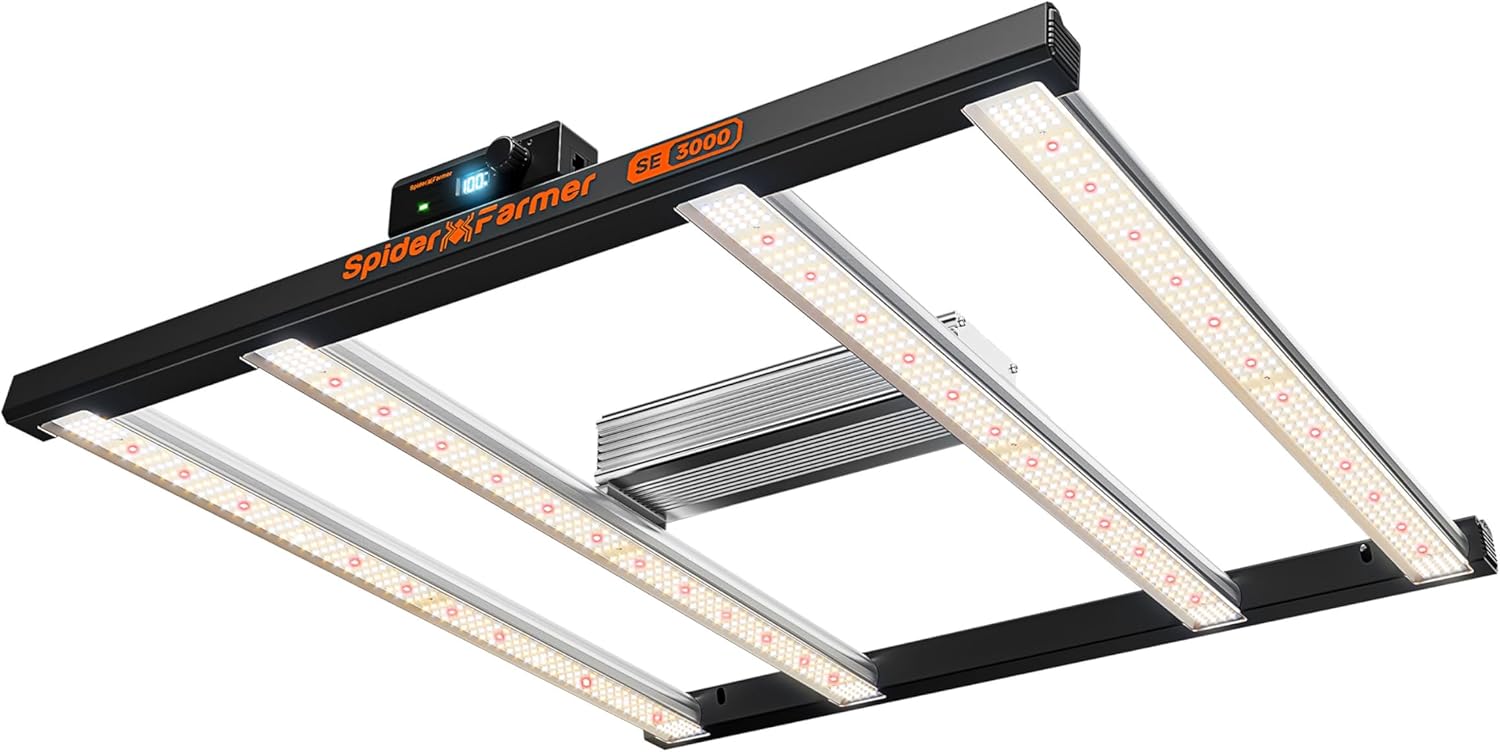
Spider Farmer SE3000 300W LED Grow Light with App Control
| Light Source Type | LED |
|---|---|
| Wattage | 300 watts |
| Power Source | Corded Electric |
| Light Source Special Features | dimmable |
| Number of Light Sources | 896 |
The Spider Farmer SE3000 is a bar-style 300W LED grow light built for full-cycle indoor growing in a 3×3 foot tent. It uses premium Bridgelux diodes and a tuned full spectrum with strong deep red output to support seedlings through flowering while keeping heat output low. The fixture includes an electronic dimming box with a digital display and an app for remote scheduling, sunrise/sunset simulation, and brightness adjustments, which makes it easy to set stage-specific light levels and manage multiple lights. Its bar layout aims to deliver even PPFD across the canopy, including edges, and the lower heat reduces risk of light burn. Practical limitations are that it is a single fixture sized for a 3×3 area so larger tents need multiple units, and setup requires mounting space and access to the controller or app. For growers focused on even canopy coverage, energy-efficient output, and remote scheduling in a small tent, the SE3000 is a solid, user-friendly option.
Best for: Growers running a single 3×3 tent who want an energy-efficient, full-cycle fixture that is easy to schedule and dim remotely and who prioritize even canopy light and low heat.
Less Ideal for: Large-scale or multi-tent growers who need wider commercial coverage or users who prefer plug-and-play clip lights for small single-plant setups.
- Energy-efficient 300W output with premium Bridgelux diodes for strong light output and lower operating heat
- App control and digital dimming box lets you schedule, simulate sunrise/sunset, and fine-tune brightness remotely
- Bar-style design intended to give uniform PPFD across a 3×3 ft canopy including edges
- Tuned full spectrum with high proportion of deep red to support photosynthesis through flowering
- UL specification and a 5-year manufacturer coverage for longer-term reassurance
- Designed for a 3×3 personal coverage so larger grows require additional fixtures
- Requires wall or ceiling mounting and space for the digital dimming box which may complicate placement
Verdict: For a 3×3 tent, the SE3000 delivers efficient, even full-spectrum light with app-based scheduling and precise dimming that simplifies full-cycle indoor growing.
AC Infinity IONFRAME EVO4 300W Samsung EVO Bar LED Grow Light

| Light Source Type | Light Emitting Diode |
|---|---|
| Wattage | 300 watts |
| Number of Light Sources | 896 |
| Color Rendering Index | 90 |
| Light Source Special Features | Schedule controls, sunrise/sunset dimming, 10 brightness levels, WiFi app control compatibility, daisy-chaining, IP-65 |
The AC Infinity IONFRAME EVO4 is a performance-focused 300W bar-style grow light designed for small indoor spaces such as a 3×3 tent. It uses Samsung LM301H EVO diodes and 896 LEDs to deliver high efficacy (3.14 µmol/J) and strong PPFD for canopy penetration, while the algorithmic diode spacing reduces hotspots for more even coverage. Programmable features include 10 brightness levels, sunrise/sunset dimming, daily scheduling, and compatibility with AC Infinity's WiFi app and controllers for remote automation. The unit supports daisy-chaining and has a removable passive-cooled driver to help manage heat without noisy fans, plus an IP65 rating for humid environments. Practical benefits include precise light scheduling, deep canopy reach for flower stages, and easy installation with magnetic mounting options. Limitations to expect are the need to pair it with AC Infinity controller hardware to unlock advanced automation and that a 300W fixture may still require close height and intensity management for very small seedlings or very dense canopies.
Best for: Growers who prioritize light performance and controllable schedules for a 3×3 tent and want precise, commercial-grade LEDs and automation-ready features.
Less Ideal for: Casual hobbyists who want a plug-and-play, controller-free lamp or growers with only a few seedlings who need very low-intensity starter lighting.
- High-efficiency Samsung LM301H EVO diodes rated at 3.14 µmol/J for strong light output per watt
- Programmable controls with 10 brightness levels, schedule and sunrise/sunset dimming for automated cycles
- Algorithmic diode spacing and 896 LEDs provide even coverage and improved canopy penetration
- Passive-cooled removable driver and IP65 rating allow quieter operation and use in humid grow tents
- Daisy-chaining support simplifies expanding light arrays without extra drivers
- Advanced app-based automation requires AC Infinity controller hardware (sold separately)
- At 300W it still needs careful positioning in a densely planted or seedling-heavy 3×3 tent to avoid light stress
Verdict: If you want a high-efficiency, automation-ready fixture that delivers even, high-PPFD coverage for a 3×3 tent, the IONFRAME EVO4 is a top performance choice.
MARS HYDRO FC-E3000 300W Full-Spectrum LED Grow Light

| Light Source Type | LED |
|---|---|
| Power Source | Corded Electric |
| Voltage | 120 volts |
| Light Output Maximum | 52971 lumens |
| Wattage | 300 |
The MARS HYDRO FC-E3000 is a 300W full-spectrum LED bar intended to light a 3×3 ft grow area with dense, uniform output for both veg and bloom stages. It uses Bridgelux diodes with an enhanced OSRAM deep-red component to increase flowering response and reports a PPF/PPE balance aimed at efficient photosynthesis. Typical use is ceiling- or hang-mounted in a 3×3 grow tent where the dimmable output and remote/app control let you tailor intensity across plant stages. Notable features include app compatibility for scheduling and dimming, removable/assemble-required bars for easier installation and service, and an aluminum body that helps dissipate heat. Practical benefits are even canopy coverage, adjustable light levels to save energy during veg, and a compact footprint that fits common tent sizes. Limitations are that it requires assembly and may need a separate controller or hub for full smart features, and buyers seeking the very highest commercial PPFD numbers may prefer higher-watt flagships.
Best for: Growers who want a cost-effective, space-efficient light that balances flowering-focused output with energy-conscious operation in a standard 3×3 tent.
Less Ideal for: Large commercial grows or growers who need built-in advanced control hardware out of the box should consider higher-output fixtures or integrated systems instead.
- Full-spectrum LED array with stronger red output to support flowering
- Dimmable and app/remote compatible for schedule and intensity control
- Designed for uniform coverage over a 3×3 ft area which suits small tents
- Aluminum construction and removable bars aid heat dissipation and maintenance
- Requires assembly and may need an external hub/controller to access full smart functions
Verdict: A compact, energy-conscious 300W full-spectrum LED that delivers even 3×3 tent coverage and adjustable output for practical growers focused on efficiency and flowering performance.
Phovivis OptiGrowX240 LED Full-Spectrum Grow Light

| Wattage | 220 watts |
|---|---|
| Light Output Maximum | 33600 lumens |
| Color Temperature | 3500 Kelvin |
| Color Rendering Index | 95 |
| Light Source Type | Light Emitting Diode |
The Phovivis OptiGrowX240 is a compact, ceiling-mount LED grow light engineered for full-cycle indoor cultivation in 2×2–3×3 tents. It offers independent Veg and Bloom knobs so you can dial spectrum and intensity for seedlings through flowering without swapping fixtures. The light uses 952 LEDs across several color temperatures and bands to deliver a broad full spectrum while an advanced optical lens focuses usable photons into the canopy for deeper penetration. Measured output claims (high PPFD at typical tent heights) and a 220W draw position it as an efficient replacement for older 400W HPS fixtures, and the full-aluminum body with passive cooling helps with durability and quiet operation. Practical extras include dimming, a daisy-chain RJ45 for multi-light setups, and included hang kit and power cord. Limits to note: it is a single-panel unit best suited to small tents rather than large rooms, and large commercial users may need multiple units and external controllers to scale. The unit also requires proper placement and ventilation to hit the claimed canopy PPFD values.
Best for: Growers who prioritize reliable, tunable performance for a 3×3 tent and want a compact, low-maintenance fixture that handles full growth cycles without frequent swapping or complex setup.
Less Ideal for: Large-scale growers or those needing wide-area lighting for multiple tents or rooms should consider multi-panel fixtures or higher-output units instead.
- Dual Veg and Bloom controls for on-the-fly spectrum and intensity adjustments
- Advanced optical lens design for improved canopy penetration and more uniform coverage
- High-efficiency 220W output with claimed strong PPFD suitable for 3×3 tents
- Daisy-chain RJ45 and compatibility with external controllers for scalable setups
- Full-aluminum body with passive cooling and included hang kit for easy installation
- Single-panel design limits effective coverage beyond a 3×3 tent without adding more units
- Manufacturer PPFD and energy-savings claims should be validated in your own setup
Verdict: A compact, energy-efficient full‑spectrum LED built for dependable, tunable performance in a 3×3 grow tent.
Spider Farmer SF1000 100W Full Spectrum LED Grow Light

| Light Source Type | LED |
|---|---|
| Light Output Maximum | 10000 lumens |
| Light Source Wattage | 100 watts |
| Light Source Special Features | Dimmable |
| Specification Met | IP67 |
The Spider Farmer SF1000 is a compact 100W full spectrum LED grow light intended for 2×2 to 3×3 grow spaces and small tents. It uses a high diode count and upgraded LED chips to deliver broad-spectrum output that supports seedlings through flowering, with a dimmer knob to reduce intensity for early stages and ramp up for bloom. The fanless design and thick aluminum heatsink keep operation quiet while providing passive cooling, and the fixture meets IP67 for durable performance. Typical use is ceiling or tent mounting above individual plants or a small canopy where uniform coverage and deeper canopy penetration matter. Notable features include daisy-chain compatibility for linking multiple units under unified dimming, a 0–100% dimmable control, and a driver claimed to offer efficient power delivery. Practical benefits are even light distribution in a small footprint, predictable veg-to-flower capability, and near-silent operation. Limitations are inherent to its class: it is sized for small areas so you will need multiple units for larger tents, and the product description emphasizes specs from manufacturer tests rather than independent third-party PPFD maps.
Best for: Growers who want a quiet, compact full spectrum light for a small tent or single-plant setup and value adjustable intensity for each growth stage.
Less Ideal for: People running larger multi-plant rooms or commercial operations who need higher total output and broader single-fixture coverage.
- Full spectrum output suitable for all growth stages with added red and IR for flowering
- Dimmable 0–100% control lets you tailor light intensity to seedlings, veg, and bloom
- Fanless design with sturdy aluminum heatsink for quiet, low-maintenance operation
- Compact footprint ideal for 2×2 to 3×3 tents and small indoor setups
- Daisy-chain capable so multiple fixtures can be linked and dimmed together
- Coverage and power are intended for small grows so larger areas require multiple units
- Manufacturer gives efficiency and coverage figures without independent third-party PPFD charts
Verdict: A quiet, dimmable 100W full spectrum fixture that is a practical, balanced choice for hobbyists running 2×2 to 3×3 tents.
MARS HYDRO TS1000 150W Full Spectrum LED Grow Light

| Wattage | 150 watts |
|---|---|
| Light Source Type | Light Emitting Diode |
| Power Source | Corded Electric |
| Light Source Special Features | Dimmable, Daisy Chain |
| Number of Light Sources | 342 |
The MARS HYDRO TS1000 is a compact 150W LED grow light built for small indoor grows and tent setups. It delivers a full-spectrum output aimed at all growth stages and uses a dense array of 342 LEDs arranged to give stronger, more even light in the center and usable coverage up to about 3×3 feet for vegetative growth and 2.5×2.5 feet in bloom. The driver offers 0–100% dimming and the fixture supports daisy-chaining multiple units, which makes it easy to scale a canopy without extra wiring. Its aluminum body and patented white reflector boost light utilization while the fanless design keeps operation silent. Practical benefits include low energy draw compared with equivalent HID systems and simple inside-mount installation for tents or racks. Limitations are its modest total wattage and coverage, which mean multiple units are needed for larger rooms, and true smart controls are optional add-ons rather than built in. Also the RJ12 connector for daisy-chaining may be required separately.
Best for: Growers who want a reliable, energy-efficient light for a single tent or small personal garden and value quiet, even lighting and easy scaling with additional fixtures.
Less Ideal for: People planning to light large rooms or commercial canopies with a single fixture should look at higher-wattage models or multiple-unit kits instead.
- Full-spectrum LED array suitable for seed-to-flower growth stages
- Dimmable 0–100% driver for easy light intensity control
- Fanless aluminum design runs quietly and dissipates heat efficiently
- Daisy-chain support lets you connect multiple units for larger coverage
- 150W output limits single-unit coverage to small tents or compact setups
- RJ12 connector for chaining is not included and must be sourced separately
Verdict: A quiet, energy-efficient 150W full-spectrum LED that fits small grow tents and scales well if you add more units.
Choosing the Right Grow Light for 3X3 Tent: Key Factors to Consider
Light Intensity and Canopy Coverage
Light intensity determines how much usable light reaches leaves and therefore directly affects photosynthesis and yield. In a 3×3 tent you must account for both center PPFD and edge falloff because fixtures that concentrate output in a small spot will leave outer plants shaded.
Look for published PPFD maps or measured values over a 3×3 area so you can judge whether a fixture gives even coverage at realistic hanging heights. Consider whether the fixture can be raised or dimmed to tune intensity as plants grow.
Spectrum and Stage Control
Spectrum affects morphology, flowering timing, and resin production. For small tent grows, the ability to switch or tune between vegetative and flowering spectra simplifies scheduling and reduces the need to move lamps.
Fixtures with selectable veg/flower modes or adjustable spectral channels let you favor blue for compact vegetative growth or red for flowering without swapping lights. A full-spectrum output with supplemental far-red or UV options can also help final flower development in compact canopies.
Heat Output and Ventilation Impact
Heat matters more in a 3×3 tent than in open rooms because heat builds quickly in a confined reflective space. High heat output forces higher inline fan speeds, which increases noise and can dry the canopy if not balanced.
Evaluate fixture cooling design, whether passive or active, and plan for how the light will affect your tent ventilation. Low-profile lights that run cool give more margin for timing and placement, while high-heat fixtures may require higher exhaust rates or additional circulation fans.
Electrical Efficiency and Running Costs
Efficiency, expressed as µmol per joule, tells you how much photosynthetic light the fixture produces for each watt consumed. In a small tent, efficiency affects both your electricity bill and how much waste heat the light generates.
Higher-efficiency fixtures usually run cooler for a given output and let you hit target PPFD with lower input power. Also check whether the driver supports dimming or scheduling to reduce energy use during early veg cycles.
Fixture Size, Weight, and Mounting Options
The physical footprint of a grow light determines hanging height options and how close it sits to plant tops. Heavy or oversized fixtures can be awkward in a 3×3 tent and may block airflow or create shadowed zones.
Look for lights with flexible hanging systems, multiple attachment points, and a low center of gravity. Consider daisy-chaining capability or integrated ratchets to simplify setup and allow fine height adjustments as plants grow.
Durability and Maintenance
In a humid tent environment, fixture longevity depends on driver protection, IP ratings, and ease of cleaning. Dust and resin buildup on LEDs and heatsinks reduces output and can create hot spots over time.
Choose fixtures with sealed electronics or accessible covers and straightforward cleaning procedures. Replaceable drivers or modular boards make repairs easier and extend the fixture's useful life in a small-scale grow setting.
Sizing Your Light For 3X3 Canopy Needs
Calculate target PPFD for the crop and growth stage rather than relying solely on wattage. Many flowering crops in a 3×3 tent benefit from average canopy PPFD in the 600 to 900 µmol/m2/s range during peak bloom, but lower values work for veg or more conservative setups. Use published PPFD maps when available and plan hanging height so the center and corners are within a usable range.
- Measure canopy area and note reflector behavior inside the tent.
- Aim for even PPFD across the 3×3 footprint rather than maximum center output.
- Keep hanging height adjustable to follow plant growth.
Managing Heat Without Sacrificing Light
Place lights to favor airflow across the canopy and avoid dead-air pockets. Use internal circulation fans to move air under and through foliage so heat does not stratify at plant tops. If a fixture runs hot, raise it a little and increase exhaust CFM rather than forcing plants closer to the light for intensity. Fixtures that offer good cooling designs reduce the load on tent ventilation and lower ambient temperatures.
- Use an inline exhaust fan sized for the tent plus heat load.
- Position oscillating fans to move air horizontally across the canopy.
- Monitor canopy temperature, not just air temperature, near the light source.
Spectrum Choices for Compact Growing
Think of spectrum as a tool to control plant form. More blue light yields stockier plants with closer internodes, which is useful when canopy space is limited. Red-rich spectra promote stem elongation and flowering response. Adjustable spectrum fixtures let you shape plants without pruning or training as aggressively. If you grow mixed species in one tent, a tunable fixture lets you dial conditions toward the needs of different crops across the cycle.
- Use higher blue ratios during veg for compact growth.
- Switch to red-dominant or full bloom spectra during flowering to maximize flower set.
- Consider small amounts of far-red or UV near finish if your fixture supports it.
Practical Setup and Electrical Considerations
Check the tent's electrical circuit capacity before installing efficient but high-draw fixtures. Dimming support and timers reduce peak draw during non-critical phases. Also confirm the driver's compatibility with common dimming signals and that cables and plugs fit your setup. Plan cable routing to avoid heat traps and keep drivers outside the tent if possible for thermal relief and easier access.
- Verify circuit capacity and avoid overloading outlets.
- Use proper-rated extension cords and keep connections outside the tent if feasible.
- Label and organize power runs for safe maintenance.
Maintenance Routines For Consistent Output
Schedule regular cleaning of lenses, heatsinks, and fans to prevent light loss and localized overheating. Inspect driver housings and connectors for moisture or salt build-up caused by nutrient aerosols. Keep spare hangers or mounting hardware on hand to avoid long downtime during a grow cycle. A short maintenance checklist after each grow cycle preserves output and helps spot early failures before they affect the next crop.
- Wipe lenses with a soft cloth and isopropyl if needed.
- Blow dust from heatsinks and check fan bearings.
- Test dimming and driver function between cycles.
How We Chose the Best Grow Light for 3X3 Tent
We focused on the features that matter in a compact 3×3 tent where space, light distribution, and thermal control directly affect plant health. Our editorial filters emphasized measurable lighting performance, spectrum flexibility, and how each fixture behaves inside a highly reflective, small-volume grow space. Evaluation criteria included delivered photosynthetic photon flux density across a 3×3 canopy, full-spectrum tuning or selectable veg/flower modes, heat output and cooling design, fixture footprint and hanging adjustability, and electrical efficiency and reliability. We also considered ease of use for tent growers, including daisy-chaining, dimming, and mounting hardware. We excluded fixtures intended only for large commercial rooms or single-plant hobby lamps that cannot be positioned for even canopy coverage. Cheap, untested LED strips or bulbs without published lumen or PPFD data were removed from consideration. The resulting shortlist contains lights that provide documented light output, practical heat management, and features suitable for small tent environments.
FAQ
What PPFD should I aim for inside a 3×3 tent?
It depends on the crop and stage. Vegetative stages often do well at 200 to 400 µmol/m2/s, while flowering targets commonly range from 600 to 900 µmol/m2/s for dense-canopy crops. Many growers aim for a compromise and ramp intensity over time.
Can one fixture cover a 3×3 tent or are multiple needed?
Many mid- to high-power fixtures are designed to cover a 3×3 area if their beam and distribution match the canopy. Look at PPFD maps and hanging heights; sometimes two lower-profile fixtures give more uniform light than one concentrated source.
How high should I hang a grow light in a 3×3 tent?
Start higher to avoid light stress and heat, then lower the fixture as plants develop. Recommended heights vary by fixture type and output; consult PPFD data for the light and watch plants for bleaching or stretch to guide adjustments.
Will a more efficient fixture mean less heat in the tent?
Usually yes. Higher µmol/J means more light per watt and typically less waste heat for the same PPFD. However, fixture cooling design and driver placement also influence how heat affects the tent environment.
Is spectrum tuning necessary for small tent grows?
Spectrum tuning is not essential but is useful. It lets you favor compact vegetative growth or boost flowering response without changing fixtures. For single-crop setups, a well-balanced full-spectrum light often works fine.
How do I prevent hot spots and uneven canopy development?
Choose fixtures with even distribution or use multiple smaller fixtures to overlap light. Adjust hanging height and use reflectivity inside the tent to minimize edge falloff. Circulate air to avoid heat-related stress in localized zones.
Final Verdict
For a 3×3 tent, prioritize even canopy PPFD, effective heat management, and practical mounting options. Efficiency and spectrum flexibility help you hit target light levels with less waste heat and allow easier tuning across growth stages. Balance intensity with ventilation capacity and choose a fixture whose footprint matches your canopy rather than chasing raw wattage. Focusing on these tradeoffs will help you pick a grow light that fits your tent environment and crop goals with predictable results.
