

Note: This article contains affiliate links. If you click on these links and make a purchase, I may earn a small commission at no extra cost to you. This helps support my research and content. Read my full affiliate disclosure here.
You want to manage aphids, whiteflies, spider mites, and other pests without exposing your plants, pollinators, or family to harsh chemicals. A well-chosen natural insecticide spray limits pest damage while preserving beneficial insects and allowing safe use on ornamentals and many edibles. This guide shortlists seven top-rated options and explains how we evaluated them. We focus on real-garden outcomes like knockdown speed, residual protection, and plant safety so you can pick a spray suited to your yard, patio containers, or vegetable beds.
Top Picks at a Glance
| Best Overall The best all-around choice for most situations | Bonide Captain Jack's Ready-to-Use Neem Oil Spray, 32 oz |  |
| Best Quality Built to a higher standard if you want something more solid | Wondercide Outdoor Pest Control Spray, Ready-to-Use, 32 oz |  |
| Best Value The sweet spot between price and what you get | BioAdvanced Organics Neem Oil Spray, Ready-to-Use, 24 fl oz |  |
| Best Budget The cheapest option that still gets the job done reliably | STEM Plant-Based Bug Spray for Ants, Roaches and Flies, 12 fl oz |  |
| Highest Rated A top-rated pick with lots of positive feedback | NatureStop Whitefly Killer for Plants, 16 oz |  |
| Most Popular A crowd favorite that many people choose with confidence | Mighty Mint Peppermint Oil Insect Repellent Spray, 16 oz |  |
| Best Seller A high-volume bestseller chosen again and again | Garden Safe Insecticidal Soap Ready-to-Use Spray, 32 oz |  |
Bonide Captain Jack's Ready-to-Use Neem Oil Spray, 32 oz

| Item Form | Liquid |
|---|---|
| Liquid Volume | 32 fluid ounces |
| Target Species | Insects |
| Active Ingredients | Clarified Hydrophobic Extract of Neem Oil |
Bonide Captain Jack's Ready-to-Use Neem Oil is an all-purpose garden spray that combines insecticidal, miticidal, and fungicidal action in one trigger bottle. It is used by shaking and spraying plant surfaces, including undersides of leaves, at the first sign of pests or disease and can be applied on roses, vegetables, herbs, houseplants, shrubs, and trees. The formulation claims to kill eggs, larvae, and adults of common pests such as aphids, whiteflies, and spider mites while also helping prevent fungal problems like powdery mildew and blight. Practical benefits include convenience of a ready-to-use sprayer, organic-approved active ingredient for gardeners who prefer minimal synthetic chemistry, and year-round applicability up to the day of harvest on edible plants. Important limitations are that repeated applications every 7 to 14 days may be needed for control, effectiveness depends on thorough coverage so heavy infestations may require additional methods, and it should not be sprayed in peak sunlight and must be kept away from children and pets.
Best for: Practical home gardeners who want a single, organic-friendly spray to manage common pests and fungal issues across flowers, vegetables, and houseplants without mixing concentrates.
Less Ideal for: Gardeners facing severe, fast-spreading infestations who need fast-acting chemical control or those who prefer a concentrate for customizing spray strength.
- Multi-use: insecticide, miticide, and fungicide in one product
- Ready-to-use trigger bottle requires no mixing
- Active ingredient is neem oil suitable for organic gardening
- Safe for use on a wide range of plants including edibles up to harvest
- Requires thorough coverage and repeat applications for reliable control
- Not a quick knockdown in heavy infestations compared with synthetic insecticides
Verdict: A convenient, organic-approved all-in-one neem spray for gardeners who want a balanced, ready-to-use solution for common pests and fungal problems.
Wondercide Outdoor Pest Control Spray, Ready-to-Use, 32 oz

| Format | Pre-mixed, hose-end spray |
|---|---|
| Active ingredients | Cedarwood Oil 12.63%, Sesame Oil 2.73% |
| Coverage | Up to 5,000 sq ft (general pests); 2,500 sq ft (ticks) |
Wondercide Ready-to-Use Outdoor Pest Control is a hose-end yard spray formulated with cedarwood and sesame oils to kill and repel a broad range of outdoor pests. It attaches to a garden hose for quick coverage and is designed to treat up to 5,000 square feet for general pests and up to 2,500 square feet for tick control. Typical use is perimeter and lawn spraying: walk steadily from the house outward using sweeping passes, reapplying every few days during active infestations or after heavy rain. Notable features include plant-powered active ingredients, a ready-to-use hose sprayer for fast application, and instructions that emphasize avoiding high heat and direct sun to prevent plant burn. In practice this product gives a convenient, low-odor alternative to conventional pesticides that is safe to use around people and pets when directions are followed and that is reported to be pollinator friendly. Limitations are that efficacy depends on thorough coverage, water pressure, and reapplication frequency, and it can cause phytotoxic damage if applied in temperatures over 90°F or in direct hot sun, so timing and technique matter for best results.
Best for: Buyers who want a high-performing, plant-based yard spray that delivers broad pest control across large areas and prioritize effective, repeatable results over a one-time fix.
Less Ideal for: Gardeners who need an instant, long-lasting residual solution without reapplication or those who cannot avoid spraying during hot, sunny conditions.
- Ready-to-use hose-end sprayer for fast, large-area application
- Plant-based actives (cedarwood and sesame oils) that target common yard pests
- Covers up to 5,000 sq ft for general pests and 2,500 sq ft for ticks
- Formulation and directions designed to be safe around people, pets, and pollinators when used as directed
- Can cause phytotoxic burn if applied in high heat or direct sun
- Performance depends on proper coverage, water pressure, and repeat applications after heavy rain
Verdict: If you want a ready-to-use, plant-powered yard spray that delivers widespread, repeatable control of mosquitoes, ticks, fleas, and other common pests, this is a strong performance-oriented natural option.
BioAdvanced Organics Neem Oil Spray, Ready-to-Use, 24 fl oz

| Unit Count | 24 Fluid Ounces |
|---|---|
| Item Form | Oil |
| Target Species | Spider |
| Active Ingredients | Clarified Hydrophobic Extract of Neem Oil 0.9% |
| Specification Met | OMRI |
This ready-to-use BioAdvanced Organics Neem Oil spray is designed as a multi-purpose garden treatment that controls listed insects and mites while preventing and treating common fungal diseases. You use it like a regular trigger-spray: apply at the first sign of pests or follow a 7 to 14 day preventative schedule for disease control, and it is labeled for roses, flowers, vegetables, fruits, shrubs, and houseplants. The product’s clarified neem oil formulation kills eggs, larvae, and adults on contact and also helps manage blackspot, powdery mildew, rust, and similar fungal problems. Being OMRI-listed and approved for use up to the day of harvest makes it practical for edible gardens. Because it is ready-to-use there is no mixing or measuring, which saves time for routine maintenance. Limitations are that it is a low-concentration neem extract so repeated applications are usually needed for heavy infestations, and contact action means coverage matters for effectiveness.
Best for: Gardeners who want a simple, low-effort natural option to manage both common pests and fungal diseases across ornamental and edible plants and who prioritize convenience and organic compatibility.
Less Ideal for: Users needing a fast knockout for severe or widespread infestations or those who prefer concentrated products that treat large areas with a single mixed batch.
- Ready-to-use trigger sprayer requires no mixing or dilution
- Combines insecticide, miticide, and fungicide action in one product
- OMRI-listed and labeled for use up to day of harvest on edible crops
- Effective at killing eggs, larvae, and adult stages of listed pests on contact
- Low active concentration means frequent reapplication may be necessary
- Works by contact so thorough coverage is required for good control
Verdict: A convenient, OMRI-listed ready-to-use neem spray that lets practical gardeners treat pests and common fungal diseases on edible and ornamental plants without mixing.
STEM Plant-Based Bug Spray for Ants, Roaches and Flies, 12 fl oz

| Active ingredients | Geraniol 6.2%, Lemongrass Oil 0.5% |
|---|---|
| Other ingredients | White Mineral Oil, Isopropyl Myristate, (+)-Ethyl Lactate 93.9% |
| Form | Trigger spray |
| Use | Indoor and outdoor spot treatments |
This STEM bug spray is a trigger-spray insecticide formulated with plant-derived actives such as geraniol and lemongrass oil to kill ants, roaches and flies on contact. It is intended for targeted indoor and outdoor spot treatments: shake, hold about a foot from the insect and spray directly on or where insects congregate. The product’s botanical formula and absence of added dyes or strong chemical fragrances make it a reasonable choice for homes where users prefer less synthetic-smelling options. The trigger bottle gives control for spot application and repeated short bursts, and the directions note it is oil-based so spills should be cleaned promptly. Important limitations are that it is not for spraying on people, pets or plants and requires direct hits for best effect rather than long-range fogging. For persistent infestations you may need supplemental measures because this is designed for surface and contact kills rather than residual baiting or area-wide control.
Best for: Buyers who want an affordable, low-odor botanical spray for quick spot control of common household pests and who prioritize a simple, easy-to-use trigger bottle for targeted treatments.
Less Ideal for: People facing large or hidden infestations who need long-lasting residual control or bait-style solutions should consider professional products or integrated pest control approaches.
- Plant-based active ingredients (geraniol and lemongrass oil) that reduce strong chemical odor
- Trigger-spray bottle for controlled, targeted application
- Labeled for both indoor and outdoor spot treatments when used as directed
- No added dye or fragrance listed, which minimizes residue and scent
- Oil-based formula can leave slippery residue if spilled
- Requires direct spraying of insects for effectiveness and offers limited residual control
- Not safe to spray on people, pets or plants
Verdict: A budget-friendly, low-odor plant-based trigger spray that provides quick, targeted kills of ants, roaches and flies for everyday spot treatments.
NatureStop Whitefly Killer for Plants, 16 oz

| Item Form | Liquid |
|---|---|
| Target Species | Whitefly |
| Liquid Volume | 16 fluid ounces |
NatureStop Whitefly Killer is a ready-to-use liquid spray aimed at controlling whiteflies on both indoor and outdoor plants. The product is applied directly to leaves, stems and the undersides of foliage where whiteflies congregate; the oil-based formula smothers insects and can be incorporated into routine plant care. Its natural oil formulation is marketed as a gentler alternative to harsh chemical insecticides and is described as safe to use around pets and family when directions are followed. Practical benefits include targeted application to infested areas, a pump-spray convenience for spot treatments, and a size that suits repeated use on multiple houseplants or a few container groupings. Limitations are that it targets whiteflies specifically rather than a broad spectrum of pests and may require repeat applications to catch newly hatched insects or heavy infestations. Users should follow label directions to avoid leaf residue on sensitive plants and to time treatments for best efficacy.
Best for: Gardeners who prioritize reliable, plant-safe whitefly control and want a simple spray they can use as part of regular plant care for indoor or container plants.
Less Ideal for: People seeking a single product to eliminate a wide range of garden pests or those who need immediate knockdown of very large infestations should consider broader-spectrum options.
- Oil-based, plant-friendly formula designed to be gentler than harsh chemical sprays
- Ready-to-use spray for direct application to leaves, stems, and undersides where whiteflies hide
- Suitable for indoor and outdoor use, supporting routine plant maintenance
- 16 fl oz size provides enough product for multiple spot treatments
- Formulation is targeted at whiteflies and not labeled as a broad-spectrum insecticide
- May require repeat applications to control heavy or recurring infestations
Verdict: Choose this spray if you want a reliable, natural oil-based product to manage whiteflies as part of routine plant care.
Mighty Mint Peppermint Oil Insect Repellent Spray, 16 oz
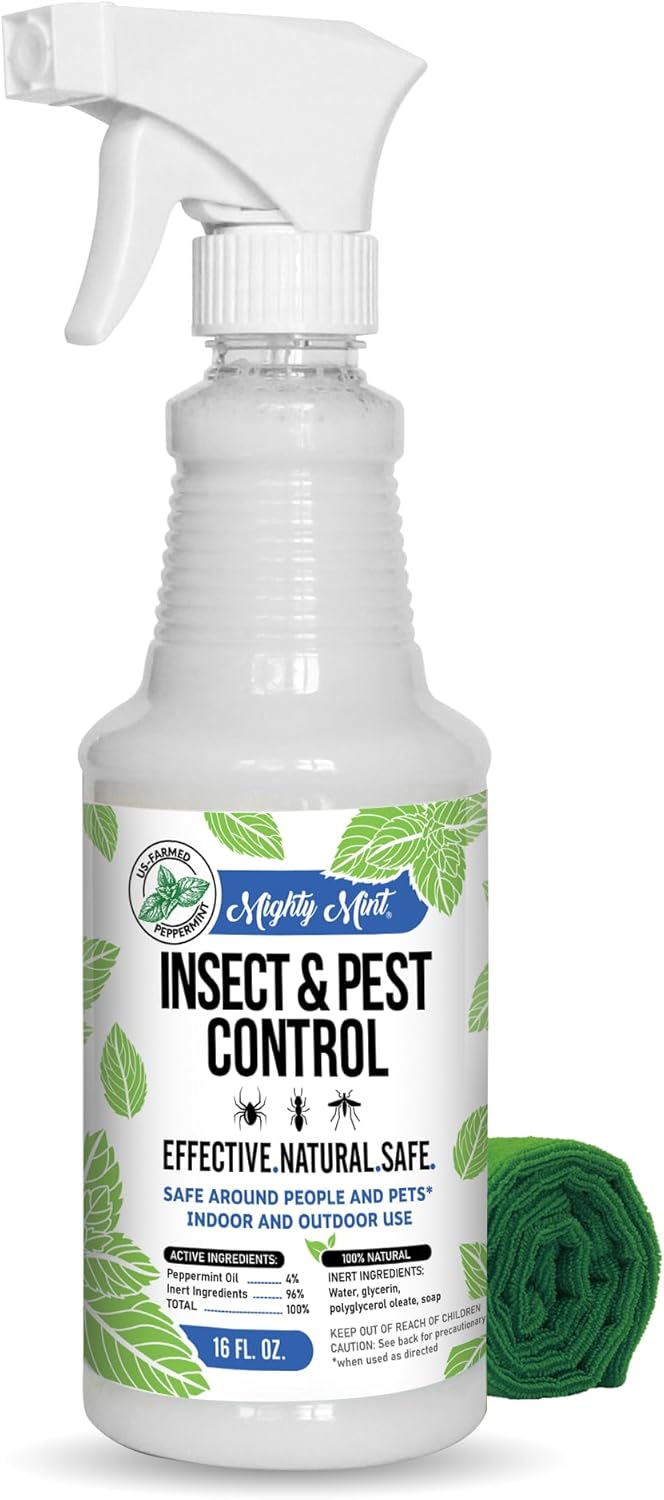
| Volume | 16 oz |
|---|---|
| Ingredients | Water, Glycerine, Polyglycerol oleate, Soap, Peppermint oil |
| Use Areas | Indoor / Outdoor |
| Pests | Spiders, Ants, Roaches and other common insects |
Mighty Mint Peppermint Oil Insect Repellent is a plant-based, ready-to-use spray for spot treating areas where spiders, ants, roaches and other common pests appear. You use it the same way as conventional sprays: shake, aim at baseboards, entry points, patios or around storage and spray until the surface is covered; repeat applications a couple times per week for maintenance. The formula lists water, glycerine, surfactants and concentrated peppermint oil, which gives the product its repellent action and a noticeable mint scent. Practical benefits include a non-toxic profile for household use when applied as directed and no synthetic fragrance, making it suitable around scent-sensitive people and many pets once surfaces are dry. Important limitations are that it is a deterrent rather than a contact kill in most cases and needs repeated application to keep pests away; the label also warns not to apply when pollinators are present and to avoid skin contact and ingestion. For localized, natural pest control this is an easy, low-odor option, but it is not a one-time fix for established infestations.
Best for: Buyers who prioritize natural, low-toxicity pest control and want a spray they can use for spot treatments around the home and outdoor thresholds with minimal harsh fumes.
Less Ideal for: People facing large or entrenched infestations who need fast-acting lethal treatments or long-duration residual protection should consider stronger pest-control methods.
- Plant-based formula using concentrated peppermint oil for a natural repellent effect
- Ready-to-use spray bottle for targeted, quick applications
- Suitable for indoor and outdoor use on baseboards, entryways and patios
- Mild, natural scent that is generally pleasant and less harsh than chemical sprays
- Requires repeat applications for ongoing protection rather than a long-lasting chemical barrier
- Not intended for direct skin application and should not be used where pollinators are active
Verdict: A convenient, plant-based spray for people seeking a low-toxicity, peppermint-scented way to deter common household pests with targeted spot treatments.
Garden Safe Insecticidal Soap Ready-to-Use Spray, 32 oz

| Item Form | Spray |
|---|---|
| Target Species | Insects |
| Liquid Volume | 32 fluid ounces |
| Active Ingredients | Potassium Salts Of Fatty Acids |
Garden Safe Insecticidal Soap is a ready-to-use contact spray formulated with potassium salts of fatty acids to control soft-bodied pests such as aphids, mealybugs, mites, whiteflies and thrips. You use it by thoroughly spraying affected plant parts, including undersides of leaves, and pests must be hit directly to be controlled. It is safe for use on vegetables, fruit trees, ornamentals, shrubs, flowers and in greenhouses, and the label allows application to edibles up to the day of harvest which simplifies treatment timing for food crops. The bottle requires no mixing and is convenient for small- to medium-scale garden patches, but because it works by contact you may need repeated applications for new infestations and heavy outbreaks. The product notes environmental precautions for aquatic invertebrates and stresses avoiding application in windy conditions or before rain, so plan treatments accordingly. For gardeners looking for a low-residue, soap-based option, this is a straightforward, easy-to-use choice.
Best for: Gardeners who prioritize low-residue, familiar soap-based pest control and want a simple, ready-to-use spray for vegetables, fruit trees and ornamentals that can be applied up to harvest.
Less Ideal for: People needing a systemic or long-lasting solution for severe infestations or for pests that hide inside plant tissues or soil.
- Ready-to-use formula with no mixing required for quick spot treatments
- Labeled for use on vegetables and fruit up to the day of harvest
- Effective on common soft-bodied pests when sprayed directly
- Works safely in greenhouses and on ornamentals as well as edible plants
- Contact-only mode means it will not control pests hidden inside buds or in soil
- Requires repeated applications to manage heavy or ongoing infestations
- Hazardous to aquatic invertebrates so care is needed near water
Verdict: A straightforward, ready-to-use soap spray for gardeners who want a low-residue contact treatment safe for use on edibles through harvest.
Choosing the Right Natural Insecticide Spray: Key Factors to Consider
Mode of Action and Target Pests
Natural sprays work by different mechanisms: some are contact poisons that desiccate soft-bodied insects, others disrupt insect nervous systems in ways considered low risk to vertebrates, and a few act as repellents. Knowing the mode of action helps you match a spray to the pest you actually have.
For example, aphids and whiteflies are usually controlled by contact-acting botanical oils or insecticidal soaps, while certain botanical extracts may work better as repellents for beetles. Choosing the right mode reduces wasted applications and lowers chances of developing pest tolerance.
Plant Compatibility and Phytotoxicity
Many natural sprays can stress plants if applied at the wrong concentration, in hot sun, or to sensitive species. Oils and soaps are commonly associated with leaf burn on tender growth and some ornamentals, and certain botanical extracts can discolor fruit skins or thin cuticles.
Always consider whether the product is labeled safe for edibles and do a small spot test before broad application. Timing applications for cooler parts of the day and avoiding use on drought-stressed plants reduces phytotoxic risk.
Persistence and Weather Resistance
How long a spray remains active affects both efficacy and reapplication frequency. Many natural formulations have short residual life because they break down quickly in sunlight or wash off in rain. That can be desirable to limit non-target exposure but means more frequent applications when pest pressure is high.
Assess the expected persistence and plan sprays around weather forecasts. Some products include adjuvants that improve rain resistance; others recommend repeat treatments every few days until control is achieved.
Effect on Beneficial Insects and Pollinators
One main reason gardeners choose natural sprays is to protect beneficial insects. However, not all natural products spare beneficials. Broad-contact materials can kill predator mites, parasitic wasps, and bees if applied when pollinators are active.
Select sprays with lower toxicity to pollinators or use application methods and timing that reduce exposure, such as evening sprays and spot treatments. Protecting beneficials preserves natural pest control and reduces long-term reliance on repeated applications.
Ease of Use and Mixing Accuracy
Gardeners need products they can measure and apply reliably. Concentrates that require precise dilution increase the chance of underdosing or causing phytotoxicity. Ready-to-use bottles are simpler for spot treatments, while concentrates can be economical for large plantings if mixing instructions are clear.
Look for clear labels, measuring aids, and sturdy sprayer hardware. Products that foam or clog nozzle filters should be avoided for routine use because they complicate application and maintenance.
Residue Concerns and Harvest Intervals
When using sprays on vegetables and herbs, residue and pre-harvest intervals matter. Some natural ingredients degrade quickly and have short or no required wait times, while others advise a buffer before harvest.
Review label directions about re-entry and harvest timing and choose sprays compatible with your cropping and harvest schedule. Shorter intervals make a product more practical for frequent-harvest crops like salad greens or herbs.
Best Application Timing and Technique
Timing and spray technique determine whether a natural insecticide gives control or just a brief knockback. Apply in the early morning or late evening when temperatures are cooler and pollinators are less active. That reduces leaf burn and non-target exposure while improving coverage of pests hiding under leaves.
Use thorough, even coverage of the undersides of leaves where many pests hide. For dense plants, thinning foliage or spot-treating heavily infested areas concentrates material where it is needed and lowers overall exposure to beneficials.
- Avoid spraying in direct midday sun or during heat stress.
- Target spray to the lower leaf surfaces and stem crevices.
- Repeat applications at labeled intervals rather than increasing concentration.
Integrating Natural Sprays Into IPM
Natural sprays work best as one tool within integrated pest management. Start with monitoring to identify pest species and threshold levels. Pair sprays with cultural controls such as row covers, pruning to improve airflow, and planting pest-resistant varieties.
Reserve sprays for thresholds where pest numbers are likely to cause economic or aesthetic damage. Use selective sprays and timing that preserve predators and parasitic insects to keep pest populations suppressed between treatments.
- Scout weekly for early infestations.
- Encourage predators by providing habitat and avoiding broad-spray calendars.
- Combine cultural tactics with targeted spray interventions.
Safety and Personal Protective Practices
Even natural insecticides can irritate skin or eyes and have label-required protective measures. Wear gloves, eye protection, and follow the product label for recommended clothing and re-entry intervals. Avoid inhalation of fine sprays and mist.
Store concentrates out of reach of children and pets and clearly label any mixed spray leftover in a closed container. Rinse sprayers and tools after use to prevent accidental cross-contamination with other garden products.
- Read and follow label PPE and first-aid instructions.
- Mix outdoors or in well-ventilated areas.
- Dispose of rinsate according to local guidelines.
Environmental Considerations and Water Safety
Some botanical ingredients can be toxic to aquatic life even at low concentrations. Avoid spraying near ponds, streams, and storm drains. Be mindful of runoff from treated areas during heavy rain.
Select products with ingredients that rapidly break down in soil and water when your garden borders sensitive habitats. Buffer zones and careful application reduce off-target impacts and protect local wildlife.
- Maintain a 10 to 20 foot buffer from water bodies when possible.
- Do not apply before heavy rain is forecast.
- Use targeted spot applications rather than blanket sprays near habitats.
Storage, Shelf Life, and Mixing Tips
Natural concentrates vary in stability. Store products in a cool, dark place and avoid temperature extremes to maintain potency. Check the label for recommended shelf life after opening.
When mixing, measure carefully and use clean water. Add the concentrate to water rather than water to concentrate when instructed. Label any mixed solution with dilution rate and date and discard unused mix after the recommended period.
- Keep sprayers dedicated to insecticidal use and rinse after each job.
- Record dilution and application dates for repeat treatments.
- Discard old or discolored concentrates that show separation.
How We Chose the Best Natural Insecticide Spray
We evaluated products that are marketed as botanical or naturally derived sprays and measured them against criteria that matter in an active garden. Key evaluation dimensions included immediate knockdown of common soft-bodied pests, contact versus systemic action, plant-safety across ornamentals and edible crops, persistence under sun and rain, and effects on non-target beneficial insects. We also considered user-friendly factors such as ease of mixing and application, clarity of label instructions, and compatibility with integrated pest management practices. Exclusions: products that rely on synthetic neurotoxic chemistries, those intended only for indoor pest control, and concentrates without clear dilution or safety instructions were excluded. We prioritized sprays with transparent ingredient lists and documented modes of action used safely in home gardens. The resulting selection favors options that balance effective pest control with minimal ecological disruption and straightforward application for backyard gardeners.
FAQ
Are natural insecticide sprays safe to use on vegetables?
Often yes, but it depends on the ingredient and label directions. Many botanical oils and soaps are approved for use on edibles with short or no harvest intervals, while other extracts may advise a wait. Always follow label instructions and test a small area first.
Will natural sprays harm bees and other pollinators?
They can if applied when pollinators are active or if the material is broad-contact. Use evening applications, avoid bloom-targeted sprays, and select products with lower toxicity to pollinators to reduce risk.
How often do I need to reapply natural insecticide sprays?
Reapplication frequency depends on persistence and pest pressure. Many natural sprays require repeat treatments every 3 to 7 days during heavy infestations. Check product directions and adjust timing around weather and observed control.
Can I mix different natural sprays together?
Mixing is sometimes possible but not always safe. Check labels for compatibility and perform a small jar test before tank-mixing. When in doubt, apply different products separately on different days to avoid phytotoxicity.
Do natural insecticide sprays control all garden pests?
No. Natural sprays are generally most effective against soft-bodied pests like aphids, whiteflies, and mites. Hard-shelled beetles, certain caterpillars, and soil-dwelling pests often require other tactics or targeted products.
Are ready-to-use bottles better than concentrates?
Ready-to-use bottles are convenient for spot treatments and small gardens, while concentrates can be economical for larger plantings if mixed accurately. Choose based on the area you treat and your comfort with measuring and mixing.
Final Verdict
When selecting a natural insecticide spray, prioritize matching the mode of action to the pest, confirming plant safety for ornamentals and edibles, and choosing application timing that protects beneficial insects. Expect tradeoffs between rapid knockdown and short residual activity; shorter persistence reduces non-target harm but increases reapplication needs. Make decisions based on the pests present, your garden layout, and how often you can scout and spray. Focus on targeted, well-timed use and preserving natural predators for the most sustainable, effective pest control.
