

Note: This article contains affiliate links. If you click on these links and make a purchase, I may earn a small commission at no extra cost to you. This helps support my research and content. Read my full affiliate disclosure here.
Choosing the right double ended grow light matters when you need deep canopy penetration, consistent spectrum, and reliable run times in an indoor garden. These fixtures deliver higher output than many single-ended units, but they also demand attention to heat, mounting, and ballast compatibility. This guide shortlists six top options and explains the practical differences that matter in a grow tent, small room, or commercial bench. We evaluate each light for output, heat management, durability, and ease of installation so you can match a fixture to your space and crop. Read on for a concise breakdown of the technical considerations before the product list.
Top Picks at a Glance
| Best Overall The best all-around choice for most situations | Plantmax PX-LU1000/DE Double-Ended 1000W High Pressure Sodium Grow Lamp |  |
| Best Quality Built to a higher standard if you want something more solid | Ushio Pro-Plus Double-Ended 1000W HPS Grow Lamp |  |
| Best Value The sweet spot between price and what you get | YauldSun DE HPS1000 Double-Ended 1000W HPS Grow Light Bulb |  |
| Best Budget The cheapest option that still gets the job done reliably | Silk Road Greenhouse 1000W Double-Ended HPS Grow Light Bulb (2000K) |  |
| Highest Rated A top-rated pick with lots of positive feedback | Vegelumax Double-Ended 1000W Metal Halide Grow Bulb (6000K) — 6-Pack |  |
| Most Popular A crowd favorite that many people choose with confidence | iGrowtek 1000W Double-Ended HPS Grow Light Bulb (2000K) |  |
Plantmax PX-LU1000/DE Double-Ended 1000W High Pressure Sodium Grow Lamp

| Light Type | HPS |
|---|---|
| Wattage | 1000 watts |
| Color Temperature | 2000 Kelvin |
| Light Source Operating Life | 20000 hours |
| White Brightness | 140000 lumens |
The Plantmax PX-LU1000/DE is a double-ended 1000W HPS lamp built for indoor grow rooms and commercial reflecting fixtures. It produces very high initial lumens (listed around 140000–150000) at a warm 2000 K color temperature, which supports strong flowering and fruiting phases where HPS spectra excel. The double-ended design improves arc stability and reflector efficiency compared with single-ended bulbs, and the rated 20,000 hour operating life reduces the frequency of replacements for steady runs. Practical use is straightforward: install in a compatible double-ended fixture and ballast, run for bloom-cycle schedules, and expect robust lumen maintenance over time. Limitations are inherent to HPS technology: it runs hot, consumes 1000 watts continuously, and requires appropriate ballast, venting, and cooling. It also lacks the broader spectrum of modern LED fixtures, so growers focused on full-spectrum or lower energy consumption may prefer alternatives.
Best for: Growers who want a proven, high-output bloom lamp for dedicated indoor flowering spaces and who prioritize raw light intensity and lumen maintenance over lowest energy use.
Less Ideal for: Small hobbyists with limited ventilation or anyone seeking full-spectrum, energy-efficient LED solutions for mixed-stage growing.
- Very high initial lumen output suited for heavy-flowering stages
- Double-ended construction improves reflector efficiency and arc stability
- Long rated operating life of 20,000 hours reduces replacement frequency
- Commercial-grade build intended for professional grow fixtures
- Consumes 1000 watts and generates substantial heat requiring active cooling
- Requires a compatible double-ended ballast and fixture rather than plug-and-play bulbs
Verdict: Choose this double-ended 1000W HPS lamp when you need maximum bloom-phase light output and long lumen life in a commercial-style indoor grow setup.
Ushio Pro-Plus Double-Ended 1000W HPS Grow Lamp

| Light Type | HPS |
|---|---|
| Wattage | 1000 watts |
| Color Temperature | 2200 Kelvin |
| Indoor Outdoor Usage | Indoor |
The Ushio Pro-Plus double-ended 1000W HPS lamp is built for growers who need high light output from a single bulb in compact DE fixtures. It produces a warm 2200K spectrum with strong red and measured blue components to support flowering and maintain sturdier vegetative growth compared with older HPS designs. The lamp is specified to deliver high PAR (about 2100 micromole/s) and is made in Germany in an ISO9001 facility, which suggests consistent manufacturing and long life. Typical use is in commercial or advanced hobbyist indoor setups where a DE 1000W fits existing ballast and reflector systems; it suits situations that prioritize maximum lumen and PAR per fixture over lower-wattage flexibility. Limitations are the fixed HPS spectrum and 1000W power draw, which mean higher heat and energy consumption than LED alternatives and no spectrum tuning. It also requires compatible double-ended ballasts and proper ventilation to manage temperature and safety.
Best for: Experienced indoor growers and commercial operators who prioritize maximum PAR and reliable DE HPS performance for high-yield flowering runs.
Less Ideal for: Casual hobbyists, small-space growers, or anyone seeking lower energy consumption and adjustable spectrums should consider LED alternatives instead.
- High PAR output (listed ~2100 micromole/s) for strong photosynthetic performance
- Engineered in an ISO9001 facility and made in Germany for consistent build quality
- Double-ended design offers stable arc and efficient lumen delivery in DE fixtures
- Economical long life and high lumen output for sustained indoor production
- Fixed HPS spectrum and high 1000W power draw generate more heat and energy use than LEDs
- Requires compatible double-ended ballast and proper ventilation for safe operation
Verdict: Choose this Ushio DE 1000W HPS when you need maximum PAR and proven, consistent performance from a double-ended lamp for high-output flowering setups.
YauldSun DE HPS1000 Double-Ended 1000W HPS Grow Light Bulb

| Light Type | HPS |
|---|---|
| Wattage | 1000 watts |
| Color Temperature | 2100 Kelvin |
| Light Source Operating Life | 24000 hours |
| Indoor Outdoor Usage | Indoor |
The YauldSun DE HPS1000 is a double-ended 1000W HPS lamp built to push intense red-orange light for flowering and fruiting stages. It is used in enclosed grow fixtures with compatible DE sockets and offers very high lumen and PAR output for heavy feeders or larger canopy areas. Notable features include the DE construction for more even light distribution, a quoted 151,000 lumens output and a 2100K color temperature tuned toward bloom, plus an operating life listed at 24,000 hours. In practice this bulb will increase flowering density compared with lower-output bulbs and can replace single-ended HPS setups to raise usable light per watt. Trade-offs are the high power draw and need for proper ballasts, fixtures, and ventilation because it produces substantial heat, and it requires DE-specific sockets. The bulb is glass and elongated, so handle carefully during installation and disposal. For growers optimizing yield per fixture this is a straightforward high-output HPS option; for small hobby setups the installation and heat management demands may be disproportionate.
Best for: Growers who prioritize maximizing flowering and yield from DE HPS fixtures and who can provide proper ballasts, fixtures, and ventilation infrastructure.
Less Ideal for: Casual hobbyists or small apartments lacking the electrical, cooling, or fixture requirements for a high-power HPS lamp should consider lower-power or LED alternatives.
- Double-ended design for more even, higher-quality light output compared with single-ended HPS bulbs
- Very high lumen and PAR output suited to flowering and heavy-feeding plants
- Longoretical operating life listed at 24,000 hours reduces replacement frequency
- Requires compatible double-ended sockets and appropriate ballasts not included
- High heat and power draw demand robust ventilation and electrical capacity
Verdict: Choose this double-ended 1000W HPS bulb when you need high-PAR, bloom-focused light to push larger flowering yields from a properly equipped DE HPS setup.
Silk Road Greenhouse 1000W Double-Ended HPS Grow Light Bulb (2000K)
| Light Type | HPS |
|---|---|
| Wattage | 1000 watts |
| Bulb Base | GX53 |
| Color Temperature | 2000 Kelvin |
| Light Output Maximum | 90000 lumens |
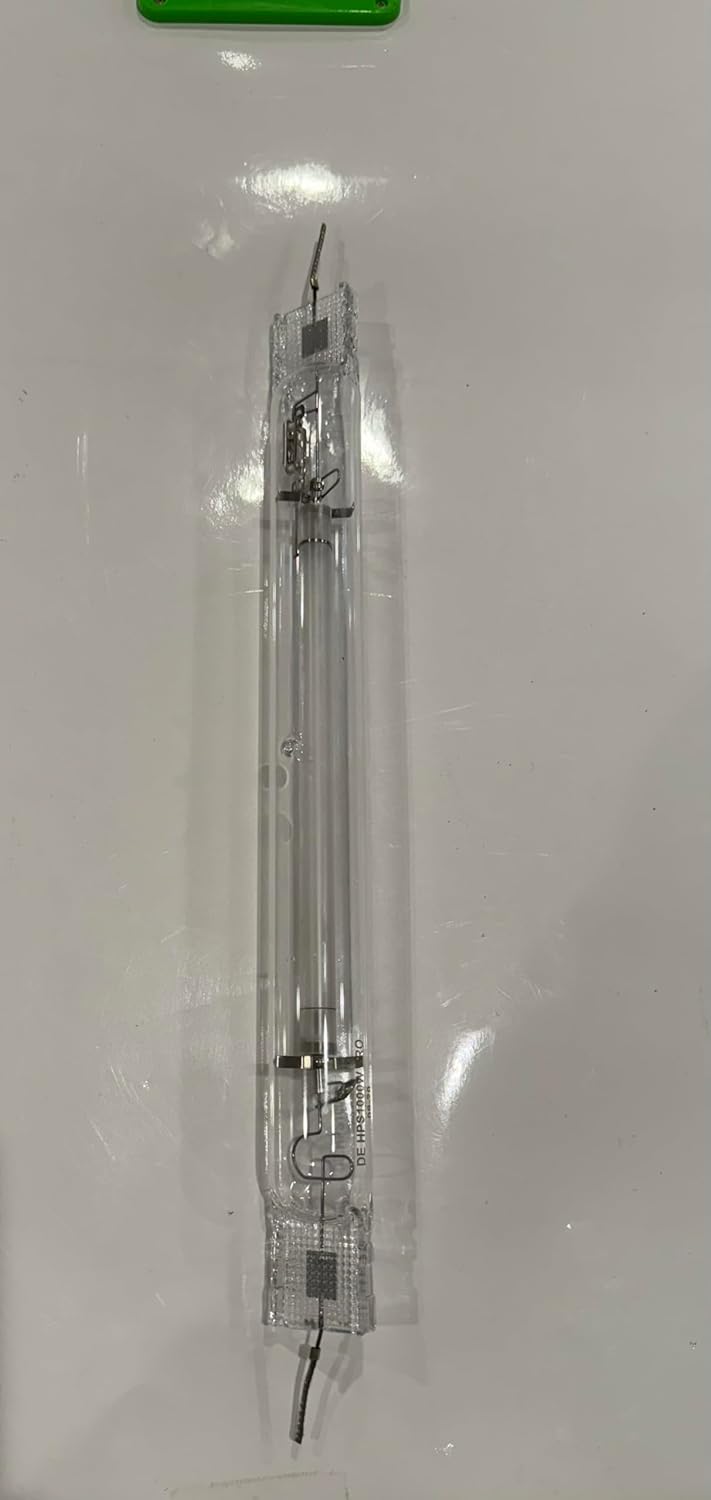
This Silk Road Greenhouse 1000W double-ended HPS bulb is designed to push flowering and fruiting with a warm 2000K spectrum and very high light output. Installed in a compatible DE fixture, it produces strong red and yellow spectra that encourage bloom development and higher metabolic activity in mature plants. The bulb is shock resistant with a GX53-style double-ended base and is intended for indoor grow rooms and greenhouse racks where concentrated PAR during flower is the priority. Practical benefits include high lumen output for dense canopies and a spectrum tuned for flowering, plus a glass/quartz envelope that preserves light quality. Limitations are typical of DE HPS technology: it runs hot, requires a ballast and DE fixture, and is less efficient at vegetative blue-light needs than some CMH or LED options. For budget-focused growers wanting robust flowering light without changing fixtures, this is a straightforward high-output choice, but expect higher heat and electrical draw compared with modern LEDs.
Best for: Growers on a tight budget who already own a DE fixture or ballast and want a high-intensity bulb to maximize flowering and yield in indoor or greenhouse setups.
Less Ideal for: Growers starting from scratch who prefer lower-heat, lower-power systems or those prioritizing vegetative blue-spectrum lighting should consider CMH or LED alternatives.
- High 1000W output delivers strong light intensity suitable for flowering phases
- Warm 2000K spectrum emphasizes red/yellow wavelengths that support bud and flower development
- Shock resistant glass construction and double-ended base for stable performance in DE fixtures
- Produces significant heat and requires proper ventilation and a compatible DE ballast
- Less balanced for vegetative growth compared with technologies with higher blue light content
Verdict: If you need a cost-effective, high-intensity DE bulb to boost flowering in an existing double-ended setup, this 1000W HPS is a simple and powerful choice.
Vegelumax Double-Ended 1000W Metal Halide Grow Bulb (6000K) — 6-Pack

| Wattage | 1000 watts |
|---|---|
| Color Temperature | 6000 Kelvin |
| Light Output Maximum | 95000 lumens |
| Photon flux | 1350 μmol/s |
| Indoor Outdoor Usage | Indoor |
The Vegelumax 1000W double-ended metal halide bulbs are built for serious vegetative-stage lighting in commercial or large home grows. Each bulb delivers very high initial lumen output (about 95,000 lumens) and a horticulture-focused spectrum at 6000K to encourage compact, bushy growth and strong photosynthetic performance. They are intended for use with compatible double-ended fixtures and high-frequency electronic ballasts and are rated for horizontal burning. Notable features include high photon flux (about 1350 μmol/s), quartz construction for consistent spectral output, pulse-start capability and a claimed long usable life with most lumen retention through thousands of hours. Practical benefits are even light distribution from both ends and a spectrum optimized for vegetative vigor, which helps when uniform canopy coverage matters. Important limitations are the need for a DE-rated ballast and fixture, horizontal orientation requirements, and the high power and heat load that suit larger, well-ventilated setups rather than small tents or casual hobbyists. Handle carefully and avoid direct contact with bare hands to protect the lamp envelope.
Best for: Growers who prioritize consistent, high-output vegetative lighting for medium to large indoor grows and who maintain ballasts and fixtures to industry standards.
Less Ideal for: Casual hobbyists with small tents, growers without DE-compatible ballasts, or anyone lacking adequate ventilation and electrical infrastructure.
- High initial lumen output (~95,000 lumens) and strong PAR performance for dense vegetative growth.
- Double-ended design provides more even illumination and about 10% more usable energy than single-ended MH bulbs.
- Quartz construction and pulse-start capability support stable spectral output and reliable ignition with compatible ballasts.
- Designed spectrum (6000K) encourages short internodal spacing and bushy plant structure.
- Requires a double-ended compatible fixture and high-frequency electronic ballast; not plug-and-play with standard sockets.
- High wattage produces significant heat and power draw, needing robust ventilation and electrical capacity.
Verdict: If you need reliable, high-output vegetative lighting for a large indoor grow, this double-ended 1000W MH bulb delivers consistent spectrum and strong PAR where dependability matters.
iGrowtek 1000W Double-Ended HPS Grow Light Bulb (2000K)
| Wattage | 1000 watts |
|---|---|
| Color Temperature | 2000 Kelvin |
| Light Type | HPS |
| White Brightness | 155000 lumens |
| Light Source Operating Life | 15000 hours |
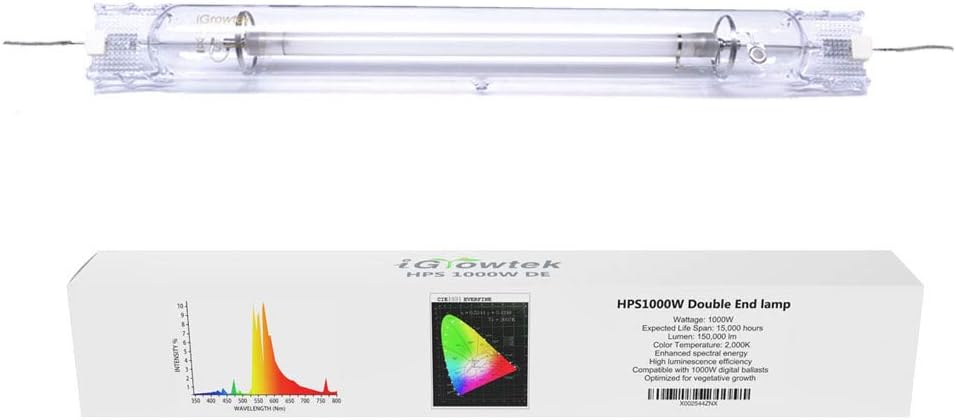
This iGrowtek 1000W double-ended HPS bulb is built for greenhouse and indoor flowering applications where strong red-yellow light and high PAR are desired. It installs into standard K12*30S DE fixtures and is intended to run on compatible 1000W digital ballasts. The lamp produces very high lumen output and PAR (listed as 155000 lm and about 2000 umol/s), making it capable of driving photosynthesis across larger canopy areas so fewer fixtures may be needed. Rated life is around 15,000 hours with high lumen maintenance early in life, and the quartz glass construction is typical for HID bulbs. Practical considerations: it requires appropriate DE fixtures, a matching ballast and safety gear when handling, and it emits a warm spectrum that favors flowering rather than vegetative growth. Expect heat output and the need for ventilation and correct lamp disposal. This is a straightforward, no-frills HPS option for growers who prioritize floral-stage light intensity over the broader spectrum benefits of modern LEDs.
Best for: Growers running DE HID fixtures who need high-intensity, flowering-stage light for greenhouse or indoor setups and who prefer proven HPS performance over newer lamp technologies.
Less Ideal for: Casual hobbyists with small tents or growers seeking cooler full-spectrum light for vegetative growth should consider LED solutions instead.
- High PAR output suitable for flowering and dense canopy coverage
- High luminous efficiency (listed 155 lm/W) for strong light per watt
- Standard K12*30S double-ended base fits common 1000W DE fixtures
- Long rated operating life (around 15,000 hours) with good lumen maintenance
- Requires a compatible 1000W DE ballast and fixture so not plug-and-play in non-DE setups
- Generates substantial heat and needs ventilation and appropriate safety measures
- Warm 2000K spectrum is optimized for flowering and less ideal for early vegetative stages
Verdict: Choose this if you want a high-output, reliable 1000W double-ended HPS bulb expressly tuned to maximize flowering yields.
Choosing the Right Double Ended Grow Light: Key Factors to Consider
Light Output and Spectrum
Total photon output and the spectral distribution determine how effectively a lamp drives photosynthesis. Higher PPF (photosynthetic photon flux) numbers mean more usable light for the canopy, but spectrum balance affects growth stages. A lamp with strong blue and red components supports vegetative and flowering phases respectively, while a fuller spectrum can improve overall plant health.
Consider how the stated PPF relates to the area you need to cover. Manufacturers sometimes quote peak output at short test distances; in practice you should match output to your canopy depth and fixture height to avoid light loss and uneven development.
Canopy Penetration and Beam Spread
Canopy penetration is how well light reaches lower leaves and inner bud sites. Double ended lamps tend to have tighter beam spreads and higher center intensity, which increases penetration compared with many single-ended designs. That helps thicker canopies and taller plants receive quality light below the top layer.
Beam angle and reflector design change how evenly light distributes across a bed or tent. A tight beam maximizes penetration but may reduce uniformity at wider distances, so match reflector geometry to your spacing and plant layout.
Heat Output and Thermal Management
High-output lamps generate substantial heat. Effective thermal management prevents heat stress on plants and prolongs component life. Look at fixture cooling measures such as forced-air designs, high-conductivity reflectors, and enough clearance for airflow. If using lights in a tent, calculate how the lamp will interact with your ventilation so temperatures remain within the crop's preferred range.
Also consider how heat affects surrounding equipment and the need for additional exhaust capacity. Better-cooled fixtures often sustain higher output without accelerated lumen depreciation.
Fixture Construction and Longevity
The mechanical quality of the housing, reflector finish, and socket connections affects longevity and consistent performance. Corrosion-resistant materials and secure mounting points reduce maintenance and avoid misalignment that degrades light distribution. Durable wiring and quality sockets help prevent intermittent failures under daily on-off cycles.
Longer rated lamp life or manufacturer specs for operating hours give a sense of expected service life, but actual longevity depends on cooling and operating environment.
Electrical Compatibility and Safety
Double ended lamps frequently require specific ballasts or drivers. Confirm that the fixture you choose is compatible with your existing electrical setup and that it adheres to safety standards for continuous use. Look for proper grounding, secure connectors, and thermal protections. Miswired or incompatible components increase fire risk and hurt lamp performance.
If you plan to retrofit an existing ballast, verify wiring diagrams and connectors so you do not create an unsafe configuration.
Installation Flexibility and Mounting
Mounting options and fixture weight affect where and how you can use a lamp. Rigging hardware, adjustable hangers, and low-profile designs help place the light at optimal heights for different growth phases. Ease of bulb replacement, ballast access, and serviceability also matter when you run multiple fixtures and need quick maintenance.
Consider whether the fixture works with common tent rails, ceiling mounts, or commercial racking to avoid custom rigging that adds time and cost.
Sizing Your Lighting to Grow Space
Measure your canopy and decide target photon density for the crop. Different plants and growth stages need different average PPFD (photosynthetic photon flux density). For dense or tall canopies, aim for higher center intensity and better penetration rather than simply covering area with lower-output fixtures.
- Map usable canopy square footage after accounting for walkways and edge drop-off
- Plan fixture spacing so peak beams overlap for uniformity
- Factor in adjustable height to raise or lower intensity through the cycle
Mounting and Orientation Tips
Place fixtures to balance penetration and uniformity. Taller plants benefit from a slightly narrower beam and closer placement during bloom, while seedlings need lower intensity and a wider spread. Use sturdy hangers and measure light at canopy height after installation to fine-tune positioning.
- Use ratchet hangers for quick height changes
- Avoid mounting near reflective tent walls without testing for hotspots
- Allow clearance for air circulation around the fixture
Managing Heat in Confined Spaces
In tents and small rooms, heat quickly becomes the limiting factor. Pair high-output lamps with an exhaust that can handle the extra BTUs, and keep thermostat or probe placement representative of the canopy microclimate rather than the ceiling hot spot. When ventilation is marginal, choose fixtures with improved thermal designs or consider supplemental inline cooling.
- Monitor canopy-level temperature and humidity, not just ambient air at ceiling height
- Place ducting to remove heat at the fixture level when possible
- Use oscillating fans to reduce heat stratification within the canopy
Balancing Penetration and Uniformity
High center intensity improves lower canopy growth but can create uneven edges. For wider benches, combine fixtures with slightly overlapping beams to reduce variance. Alternatively, use more fixtures at lower individual intensity to get even spread while sacrificing some penetration depth.
- Stagger fixtures to smooth out hot and cold spots
- Measure PPFD grid to verify evenness across the bed
- Adjust fixture height incrementally and retest light maps
Maintenance and Replacement Considerations
Plan for accessible bulbs and sockets so that routine replacement is quick and safe. Keep spare bulbs, and track operating hours to rotate or replace lamps before significant lumen depreciation. Regularly inspect reflectors and electrical connections for dust build-up or corrosion that reduces output and safety.
- Keep a log of runtime hours per fixture
- Clean reflectors with a soft, dry cloth to maintain reflectivity
- Schedule annual electrical checks if fixtures run constantly
How We Chose the Best Double Ended Grow Light
We focused on attributes that actually affect performance and usability in real indoor gardens. Our editorial filters prioritized raw light output and spectral stability because those determine how deeply light reaches the canopy and how plants respond across growth stages. Thermal behavior and cooling design were treated as first-order concerns since uncontrolled heat shortens lamp life and stresses plants. Build quality and electrical safety were required to ensure stable operation under continuous schedules. Ease of installation and compatibility with common ballasts or drivers helped narrow candidates to lights that fit standard rigs. Reliability and rated lamp life were included to favor fixtures that maintain output over multiple cycles. We excluded experimental or prototype units, lights without clear technical specifications, and products lacking basic safety certifications. The final list balances high photon delivery, manageable heat, mechanical durability, and straightforward integration into common indoor setups.
FAQ
How high should I hang a double ended grow light above the canopy?
Height depends on lamp output and plant stage. Start higher during seedlings and lower gradually during vegetative and bloom phases. Always monitor PPFD and canopy temperature after changes and allow at least a few inches of clearance for heat dissipation.
Do double ended lights use special ballasts or drivers?
Often they require ballasts rated for double ended lamps or compatible electronic drivers. Check manufacturer specifications for compatibility. Using the wrong ballast can reduce performance or create safety issues.
Can I use double ended lights in a small grow tent?
You can, but heat and beam intensity must be managed carefully. Ensure your ventilation can remove the extra heat load and that light intensity is adjustable so young plants are not stressed by high center intensity.
Are double ended lamps more efficient than single ended fixtures?
They typically deliver higher photon flux and better canopy penetration per lamp, which can improve photon delivery to lower canopy levels. Efficiency depends on the overall system design, including ballast efficiency and cooling.
How often should I replace double ended bulbs?
Bulb life varies, but replace bulbs according to rated operating hours or when you notice measurable lumen decline. Tracking run hours helps you swap bulbs before output falls significantly.
Will double ended lights damage lower leaves from heat?
They can if mounted too close or without proper ventilation. Maintain adequate air flow and monitor canopy temperature to prevent heat stress and leaf burn.
Final Verdict
Double ended grow lights are a strong choice when canopy penetration and consistent spectrum are top priorities. Prioritize fixtures with verified photon output, good thermal management, and clear electrical compatibility so you can run them safely in your specific setup. Tradeoffs often fall between peak penetration and even coverage, so match beam geometry and spacing to your plant layout and ventilation capacity. With proper mounting, cooling, and maintenance, a double ended fixture can deliver robust light to deeper parts of the canopy and support higher yields in well-ventilated indoor gardens.
