

Note: This article contains affiliate links. If you click on these links and make a purchase, I may earn a small commission at no extra cost to you. This helps support my research and content. Read my full affiliate disclosure here.
If you keep houseplants, start seedlings, or run a small indoor patch, the right grow light makes a noticeable difference in plant health and consistency. Homeowner-focused grow lights balance footprint, energy use, and spectral output so you get vigorous growth without a complicated setup. This guide covers seven shortlisted options chosen for typical home conditions-from limited counter space to mixed plant types. We evaluate each pick for light spectrum, energy use, heat management, and user-friendly controls to help you match a light to your space and plants. Read on for practical guidance on what will work best in a home environment.
Top Picks at a Glance
| Best Overall The best all-around choice for most situations | VIPARSPECTRA P700 70W Dimmable Full Spectrum LED Grow Light |  |
| Best Quality Built to a higher standard if you want something more solid | VIVOSUN LumaLight 100W LED Full Spectrum Grow Light |  |
| Best Value The sweet spot between price and what you get | bseah Full Spectrum LED Grow Light for Indoor Plants (2-Tube, 10W) |  |
| Best Budget The cheapest option that still gets the job done reliably | DOMMIA Under-Shelf USB LED Grow Light Panel, 2-Pack |  |
| Highest Rated A top-rated pick with lots of positive feedback | GLOWRIUM Full-Spectrum Smart LED Grow Light (Freestanding Desk Lamp) |  |
| Most Popular A crowd favorite that many people choose with confidence | GooingTop HY-021 6000K Full-Spectrum Clip Grow Light |  |
| Best Seller A high-volume bestseller chosen again and again | Briignite A19 Full Spectrum LED Grow Light Bulb (2-Pack) |  |
VIPARSPECTRA P700 70W Dimmable Full Spectrum LED Grow Light

| Light Output Maximum | 11000 lumens |
|---|---|
| Light Source Wattage | 70 watts |
| Mounting Type | Hanging Mount |
| Light Source Special Features | Dimmable |
| Number of Light Sources | 216 |
The VIPARSPECTRA P700 is a 70W full spectrum LED grow light built for seed starting and vegetative stages. It uses 216 diodes and a tuned mix of red and white LEDs to deliver high PAR output (advertised 11,000 lumens) across a small footprint roughly suited to a 2×2 ft veg area. The light is fanless and relies on large aluminum heat sinks to keep running temperatures low while the included 4-level dimmer lets you dial intensity for seedlings, clones, or mature veg. Setup is simple with hanging mount hardware included and the unit draws about 0.65 A at 120V so it runs far cooler and uses far less power than a comparable 150W HPS/MH system. For compact tents, shelves, or single-cabinet grows it offers a good balance of light output, spectrum, and efficiency. Limitations are its small coverage area and modest absolute wattage compared with larger fixtures, so gardeners with bigger canopies will want a higher-output model or multiple units.
Best for: Growers who want an efficient, low-heat fixture to run a single tent, shelf, or cabinet and who prioritize electricity savings and adjustable output for seedlings and veg.
Less Ideal for: Commercial growers or hobbyists running multi-plant canopies or larger tents who need wider coverage and higher total light output.
- Full spectrum diode layout optimized for seedlings and vegetative growth
- Low power draw (70W) with high reported lumen/PAR output for energy efficiency
- Fanless design with aluminum heat sinks for quiet, low-heat operation
- Integrated 4-level dimmer for easy intensity adjustment
- Coverage geared to a small 2×2 ft veg area so not ideal for larger grows
- Absolute wattage and diode count are modest compared with larger commercial fixtures
Verdict: A compact, energy-efficient full spectrum LED that delivers strong veg-stage light and adjustable intensity for small tents and cabinets.
VIVOSUN LumaLight 100W LED Full Spectrum Grow Light

| Wattage | 100 watts |
|---|---|
| Light Source Type | LED |
| Number of Light Sources | 336 |
| Is Waterproof | True |
| Control Method | Remote |
The VIVOSUN LumaLight 100W is a compact full-spectrum LED grow light intended for indoor gardens and patios. It uses a mix of white, blue, red and far-red diodes to support all growth stages from seedlings through flowering, and the array is arranged to deliver uniform intensity across the canopy. Typical use is hanging above a small grow area with the included rope hangers and adjusting intensity via the four-level dimming knob or remote/mobile control when paired with VIVOSUN accessories. Notable features include IP65 water and dust resistance for high-humidity setups, a low-heat design for closer placement to plants, and Bluetooth/remote control compatibility for easier scheduling. Practical benefits are even coverage for several small plants, lower heat stress, and long expected LED life. Limitations are its 100W power level, which is best for small tents or a few plants rather than larger grow rooms, and some advanced scheduling requires the separate GrowHub controller for full smart automation.
Best for: A practical home grower who wants a reliable, compact full-spectrum light for seedlings through flowering and values even coverage and low heat in a small tent or patio setup.
Less Ideal for: Large-scale growers or those outfitting multi-shelf systems who need higher wattage fixtures or broader coverage should consider more powerful models.
- Full-spectrum diode mix (white, blue, red, far-red) suitable for all growth stages
- Dimmable four-level control plus Bluetooth/remote connectivity for convenient intensity adjustments
- IP65 waterproof and dustproof rating allows use in humid or misted environments
- Low-heat design with aluminum body for efficient thermal management and longer LED life
- At 100 watts it is intended for small tents or modest plant counts and not optimized for larger grows
- Advanced smart scheduling requires purchasing the GrowHub controller separately
Verdict: A dependable, compact full-spectrum LED grow light that delivers even coverage and low heat for small indoor grows.
bseah Full Spectrum LED Grow Light for Indoor Plants (2-Tube, 10W)

| Wattage | 10 watts |
|---|---|
| Power Source | DC 5V (USB) |
| Number of Light Sources | 2 |
| Control Method | Remote |
This bseah grow light is a tabletop LED lamp designed to help seedlings and young plants get steady light when natural sun is insufficient. It plugs into USB power and uses two tubes of yellow and white full-spectrum LEDs to support germination, vegetative growth, and flowering stages. The flexible metal gooseneck and non-slip base make it easy to position over a tray of seeds or a few small pots, while the remote and on-device controls offer three mode presets plus 10 dimming levels so you can lower intensity for delicate seedlings or boost it for heavier growth. The built-in 3/9/12 hour timer with memory simplifies daily schedules. Practical benefits include long LED life expectancy and a lightweight, desktop setup that fits on a windowsill or seed-starting bench. Limitations are the low 10 watt total output and single light head which mean coverage is limited to a small area and taller seedlings may need the lamp repositioned as they grow. For starting seeds you may need multiple units or supplemental light for larger trays.
Best for: Buyers who want an inexpensive, compact lamp to start small batches of seeds or care for a few seedlings on a windowsill and prefer a simple plug-and-play setup.
Less Ideal for: Gardeners who need to light large seed trays, multiple flats, or quickly grow taller seedlings should look for higher-output fixtures or expand with additional units.
- Full spectrum LED output suitable for seed germination through early growth
- Adjustable gooseneck and non-slip base for precise positioning over seedlings
- Ten dim levels and three mode presets let you tailor light intensity for stages
- Auto 3/9/12 hour timer with memory simplifies daily on/off scheduling
- USB power lets it run from common adapters, power banks, or a computer
- Only 10 watts and two tubes limit coverage to a small seed tray or a few pots
- Not waterproof so it must be kept away from wet benches or high-humidity setups
Verdict: A budget-friendly, easy-to-use USB grow lamp that works well for starting small batches of seeds and supporting early seedling growth.
DOMMIA Under-Shelf USB LED Grow Light Panel, 2-Pack

| Wattage | 10 watts |
|---|---|
| Light Source Type | LED |
| Power Source | Corded Electric (USB 5V 2A) |
| Mounting Type | Under Cabinet Mount |
| Number of Light Sources | 2 |
The DOMMIA two-panel grow light is a compact LED solution made for cramped shelves, plant cabinets, and seedling trays. Each 4" square panel is ultra-thin and mounts with adhesive or magnets so you can position light directly over small pots or seedling flats. The panels provide a full 380–780nm spectrum with built-in optical lenses that concentrate light downward; the listing reports about 260 µmol/m²/s PPFD at 4 inches, which is well suited to germination and early vegetative growth. Controls live on a USB-powered smart controller with a 6/12/16 hour auto timer and four brightness levels, plus memory to restore settings after power loss. USB power and a 6 ft cord make it easy to use with a power bank or USB adapter, and the low-voltage design is safer around humid setups. Expect good coverage for a few seed trays or multiple small pots, but larger flats or multiple shelving tiers will need additional panels for even light. The construction is lightweight aluminum and plastic which keeps cost and bulk down but may be less robust than heavier fixtures.
Best for: Ideal for home gardeners starting seeds or growing a few small seedlings on a tight budget who need a low-profile, easy-to-install light for shelves and cabinets.
Less Ideal for: Not a good fit for growers who need high output over large trays, full shelving racks, or consistent commercial-scale lighting across many plants.
- Ultra-slim 4"x4" panels mount easily under shelves or inside cabinets.
- Full 380–780nm spectrum with optical lenses for focused light on seedlings.
- Built-in 6/12/16H auto timer and 4 brightness levels for set-and-forget use.
- USB 5V power and 6 ft cord work with adapters, power banks, and USB hubs.
- Small panel size limits effective coverage per unit, so multiple panels are needed for larger seedling batches.
- Lightweight plastic/aluminum build may feel less durable than heavier fixtures.
Verdict: A very affordable, ultra-slim USB LED panel set that gives seedlings focused full-spectrum light and automatic timers for small-scale indoor starts.
GLOWRIUM Full-Spectrum Smart LED Grow Light (Freestanding Desk Lamp)
| Power Source | Corded Electric |
|---|---|
| Wattage | 12 watts |
| Control Method | App, Push Button |
| Additional Features | Adjustable Height, App Control, Dimmable, Full Spectrum, Timer |
| Connectivity Protocol | Bluetooth |
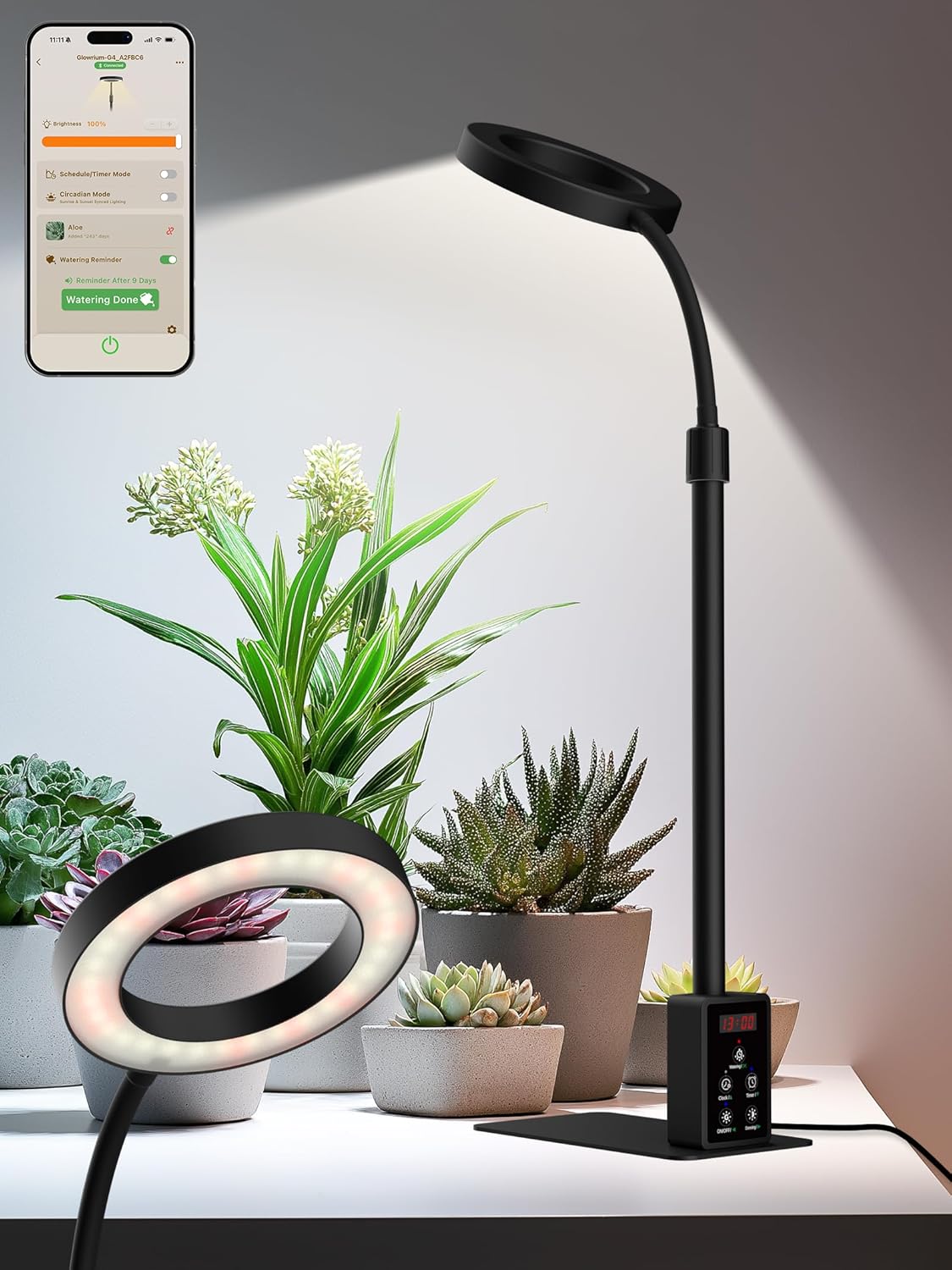
This GLOWRIUM grow light is a compact freestanding LED lamp built to support seedlings through flowering with a full-spectrum output and stepless dimming. It is typically used beside windowsills, desks, or small plant stands where you need targeted supplemental light; the flexible gooseneck and enlarged lamp head let you angle the beam and cover multiple small pots. Notable features include Bluetooth app control with scheduling, automatic sunrise/sunset sync, care reminders and simple push-button controls for manual use. Practical benefits are straightforward: the 24V low-voltage system and aluminum construction feel durable, the timer and app make daily routines hands-off, and the frosted diffuser provides softer light for indoor rooms. Important limitations are its modest 12W power and single light source, which mean it is best for individual houseplants or small clusters rather than large stands or dense seed trays, and it is not water resistant so placement near wet areas requires care. Overall it works well as a reliable, space-saving supplemental light for typical home plant setups.
Best for: Homeowners who want a dependable, easy-to-use supplemental light for a few houseplants and value smart scheduling and simple maintenance.
Less Ideal for: People needing high-output lighting for large plant racks, dense seed-starting trays, or greenhouse-scale setups should choose a more powerful multi-head fixture.
- Full-spectrum LED with stepless dimming supports all growth stages
- Bluetooth app and push-button control with programmable timers and sunrise/sunset sync
- Adjustable height and flexible gooseneck for targeted coverage
- Aluminum construction and 24V low-voltage design for durable, safe operation
- 12W single light source is underpowered for large setups or multiple large plants
- Not water resistant so it must be kept away from humid or wet locations
Verdict: A reliable, smart-grown lamp for homeowners who need a compact, easy-to-manage supplemental light for individual houseplants.
GooingTop HY-021 6000K Full-Spectrum Clip Grow Light
| Power Source | Corded Electric |
|---|---|
| Color Temperature | 6000 Kelvin |
| Light Output Maximum | 2500 lumens |
| Light Source Special Features | Dimmable |
| Number of Light Sources | 84 |
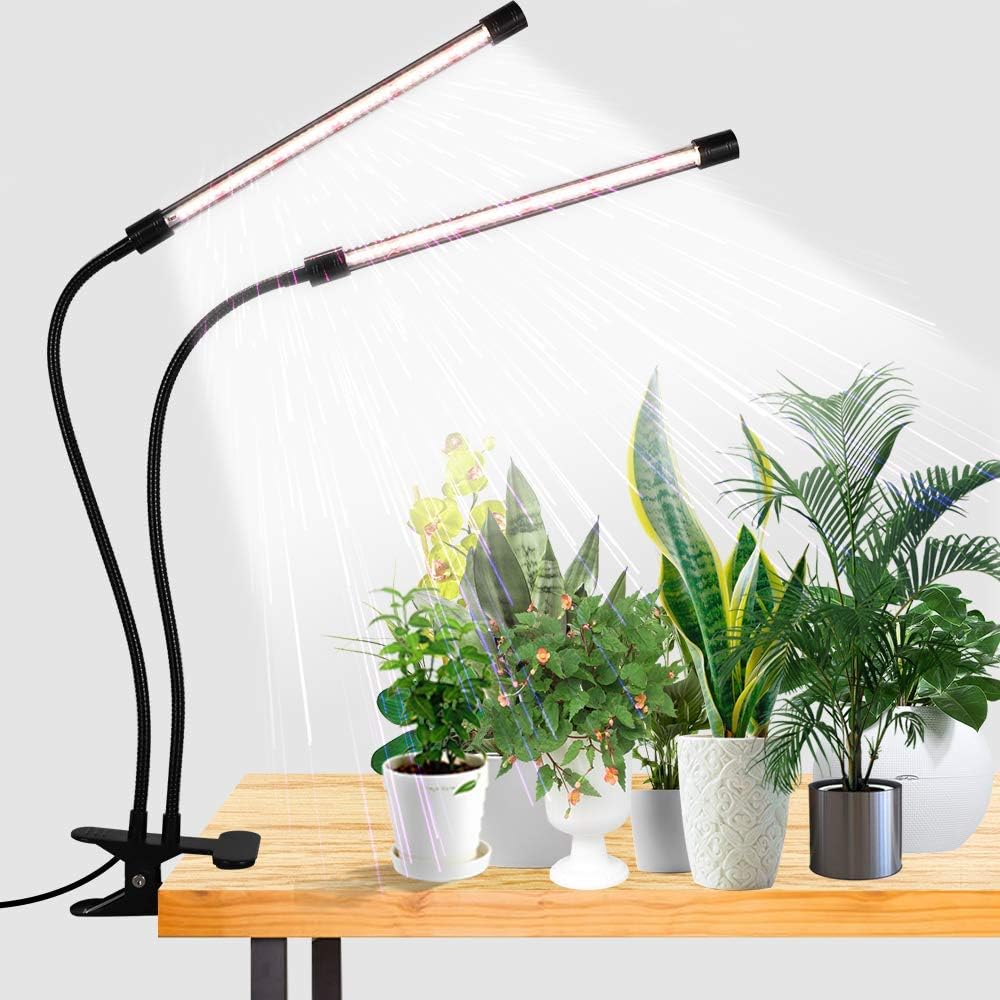
This GooingTop HY-021 is a compact clip-on grow light built for small houseplants, seedlings and shelf gardens. It uses 84 LEDs (white plus deep red) to deliver a 6000K full-spectrum output intended to mimic midday sun, with a high color-rendering output that also makes it pleasant as a reading lamp. Two flexible gooseneck heads and a strong clamp let you aim light precisely over pots and seed trays, while the attached remote provides 50%/100% dim levels and repeating timers at 4, 8 or 12 hours for hands-off scheduling. Practical benefits include low power draw (listed as roughly 10 W LED draw), a claimed 1 to 2 square meter coverage for seedlings, and an included timer that simplifies day/night cycles. Limitations are its design for small setups rather than large grow racks and the clip mounting limits placement compared with freestanding fixtures. The unit also relies on the corded remote instead of a smartphone app and the lifespan claim is typical of LEDs but not independently verifiable from the listing.
Best for: Buyers who want a simple, low-power, plug-and-play grow light to boost seedlings and a few houseplants on a desk or shelf and who value an easy-to-use timer and adjustable brightness.
Less Ideal for: Growers planning multi-shelf installations, larger vegetable grows, or who need networked or app-based control should consider larger bar lights or fixtures designed for commercial racks.
- Full-spectrum 6000K output with added 660 nm red LEDs to support vegetative growth and flowering
- Attached remote with dimming (50%/100%) and repeat timer settings (4/8/12 hours) for easy scheduling
- Flexible dual goosenecks and strong clamp enable precise positioning over small pots and seed trays
- High reported color rendering for comfortable viewing and accurate plant color assessment
- Low electrical draw around 10 W while covering small growing areas
- Clip-mount design and stated 1–2 m² coverage make it better suited to individual plants or small trays rather than large multi-shelf setups
- No smart app or wireless control option; remote is cord-attached which limits placement flexibility
Verdict: A compact, easy-to-use clip grow light that delivers full-spectrum light and convenient timer/dim controls for small indoor plant setups.
Briignite A19 Full Spectrum LED Grow Light Bulb (2-Pack)

| Light Type | LED |
|---|---|
| Additional Features | Full Spectrum |
| Bulb Base | E26 |
| Light Output Maximum | 1000 lumens |
| Light Source Operating Life | 30000 hours |
These Briignite A19 grow bulbs are full-spectrum LED replacements that screw into any standard E26 fixture to give indoor plants consistent, natural-looking light. Each bulb outputs about 1000 lumens at roughly 11 to 12 watts, so they act like a 60 to 100 watt incandescent while using far less energy, which is handy for running multiple bulbs on a budget. The 3500–4000K warm daylight color and high CRI make foliage colors appear normal rather than the purple hue of some grow lights, so they work well in living spaces and plant shelves. Built-in features include app control and push-button options and an advertised 25,000 to 30,000 hour operating life. Limitations to note are modest reported PPF compared with purpose-built high‑output grow fixtures and the 180 degree beam, which is better for general room lighting than targeted canopy penetration for dense or tall plants. For small collections, seed starting, or supplementing light in low-light rooms these bulbs are an economical, easy-to-install choice.
Best for: Houseplant owners who need an affordable, plug-and-play light to supplement natural light for a few pots, seedlings, or a small indoor garden while keeping energy costs low.
Less Ideal for: Growers aiming to flower large or dense canopy crops or outfitting multi-tiered grow racks will want higher‑PPF, purpose-built fixtures instead.
- Full spectrum output that looks like natural white light and preserves true foliage color
- Low power draw (around 11–12W) with 1000 lumens brightness for energy-efficient continuous use
- Standard E26 base fits common fixtures for tool-free installation
- High CRI of 90 helps accurate color rendering in living spaces
- Beam angle and lumen-focused design give less concentrated PAR/PPF than dedicated high‑output grow fixtures
- App and push-button controls are basic compared with advanced programmable controllers
Verdict: A low-cost, easy-to-install full-spectrum LED bulb that gives natural-looking light and energy savings for small indoor plant collections.
Choosing the Right Grow Light for Homeowners: Key Factors to Consider
Light Spectrum and Plant Stage
Different stages of plant growth respond to different wavelengths. Blue-rich light supports compact, leafy growth and strong vegetative structure, while higher red ratios encourage flowering and stretch. Full-spectrum LEDs attempt to cover both needs so you do not need separate fixtures for seedlings and mature plants.
For homeowners, look for lights with published spectral graphs or a stated broad spectrum. That helps you judge whether the fixture will support seedlings, leafy houseplants, or flowering ornamentals. If you plan to grow a mix, choose a versatile spectrum or one with adjustable modes.
Coverage Area and Light Intensity
A fixture's usable coverage depends on its output and mounting height. Measured PPFD or an indicated square-foot coverage gives a realistic sense of how many pots or seedlings will receive adequate light. Higher intensity is needed for fruiting or flowering plants, while foliage plants and seedlings often do fine with moderate output.
Think about the vertical space too. A powerful light mounted low can burn tops, while a weaker light mounted high may not penetrate dense canopies. For home use, choose a model whose stated coverage matches your staging trays, shelves, or grow tent footprint.
Energy Use and Running Costs
Grow lights often run for many hours daily, so efficiency affects your electricity bill. Compare input wattage to the stated coverage and output; higher efficiency means you get needed light for less power. Look for fixtures that list actual draw rather than rated maximum or theoretical numbers.
Also consider dimming and timers. The ability to lower output during vegetative stages or shorten daily run time reduces energy use. For homeowners on typical circuits, moderate wattage helps avoid overloading outlets shared with other appliances.
Heat Output and Placement Flexibility
Even LEDs produce heat that can stress seedlings or warp plastics if placed too close. Good thermal design moves heat away from LEDs and keeps the fixture surface cooler. Low heat output lets you place lights nearer to delicate leaves and fit lights into low-clearance shelves.
If you plan to run lights in a small room or near furniture, check whether the fixture requires extra clearance or active cooling. Passive-cooled units are quieter and easier to integrate in living spaces, while fans add noise but can improve longevity in higher-output fixtures.
Ease of Use and Controls
Home setups benefit from simple controls: plug-and-play mounting, built-in timers, and easy dimming. Digital interfaces, smartphone apps, or simple knob controls each have tradeoffs. Complex programming is unnecessary for most home gardeners, but a reliable 12 to 16 hour timer and at least one dimming option help you match light to plants and seasons.
Also consider mounting options: hangable fixtures, clip mounts for shelves, or freestanding panels. The right physical form factor reduces installation time and minimizes interference with household routines.
Durability and Warranty Expectations
LED fixtures are long-term investments. Look for durable housings, quality drivers, and clear expected lifespans. A well-built unit with adequate thermal management will deliver consistent light output for years with minimal degradation.
Warranty terms matter for homeowners who expect low maintenance. Prefer models that document expected hours of life and offer reasonable support in case of early failures. Reliability reduces hassle and the need to source replacements.
Matching Lights to Common Home Setups
Homes present varied footprints: a sunny windowsill backup, a shelf of mixed houseplants, a seed-starting tray on a counter, or a compact grow tent in a closet. For low-density shelving or single pots, compact panels or clip lights can deliver targeted illumination without occupying much space. For seed trays or multi-pot staging, wider panels that offer uniform coverage perform better and reduce the need to rotate trays frequently.
Consider how the light integrates with furniture and household traffic. Low-profile fixtures and those with flexible hangers are more adaptable. If your lighting will share a room with living spaces, prioritize quieter operation and lower visible heat.
- Clip or bar lights for single pots and windowsills
- Wide panels for trays and multi-pot arrangements
- Adjustable-height hangers for changing plant stages
- Low-noise options for living areas
Timers, Dimming, and Automation
Automating daily cycles simplifies care, especially when balancing work and family life. Built-in timers that offer 8 to 16 hour settings match common photoperiod needs for most ornamentals and seedlings. Dimming lets you reduce intensity during vegetative phases or gradually increase light as plants strengthen.
- Use timers to mimic natural day length and reduce burning risk
- Dimming can extend lamp life and cut energy use
- Smart plugs work as a budget automation option
Placement and Safety Tips for Indoor Use
Keep fixtures away from water sources and make sure cords are routed to avoid tripping. If using lights near curtains or paper, maintain recommended clearances, especially for higher-output units. Secure hangers and mounts to resist accidental knocks from pets or children.
Test placement with a single plant first to confirm heat and light levels. Observe leaves for a week: pale, stretched growth usually indicates insufficient light; brown, crispy leaf tips suggest heat or light stress.
- Avoid mounting lights directly above combustible materials
- Check for hot spots and adjust height after initial observation
- Use a timer to avoid leaving lights on continuously
Seed Starting Versus Mature Houseplants
Seedlings need steady, close light to prevent stretching and weak stems. A focused panel with higher PPFD at a short distance often produces sturdier starts. For mature houseplants the goal is even, less intense illumination to maintain foliage health without forcing rapid stretch or bloom.
If you want one fixture to handle both, choose a model with adjustable intensity and adequate coverage so you can raise the light and lower output for older plants, or dim and lower it for seedlings.
- Seed trays benefit from higher intensity placed closer
- Mature foliage prefers broader, softer light
- Adjustability enables multi-use fixtures
Integrating Grow Lights with Natural Light
Supplementing a bright window with a grow light extends usable hours and evens out day-to-day variability. Use lower-intensity fixtures to augment natural light for shade-tolerant houseplants, and reserve stronger outputs for windows with limited direct sun.
Place supplemental lights to fill gaps in canopy or to boost winter light levels rather than duplicate bright sun. This strategy reduces energy use while achieving more even plant growth.
- Use supplemental lighting during short winter days
- Aim lights to the darkest side of the plant structure
- Reduce artificial hours when natural sun is strong
How We Chose the Best Grow Light for Homeowners
We prioritized criteria that matter in everyday home gardening situations. First, spectral output and coverage were assessed to ensure lights provide the right balance of red and blue wavelengths for seedlings, foliage, and flowering phases. Second, energy efficiency and input wattage were considered to keep running costs and household electrical load manageable. Third, heat management and thermal design were evaluated so lights can be used safely near shelves, seedlings, and decorative plants without causing scorch or requiring large clearances. Fourth, ease of installation, controls, and adjustability were included because home setups vary from small pots to taller plant stands. Fifth, long-term reliability and expected LED lifespan were considered to reduce maintenance and replacement frequency. We excluded commercial-grade fixtures intended for high-intensity greenhouse or warehouse use and lights that require complex electrical work or custom drivers. The shortlist favors units that are practical for typical homeowners: easy to mount or place, offer usable dimming or timers, and deliver documented spectral characteristics. These editorial filters align with the scoring criteria we used to rate each product.
FAQ
How many hours should a grow light run for seedlings?
Seedlings typically need 12 to 16 hours of light daily to develop compact, sturdy stems. Many home gardeners use 14 hours as a practical middle ground and pair it with a dark period to encourage normal plant rhythms.
Can I use a grow light near a couch or bookshelf?
Yes if the fixture has low surface heat and secure mounting. Keep the light a safe distance from flammable materials and avoid routing cords across seating areas. Passive-cooled LEDs are often better for living spaces.
Do I need full-spectrum lights for houseplants?
Full-spectrum fixtures mimic natural daylight and are versatile for a range of plants. Many houseplants do well under broad-spectrum LEDs, but some growers use adjustable spectrum modes to emphasize red for flowering or blue for vegetative growth.
Will a higher wattage always mean better growth?
Not necessarily. Useful light depends on actual output and efficiency rather than raw wattage. A low-wattage high-efficiency LED can outperform an older, higher-wattage fixture. Consider coverage and reported PPFD where available.
How close should a grow light be to my plants?
Distance depends on intensity and plant stage. Seedlings often sit 6 to 12 inches from a moderate panel, while mature plants may need a foot or more. Start higher and move closer if plants show signs of insufficient light.
Final Verdict
For homeowners, the best grow light balances spectrum, manageable heat, and energy efficiency while fitting your available space. Prioritize fixtures that list spectral information, offer dimming or timers, and match the coverage to your trays or pots. Expect tradeoffs: higher output demands better heat management and draws more power, while compact units trade coverage for convenience. Choose the configuration that aligns with your typical plants and room layout and you will get reliable indoor growth without complicated installs.
