

Note: This article contains affiliate links. If you click on these links and make a purchase, I may earn a small commission at no extra cost to you. This helps support my research and content. Read my full affiliate disclosure here.
Growing lavender indoors or extending its season outdoors with supplemental light requires more than a bright bulb. Lavender needs the right light spectrum, intensity, and run schedule to set fragrant buds and stay compact rather than leggy. This guide gathers six top grow lights for lavender that suit small pots, larger planter beds, and window setups. We shortlisted options that deliver the right spectrum, run cool near delicate foliage, and are practical to mount in a home or greenhouse. Below you will find our top picks and the criteria we used to evaluate them, plus practical advice for placement, timing, and maintenance.
Top Picks at a Glance
| Best Overall The best all-around choice for most situations | LEOTER 4-Head LED Grow Light with Full Spectrum, Timer and 10-Level Dimming |  |
| Best Quality Built to a higher standard if you want something more solid | VIPARSPECTRA P700 70W Dimmable Full Spectrum LED Grow Light |  |
| Best Value The sweet spot between price and what you get | Garpsen 2-Head Full Spectrum USB LED Grow Light with Timer |  |
| Highest Rated A top-rated pick with lots of positive feedback | Hemonee 5-Head LED Grow Light with Adjustable Tripod Stand |  |
| Most Popular A crowd favorite that many people choose with confidence | GooingTop HY-021 6000K Full-Spectrum Clip Grow Light |  |
| Best Seller A high-volume bestseller chosen again and again | Aokrean Halo Full-Spectrum LED Grow Light with Base |  |
LEOTER 4-Head LED Grow Light with Full Spectrum, Timer and 10-Level Dimming

| Light Source Type | LED |
|---|---|
| Number of Light Sources | 80 |
| Wattage | 80 watts |
| Control Method | Remote |
| Mounting Type | Clip On |
The LEOTER 4-head grow light is a USB-powered, clip-on lamp built for indoor plant care that combines full-spectrum and targeted red/blue diodes to support seedlings, vegetative growth and flowering. It uses 80 LEDs arranged across four adjustable heads on flexible goosenecks so you can position light over individual large plants or groupings. Notable features are three spectral modes (red+blue, warm/full spectrum, and combined), a circular memory timer with 3/9/12-hour presets, and ten brightness levels for fine control over intensity. The strong metal clip and flexible necks make it simple to aim light at tall foliage without permanent installation. Practical benefits include reduced need for supplemental natural light, convenient daily scheduling for busy users, and a compact footprint that suits shelves or plant stands. Important limitations are that the unit is described as a clip/desk lamp rather than a wide-panel fixture, so coverage for very large single specimens may require placing heads close to foliage or using multiple units, and the timer resets if unplugged so it needs occasional reprogramming after power loss.
Best for: Buyers who want a controllable, space-efficient grow light to supplement indoor sun for larger houseplants and prefer a proven, feature-rich unit with preset timers and adjustable heads.
Less Ideal for: Growers who need single-fixture coverage for floor-to-ceiling specimens or large multi-plant setups should consider full-size panel fixtures or multiple units instead.
- Full spectrum plus red and blue LEDs (80 total) to support all growth stages
- Ten dimming levels for precise intensity control
- Three timer presets with memory function for hands-off daily scheduling
- Adjustable 4-head design and flexible goosenecks for targeted placement
- Strong metal clip allows mounting on shelves, desks, or plant stands
- Designed as a clip-on lamp so single-unit coverage is limited for very large plants
- Timer settings must be reset after the light is unplugged
Verdict: A versatile, adjustable clip-on grow light that gives busy indoor gardeners precise control over spectrum, intensity and scheduling to boost large plant growth in compact spaces.
VIPARSPECTRA P700 70W Dimmable Full Spectrum LED Grow Light

| Light Output Maximum | 11000 lumens |
|---|---|
| Light Source Wattage | 70 watts |
| Mounting Type | Hanging Mount |
| Light Source Special Features | Dimmable |
| Number of Light Sources | 216 |
The VIPARSPECTRA P700 is a 70W full spectrum LED grow light built for seed starting and vegetative stages. It uses 216 diodes and a tuned mix of red and white LEDs to deliver high PAR output (advertised 11,000 lumens) across a small footprint roughly suited to a 2×2 ft veg area. The light is fanless and relies on large aluminum heat sinks to keep running temperatures low while the included 4-level dimmer lets you dial intensity for seedlings, clones, or mature veg. Setup is simple with hanging mount hardware included and the unit draws about 0.65 A at 120V so it runs far cooler and uses far less power than a comparable 150W HPS/MH system. For compact tents, shelves, or single-cabinet grows it offers a good balance of light output, spectrum, and efficiency. Limitations are its small coverage area and modest absolute wattage compared with larger fixtures, so gardeners with bigger canopies will want a higher-output model or multiple units.
Best for: Growers who want an efficient, low-heat fixture to run a single tent, shelf, or cabinet and who prioritize electricity savings and adjustable output for seedlings and veg.
Less Ideal for: Commercial growers or hobbyists running multi-plant canopies or larger tents who need wider coverage and higher total light output.
- Full spectrum diode layout optimized for seedlings and vegetative growth
- Low power draw (70W) with high reported lumen/PAR output for energy efficiency
- Fanless design with aluminum heat sinks for quiet, low-heat operation
- Integrated 4-level dimmer for easy intensity adjustment
- Coverage geared to a small 2×2 ft veg area so not ideal for larger grows
- Absolute wattage and diode count are modest compared with larger commercial fixtures
Verdict: A compact, energy-efficient full spectrum LED that delivers strong veg-stage light and adjustable intensity for small tents and cabinets.
Garpsen 2-Head Full Spectrum USB LED Grow Light with Timer

| Wattage | 12 watts |
|---|---|
| Number of Light Sources | 2 |
| Power Source | Corded Electric (USB) |
| Additional Features | Dimmable, Full Spectrum, Timer |
| Controller Type | Remote Control |
This Garpsen 2-head grow light is a budget-friendly LED lamp designed to supplement light for small indoor plantings. Each head houses full-spectrum LEDs (red, blue, and warm white) and the unit offers three color modes plus five brightness settings so you can tailor light for seedlings through vegetative growth. It includes built-in timers (6/12/16 hours) and remote control for hands-off scheduling, a 360 degree flexible gooseneck for precise positioning, and a strong clip so you can attach it to shelves or pots. The USB power option and low 12 W draw make it easy to run from a wall adapter or USB outlet with low energy use. Limitations are its compact coverage area — best for a few pots or a single lavender plant rather than a large tray — and the clip/base mounting is not as stable as a freestanding stand for heavier setups. The unit is practical for growers who want an inexpensive, adjustable light with timer convenience for small-scale indoor lavender or herb care.
Best for: Buyers who want a low-cost, easy-to-run supplemental light to keep one or a few potted lavender plants healthy indoors without complex setup or high energy use.
Less Ideal for: Growers planning to light multiple lavender plants, larger seed trays, or a full grow shelf should choose a wider, higher-output fixture or a stand-mounted system instead.
- Full spectrum LED array (red, blue, warm white) suitable across growth stages.
- Five dimming levels and three color modes for flexible light tuning.
- Built-in 6/12/16 hour timer and remote control for automated daily schedules.
- Flexible 360° goosenecks and a strong clip for targeted positioning and easy setup.
- USB power and low 12 W consumption make it energy efficient and portable.
- Limited illumination footprint, best for one or a few small plants rather than larger lavender groupings.
- Clip/tabletop mounting can be less stable for taller setups or heavier fixtures.
Verdict: A compact, energy-efficient full-spectrum grow light with timer and dimming that makes it simple to maintain one or two potted lavender plants indoors.
Hemonee 5-Head LED Grow Light with Adjustable Tripod Stand

| Adjustable height | 15" to 63" |
|---|---|
| Heads | 5 LED heads |
| Spectral modes | Red+Blue, White, Mixed |
| Dimming levels | 10 levels (10%–100%) |
| Timer | 4/8/12H auto on/off |
This Hemonee 5-head LED grow light is built to give indoor plants steady, customizable light without fuss. The telescoping tripod and 360 degree flexible goosenecks let you aim each head and set the lamp height from roughly seedling to mature plant stage. It offers three spectrum presets (red+blue, white, or a full mix) and 10 brightness levels so you can match light intensity and quality to lavender's flowering needs. A built-in timer and both inline and RF remote control make daily scheduling simple, and independent head control lets you concentrate light where individual pots need it. The body uses aluminum with an aviation-grade heat sink for better heat dissipation, which helps maintain consistent output during multi-hour runs. Assembly is quick and no hanging hardware is required. Limitations to note are that the product does not list exact PAR or wattage values on the listing and a tripod form factor takes more floor space than an overhead fixture, so placement in very small rooms may be awkward.
Best for: Buyers who prioritize dependable, easy-to-use lighting and want a configurable fixture they can position precisely for flowering herbs like lavender.
Less Ideal for: Growers who need a compact, ceiling-mounted solution or who require technical PAR/wattage specifications for high-intensity grow setups.
- Adjustable tripod and 360° flexible goosenecks for precise light positioning
- Three spectral modes plus 10 dimming levels to suit different growth stages
- Built-in timer with inline and RF remote for convenient automated scheduling
- Aluminum housing with aviation-grade heat sink for improved heat dissipation
- No listed PAR or wattage figures to quantify light output for demanding growers
- Tripod stand requires floor space and may be less convenient than ceiling or shelf mounts
Verdict: A reliable, configurable floor-mounted LED grow light that makes automated, targeted lighting simple for flowering herbs like lavender.
GooingTop HY-021 6000K Full-Spectrum Clip Grow Light

| Power Source | Corded Electric |
|---|---|
| Color Temperature | 6000 Kelvin |
| Light Output Maximum | 2500 lumens |
| Light Source Special Features | Dimmable |
| Number of Light Sources | 84 |
This GooingTop HY-021 is a compact clip-on grow light built for small houseplants, seedlings and shelf gardens. It uses 84 LEDs (white plus deep red) to deliver a 6000K full-spectrum output intended to mimic midday sun, with a high color-rendering output that also makes it pleasant as a reading lamp. Two flexible gooseneck heads and a strong clamp let you aim light precisely over pots and seed trays, while the attached remote provides 50%/100% dim levels and repeating timers at 4, 8 or 12 hours for hands-off scheduling. Practical benefits include low power draw (listed as roughly 10 W LED draw), a claimed 1 to 2 square meter coverage for seedlings, and an included timer that simplifies day/night cycles. Limitations are its design for small setups rather than large grow racks and the clip mounting limits placement compared with freestanding fixtures. The unit also relies on the corded remote instead of a smartphone app and the lifespan claim is typical of LEDs but not independently verifiable from the listing.
Best for: Buyers who want a simple, low-power, plug-and-play grow light to boost seedlings and a few houseplants on a desk or shelf and who value an easy-to-use timer and adjustable brightness.
Less Ideal for: Growers planning multi-shelf installations, larger vegetable grows, or who need networked or app-based control should consider larger bar lights or fixtures designed for commercial racks.
- Full-spectrum 6000K output with added 660 nm red LEDs to support vegetative growth and flowering
- Attached remote with dimming (50%/100%) and repeat timer settings (4/8/12 hours) for easy scheduling
- Flexible dual goosenecks and strong clamp enable precise positioning over small pots and seed trays
- High reported color rendering for comfortable viewing and accurate plant color assessment
- Low electrical draw around 10 W while covering small growing areas
- Clip-mount design and stated 1–2 m² coverage make it better suited to individual plants or small trays rather than large multi-shelf setups
- No smart app or wireless control option; remote is cord-attached which limits placement flexibility
Verdict: A compact, easy-to-use clip grow light that delivers full-spectrum light and convenient timer/dim controls for small indoor plant setups.
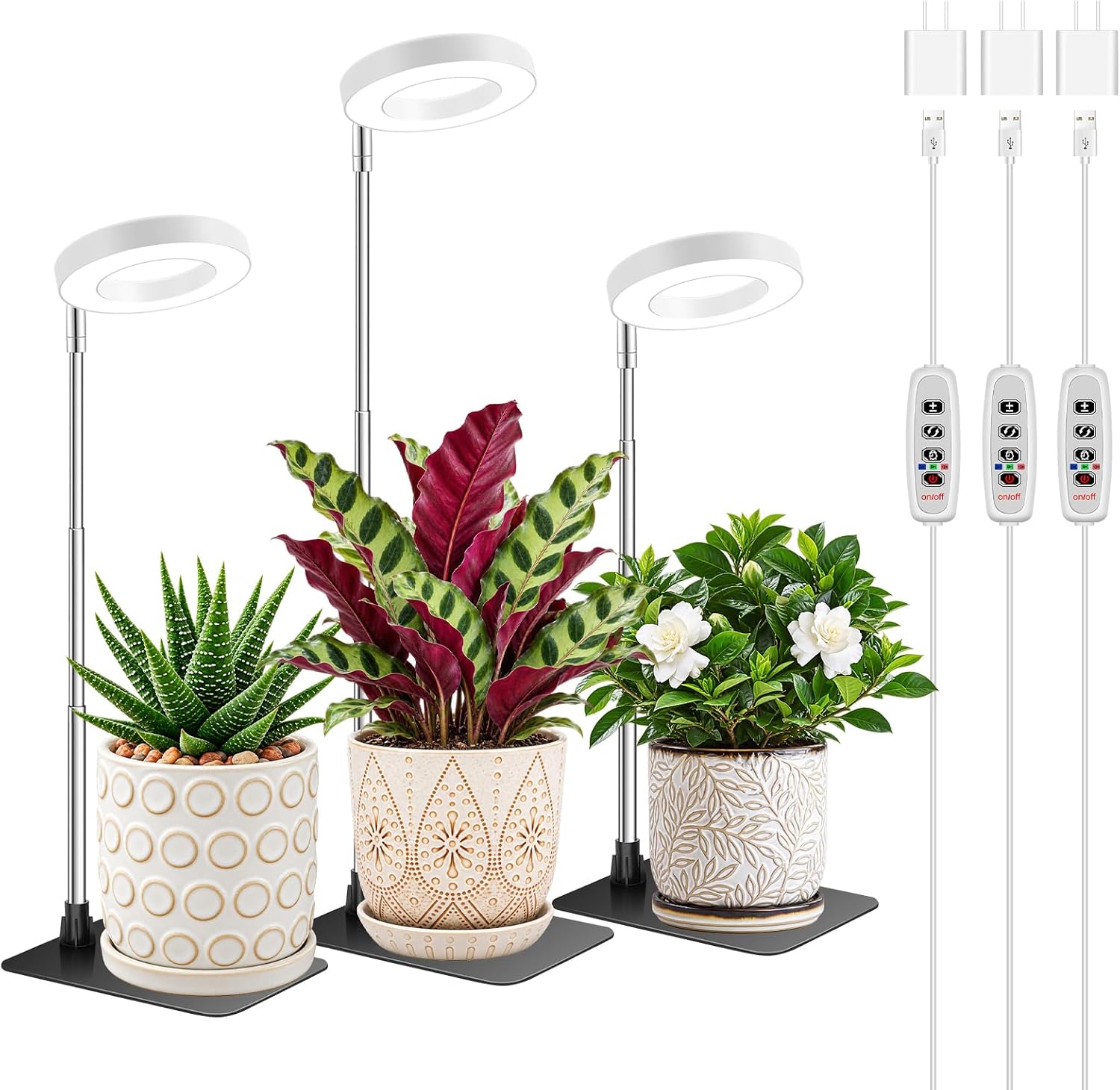
Aokrean Halo Full-Spectrum LED Grow Light with Base
| Light Source Type | 48 LEDs |
|---|---|
| Lighting Method | LED |
| Power Source | Corded Electric |
| Height Adjustable | 6.5-26 inch |
| Timer | 3/9/12 hours |
This Aokrean Halo grow light is built for everyday indoor plant care and is particularly suited to potted specimens like Monstera. It uses 48 LEDs in a halo-shaped panel and offers three spectrum modes (cool, warm, and full spectrum), ten brightness levels, and 3/9/12-hour auto timers so you can match light to seedling, foliage, or flowering stages. The lamp can be used inserted in soil with a stake or freestanding on the included ABS base, and the telescoping pole adjusts from a low setting up to its full height to cover taller leaves. Practical benefits include energy-efficient LED output, a compact footprint that fits shelves or desks, and simple controls (rotary and push-button) for risk-averse users who want predictable operation. Expect limitations for larger or high-light-demand Monstera varieties since the 48-LED, small-diameter panel is best for single pots or modestly sized plants rather than whole grow racks or bright-window replacements. The plastic base and pole keep it lightweight but may feel less durable than metal stands over many years.
Best for: A cautious buyer who wants a simple, reliable indoor grow light for a single Monstera or a few small to medium potted plants and values easy controls and preset timers.
Less Ideal for: Growers looking to light multiple large Monsteras, full grow tents, or high-light vegetables should choose a larger, higher-output fixture instead.
- Full-spectrum plus separate cool and warm modes to tailor light for germination, leafy growth, or bloom
- 10-step dimming and 3/9/12-hour auto timers for hands-free, fine-tuned daily schedules
- Dual installation: stake into soil or use the weighted base for tabletop placement
- Height-adjustable pole to position light over small to medium potted plants
- Compact halo design that doubles as unobtrusive home decor
- 48-LED, small-diameter panel is best for one plant or small pots and may not provide enough canopy coverage for large Monsteras
- Plastic base and components are lightweight and may show wear faster than metal alternatives
Verdict: Aokrean Halo is a compact, easy-to-use full-spectrum lamp ideal for risk-averse plant owners who need a reliable tabletop light for one Monstera or a few small pots.
Choosing the Right Grow Light for Lavender: Key Factors to Consider
Spectrum and Flowering Response
Lavender needs a spectrum that supports both leafy growth and flower bud development. A balance of blue light helps keep plants compact and encourages healthy foliage, while red wavelengths trigger flowering. Fixtures that offer a full spectrum or adjustable red-to-blue ratios let you fine-tune light for the plant's stage: more blue during establishment, more red as buds form.
If a fixture lacks spectrum information, expect mixed results. Too much yellow or green light contributes little to photosynthesis, and overly red-biased lights can produce long, weak stems if used throughout the growth cycle.
Intensity, Coverage, and Fixture Size
Light intensity determines how close fixtures can be mounted and how many plants a single unit will support. Lavender planted in small pots needs even coverage so that all crowns receive similar photon flux; otherwise some plants will lag or become leggy. Assess recommended hanging height and the stated photosynthetic photon flux density (PPFD) or coverage area at a given height when possible.
Oversized fixtures may light a wider area but can create heat and photobleaching issues near the source. Undersized fixtures force multiple units and increase complexity. Select a fixture sized to the bench or shelf footprint and positioned to deliver even light across the crowns.
Heat Output and Plant Safety
Heat management is important because lavender prefers cooler, drier conditions. High heat near the canopy can stress foliage and dry out soil too quickly. LED fixtures generally run cooler than older HID lamps, but some high-output LEDs still emit significant radiant heat. Look for fixtures with heat sinks, active cooling, or the ability to be mounted higher above plants to reduce thermal stress.
Also consider how heat interacts with your indoor environment. In small rooms or sealed greenhouses, cumulative heat from multiple fixtures can raise humidity and temperature, creating conditions favorable to rot or pests.
Mounting Options and Adjustable Height
How you mount a grow light affects both light distribution and maintenance access. Lavender benefits from adjustable hanging systems so you can lower lights during seedling and early vegetative stages and raise them slightly for bloom to widen coverage. Fixtures that include ratchet hangers, adjustable chains, or multiple mounting points offer more precise positioning.
Fixtures designed for shelves, clip mounting, or modular link-ups can make scaling easier if you expand your lavender collection. Consider the available ceiling or bench mounting in your space when choosing a form factor.
Energy Use and Running Costs
Lavender often needs long daily photoperiods, especially during establishment or in shorter daylight months. Energy-efficient fixtures reduce the cost of running those schedules. Compare real wattage and delivered photon output rather than marketing watt equivalents. Fixtures with dimming and timers let you tailor on-hours to plant needs and lower power use when full intensity is unnecessary.
Also factor in the longevity of LEDs and any driver warranties. Long-lasting drivers and low power draw reduce maintenance and total energy expense over multiple seasons.
Durability and Moisture Resistance
Grow lights used near wet soil, misting systems, or greenhouse humidity should resist corrosion and moisture ingress. Fixtures rated for damp locations or with IP-rated housings will last longer in those environments. Durable casings, sealed connectors, and corrosion-resistant hardware protect internal components.
Consider the ease of cleaning and the replacement availability of drivers or parts. Durable fixtures reduce downtime and the chance of electrical faults in a humid planting area.
How Much Light Does Lavender Actually Need
Lavender is a sun-loving Mediterranean plant and does best with high light totals. Pragmatically, aim for bright, direct-quality light for most of the day rather than long periods of weak, diffuse light. Under artificial lighting, that translates to moderately high PPFD values positioned for even canopy coverage. For potted lavender, placing a fixture so the canopy receives consistent intensity will produce more compact growth and better bud set than sporadic lighting.
When planning, think in terms of the bench or shelf footprint and how many fixtures you need to prevent shaded pockets. Also account for seasonal goals; plants moved into bloom may benefit from slightly longer daily hours or modest increases in red wavelengths.
- Target consistent, bright light rather than long, dim cycles
- Prioritize even coverage across all crowns
- Adjust intensity during establishment and bloom phases
Placement Tips for Indoor and Greenhouse Lavender
Position lights so air circulates around the foliage and heat can dissipate. Mount fixtures centrally above benches and avoid placing lights directly against plastic covers or walls that trap heat. For window-adjacent setups, supplemental fixtures should fill shadowed areas rather than duplicate existing sun exposure.
Use adjustable hangers to raise lights gradually as plants grow. Keep fixtures high enough to reduce hot spots but close enough for effective photon delivery. If you run multiple fixtures, stagger their mounting heights slightly to minimize banding and shadow lines.
- Allow good air movement to prevent heat and humidity buildup
- Supplement windows by filling gaps in natural light, not duplicating it
- Use adjustable mounts to follow plant growth
Light Schedules That Encourage Bud Formation
Lavender often benefits from long days during establishment and slightly shorter, consistent days during flowering. A common approach is 14 to 16 hours daily for seedlings and young plants, reducing to 12 to 14 hours when encouraging concrete bud set. Consistency matters: dramatic daily swings in photoperiod can stress plants and delay flowering.
Timers and dimmers simplify managing these schedules. Dimming in the final hour of the day can mimic dusk and reduce abrupt on-off transitions that sometimes shock plants.
- Seedlings: longer photoperiods for vegetative growth
- Pre-bloom: maintain steady hours and consider more red light
- Use timers for consistent daily schedules
Preventing Common Issues With Artificial Lighting
Watch for signs of too much light or heat such as leaf bleaching, curled leaf edges, or overly compact soil. Conversely, leggy stems and sparse buds usually indicate insufficient intensity or the wrong spectrum balance. Rotate pots occasionally if the fixture causes uneven growth across a bench.
Inspect fixtures regularly for dust build-up which reduces output and raises operating temperature. Clean surfaces with a dry cloth when the unit is off and cool, and check mounts and cords for wear.
- Monitor foliage for bleaching or curling as heat indicators
- Look for legginess as a low-light symptom
- Keep fixtures clean and hardware inspected
Scaling Up: From a Single Pot to a Lavender Bed
Expanding from one or two pots to a larger bed changes light planning. More plants require broader, more even coverage and sometimes multiple fixtures. Consider fixtures that link or can be daisy-chained for uniform control, and plan mounting points to avoid gaps.
Also factor in the cumulative heat and power draw of multiple units. Spreading fixtures to reduce hotspot formation and using zone timers helps manage both plant needs and energy use as you scale.
- Choose modular fixtures for easier scaling
- Plan mounting to avoid shadowed pockets
- Manage cumulative heat when using multiple lights
How We Chose the Best Grow Light for Lavender
We focused on features that directly affect lavender health and flowering rather than broad marketing claims. Key evaluation criteria included spectrum accuracy, measured as a balanced red-to-blue output that supports both vegetative growth and bud formation; light intensity and coverage, to ensure plants receive adequate photosynthetic photon flux without burning foliage; heat management, since lavender prefers dry, cooler root and foliage conditions; fixture flexibility and mounting options for common home and greenhouse setups; energy efficiency, to limit running costs for long light schedules; and durability and moisture resistance for greenhouse or mist-prone environments. We excluded fixtures aimed only at high-density vertical farms or purely decorative grow lamps that do not report usable spectral data. Units without clear mounting hardware or those that run excessively hot were also filtered out. The result is a shortlist of fixtures that perform the core botanical tasks lavender needs: correct spectrum, safe intensity, and reliable operation in home and small-scale greenhouse conditions.
FAQ
Can lavender grow under LED grow lights year-round?
Often yes. Lavender will grow year-round under LEDs if you provide the correct spectrum, sufficient intensity, and a sensible photoperiod. However, year-round indoor cultivation may require pruning and seasonally adjusted light hours to mimic natural cycles and preserve flowering vigor.
How high should I hang a grow light above lavender plants?
It depends on fixture output. Higher-output fixtures can be mounted 12 to 24 inches above a small canopy, while lower-output bars or strips may need to be closer. Aim for even coverage and watch foliage for signs of light stress to fine-tune height.
Do I need to change the light spectrum as lavender moves from vegetative growth to bloom?
Usually yes. Increasing red wavelengths during the pre-bloom and bloom phase can encourage bud formation, while blue-heavy light helps keep plants compact during vegetative growth. Fixtures with adjustable spectrum or separate veg and bloom modes make this transition easier.
Will supplemental light reduce the need for pruning or other cultural care?
Not really. Supplemental lighting helps drive growth and flowering but does not replace pruning, appropriate soil, and proper drainage. Good cultural care combined with suitable lighting produces the healthiest plants.
Is heat from grow lights harmful to lavender foliage?
It can be. Excessive radiant heat near the canopy can scorch leaves and dry soil too quickly. Choose fixtures with good heat dissipation or mount them higher and ensure adequate air circulation to protect lavender foliage.
Final Verdict
Choose a grow light that delivers an appropriate spectrum and even intensity for your planting footprint. Prioritize fixtures with good heat management and mounting flexibility so you can adjust height and coverage as plants grow. Consider energy use and durability if you run long daily schedules or set up multiple fixtures. Balancing spectrum, intensity, and practical installation will yield compact plants with strong bud set. Use the evaluation criteria here to match a fixture to your space and grow goals so you can enjoy consistently fragrant, well-flowered lavender.
