

Note: This article contains affiliate links. If you click on these links and make a purchase, I may earn a small commission at no extra cost to you. This helps support my research and content. Read my full affiliate disclosure here.
If you start annuals or tender perennials from seed, the right grow light makes the difference between leggy, weak seedlings and sturdy transplants ready for the garden. A grow light tuned for flower seedlings supplies the spectrum and intensity young plants need without overheating trays or wasting electricity. This guide covers seven top grow lights selected for seed-starting use and explains the features that matter to home gardeners. You will find options suited to different bench sizes, tray counts, and heat sensitivity, plus the evaluation criteria we used to shortlist the best choices. Read on to match a fixture to your seed schedule and growing space.
Top Picks at a Glance
| Best Overall The best all-around choice for most situations | VIPARSPECTRA P700 70W Dimmable Full Spectrum LED Grow Light |  |
| Best Quality Built to a higher standard if you want something more solid | Spider Farmer SE3000 LED Grow Light, 300W, App Controlled |  |
| Best Value The sweet spot between price and what you get | RWNTAO 2-Head Full Spectrum Clip LED Grow Light (84 LEDs) |  |
| Best Budget The cheapest option that still gets the job done reliably | CFGROW SPL-01 Full-Spectrum LED Grow Light with Adjustable Height and Timer |  |
| Highest Rated A top-rated pick with lots of positive feedback | Spider Farmer G4500 LED Grow Light 320W (App‑Controlled, Dimmable) |  |
| Most Popular A crowd favorite that many people choose with confidence | GooingTop HY-021 6000K Full-Spectrum Clip Grow Light |  |
| Best Seller A high-volume bestseller chosen again and again | Barrina T5 1ft LED Grow Lights, 5000K Full Spectrum — 4-Pack |  |
VIPARSPECTRA P700 70W Dimmable Full Spectrum LED Grow Light

| Light Output Maximum | 11000 lumens |
|---|---|
| Light Source Wattage | 70 watts |
| Mounting Type | Hanging Mount |
| Light Source Special Features | Dimmable |
| Number of Light Sources | 216 |
The VIPARSPECTRA P700 is a 70W full spectrum LED grow light built for seed starting and vegetative stages. It uses 216 diodes and a tuned mix of red and white LEDs to deliver high PAR output (advertised 11,000 lumens) across a small footprint roughly suited to a 2×2 ft veg area. The light is fanless and relies on large aluminum heat sinks to keep running temperatures low while the included 4-level dimmer lets you dial intensity for seedlings, clones, or mature veg. Setup is simple with hanging mount hardware included and the unit draws about 0.65 A at 120V so it runs far cooler and uses far less power than a comparable 150W HPS/MH system. For compact tents, shelves, or single-cabinet grows it offers a good balance of light output, spectrum, and efficiency. Limitations are its small coverage area and modest absolute wattage compared with larger fixtures, so gardeners with bigger canopies will want a higher-output model or multiple units.
Best for: Growers who want an efficient, low-heat fixture to run a single tent, shelf, or cabinet and who prioritize electricity savings and adjustable output for seedlings and veg.
Less Ideal for: Commercial growers or hobbyists running multi-plant canopies or larger tents who need wider coverage and higher total light output.
- Full spectrum diode layout optimized for seedlings and vegetative growth
- Low power draw (70W) with high reported lumen/PAR output for energy efficiency
- Fanless design with aluminum heat sinks for quiet, low-heat operation
- Integrated 4-level dimmer for easy intensity adjustment
- Coverage geared to a small 2×2 ft veg area so not ideal for larger grows
- Absolute wattage and diode count are modest compared with larger commercial fixtures
Verdict: A compact, energy-efficient full spectrum LED that delivers strong veg-stage light and adjustable intensity for small tents and cabinets.
Spider Farmer SE3000 LED Grow Light, 300W, App Controlled

| Light Source Type | LED |
|---|---|
| Power Source | Corded Electric |
| Voltage | 120 volts_of_alternating_current |
| Light Source Wattage | 300 watts |
| Dimmable | dimmable |
The Spider Farmer SE3000 is a 300W full-spectrum LED bar-style grow light built to cover a roughly 3×3 foot grow area from seedling through flowering. It uses premium Bridgelux diodes and a plant-focused spectrum with strong deep red output to maximize photosynthesis while generating relatively low heat. App control and a digital dimming box let you set schedules, simulate sunrise and sunset, and fine-tune brightness for different stages, and the light supports daisy-chaining for multi-light setups. Aluminum construction helps dissipate heat and the design aims for even PPFD across the canopy, including edges. Practical benefits include lower energy draw compared with older HPS setups, precise light management via the app or manual dial, and a five-year repair coverage. Limitations are that the 300W draw may be more than necessary for very small micro-grows and you will still need to manage ventilation and hanging height to optimize uniformity; also advanced users seeking the absolute highest PPE numbers may prefer a larger commercial fixture.
Best for: Home growers who want a reliable, energy-efficient 3×3 light that handles the full growth cycle and prioritizes easy control and even canopy coverage.
Less Ideal for: Growers needing ultra-compact, low-wattage fixtures for tiny micro-grows or large commercial operators who need higher total output per fixture.
- Engineered full-spectrum with strong deep red output to support all growth stages
- App control plus digital dimming box allows schedules, sunrise/sunset simulation, and remote brightness adjustments
- Bar-style layout and premium Bridgelux diodes give even PPFD across a 3×3 ft canopy with reduced edge drop-off
- Aluminum construction improves heat dissipation for cooler operation compared with traditional HID lights
- Supports daisy-chaining for easier multi-light installations
- 300W power draw may be higher than needed for very small setups
- Requires external ventilation and proper hanging height to achieve optimal uniformity
Verdict: A user-friendly, energy-efficient 300W full-spectrum LED that reliably covers a 3×3 ft canopy with app-based scheduling and precise dimming.
RWNTAO 2-Head Full Spectrum Clip LED Grow Light (84 LEDs)
| Light Source Type | LED |
|---|---|
| Number of Light Sources | 84 |
| Control Method | App |
| Power Source | Corded Electric |
| Additional Features | Dimmable, Timer |
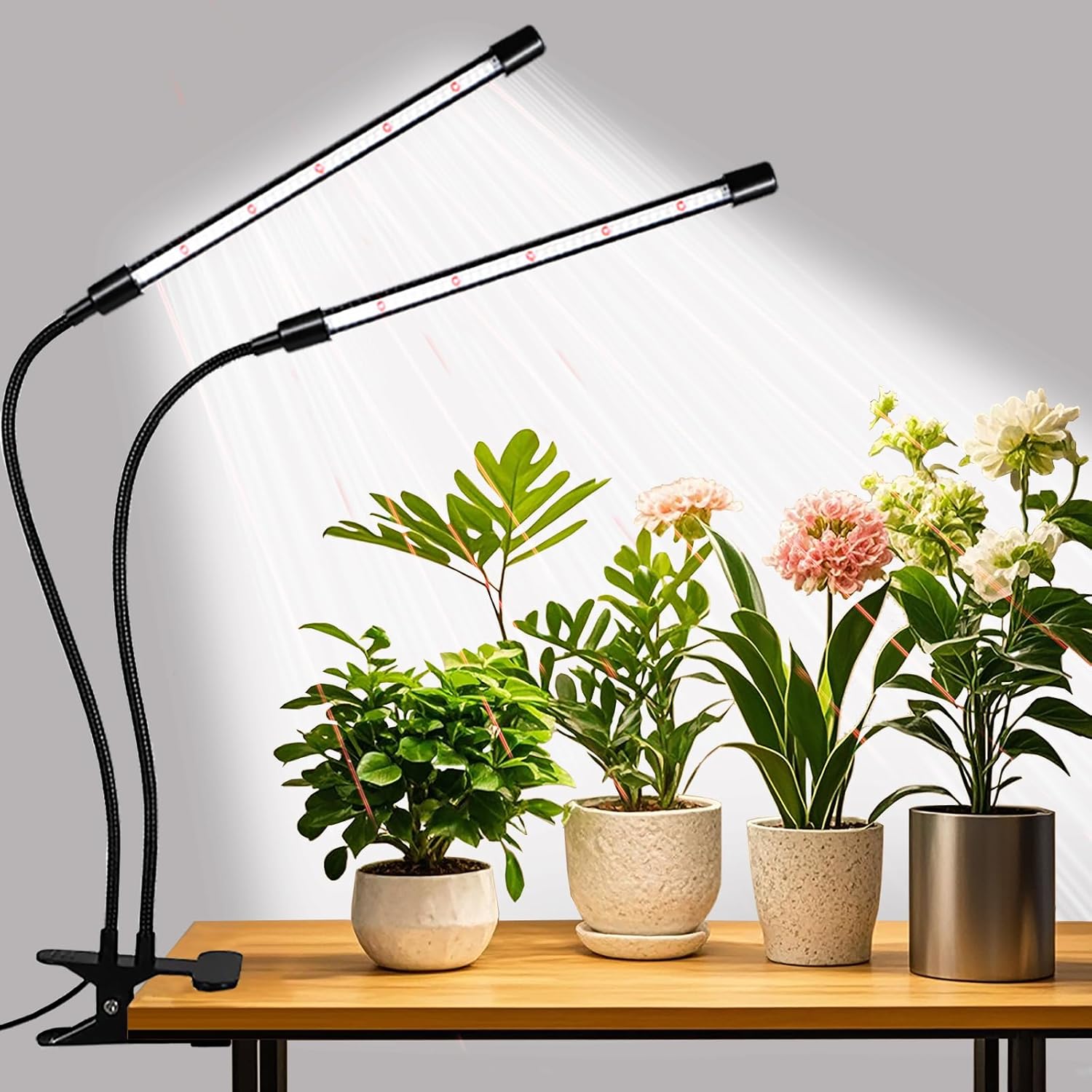
This RWNTAO two-head clip grow light supplies a full spectrum (white plus red) using 84 LEDs across two adjustable bars and is aimed at small-scale indoor growing like seedlings and potted plants. You clamp the unit to a shelf or table and position the flexible gooseneck heads to target young tomato seedlings or multiple small pots. Useful controls include 10 dimmable levels, three color modes (white, red, red+white) and a cycle memory timer with 3/9/12-hour presets so lights can run on a repeat schedule while you are away. The clamp and 360 degree goosenecks make it easy to get even coverage for a few seedlings without rigging a fixture. Practical limits are its modest LED count and single USB/5V power arrangement, which mean it is best for a small tray of seedlings rather than an entire grow rack; distance and coverage recommendations in the description should be followed for good results. Build is mainly aluminum or plastic and the clip supports thicker surfaces for stable placement.
Best for: A cost-conscious grower who needs an easy-to-use light for a few tomato seedlings or small trays and values simple timers and adjustable brightness over high-end output.
Less Ideal for: Growers planning to light large seedling batches, multiple racks, or full canopy coverage should choose a higher-output panel sized for their space.
- Full-spectrum white plus red LEDs suitable for vegetative and flowering stages
- 10 dimmable levels and 3 timer presets for hands-off, repeatable schedules
- Flexible 360° goosenecks and a strong clamp for accurate placement and stable mounting
- Designed for small setups so it will not provide sufficient coverage or intensity for large seedling flats or multiple tiers
Verdict: A budget-friendly, clamp-mounted full-spectrum LED grow light that gives tomato seedling growers simple timer and dimming controls for reliable small-scale starts.
CFGROW SPL-01 Full-Spectrum LED Grow Light with Adjustable Height and Timer

| Power Source | Corded Electric |
|---|---|
| Light Source | LED |
| Wattage | 15 watts |
| Brightness | 2000 lumen |
| Control Method | Remote |
The CFGROW SPL-01 is a tabletop freestanding LED grow light made for small indoor gardens and desktop plants. It supplies a full 380–800 nm spectrum across selectable red, blue, and white modes, and offers 10 brightness settings so you can tailor light intensity to seedlings, succulents, or mature houseplants. The unit includes a height-adjustable pole system and a removable stake so you can place the lamp above pots or insert it in soil for lower profiles. A circular memory timer with 3/9/12 hour options automates daily on/off cycles, which is useful when you cannot tend plants every day. At roughly 15 watts and about 2000 lumens, it is energy efficient for continuous use and claims long LED life. Practical limits are its small coverage area and nonwaterproof plastic construction, so it is best for individual pots or small clusters indoors rather than larger grow racks or humid greenhouse setups. The remote control and dimmer make fine tuning easy, but the timer must be reset after a power interruption.
Best for: Buyers looking for an affordable, energy-efficient grow light to keep a few desktop plants, succulents, or seedlings healthy with minimal fuss and automated lighting.
Less Ideal for: Growers who need wide area coverage, commercial-scale output, or a waterproof fixture for humid environments should look at larger, higher-powered alternatives.
- Full spectrum LEDs with three light modes for different growth stages
- Ten dimmable levels allow precise control of intensity
- Height-adjustable pole and removable stake for versatile placement
- Built-in memory timer with 3/9/12 hour auto on/off for hands-off scheduling
- Low wattage (15W) and high lumen output for energy-efficient operation
- Small coverage area limits use to single pots or small clusters indoors
- Plastic, nonwaterproof construction makes it unsuitable for humid or wet locations
Verdict: A budget-friendly, energy-efficient full-spectrum lamp that automates light schedules and is ideal for keeping a few small indoor plants healthy.
Spider Farmer G4500 LED Grow Light 320W (App‑Controlled, Dimmable)

| Light Source Type | LED |
|---|---|
| Wattage | 320 watts |
| Light Source Special Features | Dimmable, App-Controlled, Daisy-Chain Function |
| Power Source | Corded Electric |
The Spider Farmer G4500 is a high-efficiency LED grow light built for full-cycle indoor growing in small commercial or serious hobby setups. It delivers 320 watts using high-density Bridgelux diodes and a long bar design that spreads light more evenly across the canopy, making it suited to 2×4 and up to 3×5 coverage areas. The fixture is dimmable from 10 to 100 percent, supports daisy-chaining up to 50 units for synchronized control, and connects to the Spider Farmer app for scheduling and remote brightness adjustments. Practical benefits include strong PPE (listed at 2.85 umol/J in the G series data), low heat output from efficient diodes, and an aluminum housing that helps with passive cooling. The light is aimed at growers who prioritize uniform penetration and programmable control rather than novelty extras. Limitations are typical of high-output fixtures: you will need appropriate ventilation and mounting height to avoid light stress, and the elongated bar requires enough horizontal space in the tent or room. Assembly is not required but plan for cable management and app setup time.
Best for: Growers who want strong, uniform light and programmable control for full-cycle performance in a 2×4 to 3×5 tent or small grow room and who prioritize output and efficiency over minimal footprint.
Less Ideal for: Casual plant owners with a single small shelf or tabletop setup who need a compact, low-intensity lamp rather than a high-output grow fixture.
- High-efficiency Bridgelux diodes with reported PPE of 2.85 umol/J for strong light output per watt
- Elongated bar design for more uniform edge-to-edge canopy coverage over 2×4 to 3×5 areas
- Dimmable 10–100% plus daisy-chain support for synchronized control of multiple units
- App control with scheduling, remote dimming, and sunrise/sunset simulation for hands-off management
- Aluminum housing that helps dissipate heat and supports continuous operation
- Requires adequate ventilation and mounting height to manage intensity and heat in small enclosures
- Large footprint compared with compact panels, so it needs enough horizontal space in the grow area
Verdict: Buy this if you need a high-efficiency, app-controlled LED that delivers uniform, high-output coverage for performance-focused 2×4 to 3×5 indoor grows.
GooingTop HY-021 6000K Full-Spectrum Clip Grow Light
| Power Source | Corded Electric |
|---|---|
| Color Temperature | 6000 Kelvin |
| Light Output Maximum | 2500 lumens |
| Light Source Special Features | Dimmable |
| Number of Light Sources | 84 |
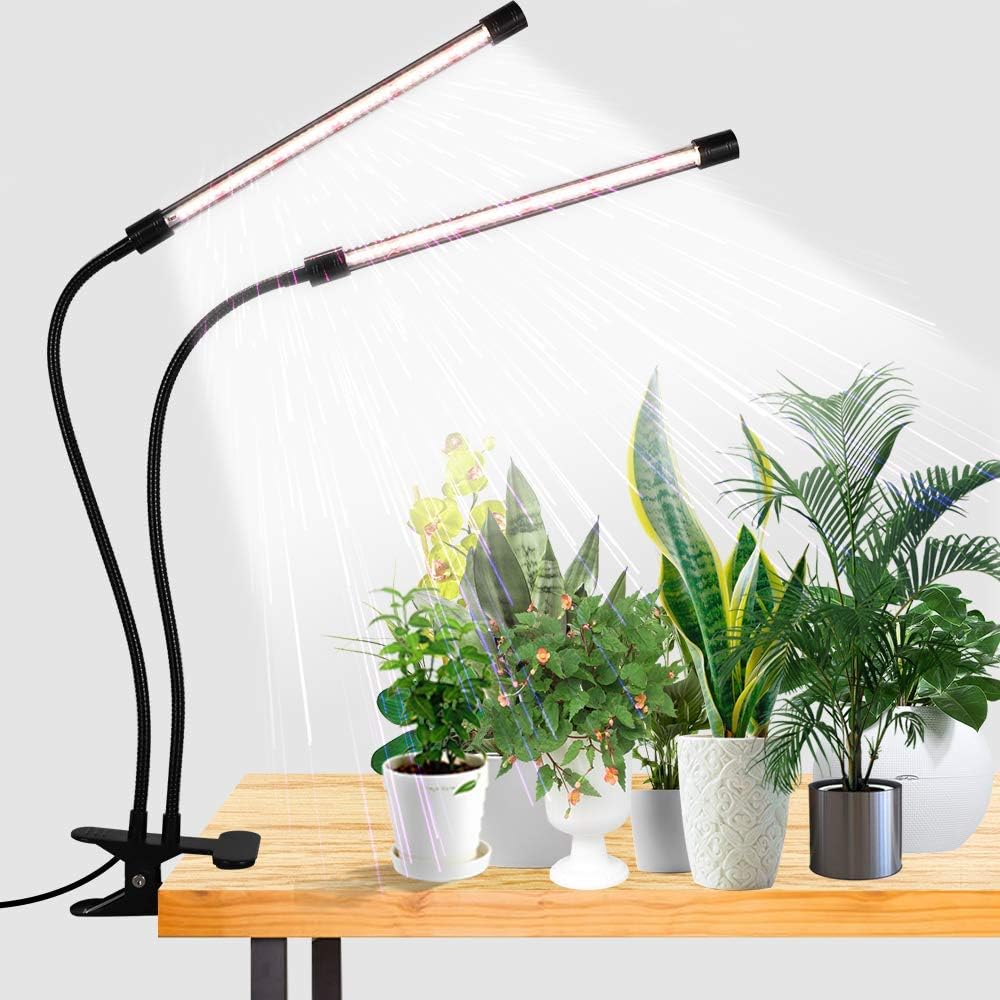
This GooingTop HY-021 is a compact clip-on grow light built for small houseplants, seedlings and shelf gardens. It uses 84 LEDs (white plus deep red) to deliver a 6000K full-spectrum output intended to mimic midday sun, with a high color-rendering output that also makes it pleasant as a reading lamp. Two flexible gooseneck heads and a strong clamp let you aim light precisely over pots and seed trays, while the attached remote provides 50%/100% dim levels and repeating timers at 4, 8 or 12 hours for hands-off scheduling. Practical benefits include low power draw (listed as roughly 10 W LED draw), a claimed 1 to 2 square meter coverage for seedlings, and an included timer that simplifies day/night cycles. Limitations are its design for small setups rather than large grow racks and the clip mounting limits placement compared with freestanding fixtures. The unit also relies on the corded remote instead of a smartphone app and the lifespan claim is typical of LEDs but not independently verifiable from the listing.
Best for: Buyers who want a simple, low-power, plug-and-play grow light to boost seedlings and a few houseplants on a desk or shelf and who value an easy-to-use timer and adjustable brightness.
Less Ideal for: Growers planning multi-shelf installations, larger vegetable grows, or who need networked or app-based control should consider larger bar lights or fixtures designed for commercial racks.
- Full-spectrum 6000K output with added 660 nm red LEDs to support vegetative growth and flowering
- Attached remote with dimming (50%/100%) and repeat timer settings (4/8/12 hours) for easy scheduling
- Flexible dual goosenecks and strong clamp enable precise positioning over small pots and seed trays
- High reported color rendering for comfortable viewing and accurate plant color assessment
- Low electrical draw around 10 W while covering small growing areas
- Clip-mount design and stated 1–2 m² coverage make it better suited to individual plants or small trays rather than large multi-shelf setups
- No smart app or wireless control option; remote is cord-attached which limits placement flexibility
Verdict: A compact, easy-to-use clip grow light that delivers full-spectrum light and convenient timer/dim controls for small indoor plant setups.
Barrina T5 1ft LED Grow Lights, 5000K Full Spectrum — 4-Pack

| Wattage | 5W |
|---|---|
| Color temperature | 5000K |
| Linkable | Link up to 16 lights |
| Control | Separate on/off switches |
The Barrina T5 1ft grow light 4-pack provides straightforward, energy-efficient supplemental lighting for seedlings, vegetative plants, and flowering houseplants. Each slim fixture produces a 5000K full spectrum output at 5W and includes an on/off switch so you can control lights individually or run them together. The lights are plug-and-play and come with power cords, connector cables, clips, double-sided tape, and cable ties for quick installation on shelves, racks, or small indoor shelving units. Because fixtures link up to 16 units, you can scale a multi-shelf setup without extra wiring. Practical benefits include low power draw, compact footprint that fits tight spaces, and a high PPFD-focused output that supports photosynthesis. Limitations are that these are short 1-foot fixtures intended for close-proximity use rather than lighting large rooms, the mounting relies on adhesive and clips rather than a heavy-duty mounting system, and they are not magnetic, which reduces some placement options. For growers who want an easy, modular lighting solution for small indoor setups, these deliver reliable light for everyday use.
Best for: Buyers who want a compact, energy-efficient grow-light system to brighten shelves or small indoor racks and who value easy installation and scalable setups.
Less Ideal for: Growers who need to light large rooms, tall plants, or wide benches should choose longer or higher-output fixtures instead.
- Full-spectrum 5000K output suitable for seedlings through flowering
- Individual on/off switches for each fixture allow flexible light scheduling
- Linkable design supports up to 16 lights for easy expansion
- Low power consumption (5W per 1ft fixture) reduces energy use
- Includes basic installation kit (power cords, connectors, clips, tape, cable ties)
- Short 1ft length limits coverage area per fixture
- Mounting depends on adhesive and clips rather than more secure hardware
- Not magnetic, reducing placement options on metal surfaces
Verdict: A compact, low-energy, and linkable 1ft grow light kit ideal for efficiently lighting shelves and small indoor plant setups.
Choosing the Right Grow Light for Flower Seedlings: Key Factors to Consider
Light Spectrum and Color Temperature
The spectral output determines how seedlings allocate energy between leaf development and stem elongation. Flower seedlings benefit from a balanced spectrum heavy on blue wavelengths early on because blue light promotes compact, sturdy leaf growth and short internodes.
Color temperature and the presence of specific red and far-red peaks also influence stretch and chlorophyll production. Choosing a fixture with a clear manufacturer spectrum or a full-spectrum description helps you avoid lamps that push seedlings to become tall and weak before they have true leaves.
Coverage and Fixture Size
Coverage affects how many trays you can run under a single fixture and how evenly seedlings receive light. Uneven coverage creates hot spots where plants outgrow neighbors and shaded zones where leggy plants form.
Match fixture length and beam angle to your bench. Longer fixtures with wide-angle optics work better for multiple trays; compact lamps work well for single trays or small racks. Consider overlap patterns if you plan to daisy-chain multiple fixtures to achieve uniform light across larger benches.
Adjustability and Intensity Control
Seedlings need lower light intensity at germination and higher PPFD as they develop true leaves. Fixtures that offer dimming, multiple power settings, or the ability to be raised and lowered maintain appropriate light levels without moving plants constantly.
Control options also let you reduce stress during hardening off or when seedlings show signs of stretching. Timers integrate with intensity control to simulate daylength and help ensure consistent photoperiods for species that respond to day-length cues.
Thermal Behavior and Heat Management
Heat near the canopy can quickly desiccate tiny cotyledons or raise tray temperatures, affecting germination and damping-off risk. Low-wattage LEDs typically produce less radiant heat than high-output lamps; however, thermal design still matters because hot spots above small trays can occur.
Look for fixtures with heat sinks, built-in fans, or passive cooling that keep surface temperatures moderate. Proper clearance from delicate seedlings and good bench airflow reduces humidity pockets that favor pathogens.
Energy Use and Operational Cost
Seed starting often requires lights running for 12 to 16 hours daily for several weeks, so energy consumption adds up. Compare power draw and expected lumen or PPFD output to gauge efficiency rather than assuming higher wattage is better.
A slightly higher upfront cost for a more efficient fixture can pay off through lower electricity use over the season. Also consider whether integrated timers or automated dimming reduce the need for external controllers, which adds convenience and may save energy through smarter schedules.
Durability and Mounting Options
Seed-starting environments can be damp and busy, so fixtures should withstand occasional splashes and repeated adjustments. Corrosion-resistant housings, secure hanging brackets, and easy-to-clean surfaces keep fixtures working season after season.
Mounting flexibility matters: adjustable ratchet hangers, telescoping poles, or integrated stands make it easier to maintain proper light distance as seedlings grow. Quick-release cords and accessible power switches reduce the fuss of daily use.
Setting Up a Seedling Bench
Start by deciding how many trays you will run and the bench footprint you have available. Place fixtures so light reaches all cells evenly; aim for a single fixture over a single tray or overlapping fixtures for multi-tray benches to avoid shaded edges.
- Measure tray dimensions and map fixture spacing before mounting.
- Allow 2 to 6 inches between seedlings and the light for low-intensity fixtures, more for higher-output units.
- Use reflective bench surfaces to bounce light back into shaded lower leaves.
Timing and Daily Light Management
Most flower seedlings do well with 12 to 16 hours of light per day. Start on the shorter end during germination and increase duration and intensity gradually as true leaves appear. Consistent schedules reduce stretch and promote uniform growth.
- Use a dedicated timer rather than manual switching to keep photoperiods steady.
- Reduce intensity or lift fixtures if leaves bleach or curl from excess light.
- Simulate dawn/dusk by ramping intensity on fixtures that support gradual dimming, if available.
Hardening Off Seedlings Grown Under Lights
Transitioning seedlings from controlled indoor light to outdoor sun requires a stepwise approach. Begin by placing seedlings in a sheltered, partially shaded spot for a few hours daily, increasing exposure over a week to ten days. This reduces transplant shock and sunscald when seedlings face full sun.
- Start on calm days to avoid wind stress.
- Bring seedlings back inside overnight if cold nights are expected.
- Reduce irrigation slightly during hardening to toughen foliage.
Tray Types, Media, and Watering Interactions
The type of tray and growing medium you use can alter light requirements. Dark, moisture-retentive media can heat more under lights and increase disease risk, while coarse mixes dry faster and may need more frequent watering under high light. Observe how media surface temperature and moisture respond to your chosen fixture and adjust light distance or bench humidity accordingly. Bottom-watering or capillary mats can reduce damp foliage and lower the chance of fungal issues.
- Use clear lids for germination and remove them once true leaves form to prevent damping-off.
- Keep watering consistent but avoid overwatering shallow flats under constant light.
Scaling Up From Single Trays to a Small Greenhouse
When you move from a few flats to dozens of trays, fixture layout and power management become more important. Plan runs with even spacing, and consider circuits and cord length so you do not overload outlets or create trip hazards. Label rows and keep a planting calendar to track sowing dates, crop rotation, and light schedules. As you scale, regular maintenance of fixtures, such as dusting lenses and checking hangers, preserves light output and safety.
- Document which fixtures cover which benches to simplify rotation.
- Group seedlings by species or transplant date to streamline intensity and timing adjustments.
How We Chose the Best Grow Light for Flower Seedlings
We focused on fixtures that perform reliably for germination and the first four to six weeks of seedling growth. Selection emphasized light spectrum and intensity suited to flower seedlings, uniform coverage over standard seed trays, and adjustable height or dimming so young plants get appropriate PPFD as they develop. Energy efficiency and thermal behavior were measured by lamp type and power draw to ensure units do not overheat small trays or raise greenhouse temperatures. Build quality and ease of setup were also part of the filter: stable mounting options, corrosion-resistant housings for damp bench environments, and straightforward controls matter in a busy seed-starting routine. We excluded fixtures designed only for mature, flowering plants that require bloom-specific spectrums or high-intensity vertical racks, because those do not suit delicate seedlings. In short, we selected units that provide a balanced spectrum for vegetative seedling growth, predictable coverage for standard trays, safe heat profiles, adjustable light intensity or distance, and practical installation for hobby and small-scale greenhouse use.
FAQ
How close should a grow light be to flower seedlings?
Distance depends on fixture output. Low-intensity lights can be 2 to 6 inches above cotyledons, while higher-output LEDs often need 8 to 18 inches. Start farther away and move closer as seedlings show they can handle more light.
What daily light hours do flower seedlings need?
Most flower seedlings thrive on 12 to 16 hours of light per day. Shorter periods are fine for germination; increase duration and intensity gradually as true leaves develop.
Can I use regular household bulbs for seed starting?
Household bulbs usually lack the balanced spectrum and intensity seedlings need and can produce unwanted heat. Fixtures designed for plant growth provide the appropriate blue-rich spectrum and safer thermal performance.
Should I use full spectrum or red-heavy lights for flowers?
For seedlings, a blue-leaning or full spectrum that emphasizes blue wavelengths promotes compact growth. Red-heavy spectrums are more relevant later in the flowering stage and are not necessary for early seedling development.
How do I prevent seedlings from getting leggy under lights?
Ensure adequate blue light, maintain proper distance so plants do not stretch toward the fixture, and provide sufficient daily light duration. Dimming capabilities and raising fixtures as plants grow also help keep stems short and sturdy.
Do grow lights affect indoor humidity or temperature?
Some fixtures add measurable heat, especially older high-wattage types. LEDs generally run cooler but still can warm small enclosed spaces. Monitor bench temperature and provide ventilation to avoid humidity pockets that encourage disease.
Final Verdict
Focus on spectrum, coverage, and control when choosing a grow light for flower seedlings. Prioritize fixtures that give a blue-rich or balanced spectrum, offer even light across your tray footprint, and allow you to adjust intensity or height as seedlings mature. Consider heat output and energy use to protect delicate cotyledons and manage operating costs. By weighing those tradeoffs relative to your bench size and sowing schedule, you can pick a fixture that produces compact, healthy seedlings ready for transplanting with minimal fuss.
