

Note: This article contains affiliate links. If you click on these links and make a purchase, I may earn a small commission at no extra cost to you. This helps support my research and content. Read my full affiliate disclosure here.
Picking the right hand saw for cross cuts matters when you want clean end-grain slices, accurate joinery, or neat trim work around the house and garden projects. A saw tuned for cross cuts behaves differently than a rip saw: it severs wood fibers across the grain, so tooth shape, set, and blade stiffness all change the result and how you work. This guide shortlists the top hand saws for cross cuts and explains the practical differences between tooth patterns, handle ergonomics, and blade control. We evaluated options across common garden and workshop tasks, focusing on how each design affects cut quality and user effort. Read on to understand the tradeoffs and figure out which saw style suits your cutting needs.
Top Picks at a Glance
| Best Overall The best all-around choice for most situations | Lynx (Taytools) 22" Garlick Thomas Flinn Crosscut Saw with Beech Handle |  |
| Best Quality Built to a higher standard if you want something more solid | Disston D8 26" Cross Cut Hand Saw with Walnut Handle |  |
| Best Value The sweet spot between price and what you get | Jorgensen 15-Inch Hand Saw with 8 TPI Black-Coated Blade |  |
| Best Budget The cheapest option that still gets the job done reliably | QYQRQF 14 in. Pro Hand Saw with Ergonomic Soft-Grip Handle |  |
| Highest Rated A top-rated pick with lots of positive feedback | Tempest 14" Pro Hand Saw with 65Mn Carbon Steel Blade and Protective Sleeve |  |
| Most Popular A crowd favorite that many people choose with confidence | RUITOOL 6" Japanese Ryoba Double-Edge Pull Saw |  |
Lynx (Taytools) 22" Garlick Thomas Flinn Crosscut Saw with Beech Handle

| Blade Length | 22 inches |
|---|---|
| Number of Teeth | 220 |
| Blade Material | Alloy Steel |
| Handle Material | Beechwood |
This 22-inch Lynx/Taytools crosscut saw is a straightforward, high-quality hand saw for cutting across wood grain. It has a taper-ground alloy steel blade with 10 TPI filed for crosscutting, which reduces binding and gives smooth, controlled cuts in dimensional lumber and finished boards. The handle is stained European beech secured with brass button screws for a comfortable, classic grip that suits extended use. The blade is hand-sharpened at the factory and can be resharpened when needed, so the saw is serviceable rather than disposable. Its construction and tooth count make it best for general workshop and jobsite cross cuts rather than fast rip cuts or very fine joinery. Because the blade is taper-ground it tracks well without much set, but users who need faster removal or aggressive cutting will find handsaws with coarser TPI or rip geometry quicker. This saw is a good fit for someone who values traditional build quality and wants a reliable manual tool for clean crosscutting tasks.
Best for: Buyers wanting a well-made traditional hand saw for reliable crosscutting in the workshop or at the jobsite who prioritize cut quality and serviceability over maximum speed.
Less Ideal for: Users who need rapid stock removal, rip cutting, or ultra-fine finish work should consider purpose-specific saws instead.
- Taper-ground alloy steel blade reduces binding for smoother cuts.
- 10 TPI filed teeth optimized for clean crosscuts in dimensional lumber.
- Hand-sharpened factory finish and resharpenable blade extend useful life.
- Comfortable stained European beech handle with brass button screws for secure grip.
- 10 TPI limits fast material removal compared with coarser rip saws.
- Not intended for very fine joinery where higher tooth counts are preferred.
Verdict: A durable, serviceable 22-inch crosscut saw that delivers smooth, low-binding crosscuts for buyers who value traditional build quality.
Disston D8 26" Cross Cut Hand Saw with Walnut Handle

| Blade Length | 26 inches |
|---|---|
| Blade Material | High Speed Steel |
| Handle Material | Walnut |
| Number of Teeth | 10 |
| Power Source | Manual |
This Disston D8 is a purpose-built 26-inch cross-cut saw that pairs a high-speed steel, taper-ground blade with a custom-carved American walnut handle. It is used much like a conventional handsaw for cutting across the grain of dimensional lumber and finished boards; the 10-tooth blade and taper grind reduce binding and help produce smooth, efficient strokes. The walnut handle is shaped for a comfortable grip and gives good control during long cutting runs, while the rectangular blade profile and carved tooth line help maintain straight tracking. Practical benefits include predictable, low-friction cutting and a traditional feel that works well for finish carpentry, framing snips, and down-the-line rip cuts when precision is needed. Limitations are that the saw is sized for general-purpose cross cuts rather than fine dovetail or very coarse rough work, and it requires sharpening or professional service over time to restore peak performance. Heavy-duty demolition tasks or metal cutting are outside its intended use.
Best for: A buyer who prioritizes cutting performance and control for cross-grain work and wants a traditional, durable handsaw for finish carpentry and daily woodworking tasks.
Less Ideal for: People who need a saw for fine joinery like dovetails or for heavy demolition and metal cutting should consider specialty saws or powered tools instead.
- Taper-ground high-speed steel blade reduces binding for smoother cuts
- Custom carved American walnut handle provides a comfortable, controlled grip
- 26-inch blade length covers typical board widths without repositioning
- Rectangular blade and carved tooth line help maintain straight cutting lines
- Only 10 teeth per blade limits suitability for very fine finish joinery
- Not intended for metal or heavy demolition work requiring coarse or hardened blades
Verdict: Buy this saw if you want a high-performance, traditional 26" cross-cut saw that favors smooth, controlled cuts and long-term durability.
Jorgensen 15-Inch Hand Saw with 8 TPI Black-Coated Blade

| Number of Teeth | 8 |
|---|---|
| Blade Material | Alloy Steel |
| Handle Material | Aluminum |
| Surface Recommendation | Plastic,Wood |
The Jorgensen 15-inch hand saw is a straightforward, heavy-cut handsaw aimed at general woodworking and outdoor trimming tasks. Its 8 TPI triple-ground teeth deliver aggressive, fast cuts through dimensional lumber and framing stock, while the SK5 high-carbon steel blade holds an edge and resists bending under regular use. The black Teflon-like coating reduces friction and helps keep sap and debris from building up on the blade. The reinforced aluminum frame and TPE/ABS ergonomic grip make it comfortable to hold for extended sessions and the handle includes 45° and 90° angle guides useful for marking cuts. Practical uses include rip and cross cuts on rough lumber, pruning thick branches, and cutting PVC or trim where speed matters more than ultra-fine finish. Limitations are inherent to the coarse 8 TPI: it is not intended for fine finish work or precise joinery and will leave a rougher cut on delicate stock. Also, being a fixed non-folding saw it requires safe storage with the included edge protector.
Best for: A buyer who wants a reliable, fast-cutting handsaw for general carpentry, framing, and heavier trimming tasks and values durability and comfort during frequent use.
Less Ideal for: Not the best choice for woodworkers focused on fine finish work, delicate trimming, or precision joinery who need higher-tooth-count saws.
- Aggressive 8 TPI triple-ground teeth for fast, efficient cutting of rough lumber
- SK5 high-carbon steel blade offers good edge retention and resists bending
- Black low-friction coating reduces material buildup and helps corrosion resistance
- Ergonomic aluminum-framed handle with TPE/ABS grip and built-in angle guides
- Coarse 8 TPI tooth pattern produces a rougher finish not suited to fine joinery
- Fixed blade requires careful storage and is less portable than folding saws
Verdict: Choose this saw if you want a durable, comfortable hand saw that makes fast, aggressive cuts for general carpentry and trimming.
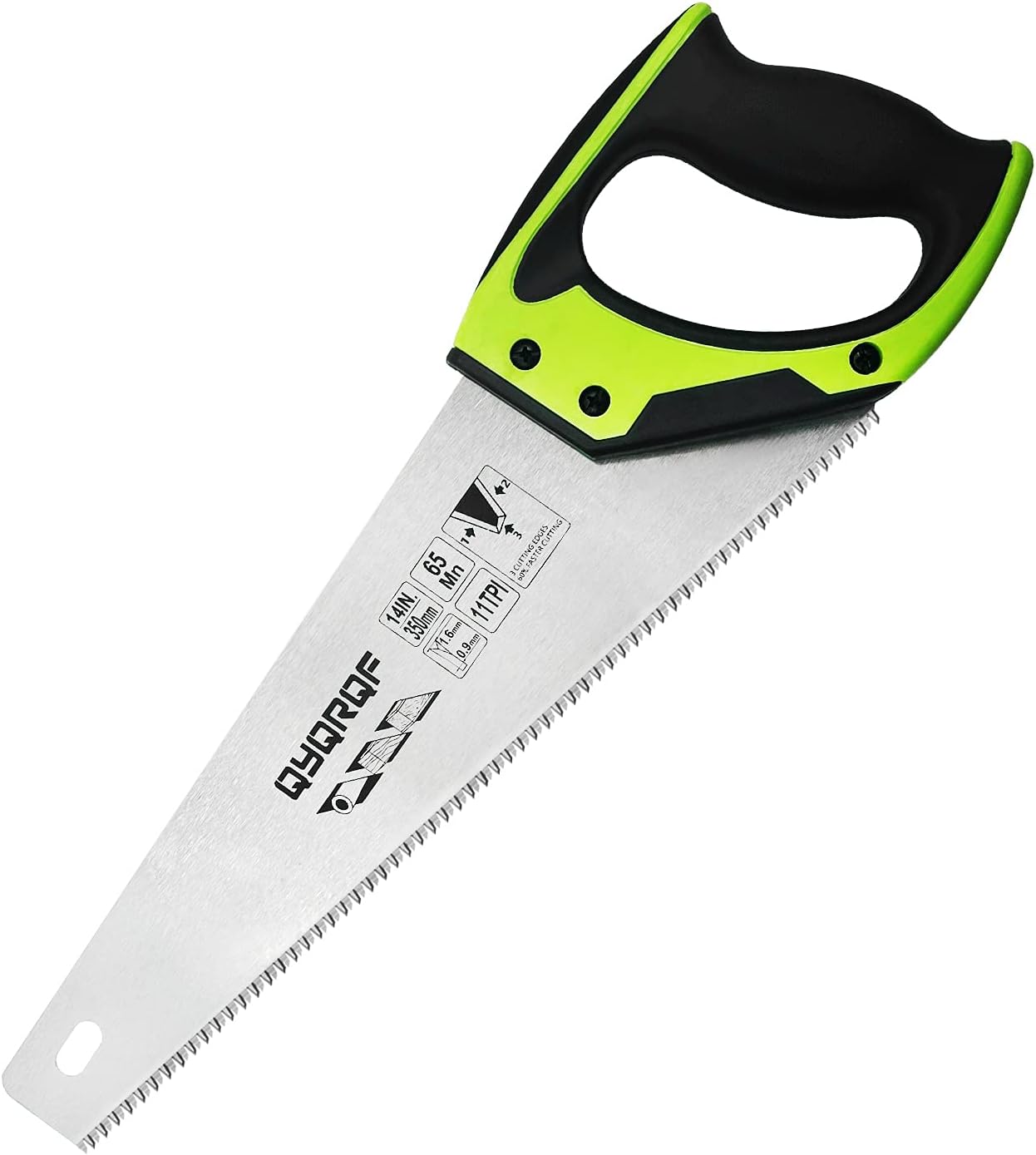
QYQRQF 14 in. Pro Hand Saw with Ergonomic Soft-Grip Handle
| Blade Material | Alloy Steel |
|---|---|
| Blade Length | 14 inches |
| Number of Teeth | 11 |
| Handle Material | Thermoplastic Elastomers |
This 14-inch pro hand saw is built for fast, accurate cuts in wood, plywood and PVC pipe. The 65Mn heat-treated alloy-steel blade with three-face grinding and deep gullets clears chips quickly, and the 11 TPI fine-cut tooth pattern makes controlled crosscuts and trim work straightforward. A low-friction coating helps the blade slide through material, while the thermoplastic elastomer soft-grip handle is shaped for comfort during repeated strokes and reduces hand fatigue. It ships with a protective sleeve and a hard case for safe storage. For someone focused on practical performance, the saw delivers durable sharpness and predictable cuts without power tools. Limitations are its manual speed compared with a power saw and that the 11 TPI is a compromise between fast ripping and very fine finishing, so you may need a different tooth count for very fine trim or rip work.
Best for: Buyers who prioritize efficient, reliable hand cutting for routine wood trimming and light carpentry and want a durable tool that reduces hand fatigue during regular use.
Less Ideal for: Users who need the fastest bulk ripping or ultra-fine finish cuts, or those who prefer powered saws for large projects.
- Heat-treated 65Mn alloy-steel blade for long-lasting edge retention
- Three-face grinding and deep gullets for faster chip removal and quicker cuts
- Low-friction coating reduces binding and improves stroke efficiency
- Ergonomic non-slip soft-grip handle reduces hand fatigue during extended use
- Manual saw cannot match the speed of powered cutting tools
- 11 TPI is a middle-ground tooth count and may not be ideal for very fine finish cuts or fast ripping
Verdict: A durable, comfortable 14-inch hand saw that speeds up manual cutting with a heat-treated blade and efficient tooth geometry, ideal for everyday wood and trim work.
Tempest 14" Pro Hand Saw with 65Mn Carbon Steel Blade and Protective Sleeve

| Blade Material | Carbon Steel (65Mn) |
|---|---|
| Blade Thickness | 0.9 mm |
| Teeth | 11 TPI, triple-ground |
| Handle Material | Thermoplastic Elastomers |
| Included Components | Protective Sleeve |
The Tempest 14" Pro Hand Saw is built for reliable, everyday crosscutting of lumber, plywood, branches, drywall, and plastic pipe. Its 65Mn carbon steel blade and 0.9 mm thickness give the blade stiffness that reduces wobble when making straight crosscuts, while the 11 TPI triple-ground teeth deliver aggressive but controlled bite for relatively fast, clean strokes. The ergonomic thermoplastic elastomer handle is non-slip and comfortable during longer sessions, and the included protective sleeve keeps the teeth safe in a toolbox or on a jobsite. In practical use this saw performs like a heavier-duty carpenter's handsaw rather than a fine-tooth finish saw, so it excels at framing cuts, pruning thicker branches, and general workshop trimming. The trade-off is that at 11 TPI it will leave a slightly rougher surface than a higher-TPI crosscut or rip saw, so extra sanding may be needed when a smooth finish is required. Overall it is a sturdy, no-frills saw that favors durability and straight cutting under pressure.
Best for: Buyers who prioritize a durable, dependable handsaw for regular crosscutting tasks like framing, pruning, and workshop trim where straight, fast cuts matter more than a glass-smooth finish.
Less Ideal for: If your primary need is fine finish carpentry or cutting joinery that requires very smooth surfaces, a finer-tooth saw or a dedicated crosscut saw with higher TPI is a better choice.
- Stiff 0.9 mm 65Mn carbon steel blade minimizes wobble for straighter cuts
- 11 TPI triple-ground teeth provide fast, efficient cutting through common materials
- Ergonomic non-slip TPR handle reduces hand fatigue during extended use
- Protective sleeve shields teeth for safer storage and longer tooth life
- 11 TPI leaves a rougher finish than higher-TPI crosscut saws, requiring more sanding for finish work
- Fixed blade thickness and tooth pattern make it less suited for very fine or finish carpentry
Verdict: Choose this saw when you want a stiff, reliable 14-inch handsaw that cuts fast and straight for everyday crosscut and pruning work.
RUITOOL 6" Japanese Ryoba Double-Edge Pull Saw

| Blade Material | SK5 steel |
|---|---|
| Blade Length | 6 inches |
| Number of Teeth | 17 (one side) and 14 (other side) |
| Handle Material | Beechwood |
| Power Source | Hand Powered |
The RUITOOL 6" Ryoba pull saw is a small, precision hand saw built for fine crosscuts and flush trimming. It uses a thin, flexible SK5 high-carbon steel blade with two tooth patterns — 17 TPI on one edge and 14 TPI on the other — so you can switch between finer crosscuts and slightly more aggressive rip-style cutting without changing tools. The hardened three-edge teeth and ultra-thin blade produce fast, clean cuts and reduce tear-out on finish work, while the compact 6" blade makes the saw easy to control in tight spaces or for trim tasks. The comfortable beechwood handle is lightweight and slips comfortably into hand-held work where a pull stroke gives better control than a Western push saw. Limitations to note are the short blade length, which makes long rip cuts or larger stock slower, and the thin blade may flex under heavy-duty pruning or demanding structural work. For cabinetry, trim, and detailed joinery this saw offers precise results; for bulk cutting a longer or coarser saw will work faster.
Best for: Buyers who prioritize precise finish cuts and tidy joinery in trim, cabinetry, or small woodworking projects and who prefer a controllable pull-stroke saw for detail work.
Less Ideal for: Users needing to make fast bulk ripping or long crosscuts on large boards or for rough outdoor pruning should choose a longer, coarser bladesaw instead.
- Dual 14/17 TPI edges let you switch between finer crosscuts and coarser ripping without changing saws
- SK5 high-carbon steel blade is thin and flexible for accurate flush and finish cuts
- Hardened three-edge teeth increase sharpness and chip removal for faster, cleaner cutting
- Lightweight, comfortable beechwood handle improves control during pull strokes
- 6-inch blade is short so long or bulky cuts require more strokes or a longer saw
- Thin flexible blade can bend if used on very hard or heavy stock
Verdict: Choose this compact Ryoba if you want a precise, easy-to-control pull saw for clean crosscuts and finish trimming.
Choosing the Right Hand Saw for Cross Cuts: Key Factors to Consider
Tooth Pattern and Pitch
Tooth shape and teeth per inch determine how a hand saw severs wood across the grain. Cross-cut teeth are typically beveled to act like tiny knives that slice fibers rather than tear them. A finer pitch gives smoother results on thin stock and trim, while a coarser pitch removes material faster on thicker boards.
Matching pitch to the task is important: use a finer tooth count for finish work and tight joints to reduce tearout and splintering. For larger outdoor timbers or quick rough cuts, a coarser cross-cut pattern speeds the job but may leave a rougher surface that needs sanding or paring.
Blade Stiffness and Length
Blade stiffness affects how straight your cut will be and how much the blade deflects under pressure. Stiff blades resist bending on long strokes and help you keep a line when cutting across wider boards. Thinner blades flex more easily and can be helpful for short curved or intricate cuts, but they require a steadier hand.
Blade length dictates the stroke and the maximum width you can cut in a single pass. Shorter blades are easier to control for trim and small joints; longer blades cover wider stock with fewer strokes, improving efficiency on large panels or framing lumber.
Handle Comfort and Control
The handle is your interface with the saw, so its shape, grip material, and orientation matter for accurate cross cuts. An ergonomic handle reduces wrist strain during repeated short cuts and helps maintain consistent pressure through the stroke. Look for handles that align the blade with your forearm to reduce twisting and that give a secure grip even when your hands are sweaty or damp.
A comfortable handle makes it easier to guide the tooth pattern consistently into the wood, which directly affects tearout, cut straightness, and user fatigue during longer projects.
Set and Blade Finish
Set refers to how far the teeth are bent away from the blade body. Proper set creates a kerf slightly wider than the blade so the saw does not bind as it moves through the wood. For cross cuts, an even, controlled set helps prevent pinching and reduces the effort required to complete a cut.
The blade finish and any protective coatings influence drag and corrosion resistance. A smooth finish helps the saw glide and minimizes friction, while coatings slow rust when the saw is used or stored in damp outdoor environments.
Maintenance and Sharpening
Cross-cut teeth can be sharpened and maintained but require different files and techniques than rip teeth because of their beveled faces. Consider how easy it is to resharpen or re-set teeth if you plan to keep a saw for years. Some users prefer replaceable blades or saws that take standard triangular files; others expect to use professional sharpening services.
Easy maintenance keeps performance consistent and prolongs the tool's usable life, which is especially important if you use the saw outdoors where grit and moisture accelerate wear.
Understanding Cross-Cut Tooth Types
Cross-cut tooth profiles vary from traditional bevel-cut teeth to modern impulse-hardened patterns. The basic idea is teeth are shaped to slice fibers cleanly at the edge rather than chop parallel to the grain. Different profiles produce subtle differences in the surface finish and how much effort is needed.
For typical garden and home projects, look for teeth set and sharpened specifically for cross cutting. This delivers cleaner ends on dimensional lumber, trim, and small branches compared with a rip-style tooth. If you need the absolute cleanest finish for visible joinery, finer pitch and well-sharpened bevel teeth are the better choice.
- Beveled cross-cut teeth slice fibers cleanly for less splintering
- Finer pitch produces smoother finishes on thin stock
- Coarser teeth speed cutting on thicker boards but may need more cleanup
Practical Cutting Techniques for Better Results
Control the cutting angle and let the saw do the work. For cross cuts, a slightly angled entry helps teeth engage cleanly, and consistent, moderate pressure on the forward stroke keeps the cut even. Avoid forcing the blade; forcing increases tearout and blade wander.
Start cuts with a few light strokes to establish a kerf before using full-power strokes. When cutting finished or veneered pieces, support the waste side near the cut to reduce breakout on the far surface. Clamping small workpieces or using a cutting sled can dramatically improve cut quality and safety.
- Begin with light scoring strokes to set an accurate kerf
- Support the waste side of cross cuts to minimize splintering
- Maintain a smooth, even stroke rather than jerky motions
Choosing Between Panel, Tenon, and General-Purpose Blades
Different blade shapes suit different tasks. Panel hand saws typically use a longer, thin blade for straight long cuts across boards and sheet goods. Tenon or carcass saws have shorter blades and finer teeth for precise joinery and trimming in tight spaces. General-purpose cross-cut saws sit between those extremes and are useful for a wide range of yard and workshop jobs.
Think about the cuts you do most. For trim carpentry and fine joinery, prioritize shorter blades with finer teeth for control. For cutting larger boards or occasional outdoor timbers, a longer cross-cut saw gives you the stroke length and speed needed to work efficiently.
- Panel saws for longer, straight cross cuts on wide stock
- Tenon saws for tight joinery and precise short cuts
- General-purpose blades for versatile yard and workshop use
Maintaining a Cross-Cut Hand Saw
Keep the blade clean and lightly oiled to resist rust, especially if you store tools in an outdoor shed or damp workspace. Regularly clear pitch and sap buildup from teeth with a solvent and a small brush to maintain cutting action.
Inspect tooth set and sharpness periodically. A dull cross-cut saw requires more force and produces rougher finishes. When resharpening, use the correct file and technique for beveled teeth or take the blade to a professional service if you are unsure.
- Clean pitch and sap after outdoor cutting
- Apply a light oil film for corrosion protection
- Check and adjust tooth set and sharpness as needed
Safety Tips for Hand Saw Use Outdoors
Always secure the workpiece with clamps or a vise before starting a cross cut. Unsecured wood shifts and increases the risk of slips and inaccurate cuts. Keep your free hand well away from the blade path and maintain a stable stance to control the stroke.
Wear eye protection to catch splinters and gloves if you need extra grip for rough outdoor timber. Inspect the blade for cracks or heavy corrosion before use; damaged blades can fail under load and cause injury.
- Clamp work securely to prevent shifting
- Use eye protection and consider gloves for heavy outdoor cuts
- Inspect blades for damage before each use
How We Chose the Best Hand Saw for Cross Cuts
We started by selecting hand saw designs commonly used for cross cutting in garden and workshop settings, then filtered for features that actually affect cut quality and user experience. Evaluation criteria emphasized tooth geometry and sharpness because cross-cut teeth are shaped to slice fibers cleanly. Blade control received attention for how stiffness and thickness affect wobble and straightness when making short or angled cuts. Handle ergonomics and grip were considered to reduce user fatigue and improve control during precise cuts. Cutting efficiency and effort reflect how fast a saw passes through end grain without excessive force. Durability covered blade temper and edge retention so a saw keeps cutting well after repeated outdoor and workshop use. We excluded tools designed primarily for ripping, power saws, or specialty veneer cutters that do not behave like typical cross-cut hand saws. Only models with clear cross-cut tooth geometry and practical blade lengths for common garden and trim tasks were included. The result is a list focused on saws that deliver clean end-grain cuts, usable control, and long-term reliability.
FAQ
What tooth count is best for clean cross cuts on trim?
A finer tooth count is usually best for trim and finish work because it produces a smoother surface and reduces splintering. For fine joinery, aim for higher teeth per inch so the saw slices fibers cleanly without chipping the finish.
Can I use the same hand saw for both cross cuts and rip cuts?
You can use a general-purpose saw for both, but it will be a compromise. Rip teeth are shaped to cut along the grain and will not give as clean an end-grain finish as a dedicated cross-cut pattern. For frequent cross cutting, choose a saw with cross-cut geometry.
How do I reduce tearout when cutting across veneer or plywood?
Support the waste side of the cut and start with light scoring strokes to open a clean kerf. Clamping a sacrificial board on the cut line or using a cutting sled helps prevent breakout on the far face.
How often should I sharpen a cross-cut hand saw?
Frequency depends on use, but typically after many hours of cutting the teeth will feel dull and require more force. Inspect tooth edges regularly and resharpen when the saw starts to drag or produce rougher cuts. Proper maintenance extends blade life.
Is blade coating important for outdoor use?
A light protective finish or coating helps resist rust when you use or store the saw in damp conditions. Coatings do not change cutting geometry but reduce corrosion and binding caused by grit and moisture.
Final Verdict
For cross cuts, prioritize tooth geometry and blade control over raw aggressiveness. Fine-pitched, well-sharpened cross-cut teeth with a stiff blade and comfortable handle produce the cleanest end-grain results and require less cleanup. Consider the length and stiffness you need for the stock you cut most often and be prepared to maintain tooth set and sharpness. Balancing cut quality, ease of control, and maintainability will help you choose the best hand saw for cross cuts for your projects. Focus on the specific tasks you do most and pick a saw whose blade type and ergonomics match that work for reliable, tidy results.
