

Note: This article contains affiliate links. If you click on these links and make a purchase, I may earn a small commission at no extra cost to you. This helps support my research and content. Read my full affiliate disclosure here.
Picking the right potting mix for self watering containers changes how often you tend the reservoir and how well plants use delivered moisture. The wrong mix can stay soggy against the wick or dry out too quickly despite a reservoir. This guide covers seven top-rated potting mixes chosen for how they behave in container reservoirs and wicking systems, with attention to moisture control, aeration, and nutrient retention. Below we explain what made the shortlist and the practical tradeoffs gardeners face when matching mixes to plant types and container setups. Read on to see the criteria used and the key considerations that will help you pick the best mix for your setup.
Top Picks at a Glance
| Best Overall The best all-around choice for most situations | Miracle-Gro Moisture Control Potting Mix, 16-Quart |  |
| Best Quality Built to a higher standard if you want something more solid | Burpee Premium Organic Potting Mix with Coco Coir (9 Quart) |  |
| Best Value The sweet spot between price and what you get | Miracle-Gro Indoor Potting Mix for All Plants, 6 qt., 2-Pack |  |
| Best Budget The cheapest option that still gets the job done reliably | Back to the Roots Organic Indoor Potting Mix, 6 Quart |  |
| Highest Rated A top-rated pick with lots of positive feedback | Gardener's Supply Company 20 qt Potting Mix with SuperRoot Booster & Moisture‑Retaining Coir |  |
| Most Popular A crowd favorite that many people choose with confidence | Miracle-Gro Moisture Control Potting Mix, 16 qt. (2-Pack) |  |
| Best Seller A high-volume bestseller chosen again and again | Back to the Roots Organic Expanding Coco Coir Potting Soil Brick (10 lb) |  |
Miracle-Gro Moisture Control Potting Mix, 16-Quart

| Brand Name | Miracle‑Gro |
|---|---|
| Unit Count | 1 Count |
| Volume | 16 quarts |
| Feeds up to | 6 months |
This 16‑quart Miracle‑Gro Moisture Control Potting Mix is formulated for container gardening and is designed to reduce both overwatering and underwatering with an AquaCoir wetting formula. You use it like any potting mix: fill a pot about one third, set the plant, add mix and water. Notable features include improved water retention (claims up to 33% more absorption than basic mixes) and built‑in nutrients that feed plants for up to six months, which reduces how often you need to fertilize. For potted hostas it provides a loose, well‑draining medium that helps keep roots aerated while holding enough moisture between waterings. Limitations are that the bag is a single 16‑quart unit so it covers only a few pots and the product description emphasizes annual repotting to refresh nutrients, so it is not a permanent soil solution. Also its moisture balance may still require attention in very wet or very dry microclimates.
Best for: Buyers who want a reliable, low‑maintenance potting mix for container hostas that keeps moisture consistent and reduces the need for frequent feeding.
Less Ideal for: Gardeners who prefer to mix their own bespoke soil blends or who need bulk quantities for many large containers should look elsewhere.
- Designed to reduce both overwatering and underwatering with AquaCoir and a wetting agent
- Includes nutrients that feed plants for up to six months
- Improved water absorption compared with basic potting soil helps maintain consistent moisture for container plants
- Loose mix intended to provide drainage and root aeration suitable for potted ornamentals
- 16‑quart bag covers a limited number of pots so multiple bags are needed for several hostas
- Requires annual repotting to replenish nutrients rather than serving as a long‑term in‑pot soil
Verdict: A convenient, moisture‑balancing potting mix that makes growing healthy hostas in pots easier by holding moisture and supplying months of nutrients.
Burpee Premium Organic Potting Mix with Coco Coir (9 Quart)

| Item Form | Powder |
|---|---|
| Specific Uses For Product | Plant Growth, Root Development, Seed Development, Soil Conditioning |
| Coverage | 9 Qt Container |
| Liquid Volume | 9 quarts |
Burpee Premium Organic Potting Mix is a ready-to-use container soil designed for indoor and outdoor pots, seed starting, and raised bed containers. The mix combines coco coir for improved aeration and moisture retention with a nutrient blend that feeds plants for up to three months, making it useful for establishing seedlings or repotting established vegetables, herbs, and ornamentals. It is OMRI listed, which suits organic growers, and the bag is sold in a convenient 9-quart size that fits most small to medium containers. Practical benefits include reduced watering frequency thanks to the coir component and a balanced medium that promotes root development and germination. Limitations are the small bag size for larger projects and that it supplies nutrients for only a limited period, so longer-term containers will need supplemental fertilizer. The mix is powdery and light, so it is easy to handle but may compress over time in deep pots and benefit from occasional loosening.
Best for: Gardeners who want a compact, ready-made organic potting mix that reduces maintenance and supports reliable seed starting and container growth.
Less Ideal for: Those establishing large beds or filling many large containers at once should choose bulk soil or larger bags instead.
- OMRI listed organic blend suitable for organic container gardening
- Coco coir improves moisture retention while maintaining good aeration
- Includes slow-release nutrients that feed plants for up to three months
- Light, easy-to-handle texture ideal for seed starting and repotting
- 9-quart bag is small for larger containers or multiple pots
- Nutrient supply is temporary so additional fertilizer is required for long-season crops
Verdict: A compact OMRI-listed potting mix with coco coir that simplifies seed starting and short-term container growing by improving moisture balance and early root development.
Miracle-Gro Indoor Potting Mix for All Plants, 6 qt., 2-Pack

| Number of Packs | 2 |
|---|---|
| Unit Count | 400.58 Ounce |
| Item Highlight | Feeds for up to 6 Months |
| Ingredients | Sphagnum Peat Moss, Coir, Perlite, Fertilizer, Wetting Agent |
This Miracle-Gro indoor potting mix is formulated as an all-purpose soil for indoor container plants and is sold in a two-pack of 6‑quart bags. It combines sphagnum peat moss, coconut coir, and perlite to create a lightweight, well-draining mix that holds moisture yet releases it to roots, which helps tropical houseplants like a Dragon Tree avoid waterlogged roots. The bagged mix includes a slow-release fertilizer meant to feed plants for up to six months so you do not need to amend immediately after potting. Notably the formula excludes bark and compost, which can reduce habitats for fungus gnats — useful when repotting indoor specimens. Use is straightforward: fill a pot with drainage, set the plant, backfill with mix, and water. Limitations are that the fertilizer schedule is fixed to the included feed and heavy feeders may need additional fertilizing after several months, and serious growers who want a custom cactus or orchid-style mix will find the texture too fine. For routine repotting of Dragon Trees and similar tropical houseplants this mix is convenient and consistent.
Best for: Buyers who want a reliable, low-effort potting mix for repotting tropical houseplants like Dragon Trees and prefer a product with built-in feeding and pest-reduction features.
Less Ideal for: Specialist growers who need custom texture blends for succulents, orchids, or aggressive feeders should choose purpose-formulated mixes or amend this product accordingly.
- Balanced blend of peat moss, coir, and perlite for good moisture retention and drainage
- Includes slow-release fertilizer that feeds up to six months for low-maintenance care
- Bark- and compost-free formula reduces places for fungus gnats to breed
- Ready-to-use bag makes repotting quick with no mixing required
- Fertilizer is fixed for about six months so additional feeding may be necessary for heavy feeders
- Texture may be too fine for plants that prefer very fast-draining or chunky mixes
Verdict: A convenient, low-maintenance indoor potting mix that keeps Dragon Trees healthy with good drainage and up to six months of built-in feeding.
Back to the Roots Organic Indoor Potting Mix, 6 Quart

| Unit Count | 192 Fluid Ounces |
|---|---|
| Item Type Name | Indoor Potting Mix 6qt |
| Item Highlight | Peat-free, 100% organic, made in the USA |
| Ingredients | Coconut Coir, Yucca, Mycorrhizae, Perlite, Horticultural Sand |
This Back to the Roots indoor potting mix is a ready-to-use, 6-quart blend designed for common houseplants such as pothos, monstera and ferns. It combines coconut coir, yucca extract, mycorrhizae, perlite and horticultural sand to improve moisture retention, drainage and root development without peat. In practice it feels light and friable, so it is easy to pot seedlings or repot mature plants and it reduces compaction that can suffocate roots. The added mycorrhizae helps young roots establish and take up nutrients more efficiently while yucca extract helps the mix hold water between waterings, which is convenient for forgetful or busy plant owners. Because it is peat-free and made in the USA, it is a more sustainable choice versus traditional peat-based mixes. Limitations are the small 6-quart size, which means frequent repurchasing for larger collections, and the bag does not include fertilizer so you will need to feed plants separately as they grow.
Best for: Buyers who prioritize low-risk, easy-care houseplant solutions and want an organic, ready-to-use potting mix that reduces watering hassles and supports healthy root growth.
Less Ideal for: Not ideal for gardeners who need large-volume soil for many pots or for those expecting a mix that includes built-in fertilizer for long-term feeding.
- Peat-free organic formula that reduces environmental impact
- Yucca extract improves moisture retention between waterings
- Contains mycorrhizae to support root development and nutrient uptake
- Light, well-draining texture suitable for repotting seedlings and houseplants
- Small 6-quart volume may require frequent repurchasing for larger plant collections
- Does not include fertilizer so additional feeding is necessary
Verdict: A compact, peat-free potting mix that simplifies indoor plant care by holding moisture and boosting root establishment.
Gardener's Supply Company 20 qt Potting Mix with SuperRoot Booster & Moisture‑Retaining Coir

| Brand Name | Gardener's Supply Company |
|---|---|
| Unit Count | 744.6 Ounce |
| Volume | 20 quarts |
This potting mix is formulated for container gardening and works well in self‑watering planters because the peat and coconut coir blend holds moisture while still allowing drainage. It is typically used for seed starting, transplants, hanging baskets and larger pots where consistent moisture is important. The included SuperRoot Booster with MycoActive® technology is designed to support root development and improve nutrient and water uptake, which can help plants recover after transplanting and maintain steady growth. Practical benefits include good wicking action for self‑watering systems, a lightweight texture that makes repotting easier, and an organic‑lean formulation suited to indoor and outdoor containers. Limitations to expect are that the mix does not list measured nutrient analysis or long‑term fertilizer content, so heavier feeding plants will need supplemental fertilizer over time, and peat‑based blends can compress over multiple seasons requiring refreshes or replacement for best performance.
Best for: Buyers who prioritize reliable, low‑maintenance moisture control for container plantings and want a ready‑to‑use mix that promotes strong root growth in self‑watering systems.
Less Ideal for: Gardeners who need a potting mix with specified N‑P‑K values or long‑lasting fertilizer built in should consider mixes formulated for heavy feeders or amend this mix with their own fertilizers.
- Moisture‑retaining peat and coconut coir blend that supports consistent hydration in self‑watering containers
- SuperRoot Booster with MycoActive® to encourage stronger root development and better nutrient uptake
- Lightweight texture suitable for easy filling and repotting of containers and hanging baskets
- Formulated for both indoor and outdoor container use, including seed starting and transplants
- No detailed nutrient analysis or slow‑release fertilizer content provided, so additional feeding may be needed for heavy feeders
- Peat component can compress with time and may require refreshing after repeated watering cycles
Verdict: A dependable, moisture‑retaining potting mix that helps self‑watering containers maintain steady hydration while supporting healthy root development.
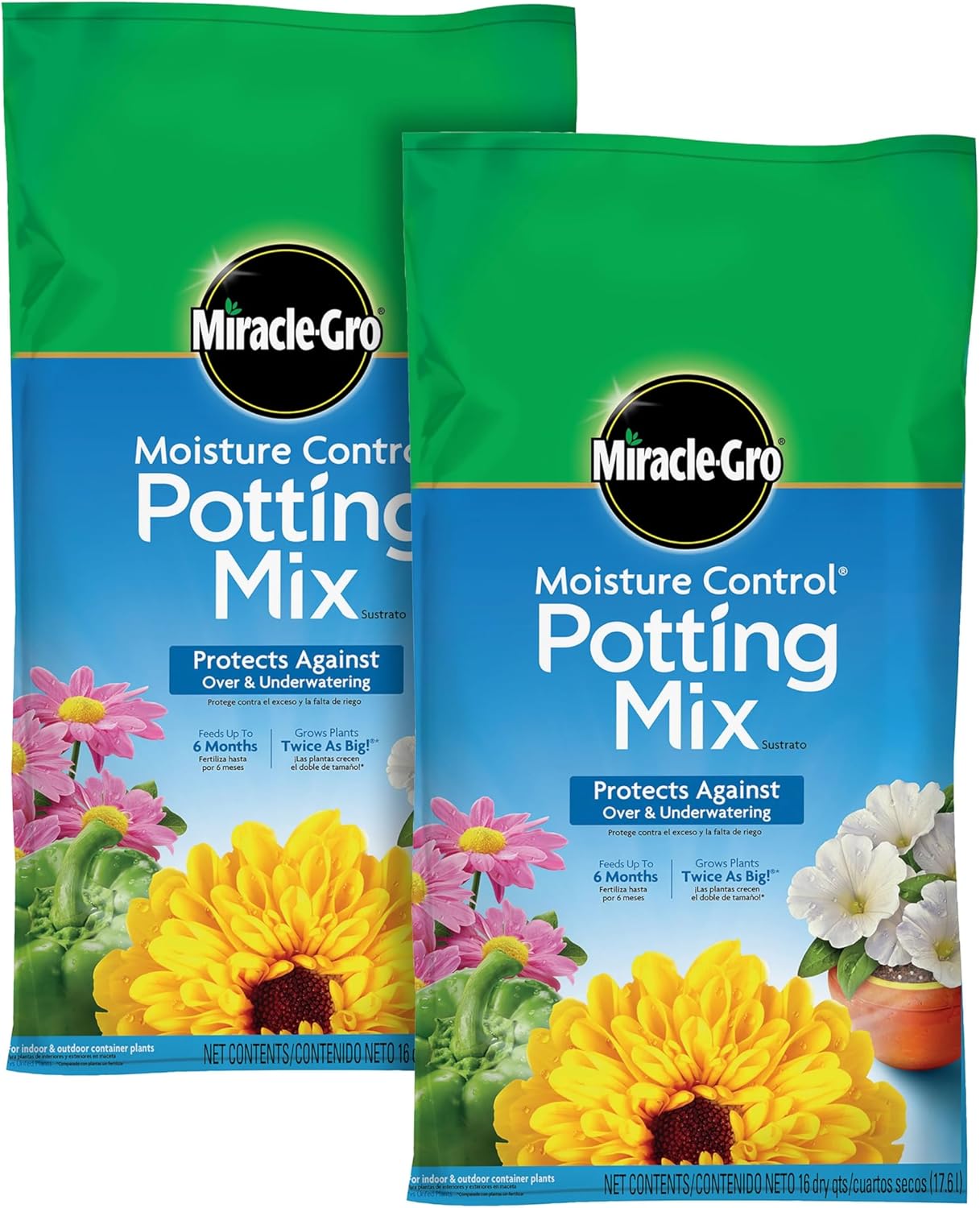
Miracle-Gro Moisture Control Potting Mix, 16 qt. (2-Pack)
| Number of Packs | 2 |
|---|---|
| Item Type Name | Miracle-Gro Moisture Control Potting Mix |
| Feeds Plants | Up to 6 months |
| Best For | Containers & planters |
This two-pack of Miracle-Gro Moisture Control Potting Mix is built for container gardening and is easy to use when potting mint or other herbs. The mix contains an AquaCoir formula with sphagnum peat moss, coir, and a wetting agent that helps it absorb more water than basic potting soils, which reduces the risk of both over- and under-watering in pots. It is light and airy so roots can breathe and it includes nutrients that feed plants for up to six months, cutting back on how often you need to fertilize young mint plants. Typical use is straightforward: pick a pot with drainage, fill about one third, plant, top off, and water through. For someone growing mint in patio pots or herb containers this mix simplifies watering and supports vigorous root development. It is not a replacement for annual repotting or supplemental feeding beyond six months, and container gardeners who prefer fully organic mixes should look elsewhere.
Best for: Practical container gardeners who want an easy, low-maintenance potting mix that stabilizes watering and supports steady root growth for mint and other potted herbs.
Less Ideal for: Growers who prioritize fully organic inputs or who want a long-term in-pot soil that never needs replenishing should consider other specialty or homemade mixes.
- Moisture-control formula absorbs up to 33% more water than basic potting soil, helping prevent over- and under-watering
- Feeds plants for up to six months, reducing immediate need for additional fertilizer
- Airy texture supports healthy root growth in containers and hanging baskets
- Pack includes two 16 qt. bags, covering multiple 12-inch pots
- Not marketed as a fully organic potting mix, which may matter to some herb growers
- Nutrient feeding lasts up to six months so plants will need repotting or additional fertilizer afterward
Verdict: A convenient moisture-control potting mix that makes watering mint in pots more forgiving while providing up to six months of nutrition.
Back to the Roots Organic Expanding Coco Coir Potting Soil Brick (10 lb)

| Item Highlight | 10 lb compressed coco coir brick; peat-free; OMRI Listed |
|---|---|
| Item Type Name | Coconut Coir |
| Volume | 2 cubic feet |
| Ingredients | Coconut Coir |
| Style Name | Expanding Potting Soil |
This compressed coco coir brick provides a lightweight, peat-free potting medium that expands when you add water to create loose, airy substrate for containers and seed flats. It is typically used by hydrating the 10 lb block to about 2 cubic feet of coir and then using it alone for potted plants, mixing it into garden soil to improve drainage and aeration, or blending with compost for starting seeds. Notable features include OMRI listing for organic use, a balanced pH suited to a wide range of plants, and compact storage before expansion which saves space. Practical benefits are improved root aeration and water retention compared with heavy garden loam, easier handling than bulky bags, and versatility across vegetables, herbs, and ornamentals. Important limitations are that coco coir is a soilless substrate and does not supply significant nutrients on its own so you will need to add fertilizer or compost for long-term potted herbs like rosemary, and the product requires time and a water source to expand before use.
Best for: Buyers who prioritize low-risk, easy-to-handle, organic potting media and want a versatile base for container herbs and seed starting without dealing with heavy bags.
Less Ideal for: Gardeners who want a ready-to-plant, nutrient-rich potting mix out of the box or those who prefer soil with built-in slow-release fertilizer.
- Peat-free OMRI listed organic coco coir suitable for organic growing
- Expands from a compact brick to about 2 cubic feet for easy storage and transport
- pH balanced and airy texture that improves drainage and root aeration
- Versatile use: can be used alone, for seed starting, or mixed into existing soil
- Provides little inherent fertility so supplemental feeding or compost is needed for nutrient-hungry plants
Verdict: A compact, peat-free coco coir brick that expands into an airy, pH-balanced base ideal for low-risk organic container gardening and seed starting when paired with fertilizer or compost.
Choosing the Right Potting Mix for Self Watering Containers: Key Factors to Consider
Water Retention Balance
How a mix holds water determines how often the reservoir meets plant demand. A mix that retains too much moisture can stay waterlogged at the root zone when the wick or reservoir continues to feed, increasing risk of root rot. Conversely, a mix that sheds moisture too quickly will leave plants dependent on frequent reservoir top-ups or cause roots to dry between fills.
Look for mixes with a blend of water-holding ingredients and chunky components. Amendments such as peat alternatives, coir, or gel-forming polymers can increase retention, but they must be paired with larger particles that maintain pore space so oxygen can reach roots.
Aeration and Particle Structure
Root health in self watering containers relies on consistent air pockets and good drainage below the root ball. Particle size and shape control how easily water moves and how much air remains after the reservoir wets the mix. Fine, compacting materials reduce oxygen and compact over time; coarse particles like perlite, pumice, or chunky bark preserve air-filled porosity.
Consider mixes with varied particle sizes that create an open matrix. That structure helps prevent the bottom of the pot from staying saturated while the reservoir is full and supports aerobic root function during wet periods.
Wicking Compatibility
Self watering systems depend on capillary action between the reservoir and the potting mix. A mix that is too coarse may not draw water effectively, while a mix that is uniformly too fine can choke airflow. The ideal mix wicks water upward at a steady rate without turning into a dense slurry around the wick.
Evaluate whether a mix explicitly notes use with reservoir or wicking systems, and look for components that help capillary action such as fine coir blended with larger aggregates. Testing a small container first can reveal how the mix behaves with your specific wick and reservoir dimensions.
Nutrient Holding and Fertility
Potting mixes for self watering containers should hold nutrients without locking them away or releasing salts into the reservoir. Organic matter and specific clay fines can help retain cations and release them to roots over time. However, salts can concentrate in the reservoir or at the substrate surface if the mix includes high-salt amendments.
Choose mixes formulated for container use with balanced, slow-release feeding or mixes that are neutral so you can control fertilization. For edibles, a lower starting salt load reduces the chance of nutrient burn when the reservoir repeatedly cycles water past the root zone.
Long-Term Physical Stability
Repeated wetting and drying cycles are part of self watering container life. Some mixes compress, lose porosity, or break down into fines that reduce drainage and aeration after a single season. Durable components such as pumice, horticultural perlite, or well-aged bark help the mix hold structure for multiple seasons.
If you plan to reuse potting mix, prioritize stability and avoid mixes heavy in short-lived fine organic particles. Periodic topping up with fresh mix or chunky amendments can extend useful life, but initial stability reduces maintenance frequency.
pH and Salt Content
The chemical environment influences nutrient availability and plant performance in a sealed reservoir setup. A mix with an inappropriate pH can lock out certain nutrients even if they are present. High soluble salt content can concentrate in the reservoir, stressing roots over time.
Look for mixes labeled as pH-balanced for containers and consider those tested for low soluble salts, particularly when growing sensitive ornamentals or vegetables. If a mix does not specify, assume you may need to flush the container periodically and monitor plant response.
How Self Watering Systems Change Mix Needs
Self watering containers decouple water supply from surface evaporation, so the substrate must reliably move moisture from the reservoir to the roots. That changes which mix properties matter compared with top-watered pots. You want a mix that maintains an even moisture gradient rather than collecting standing water at the base or leaving the crown bone-dry.
Consider how the wick, reservoir depth, and plant root distribution in your container interact with mix choice. A deep reservoir with a long wick favors mixes that wick well over distance. Shallow reservoirs need mixes that hold more moisture close to the wick and still allow good oxygen exchange at the root crown.
- Wicking distance influences how coarse or fine the mix should be.
- Rooting depth of plant species affects needed moisture profile.
- Reservoir design determines how often the mix is recharged.
Adjusting Mixes for Different Plant Types
Vegetables and heavy-feeders often prefer mixes with higher nutrient-holding capacity and steady moisture. Incorporating a higher proportion of organic matter or a slow-release fertilizer can support fruiting crops without frequent reservoir feeding.
Ornamental foliage plants may need lighter mixes with extra inorganic aeration to avoid soft, waterlogged stems. Succulents and drought-tolerant plants require a much grittier blend; in a self watering container they need a very coarse matrix to avoid constant saturation.
- Edibles: moderate retention, good nutrient holding.
- Foliage ornamentals: stronger aeration, moderate retention.
- Succulents: extremely coarse, minimal water-holding amendments.
Simple Tests to Check Mix Behavior
Before filling all your containers, test a small batch. Fill a test pot with your chosen mix, install the wick and reservoir if possible, and monitor how the moisture front climbs and how quickly the surface dries after a full reservoir cycle. Observe the root zone for signs of saturation or dryness over a week.
A squeeze test also helps: moisten a sample and squeeze it in your hand. It should crumble with pressure while holding some moisture rather than forming a dripping mud ball or collapsing into dust.
- Fill a test pot with identical reservoir and wick setup.
- Monitor moisture distribution over several days.
- Perform the hand squeeze test to assess structure.
Maintenance Tips for Longevity
Top up with chunky amendments like pumice or coarse perlite each season to rebuild porosity as mixes compress. Lift plants and refresh the top few inches if you see compaction or slow drainage. Periodic flushing of the reservoir helps prevent salt buildup, especially if you apply regular fertilizer.
Avoid overfilling the reservoir beyond recommended levels and ensure overflow/drain holes function so the system can purge excess salts or nutrients. Rotate mixes between containers over seasons if you grow different crop types to match structure and nutrient needs.
- Add coarse material annually to restore aeration.
- Flush reservoirs periodically to remove salt buildup.
- Refresh top layers or repot every 1 to 3 years depending on compression.
DIY Mix Adjustments
If a ready-made mix is too fine or too coarse, you can rebalance it. Add pumice, perlite, or coarse sand to increase drainage and aeration. Add coir or well-composed compost to boost water retention and nutrient availability. Make incremental changes and test in a small container first.
When adding amendments, aim for a blend that keeps some medium-sized particles to maintain capillary pathways for the wick. Avoid adding too much peat or fine compost that will collapse into a dense mat when wet.
- To increase aeration: mix in 10 to 30 percent pumice or perlite.
- To increase retention: add 10 to 25 percent coir or compost.
- Test changes in a single pot before applying across all containers.
How We Chose the Best Potting Mix for Self Watering Containers
We focused on characteristics that directly affect performance in self watering containers rather than general garden soils. Selection emphasized mixes that promote consistent reservoir-fed moisture delivery while avoiding persistent saturation at the root crown. We prioritized water retention that pairs with capillary action, open structure for oxygen around roots, and resistance to compaction over time. Our evaluation included particle size distribution, inclusion of water-holding amendments, drainage and aeration profile, nutrient holding capacity and slow-release amendments, and physical stability under repeated wet-dry cycles. We excluded soil-based garden loams and mixes intended only for ground beds or hanging baskets because their behavior with a reservoir differs substantially. Also excluded were mixes formulated exclusively for specific specialty crops that require very different chemistry, such as carnivorous plant substrates. Final picks passed criteria for reliable wicking compatibility, predictable moisture release, and minimal long-term compaction, with consideration for pH neutrality and safe levels of salts for container-grown vegetables and ornamentals.
FAQ
Can I use regular potting mix in a self watering container?
Often you can, but regular mixes vary widely. Some compact and retain too much moisture, leading to poor oxygenation in a reservoir system. If you use a standard mix, consider blending in coarse aggregates or coir to improve wicking and aeration.
How often should I top up the reservoir with a particular mix?
It depends on plant water use and mix retention. High-retention blends will need less frequent fills, while coarser mixes require more frequent refilling. Monitor plant water stress and the reservoir level to set a schedule rather than relying on fixed intervals.
Will self watering containers cause salt buildup with potting mix?
They can. Because water cycles through a closed reservoir, soluble salts from fertilizers may concentrate. Periodically flushing the reservoir and occasionally leaching the substrate helps prevent salt stress, especially for sensitive crops.
Is coir or peat better for self watering systems?
Coir and peat both retain water, but coir tends to be more sustainable and resists compression better over time. Either can work if balanced with coarse materials to maintain pore space. Choose based on availability and the structure of the overall mix.
Can I reuse potting mix from a self watering container?
You can, but expect some loss of structure and possible salt accumulation. Refresh reused mix by adding coarse amendments and replacing the top few inches. Test drainage and aeration before replanting to ensure it still supports healthy root growth.
How does reservoir depth affect the ideal mix?
Deeper reservoirs allow water to be stored farther from the root crown, which favors mixes that wick over distance and hold moisture. Shallow reservoirs require mixes that keep water available near the wick and still provide oxygen at the crown, so they often need slightly higher retention.
Final Verdict
When choosing a potting mix for self watering containers, prioritize a balance between water retention and aeration, plus stable particle structure that resists compaction. Match mix adjustments to plant type and reservoir design so the wick can deliver moisture without creating anoxic conditions. Focus on mixes that advertise reservoir or wicking compatibility, and plan for simple maintenance such as periodic flushing and adding coarse amendments. With the right balance you will minimize refill frequency while keeping roots healthy and productive.
