

Note: This article contains affiliate links. If you click on these links and make a purchase, I may earn a small commission at no extra cost to you. This helps support my research and content. Read my full affiliate disclosure here.
If you mow on uneven ground, thick turf, or a yard with long grass, choosing the right high wheel lawn mower changes how quickly and comfortably the job gets done. High wheel mowers raise the rear diameter for better rollover over bumps, improved traction on slopes, and reduced scalping in long grass. This guide covers seven shortlisted high wheel lawn mowers selected for their real-world handling, cutting consistency, and maintenance ease. You will find evaluation notes on steering, deck design, engine or motor suitability, and long-term durability to help match a mower to your yard.
Top Picks at a Glance
| Best Overall The best all-around choice for most situations | SENIX 201cc 22" Self-Propelled 3-in-1 Gas Lawn Mower |  |
| Best Quality Built to a higher standard if you want something more solid | YARDMAX 22 in. 201cc Select PACE CVT Self-Propelled High-Wheel Lawn Mower (YG2860) |  |
| Best Value The sweet spot between price and what you get | SENIX 21-Inch Gas Push Lawn Mower, 144cc 4-Cycle, 2-in-1 Mulching/Side Discharge |  |
| Best Budget The cheapest option that still gets the job done reliably | ZLLIEZQU 140CC 5HP Self-Propelled 20" High-Wheel Gas Lawn Mower |  |
| Highest Rated A top-rated pick with lots of positive feedback | SENIX 21-Inch Gas Push Lawn Mower, 144cc 4-Stroke, Steel Deck |  |
| Most Popular A crowd favorite that many people choose with confidence | Greenworks 60V 21" Self-Propelled Lawn Mower with (2) 4.0Ah Batteries |  |
| Best Seller A high-volume bestseller chosen again and again | Greenworks 80V 21" Self-Propelled Lawn Mower with 4.0 Ah Battery and Charger |  |
SENIX 201cc 22" Self-Propelled 3-in-1 Gas Lawn Mower

| Power Source | Gas Powered |
|---|---|
| Cutting width | 22 inches |
| Operation Mode | Automatic |
| Number of Positions | 6 |
| Maximum Adjustable Cutting Height | 4 inches |
The SENIX 201cc 22" self-propelled mower is built to cover medium to large yards more quickly than a standard 20-inch mower thanks to its wider 22-inch steel deck and sharp blade. It is powered by a 201cc OHV 4-cycle engine that provides steady cutting performance and pairs with an eleven-inch rear-wheel drive for easier handling on slopes and uneven ground. The mower offers three discharge options — bagging, mulching, and side discharge — so you can switch modes to match lawn conditions, and a single-lever, six-position height adjustment (1.25" to 4") makes it simple to dial in the desired finish. Practical benefits include faster mowing per pass, improved traction on tougher terrain, and the flexibility to manage grass clippings based on season or yard care goals. Important limitations are its gas engine maintenance needs, heavier weight compared with electric models, and the typical noise and emissions of a gasoline mower, which may matter in noise-sensitive neighborhoods.
Best for: Buyers who prioritize efficient coverage and reliable gasoline power for medium to large lawns and who value proven features and peer-reviewed performance when choosing a robust, wider-cut walk-behind mower.
Less Ideal for: People who need a very quiet, low-maintenance, or lightweight mower for small yards or who prefer emissions-free electric operation should consider compact battery or electric models instead.
- 22-inch steel cutting deck covers more ground per pass than 20-inch mowers
- 201cc OHV 4-cycle engine delivers consistent power for medium to large lawns
- Rear-wheel self-propelled drive with 11-inch wheels improves traction and maneuverability
- 3-in-1 bagging, mulching, and side discharge offers versatile grass management
- Single-lever six-position height adjustment for quick deck changes
- Gas engine requires regular maintenance and fuel handling
- Heavier and louder than battery-electric alternatives
Verdict: Choose this SENIX if you want a wider 22-inch gas mower that combines reliable 201cc power with self-propelled traction for faster, more confident mowing of medium to large lawns.
YARDMAX 22 in. 201cc Select PACE CVT Self-Propelled High-Wheel Lawn Mower (YG2860)

| Engine displacement | 201cc OHV |
|---|---|
| Drive type | Front wheel drive (FWD) self-propelled |
| Cutting width | 22 in. |
| Transmission | Continuously variable transmission (CVT) with 6 speeds |
| Warranty | 2-Year Residential |
The YARDMAX YG2860 is a performance-focused 22-inch gas walk-behind mower built to make regular yard work faster and more controllable. It uses a 201cc OHV engine with an automatic choke for easy starting and a continuously variable transmission (CVT) with a 6-speed selector that adapts to your walking pace, which helps maintain steady ground speed on slopes and varied terrain. High rear wheels with aggressive spiked tread and double ball bearings improve traction and maneuverability on uneven lawns while the MaxFlow volute deck promotes longer airflow for better mulching or bagging. A single-lever deck height adjustment and a deck washout port simplify setup and cleanup. The unit ships fully assembled and folds compactly for storage. Expect a sturdy cutting performance and good uphill control, though the mower is relatively heavy and focused on gas maintenance needs. If you want a consistently fast, controllable mow and are comfortable with routine engine care, this model delivers strong real-world performance for medium to large yards.
Best for: Buyers who prioritize consistent cutting performance and precise ground-speed control for medium to large lawns and want a gas-powered mower that handles uneven terrain well.
Less Ideal for: Those who prefer near-silent operation, minimal maintenance, or very small urban yards where a lightweight electric mower would be more convenient.
- Continuously variable transmission with 6-speed selector for smooth speed control matching walking pace
- 201cc OHV engine with automatic choke for easier starting
- High rear wheels and spiked tread tires that improve traction and maneuverability on uneven terrain
- MaxFlow deck design that supports effective mulching and clean bagging
- Deck washout port and single-lever height adjustment for faster cleaning and setup
- Heavier build which can make maneuvering and lifting more difficult for some users
- Requires regular gas engine maintenance unlike cordless electric models
Verdict: Choose the YARDMAX YG2860 for strong gas-powered mowing performance with CVT speed control and high-wheel traction that keeps pace on uneven, medium to large lawns.
SENIX 21-Inch Gas Push Lawn Mower, 144cc 4-Cycle, 2-in-1 Mulching/Side Discharge
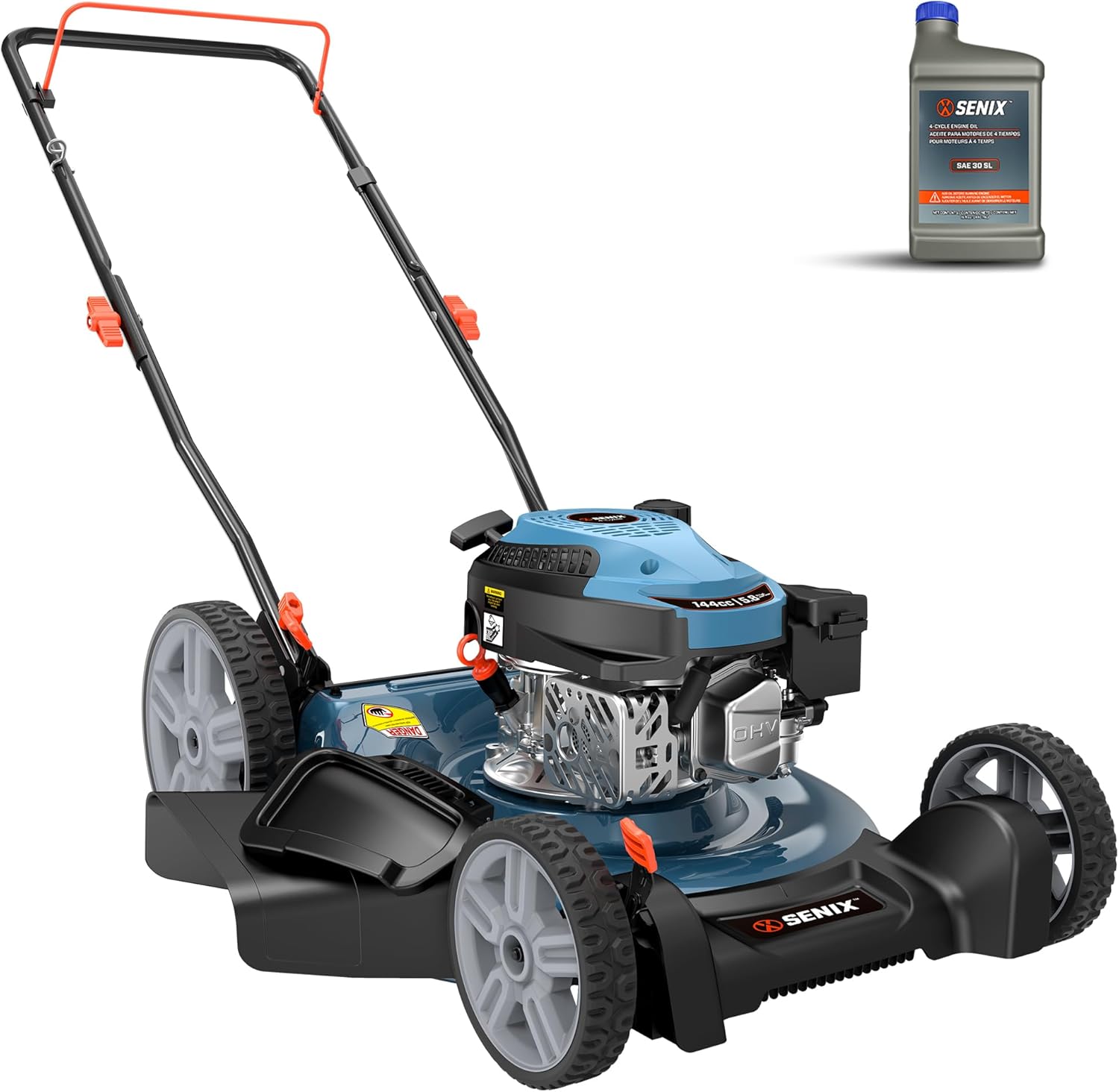
| Power Source | Gasoline-Powered |
|---|---|
| Cutting width | 21 inches |
| Number of Positions | 6 |
| Item Highlight | 4-Cycle Engine, Side Discharge, 6-Position Height Adjustment |
This SENIX 21-inch push mower pairs a 144cc 4-cycle engine with a 2-in-1 deck so you can mulch or side-discharge depending on grass conditions. It is built for routine residential mowing and is most useful for yards up to roughly 1/2 acre where corded or battery options are inconvenient. The high-rear 11-inch wheels and oversized front wheels make it easier to push across uneven lawns and through taller turf, while the dual-lever six-position height adjustment (1.25 to 3.75 inches) lets you switch quickly between a close cut and a taller, protective setting. Assembly is straightforward and the mower comes with a basic tool kit. Expect reliable power on thicker turf and slopes without frequent stalling, but remember a gas mower needs regular fuel, oil, and spark plug upkeep and makes more noise and emissions than electric alternatives. For a homeowner who prioritizes straightforward power, wide cutting path, and adjustable finish, this is a practical and capable choice; if you need zero-emission operation or are unwilling to maintain an engine, consider an electric or battery model instead.
Best for: Homeowners who want a straightforward, gas-powered mower that reliably handles thicker turf and uneven lawns and who value runtime and cutting width over zero-emission operation.
Less Ideal for: City dwellers or small-lot owners who prefer quiet, low-maintenance, and emission-free mowing should consider electric or battery alternatives instead.
- Powerful 144cc 4-cycle engine delivers steady performance on thick grass and gentle slopes
- 21-inch cutting deck covers more ground per pass for faster mowing of medium yards
- 2-in-1 mulching and side-discharge options adapt to different grass and cleanup needs
- High 11-inch rear wheels improve maneuverability over uneven terrain
- Dual-lever six-position height adjustment allows quick, tool-free changes
- Requires regular gas engine maintenance and produces more noise and emissions than electric mowers
- Heavier than comparable battery models which can make transport and storage less convenient
Verdict: Choose this mower if you need a practical, gas-powered 21-inch machine that delivers reliable power and easy height adjustment for medium residential lawns.
ZLLIEZQU 140CC 5HP Self-Propelled 20" High-Wheel Gas Lawn Mower

| Power | 5HP, 140CC |
|---|---|
| Cutting width | 20 inches |
| Drive | Self-propelled |
| Grass bag capacity | 60L |
| Mowing height positions | 8 (1–3.2 inches) |
This ZLLIEZQU high-wheel mower is a budget-focused gas-powered machine aimed at homeowners who need a durable, no-frills cutter for larger yards. It uses a 140cc OHV single-cylinder engine with a 20-inch cutting deck and self-propelled drive, so it pulls forward to reduce push effort on uneven or sloped turf. The high rear wheels and 8-height positions let you move between low trim and longer turf quickly, and the included 60L grass bag handles extended runs without constant emptying. Construction mixes steel, nylon, and manganese steel for a heavier-duty feel compared with entry-level plastic models. Expect a pull-start engine and about 70 dB noise during operation. Downsides for the budget buyer are the mower's 72 lb weight, which makes garage storage and lifting into transport harder, and the absence of electric start. Assembly and occasional tuning will be needed to keep the engine running smoothly, but for basic, powerful mowing on sports fields, larger yards, or community spaces this mower delivers straightforward performance at a modest cost.
Best for: Buyers who want a powerful, straightforward gas mower that handles larger yards and uneven lawns without premium features, prioritizing durability and cutting performance over light weight or convenience.
Less Ideal for: Small-lot owners, apartment dwellers, or anyone who needs a lightweight, easily stored mower with electric start or battery power.
- Self-propelled drive reduces effort on slopes and larger lawns
- Robust 140cc 5HP OHV engine suitable for heavy grass and extended use
- 20-inch cutting width balances maneuverability and coverage
- Large 60L grass catch bag for longer runs between empties
- High-wheel design improves handling on uneven terrain
- No electric or key start; uses pull-start only
- Relatively heavy at 72 pounds which complicates storage and transport
Verdict: A sturdy, no-frills high-wheel gas mower that delivers reliable cutting power and self-propelled convenience for larger yards on a budget.
SENIX 21-Inch Gas Push Lawn Mower, 144cc 4-Stroke, Steel Deck

| Power Source | Gas Powered |
|---|---|
| Cutting width | 21 inches |
| Maximum Adjustable Cutting Height | 3.75 inches |
| Minimum Adjustable Cutting Height | 1.25 inches |
| Number of Positions | 6 |
This SENIX 21-inch gas push mower is built around a 144cc OHV 4-stroke engine and a stamped steel deck to handle regular lawn maintenance for small to mid-size yards. Typical use is straightforward: fill with oil and gas, set one of six cutting heights from 1.25 to 3.75 inches, then choose mulching, side discharge, or rear bagging with the included 1.7-bushel catcher. Notable features include the low-vibration OHV engine that delivers about 3.4 HP, a vortex-style deck to reduce clumping, and larger rear wheels that help when mowing uneven turf. Practical benefits are reliable starting and longer engine life from the 4-stroke design, decent cutting coverage from the 21-inch deck, and flexibility for different grass conditions thanks to the 3-in-1 system. Important limitations are that it is a manual push model rather than self-propelled and the bag capacity is modest, so it is best suited to up to roughly a third-acre rather than large properties.
Best for: Buyers who prioritize a dependable, serviceable gas mower for routine lawn care on small to mid-size yards and want straightforward mechanics that are easy to maintain.
Less Ideal for: People with larger properties, steep slopes, or those who prefer low-effort mowing should consider a self-propelled or larger-capacity model instead.
- 144cc OHV 4-stroke engine designed for reliable starting and longer service life
- 3-in-1 steel deck supports mulching, side discharge, and rear bagging for flexible mowing
- Six-position dual-lever height adjustment for precise cut from 1.25 to 3.75 inches
- Vortex deck design reduces grass buildup and larger rear wheels improve maneuverability on uneven ground
- Push-only operation requires more physical effort than self-propelled mowers for larger yards
- 1.7-bushel grass bag is relatively small, requiring frequent emptying on dense growth
Verdict: A sturdy, easy-to-maintain gas push mower that delivers reliable performance for routine care of small to mid-size lawns.
Greenworks 60V 21" Self-Propelled Lawn Mower with (2) 4.0Ah Batteries

| Power Source | dc |
|---|---|
| Operation Mode | Manual |
| Maximum Adjustable Cutting Height | 4 inches |
| Minimum Adjustable Cutting Height | 1 inches |
| Number of Positions | 7 |
The Greenworks 60V 21" self-propelled mower delivers gas-like cutting power with a brushless motor and dual 4.0Ah batteries that together provide roughly 60+ minutes of runtime, enough to cover up to about 3/4 acre under typical conditions. It is used like a conventional walk-behind mower but with rear-wheel self-propulsion that you can adjust on the go for slopes or thick grass. Notable features include seven height positions for precise cutting, LED headlights for low-light work, a 4-in-1 discharge system for bagging, mulching, side-discharge and turbo leaf pickup, and foldable handles for compact storage. Practical benefits are quiet operation compared with gas mowers, simple electric starts, and battery compatibility across the Greenworks 60V ecosystem so you can share batteries with other tools. Important limitations are that runtime will vary with terrain and grass height, the included batteries are mid-capacity so very large properties may require spare packs or higher-capacity options, and the mower uses plastic and aluminum components that require reasonable care to avoid damage over time.
Best for: Buyers who want a quieter, low-maintenance alternative to gas mowers for medium-size lawns and value proven features and compatibility with a 60V battery ecosystem.
Less Ideal for: Those with very large properties who need continuous runtime without swapping batteries or buyers who prefer fully metal, commercial-grade construction.
- Brushless 60V motor provides strong, quiet cutting performance similar to gas models
- Two 4.0Ah batteries with auto switchover deliver about 60+ minutes runtime for up to 3/4 acre
- Self-propelled rear-wheel drive with adjustable pace makes slopes and thick grass easier to manage
- 7-position height adjustment and 4-in-1 deck versatility (mulch, bag, side discharge, turbo)
- LED headlights and foldable handles improve usability and storage
- Included 4.0Ah batteries may be undersized for very large yards without spare high-capacity packs
- Certain structural parts use plastic which can be less durable than full-metal alternatives
Verdict: A capable, quiet 60V self-propelled mower that covers medium lawns well while sharing batteries with a broad 60V tool ecosystem.
Greenworks 80V 21" Self-Propelled Lawn Mower with 4.0 Ah Battery and Charger

| Power Source | Battery Powered |
|---|---|
| Battery Average Life | 2 hours |
| Number of Positions | 7 |
| Material Type | Plastic, Stainless Steel |
| Cutting width | 20.28 inches |
This Greenworks 80V 21" self-propelled mower is built for homeowners who want the power of gas without the noise and maintenance. It uses a brushless motor and a 4.0 Ah 80V battery to run a durable 21-inch steel deck and offers a 4-in-1 cutting system for mulching, bagging, side discharge, and rear discharge. The self-propelled rear-wheel drive and variable speed control make it easier to manage larger yards and slopes, while the seven-position height adjustment handles different grass lengths. LED headlights extend usable mowing hours and the mower is noticeably quieter than gas models. Practical benefits include compatibility with the 80V battery ecosystem, so the battery can be shared with other Greenworks tools, and a rapid charger that reduces downtime. Important limitations are that runtime will vary with grass conditions and the included 4.0 Ah pack is sized for about a half acre per charge under ideal conditions, so very large properties may need spare batteries for continuous work. Assembly and storage require some space because of the mower's footprint.
Best for: Homeowners who want a low-maintenance, quieter alternative to gas mowers for medium to large yards and who value sharing batteries across outdoor tools to optimize cost and convenience.
Less Ideal for: People with very large properties who need continuous runtime without swapping batteries or users who must store equipment in very small sheds or garages.
- Brushless motor delivers higher torque with quieter operation and longer motor life
- Self-propelled rear-wheel drive with variable speed eases mowing on larger lawns and slopes
- Compatible with Greenworks 80V battery ecosystem so batteries work across 75+ tools
- Seven-position height adjustment and 4-in-1 cutting options for flexible grass management
- Included 4.0 Ah battery is sized for roughly a half acre under ideal conditions, so very large lawns may need additional batteries
- Relatively large footprint requires adequate storage space
Verdict: A practical, gas-beating cordless mower for medium to large lawns that reduces noise and maintenance while letting you share batteries across an 80V tool ecosystem.
Choosing the Right High Wheel Lawn Mower: Key Factors to Consider
Wheel Diameter and Traction
Wheel diameter determines how easily a mower rolls over bumps, thatch, and compacted soil. Larger rear wheels reduce the tendency to get hung up on ruts and help maintain forward momentum through thicker turf. Tire tread and compound matter for grip on damp grass and gentle slopes; firmer tires resist wear but may slip more on wet surfaces while softer, knobbier treads bite better but wear faster.
When assessing traction, think about common conditions in your yard. Frequent wet mornings, clay soils, or mild slopes increase the importance of a treaded, larger-diameter rear wheel. Also consider front wheel size relative to the rear: a too-small front wheel can still catch on obstacles and negate the benefit of large rear wheels.
Deck Width and Construction
Deck width determines how many passes you need to mow and affects maneuvering around obstacles. Wider decks reduce overall mowing time on open lawns but make tight turns harder around trees and beds. Thickness and material of the deck influence longevity; stamped steel decks are common and affordable but can deform over time, while heavier-gauge or welded decks stand up better to knocks and resist warping.
Deck design also affects air flow and clippings discharge. A well-shaped deck promotes consistent lift and prevents scalping on uneven ground. If you often cut tall or wet grass, look for decks designed to maintain suction rather than clog or fold clippings under the housing.
Cutting System and Blade Options
Blade type, blade speed, and deck airflow together determine cut quality. Mulching blades chop clippings finer and return nutrients to the lawn but require sufficient airflow and engine torque to avoid clogging. High lift blades evacuate clippings quickly into a bagger but can stress smaller engines.
Consider whether the mower offers easy blade changes and whether replacement blades are widely available. Adjustable blade heights and a good range of deck positions matter when your yard varies from low-fertility sport turf to taller ornamental grasses.
Power Source and Torque Delivery
Whether a mower is gas-powered, electric, or battery-driven affects torque, runtime, and maintenance. Gas engines typically deliver strong torque useful for thick or tall grass and struggling up slopes. Battery mowers have cleaner operation and lower maintenance but require checking run time and battery recharge options for full yard coverage.
Torque delivery matters for consistent blade speed under load; a mower that bogs down in heavy grass will produce uneven cuts. For battery models, factor in available spare battery or fast charging if your lawn exceeds a single charge duration.
Slope Handling and Safety
High wheel designs improve rollover behavior, but slope capability depends on traction, center of gravity, and braking control. Manufacturers often specify a safe operating slope; match that to your yard's steepest sections. A mower with good traction and a lower center of gravity is less likely to lose traction or tip when turning across a grade.
Also evaluate stopping control and user stance. Reliable operator controls and a stable stance reduce the risk of slipping during startups, stops, and turns on inclines.
Serviceability and Seasonal Maintenance
Routine maintenance keeps a mower running and preserves resale value. Easy access to spark plugs, air filters, belts, and blade mounts saves time during seasonal tune-ups. Mowers that allow the deck to be cleaned or tilted without disassembly simplify rust prevention and blade access.
Consider availability of common replacement parts like belts, blades, and wheels when planning for long-term ownership. Clear service points and simple controls reduce the need for professional repairs and help keep the mower dependable year after year.
When a High Wheel Mower Makes Sense
High wheel mowers are not automatically better for every yard. They excel when your terrain includes ruts, uneven grade changes, or when you frequently let grass grow taller between cuts. The taller rear wheels let the mower roll more smoothly over obstacles and reduce front-wheel hang-ups, which speeds mowing and reduces operator fatigue.
- Best for yards with bumps, shallow ruts, or frequent tall grass
- Helpful on moderate slopes when traction is adequate
- Less advantage on perfectly flat, manicured lawns where deck stability and low profile matter more
Preparing Your Yard for High Wheel Use
Before you mow, remove larger debris and check for hidden obstacles that could catch a high front wheel. Trim around garden beds so the mower can pass without forcing tight turns that expose the deck to scalping. On sloped lawns, plan your mowing lines to avoid turning across steep grades; favor up-and-down passes when possible.
- Clear sticks and stones to prevent wheel bounce and blade damage
- Mow when grass is dry for better traction and cleaner cut
- Use the correct wheel pressure if the model allows to balance traction and turf compaction
Routine Maintenance Tips Specific to High Wheel Mowers
High wheel designs put different loads on axles and bearings, so check wheel bearings and mounting bolts at the start and end of each season. Keep the underside of the deck clean to prevent rust that can alter blade path and cause uneven cutting. Inspect wheel tires for cracking, chunking, or uneven wear and replace before a loss of traction becomes a problem.
- Grease wheel bearings where fittings exist
- Sharpen or replace blades annually or sooner if you hit debris
- Store with the deck clean and slightly elevated to prevent flat spots on tires
Adjusting Mower Setup for Better Results
Small setup changes change performance. Raising the cutting height a notch prevents scalping on uneven ground, while slightly higher front wheel pressure can reduce snags on tall turf. If your mower offers a drive engagement or variable speed, adjust the ground speed down when encountering thick patches to maintain blade RPM and cut quality.
- Test cut on a small patch after adjustments before mowing the whole yard
- Match walking speed to engine load to avoid bogging
- Balance bagging vs mulching settings based on grass length and moisture
How We Chose the Best High Wheel Lawn Mower
We focused on attributes that matter in everyday yard work and excluded specialized commercial machines and walk-behind units not built with elevated rear wheels. Primary criteria included maneuverability across varied terrain, cutting system consistency on different grass heights, and wheel and traction design for slopes and bumps. We also weighed deck construction and width for striping and scalping resistance, as well as engine or motor reliability and serviceability for seasonal maintenance. Noise and vibration levels were considered because comfort affects how long you can mow without fatigue. Products with incompatible wheel sizes, unsafe slope ratings, or decks not suited to typical residential lawns were excluded. The final list favors mowers that balance traction and steering control with accessible maintenance and consistent cut quality.
FAQ
Are high wheel mowers harder to steer than standard mowers?
They can feel different at first because the larger rear wheels change pivot dynamics, but most users find steering easier on uneven ground. The increased rear-wheel diameter reduces front-wheel hang-ups so initial maneuvering may feel more controlled once you adapt.
Can I use a high wheel mower on steep slopes?
It depends on the specific slope rating and traction of the mower. High wheels help roll over obstacles, but you should follow the mower's recommended slope limits and choose a model with good tire tread and a stable stance for safer operation.
Do high wheel mowers cause more turf damage?
When used correctly, they can reduce scalping because the large rear wheels keep the deck more stable over bumps. However, improper wheel pressure or using an overly low deck height on uneven ground can still damage turf.
Is a battery high wheel mower powerful enough for tall or thick grass?
Battery mowers have improved torque but runtime and sustained power under load vary by battery capacity and motor design. For large areas of tall or heavy grass, check run time and consider spare batteries or a model with higher torque rating.
How often should I sharpen blades on a high wheel mower?
Inspect blades every few weeks during peak season and sharpen at least once per season, more often if you hit debris or cut coarse vegetation. Dull blades tear grass and reduce cut quality regardless of wheel design.
Final Verdict
Choose a high wheel lawn mower when your yard has uneven ground, shallow ruts, or frequent taller grass that interferes with a standard mower's front wheels. Prioritize traction and wheel diameter for bump handling, and balance deck width against maneuverability around obstacles. Focus on engine or motor torque and ease of maintenance to keep the mower working well season after season. With the right tradeoffs accounted for, a high wheel mower can make mowing faster, less fatiguing, and more consistent across challenging lawns.
