

Note: This article contains affiliate links. If you click on these links and make a purchase, I may earn a small commission at no extra cost to you. This helps support my research and content. Read my full affiliate disclosure here.
Choosing the right flower bed irrigation system matters for healthy plants, consistent blooms, and efficient water use in small beds, mixed borders, or planter beds. A properly designed system prevents dry spots, reduces fungal problems from overhead watering, and frees you from daily hose duties. This guide covers seven shortlisted options that suit the Best Flower Bed Irrigation System brief and explains the practical tradeoffs gardeners face. We'll evaluate each option on coverage, water efficiency, installation effort, and durability so you can pick the setup that fits your bed size and gardening routine.
Top Picks at a Glance
| Best Overall The best all-around choice for most situations | MIXC 300ft Quick Push-to-Connect Drip Irrigation System Kit |  |
| Best Quality Built to a higher standard if you want something more solid | Rain Bird LNDDRIPKIT 108-Piece Landscape & Garden Drip Irrigation Kit |  |
| Best Value The sweet spot between price and what you get | MQJIAZHI 246 ft Drip Irrigation System with 1/2" Main Tube and 1/4" Branch Tubing |  |
| Best Budget The cheapest option that still gets the job done reliably | SMIDOLE 100FT Drip Irrigation System Kit with Quick-Connect Tubing and Adjustable Emitters |  |
| Highest Rated A top-rated pick with lots of positive feedback | Deepoter 165 ft Drip Irrigation System with Programmable Timer and Brass Connectors |  |
| Most Popular A crowd favorite that many people choose with confidence | Flantor 50ft Drip Irrigation Kit with Adjustable Nozzles |  |
| Best Seller A high-volume bestseller chosen again and again | MIXC 200ft 1/4" Drip Irrigation Kit with 32 Adjustable Copper Nozzles |  |
MIXC 300ft Quick Push-to-Connect Drip Irrigation System Kit
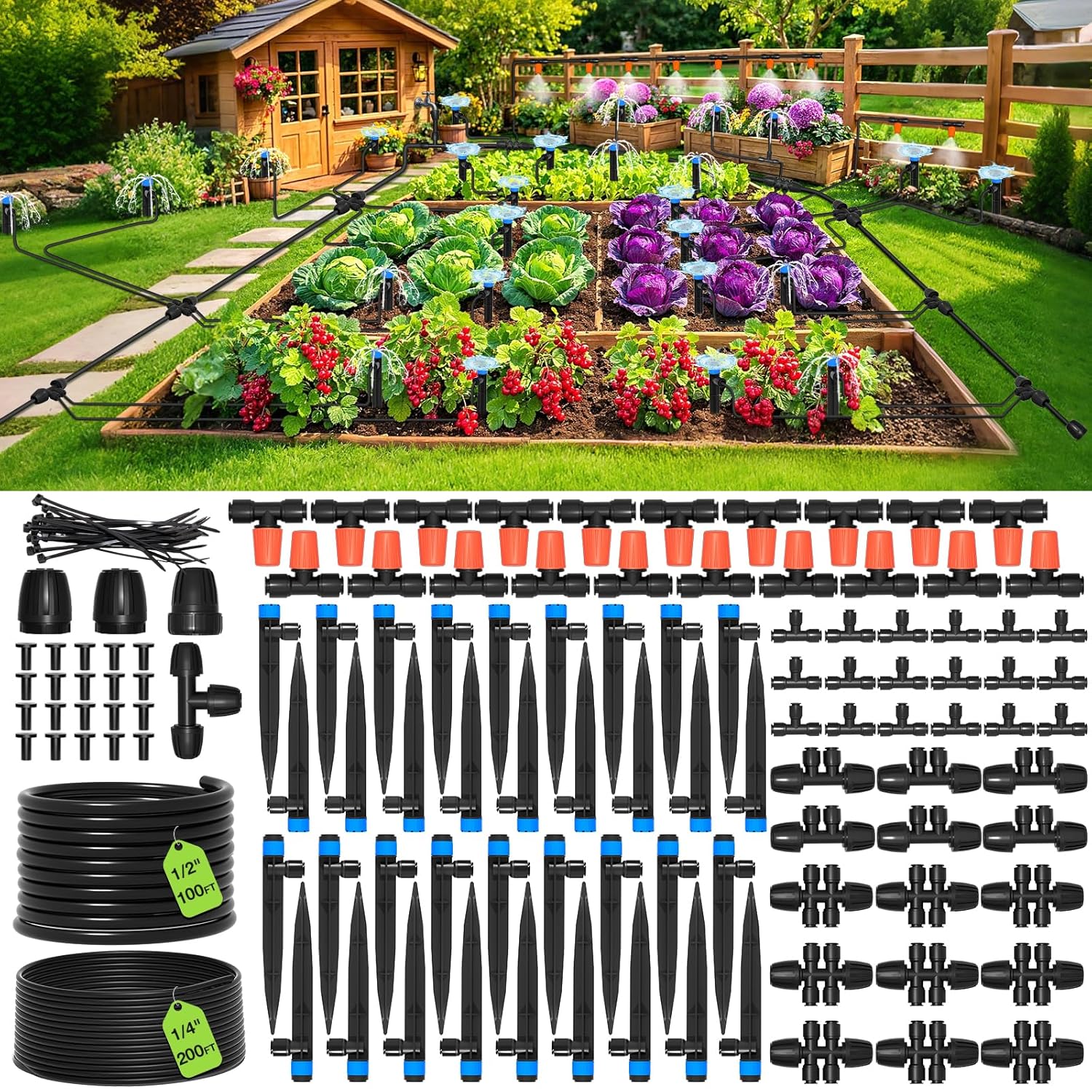
| Hose Length | 300 feet |
|---|---|
| Size | 100FT Main Tube+200FT 1/4'' Tube |
| Special Features | Leak Resistant, Weather Resistant |
| Material | PVC |
| Included Components | Drip Irrigation Fittings |
The MIXC 300 ft drip irrigation kit supplies a full set of tubing, fittings, and adjustable emitters to automate watering for raised beds, containers, and small greenhouses. It uses a 100 ft 1/2" main line and 200 ft of 1/4" branch tubing with push-to-connect joints for tool-free assembly, so you can lay out a grid or individual runs quickly. The kit includes misting nozzles, stream and vortex emitters, tees, plugs, and zip ties so you can tailor flow rates to seedlings, vegetables, or established plants. Because connections are described as leak resistant and the system is timer compatible, it supports scheduled irrigation that reduces run-off and evaporation compared with overhead watering. Practical limits are that components are PVC so durability will depend on sun exposure and winter care, and very large or complex beds may need additional tubing or emitters beyond the included supply. Installation is beginner-friendly but planning the layout ahead makes setup and later adjustments much easier.
Best for: Gardeners who want a ready-to-install, water-efficient system for multiple raised beds or container groups and prefer a straightforward DIY setup that can be automated with a timer.
Less Ideal for: Large-scale vegetable farms or very complex multi-zone systems that require professional-grade fittings and heavier-duty materials.
- Comprehensive kit includes main and branch tubing plus a wide selection of emitters and fittings for flexible layouts
- Push-to-connect design enables fast, tool-free installation
- Adjustable emitters and misting nozzles let you fine-tune water delivery for different plants
- Leak-resistant connections and timer compatibility support reliable automated watering
- Includes zip ties and multiple tees for neat runs and grid-style layouts
- PVC components can degrade with long-term UV exposure if not protected or winterized
- 300 ft total may be insufficient for very large or highly segmented raised bed setups
Verdict: A ready-to-install, adjustable 300 ft kit that simplifies automated, water-saving irrigation for raised beds and small garden layouts.
Rain Bird LNDDRIPKIT 108-Piece Landscape & Garden Drip Irrigation Kit

| Number of Pieces | 108 |
|---|---|
| Hose Length | 50 inches |
| Maximum Pressure | 50 psi |
| Power Source | Water |
| Material | Plastic |
The Rain Bird LNDDRIPKIT is a complete starter kit for installing a small- to mid-size drip system around container plants, flower beds, or a modest garden. It supplies 50 feet of 1/2" tubing plus 1/4" distribution tubing, a pressure regulator and backflow preventer, and a mix of drippers, micro-bubblers and micro-sprays so you can spot-water up to eight plants or cover wider spacing. Pressure-compensating, clog-resistant emitters and professional-grade tubing make layout and long-term performance straightforward, and the included emitter installation/removal tool speeds setup. Typical use is running the main tubing from an outdoor faucet, branching to individual plants with 1/4" lines, and hiding tubing under mulch for a tidy look. The kit covers basic layouts and saves water versus hand-watering, but it does not include a timer for full automation and may need extra fittings or longer tubing for larger planting areas. Users should also follow local plumbing rules when connecting to a potable water source.
Best for: Gardeners who want a reliable, water-saving drip system that is easy to set up and customize for patios, container plantings, and small landscaped beds.
Less Ideal for: People planning to irrigate large gardens or multiple planting zones without buying significant extra tubing and parts, or those who need built-in scheduling without adding a separate timer.
- Comprehensive 108-piece set includes tubing, pressure regulator, backflow preventer, and a variety of emitters for flexible layouts.
- Pressure-compensating, clog-resistant emitters deliver consistent water to each plant location.
- Professional-grade tubing resists UV, chemicals and algae for longer service life.
- Includes an installation/removal tool and stakes with bug caps to simplify setup and keep emitters clean.
- No hose-end timer included so automation requires an additional purchase.
- Designed for small to mid-size setups and may need extra tubing or fittings for larger gardens.
Verdict: A ready-to-install, water-saving 108-piece kit that gives hobby gardeners a durable, flexible drip system for patios and small garden beds.
MQJIAZHI 246 ft Drip Irrigation System with 1/2" Main Tube and 1/4" Branch Tubing

| Hose Length | 33 feet (main) + 213 ft branch tubing |
|---|---|
| Number of Pieces | 152 |
| Power Source | Water Pressure-driven |
| Material | Polyethylene (PE) |
This MQJIAZHI kit provides a nearly complete DIY drip system for larger plots by combining a 33 ft 1/2‑inch main tube with 213 ft of 1/4‑inch branch tubing and 152 components. It is water pressure driven and includes three adjustable emitter types so you can switch between microdroplets, spray, and direct drip to suit flower beds, vegetable rows, or greenhouse benches. Quick‑plug fittings on the 1/4‑inch lines and locking couplers on the main tube make layout and repairs straightforward for a weekend install. The PE tubing is UV resistant for outdoor longevity and the kit is designed to concentrate water at the root zone to reduce evaporation and water use. Because it is a full kit rather than an automated controller, you will need a timer or manual valve to schedule watering and pressure at the tap affects range and uniformity, so longer runs may need pressure management. The system is a practical, low‑cost way to irrigate a large garden when you want a hands‑on setup that saves water without complex electronics.
Best for: Gardeners on a tight budget who need to irrigate multiple raised beds or a large backyard and are comfortable assembling and customizing a DIY drip layout.
Less Ideal for: People who want a plug‑and‑play electronic controller or who cannot add a pressure regulator or timer; small container gardeners who do not need extensive tubing.
- Very long combined tubing length suitable for large beds and multiple zones
- Three adjustable emitter types for flexible watering patterns
- Quick‑plug and locking connectors speed installation and repairs
- UV‑protected polyethylene tubing designed for outdoor durability
- No built‑in timer or pressure regulator included so buyer must add accessories for automated, uniform watering
- Performance depends on household water pressure which can reduce flow at far ends
Verdict: A cost‑effective, long‑reach drip kit that delivers adjustable, root‑targeted watering for large gardens when paired with a timer or pressure regulator.
SMIDOLE 100FT Drip Irrigation System Kit with Quick-Connect Tubing and Adjustable Emitters

| Length | 100FT |
|---|---|
| Hose Length | 100 feet |
| Special Features | Adjustable |
| Fit Type | Quick-Connect |
This SMIDOLE 100FT drip irrigation kit supplies water directly to plant roots using a 25 ft 1/2" main line and 75 ft of 1/4" distribution tubing with push-fit quick-connects for tool-free assembly. The kit includes a mix of vortex drip emitters and stream emitters and 6-way connectors so you can route lines around raised beds and add multiple watering points. In practice it is easy to install in under 30 minutes for someone setting up a few beds or multiple rows of vegetables, and the adjustable emitters let you tailor flow for seedlings versus established plants. It is a simple, water-saving option for maintaining consistent moisture and reducing overhead watering. Expect straightforward plastic fittings and basic components that work well for small to medium raised beds but may not be as durable as pro-grade systems or ideal for very high-pressure setups. For a low-cost, do-it-yourself kit it gives clear practical value for routine raised-bed irrigation.
Best for: Budget-minded gardeners installing watering for raised beds or small vegetable plots who want a quick, DIY solution that saves water and time.
Less Ideal for: Large properties, commercial growers, or anyone needing heavy-duty fittings and long-term professional durability should consider more robust systems.
- Quick-connect fittings allow tool-free, leak-resistant assembly
- Includes both 1/2" main tubing and 1/4" distribution tubing for multi-zone layouts
- Adjustable vortex and stream emitters let you match flow to different plants
- Compact kit covers typical raised beds and can be set up in about 30 minutes
- Plastic components are basic and may show wear faster than commercial-grade systems
- Not designed for very high water pressure or large-scale irrigation without upgrades
Verdict: A low-cost, easy-to-install drip kit that delivers precise, adjustable watering for raised beds and small vegetable gardens.
Deepoter 165 ft Drip Irrigation System with Programmable Timer and Brass Connectors

| Hose Length | 165 feet |
|---|---|
| Included Components | 80 Pcs |
| Power Source | Battery Powered |
| Maximum Pressure | 45 psi |
This Deepoter 165 ft drip irrigation system is a turnkey kit for automating small to medium flower beds, raised beds, and container groupings. It includes a battery-powered digital timer you can program for regular schedules and durable solid brass connectors that reduce leak points compared with typical plastic fittings. The kit ships with 165 feet of flexible polyethylene tubing, 28 adjustable emitters that offer mist, stream, or drip settings, and a universal faucet adapter so you can hook up without extra parts. Setup is tool-free and works without digging: lay the tubing, insert connectors and emitters, and fine-tune flow at each plant. It performs best with higher household water pressure and specifies a minimum working pressure; if your supply is weak you may get only drips from the nozzles. The system is practical for keeping flower beds evenly watered when you are away, but expect to manage pressure and occasional emitter adjustments for optimal coverage and spray patterns.
Best for: Gardeners who prioritize a dependable, low-maintenance irrigation setup for flower beds and raised beds and want a kit that minimizes leaks and runs on a programmable schedule.
Less Ideal for: People with very low household water pressure or those who need heavy-duty commercial irrigation for large acreage should look for systems designed for higher flow and industrial use.
- Programmable battery-powered timer for automated schedules
- Solid brass connectors for more reliable, long-lasting connections
- 28 adjustable emitters with mist, stream, and drip modes for plant-specific watering
- 165 feet of flexible tubing and an 80-piece kit provide parts to outfit multiple beds without extra purchases
- Requires a minimum water pressure to operate as intended so performance may be limited on low-pressure supplies
- Some nozzle settings need manual loosening/adjustment to activate optimal spray patterns
Verdict: Choose this kit if you want a ready-made, reliability-minded drip system with a programmable timer and brass fittings to keep flower beds consistently watered.
Flantor 50ft Drip Irrigation Kit with Adjustable Nozzles

| Size | 50ft |
|---|---|
| Hose Length | 50 feet |
| Special Features | Automatic Watering |
| Control Type | Adjustable Nozzles |
| Material | Plastic |
This Flantor drip irrigation kit is a straightforward plug-and-play system that converts a faucet into a low-pressure drip network for flower beds and small gardens. The kit includes 1/4 inch tubing, fittings and two types of adjustable nozzles so you can tune flow to individual plants and cover a continuous 50 foot run. It is typically used laid along beds or threaded through pots and hung baskets, then connected to a tap; adding an external timer makes it truly automatic while you are away. The plastic components make the kit lightweight and easy to handle, and the manufacturer recommends warming the tubing briefly in hot water to ease assembly. Practical benefits are even watering across multiple plants, simple installation without digging or specialized tools, and the option to split lines with the included faucet connector for multiple zones. Limitations are the basic plastic construction which can be less durable than heavier commercial systems and the lack of a built-in timer or filtration, so users should expect occasional nozzle clogging and plan for a separate timer or filter on particulate-prone water sources.
Best for: Gardeners who want an inexpensive, easy-to-install drip solution to keep flower beds and containers evenly watered without professional installation and who prefer near-term, practical performance over heavy-duty longevity.
Less Ideal for: Large acreage or commercial installations that need heavy-duty, long-life components and integrated controllers should look for professional-grade systems instead.
- Adjustable nozzles let you tailor water to different plants on the same line
- 50 foot tubing covers most small flower beds and multiple containers
- Simple faucet connector allows splitting to multiple tributaries for broader coverage
- Easy DIY installation with no digging or plumbing skills required
- Plastic parts and tubing are basic and may degrade faster under prolonged sun exposure
- No built-in timer or filter included so additional components are needed for fully automatic, low-maintenance use
Verdict: A budget-friendly, easy-to-install drip kit that delivers adjustable, even watering across small flower beds and container groupings when paired with a timer.
MIXC 200ft 1/4" Drip Irrigation Kit with 32 Adjustable Copper Nozzles

| Size | 200ft |
|---|---|
| Power Source | Water Pressure-driven |
| Fit Type | quick-connect |
| Maximum Pressure | 50 psi |
| Included Components | 200ft tubing, 32 nozzles, quick connectors, accessories |
This MIXC kit supplies 200 feet of 1/4" tubing plus connectors and 32 adjustable copper nozzles to build a flexible drip or mist system for raised beds, containers, and small lawns. It is assembled with quick-connect 2-way and 3-way fittings so you can lay runs, branch lines, and reposition emitters without special tools. The copper nozzles and aluminum-alloy wands allow a range of spray patterns and 360 degree adjustment, which is useful when irrigating mixed plantings or targeting root zones in raised beds. The manufacturer recommends no more than eight emitters per 50 feet of tubing to avoid pressure loss, so you may need a thicker main line or shorter runs for larger beds. The kit is water-pressure driven and rated to 50 psi, and it includes stakes, plugs, and ties to keep tubing neat. Practical limitations are that it lacks a timer and larger-diameter mains, so automatic scheduling and long low-pressure runs require adding a timer or 1/2" feed line. For gardeners who want an economical, modular way to water raised beds, this provides the core parts to get started quickly.
Best for: Gardeners setting up or expanding drip lines for raised beds who value a ready-to-install kit they can configure and adjust by hand and who prefer components that match common US tubing sizes.
Less Ideal for: Large acreage irrigation or gardeners who need a fully automated system out of the box with integrated timers and high-flow mains.
- Generous 200 ft of 1/4" tubing suitable for multiple raised bed runs
- Quick-connect fittings simplify assembly and reconfiguration without tools
- Durable copper nozzles and aluminum-alloy wands offer adjustable 360-degree spray patterns
- Includes stakes, plugs and cable ties to secure tubing and keep layout tidy
- No timer included so scheduling requires an added controller or manual operation
- Designed for 1/4" lateral runs so long runs may suffer pressure drop without a larger main line
Verdict: A hands-on, configurable 200 ft 1/4" kit that gives raised-bed gardeners durable adjustable nozzles and easy quick-connect plumbing to set up targeted drip or mist irrigation fast.
Choosing the Right Flower Bed Irrigation System: Key Factors to Consider
Emitter Type and Spacing
Emitter type determines how water is delivered to plant roots. Point-source emitters and micro-sprays distribute water very differently: point emitters place water directly at the root zone, reducing surface evaporation, while micro-sprays cover a wider radius which can be helpful in mixed beds where roots spread. Matching emitter spacing to plant spacing avoids soaking foliage or leaving dry gaps.
Emitter flow rates matter too. Low-flow emitters are better for shallow-rooted annuals and newly installed perennials because they wet the root zone slowly, improving uptake and reducing runoff. Higher flow rates can work for grouped shrubs but may need shorter run times or different spacing. Consider whether emitters are adjustable or fixed, and whether they can be replaced individually without redoing the entire line.
System Layout and Coverage
How you lay out tubing and emitters determines whether each plant gets the right amount of water. Linear beds, circular plantings, and islands all require different emitter arrangements to avoid overwatering edges or leaving center plants thirsty. Planning a layout before installation helps minimize tubing length and pressure loss.
Also think about future changes. Beds evolve over seasons, so choose a system with flexible emitter placement or add-on options. Systems that allow easy repositioning of emitters or simple addition of extra lines adapt better when you divide perennials or add new planting pockets.
Water Source and Pressure Compatibility
Garden water pressure and source type influence which systems will perform reliably. Drip and micro-irrigation systems usually need low, consistent pressure for uniform emitter output; oversized pressure can cause uneven flow or damage emitters, while very low pressure can reduce coverage.
Check whether the system works with gravity-fed barrels, municipal water with variable pressure, or requires a booster or pressure regulator. Also confirm compatibility with timers, backflow prevention requirements, and any local irrigation codes. Choosing gear that matches your water conditions avoids chronic under- or over-watering and reduces headaches during the season.
Ease of Installation and Adjustability
Installation effort varies from simple plug-and-play kits to systems needing significant trenching or fittings. If you prefer a weekend DIY project, look for flexible tubing, push-fit connectors, and clear emitter placement markings. Harder installs can offer neater results but require more tools and time.
Adjustability matters for seasonal change. Systems with modular components let you move emitters as plants mature and allow targeted adjustments for droughts or heavy rains. Ease of winterizing and draining the system is also part of install practicality, especially in climates with freezing winters.
Maintenance and Clog Resistance
Maintaining clear flow is critical for long-term reliability. Soil particles, minerals, and organic debris can clog small orifices in emitters. Systems that include good filtration and easy-access flush points reduce the frequency of manual cleaning.
Consider whether emitters are serviceable and whether replacement parts are readily available. Some systems use self-flushing designs or larger orifice emitters that resist clogging better in hard-water or organic-rich soils. Regular seasonal checks and accessible components will keep the system delivering predictable moisture.
Material Durability and UV Resistance
Materials left exposed to sun and soil must resist degradation. Tubing grade, emitter plastics, and connectors differ in UV resistance and flexibility. Low-quality materials can become brittle, crack, or fail at fittings after a few seasons, especially in hot, sunny locations.
Look for tubing and fittings rated for outdoor use and for emitters designed to withstand regular handling. Durability also ties to the type of fastening you use; secure stakes and robust connectors decrease the chance of lines being tugged loose during garden work. Durable materials reduce long-term replacement and repair effort.
Sizing a System to Your Bed
Measure bed length, width, and plant spacing before selecting a system. Small rectangular beds often do well with a single lateral line and evenly spaced emitters, while mixed perennial borders may need a grid of micro-sprays or multiple driplines to reach all root zones. Account for existing irrigation fixtures and how new tubing will route around hardscaping or shrubs. Planning sizing up front avoids common problems like pressure drop or uneven coverage.
- Sketch the bed and mark plant groups
- Calculate tubing runs to minimize unnecessary length
- Plan emitters based on predominant plant spacing
Controller and Automation Options
Basic battery timers can automate watering schedules for seasonal convenience, while more advanced controllers offer multiple zones and weekly programming. Automation helps maintain consistent moisture during heat waves and reduces reliance on manual watering. For small flower beds a single-station battery timer is often sufficient; larger setups may benefit from a multi-zone controller so different bed types get tailored schedules.
- Battery timers for single-line beds
- Multizone controllers for complex layouts
- Consider rain delay or soil-moisture overrides
Winterizing and Seasonal Care
Draining lines and removing or protecting sensitive components before frost prevents freeze damage. Systems with simple removable emitters or quick-drain valves are much easier to winterize. During the growing season, flush lines monthly and check filters to reduce clogging. Replace brittle stakes and cracked tubing in spring to maintain reliable delivery.
- Install shutoff and drain points at low spots
- Remove timers or store them indoors if not rated for cold
- Flush lines at season start and midseason
Integrating with Existing Garden Features
Route tubing around mulch, decorative stone, and ornaments so it is unobtrusive but still accessible for maintenance. Burying lines under mulch can hide tubing while insulating it from UV, but avoid deep burial if you need frequent emitter adjustments. Tie irrigation access points to visible landmarks to make winterizing and repairs easier.
- Use mulch to conceal tubing without covering emitters
- Anchor tubing with stakes near high-traffic areas
- Label zone valves or timers for quick identification
How We Chose the Best Flower Bed Irrigation System
We focused on systems gardeners can install and maintain in flower beds, borders, and planter areas. Selection started with systems suited to hand-tended ornamental beds rather than large agricultural or turf irrigation. We prioritized options that deliver even coverage for shallow-rooted ornamentals, allow flow control at the emitters, and are compatible with typical household water supplies. Key evaluation criteria included emitter spacing and flow control to measure coverage precision, water efficiency to assess drip versus spray losses, installation complexity to reflect DIY fit, material durability for UV and soil exposure, and maintenance access for unclogging or winterizing. We excluded temporary decorative sprinklers and systems intended only for large-scale landscape contractors. Systems that required specialized power or commercial controllers were also filtered out. The resulting shortlist emphasizes practical performance in real garden conditions: how easily the system gives uniform moisture, how much water it saves, and how durable and serviceable it will be over seasons.
FAQ
How often should flower bed irrigation run?
How often depends on soil type, plant species, and weather. Sandy soils often need shorter, more frequent runs while clay soils need less frequent, longer watering to penetrate. A common approach is short daily or every-other-day runs during hot stretches, adjusted by observing plant vigor and soil moisture.
Can I use a rain barrel with a drip irrigation system?
Yes, but you must consider head pressure. Gravity-fed barrels work well for low-pressure drip systems if the barrel is elevated to provide flow. Filters and a good connection point help prevent debris from entering lines. Very long runs may suffer low pressure from gravity alone.
Will drip irrigation reduce fungal disease on flowers?
Usually yes. Delivering water to the root zone instead of overhead watering keeps foliage drier, which reduces many fungal problems. Proper emitter placement is important to avoid wetting crown tissues of sensitive perennials.
How do I prevent emitters from clogging?
Install an inline filter sized for your system and flush the lines when you first run them. Choose emitters with larger orifices or self-flushing designs if you have hard water or lots of organic debris. Periodic disassembly and cleaning at season start helps maintain flow.
Is it better to use drip tubing or micro-spray for mixed flower beds?
It depends on plant spacing and root spread. Drip tubing and point emitters are best for individual plants and deep root watering, while micro-sprays cover wider zones useful for groundcovers or clustered bedding plants. Many gardeners mix both types in the same bed for optimal coverage.
Final Verdict
Focus on coverage and water efficiency when choosing a flower bed irrigation system. Decide first whether direct root-zone emitters or wider micro-sprays suit your bed layout, then check that the system matches your water pressure and offers easy installation and maintenance. Durable materials and accessible filters reduce long-term fuss. Prioritize systems that are flexible so you can adjust emitters as plants mature and you will get reliable, low-effort watering that supports healthier blooms.
