

Note: This article contains affiliate links. If you click on these links and make a purchase, I may earn a small commission at no extra cost to you. This helps support my research and content. Read my full affiliate disclosure here.
Getting irrigation right for pots, window boxes, and hanging baskets changes how well container plants establish and flower. The wrong approach leads to stress from drying or overwatering, uneven growth, and more time spent hand-watering. This guide covers six shortlisted irrigation systems that work specifically for container plants, focusing on how they behave in patios, balconies, and greenhouse benches. We evaluated options based on how easy they are to install in container setups, how accurately they deliver water to individual pots, and how well they resist clogging or evaporation. Read on to understand the tradeoffs so you can choose a system that matches your watering routine and container layout.
Top Picks at a Glance
| Best Overall The best all-around choice for most situations | RAINPOINT ITP153 Automatic Indoor Drip Plant Watering System with Large Display |  |
| Best Quality Built to a higher standard if you want something more solid | VIVOSUN Professional Automatic 8-Plant Drip Irrigation Kit (Includes Pump, Timer, Regulator) |  |
| Best Value The sweet spot between price and what you get | MIXC 1/4" 100ft Drip Irrigation Kit with 16 Adjustable Brass Nozzles and Connectors |  |
| Best Budget The cheapest option that still gets the job done reliably | PESIODU 50 ft Drip Irrigation Kit with 11 Emitters and Quick-Connect Tubing |  |
| Highest Rated A top-rated pick with lots of positive feedback | Haliwaii 50ft Automatic Plant Watering System with Digital Timer |  |
| Most Popular A crowd favorite that many people choose with confidence | Raindrip R560DP Automatic Drip Irrigation Kit with Timer for Containers and Hanging Baskets |  |
RAINPOINT ITP153 Automatic Indoor Drip Plant Watering System with Large Display

| Power Source | Rechargeable Battery & Usb-c Powered |
|---|---|
| Special Features | Automatic Watering, Digital Timer, Leak Resistant, Programmable |
| Included Components | Pump, tubing, drip emitters, connectors, anti-siphon valve, filter |
| Coverage | Accessories for 10 plants (expandable to 15) |
The RAINPOINT ITP153 is an indoor automatic drip watering system designed to keep container plants evenly hydrated while you are home or away. It uses a rechargeable USB-C pump with a large LCD that shows the next scheduled watering and stores your program when power is lost. Setup includes a main line, branch tubing, barb fittings, drip emitters and an anti-siphon valve so you can run water from a reservoir to about 10 plants out of the box and expand to 15 with extra parts. Programmable interval (8 hours to 30 days) and run-time (20 seconds to 20 minutes) plus a Cycle & Soak option help reduce runoff and improve soak-through for mixed pot sizes. Manual and delay functions let you pause or add water without changing the saved schedule. Practical limitations are indoor-only design and reliance on a separate water container rather than a tap connection, so you must manage reservoir placement and refill frequency for larger setups.
Best for: Ideal for houseplant owners or small-scale container gardeners who want reliable, programmable watering for multiple pots and value easy setup and clear feedback from the controller.
Less Ideal for: Not a good fit for gardeners needing an outdoor, weatherproof system or anyone who wants a direct tap-connected irrigation setup for large-scale beds.
- Rechargeable USB-C powered pump with memory so schedules persist through recharging
- Large LCD makes next watering time and settings easy to check at a glance
- Cycle & Soak mode minimizes runoff and improves even water penetration in pots
- Includes tubing, emitters, anti-siphon valve and filter for an out-of-the-box 10-plant system
- Manual and delay controls let you override or pause watering without reprogramming
- Designed for indoor use only and not rated for outdoor weather exposure
- Uses a water container as the source so frequent refilling is needed for larger collections
Verdict: A clear, rechargeable indoor drip kit that reliably automates watering for a medium group of container plants and improves even moisture with Cycle & Soak scheduling.
VIVOSUN Professional Automatic 8-Plant Drip Irrigation Kit (Includes Pump, Timer, Regulator)

| Size | 8-plant kit |
|---|---|
| Power Source | Electric Powered |
| Control Type | Automatic |
| Material | Polypropylene, Polyvinyl Chloride |
| Unit Count | 8 Count |
This VIVOSUN kit is a self-contained drip irrigation system aimed at automating watering for up to eight pots or containers. It includes a 15W submersible pump, a programmable timer with manual override, flow regulators and drip emitters so you can set repeatable cycles and adjust flow to individual plants. Setup is straightforward: place the pump in a reservoir or bucket, run tubing to each pot, drill small holes where needed, and program the schedule. Practical benefits include consistent, water-saving delivery to each root zone, suitability for soil and soilless media, and a low operating noise level reported at roughly 30 to 40 dB. Because the pump is reservoir-based you can add fertilizer directly to the water for fertigation and use it off-grid from a faucet. Important limitations are that the system depends on a properly sized reservoir and periodic maintenance to prevent clogging, and the kit is optimized for up to eight sites so larger patios or many containers will need additional units or a different layout.
Best for: Gardeners who want a performance-focused, automated solution to reliably water a modest-sized container collection and who prioritize consistent root-zone irrigation and controllable schedules.
Less Ideal for: Large-scale container gardens or users who need a tap-fed, inline municipal connection; those unwilling to perform occasional clog prevention and reservoir management should consider simpler self-watering planters.
- All-in-one kit with pump, timer, regulators and emitters for quick deployment
- Programmable timer with manual override enables repeatable, customized schedules
- Reservoir-based submersible pump allows use without tap connection and supports fertigation
- Includes flow stabilizers and regulators for more even distribution across emitters
- Limited to eight plant sites per kit so not suited to larger container setups
- Requires a reservoir and occasional emitter maintenance to prevent clogging
Verdict: A compact, performance-oriented automatic drip kit that reliably delivers programmable, even irrigation to up to eight container plants.
MIXC 1/4" 100ft Drip Irrigation Kit with 16 Adjustable Brass Nozzles and Connectors

| Fit Type | 1/4" |
|---|---|
| Hose Length | 100 feet |
| Maximum Pressure | 60 psi |
| Power Source | Water Pressure-driven |
| Special Features | Programmable |
This MIXC kit supplies a complete 100 ft run of 1/4" tubing plus connectors, bendable emitter rods and 16 adjustable metal nozzles so you can build a simple raised bed irrigation layout without specialty tools. Typical use is laying the 1/4" line along beds, adding three-way or Y connectors where you need branches, inserting the aluminum-core emitter rods and pointing the copper nozzles to target plant roots or foliage. Notable features include the US-focused 1/4" fit type to match common drip lines, quick-connect fittings for fast assembly and 360° adjustable copper nozzles that let you change spray patterns from mist to directed drip. Practical benefits are straightforward installation, flexibility to position emitters precisely and more durable metal nozzles compared with all-plastic kits. Important limitations are that the system is pressure-driven with a recommended limit of about eight emitters per 50 ft of tubing, so larger raised bed systems usually need a larger main line or additional loops to maintain pressure; the kit also does not include a timer so scheduling requires an external controller.
Best for: Gardeners who want a practical, no-frills drip solution for raised beds and container rows and who prioritize reliable fit and easy reconfiguration over automated scheduling.
Less Ideal for: Large or high-flow irrigation projects that require many emitters per run or integrated automation without adding a separate timer or higher-capacity main tubing.
- Complete 100 ft 1/4" tubing and comprehensive connector set for end-to-end installs
- 360° adjustable copper nozzles for precise watering patterns
- Bendable aluminum-core emitter rods let you aim water exactly where plants need it
- Quick-connect fittings speed up assembly and make reconfiguration easier
- Designed for 1/4" lateral lines so flow drops if you exceed recommended emitter count without a larger main supply
- No built-in timer or controller included
Verdict: A practical, easy-to-install 1/4" drip kit that gives precise, durable emitter placement for raised beds when you want a configurable manual system.
PESIODU 50 ft Drip Irrigation Kit with 11 Emitters and Quick-Connect Tubing

| Hose Length | 50 feet |
|---|---|
| Number of Pieces | 11 |
| Power Source | Water Pressure-driven |
| Fit Type | Quick Connect |
| Material | Plastic |
This PESIODU kit is a compact starter drip irrigation system aimed at small gardens and raised beds. It supplies 50 feet of 1/4" PE tubing plus a Y quick-connect splitter and a mix of 11 emitters: adjustable vortex drippers, steady stream drippers and bendable 360° misting nozzles. You install the tubing from a faucet or supply line, use the push-fit connectors and stakes to route lines through raised beds or containers, and position the emitters near roots or seedlings for targeted watering. Practical benefits include water-efficient delivery to plant roots, flexible layout for rows or individual pots and effortless quick-connect assembly for DIY setups. The plastic components keep cost down but mean fittings and emitters are less rugged than professional kits, and the 50 ft length limits coverage to a single small bed or a few containers unless extended with extra tubing. Expect decent performance for seasonal vegetable beds, starter gardens and greenhouse benches where affordability and simplicity matter.
Best for: Gardeners on a tight budget who need a simple, no-frills irrigation solution for one raised bed, a few containers, or a small greenhouse area and value easy DIY setup.
Less Ideal for: Large vegetable plots, multi-bed systems, or users who want heavy-duty, long-lasting commercial fittings should consider more robust or expandable kits.
- Includes 50 ft of 1/4" tubing and a Y quick-connect splitter for easy DIY routing
- Mix of adjustable emitters (vortex, stream, mist) for different plant needs
- Quick-connect push-fit parts simplify installation without tools
- Water pressure-driven automatic watering reduces waste compared with overhead watering
- Plastic fittings and emitters may wear faster than metal or commercial-grade parts
- 50 ft tubing may be insufficient for larger raised bed layouts without buying extensions
Verdict: A low-cost, easy-to-install starter kit that delivers targeted watering for a single raised bed or a few containers.
Haliwaii 50ft Automatic Plant Watering System with Digital Timer

| Size | 50FT |
|---|---|
| Special Features | Automatic Watering, Digital Timer, Weather Resistant |
| Material | Plastic |
| Included Components | Watering Pump, 50FT Tubing, 15 T Connectors, Anti-Siphon Valve, USB Cable |
This Haliwaii kit is a self-contained drip irrigation system designed to keep container plants hydrated without complicated setup. The pump runs from a built-in 2200mAh rechargeable battery and is controlled by simple mechanical dials for interval and duration, so you can set a repeat schedule without apps or WiFi. The kit includes 50 feet of flexible tubing, 15 T-connectors and an anti-siphon valve so you can route water to multiple pots, balconies, or a small greenhouse fed from a bucket or tank. IP65 weather resistance and a USB Type-C charging cable make it suitable for protected outdoor use and occasional exposure to moisture. Installation is tool-light and aimed at DIYers: the parts list covers most needs but the plastic construction means careful placement and occasional maintenance of fittings. The system is best for people who want a dependable, low-tech solution for dozens of containers rather than a permanent in-ground irrigation setup.
Best for: Plant owners who need a reliable, low-tech automatic watering solution for multiple containers, balconies, or a small patio and prefer a simple rechargeable unit over networked controllers.
Less Ideal for: Large in-ground landscapes or users who require direct faucet or mains-powered irrigation and fully weatherproof permanent installations.
- Rechargeable 2200mAh battery provides unattended watering without constant battery changes
- Simple mechanical timer dials make scheduling easy without apps or WiFi
- 50 feet of tubing and 15 T-connectors let you run lines to many containers
- IP65 weather resistant housing allows outdoor use in patios and balconies
- Plastic components and tubing may need occasional tightening or replacement under heavy sun exposure
- Depends on a bucket or tank water source rather than direct faucet hookup
Verdict: A straightforward, rechargeable drip kit that reliably automates watering for container gardens and small patios without needing WiFi or complex setup.
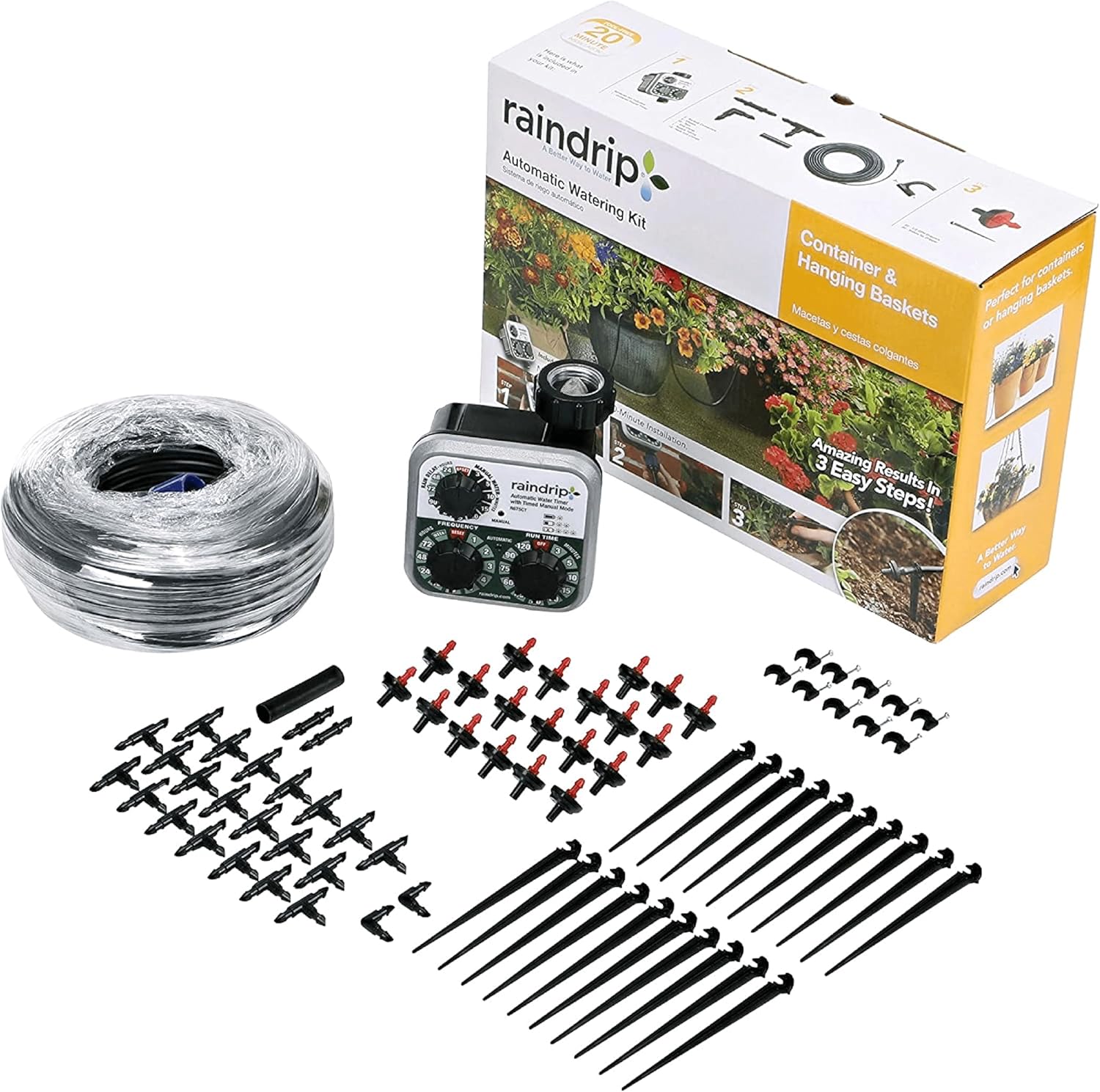
Raindrip R560DP Automatic Drip Irrigation Kit with Timer for Containers and Hanging Baskets
| Hose Length | 75 feet |
|---|---|
| Number of Pieces | 20 |
| Power Source | Battery Powered |
| Control Type | Button Control |
| Included Components | Timer, Tubing, 20 Drippers, Stakes, Tees, Clamps, Couplings & Elbows, Plug |
The Raindrip R560DP is a complete drip-watering kit built to automate watering for up to twenty container or hanging plants. The kit includes a battery-powered timer, 75 feet of 1/4 in. tubing, 20 drippers, clamps, stakes and basic fittings so you can connect to a faucet, lay out supply tubing and plug in emitters without buying extra parts. In use it provides slow, even delivery to individual pots and hanging baskets, which helps keep soil moisture consistent and reduces waste compared with hand watering. The kit is straightforward to install for gardeners who follow basic instructions and want a low-maintenance solution. Important limitations are the basic plastic components and the fixed number of included emitters, so larger or more complex layouts will need additional tubing and drippers. The timer is battery powered and button controlled, which is convenient but not as flexible as smart-phone timers or multi-zone controllers. For routine container irrigation where simplicity and reliability matter, this kit covers the essentials well.
Best for: Gardeners who want a straightforward, proven kit to automate watering for multiple pots or hanging baskets and prefer a complete, ready-to-install solution with minimal setup.
Less Ideal for: People needing multi-zone control, smartphone integration, heavy-duty materials, or large landscapes beyond container clusters should consider more advanced or expandable systems.
- Complete starter kit: includes timer, 75 ft tubing, 20 drippers and common fittings for one purchase setup
- Automatic battery-powered timer makes scheduled watering hands-free
- Designed for containers and hanging baskets so emitters deliver water directly to individual plants
- Simple threaded and barbed connections allow quick assembly without specialized tools
- Basic plastic parts may wear faster than higher-end materials
- Limited to the 20 included drippers and 75 ft of tubing unless you buy add-ons
- Timer is a simple button-control unit rather than a smart or multi-zone controller
Verdict: A reliable, all-in-one drip kit that quickly automates watering for up to twenty container or hanging plants with minimal fuss.
Choosing the Right Irrigation System for Container Plants: Key Factors to Consider
Water Delivery Precision
Container plants have small, discrete root zones and each pot often needs a different volume of water. A system that meters flow to individual emitters or drippers lets you match water output to pot size, plant type, and sun exposure. Precision reduces run-off from overwatering and ensures heavier-feeding or sun-exposed pots get sufficient moisture.
When emitters allow adjustment, you can fine-tune output during seasonal changes rather than reworking the whole layout. For mixed container plantings, look for systems with a range of flow rates and the ability to swap or cap emitters without cutting tubing.
Installation Flexibility
Container layouts vary widely: single large planters, rows of window boxes, vertical towers, and hanging baskets all require different tubing runs and mounting options. Flexible systems include thin tubing that can be threaded along rails, stake-style drippers for pots, and adapters for hose or faucet connections.
Ease of routing and simple fittings mean you can adapt the system as you rearrange containers seasonally. Consider how the main supply line will reach your pots, whether you need splitters for multiple zones, and whether inline fittings are easy to add without specialized tools.
Clogging and Maintenance
Potting mixes, fertilizers, and algae can create blockages in small orifices. A good container irrigation system minimizes clogging with larger-flow micro-sprays for coarse mixes, built-in filtration, or easily removable emitter tips for cleaning. Systems that allow flushing and have accessible filters extend interval between maintenance tasks.
Regular maintenance is part of container care, so choose components that are simple to disassemble and reassemble. If you use liquid fertilizers, consider a system that tolerates soluble feeds or that can be isolated for occasional fertilizer injection without permanent fouling.
Automation and Scheduling
Automation transforms container care by delivering consistent moisture while you are away or during hot spells. Decide whether you want a simple battery timer at the faucet or a more advanced controller that supports multiple short cycles and seasonal adjustments. Timers that allow multiple programs help prevent run-off by splitting watering into pulses, which containers absorb better.
Also check compatibility with moisture sensors or smart controllers if you prefer soil-feedback watering. For small setups, simple timers are often adequate. For mixed exposures or long absences, programmable controllers with repeatable schedules are more reliable.
Durability and Weather Resistance
Outdoor container systems are exposed to UV, temperature swings, and physical wear from pets or foot traffic. Choose tubing and fittings rated for outdoor UV exposure and components with corrosion-resistant materials. Freeze-prone climates require systems that can be easily drained or removed for winter to avoid split tubing and damaged valves.
Durability also means connections hold under tension and emitters resist cracking. When planning permanent installations on a balcony or patio, opt for components with documented outdoor ratings or heavier-duty construction to reduce replacements.
Scalability and Modularity
As container collections grow or move, you want a system that scales without a complete overhaul. Modular designs with quick-connect fittings and add-on emitter kits let you expand by adding loops or branches. This is especially useful for seasonal changes when you might add more pots or rearrange plant groupings.
Scalability also affects how you manage water pressure and flow. Systems that include pressure compensating emitters or offer multiple flow-rate options make it easier to maintain even watering across a changing layout.
Matching System Types to Container Setups
There are several common approaches for container watering: individual drippers or emitters, micro-sprays, capillary mat systems for plant benches, and self-watering reservoirs. Each performs differently depending on container size and arrangement. Drippers work well for widely spaced pots where precise volumes are needed, while micro-sprays can cover multiple small pots from a single nozzle but may increase evaporation.
Consider vertical or hanging setups where gravity and access limit where tubing can run. In those cases, lightweight tubing and stake-mounted emitters are easiest to position. For tightly grouped pots on benches, a capillary mat or soak hose under the pots can simplify routing and reduce visible tubing.
- Drippers: precise, adjustable, best for individual pots
- Micro-sprays: cover clusters, watch for evaporation
- Capillary mats: tidy for benches, limited to flat surfaces
- Self-watering reservoirs: low-maintenance for single containers
Dealing with Hard Water and Fertilizer Build-up
Minerals from hard water and precipitated fertilizer salts can clog small emitters. Install a small inline filter at the supply point and plan a periodic flushing routine to clear lines. Where buildup is persistent, choose emitters with larger or replaceable orifices that tolerate particulate.
If you use concentrated liquid feeds, run clear water through the system after fertilizing or use a separate feed line designed for soluble fertilizers to avoid fouling the main irrigation components.
- Install a pre-filter on the supply line
- Flush lines monthly during heavy use
- Consider larger-orifice emitters for gritty mixes
Winterizing and Off-Season Storage
In climates with freezing temperatures, draining and removing above-ground irrigation components prevents cracking. Disconnect the supply, blow out the lines if possible, or store tubing and fittings indoors. Even in mild climates, elevated UV exposure over months will degrade thin tubing, so short-term storage can extend component life.
Label tubing runs or take quick photos of your layout before disassembly so reinstallation in spring is straightforward. Small inexpensive parts like stakes and emitter caps are easy to lose, so keep them together in a labeled container.
- Drain or remove components before freezing weather
- Store small parts and take layout photos for reassembly
- Replace brittle tubing rather than forcing reuse
Integrating Moisture Sensors and Smart Controls
Moisture sensors add feedback that prevents overwatering by telling a controller when pots have reached target moisture. For container systems, place sensors at representative pots rather than relying only on timer schedules. This is especially useful for mixed-exposure setups where some pots dry faster.
Smart controllers can reduce wasted water and adjust schedules remotely, but they are only as effective as the sensor placement and the emitter layout. For small installations, a single sensor and a basic programmable timer often provide a good balance of control and simplicity.
- Place sensors in pots that represent the driest exposures
- Use short cycles with soak intervals to improve absorption
- Prefer controllers that support multiple daily programs
Practical Routing and Aesthetics
Routing tubing neatly keeps the patio or balcony looking tidy and reduces tripping hazards. Use clips along railings, tuck lines behind pots, or run tubing under bench slats. Thin-profile tubing and dark colors are less visible against planters and decking.
Consider removable clips or adhesive mounts if you rent or need to change layouts seasonally. Hidden routing also protects tubing from pets and foot traffic, which reduces accidental damage and maintenance.
- Use mounting clips and stakes to keep lines tidy
- Tuck tubing behind or under planters when possible
- Choose darker tubing to blend with decking and pots
How We Chose the Best Irrigation System for Container Plants
We selected systems that are purpose-built or easily adapted for container gardening and that demonstrate reliable, repeatable performance in small-scale irrigation scenarios. Key evaluation criteria included water delivery precision for individual pots, installation and routing flexibility on patios and balconies, resistance to clogging from potting mixes and hard water, and the ability to integrate timers or flow control for automated schedules. We also checked material durability for outdoor exposure, ease of winterizing or draining, and the clarity of setup instructions for typical home gardeners. Products were excluded if they were designed exclusively for large in-ground lawns, required specialized plumbing beyond common garden hose connections, or lacked meaningful options for individual-pot adjustment. We prioritized systems that balance simplicity with control so container gardeners can tailor water volume and timing without complex plumbing work.
FAQ
Can I connect an irrigation system for container plants to a standard garden hose or faucet?
Often yes. Many container irrigation systems use a hose adapter or faucet connection as the supply. Look for kits that include common adapters or simple fittings so you can attach the system without changing existing plumbing.
How often should I water my container plants with an automatic system?
It depends on pot size, soil mix, plant species, and weather. Shorter, more frequent cycles are common for small pots to improve absorption. Monitor soil moisture and adjust schedules seasonally rather than relying on a fixed weekly routine.
Will drip emitters clog with potting mix or fertilizers?
They can, especially with fine or gritty mixes and concentrated fertilizers. Using inline filters, choosing larger-orifice emitters, and flushing lines periodically reduces clogging. Removable emitter tips also make cleaning easier.
Are moisture sensors worth adding to a container irrigation system?
Often they are, particularly for mixed exposures or when you want to avoid overwatering. A well-placed sensor can prevent unnecessary cycles and conserve water, but sensor location matters, so place it in representative pots.
How do I winterize a container irrigation setup?
Drain the lines, disconnect the supply, and store delicate components indoors if you expect freezing temperatures. For permanent installs in mild climates, at minimum flush the system and inspect tubing for brittle sections before the first frost.
Can I use the same system for hanging baskets and large patio planters?
Yes, but choose flexible tubing and lightweight emitters for hanging baskets to avoid adding weight. Large patio planters may need higher-flow emitters or multiple drippers per pot to ensure deep wetting.
Final Verdict
For container plants, prioritize systems that offer precise individual-pot control, resist clogging, and are easy to route around your specific layout. Automation and sensors add convenience and can prevent common watering errors, but they require thoughtful placement and occasional maintenance. Balance simplicity with control: a straightforward dripper-based system with a reliable timer often suits most patios and balconies, while more complex setups make sense when you manage many mixed-exposure containers. Choose components that match your climate and plan for winter care to extend system life.
