

Note: This article contains affiliate links. If you click on these links and make a purchase, I may earn a small commission at no extra cost to you. This helps support my research and content. Read my full affiliate disclosure here.
If you regularly remove large limbs, fell medium to large trees, or manage storm cleanup, the right chainsaw changes the job from grueling to manageable. A chainsaw for tree cutting needs reliable cutting power, consistent bar and chain feed, and features that reduce kickback and operator fatigue. This guide covers seven top-rated chainsaws shortlisted for real-world arborist and homeowner tasks. We evaluate each on cutting capability, runtime or fuel handling, safety features, and ease of maintenance so you can pick the right tool for the size of tree and frequency of use.
Top Picks at a Glance
| Best Overall The best all-around choice for most situations | EGO POWER+ 16" Cordless Chain Saw with 2.5Ah Battery and Charger (CS1611) |  |
| Best Quality Built to a higher standard if you want something more solid | Husqvarna 460 Rancher 24" Gas Chainsaw |  |
| Best Value The sweet spot between price and what you get | SEESII 40V Cordless 16" Electric Chainsaw (2×40V Batteries) |  |
| Best Budget The cheapest option that still gets the job done reliably | kunghei 12-inch Top-Handle Gas Chainsaw, 25.4cc 2-Stroke |  |
| Highest Rated A top-rated pick with lots of positive feedback | Husqvarna 120 Mark III 16-inch Gas Chainsaw (38cc X-Torq) |  |
| Most Popular A crowd favorite that many people choose with confidence | SEESII 12-Inch Cordless Brushless Chainsaw with Dual 4.0Ah Batteries |  |
| Best Seller A high-volume bestseller chosen again and again | Oregon CS1500 18" Corded Electric Chainsaw with PowerSharp Self-Sharpening |  |
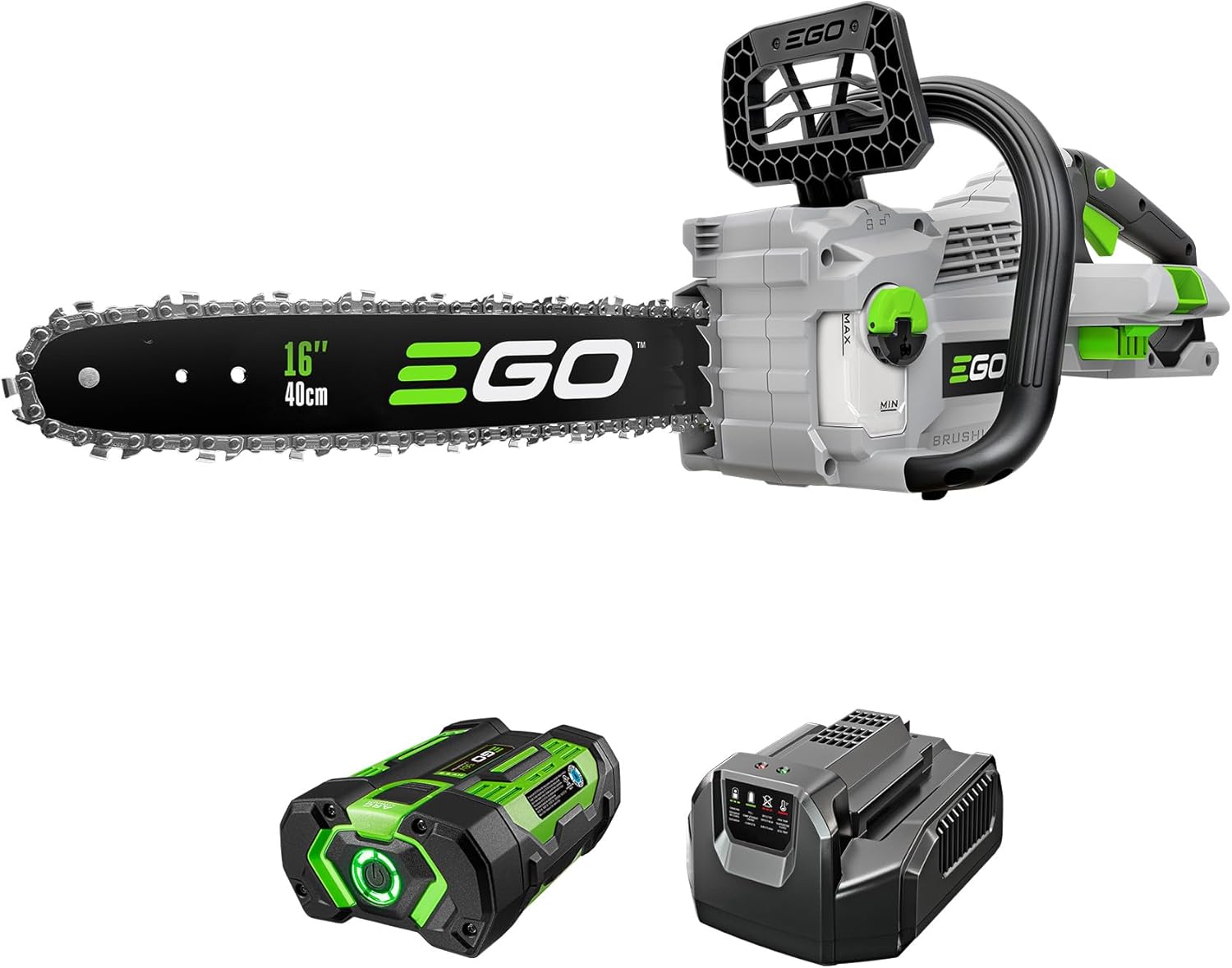
EGO POWER+ 16" Cordless Chain Saw with 2.5Ah Battery and Charger (CS1611)
| Power Source | Battery Powered |
|---|---|
| Horsepower | 2.3 |
| Chain Length | 16 inches |
| Included Components | 2.5Ah Battery and Standard Charger |
The EGO POWER+ 16" cordless chainsaw is built to give homeowners the cutting power of a small gas saw without fumes or the ongoing maintenance of fuel. It is intended for general-purpose tree work and limb cutting around the yard, using the included 2.5Ah battery for shorter jobs or larger EGO batteries for extended runtime. Notable features are the brushless motor rated as a 40CC equivalent, a 20 m/s chain speed for efficient cuts, tool-free chain tensioning via dials, automatic oiling with a spill-free reservoir, and IPX4 weather resistance for use in damp conditions. Practical benefits include quieter operation, low vibration for easier handling, and metal bucking spikes plus a kickback brake for safer control when bucking or pruning. Limitations to consider are that the included 2.5Ah battery supports roughly 130 cuts on a 4×4 so heavy, prolonged tree-felling will require larger batteries or multiple charges, and the 16" bar limits maximum cutting diameter compared with longer professional saws.
Best for: A homeowner or property manager who wants a quiet, low-maintenance chainsaw for routine tree trimming, pruning, and mid-size limb or log cutting and who values cordless convenience.
Less Ideal for: Arborists or users who regularly fell large trees or need to cut very wide logs should consider larger bar lengths and higher-capacity battery or gas models.
- Brushless motor delivers power comparable to a 40CC gas chainsaw without fumes or excessive noise
- Tool-free chain tensioning for quick on-job adjustments
- Automatic oiling with a spill-free reservoir keeps chain lubricated during use
- IPX4 weather resistance lets you work in light rain or damp conditions
- Included 2.5Ah battery provides limited runtime for extended or heavy tree work
- 16-inch bar restricts maximum log diameter compared with larger professional chainsaws
Verdict: A powerful, low-maintenance cordless chainsaw that is ideal for homeowners who want gas-equivalent cutting performance for routine tree and limb work without the fuss of gas engines.
Husqvarna 460 Rancher 24" Gas Chainsaw

| Power Source | Gas Powered |
|---|---|
| Horsepower | 3.6 |
| Chain Speed | 24 inch |
The Husqvarna 460 Rancher is built for heavy-duty tree work and large firewood cutting where power and reach matter. It pairs a 60.3-cc, 3.6-HP X-Torq two-stroke engine with a 24-inch bar to deliver the torque needed for big trunks and long cuts, while Smart Start and combined choke/stop controls make starting less frustrating in the field. Practical features like Air Injection centrifugal cleaning extend filter life on dusty jobs, a side-mounted tensioner simplifies chain adjustments, and LowVib technology plus an ergonomic offset front handle reduce fatigue during extended use. The saw comes with a bar, chain, basic tools, and a small pre-mix sample so you can get to work right away. Expect strong cutting performance and good durability, though its weight and fuel use reflect its larger engine so it demands more physical effort and regular maintenance than smaller saws. For property owners and pros tackling frequent, heavy tree cutting this saw delivers dependable power; casual users with occasional limb trimming needs may find it more saw than necessary.
Best for: Buyers who need a powerful, gas-driven saw for regular tree cutting, firewood preparation, or land maintenance and prioritize cutting performance and durability over light weight.
Less Ideal for: Those who only do occasional trimming, small yard tasks, or prefer low-maintenance electric alternatives should consider smaller or battery models instead.
- High torque 60.3-cc, 3.6-HP X-Torq engine for demanding cuts
- 24-inch bar offers extended reach for large trunks and long cuts
- Smart Start and combined choke/stop controls simplify starting
- Air Injection system helps keep the air filter cleaner for longer
- Side-mounted tensioning and ergonomic handle reduce downtime and fatigue
- Heavier and thirstier than smaller saws, requiring more physical effort and fuel
- Requires routine two-stroke maintenance and proper fuel mixing
Verdict: Choose the Husqvarna 460 Rancher when you need a rugged, high-torque gas chainsaw that handles large tree-cutting and heavy firewood work reliably.
SEESII 40V Cordless 16" Electric Chainsaw (2×40V Batteries)

| Power Source | Battery Powered |
|---|---|
| Motor | 2000W Brushless |
| Chain Speed | 35FT/S |
| Number of Batteries | 2 × 40V 4.0Ah |
The SEESII 40V 16-inch cordless chainsaw brings near-gas power to homeowners and DIYers in a convenient battery kit. It uses a 2000W brushless 40V motor and two 40V 4.0Ah batteries to sustain long cutting sessions without fumes or a pull-start. Typical uses are limb pruning, storm cleanup, firewood cutting, and general tree trimming where portability and quick setup matter. Notable features include an automatic chain oiler with a visible reservoir, tool-free chain tensioning, a responsive chain brake and safety lock, plus included gloves and goggles. Practical benefits are straightforward: long runtime from the dual-battery system, reduced maintenance compared with gas units, and easier handling thanks to the modest 10.3 lb weight. Important limitations are that its 16-inch bar caps maximum cut diameter and it relies on proprietary 40V batteries so you cannot mix with 20V tools; very large trunks or commercial logging tasks will still need a larger or gas-powered saw. For most homeowners needing a powerful, low-maintenance saw for tree cutting and property cleanup this model delivers strong performance and user-friendly controls.
Best for: Homeowners and DIYers who want near-gas cutting power without fumes and prefer a portable, low-maintenance chainsaw for pruning, storm cleanup, and firewood preparation.
Less Ideal for: Professional arborists or users who regularly cut very large trunks or need the sustained power and reach of larger gas or higher-bar commercial chainsaws.
- 2000W 40V brushless motor provides high torque and fast cutting speed
- Includes two 40V 4.0Ah batteries and dual fast charger for extended runtime
- Automatic chain oiler reduces friction and maintenance during long cuts
- Tool-free chain tensioning makes on-the-job adjustments quick and easy
- 16-inch bar limits cutting diameter compared with larger professional saws
- Batteries are specific to the 40V system and not compatible with 20V tools
Verdict: A powerful, user-friendly cordless chainsaw that gives homeowners gas-like cutting performance with long runtime and low maintenance.
kunghei 12-inch Top-Handle Gas Chainsaw, 25.4cc 2-Stroke

| Power Source | Gas Powered |
|---|---|
| Horsepower | 1.22 hp |
This compact top-handle chainsaw pairs a 25.4cc 2-stroke motor (about 1.22 hp) with an 11.8-inch guide plate to deliver quick, precise cutting for pruning, small-diameter felling, and household firewood work. It is built with an aluminum alloy case and reinforced nylon shell for durability while staying light enough for handheld use and longer sessions. The engine claims up to 900W and a 9,000 rpm chain speed, which helps the quenched chain slice through branches cleanly. Practical touches include an ergonomic anti-slip handle, an easy pull-start system that typically fires up in a few pulls, simple chain tension adjustments, and basic safety features like a lock and protective baffle. Expect good value for occasional to moderate use, especially around the yard and orchard. Limitations are its small 12-inch bar, which restricts it to thinner trunks and limbing rather than large tree felling, and as a two-stroke gas unit it requires mixing fuel and routine engine maintenance.
Best for: Buyers who need an affordable, portable gas chainsaw for yard work, fruit-tree pruning, and cutting firewood where mobility and ease of use matter more than heavy-duty felling.
Less Ideal for: Do not choose this if you regularly fell large trees or need a long bar for processing big logs; look for a larger professional chainsaw instead.
- Compact, lightweight design makes it easy to handle for pruning and extended tasks
- Durable aluminum alloy body with reinforced nylon shell for outdoor use
- Quick-start pull cord and user-friendly chain tension adjustment reduce downtime
- High chain speed and quenched chain provide sharp, efficient cutting on small to medium wood
- 11.8-inch guide plate limits cutting to smaller diameter trunks and prevents efficient large-tree felling
- Two-stroke gas engine requires fuel mixing and regular maintenance
Verdict: A budget-friendly, lightweight gas chainsaw that is well suited for pruning and small tree work where portability and simple operation matter most.
Husqvarna 120 Mark III 16-inch Gas Chainsaw (38cc X-Torq)

| Power Source | Gas Powered |
|---|---|
| Horsepower | 1.88 hp |
| Chain Length | 16 inches |
The Husqvarna 120 Mark III is a straightforward gas chainsaw aimed at homeowners and property keepers who need a reliable tool for tree cutting tasks. Its 38-cc X-Torq two-stroke engine produces about 1.8 horsepower and is paired with a 16-inch bar suited to light felling, pruning, and cutting firewood. Practical features include an air purge for easier starts, a combined choke/stop control to reduce flooding, and an inertia-activated chain brake for kickback protection. LowVib dampeners help reduce operator fatigue during longer jobs and an Air Injection centrifugal system pre-cleans incoming air to extend filter life. The chain tensioning system is simple to adjust in the field and an automatic oiler keeps the chain lubricated during use. Limitations for serious tree professionals are the modest power and 16-inch bar, which make it less suited to large-diameter trunks or continuous heavy logging, and the typical maintenance demands of a gas two-stroke engine. For routine residential tree cutting and landscape maintenance it delivers dependable performance with user-focused starting and safety aids.
Best for: Buyers who prioritize a dependable, easy-to-use saw for home and property tree cutting and routine landscape tasks where ease of starting and low vibration matter most.
Less Ideal for: Professional arborists or users who need a high-power saw for frequent heavy felling and very large-diameter trees should choose a larger commercial model.
- User-friendly starting with air purge and combined choke/stop control for fewer failed starts
- Inertia-activated chain brake and LowVib system improve safety and reduce operator fatigue
- Air Injection centrifugal pre-cleaning extends engine and air filter life
- Automatic oiler and simple chain tensioning enable easy field maintenance
- Power and 16-inch bar limit effectiveness on very large trunks or continuous professional logging
- Requires routine two-stroke gas maintenance and correct fuel mix
Verdict: A reliable, easy-starting 16-inch gas saw built for homeowners who want safe, low-vibration performance for routine tree cutting and firewood work.
SEESII 12-Inch Cordless Brushless Chainsaw with Dual 4.0Ah Batteries

| Power Source | Battery Powered |
|---|---|
| Horsepower | 1200 watts |
| Chain Length | 12 inches |
| Included Components | chainsaw |
| Item Highlight | 2 x 4.0Ah Battery, Auto Oiling, Tool-free Chain Tension |
The SEESII 12-inch cordless chainsaw is built for homeowners and light pros who need a portable saw for pruning, storm cleanup, and cutting small logs. It pairs a 1200W brushless motor with two 4.0Ah batteries to give extended runtime and steady cutting power, and the 12-inch bar handles most residential tree-cutting tasks. Practical touches include a smart auto-oiling system with a 60mL tank to keep the chain lubricated during heavier cuts and a tool-free chain tensioner for quick field adjustments. The saw’s cordless design and relatively light feel make it easy to maneuver in trees and around the yard, while the battery indicator helps avoid unexpected shutdowns. Important limitations are the 12-inch bar, which is not suitable for very large trunks, and battery-reliant runtime that may require swapping batteries on long jobs. For anyone prioritizing portability and ease of maintenance over heavy-duty commercial cutting, this unit is a strong option.
Best for: Buyers who value proven performance and documented reliability for routine tree cutting and storm cleanup and who prefer a cordless saw that is easy to maintain and operate.
Less Ideal for: Not a good fit for commercial arborists or homeowners who need to fell very large trees or make long continuous cuts without battery changes.
- 1200W brushless motor delivers efficient, consistent cutting power for residential tree and yard work
- Includes two 4.0Ah batteries for longer continuous runtime compared with single-battery kits
- Smart auto-oiling system reduces chain wear and downtime with an adjustable flow and 60mL tank
- Tool-free chain tensioning and a visible battery indicator simplify setup and on-the-job adjustments
- 12-inch bar limits capacity for very large trunks or heavy commercial forestry work
- Runtime depends on battery charge and may require swapping batteries for extended jobs
Verdict: A portable, easy-to-maintain cordless chainsaw that pairs strong brushless power with dual batteries to handle most residential tree-cutting jobs.
Oregon CS1500 18" Corded Electric Chainsaw with PowerSharp Self-Sharpening

| Power Source | Corded Electric |
|---|---|
| Horsepower | 2400 watts |
| Chain Length | 18 inches |
| Manufacturer Warranty Description | 2 year |
The Oregon CS1500 is a homeowner-focused corded electric chainsaw designed for regular tree trimming, limb removal, and general yard cleanup. It delivers strong electric power and starts instantly so you avoid engine maintenance or gas mixing. The standout feature is the integrated PowerSharp self-sharpening system that sharpens the chain in a few seconds without removing it, which cuts downtime and keeps cuts consistent. Tool-less chain tensioning and an automatic oiler simplify upkeep, making the saw easy to maintain between uses. Safety-oriented elements such as a chain brake and a lower-noise corded motor suit suburban settings and neighbors. Limitations include dependence on a power cord, which restricts reach compared with cordless or gas saws, and a fixed 18-inch bar that is less suitable for very large trunks. For routine tree cutting on a small to medium property this model balances power, low maintenance, and safety in a package aimed at cautious, practical users.
Best for: Homeowners who want a reliable, low-maintenance chainsaw for regular pruning, limb removal, and small-to-medium tree cutting without dealing with gas engines.
Less Ideal for: Landscapers, remote jobs, or users who need cordless portability or a saw for frequent heavy-duty felling of very large trees.
- Integrated PowerSharp self-sharpening sharpens the chain in seconds without removal
- Instant corded electric start avoids gas mixing and engine maintenance
- Automatic oiler keeps bar and chain lubricated during use
- Tool-less tensioning makes chain adjustments quick and simple
- Lower noise and built-in chain brake improve safety for residential use
- Corded power limits mobility and requires access to an extension cord
- 18-inch bar is not ideal for cutting very large tree trunks
Verdict: If you want a safe, low-maintenance chainsaw for routine tree cutting around the yard, the Oregon CS1500 delivers instant corded power and a unique self-sharpening chain that keeps you cutting with minimal fuss.
Choosing the Right Chainsaw for Tree Cutting: Key Factors to Consider
Cutting Power and Bar Length
Cutting power determines whether a chainsaw can bite through large-diameter trunks and dense hardwood without bogging down. Higher engine displacement or motor output and faster chain speed make cutting smoother and reduce the need for repeated passes.
Bar length matters because it limits the maximum single-pass cut diameter. For felling medium to large trees, bars in the appropriate length range let you complete a cut without switching tools or making awkward multi-stage cuts. Overshooting required bar length adds weight and can compromise balance, so match bar length to the typical trunk sizes you expect to cut.
Safety Systems and Kickback Reduction
A chainsaw for tree work must include reliable chain-brake systems and features that reduce kickback risk. Chain brakes that engage instantly and reduced-kickback chain designs lower the chance of the bar snapping upward toward the operator during a misfeed or pinch.
Additional safety elements like throttle lockouts, inertia-activated brakes, and effective hand guards also matter because tree cutting often places the operator in awkward positions or on ladders. Consider how the saw's safety systems perform when wearing gloves and in dusty or wet conditions.
Runtime, Fuel Handling, and Refueling
For long tree jobs, runtime is crucial. Battery saws need sufficient amp-hour capacity and efficient motors to avoid mid-job downtime, while gas saws should have tank sizes and engine efficiency that let you finish a tree or limb without frequent refills.
Refueling or battery swapping logistics also affect workflow. Easy-access filler caps, clear fuel/oil-level indicators, and rapid-change battery systems reduce interruptions. For multi-tree jobs, consider how many spare batteries or fuel cans you will realistically carry and how quickly you can get back to cutting.
Ease of Maintenance and Field Serviceability
A saw that is easy to maintain stays dependable in the field. Look for tool-free chain tensioning and bar removal, accessible air filters you can clean without tools, and straightforward spark plug or battery access. Simpler maintenance procedures mean less time down when you need to clear a clogged chain, sharpen teeth, or replace consumables.
Also consider the availability of common bar and chain sizes and whether replacement parts are standard. Field serviceability matters when you are remote or working on a multi-hour job where quick fixes keep you productive.
Weight, Balance, and Operator Comfort
Weight affects how long you can handle the saw without fatigue, especially when cutting at height or from awkward angles. A well-balanced saw with the motor close to the handle reduces wrist strain and improves control during felling and limbing.
Vibration damping and handle ergonomics also influence comfort during prolonged use. Choose a saw that balances manageable weight with enough mass to reduce recoil while still allowing steady, controlled cuts.
Matching Saw Type to the Job
Gas, battery, and corded models each have distinct strengths for tree cutting. Gas models deliver sustained power for large trees and extended jobs without swapping batteries. Modern battery systems can match moderate gas performance for many homeowners and offer quieter, lower-maintenance operation. Corded units are rarely practical for felling but can serve for repeated cuts near a power source.
Think about the typical job duration and location. For occasional small-tree work close to the house, a high-capacity battery saw keeps noise and maintenance low. For multi-tree jobs or hardwoods, gas remains the choice for uninterrupted power.
- Battery saws: lower noise, simpler maintenance, limited by battery life
- Gas saws: long runtime, high sustained power, more maintenance
- Corded saws: continuous power, restricted mobility
Safe Cutting Techniques and Setup
Beyond the tool, how you set up a cut greatly affects safety. Plan escape routes when felling, clear underbrush, and inspect trees for lean, rot, or dead branches that change how a tree will fall. Use wedges to prevent bar pinching in deep cuts and to control the direction of fall.
When cutting limbs, support the branch to avoid binding the chain. Make relief cuts to prevent bark tear-out when removing heavy limbs. Proper technique reduces the risk of saw stall, kickback, and sudden loads on the bar.
- Clear a 45-degree escape path away from the planned fall direction
- Make a notch and a back cut when felling, and use wedges as needed
- Avoid cutting above shoulder height without secure footing or fall protection
Bar and Chain Choices for Tree Work
Chain pitch and gauge influence cutting speed and smoothness. Reduced-kickback chains trade off a bit of removal rate for safer operation and are a good default for many users. Full chisel chains cut faster but require frequent sharpening and are more prone to kickback.
Match chain size to the bar and choose a length that gives you safe reach without excess weight. Consider carrying a spare chain and a compact sharpener so you can restore cutting performance on long jobs.
- Reduced-kickback chains for better safety
- Semi-chisel chains balance durability and cutting speed
- Carry a spare chain and a field sharpener
Maintenance Routines That Keep You Working
Regular maintenance preserves cutting performance and reliability. Clean the air filter frequently in dusty conditions, check chain tension before each session, and keep the bar groove free of debris. A sharp chain reduces fuel or battery draw and makes cuts safer.
Establish a pre-job checklist: chain tension, chain oil level, visible damage to the bar or sprocket, fuel or battery charge, and functional safety systems. For gas engines, follow a seasonal tune-up schedule for spark plugs and carburetor settings to keep starting predictable.
- Daily checks: chain tension, bar oil, visible damage
- Weekly: clean or replace air filter, inspect sprocket
- Seasonal: tune gas engines, replace worn bars and chains
Transport, Storage, and Fuel Safety
Transport saws in a locked case or with the bar covered, and secure fuel cans upright to prevent spills. For battery saws, store batteries in a cool, dry place and avoid full charge storage at high temperatures for long periods. For gas saws, drain or stabilize fuel if storing for more than a month.
Safe storage also includes keeping the chain covered and away from children and pets. Properly maintained storage preserves readiness and reduces corrosion, fuel degradation, and accidental starts.
- Use a rigid scabbard to protect the bar and chain
- Store batteries at moderate charge and temperature
- Follow local guidelines for fuel storage and disposal
How We Chose the Best Chainsaw for Tree Cutting
We shortlisted chainsaws that are built for the stresses of cutting standing trees and large limbs, then filtered by objective, gardener-relevant criteria. Primary evaluation criteria included cutting power and chain speed, because efficient bite and torque determine how well a saw handles big-diameter wood. We also weighed operator safety features such as chain brakes, reduced-kickback chains, and vibration damping since those reduce injury risk during repetitive or awkward cuts. Runtime and fuel handling were considered next, looking at battery capacity or fuel tank size and real-world run duration under load. Ease of maintenance was assessed through tool-free chain tensioning, accessible air filters, and common bar and chain sizes. Finally, usability factors such as weight distribution and starting reliability were included to reflect how a saw behaves on ladders or when making multiple cuts. Excluded items included lightweight pruning-only saws and specialty pole saws that are not designed for felling or ripping large trunks. We also excluded chainsaws lacking basic safety systems. The picks that made the list score well across the listed dimensions and are suitable for serious tree-cutting tasks rather than occasional light pruning.
FAQ
What bar length is best for cutting medium to large trees?
Bar length should exceed the trunk diameter you expect to cut in a single pass. For many medium trees, a mid-length bar is sufficient. Larger trunks often require longer bars or staged cuts. Balance bar length against added weight and handling difficulty.
Are battery chainsaws powerful enough for felling trees?
Battery chainsaws have advanced and can handle many tree-felling tasks, especially with high-capacity batteries. Their effectiveness depends on battery amp-hours and motor power, and they may be limited for continuous cutting of very large hardwoods compared with gas models.
How often should I sharpen the chain when cutting many trees?
Sharpen the chain whenever cutting performance drops, the saw requires more force, or the cut becomes uneven. For heavy use, sharpening after a few hours of cutting or carrying a spare chain reduces downtime.
What protective gear is essential for tree cutting?
Wear chainsaw chaps or pants, a helmet with face and hearing protection, cut-resistant gloves, and sturdy boots with good traction. High-visibility clothing helps if others are nearby. Proper gear reduces injury risk from kickback, falling debris, and accidental contact.
Can I use carving or pruning chains for tree removal?
Pruning chains are designed for small branches and may not be durable enough for trunk cutting. For tree removal, use chains rated for heavy cutting and matched to the bar size to ensure safe and efficient cutting.
Final Verdict
Choosing the right chainsaw for tree cutting requires balancing cutting power, safety features, and handling. Prioritize a tool that delivers enough sustained power for the trunk sizes you face and includes robust kickback protection and chain brakes. Also weigh runtime or fuel logistics, ease of field maintenance, and weight distribution so you can work longer with less fatigue. Decide which tradeoffs matter most for your situation: opt for sustained gas power on long, remote jobs or select a high-capacity battery model for quieter, lower-maintenance use near the home. Focus on safety systems and maintenance accessibility to keep the saw reliable during demanding tree work.
