

Note: This article contains affiliate links. If you click on these links and make a purchase, I may earn a small commission at no extra cost to you. This helps support my research and content. Read my full affiliate disclosure here.
Outdoor pest control affects plant health, patio comfort, and how much time you can spend outside without constant swatting. Choosing the right pest repeller for outdoor use matters because garden pests, rodents, and insects behave differently than indoor pests and require devices rated for exposure to weather and open spaces. This guide covers the top shortlisted pest repellers for outdoor use, with practical notes on coverage, installation, and durability. Below you will find our top picks and clear evaluation criteria so you can match a repeller to your yard size, planting layout, and tolerance for maintenance.
Top Picks at a Glance
| Best Overall The best all-around choice for most situations | ASPECTEK Yard Sentinel 2-Pack Outdoor Ultrasonic Animal Repeller with AC Adapter |  |
| Best Quality Built to a higher standard if you want something more solid | PHIMINNEX Solar Ultrasonic Animal Repeller with LED Strobe (AR902) |  |
| Best Value The sweet spot between price and what you get | G-Jyuncyou Solar Ultrasonic Animal Repeller (2-Pack) |  |
| Best Budget The cheapest option that still gets the job done reliably | CKCOEO Solar Ultrasonic Animal Repellent with Motion Sensor and Strobe Light |  |
| Highest Rated A top-rated pick with lots of positive feedback | PEXPEL 4-Pack Solar Ultrasonic Animal Repellent with Motion Sensor and Strobe Light |  |
| Most Popular A crowd favorite that many people choose with confidence | BORHOOD Solar Ultrasonic Mole and Pest Repellent, 4-Pack |  |
| Best Seller A high-volume bestseller chosen again and again | CKCOEO Solar Ultrasonic Outdoor Animal Repellent, 2-Pack |  |
ASPECTEK Yard Sentinel 2-Pack Outdoor Ultrasonic Animal Repeller with AC Adapter

| Unit Count | 2 Count |
|---|---|
| Included Components | AC Adapter, Extension Cord |
| Target Species | Birds, Cat, Mosquito, Mouse, Raccoon, Rat, Skunk, Squirrel |
| Power Source | Battery Powered |
The ASPECTEK Yard Sentinel is a corded-capable ultrasonic animal repeller sold as a two-pack with AC adapter and extension cord included. It emits ultrasonic (15–18 kHz), sonic and predator sounds and has an adjustable dial so you can tune output for different pests or silence the audible sonic mode while keeping ultrasound active. A built-in PIR motion sensor and strobe-like signal focus the active deterrent when animals enter the device's forward coverage zone, helping conserve power and draw attention to intruders. The units are weatherproof and rated to operate in a wide temperature range, so they can be mounted on a shed, fence, or porch for continuous or motion-triggered protection. Practical benefits include chemical-free, hands-off pest control for rodents, squirrels, birds and common nuisance animals and included power accessories for fast setup. Important limitations are that effectiveness varies by species, placement and environment, and ultrasonic output is directional so multiple units or careful aiming may be needed to cover larger or irregular yards.
Best for: Buyers who prioritize measurable, performance-focused pest reduction and want a corded-capable, adjustable deterrent they can position and tune for specific problem animals.
Less Ideal for: People who need guaranteed elimination across large, densely vegetated properties or who prefer physical trapping or chemical control methods.
- Two-pack with AC adapter and long extension cord for immediate setup
- Adjustable frequency dial lets you target different pests or mute audible sonic mode
- PIR motion sensor focuses deterrent when animals approach to conserve power and increase effectiveness
- Weatherproof design and wide operating temperature range for outdoor use
- Ultrasonic coverage is directional and may require multiple units or careful placement to protect larger areas
- Effectiveness can vary by species and environmental conditions and is not guaranteed for all pests
Verdict: For buyers who want a performance-focused, corded-capable ultrasonic deterrent they can tune and place for targeted animal control, the Yard Sentinel two-pack delivers flexible, ready-to-install protection.
PHIMINNEX Solar Ultrasonic Animal Repeller with LED Strobe (AR902)

| Power Source | Solar Powered |
|---|---|
| Number of Pieces | 1 |
| IP Rating | IP65/IP66 (weather resistant) |
| Detection Range | Up to 33 feet |
| Frequency Range | 13.5 kHz–45.5 kHz |
The PHIMINNEX AR902 combines ultrasonic sound, variable alarm tones, and a bright LED strobe to discourage animals such as squirrels, raccoons, rabbits, and stray cats from entering gardens and lawns. It mounts in soil or on a wall and runs off an integrated solar panel with USB backup charging, so placement in sunlit locations provides continuous operation and cloudy days can be covered by a USB recharge. The unit offers multiple frequency bands and five operating modes plus adjustable volume to reduce habituation and let you fine-tune intensity for the target pest and nearby people. A PIR motion sensor covers a wide detection angle and claims up to roughly 33 feet of range, making it suitable for protecting planting beds, compost areas, and small yards. Build materials are weather resistant and rated for outdoor use. Important limitations: effectiveness varies by species and local food incentives so results may take weeks and are not guaranteed, and nearby pets that are sensitive to high frequencies may require repositioning or frequency changes.
Best for: Gardeners and property owners who want a low-maintenance, tech-driven deterrent and prioritize measurable performance against small to medium wildlife in planting areas.
Less Ideal for: People who need an instant, guaranteed solution for heavy infestations or those who cannot relocate sensitive pets away from the device’s coverage area.
- Solar panel plus USB backup reduces downtime and avoids wiring
- Multiple frequency bands and five modes help prevent animal habituation
- Adjustable volume allows reducing disturbance to neighbors or household pets
- PIR motion sensor with wide detection angle for automatic activation
- IP65/66-level weather resistance suitable for outdoor exposure
- Effectiveness depends on animal behavior and may require 2–4 weeks to see results
- Ultrasonic output may affect sensitive pets if placed too close
Verdict: For yards where long-term, adjustable ultrasonic deterrence matters, this solar-powered unit delivers flexible modes and weatherproof operation to reduce squirrel and other small-animal visits.
G-Jyuncyou Solar Ultrasonic Animal Repeller (2-Pack)
| Power Source | Solar Powered |
|---|---|
| IP Rating | IP65 |
| Frequency Range | 18–45 kHz |
| Charging | Solar and USB charging option |
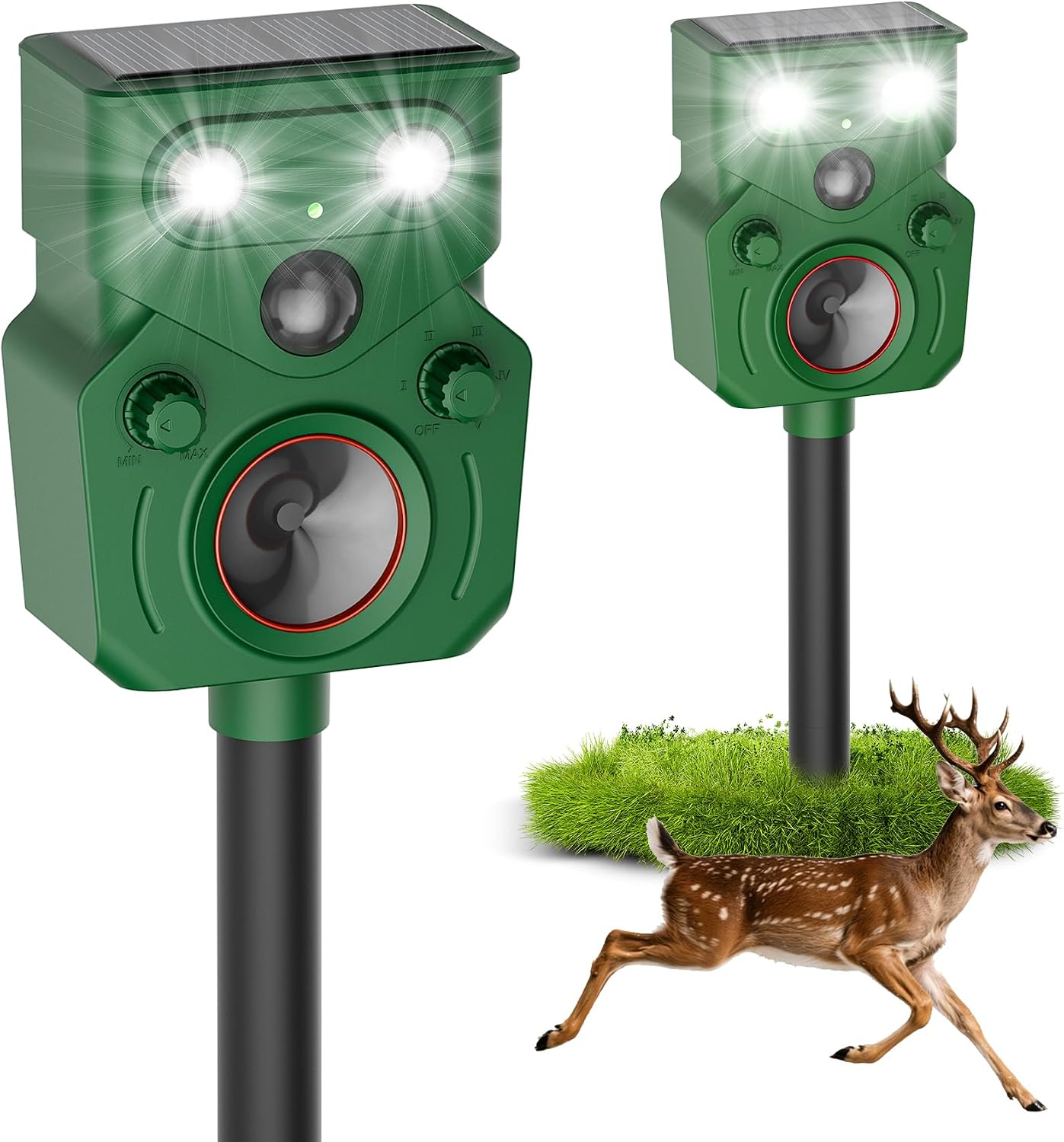
This two-pack of G-Jyuncyou solar ultrasonic repellers combines PIR motion detection, adjustable ultrasonic frequency and strobe lighting to protect yards, orchards, and gardens from deer, raccoons, coyotes and similar animals. Install by staking into the ground or hanging; the PIR sensor triggers ultrasonic pulses (18–45 kHz depending on mode) and flashing LEDs when animals enter the detection zone. There are five modes including sweep, high-frequency, full cycle and strobe-only, plus separate knobs for sensitivity and frequency so you can tune coverage for different animals and distances. Solar panels recharge during the day and a USB port lets you top up the internal battery when sunlight is limited. The unit is IP65 rated, built from ABS plastic, and intended for continuous outdoor use. Important limitations are that ultrasonic effectiveness varies by species and environment and requires correct placement and angle; sound does not physically harm animals and results are not instant in every situation. The device is best used as part of a layered approach to deer control rather than a guaranteed single solution.
Best for: Buyers who prioritize a low-maintenance, weatherproof deterrent they can rely on for continuous outdoor protection and who want the ability to fine-tune detection and frequency settings.
Less Ideal for: Those seeking an immediate, guaranteed elimination of large herd deer or users who prefer physical exclusion methods only should consider alternative or additional solutions.
- Adjustable frequency and sensitivity knobs let you target different animals and tune detection range.
- Dual charging via solar panel plus USB ensures power even in cloudy weather or winter.
- IP65 waterproof rating and ABS construction for outdoor durability.
- Multiple working modes including strobe-only and full-cycle provide flexible deterrent patterns.
- Ultrasonic effectiveness depends on species, landscape and placement so results can vary.
- No detailed coverage radius provided, so planning exact placement requires trial and error.
Verdict: A weatherproof, adjustable solar-powered repeller that provides reliable, low-maintenance deterrence when used as part of a broader deer-control strategy.
CKCOEO Solar Ultrasonic Animal Repellent with Motion Sensor and Strobe Light

| Power source | Solar |
|---|---|
| Detection angle | 150 degrees |
| Detection range | 25-30 ft |
| Waterproof rating | IP65 |
This solar ultrasonic repellent combines a PIR motion sensor, high-frequency sound pulses, and a flashing strobe to keep small mammals out of gardens and yards. Install it on a stake about 9 to 10 inches above the ground or hang it on a fence facing animal paths; when the sensor detects movement within about 25 to 30 feet and 150 degrees, the unit emits ultrasonic bursts and a bright LED flash for immediate deterrence and then returns to standby. The built-in solar panel charges the internal battery so the device runs after dark without wiring, and the IP65 ABS housing tolerates rain and sprinklers for year-round outdoor use. Practical benefits include easy, tool-free setup, chemical-free operation, and coverage that targets a wide range of species. Limitations to note are the need for good sun exposure to maintain charge, an advertised adjustment period of a few weeks for persistent animals, and the typical line-of-sight requirement of ultrasonic devices which reduces effectiveness around dense vegetation or obstructed approaches.
Best for: Gardeners and yard owners who want a low-maintenance, chemical-free deterrent that can be set-and-forgotten to reduce small mammal damage around beds and lawns.
Less Ideal for: People with shaded sites that get little direct sun or those who need immediate, guaranteed removal of persistent animals in heavily obstructed areas.
- Solar-powered with on-board charging so it runs at night without external power
- PIR motion sensor covers up to about 150 degrees and 25–30 feet for triggered activation
- IP65-rated ABS housing protects electronics from rain and outdoor conditions
- Dual-action deterrent using ultrasonic pulses plus flashing LED to startle animals
- Performance depends on direct sunlight for reliable charging and runtime
- Ultrasonic effectiveness is reduced by obstacles and may take weeks for animals to adapt or leave
Verdict: A hands-off, solar-powered ultrasonic repeller that gives practical, weatherproof protection against squirrels and other small pests for sun-exposed gardens.
PEXPEL 4-Pack Solar Ultrasonic Animal Repellent with Motion Sensor and Strobe Light

| Power Source | solar_powered |
|---|---|
| Number of Pieces | 4 |
| IP Rating | IP65 |
This four-pack of PEXPEL solar ultrasonic repellers is built for hands-off, long-term yard protection. Each unit uses a PIR motion sensor to trigger ultrasonic pulses (18–45 kHz) plus a strobe light, and the left and right knobs let you change detection sensitivity and choose from five operating modes to match different pests. It charges from sunlight and also accepts USB fast charging, and a full charge is claimed to run roughly 25–30 days, which makes it convenient for seasonal use without daily maintenance. The IP65 rating and included ground stakes or mounting options mean you can place them in beds, along fences, or near known animal paths and expect weatherproof performance. Expect effective deterrence for medium and small mammals in open, sunny areas; like most ultrasonic devices they work best as part of a layered strategy and performance can vary by species and landscape. If you need a low-effort, weather-resistant solution to reduce cat visits and other garden pests, this set offers flexible controls and multi-unit coverage.
Best for: Gardeners who prioritize a reliable, low-maintenance deterrent and want adjustable settings and weatherproof hardware to reduce visits from neighborhood cats and other small to medium mammals.
Less Ideal for: People seeking an immediate, guaranteed removal of persistent animals or solutions for indoor pests should consider other methods.
- Solar plus USB charging with claimed 25–30 days runtime per full charge reduces maintenance
- Adjustable sensitivity and five operating modes let you tailor detection for different animals
- IP65 waterproof construction and included mounting stakes allow outdoor, year-round placement
- Sold as a four-pack to provide broader coverage across a yard or multiple sites
- Ultrasonic effectiveness varies by species and obstruction and may not stop all animals
- Performance depends on placement in sunny locations for reliable solar charging
Verdict: A weatherproof, low-maintenance four-pack with adjustable sensitivity and solar plus USB charging that suits gardeners who want dependable, set-and-forget outdoor cat and small-mammal deterrence.
BORHOOD Solar Ultrasonic Mole and Pest Repellent, 4-Pack

| Power source | Solar |
|---|---|
| Waterproof rating | IP65 |
| Pack size | 4 pack |
| Coverage per unit | Up to 7000 square feet |
This four-pack solar ultrasonic repellent combines a small solar panel, vibration motor, and ultrasonic pulses to discourage moles, gophers and a range of small mammals from burrowing in lawns and garden beds. Installation is simple: press each stake into the soil, flip the switch and let the units run continuously; the manufacturer says the pulses repeat roughly every 20 seconds so the effect is intermittent rather than constant. The units are rated IP65 for weather resistance and run off solar energy so there is no wiring or battery replacement required under normal conditions. In practice the stakes are best for open, well-drained areas where sunlight can recharge the panels and where you can deploy multiple units to cover the whole yard. Expect to give the product a week or two to notice reduced activity rather than immediate elimination of tunnels. Limitations include variable effectiveness depending on soil type and animal behavior and the fact that ultrasonic/vibration devices rarely guarantee complete removal of persistent pests, so this is most effective as a preventive or part of a layered approach.
Best for: Homeowners who prefer low-maintenance, nonchemical options and want an easy-to-install deterrent to reduce burrowing activity across lawns and garden beds.
Less Ideal for: People facing severe, long-standing gopher or mole infestations who need immediate removal or professional trapping and exclusion methods.
- Solar-powered operation eliminates the need for batteries or wiring
- IP65 weather resistance for continuous outdoor use
- Covers a large advertised area per unit, useful for yard-wide protection
- Easy installation—stake into soil and switch on
- Effectiveness varies with soil type and local pest behavior
- May take a week or more to show measurable results
- Ultrasonic/vibration devices do not reliably eliminate entrenched infestations
Verdict: A low-maintenance, nonchemical solar stake system that provides broad deterrent coverage for homeowners seeking a simple preventive solution against moles and gophers.
CKCOEO Solar Ultrasonic Outdoor Animal Repellent, 2-Pack

| Unit Count | 2 Count |
|---|---|
| Detection Angle | 150° |
| Detection Range | 25-30 ft |
| Waterproof Rating | IP65 |
This 2-pack of solar ultrasonic repellents uses a PIR motion sensor to trigger high-frequency sound pulses and a flashing strobe light to discourage animals from entering gardens and lawns. Install one where animals enter a bed or pathway about 9 to 10 inches above ground or hang it on a fence; when motion is detected within roughly 25 to 30 feet and 150 degrees, the unit emits ultrasonic bursts and a strobe for about 15 seconds before returning to standby. Practical benefits include solar charging for continuous day-to-night operation, IP65 waterproof ABS housing for outdoor durability, and simple tool-free setup that most users complete in minutes. For performance-minded buyers the sensor coverage and dual-action stimulus give a stronger active deterrent than passive methods like barriers. Limitations to expect are a required initial charge period in direct sun, a recommended adjustment period of a few weeks before animals consistently avoid the area, and the possibility that very determined or habituated animals may eventually become less responsive without repositioning or adding units to cover entry points.
Best for: Buyers who prioritize active, low-maintenance pest control and want a performance-focused, weatherproof solution to reduce cat and small wildlife activity in garden beds and yards without chemicals.
Less Ideal for: People who need immediate results overnight or who lack reliable sun exposure for charging should consider hardwired or battery-backed options instead.
- Solar-powered with built-in charging for continuous day-to-night operation
- Dual-action deterrent combining ultrasonic pulses and flashing strobe light
- Wide PIR detection angle up to 150 degrees and 25–30 foot range
- IP65 waterproof ABS construction suitable for outdoor exposure
- Tool-free installation with stake or hanging options for flexible placement
- Requires direct sun for initial charging and consistent solar performance
- May take 2–4 weeks to reach full effectiveness as animals learn to avoid it
- Ultrasonic stimulus may be less effective on habituated or determined animals
Verdict: A performance-focused, weatherproof solar repellent that delivers active ultrasonic plus strobe deterrence for long-term reduction of cats and small wildlife in outdoor gardens.
Choosing the Right Pest Repeller for Outdoor: Key Factors to Consider
Coverage Area and Placement
Coverage area determines how many units you need and where to place them. A device rated for a wide open lawn may perform poorly in dense shrubs or around raised beds because obstacles block propagation of sound or scent-based deterrents. Measure the area you want protected and look for conservative range estimates. Consider whether the device provides directional coverage or 360-degree protection, and plan spacing so there are overlapping zones rather than gaps.
Placement also affects effectiveness. Install units elevated above ground if they rely on sound or ultrasonic waves so the signal clears low vegetation. For scent or vapor-based options, place devices upwind of sensitive plants when possible to avoid residues settling on foliage.
Weather Resistance and Durability
Outdoor devices are constantly exposed to sun, rain, humidity, and temperature swings, so build quality matters. Look for weatherproof housings and specified IP ratings when available. UV-stable plastics resist cracking and color fade, while corrosion-resistant metal parts last longer in coastal or humid climates. Consider how the unit handles freeze-thaw cycles if you live where temperatures dip below freezing.
Durability influences long-term cost and reliability. A tougher enclosure and sealed electronics reduce the need for seasonal replacement. Also check how easily you can access panels for battery swaps or cleaning without breaking seals that keep moisture out.
Repellent Method and Target Pest Match
Different repellers work by sound, ultrasonic waves, lights, motion activation, scent, or physical barriers. Each method suits particular pests. Ultrasonic or high-frequency devices are aimed primarily at rodents and some insects, while sonic or distress-call emitters can deter larger animals. Light-based or strobe deterrents may help night-active pests but can disturb neighbors or beneficial insects.
Match the method to the pest problem you actually have. For mixed infestations, a combination approach or units that allow adjustable modes gives better results. Also consider potential effects on wildlife you want to keep, like pollinators and songbirds, and choose methods that minimize unintended impact.
Power Source and Energy Use
Outdoor repellers run on mains power, batteries, solar panels, or hybrid systems. Each option has tradeoffs in reliability and maintenance. Hardwired units provide constant operation but need safe outdoor electrical installation. Battery models offer placement flexibility but require periodic replacement or recharge, which can be inconvenient for many garden sites. Solar-powered devices reduce maintenance and operating cost but need adequate sun exposure to remain effective.
Estimate runtime between battery changes and verify solar panel capacity if you plan to rely on sunlight. For seasonal gardens, consider whether you can easily remove and store the device in winter when activity and exposure change.
Installation, Maintenance, and Accessibility
How simple a device is to install and maintain affects whether it stays effective. Ground-stake units should have sturdy spikes that grip soil and resist overturning. Wall or post mounts need clear instructions and secure fasteners to prevent loosening. Ease of access to controls, battery compartments, and solar panels matters for seasonal cleaning and adjustments.
Also consider whether the unit needs regular cleaning of sensors, replacement cartridges, or software updates. Devices that require specialized tools or frequent calibration add hidden labor. Look for user-serviceable parts and clear maintenance guidance to keep performance consistent.
Safety for Garden Plants and Wildlife
Outdoor repellents interact with the local ecosystem, so choose options that avoid harming beneficial species. Scent-based or chemical deterrents can leave residues that affect pollinators or contaminate edible plants. Ultrasonic devices might have limited effects on insects and can disrupt certain wildlife behaviors if not carefully targeted.
Review whether a repellent is labeled safe around vegetable beds and pollinator areas. Prefer non-toxic methods where possible and use targeted placement to protect vulnerable plantings while minimizing broader ecological impact.
Matching Repellent Style to Common Outdoor Pests
Different pests respond to different stimuli. Rodents often avoid high-frequency sounds and sudden bursts of noise, while deer and rabbits are more responsive to motion-activated lights and physical barriers. Insect pests may be displaced by light traps or targeted biological controls rather than general-purpose ultrasonic devices.
Start by identifying the most persistent pest. For a mole or vole issue, focus on devices that claim subsurface or ground-vibration effects. For flying insects around evening patio use, prioritize light or trap-based solutions that operate after dusk.
- Rodents: ultrasonic/sound or motion-triggered bursts plus exclusion
- Deer and rabbits: motion lights, physical barriers, and scent deterrents
- Moles and voles: ground vibration units or trapping for population control
- Insects: targeted traps or light-based attract-and-capture systems
Preparing Your Yard for a Repeller
A repeller performs best in a yard that reduces pest attractants. Remove obvious food sources such as exposed compost, pet food, or fallen fruit. Trim dense groundcover where rodents and insects hide and keep brush piles and debris away from the house and planting beds.
Clearing travel corridors and sealing gaps under sheds or decks helps a repeller work by reducing alternate sheltered routes pests use. Combining sanitation and habitat modification with a repeller increases the likelihood of a sustained reduction in pests.
- Clean up food and standing water
- Trim vegetation that offers shelter
- Seal entry points in structures near the garden
Placement Tips for Best Results
Place units where pests travel or congregate rather than in the exact center of a yard. For perimeter protection, situate devices at intervals along fence lines or near known burrows. For patio protection, aim sensors and emitters toward seating areas but avoid pointing devices directly at neighbors' windows or shared pathways.
Avoid hiding a unit deep inside thick shrubs if it relies on sound or light that must reach open space. For solar units, orient panels toward the predominant sun exposure and clear leaves or dust regularly to maintain charging efficiency.
- Target travel corridors and entry points
- Provide overlapping coverage when protecting larger zones
- Keep solar panels clean and oriented toward sun
Seasonal Use and Storage Advice
Pest pressure changes with the seasons, and some devices benefit from seasonal operation. Many repellers can be run continuously through active months and stored during cold or dormant seasons when pest activity drops. Remove batteries before long storage periods to prevent leakage and corrosion.
If a device is rated for year-round outdoor use, still inspect seals and mounts after winter storms. For solar units, check panel output in spring and replace worn stakes or fasteners before the busy season begins.
- Remove or store battery-powered units in winter
- Inspect seals after extreme weather
- Test solar charging and replace weak batteries ahead of peak season
Integrating Repellers with Other Control Methods
Repellers work best as part of an integrated approach. Combine them with habitat modification, exclusion, trapping where appropriate, and targeted biological or mechanical controls. Using a mix of methods reduces reliance on any single tool and provides more durable pest suppression.
Document where you place devices and track pest activity so you can evaluate effectiveness and try different placements or modes before concluding a solution does not work.
- Use exclusion and sanitation alongside repellents
- Track activity to adjust placement and modes
- Consider rotating methods if pests habituate to a single stimulus
How We Chose the Best Pest Repeller for Outdoor
We shortlisted pest repellers for outdoor use based on criteria gardeners actually encounter in yards, patios, and near plantings. Primary evaluation dimensions included effective coverage area to ensure a device can reach the lawn, garden beds, or perimeter; durability and weather resistance for continuous outdoor exposure; target spectrum or repellant method to match the pest type being managed; and ease of installation and ongoing maintenance so the unit stays operational through seasons. We excluded indoor-only units, devices with unverified outdoor ratings, and repellents that require frequent chemical refills that are impractical for garden settings. We prioritized models with clear technical specs for range and ingress protection, practical mounting or placement options, and straightforward user controls. Additional considerations included power source flexibility and evidence of non-target safety for beneficial wildlife. These filters ensured the list focuses on products suitable for real outdoor gardening conditions.
FAQ
How far will a typical outdoor pest repeller reach?
Range varies by method and model. Open-area coverage is usually greater than in cluttered vegetation. Expect manufacturer ranges to be optimistic, so plan for overlapping coverage and test placements.
Are ultrasonic repellers safe for pets and pollinators?
Many ultrasonic units are designed to be safe for larger pets but may affect small rodents or certain wildlife. Pollinators are generally not affected by most ultrasonic devices, but avoid placing intense light-based units near pollinator habitat.
Do solar-powered pest repellers work in shady yards?
Solar devices need consistent sun exposure to maintain charge. In shady yards they can underperform unless paired with battery backup or placed in a sunnier microclimate.
How long before I see results after installing a repeller?
Response time depends on the pest and method. Some pests avoid a treated area within days, while others require habitat changes and weeks of operation. Monitor activity and combine repellers with exclusion for faster results.
Can I leave a pest repeller outside all year?
Only if the unit is rated for year-round outdoor use and has appropriate seals and corrosion resistance. Otherwise remove or store devices during harsh winter weather and check components before redeploying.
Will a single repeller protect an entire yard?
That depends on yard size, obstacles, and pest pressure. Large or irregularly shaped yards usually need multiple units placed for overlapping coverage rather than relying on a single device.
Final Verdict
Choose an outdoor pest repeller based on the pest type, the area you need to protect, and how the device is powered and weatherproofed. Prioritize conservative coverage estimates, durable construction, and a repellent method suited to the specific pests you face. Balance placement and maintenance commitments with the scale of the problem. When paired with basic sanitation and exclusion measures, a properly chosen repeller can reduce encounters and let you enjoy outdoor spaces with fewer interruptions.
