

Note: This article contains affiliate links. If you click on these links and make a purchase, I may earn a small commission at no extra cost to you. This helps support my research and content. Read my full affiliate disclosure here.
If you are running a small 3×3 grow tent or a compact indoor setup, the right 3X3 grow light shapes plant structure, yield, and temperature control. Light footprint, spectrum, and heat output matter more here than in larger rooms because a single fixture must cover the whole canopy evenly and safely. This guide shortlists the top options for the 3×3 footprint and evaluates how well each balances light uniformity, power draw, and thermal management. You will find concise explanations of how we judged coverage, spectrum, and build quality plus practical tips for mounting and distance. The picks below are our top selections for small tent growers based on those criteria and real-world performance considerations.
Top Picks at a Glance
| Best Overall The best all-around choice for most situations | Spider Farmer SE3000 LED Grow Light, 300W, App Controlled |  |
| Best Quality Built to a higher standard if you want something more solid | AC Infinity IONFRAME EVO4 300W Samsung EVO Bar LED Grow Light (3×3) |  |
| Best Value The sweet spot between price and what you get | MARS HYDRO FC-E3000 300W Full-Spectrum LED Grow Light |  |
| Best Budget The cheapest option that still gets the job done reliably | MARS HYDRO TS1000 150W Full Spectrum LED Grow Light |  |
| Highest Rated A top-rated pick with lots of positive feedback | Phovivis OptiGrowX240 LED Grow Light — Full Spectrum, Dimmable, Dual Veg/Bloom Control |  |
| Most Popular A crowd favorite that many people choose with confidence | Spider Farmer SF1000 100W Full Spectrum LED Grow Light |  |
| Best Seller A high-volume bestseller chosen again and again | VIVOSUN LumaLight 200W Full Spectrum Dimmable LED Grow Light |  |
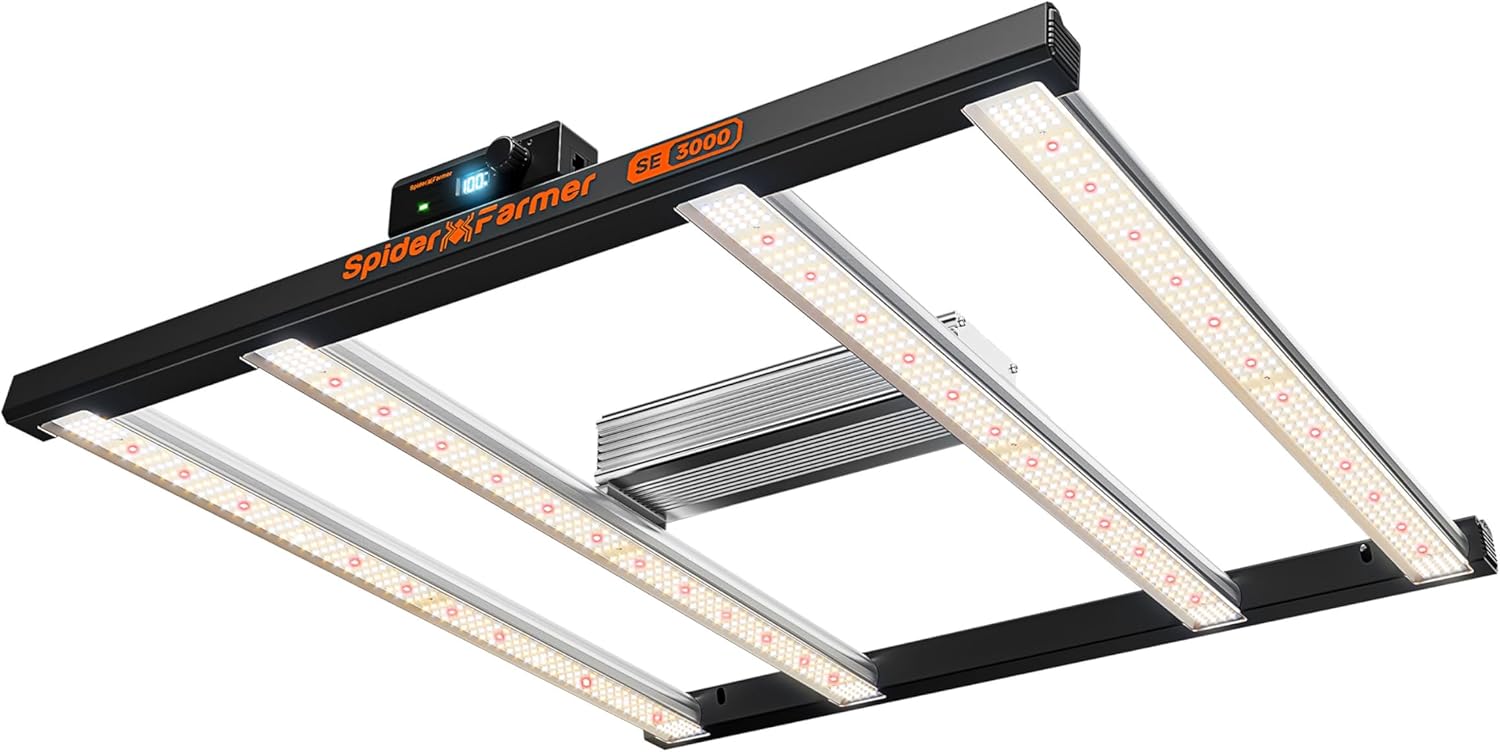
Spider Farmer SE3000 LED Grow Light, 300W, App Controlled
| Light Source Type | LED |
|---|---|
| Power Source | Corded Electric |
| Voltage | 120 volts_of_alternating_current |
| Light Source Wattage | 300 watts |
| Dimmable | dimmable |
The Spider Farmer SE3000 is a 300W full-spectrum LED bar-style grow light built to cover a roughly 3×3 foot grow area from seedling through flowering. It uses premium Bridgelux diodes and a plant-focused spectrum with strong deep red output to maximize photosynthesis while generating relatively low heat. App control and a digital dimming box let you set schedules, simulate sunrise and sunset, and fine-tune brightness for different stages, and the light supports daisy-chaining for multi-light setups. Aluminum construction helps dissipate heat and the design aims for even PPFD across the canopy, including edges. Practical benefits include lower energy draw compared with older HPS setups, precise light management via the app or manual dial, and a five-year repair coverage. Limitations are that the 300W draw may be more than necessary for very small micro-grows and you will still need to manage ventilation and hanging height to optimize uniformity; also advanced users seeking the absolute highest PPE numbers may prefer a larger commercial fixture.
Best for: Home growers who want a reliable, energy-efficient 3×3 light that handles the full growth cycle and prioritizes easy control and even canopy coverage.
Less Ideal for: Growers needing ultra-compact, low-wattage fixtures for tiny micro-grows or large commercial operators who need higher total output per fixture.
- Engineered full-spectrum with strong deep red output to support all growth stages
- App control plus digital dimming box allows schedules, sunrise/sunset simulation, and remote brightness adjustments
- Bar-style layout and premium Bridgelux diodes give even PPFD across a 3×3 ft canopy with reduced edge drop-off
- Aluminum construction improves heat dissipation for cooler operation compared with traditional HID lights
- Supports daisy-chaining for easier multi-light installations
- 300W power draw may be higher than needed for very small setups
- Requires external ventilation and proper hanging height to achieve optimal uniformity
Verdict: A user-friendly, energy-efficient 300W full-spectrum LED that reliably covers a 3×3 ft canopy with app-based scheduling and precise dimming.
AC Infinity IONFRAME EVO4 300W Samsung EVO Bar LED Grow Light (3×3)

| Light Source Type | Light Emitting Diode |
|---|---|
| Wattage | 300 watts |
| Number of Light Sources | 896 |
| Color Rendering Index | 90 |
| Light Output Maximum | 3843 lumens |
The AC Infinity IONFRAME EVO4 is a high-performance full-spectrum LED grow light built for a 3×3 tent or small indoor grow. It uses Samsung LM301H EVO diodes with 896 LEDs to deliver high efficacy (3.14 µmol/J) and strong PPFD for flowering and veg stages. The bar configuration and algorithmic diode spacing aim to reduce hotspots and improve canopy penetration, while 10 dimming levels, sunrise/sunset scheduling, and WiFi-compatible app control let you tailor daily light cycles. Passive-cooled driver design and modular construction help with heat management, and daisy-chaining support simplifies scaling multiple fixtures. Practical benefits include even coverage across a 3×3 area, remote scheduling for consistent photoperiods, and an IP65 rating that tolerates humid environments. Limitations to consider are the unit weight and physical size for tight setups and the need for the optional CONTROLLER 69 for full automation features; advanced growers will also want to verify mounting clearance and electrical setup for 277V listings where applicable.
Best for: Growers who prioritize canopy-level performance and precise light control for a 3×3 tent, especially those running sequential veg and flower cycles and planning to scale with multiple fixtures.
Less Ideal for: Casual hobbyists who want a plug-and-play, minimal-setup light or growers constrained by very low tent clearance or strict weight limits.
- High-efficiency Samsung LM301H EVO diodes for strong light output and energy-efficient photosynthetic photon efficacy.
- Bar-style layout with algorithmic diode spacing to reduce hotspots and improve canopy penetration.
- Integrated scheduling, sunrise/sunset dimming, and 10 brightness levels for precise photoperiod control.
- Daisy-chaining support and removable driver for easier scaling and maintenance.
- IP65 rating and aluminum construction suitable for humid indoor grow environments.
- Full remote automation requires AC Infinity CONTROLLER 69 (sold separately) to unlock app-driven environmental features.
- Unit is relatively heavy and sizable which may challenge very small or low-clearance tents.
Verdict: If you need a 3×3 grow light that delivers commercial-grade output, efficiency, and precise scheduling, the IONFRAME EVO4 is built to perform.
MARS HYDRO FC-E3000 300W Full-Spectrum LED Grow Light

| Light Source Type | LED |
|---|---|
| Power Source | Corded Electric |
| Voltage | 120 volts |
| Light Output Maximum | 52971 lumens |
| Wattage | 300 |
The MARS HYDRO FC-E3000 is a compact 300W LED grow light aimed at indoor gardeners running a 3×3 grow area. It uses high-efficiency Bridgelux diodes with an enhanced OSRAM red spectrum to push flowering performance while keeping energy use relatively low. The fixture is ceiling-mountable, partly modular, and requires simple assembly before hanging; its aluminum body helps dissipate heat during long runs. Built-in dimming and remote app or controller compatibility let you dial intensity for seedlings, veg, and bloom cycles and integrate with Mars Hydro smart gear. Practical benefits include uniform light over a 3×3 footprint and a focus on red wavelengths that support bud weight and density. Limitations are that the unit needs assembly and additional Mars Hydro controllers or hubs for full smart scheduling, and photo specifications like PPFD at canopy height are not listed on the product page, so you may need to verify exact light levels for high-demand crops.
Best for: Best for growers who want a compact, energy-conscious 3×3 light that emphasizes flowering and can be tuned with app or controller support.
Less Ideal for: Not a great fit for gardeners who need out-of-box standalone smart control or precise published PPFD data for high-intensity commercial grows.
- Engineered full-spectrum LED array with boosted red (OSRAM) for improved flowering
- Designed to evenly cover a 3×3 ft grow area for balanced canopy light
- Dimmable and compatible with remote/app control for flexible light schedules
- Aluminum housing and removable parts aid heat dissipation and maintenance
- Requires assembly and separate Mars Hydro controller or hub for full smart features
- Product page lacks specific PPFD maps and exact canopy light measurements
Verdict: A cost-effective, full‑spectrum 300W LED built to deliver tunable, flower‑focused lighting for a standard 3×3 grow space.
MARS HYDRO TS1000 150W Full Spectrum LED Grow Light

| Wattage | 150 watts |
|---|---|
| Light Source Type | Light Emitting Diode |
| Power Source | Corded Electric |
| Light Source Special Features | Dimmable, Daisy Chain |
| Number of Light Sources | 342 |
The MARS HYDRO TS1000 is a compact 150W LED grow light built for small indoor grows and tent setups. It delivers a full-spectrum output aimed at all growth stages and uses a dense array of 342 LEDs arranged to give stronger, more even light in the center and usable coverage up to about 3×3 feet for vegetative growth and 2.5×2.5 feet in bloom. The driver offers 0–100% dimming and the fixture supports daisy-chaining multiple units, which makes it easy to scale a canopy without extra wiring. Its aluminum body and patented white reflector boost light utilization while the fanless design keeps operation silent. Practical benefits include low energy draw compared with equivalent HID systems and simple inside-mount installation for tents or racks. Limitations are its modest total wattage and coverage, which mean multiple units are needed for larger rooms, and true smart controls are optional add-ons rather than built in. Also the RJ12 connector for daisy-chaining may be required separately.
Best for: Growers who want a reliable, energy-efficient light for a single tent or small personal garden and value quiet, even lighting and easy scaling with additional fixtures.
Less Ideal for: People planning to light large rooms or commercial canopies with a single fixture should look at higher-wattage models or multiple-unit kits instead.
- Full-spectrum LED array suitable for seed-to-flower growth stages
- Dimmable 0–100% driver for easy light intensity control
- Fanless aluminum design runs quietly and dissipates heat efficiently
- Daisy-chain support lets you connect multiple units for larger coverage
- 150W output limits single-unit coverage to small tents or compact setups
- RJ12 connector for chaining is not included and must be sourced separately
Verdict: A quiet, energy-efficient 150W full-spectrum LED that fits small grow tents and scales well if you add more units.
Phovivis OptiGrowX240 LED Grow Light — Full Spectrum, Dimmable, Dual Veg/Bloom Control

| Wattage | 220 watts |
|---|---|
| Light Output Maximum | 33600 lumens |
| Color Temperature | 3500 Kelvin |
| Color Rendering Index | 95 |
| Number of Light Sources | 952 |
The Phovivis OptiGrowX240 is a purpose-built LED fixture for small indoor tents that combines high output with controllable spectrum. It delivers 220 watts from 952 LEDs and offers separate Veg and Bloom knobs so you can dial spectrum and intensity for seedlings, vegetative growth, and flowering without swapping fixtures. The advanced optical lens and aluminum body focus light into the canopy for stronger PPFD at typical hanging heights, while passive cooling reduces moving parts and maintenance. Practical benefits include energy-efficient replacement of older 400W HPS setups, a daisy-chain RJ45 port for scaling multiple units, and included hang kit and power cord so you can install it quickly. Important limitations are that it is a single fixture sized for 2×2–3×3 coverage so larger rooms will need multiple units, and advanced integration with controllers requires compatible external hardware. For growers prioritizing dependable, high-PPFD performance in a compact tent setup this light gives precise control and low upkeep.
Best for: Growers who want a reliable, low-maintenance fixture for a 3×3 tent and value precise spectrum control across the full growth cycle.
Less Ideal for: Large-scale growers or users who need a single fixture to cover areas bigger than a 3×3 tent should consider higher-coverage fixtures or multiple units.
- Dual Veg and Bloom knobs provide on-the-fly spectrum and intensity control for all growth stages
- High-efficiency LED array and optical lens deliver strong PPFD while using 220W
- Passive aluminum body for heat dissipation reduces need for active cooling maintenance
- RJ45 daisy-chain support lets you link multiple units and centralize control
- Includes hang kit and power cord for straightforward installation
- Designed for 2×2–3×3 tents so a single unit is insufficient for larger grows
- External controllers required to unlock advanced centralized spectrum scheduling
Verdict: A compact, high-PPFD LED with dual-spectrum controls and robust passive cooling that reliably handles full-cycle grows in a 3×3 tent.
Spider Farmer SF1000 100W Full Spectrum LED Grow Light

| Light Source Type | LED |
|---|---|
| Light Output Maximum | 10000 lumens |
| Light Source Wattage | 100 watts |
| Light Source Special Features | Dimmable |
| Specification Met | IP67 |
The Spider Farmer SF1000 is a compact 100W full spectrum LED grow light intended for 2×2 to 3×3 grow spaces and small tents. It uses a high diode count and upgraded LED chips to deliver broad-spectrum output that supports seedlings through flowering, with a dimmer knob to reduce intensity for early stages and ramp up for bloom. The fanless design and thick aluminum heatsink keep operation quiet while providing passive cooling, and the fixture meets IP67 for durable performance. Typical use is ceiling or tent mounting above individual plants or a small canopy where uniform coverage and deeper canopy penetration matter. Notable features include daisy-chain compatibility for linking multiple units under unified dimming, a 0–100% dimmable control, and a driver claimed to offer efficient power delivery. Practical benefits are even light distribution in a small footprint, predictable veg-to-flower capability, and near-silent operation. Limitations are inherent to its class: it is sized for small areas so you will need multiple units for larger tents, and the product description emphasizes specs from manufacturer tests rather than independent third-party PPFD maps.
Best for: Growers who want a quiet, compact full spectrum light for a small tent or single-plant setup and value adjustable intensity for each growth stage.
Less Ideal for: People running larger multi-plant rooms or commercial operations who need higher total output and broader single-fixture coverage.
- Full spectrum output suitable for all growth stages with added red and IR for flowering
- Dimmable 0–100% control lets you tailor light intensity to seedlings, veg, and bloom
- Fanless design with sturdy aluminum heatsink for quiet, low-maintenance operation
- Compact footprint ideal for 2×2 to 3×3 tents and small indoor setups
- Daisy-chain capable so multiple fixtures can be linked and dimmed together
- Coverage and power are intended for small grows so larger areas require multiple units
- Manufacturer gives efficiency and coverage figures without independent third-party PPFD charts
Verdict: A quiet, dimmable 100W full spectrum fixture that is a practical, balanced choice for hobbyists running 2×2 to 3×3 tents.
VIVOSUN LumaLight 200W Full Spectrum Dimmable LED Grow Light

| Wattage | 200 watts |
|---|---|
| Light Source Type | LED |
| Dimmable | Yes, 25%–100% via knob |
| Mounting Type | Ceiling Mount |
| IP Rating | IP65 |
The VIVOSUN LumaLight 200W is a performance-focused LED grow light engineered to push vegetable growth from seedling through harvest. It combines a full spectrum (white, blue, red, and far-red) with 672 diodes arranged to produce a high and even PPFD across the canopy, which helps reduce edge-to-center variation and encourages consistent leaf and fruit development. Use it mounted over a single grow bench or small tent where you need concentrated output; the four-level dimming knob (25 to 100 percent) and compatibility with VIVOSUN GrowHub let you tune intensity and schedules to crop stage. Thermal management keeps surface temperatures lower than many HID options, and IP65 protection means it tolerates humid conditions and light washdowns common in vegetable grows. Practical limits are its coverage: at 200 watts it is best for 2×2 to 3×3 spaces rather than large multi-plant rooms, and advanced growers who need fully tunable spectrums or integrated fans may prefer higher-end fixtures. For focused, reliable vegetable production in modest indoor spaces, it delivers strong, usable light with smart control options.
Best for: Growers seeking reliable, high-intensity light to maximize vegetable yields in a 2×2 to 3×3 indoor setup who prioritize steady performance and simple intensity control.
Less Ideal for: Large-scale hobbyists or commercial growers who need broad coverage or fully tunable spectrum controls should consider higher-wattage or more advanced fixtures.
- Full spectrum LEDs including far-red to support all growth stages and flowering
- High diode count and strategic layout for uniform PPFD across the canopy
- Dimmable 25%–100% with local knob and GrowHub compatibility for scheduling
- IP65 rated for resistance to humidity and light washdowns
- 200W output is optimized for small tents or single benches rather than large rooms
- No built-in fan or advanced spectrum tuning compared with premium tunable fixtures
Verdict: A compact, high-intensity full-spectrum LED that gives vegetable growers tunable, uniform light for small indoor gardens to improve yields.
Choosing the Right 3X3 Grow Light: Key Factors to Consider
Canopy Coverage and Uniformity
A 3X3 grow light must spread usable light evenly across a roughly 3-foot by 3-foot canopy. Uneven hotspots force you to move plants or rely on additional fixtures, which defeats the point of a compact single-light setup. Look for fixtures with published coverage maps or PPFD charts at common hanging heights so you can predict how many micromoles reach the center and edges.
Uniform coverage reduces stretching and encourages even canopy development. Also consider how intensity falls off toward the edges; a gradual drop is easier to manage than a steep hotspot that scorches the center while leaving corners weak.
Light Spectrum and Spectrum Control
Spectrum affects plant morphology and yield. Full-spectrum white LEDs typically support all growth stages, while added deep red and far-red can influence flowering and stem elongation. Adjustable spectrum or multi-channel controls let you tune light for seedlings, vegetative growth, or bloom cycles without swapping equipment.
For a small tent, spectrum control can also help manage heat and power by shifting output to the most efficient wavelengths for a given stage. If you plan a mixed stage grow, prioritize fixtures that offer practical, labeled spectrum settings rather than vague marketing phrases.
Photosynthetic Output (PPFD) at Working Height
PPFD, measured in micromoles per square meter per second, is the real measure of usable light for photosynthesis. For a 3×3 area, check PPFD maps at typical hanging distances so you know whether the fixture gives adequate light at canopy level without being excessive in the center. Seedlings and clones need far less PPFD than flowering plants, so match the light to your crop and growth stage.
Manufacturers sometimes report total photon output without area context. Prioritize claims that include PPFD grids or that state output at realistic hanging heights for a 3×3 footprint.
Energy Use and Electrical Efficiency
In a small indoor space you will likely run lights many hours per day, so watts consumed and photons per watt are meaningful operating costs. Energy-efficient fixtures reduce long-term electricity load and can lower heat output as well. Confirm how many true watts the fixture draws and whether dimming or scheduling features can reduce power during lower-demand stages.
Also check driver efficiency and whether the unit runs at rated wattage continuously or has power modes. A unit that claims high output but draws excessive energy may require more ventilation or shorter daily run times to avoid overheating the tent.
Thermal Management and Heat Output
Small tents trap heat, and even a modestly hot fixture can raise canopy temperature beyond optimal ranges. Good thermal design uses heatsinks, airflow channels, or quiet fans to keep diodes and drivers within rated temperatures. Excess heat forces you to increase ventilation, which can stress plants and raise running costs.
Consider how the fixture mounts and whether its airflow needs conflict with your tent layout. Also evaluate whether heat is radiated downward into the canopy or exhausted to the sides or top, as that affects placement and distance from plants.
Build Quality, Controls, and Mounting Options
A robust frame, reliable drivers, and flexible mounting hardware make installation simpler and extend the fixture's usable life. Dimmable drivers, multi-channel spectrum controls, and clear, durable control interfaces help you tailor light without fiddly workarounds. In a compact tent, simple hang points and low-profile designs can save space and reduce glare.
Also consider serviceability and warranty terms. Fixtures with replaceable fans or modular boards are often easier to maintain than sealed units, which matters if you plan frequent multi-year use.
Optimal Hanging Height and Distance Tips
Hanging height strongly affects both coverage and intensity. Start higher to verify footprint and then lower the fixture in 6 to 12-inch increments while watching plant response. For full-sun vegetables in bloom, many growers aim for canopy PPFD levels in the upper range for short-duration bloom cycles, while seedlings and vegetative plants do well at lower intensities.
Use a simple PPFD meter if possible, or observe leaf color and stretch as proxies. Leaves that bleach or curl indicate excessive intensity or heat. If corners are significantly dimmer, consider a small supplemental reflector or gentle canopy training to improve light distribution rather than cranking power higher.
- Begin with the manufacturer-recommended height for a 3×3 footprint.
- Lower gradually and watch plant stress signs.
- Use dimming to tune intensity before changing distance.
Managing Heat and Ventilation in a Small Tent
Balance fixture heat with tent ventilation. Active cooling on the light helps, but exhaust and intake fans must move adequate air to carry away heat. Place fans to prevent stagnant pockets and avoid directing constant blasts directly at the plant canopy which can cause uneven transpiration.
Insulate or shield sensitive electronics from humidity and keep the driver elevated or outside the canopy airflow path if possible. If your tent lacks headroom, choose a low-profile fixture or a unit that vents heat outward instead of downward.
- Measure canopy temperature separately from ambient tent temperature.
- Prefer fixtures with rated thermal designs for continuous cycles.
- Position intake and exhaust to create a smooth airflow path.
Spectrum Strategies for Different Growth Stages
Use broader blue-rich spectra for seedlings and early vegetative growth to encourage compact internode spacing and healthy leaf formation. When transitioning to bloom, increase red and deep red components to stimulate flowering responses and potential yield increases.
If your fixture offers spectrum channels, program or mark presets for each stage. That makes transitions repeatable and reduces guesswork across cycles. For multi-harvest setups, use slightly lower peak PPFD during early vegetative stages to avoid stretching when plants are small.
- Blue for compact vegetative growth.
- Red and far-red to support flowering transitions.
- Use presets or marks to repeat successful cycles.
Mounting and Layout Considerations
Think beyond a center hang. Slight offsetting or angling can even out edge coverage in some fixtures. Ensure hang points and ratchets are rated for the fixture weight and allow for easy height adjustment as plants grow.
Also plan cabling and driver placement so cords do not block airflow or obstruct tent access. For tight tents, consider an external driver or a light with an inline driver to free up space near the canopy.
- Use rated hang hardware and test movement under load.
- Route cables away from intake pathways.
- Consider mounting the driver outside the tent if possible.
Measuring Performance Without Specialized Gear
If you do not have a PPFD meter, observe plant behavior closely. Uniform leaf color, steady growth rates, and absence of stretch indicate generally good coverage and intensity. Rotate and compare plant positions under the light to find weak spots, then adjust height, angle, or train the canopy to compensate.
Keep a journal of height, duration, and plant response for each cycle. Small changes in hanging height or dimmer settings can have outsized effects in a 3×3 space, so controlled, incremental adjustments are effective.
- Use observable plant signs as practical proxies for PPFD.
- Map tent hot and cool spots by rotating plants.
- Record changes and responses for repeatable setups.
How We Chose the Best 3X3 Grow Light
We selected lights that reliably cover a standard 3×3 footprint while delivering usable photosynthetic photon flux density across the canopy. Key editorial filters favored fixtures with documented light distribution patterns, measured PPFD or equivalent output claims, and adjustable intensity or spectrum. Energy efficiency and thermal control were prioritized because small tents trap heat and growers often run lights for long cycles. We also considered build quality and duty-cycle design that supports continuous indoor use, including effective heatsinks or active cooling and durable driver electronics. Flexibility of hanging options and dimming controls mattered for real setups where distance from canopy and light schedule vary. Fixtures lacking clear coverage data, insufficient cooling, or that depended solely on unverified marketing claims were excluded. The result is a list focused on real-world canopy performance, power consumption, spectrum usability, thermal management, and user flexibility.
FAQ
What wattage is appropriate for a 3×3 grow tent?
Appropriate wattage depends on the fixture's photon efficiency and your crop stage. Instead of raw watts, target PPFD ranges for your plants and choose a fixture with watts that deliver those levels efficiently. Seedlings need much less than flowering plants, so dimming or staged increases are common.
How close should I hang a 3X3 grow light to my canopy?
Optimal distance varies by fixture and spectrum. Start at the manufacturer-recommended height for a 3×3 footprint, then lower gradually while watching for bleaching or stretch. Use dimming to fine-tune intensity before making large distance changes.
Will a 3X3 fixture work for both veg and bloom stages?
Many 3×3 fixtures support both stages if they offer sufficient PPFD at bloom and spectrum control. Ensure the light can reach the higher PPFD levels needed for flowering without causing excessive heat in your tent.
Can I use multiple smaller lights instead of one 3×3 fixture?
Yes. Multiple smaller lights can improve edge coverage and reduce hotspots, but they add mounting complexity and potential extra heat sources. For compact setups a single well-designed 3×3 fixture is often simpler.
How important is a PPFD map when choosing a light?
Very important. PPFD maps show how photons distribute across the 3×3 area at set heights. They let you see whether the center and corners meet your crop's needs and avoid surprises after installation.
Does heat output differ between LED fixtures?
Yes. Thermal design and driver efficiency determine how much heat the fixture emits into the tent. Some LEDs run cooler due to better heatsinks or external drivers, while compact high-output units may need active cooling or stronger ventilation.
Final Verdict
Choose a 3X3 grow light by matching canopy PPFD needs, coverage uniformity, and thermal behavior to your tent and crop stage. Prioritize fixtures that publish PPFD or coverage maps and offer dimming or spectrum control so you can tune intensity as plants develop. Accept tradeoffs between raw output and heat: higher photon output can boost yields but requires better ventilation. Focus on measured coverage, efficient watts-per-photon, and practical mounting to get consistent, predictable results in a small tent.
