

Note: This article contains affiliate links. If you click on these links and make a purchase, I may earn a small commission at no extra cost to you. This helps support my research and content. Read my full affiliate disclosure here.
A reliable digital watering timer changes how you manage irrigation, whether you care for container plants on a balcony or a mixed vegetable patch. The right timer keeps soil moisture steady, prevents overwatering, and saves you time by automating repeatable schedules. In this guide we shortlisted the most dependable options and evaluated them across the features gardeners notice in daily use. You will find practical notes on battery life, programming ease, valve compatibility, and durability so you can pick a timer that matches your garden layout and maintenance style. Scroll to the product summaries to see the top choices and then read our buying guidance for decision-making details.
Top Picks at a Glance
| Best Quality Built to a higher standard if you want something more solid | MOES 4-Zone Digital Water Timer with Brass Fittings (No Wi‑Fi) |  |
| Best Value The sweet spot between price and what you get | MOES Dual-Zone Hose Water Timer with Brass Fittings |  |
| Best Budget The cheapest option that still gets the job done reliably | Ortis Programmable Hose Faucet Water Timer with IP67 Waterproofing |  |
| Highest Rated A top-rated pick with lots of positive feedback | Underhill AquaZone HBT-1 Digital Hose Timer |  |
| Most Popular A crowd favorite that many people choose with confidence | Orbit Programmable Digital Hose Watering Timer (1-Outlet) |  |
| Best Seller A high-volume bestseller chosen again and again | Orbit Programmable Digital 2-Outlet Hose Watering Timer |  |
MOES 4-Zone Digital Water Timer with Brass Fittings (No Wi‑Fi)

| Number of outlets | 4 |
|---|---|
| Fitting type | 3/4 in brass fittings |
| Battery type | AA (requires 4 alkaline) |
| Programmable range | Run time 1 minute to 23:59; frequency 1 hour to 30 days |
The MOES 4-Zone Digital Water Timer is a heavy-duty standalone controller for managing four separate watering lines from a single outdoor faucet. It mounts to a standard faucet using a solid brass inlet and 3/4 inch adapter and drives four internal valves in sequence so zones run one after another rather than all at once. Programming is done on a large LCD with independent schedules per zone, run times from 1 minute to 23:59 and frequencies from hourly up to every 30 days. Useful features include manual watering, a rain-delay of 1 to 15 days, and low-battery valve protection. Because it requires four AA alkaline batteries for reliable valve operation, it avoids Wi‑Fi setup and smart-home complexity while providing dependable, repeatable irrigation for mixed beds, drip lines, or small lawns. The main compromises are the lack of remote control or app integration and sequential operation when simultaneous flow might be desired for very high-flow setups. For gardeners who prioritize reliable on-site performance and simple programming, this is a focused, capable option.
Best for: Gardeners who want robust, reliable on-site control of multiple watering zones and value dependable valve performance and precise local programming over smart-home connectivity.
Less Ideal for: Users who need remote control, integration with smart-home systems, or who must run multiple zones at exactly the same moment for high-flow irrigation setups.
- Four independently programmable outlets for distinct schedules per zone
- Solid brass main inlet with 3/4 inch adapter for a secure, leak-resistant faucet connection
- Large LCD and flexible timing range (1 minute to 23:59 and frequency up to 30 days) for precise control
- Built-in rain delay, manual start, and low-battery valve protection for reliable field operation
- Requires four AA alkaline batteries for proper valve operation so rechargeable or partial battery setups will not work
- No Wi‑Fi or app control so scheduling and changes must be made at the device
- Sequential watering prevents all zones from running simultaneously which may lengthen total irrigation cycle time
Verdict: Choose this MOES timer when you want a rugged, no‑Wi‑Fi four‑zone controller that delivers dependable on-site performance and precise local scheduling.
MOES Dual-Zone Hose Water Timer with Brass Fittings

| Battery Type | AA (2 required) |
|---|---|
| Item Highlight | 2 independently programmable outlets; 1-15 day rain delay; manual watering; no WiFi |
| Material Type | Brass, Polycarbonate |
The MOES dual-zone water timer lets you run two separate watering programs from a single outdoor faucet, so you can water a lawn and a garden bed or two different zones without swapping hoses. It uses two AA batteries and provides independent start times, run durations and watering frequencies for each outlet plus a manual watering button and a 1–15 day rain delay. The heavy-duty 3/4-inch brass inlet and outlet fittings reduce the risk of cracking and cross-threading compared with plastic connectors and make repeated seasonal hook-ups easier. Because it is non-smart and does not rely on an app or WiFi, setup is straightforward and reliable for users who want a simple automated schedule. Limitations include required fresh alkaline AA batteries and the lack of weather-based adjustments, so you will need to pause or reprogram cycles manually during unusual wet or dry periods; it also performs best with normal faucet pressure and may underperform with very low-pressure or gravity-fed systems.
Best for: Homeowners who want a reliable, easy-to-use way to automate two separate hose-fed zones without learning an app or installing smart systems, especially for small lawns, garden beds, or sprinklers near a single faucet.
Less Ideal for: Users who need app control, remote access, or automatic weather-based scheduling, and setups that rely on low-pressure sources or long gravity-fed lines should look at different solutions.
- Two independently programmable outlets for separate zone schedules
- Solid 3/4 in brass inlet and outlet fittings for durable hose connections
- Simple local controls with manual start and 1–15 day rain delay for easy on-site adjustments
- Battery operation avoids the need for WiFi, apps, hubs, or Bluetooth
- Requires two fresh AA alkaline batteries and does not accept rechargeable cells
- No automatic weather-based adjustments or remote control capability
Verdict: Choose this timer if you want a simple, durable dual-zone controller that reliably automates two hose lines without any WiFi or app setup.
Ortis Programmable Hose Faucet Water Timer with IP67 Waterproofing
| Battery type | 3×AAA alkaline (not included) |
|---|---|
| Water pressure range | Recommended 7–120 PSI, max 150 PSI |
| Hose compatibility | 3/4-inch hoses |
| Waterproof rating | IP67 |
| Run time range | 1–300 minutes |
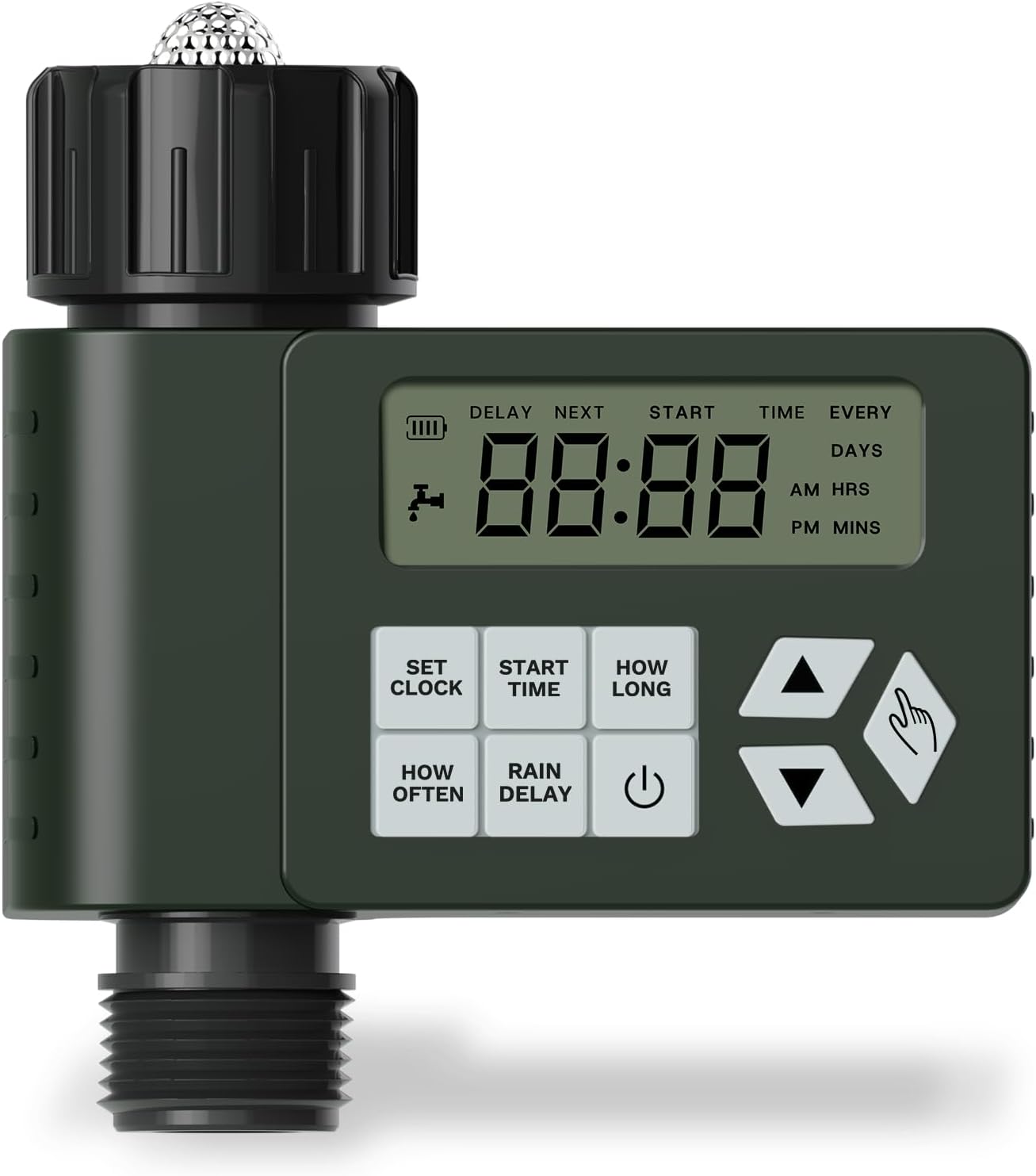
The Ortis programmable hose timer is a straightforward digital solution for automating routine garden and lawn watering. It mounts directly to a 3/4-inch hose faucet and runs on three AAA batteries, letting you schedule runs from 1 to 300 minutes and set frequencies from every 6 or 12 hours up to once every 1–7 days. The unit has three modes: automatic scheduling for hands-off irrigation, manual for one-off tasks like washing a car, and a rain delay to pause watering during wet periods. Notable features include an IP67 waterproof housing, a sealed battery compartment, a stainless steel valve core bracket designed to resist deformation under high pressure, and built-in filters to reduce clogging. For everyday residential use it delivers reliable, no-frills automation and is easy to program via its LCD and large buttons. Limitations are its basic feature set compared with multi-zone smart controllers and reliance on AAA batteries rather than rechargeable power or hardwiring, so it is best for single-hose setups rather than complex irrigation systems.
Best for: Home gardeners and budget-minded homeowners who want a simple, reliable digital timer to automate a single faucet or hose for lawn and garden watering without paying for smart controls.
Less Ideal for: People managing multi-zone irrigation, drip systems needing per-valve control, or buyers who require smartphone integration and remote monitoring.
- IP67 waterproof rating and sealed battery compartment for reliable outdoor use
- Wide adjustable run time (1–300 minutes) and flexible frequency options for simple scheduling
- Stainless steel valve core bracket and nylon-fiber composite valve to reduce leaks and withstand pressure
- Built-in stainless steel filters to help prevent clogging from impurities
- Easy-to-read LCD and large buttons for quick programming without tools
- Single-outlet design only controls one zone
- Operates on AAA batteries rather than integrated rechargeable or mains power
- Lacks advanced smart features like app control or multi-valve support
Verdict: A reliable, budget-friendly single-outlet digital timer that automates basic garden and lawn watering with durable waterproofing and leak-resistant valve hardware.
Underhill AquaZone HBT-1 Digital Hose Timer

| Number of settings | 5 |
|---|---|
| Battery Life | 12 months |
| Material Type | Plastic |
| Manufacturer Warranty Description | 2 year warranty. |
The Underhill AquaZone HBT-1 is a straightforward digital hose timer built for homeowners who want dependable automatic watering without a steep learning curve. It attaches to a standard faucet and lets you program multiple start times, day-by-day control, rain delay and a child-lock mode via a large LCD. The unit is designed for outdoor use with rugged plastic housing and brass fittings at the connection points, and its feature set includes automatic valve clean to help reduce clogging for drip systems. Practical benefits include consistent, hands-off irrigation to prevent overwatering and simple conservation controls for lawns, beds and vegetable gardens. Battery life is listed around 12 months so maintenance is minimal, but programming options are limited to five preset settings and the interface is less advanced than multi-zone irrigation controllers. For single-zone home use this model offers strong reliability and useful protection features, while users needing advanced multi-valve scheduling should consider a dedicated controller instead.
Best for: Homeowners who want a reliable, low-maintenance automatic timer for a single faucet, sprinkler or drip line and who prioritize consistent, worry-free watering over multi-zone complexity.
Less Ideal for: Gardeners managing multiple irrigation zones or requiring advanced, multi-valve programming should look at a multi-station irrigation controller instead.
- Large, easy-to-read LCD simplifies programming and status checks
- Multiple start times, independent day control and rain delay enable precise watering schedules
- Durable outdoor design with brass fittings for reliable faucet connection
- Automatic valve clean helps reduce clogging for drip systems
- Long battery life reduces maintenance
- Limited to single-zone operation so not suitable for multi-valve irrigation systems
- Only five programmable settings may restrict complex schedules
Verdict: A sturdy, easy-to-program single-zone hose timer that delivers reliable, low-maintenance automatic watering for most home gardens.
Orbit Programmable Digital Hose Watering Timer (1-Outlet)

| Power Source | 2 AA batteries (not included) |
|---|---|
| Watering Duration | 1-240 minutes |
| Watering Frequency | Every 6 hours to once every 7 days |
| Rain Delay | 24, 48, or 72 hours |
The Orbit programmable digital hose timer converts a standard outdoor faucet into a simple, dependable automated watering station. You program start times, watering duration (1 to 240 minutes) and frequency (every 6 hours up to once every 7 days) on the oversized LCD and single dial, then let it run the schedule. Useful features include a manual water button for instant watering without reprogramming and a 24/48/72-hour rain delay to pause cycles after rainfall. The unit is water-resistant for outdoor use and runs on two AA batteries, making placement flexible where no power is available. Practical benefits are consistent, repeatable watering for lawns, beds, and containers and measurable water savings by avoiding overwatering. The main limitations are that it is a basic non-networked timer with only one outlet and no remote or app control, so managing multiple zones requires additional units and on-site programming for changes.
Best for: Buyers who prioritize a proven, straightforward timer with clear on-device controls and want reliable automated watering without needing smart-home features.
Less Ideal for: Gardeners who want central control of multiple zones or remote app scheduling should consider multi-outlet or smart Wi‑Fi-enabled controllers instead.
- Wide watering duration range (1–240 minutes) for flexible run times
- Clear, oversized LCD and single-dial controls for easy programming
- Built-in rain delay and manual watering button to conserve water and handle exceptions
- Water-resistant construction suitable for outdoor faucet mounting
- Battery power allows installation without external power source
- Single outlet only so multiple watering zones need extra timers or splitters
- No Wi-Fi or app control for remote scheduling or notifications
- Plastic construction may feel less durable than metal alternatives
Verdict: A dependable, easy-to-program single-outlet timer that saves water and removes guesswork when you want reliable on-site automation without smart features.
Orbit Programmable Digital 2-Outlet Hose Watering Timer

| Item Type Name | 2-Outlet Hose Timer |
|---|---|
| Power Source | Battery powered (2 AA recommended) |
| Watering Duration | 1 to 240 minutes |
| Watering Frequency | Every 6 hours to once every 7 days |
| Rain Delay | 24, 48, or 72 hours |
The Orbit Programmable Digital 2-Outlet Hose Watering Timer converts a standard outdoor faucet into a simple, reliable automated irrigation controller for lawns, garden beds, and containers. You program run time (1 to 240 minutes) and frequency (every 6 hours to once every 7 days) using the oversized LCD and intuitive dial, and the unit supports instant manual watering without reprogramming. A built-in rain delay (24, 48, or 72 hours) helps avoid unnecessary cycles after rain. The dual outlets let you run two hoses or zones from one faucet, which is handy for mixing a sprinkler and a drip line. Being battery powered and water-resistant makes it easy to mount at the spigot and use season after season, and Orbit backs it with a multi-year warranty. Limitations are that it is not app- or Wi-Fi-enabled, so scheduling must be done on the device rather than remotely, and advanced smart features like weather-based adjustments are not available on this model.
Best for: Homeowners who want a straightforward, dependable way to automate routine watering with minimal setup and hands-on management. It appeals to buyers who prioritize reliability and simple local controls over connectivity.
Less Ideal for: Users who need remote app control, integration with smart-home systems, or automated weather-based adjustments should consider a smart-enabled timer instead.
- Dual outlets allow two independent hoses or zones from one faucet for flexible watering
- Large, easy-to-read LCD and simple controls make programming quick and accessible
- Wide range of duration and frequency settings for most garden and lawn needs
- Built-in rain delay and manual watering option conserve water and simplify seasonal changes
- Water-resistant, battery-powered design is easy to install and suitable for outdoor use
- No smartphone app, Wi-Fi, or remote control functionality for off-site scheduling
- Does not include advanced weather-based or soil-moisture automation
Verdict: A dependable, easy-to-program dual-outlet timer that simplifies regular watering and conserves water without the complexity of smart features.
Choosing the Right Digital Watering Timer: Key Factors to Consider
Programming Flexibility and Schedule Options
How many start times, run durations, and interval choices a timer provides directly affects how closely you can match a watering plan to plant needs. Vegetable beds, newly transplanted shrubs, and hanging baskets often require different frequencies and durations, so look for timers that let you set multiple start times per day and vary run lengths.
Advanced interval options such as day-of-week scheduling, odd-even day cycles, and seasonal adjustments make it easier to adapt the same timer from spring to peak summer. If you plan on mixing drip irrigation and sprinklers, the ability to program separate programs or stations will save manual intervention.
Battery Life and Power Options
Battery longevity matters because a dead timer leaves plants unwatered. Check whether the timer uses standard replaceable batteries or a rechargeable pack and whether it has a low-battery indicator. Units that accept both battery and external power give redundancy; those that store settings in nonvolatile memory preserve schedules during battery swaps.
Consider how accessible the battery compartment is and whether replacing cells requires tools. For remote or seasonal gardens, long-life alkaline cells or a solar trickle option can reduce maintenance trips.
Weather Resistance and Construction
Outdoor timers sit exposed to sun, rain, and temperature swings, so robust seals and UV-resistant housings are essential. Look for enclosures with rated gaskets around the display and battery compartment and for materials that resist cracking from sun exposure.
Plastic housings with reinforced seams and stainless-steel fasteners minimize corrosion in humid environments. A clear, readable display that remains visible in bright sunlight and during damp conditions is a practical advantage when you check settings.
Valve and Hose Compatibility
Most home irrigation uses standard hose threads or quick-connect fittings. Confirm the timer's inlet and outlet thread sizes and whether it ships with adapters for common garden systems. A mismatch forces extra fittings that can leak or complicate installation.
If you are attaching the timer to an inline valve or a spigot with a backflow preventer, ensure the profile and connection type allow a secure fit. For systems that feed multiple zones through a manifold, check whether the timer works with downstream valves or requires placement at the main spigot.
Ease of Use and Interface Clarity
A simple, well-labeled interface reduces programming errors and speeds setup. Menus that use plain language, dedicated buttons for start/stop, and a clear confirmation of scheduled events help avoid accidental overwrites. Backlit screens are useful for low-light checks but should not complicate button layouts.
Physical controls that can be operated with wet or gloved hands, and a logical menu flow for setting times and durations, make a big difference in real garden conditions. Documentation and on-device prompts that explain options save time during initial configuration.
Installation Basics for Outdoor and Patio Setups
Installing a digital watering timer is usually a one-person job if you plan the location first. Choose a spigot that provides easy access for changing batteries and that keeps the timer out of direct splash zones from nearby sprinklers. If mounting on a wall or post, ensure the timer sits slightly angled so water drains away from seams and the battery compartment.
- Attach the inlet to the spigot with a good rubber washer to prevent leaks.
- Avoid placing the timer under eaves that funnel roof runoff directly onto the unit.
- Use a short section of hose to position the timer away from fixed irrigation hardware if fittings conflict.
Programming Practicalities for Different Garden Types
Container gardens often need short, frequent waterings while lawns and larger beds require longer runs less often. When programming, start with recommended run times for the irrigation emitter type then observe soil moisture after a few cycles and adjust accordingly. Use multiple start times for early morning and late afternoon if heat or evaporation is a concern.
- For drip systems, shorter runs spaced more frequently maintain consistent moisture.
- For sprinklers, longer single runs reduce repeated soak-and-dry cycles.
- New transplants typically need separate schedules from established beds; use separate programs when possible.
Maintenance Tips to Keep Timers Reliable
Regular maintenance keeps a timer functioning season after season. Check seals and clean the inlet filters each spring before peak watering. Replace batteries before summer high-use months and note any corrosion signs on battery contacts. In frost-prone areas, remove timers or insulate them during freezing months to prevent cracking. If a timer will be idle for long periods, drain attached hoses to avoid water freezing inside the unit.
- Inspect and replace washers annually to prevent slow leaks.
- Store spare adapters and fittings in a labeled kit to simplify repairs.
- Log programming changes so you can revert if an accidental overwrite occurs.
Integrating Timers with Existing Irrigation Systems
A digital timer can work as the main controller at a spigot or as a local inline device feeding a single zone. When integrating with an existing automatic irrigation controller, use the digital timer primarily for spot-run control of seasonal beds, container clusters, or areas that need separate schedules. Be cautious about placing two timers in line active at the same time; conflicting schedules can cause pressure issues or unintentional dry spells. Use check valves when connecting to systems with backflow prevention to maintain proper pressure and prevent siphoning.
- Verify pressure requirements for downstream emitters before adding a timer.
- Use a short flexible hose to align mismatched fittings without stressing connections.
- Label lines after installation so others understand which controller governs which zone.
How We Chose the Best Digital Watering Timer
We selected Digital Watering Timers by focusing on the real-world demands gardeners face: consistent schedule control, reliable power, easy programming, compatibility with common valves and hoses, and outdoor durability. Our editorial filters prioritized timers that offered clear scheduling options (multiple start times, run durations, and interval settings) and straightforward interfaces that gardeners can operate without needing a manual every time. Battery life and power options were weighted heavily because a timer that fails mid-season defeats its purpose. We also examined build quality and water seals to exclude devices with obvious exposure risks. Compatibility with standard hose threads, quick-connect fittings, and common valve types was required to avoid units that need custom adapters. Units were excluded if they lacked basic schedule features, had no sensible waterproofing for outdoor sockets, or used proprietary power sources that are hard to replace. Our evaluation emphasized features that matter during daily garden management rather than rare or promotional extras.
FAQ
Will a digital watering timer work with a drip irrigation system?
Usually yes. Most timers support drip systems, but you should confirm the timer offers short run durations and multiple start times so you can deliver water in several short cycles rather than one long soak.
How often do I need to change the batteries?
It depends on battery type and program frequency. Timers used daily often need fresh batteries before peak season; those with low-battery indicators or external power options require less frequent service.
Can I use a digital timer with a hose-end pressure regulator or backflow preventer?
In many cases yes, but check physical clearance and thread compatibility. Adding a short hose between the regulator and timer can help align fittings and reduce stress on connections.
Is a waterproof rating necessary for a garden timer?
A weather-resistant enclosure and good seals are important because exposure to rain and sprinkler spray shortens lifespan. Full submersion ratings are rare and generally unnecessary for typical spigot-mounted use.
Will the timer retain settings when I replace batteries?
Many units store schedules in nonvolatile memory and will preserve settings during battery changes. Confirm this feature if you do not want to reprogram whenever you swap cells.
Final Verdict
Prioritize timers that match how you water rather than chasing extra features you will rarely use. Programming flexibility, reliable power options, durable weatherproof construction, and straightforward connectivity to your hose or valve are the essentials that determine whether a timer becomes a seasonal tool or an annual headache. Decide which tradeoffs matter most for your setup: ease of use over extensive automation, long battery life over touchscreen complexity, or rugged seals over low-profile design. Focus on those core dimensions and you will pick a Digital Watering Timer that keeps your garden hydrated with minimal fuss.
