

Note: This article contains affiliate links. If you click on these links and make a purchase, I may earn a small commission at no extra cost to you. This helps support my research and content. Read my full affiliate disclosure here.
Picking the right digital garden watering timer makes it easy to deliver consistent moisture across beds, containers, and new plantings without daily babysitting. The wrong timer either makes watering a chore or wastes water through leaks and unreliable schedules. This guide focuses on seven shortlisted digital garden watering timers selected for everyday home-garden use. We evaluate each option for programming flexibility, durability in outdoor conditions, battery life, and leak resistance so you can match a timer to your layout and plants. Below are our top picks followed by practical buying advice to help you choose the best fit.
Top Picks at a Glance
| Best Overall The best all-around choice for most situations | Orbit One-Outlet Single-Dial Hose Faucet Timer (Model 62056) |  |
| Best Quality Built to a higher standard if you want something more solid | Orbit Programmable Digital 2-Outlet Hose Watering Timer |  |
| Best Value The sweet spot between price and what you get | RAINPOINT Programmable Sprinkler Timer — 1-Outlet Digital Hose Timer |  |
| Best Budget The cheapest option that still gets the job done reliably | Ortis Programmable Hose Faucet Water Timer with IP67 Waterproofing |  |
| Highest Rated A top-rated pick with lots of positive feedback | RAINPOINT 2-Zone WiFi Garden Water Timer with Brass Inlet & Outlet |  |
| Most Popular A crowd favorite that many people choose with confidence | Orbit Programmable Digital Hose Watering Timer (1-Outlet) |  |
| Best Seller A high-volume bestseller chosen again and again | Orbit Programmable Digital 3-Outlet Hose Watering Timer with LCD and Rain Delay |  |
Orbit One-Outlet Single-Dial Hose Faucet Timer (Model 62056)

| Battery Type | AA (Non-rechargeable) |
|---|---|
| Number of settings | 7 |
| Run time | 1–240 minutes |
| Intervals | Every 6 hours to once every 7 days |
The Orbit One-Outlet Single-Dial Hose Faucet Timer turns a standard outdoor faucet into a programmable watering system with straightforward controls. Use the single dial and large LCD to set start time, watering duration from 1 to 240 minutes, and intervals from every 6 hours up to once every 7 days. A manual override button lets you run or pause watering without losing the program and a built-in rain delay (24, 48, 72 hours) helps avoid watering after rainfall. The brass swivel connection and plastic body are built for outdoor use and the timer runs on two AA batteries, which retain settings during battery changes. This model is ideal for lawns, garden beds, and seasonal watering where simple, reliable automation is preferred over app connectivity. Limitations are that it controls only one outlet and lacks Wi-Fi or weather-adaptive smart features, so it requires manual schedule changes for seasonal adjustments and cannot be integrated into a smart-home irrigation system.
Best for: Buyers who want a reliable, no-frills automatic timer to simplify routine watering for a single faucet without needing smartphone setup or smart-home integration.
Less Ideal for: Users who need multi-zone control, remote app scheduling, or automatic weather-based adjustments should consider a smart multi-outlet controller instead.
- Easy one-dial programming with a clear LCD for quick setup
- Wide run-time range (1 to 240 minutes) and flexible interval options including 6-hour increments
- Manual override button for immediate watering without reprogramming
- Built-in rain delay to pause schedules for 24, 48, or 72 hours
- Brass swivel connection for a secure faucet hookup and weather durability
- Single outlet only so you cannot run multiple zones from one unit
- No Wi-Fi, app control, or smart weather-based adjustment
Verdict: Choose this timer if you want a simple, dependable single-outlet controller that automates watering with easy dial programming and a helpful rain delay.
Orbit Programmable Digital 2-Outlet Hose Watering Timer

| Item Type Name | 2-Outlet Hose Timer |
|---|---|
| Power Source | Battery powered (2 AA recommended) |
| Watering Duration | 1 to 240 minutes |
| Watering Frequency | Every 6 hours to once every 7 days |
| Rain Delay | 24, 48, or 72 hours |
The Orbit Programmable Digital 2-Outlet Hose Watering Timer converts a standard outdoor faucet into a simple, reliable automated irrigation controller for lawns, garden beds, and containers. You program run time (1 to 240 minutes) and frequency (every 6 hours to once every 7 days) using the oversized LCD and intuitive dial, and the unit supports instant manual watering without reprogramming. A built-in rain delay (24, 48, or 72 hours) helps avoid unnecessary cycles after rain. The dual outlets let you run two hoses or zones from one faucet, which is handy for mixing a sprinkler and a drip line. Being battery powered and water-resistant makes it easy to mount at the spigot and use season after season, and Orbit backs it with a multi-year warranty. Limitations are that it is not app- or Wi-Fi-enabled, so scheduling must be done on the device rather than remotely, and advanced smart features like weather-based adjustments are not available on this model.
Best for: Homeowners who want a straightforward, dependable way to automate routine watering with minimal setup and hands-on management. It appeals to buyers who prioritize reliability and simple local controls over connectivity.
Less Ideal for: Users who need remote app control, integration with smart-home systems, or automated weather-based adjustments should consider a smart-enabled timer instead.
- Dual outlets allow two independent hoses or zones from one faucet for flexible watering
- Large, easy-to-read LCD and simple controls make programming quick and accessible
- Wide range of duration and frequency settings for most garden and lawn needs
- Built-in rain delay and manual watering option conserve water and simplify seasonal changes
- Water-resistant, battery-powered design is easy to install and suitable for outdoor use
- No smartphone app, Wi-Fi, or remote control functionality for off-site scheduling
- Does not include advanced weather-based or soil-moisture automation
Verdict: A dependable, easy-to-program dual-outlet timer that simplifies regular watering and conserves water without the complexity of smart features.
RAINPOINT Programmable Sprinkler Timer — 1-Outlet Digital Hose Timer

| Watering duration | 1 min–3h59min |
|---|---|
| Watering frequency | Every 1 hour to 7 days |
| Rain delay | 24/48/72 hours |
| Power | 2×AA batteries (not included) |
The RAINPOINT 1-outlet sprinkler timer turns a standard garden hose into a simple automated watering station. You set a start time, watering duration (1 minute to just under 4 hours) and frequency (from hourly options up to once every 7 days). The large LCD makes the schedule easy to read and the unit includes a rain-delay option (24/48/72 hours) plus a manual mode for one-off watering. Installation is straightforward: it threads onto an outdoor faucet and the hose connects to the outlet, powered by two AA batteries (not included). Practical benefits include flexible durations for soaker hoses or small lawn zones and the ability to pause schedules during wet weather. Limitations are that it is a basic single-zone controller with a plastic body and standard inlet fittings, so it is best for one small area rather than multi-zone systems and may not be as rugged as brass-bodied timers for heavy daily use. For gardeners who want reliable, easy-to-program automatic watering for a single hose line, it covers the essentials without unnecessary complexity.
Best for: Buyers who want a straightforward, dependable way to automate a single hose line for a small lawn, raised beds, or garden without the complexity of multi-zone controllers.
Less Ideal for: Homeowners who need to control multiple zones at once or who require a heavy-duty metal timer for frequent commercial-style use.
- Programmable start time, duration (1 min–3h59min) and frequency (hourly to every 7 days)
- Rain delay (24/48/72 hours) plus manual watering mode for ad hoc needs
- Large, easy-to-read LCD that displays schedule and battery status
- Simple installation on a standard outdoor faucet and runs on two AA batteries
- Single outlet only, so it cannot directly run multiple zones
- Plastic inlet and outlet construction is less durable than brass alternatives
Verdict: A simple, easy-to-program single-outlet timer that reliably automates one hose-fed watering zone for everyday home garden use.
Ortis Programmable Hose Faucet Water Timer with IP67 Waterproofing
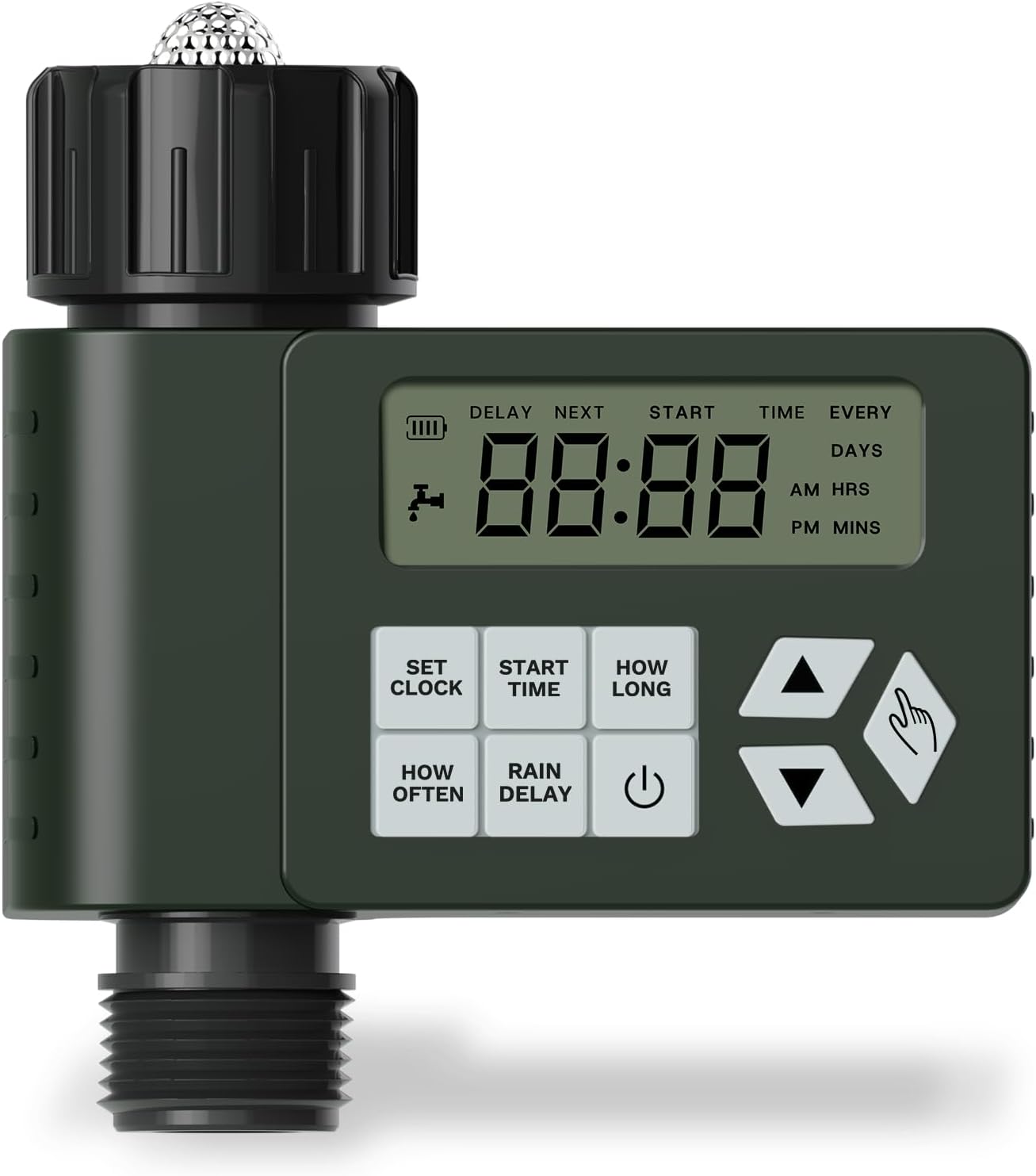
| Water pressure range | 7–120 PSI recommended, withstands up to 150 PSI |
|---|---|
| Power | 3×AAA batteries (not included) |
| IP rating | IP67 waterproof |
| Run time range | 1–300 minutes |
The Ortis programmable hose timer automates garden and lawn watering with easy-to-read controls and three operating modes: Automatic for scheduled irrigation, Manual for one-off tasks like washing a car, and Rain Delay to pause watering. Setup is straightforward on the full-view LCD and large buttons, and run times are adjustable from 1 to 300 minutes with repeat options from every 6 or 12 hours up to once every 7 days. The unit is built for all-season use with an IP67 rating, a sealed battery compartment, and a stainless steel valve core bracket designed to resist deformation and handle high pressure. Practical extras include a built-in stainless steel filter to reduce clogging and compatibility with standard 3/4-inch hoses. Expect reliable basic automation on a budget, though the interface and scheduling options are simpler than higher-end smart controllers and it requires three AAA batteries. For straightforward timed watering without smart-home integration, this is a solid economical choice.
Best for: Buyers who want an affordable, no-frills digital timer to automate routine garden or lawn watering without needing smart-home features or advanced programming.
Less Ideal for: Gardeners who need app control, remote scheduling, or zone-based multi-valve irrigation should consider a Wi-Fi-enabled or multi-zone controller instead.
- Simple three-mode operation for automatic, manual, and rain-delay control
- IP67 waterproofing and sealed battery compartment for outdoor durability
- Stainless steel valve core bracket and filter reduce leaks and clogging
- Adjustable run time (1–300 minutes) and flexible frequency options
- No smart-home or app connectivity for remote control
- Requires manual battery replacement and uses AAA cells
Verdict: A durable, budget-friendly digital timer that delivers straightforward automatic watering with dependable weatherproofing.
RAINPOINT 2-Zone WiFi Garden Water Timer with Brass Inlet & Outlet

| Number of settings | 3 |
|---|---|
| Material Type | Brass Inlet & Outlet |
| Item Highlight | Long-Range WiFi Gateway, Smart Weather-Based Watering, Water Usage Tracking |
| Number of Items | 1 |
The RAINPOINT 2-zone WiFi water timer is a reliable smart hose timer built for routine garden and greenhouse watering. It connects to a long-range HWG023 gateway so you can place the hub near your router while the timer sits at the back of the yard, and the unit controls two independent zones from the mobile app. Notable features include solid brass inlet and outlet fittings that resist leaks under household water pressure, an IP65-protected battery compartment for outdoor durability, and a built-in flow meter that records water use for 30 days and up to 12 months of history. Weather-based watering and seasonal adjustment simplify schedules for travel or changing seasons, while three watering modes including cycle-and-soak and misting let you tailor irrigation for lawns, clay soils, seedlings, or greenhouse humidity. Expect straightforward everyday use and meaningful water savings, though setup requires the gateway for long-range WiFi and the unit depends on battery power and the app for advanced scheduling.
Best for: Gardeners who prioritize dependable, low-maintenance automatic watering and want durable plumbing connections plus actionable water-use data to avoid surprises.
Less Ideal for: People who need a completely wired, mains-powered controller or those who prefer a single simple mechanical timer without app-based scheduling.
- Brass inlet and outlet reduce risk of leaks and handle typical household pressure
- Long-range gateway supports placement far from the router for reliable connectivity
- Built-in flow meter logs water usage for 30 days and up to 12 months for tracking
- Weather-based scheduling and seasonal adjustment automate watering around forecasts
- Two independent zones and three watering modes offer flexible irrigation control
- Requires the separate HWG023 gateway for maximum long-range connectivity
- Runs on batteries so regular battery changes are necessary for uninterrupted operation
Verdict: Choose this timer when you want a durable, app-controlled two-zone system that reliably automates watering and tracks water use for better long-term management.
Orbit Programmable Digital Hose Watering Timer (1-Outlet)

| Power Source | 2 AA batteries (not included) |
|---|---|
| Watering Duration | 1-240 minutes |
| Watering Frequency | Every 6 hours to once every 7 days |
| Rain Delay | 24, 48, or 72 hours |
The Orbit programmable digital hose timer converts a standard outdoor faucet into a simple, dependable automated watering station. You program start times, watering duration (1 to 240 minutes) and frequency (every 6 hours up to once every 7 days) on the oversized LCD and single dial, then let it run the schedule. Useful features include a manual water button for instant watering without reprogramming and a 24/48/72-hour rain delay to pause cycles after rainfall. The unit is water-resistant for outdoor use and runs on two AA batteries, making placement flexible where no power is available. Practical benefits are consistent, repeatable watering for lawns, beds, and containers and measurable water savings by avoiding overwatering. The main limitations are that it is a basic non-networked timer with only one outlet and no remote or app control, so managing multiple zones requires additional units and on-site programming for changes.
Best for: Buyers who prioritize a proven, straightforward timer with clear on-device controls and want reliable automated watering without needing smart-home features.
Less Ideal for: Gardeners who want central control of multiple zones or remote app scheduling should consider multi-outlet or smart Wi‑Fi-enabled controllers instead.
- Wide watering duration range (1–240 minutes) for flexible run times
- Clear, oversized LCD and single-dial controls for easy programming
- Built-in rain delay and manual watering button to conserve water and handle exceptions
- Water-resistant construction suitable for outdoor faucet mounting
- Battery power allows installation without external power source
- Single outlet only so multiple watering zones need extra timers or splitters
- No Wi-Fi or app control for remote scheduling or notifications
- Plastic construction may feel less durable than metal alternatives
Verdict: A dependable, easy-to-program single-outlet timer that saves water and removes guesswork when you want reliable on-site automation without smart features.
Orbit Programmable Digital 3-Outlet Hose Watering Timer with LCD and Rain Delay

| Power type | Battery powered |
|---|---|
| Outlets | 3 |
| Display | LCD screen |
| Feature | Built-in rain delay |
The Orbit Programmable Digital 3-Outlet Hose Watering Timer converts a single faucet into a small automatic irrigation station so you can schedule watering without manual attention. You attach it to an outdoor spigot and connect up to three hoses or splitters to run drip lines, soaker hoses, or small sprinklers on independent schedules. The clear LCD and straightforward controls make programming start times and run durations quick, and the built-in rain delay pauses cycles during wet weather to avoid overwatering. Battery power and a water-resistant housing mean it keeps working outdoors without a wired connection. Practical benefits include consistent, repeatable watering that saves time and helps maintain plant health while reducing waste. Limitations are that it runs on batteries so you will need to replace them periodically and it is designed for residential setups rather than large irrigation systems, so it is best for yards, garden beds, and container gardens rather than acreage.
Best for: A homeowner who wants a reliable, low-effort way to automate watering for lawns, garden beds, and container plants and values predictable, easy-to-use controls and weather-aware pauses.
Less Ideal for: People managing large properties or complex multi-zone irrigation who need flow metering, central controller integration, or wired power should consider more advanced systems.
- Three independent outlets let you run separate lines or zones from one faucet
- Simple LCD interface and programming make schedule setup fast and clear
- Water-resistant housing and built-in rain delay improve outdoor reliability
- Battery powered so no electrical hookup is required for installation
- Requires periodic battery replacement which can interrupt operation if not monitored
- Not suitable as a replacement for a full underground or professional irrigation system
Verdict: A dependable, easy-to-program three-outlet timer that automates small garden and container watering with weather-aware controls.
Choosing the Right Digital Garden Watering Timer: Key Factors to Consider
Programming Flexibility and Schedule Types
How granular the schedule can be matters because different plants and situations need very different routines. A model that offers multiple start times per day, adjustable run durations from minutes to hours, and options for odd/even day or interval scheduling will cover most garden needs. Flexibility lets you water early-morning cycles for containers, longer deep-soak runs for established beds, or short repeat cycles for newly seeded areas.
Greater programming options also reduce workarounds. If a timer supports seasonal changes or temporary bypass modes, you can adapt without reprogramming daily. For gardeners using drip lines or micro-sprays, the ability to set short run times with fine resolution prevents overwatering while still delivering uniform coverage.
Weather Resistance and Housing Durability
Timers live outdoors and face sun, rain, freezing nights, and heat. Durable housing rated for outdoor use and good UV resistance prevents cracking and premature failure. A water-resistant or waterproof enclosure keeps electronics safe during heavy rain and when mounted near sprinkler heads or on hose bibs.
Materials and build quality also affect long-term reliability. Robust housings and protected switches reduce the risk of water ingress around buttons or battery covers. Consider whether the unit can be mounted under a small shelter or needs to be taken in during winter; more weatherproof models reduce seasonal maintenance.
Connection Type and Leak Prevention
How a timer connects to the hose or irrigation line determines ease of installation and potential leak points. Look for standard thread fittings that match common hose bibs and integrated rubber seals or O-rings at all connection points. A secure male or female threaded inlet and outlet with tight seals limits drip and pressure loss.
Some designs include reinforced connectors or quick-coupler compatibility for faster setup. Avoid timers with brittle plastic fittings if your hose setup is frequently moved or bumped. Proper connection quality directly affects water waste and the need for repeated tightening or tape.
Power Source and Battery Life
Most digital garden timers run on batteries, though a few accept external power. Battery life influences maintenance and reliability; long-life batteries or low-power electronics reduce how often you replace cells. Consider units with clear battery indicators and easy access to the battery compartment without breaking seals.
If your garden has variable temperatures, battery performance can dip in cold weather, so models with better cold-weather tolerance or the option for a mains adapter may be preferable. Think about whether you want rechargeable options or standard replaceable cells and whether the timer keeps programming when batteries are changed.
Ease of Installation and User Interface
A straightforward physical layout and intuitive buttons make day-to-day adjustments painless, especially for gardeners who want quick seasonal tweaks. Clear displays, logical menus, and labeled controls speed setup and reduce programming mistakes. Some units include simple pre-set modes for common intervals which are useful when you do not need fine-grain control.
Physical installation should not require tools beyond a wrench for hose fittings. Wall or bib mounting options, included adapters, and clear instructions simplify placement. Consider how easy it is to access controls when the device is mounted on a wall or faucet.
Matching a Timer to Your Garden Layout
Small container gardens, raised beds, and larger lawns have different watering dynamics. Containers dry out faster and often need shorter, more frequent cycles, while larger beds and lawns benefit from longer, less frequent soakings. Choose a timer that supports the run lengths and multiple start times your layout requires.
If you run separate zones with dedicated valves or manual splitters, prioritize a timer that is easy to move between hose bibs or that offers multiple outlets. For fixed irrigation systems, make sure the timer has compatible inlet and outlet threads and can handle the system pressure.
- Containers: short run times, multiple starts per day
- Raised beds: longer soak cycles, fewer daily starts
- Multiple zones: portability or multiple outputs
Protecting Timers Through Seasons
Even weather-resistant timers benefit from basic seasonal care. In climates with freezing winters, draining the timer and storing it indoors prevents ice expansion damage. In hot, sunny regions, mounting the unit in a shaded spot or under a small overhang extends life by reducing UV exposure and heat stress.
Regularly inspect seals and connections after storms and replace worn O-rings to prevent slow leaks. A small maintenance routine at season changes keeps the unit reliable and reduces the chance of unexpected failures during peak watering periods.
- Drain and store before freezing conditions
- Shade from direct midday sun when possible
- Check seals annually and replace if brittle
Integrating Timers with Drip and Micro-irrigation
Digital garden timers work well with drip systems if the run durations and start times match the emitters' flow rates. Because drip lines often require short, repeated cycles to wet root zones without runoff, pick a timer capable of short minimum run times and frequent starts.
If your layout includes pressure-compensating emitters, ensure the timer can handle the system pressure and does not introduce pressure spikes at valve activation. For complex systems, using a master valve or pressure regulator alongside the timer improves long-term performance.
- Confirm minimum run time suits drip emitter needs
- Manage system pressure with regulators if needed
- Use repeat short cycles for established root zones
Common Troubleshooting Tips
If the timer does not start at scheduled times, check battery charge first and verify AM/PM settings or day selections. Many apparent failures are simple programming errors or drained batteries rather than mechanical faults.
For intermittent leaks, test fittings with a soapy water solution to find slow drips and replace O-rings or tighten connectors as needed. When a timer loses settings after a battery change, look for a backup memory spec or a small internal capacitor that preserves programming while swapping cells.
- Verify battery charge and correct AM/PM programming
- Test fittings with soapy water to locate leaks
- Check for memory retention before changing batteries
How We Chose the Best Digital Garden Watering Timer
We prioritized real-world reliability and features that matter in home-garden setups. Key evaluation criteria included programming flexibility to suit different plant schedules, waterproofing and housing durability for exposure to sun and rain, battery life and power options for uninterrupted operation, and hose connection integrity to avoid leaks. Installation ease and compatibility with common hose and irrigation fittings were assessed to ensure most gardeners can set a unit up without specialty tools. We also considered runtime accuracy and minimum/maximum program durations to support everything from daily micro-watering for new seedlings to longer soak cycles for established beds. Units were excluded if they lacked clear programming options, used proprietary fittings incompatible with standard hoses, or offered only mechanical timers without digital controls. We avoided devices that required complex external controllers or separate smart-home hubs, focusing on stand-alone digital garden units intended for direct hose or irrigation-line use. The result is a list of durable, user-friendly digital garden watering timers that cover a range of garden sizes and watering strategies.
FAQ
Can a digital garden watering timer handle drip irrigation?
Often yes. Most digital timers can control drip systems as long as they support short run times and the system pressure is compatible. Confirm minimum run-duration settings and check that the fittings match your drip line or valve connections.
How do I protect a timer from winter freeze?
In freezing climates, drain the timer, disconnect it from the hose bib, and store it indoors. If you must leave it in place, mount it above potential water traps and insulate the faucet and nearby piping to reduce freeze risk.
What battery type lasts longest in outdoor timers?
Alkaline batteries are common and offer long life for low-drain units. Lithium cells perform better in cold temperatures and last longer overall but check manufacturer guidance for compatibility. Look for clear battery-level indicators to plan replacements.
Will a digital timer keep programming during battery changes?
That depends on the model. Some timers retain settings in internal memory or capacitors, while others require reprogramming after battery removal. Check for explicit memory-retention features if uninterrupted settings are important.
Are weatherproof ratings important for garden timers?
Yes. A water-resistant or waterproof housing improves longevity, especially in exposed installations. Ratings and good sealing around buttons and battery covers reduce the risk of corrosion and electrical failure after heavy rain.
Final Verdict
Choose a digital garden watering timer that matches how you water and the conditions in your garden. Prioritize programming flexibility if you run mixed plant types, and select robust housing and secure fittings if the unit will remain outdoors year-round. Consider battery life and memory retention if you want low maintenance. Balancing scheduling features, leak resistance, and weather durability will get you a dependable timer that saves time and water. With those priorities in mind, pick the model that fits your layout and maintenance preferences for consistent performance.
