

Note: This article contains affiliate links. If you click on these links and make a purchase, I may earn a small commission at no extra cost to you. This helps support my research and content. Read my full affiliate disclosure here.
Carpenter ants behave differently from pavement or sugar-feeding species, so the products you use need to reach the colony, not just repel foragers. If you are dealing with wood-nesting workers inside walls, window frames, or deck timbers, the right control approach can prevent structural damage and stop recurring trails. This guide covers seven top ant killer options suited for carpenter ants. We shortlisted products that offer different modes of action and application styles and evaluated them on bait attraction, residual control, and safety considerations for homes and gardens. Read on to understand which product type fits your infestation and application preferences before the product list.
Top Picks at a Glance
| Best Overall The best all-around choice for most situations | Advance 375A Select Granular Ant Bait, 8 oz |  |
| Best Quality Built to a higher standard if you want something more solid | Syngenta Advion Ant Gel Lure, 30 g |  |
| Best Value The sweet spot between price and what you get | BioAdvanced Carpenter Ant & Termite Killer Plus Concentrate, 40 oz |  |
| Best Budget The cheapest option that still gets the job done reliably | TERRO Carpenter Ant & Termite Killer Spray, Ready-to-Use 32 oz |  |
| Highest Rated A top-rated pick with lots of positive feedback | Bonide 15 oz. Termite & Carpenter Ant Spray |  |
| Most Popular A crowd favorite that many people choose with confidence | Syngenta Advion Ant Gel (4 tubes, 30 g each) |  |
| Best Seller A high-volume bestseller chosen again and again | Spectracide Terminate Termite & Carpenter Ant Killer with AccuShot Sprayer, 1.33 Gal |  |
Advance 375A Select Granular Ant Bait, 8 oz

| Unit Count | 8 Ounce |
|---|---|
| Item Form | Granules |
| Target Species | Ants |
| Active Ingredients | Abamectin 0.011% |
Advance 375A Select is an 8 ounce granular ant bait formulated with 0.011% abamectin that targets entire ant colonies by relying on foragers to carry bait back to the nest. You apply it in small amounts around mounds, along trails, at structure perimeters, or inside bait stations when treating carpenter and other household ants. The granule mix includes multiple grit sizes so a variety of species will pick it up, and the active ingredient has a delayed effect that promotes food sharing before ants die. Practical benefits include flexible placement options for perimeter, mound, or broadcast treatments and suitability for both indoor use in protected areas and outdoor site perimeter work. Important limitations are that it is a toxic pesticide that must be used exactly per label directions and it poses hazards to fish, wildlife, pets, and people if misused, and granular bait can be less precise than contained station baits in high-traffic areas. For balanced, routine ant control around structures this product is a useful tool but it should be part of an integrated approach and handled with care.
Best for: Homeowners and property managers seeking a practical, flexible bait that targets colonies rather than just individual workers and who want a product they can apply around structures or in bait stations.
Less Ideal for: People who need a non-chemical or pet-safe ant control method or those who prefer pre-baited containment stations for precise indoor placement.
- Designed to eliminate colonies by using delayed-action abamectin that allows bait transfer
- Granule blend with multiple grit sizes improves uptake by different ant species
- Versatile application: usable in stations, around perimeters, as mound or broadcast treatment
- Formulation suitable for indoor and outdoor placement when label directions are followed
- Contains a toxic active ingredient and requires careful handling to avoid harm to people, pets, and wildlife
- Granular form can be less targeted than contained bait stations in busy or exposed areas
Verdict: A flexible granular bait that uses delayed-action abamectin to eliminate entire ant colonies, making it a solid choice for balanced, routine carpenter ant control around structures.
Syngenta Advion Ant Gel Lure, 30 g
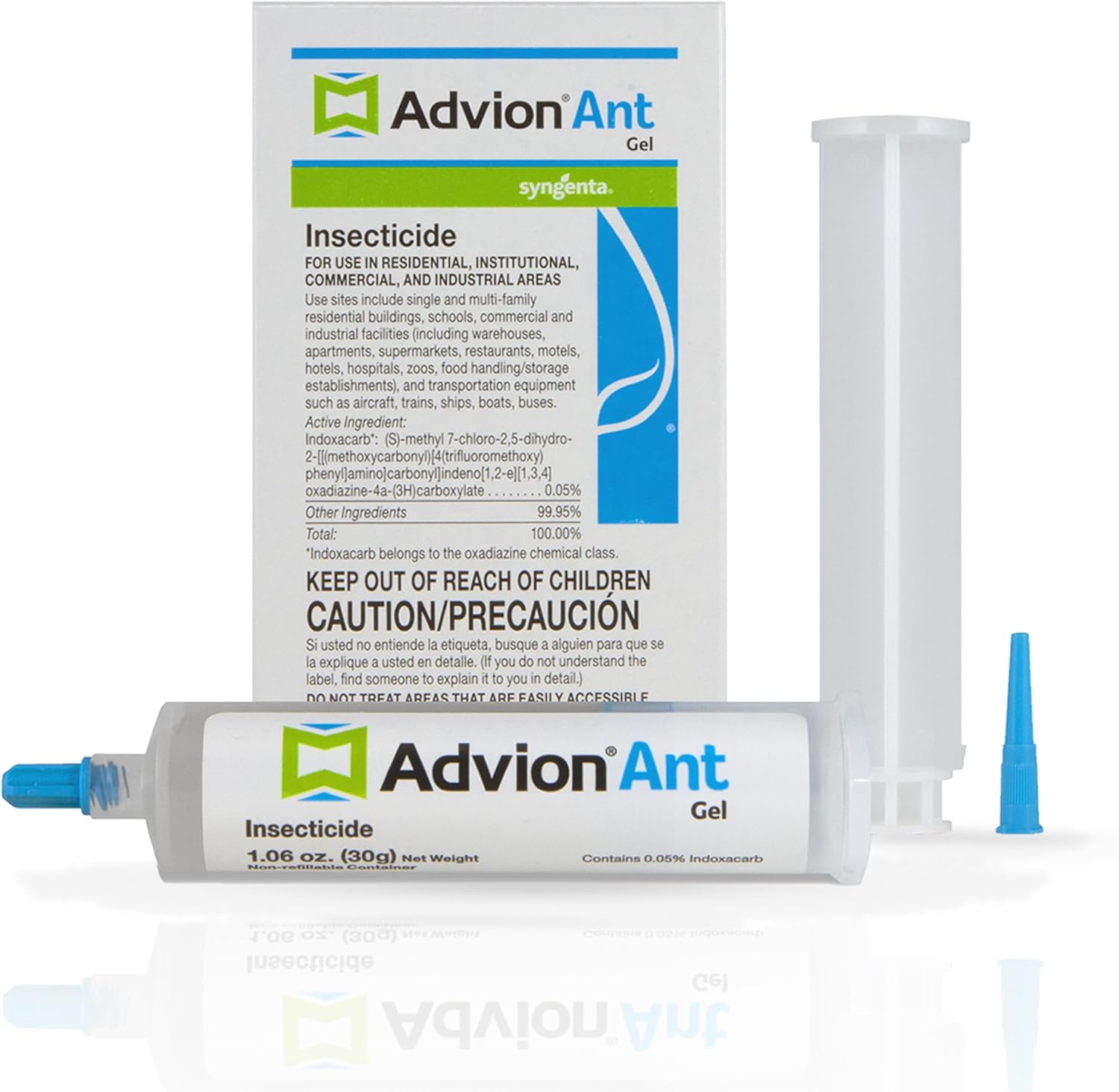
| Item Form | Gel |
|---|---|
| Target Species | Insects |
| Active Ingredients | Indoxacarb |
| Item Weight | 1.1 ounces |
Advion Ant Gel is a concentrated ant bait in a translucent, no-odor gel that relies on indoxacarb to kill foraging ants and transfer the active ingredient through the colony. You apply small beads or lines in ant runways, near nests, or at entry points; the highly palatable, homogenous formulation encourages prolonged feeding so worker ants carry lethal doses back to brood and queens. The gel’s stable, non-staining texture holds up outdoors and indoors longer than many liquid or granular baits, reducing the need for frequent reapplication. Because indoxacarb is a distinct chemistry, it remains effective where some common active ingredients have failed. Important limitations are that this is a bait product rather than a contact spray, so control depends on ants accepting and feeding on it, and very dry or heavily contaminated sites can reduce uptake. As with all insecticides, keep out of reach of children and follow label directions for safe placement around pets and sensitive areas.
Best for: People seeking a high-performance bait to eliminate persistent ant infestations and willing to follow a baiting program for colony elimination.
Less Ideal for: Those who need immediate knockdown or who cannot place baits safely around children or pets should consider alternative contact treatments or exclusion methods.
- Highly attractive gel formulation that encourages extended feeding and brood transfer
- Contains indoxacarb, a unique active ingredient effective against resistant colonies
- Translucent, low-odor, non-staining formula suitable for indoor use
- Stable gel consistency holds up longer than many liquid baits, reducing reapplications
- Effectiveness depends on ants accepting the bait so results vary with species and site conditions
- Not an instant contact killer so colonies may take days to collapse
Verdict: Choose this gel if you want a professional-grade bait that encourages sustained feeding and colony elimination using a unique active ingredient.
BioAdvanced Carpenter Ant & Termite Killer Plus Concentrate, 40 oz

| Item Form | Concentrate |
|---|---|
| Unit Count | 40 Fluid Ounces |
| Active Ingredients | B-Cyfluthrin (2.5%) |
| Specification Met | EPA |
| Target Species | Insects |
This 40 oz BioAdvanced concentrate is formulated to control carpenter ants, termites and a wide range of other crawling and flying pests when mixed and applied as an outdoor perimeter treatment. You dilute the concentrate in a pump sprayer and treat foundations, decks, wood piles, patios and landscaped areas to create a residual barrier that the manufacturer says lasts up to three months. The active ingredient, beta-cyfluthrin 2.5%, provides fast knockdown on contact and is labeled for many wood‑infesting insects as well as common yard pests. Practical features include a pump‑style sprayer compatibility and an adjustable nozzle for even coverage. Because it is a concentrate for outdoor use only, it lets you treat larger areas more economically than ready-to-use bottles, but it requires careful mixing and safe handling. Expect effective perimeter protection when applied according to the label, and plan to limit use to exterior surfaces and follow safety instructions to avoid non-target exposure.
Best for: Buyers who want a cost-effective, professional-style perimeter treatment to control carpenter ants and other yard pests and who are comfortable mixing and applying a concentrated insecticide safely.
Less Ideal for: People who prefer simple ready-to-use cans for spot indoor treatments or those unwilling to follow concentrate mixing and protective handling instructions should consider an alternative.
- Concentrated formula treats larger areas more economically than ready-to-use products
- Kills carpenter ants, termites and over 75 listed pests on contact
- Provides up to three months of perimeter residual protection
- Adjustable nozzle when used with a pump sprayer allows even coverage
- Concentrate is labeled for outdoor use only, so it cannot be used indoors
- Requires mixing and stricter safety precautions compared with ready-to-use sprays
Verdict: If you need an economical, long‑lasting outdoor perimeter treatment to stop carpenter ants and other wood‑infesting pests, this concentrated BioAdvanced formula delivers professional‑grade control when applied correctly.
TERRO Carpenter Ant & Termite Killer Spray, Ready-to-Use 32 oz

| Liquid Volume | 32 fluid ounces |
|---|---|
| Item Form | Spray |
| Target Species | Ant |
| Active Ingredients | Deltamethrin 00.02% |
This TERRO spray is a simple, budget-friendly option for treating carpenter ants and termites around the home. It comes ready to use in a 32 oz spray bottle so you can apply it directly to ant trails, hills, cracks and crevices, damaged wood, foundations, attics and crawl spaces without mixing. The formula kills on contact and the manufacturer states residual control for up to four months, which helps reduce repeat treatments when applied to entry points and hiding places. Because it targets a range of wood-boring pests it can replace multiple specialty products for general wood pest control. Limitations to expect are standard for OTC sprays: it treats localized infestations and visible entry points but is not a full-structure soil barrier or substitution for a professional termite fumigation in severe infestations. Also you must follow label instructions for indoor use and avoid spraying finished surfaces where people or pets may contact the wet product.
Best for: Homeowners who need an affordable, easy-to-apply product for spot-treating carpenter ants or early termite activity and prefer a do-it-yourself approach to pest control.
Less Ideal for: Property owners facing large, established termite colonies or those who want a long-term soil barrier treatment should consult a professional or consider specialized commercial solutions.
- Ready-to-use 32 oz spray for immediate application without mixing
- Kills carpenter ants, termites and other wood-boring insects on contact
- Claims up to four months of residual control when applied to cracks, crevices and entry points
- Versatile for indoor and outdoor targeted treatments such as foundations, crawl spaces and decks
- Not a full-structure soil treatment or replacement for professional termite eradication in heavy infestations
- Requires careful application indoors to avoid contact with people, pets, or finished surfaces
Verdict: A low-cost, ready-to-use spray that delivers quick contact kill and months of residual control for spot-treating carpenter ants and wood-boring pests.
Bonide 15 oz. Termite & Carpenter Ant Spray

| Unit Count | 1 Count |
|---|---|
| Included Components | 15 oz. Termite & Carpenter Ant Spray |
| Item Form | Spray |
| Target Species | Insects |
This Bonide 15 oz. spray is a ready‑to‑use aerosol designed for spot treatment of wood‑infesting insects such as carpenter ants and termites. It delivers fast knockdown on contact and leaves a residual killing effect for about two to four weeks, which helps protect treated areas after application. The can includes a spray tube attachment for injecting into holes, nests, cracks, and crevices so you can target colonies in wood or voids rather than broadcasting product across a large area. The active ingredient is described as Tetraperm, which provides the longer lasting action compared with simple contact sprays. Practical benefits include convenience for small infestations, targeted delivery to nests, and a compact can that is easy to store. Limitations are the small 15 oz. capacity for larger or repeated treatments and a limited residual duration relative to professional barrier treatments, so repeat applications or professional follow up may be needed for heavy infestations.
Best for: Buyers who prioritize a dependable, easy‑to‑use product for treating visible carpenter ant nests and localized wood infestations and want a targeted solution they can apply themselves.
Less Ideal for: Homeowners facing large or widespread infestations, those who need long‑term soil barrier protection, or people preferring non‑aerosol professional treatments should consider other options.
- Targets wood‑infesting insects including carpenter ants and termites
- Includes straw/spray tube for injecting into holes, nests, cracks and crevices
- Provides on‑contact knockdown plus 2–4 weeks of residual control
- Ready‑to‑use aerosol for easy spot treatments
- Small 15 oz. can may require multiple cans or repeat applications for larger infestations
- Residual protection is limited compared with professional soil barrier treatments
Verdict: A compact, targeted spray that reliably knocks down carpenter ants and treats nests for several weeks, making it a practical choice for dependable spot control.
Syngenta Advion Ant Gel (4 tubes, 30 g each)

| Item Form | Gel |
|---|---|
| Target Species | Insects |
| Active Ingredients | 0.05% indoxacarb |
| Included Components | 4 tubes x 30 g, 1 plunger, 2 tips |
Advion Ant Gel is a gel bait packaged with plungers and application tips for targeted placement along ant trails, in cracks, and in crevices. It uses 0.05% indoxacarb in a highly attractive bait matrix that encourages worker ants to feed and share the bait with nestmates, which helps collapse the colony rather than only killing visible workers. Typical use is small spots or short lines near activity indoors or outdoors around foundations, beneath appliances, and in crawl spaces. The non-repellent formulation and user-friendly dispenser make it easy to apply discreetly where carpenter ants forage, and the product is labeled for multiple common ant species. Limitations are that bait success depends on ants accepting the formula and finding the spots you place, so heavily infested or food-rich environments may require complementary sanitation or professional follow-up. Also safety precautions are needed to keep the gel out of reach of children and pets.
Best for: Homeowners who want a discreet, proven bait product to target foraging carpenter ants and prefer a product with a strong track record and clear usage guidance.
Less Ideal for: People needing an immediate broadcast spray or fast knockdown of every visible ant should consider contact insecticides or professional services instead.
- Non-repellent indoxacarb formula encourages ants to carry bait back to the nest for colony-level control
- Includes plunger and tips for precise application in cracks, crevices, and along trails
- Odorless gel that can be applied indoors and outdoors without noticeable smell
- Specifically formulated bait matrix that targets multiple common ant species including carpenter ants
- Effectiveness depends on ants preferring the bait over available food sources
- May require repeated application or complementary measures for very large or established colonies
Verdict: Use Advion Ant Gel when you want a discreet, non-repellent bait that encourages worker ants to carry poison back to the nest for colony control.
Spectracide Terminate Termite & Carpenter Ant Killer with AccuShot Sprayer, 1.33 Gal

| Unit Count | 166.4 Fluid Ounces |
|---|---|
| Item Form | Spray |
| Target Species | Insects |
| Active Ingredients | Lambda-Cyhalothrin |
| Specification Met | EPA |
Spectracide Terminate is a large ready-to-use spray designed to create an indoor and outdoor barrier against termites, carpenter ants and a range of other insects. It includes a battery-powered AccuShot sprayer with an extendable wand and continuous-action trigger so you can reach baseboards, cracks, crevices and around foundations with less hand fatigue. The formula is clear and non-staining and is described as killing on contact while providing up to nine months of indoor control against carpenter ants. In practice this makes it useful for targeted spot treatments and for perimeter treatments around porches, wood piles, fences and decks. Important limitations: it is not a substitute for professional termite remediation for active infestations and uses a synthetic active ingredient that requires careful handling around people, pets and desirable plants. Follow label directions for priming, application and safety to get reliable results and minimize exposure.
Best for: Homeowners who want an easy-to-use, do-it-yourself perimeter and spot treatment to reduce carpenter ant activity and other common household pests without professional equipment.
Less Ideal for: Property owners facing confirmed active termite colonies or large structural infestations should consult a pest control professional rather than relying on this product alone.
- Ready-to-use barrier spray that treats both indoor and outdoor problem areas
- AccuShot battery-powered sprayer with extendable wand reduces hand fatigue and improves reach
- Clear, non-staining formula with adjustable nozzle for spray or stream
- Claims up to nine months of indoor control against carpenter ants
- Not intended as sole treatment for active termite colonies or severe infestations
- Contains a synthetic insecticide that requires strict adherence to safety directions
Verdict: A convenient, ready-to-use spray with a powered extendable wand that makes DIY perimeter and spot treatments for carpenter ants quick and practical.
Choosing the Right Ant Killer for Carpenter Ants: Key Factors to Consider
Mode of Action and Colony Reach
Different ant killers work in different ways, and that affects whether the colony is eliminated or only foragers are knocked down. Slow-acting baits are formulated so foraging workers feed, return to the nest, and share the bait with larvae, queens, and other workers. That transfer is essential for carpenter ant control because the nest is often hidden in timber voids.
Fast-contact sprays may kill many visible ants quickly but often fail to stop the colony if they do not reach the queen or brood. Non-repellent products allow ants to move freely and pick up the active ingredient, increasing the chance of colony-level effects. When choosing a product, prioritize modes of action designed for colony elimination rather than immediate knockdown alone.
Bait Formulation and Attractiveness
Carpenter ants have diverse feeding preferences depending on season and colony needs, so bait palatability matters. Sugary, protein, or grease-based matrices will appeal differently through the year. A bait that matches the colony's current dietary preference will see higher uptake and better transfer back to the nest.
Look for products with proven attractants or that allow you to offer alternative matrices if initial uptake is low. Placement also matters: baits should be installed along trails and near entry points or over suspected nest locations for maximum worker contact.
Residual Performance on Common Surfaces
For perimeter or crack-and-crevice treatments, residual longevity determines how long a product continues to protect timbers and entry points. Some formulations adhere well to rough wood and masonry, while others break down quickly in sunlight or on damp surfaces.
Consider where the product will be applied and choose a formulation with documented persistence for that environment. For indoor void treatments, label allowances and product behavior in low-ventilation, warm spaces are important because heat and humidity can speed degradation or change bait palatability.
Placement Options and Application Ease
Carpenter ant infestations often require targeted application into cracks, wall voids, and around foundation perimeters. Products that are easy to place in bait stations, inject into voids, or apply as narrow-band treatments reduce the chance of wasted material and increase worker contact.
Evaluate whether you need liquid injectors, granular baits that can be placed along foundations, or ready-to-use stations for indoor use. Ease of use matters if you plan to monitor and refill baits, or if access to nesting sites is limited.
Safety and Label Restrictions
Because carpenter ants nest in structures and near vegetation, safety guidance and label restrictions are crucial. Products will vary on whether they can be used inside wall voids, near food preparation areas, or within reach of pets and children. Some formulations require stationing inside tamper-resistant containers.
Always match the product's label directions to the intended application zone. Consider seasonal timing as well, since treatments applied during high-foraging periods can increase non-target exposure. Choose products with clear instructions for disposal, reapplication intervals, and protective gear recommendations.
Monitoring and Follow-Up Requirements
Successful control of carpenter ants rarely finishes with a single treatment. Monitoring worker activity, adjusting bait placement, and re-treating residual zones are common steps. Some baits require multiple refills to ensure the queen and brood are exposed over time.
Plan for follow-up inspections and choose products that support monitoring, such as visible feeding platforms or stations that allow you to record uptake. Products that block trails temporarily without colony elimination will require more intensive follow-up, so budget time for continued observation and repeat applications if needed.
When To Use Baits Versus Residual Treatments
Baits are the preferred first step when you can observe ant trails or feeding activity because workers will carry poison back into the nest. Use baits where foragers are active and place them along trails, near entry points, and around likely nest locations. Baits are especially useful for indoor infestations since they minimize chemical exposure to living spaces.
- Use baits when worker activity is visible and consistent.
- Switch to residual treatments for perimeter protection or when nest access is unknown.
- Combine baits with targeted residuals around structural openings for best results.
Locating Carpenter Ant Nest Sites
Finding the nest fast-tracks control. Listen for rustling in wall voids, inspect damp or damaged timber, and follow worker trails at dusk when activity often peaks. Look for sawdust like frass near wood seams or window frames as a sign of active excavation.
If you cannot find the nest, concentrate baits around likely entry points and set monitoring stations along interior trails. Persistent bait uptake in those stations usually leads workers back to the nest.
- Check damp wood, rooflines, and foundation-to-wood junctions.
- Inspect attics, crawlspaces, and deck undersides where moisture damage occurs.
- Follow worker trails from outdoors into the structure at night.
Protecting Treated Areas and Non-targets
Place baits inside tamper-resistant stations when children or pets are present, and avoid broadcasting granular or liquid products where non-target animals can access them. For outdoor perimeter treatments, keep product off flowering plants to reduce exposure to pollinators and beneficial insects.
When applying residuals near structural wood, avoid direct wood staining or overapplication. Follow label drying times before allowing occupant access to treated zones. Reposition monitoring stations if pets investigate them.
- Use tamper-resistant bait stations indoors and in high-traffic yards.
- Avoid treating blooming plants and exposed soil used by native insects.
- Follow label directions on reentry intervals and personal protective equipment.
Seasonal Timing and Foraging Behavior
Carpenter ant dietary needs change through the year. In spring and early summer colonies often seek protein for brood rearing, while later in the season foragers search for carbohydrates. Matching bait type to these seasonal preferences improves uptake and transfer.
Treatment timing also affects activity levels. Late spring and early summer are often best for baiting since colonies are actively foraging and expanding. In colder months, ants forage less and bait uptake can drop, making residual or mechanical controls more relevant.
- Offer protein-based baits during brood-rearing months.
- Switch to sugar-based baits when ants seek carbohydrates.
- Plan treatments for periods of active foraging when possible.
Integrating Nonchemical Controls
Fix entry points and remove moisture sources to make your structure less hospitable to carpenter ants. Replace or repair rotten wood, reduce wood-to-soil contact, and trim vegetation away from siding to reduce hidden bridge points into structures.
Use physical exclusion and habitat modification alongside chemical controls to reduce reinfestation risk. Nonchemical measures reduce the number of workers that need to be controlled and can make baiting and residuals more effective long term.
- Repair damaged or damp wood and improve drainage.
- Store firewood away from structures and off the ground.
- Trim shrubs and tree limbs that provide access to roofs and siding.
How We Chose the Best Ant Killer for Carpenter Ants
We focused on attributes that matter for controlling wood-nesting carpenter ants rather than general garden ant management. Selection began by filtering for product types that can reach colonies: slow-acting baits that worker ants will carry to the nest, residual insecticides suitable for perimeter or structural cracks, and non-repellent formulations that allow ants to visit treated stations. Evaluation emphasized measurable performance criteria: bait attractiveness to worker ants and ability to transfer active ingredients within the colony; residual longevity on typical indoor and outdoor surfaces; application flexibility for cracks, voids, and around foundations; and safety instructions and label allowances for use near structures and vegetation. We excluded products intended only for surface repellency, short-lived contact sprays that do not reach nests, and treatments labeled solely for non-structural pests. Final selections balanced efficacy with practical considerations like ease of placement, compatibility with common bait stations, and clear label directions for use around homes. We also considered how the formulation behaves in humid or heated wall voids since these conditions affect bait uptake and residual performance.
FAQ
How long does it take for bait to eliminate a carpenter ant colony?
It often takes several weeks for slow-acting baits to eliminate a colony because workers must gather and transfer the bait to the queen and brood. Expect to monitor stations and refill as needed for two to six weeks depending on colony size and bait uptake.
Can I use the same bait year-round?
Year-round use is possible but may be less effective at certain times because ants change dietary preferences by season. Switching between protein and sugar-based baits during peak foraging periods can improve results.
Are non-repellent products better than contact sprays?
Non-repellent formulations can be more effective for colony control because ants do not avoid treated areas and can carry active ingredients back to the nest. Contact sprays kill exposed ants quickly but often do not reach the queen or brood.
Is it safe to place baits inside wall voids?
Some baits and formulations are allowed for use inside voids according to label directions. Always read and follow label restrictions before applying products into wall cavities, and observe ventilation and reentry guidelines.
What signs indicate the colony is still active after treatment?
Continued worker trails, fresh frass near timber, and persistent bait consumption indicate activity. A drop in trail counts and no frass after a period of monitoring suggest treatments are working, but keep checking for a few weeks.
Final Verdict
Choosing the right ant killer for carpenter ants depends on whether you can target foragers and reach the nest. Prioritize bait formulations and non-repellent options that promote colony transfer when elimination is the goal, and use residual treatments strategically for perimeter protection or crack-and-crevice work. Balance effectiveness with application practicality and safety around structures, pets, and beneficial insects. With proper placement, monitoring, and follow-up, you can reduce the risk of recurring wood-nesting activity and protect structural timber from further damage.
