

Note: This article contains affiliate links. If you click on these links and make a purchase, I may earn a small commission at no extra cost to you. This helps support my research and content. Read my full affiliate disclosure here.
Carpenter ants behave differently than common sugar ants: they nest in damp or decaying wood and can establish satellite colonies inside structures. Picking the right ant bait for carpenter ants matters because bait formulation, placement, and persistence determine whether you attract foragers back to the nest or just feed stray workers. This guide covers seven shortlisted options that suit indoor and perimeter placements and compares them by attractant type, longevity, and safety for occupied yards. Below we summarize how each bait performs in realistic garden and home scenarios, and we explain the practical criteria we used to narrow the field so you can choose a solution that fits your infestation size and site constraints.
Top Picks at a Glance
| Best Overall The best all-around choice for most situations | USA Supply Advance Granular Carpenter Ant Bait, 8 oz |  |
| Best Quality Built to a higher standard if you want something more solid | Envu Maxforce Fleet Ant Bait Gel (4 × 27 g) |  |
| Best Value The sweet spot between price and what you get | Advion Ant Gel Station Insecticide, Ready-to-Use Gel Bait (3 Stations) |  |
| Best Budget The cheapest option that still gets the job done reliably | Amdro Ant Killer for Outdoor Home Perimeter, 24 Oz |  |
| Highest Rated A top-rated pick with lots of positive feedback | Syngenta Advion Ant Gel Bait, 30 g |  |
| Most Popular A crowd favorite that many people choose with confidence | Syngenta Advion Ant Gel (4 tubes, 30 g each) |  |
| Best Seller A high-volume bestseller chosen again and again | Terro Perimeter Ant Bait Plus Granules, 2-Pack Shaker Canisters |  |
USA Supply Advance Granular Carpenter Ant Bait, 8 oz

| Item Form | Granules |
|---|---|
| Target Species | Ants |
| Included Components | Advance Granular Carpenter Ant Bait, Gloves |
| Specification Met | EPA |
This granular bait is designed to target carpenter ants by meeting their protein needs while delivering abamectin into the colony. You spread the granules around ant trails, entry points, and near nest areas where worker ants collect food and transport it back to the queen. The delayed-action formula helps ants feed and transfer the active ingredient so the product suppresses egg production and reduces the colony over time. It is sold with chemical-resistant gloves and a pest identification card, which helps safe handling and correct deployment. Because it is a bait rather than a spray, it is a good option for sensitive indoor areas and landscapes where non-spray control is preferred. Expect results to take days to weeks as the bait cycles through the colony, and success depends on correct placement and ants accepting the granules as food.
Best for: Homeowners and property managers who want a balanced, non-spray option to reduce carpenter ant colonies and prefer a targeted baiting approach for both indoor and outdoor sites.
Less Ideal for: People who need immediate knockdown of visible ant populations or who cannot monitor and place baits where ants forage should consider fast-acting contact treatments instead.
- Formulated with abamectin to be carried back to the nest for colony-level control
- Labeled for both indoor and outdoor use for flexible application
- Granular form is suitable for sensitive areas where sprays are undesirable
- Includes chemical-resistant gloves and a pest identification card for safer use
- Slower-acting than contact insecticides because it relies on bait uptake and transfer
- Effectiveness depends on ants accepting the granules as a food source
Verdict: Choose this granular bait when you want a pet-safe, targeted method to suppress carpenter ant colonies over time without using sprays.
Envu Maxforce Fleet Ant Bait Gel (4 × 27 g)

| Item Form | Gel |
|---|---|
| Target Species | Ants, Argentine Ants, Carpenter Ants, and Household Ants |
| Active Ingredients | Fipronil |
| Included Components | Four Syringes |
| Specification Met | EPA |
Maxforce Fleet is a thick, syringe-applied ant gel that uses fipronil to kill foraging ants and pass the active ingredient through trophallaxis to the queen and brood. You apply small dots or beads along trails, entry points, or near nests indoors or outdoors where warranted. The gel’s viscosity helps it stay put on vertical surfaces and reduces dripping during placement, while the concentrated fipronil provides fast knockdown of hard-to-control species including carpenter ants. In practice the product shortens the time to colony suppression compared with typical baits, and the included multiple syringes let you treat several hotspots without frequent refills. Important limits are that it is a chemical control and should be used with standard safety precautions around pets and children, and success still depends on correct bait placement and ant foraging activity rather than blanket application. For targeted, performance-focused control of persistent ant problems this gel is a reliable option.
Best for: Buyers who want a fast, high-performance chemical bait to eliminate persistent carpenter and household ant infestations and who will place bait strategically along active trails and entry points.
Less Ideal for: People looking for non-chemical or organic ant control methods or those unwilling to follow safety precautions around insecticide use.
- Contains fipronil, a potent active ingredient effective against carpenter and other tough ant species
- Thick gel formula adheres to vertical surfaces and resists dripping
- Designed for trophallaxis so foragers can transfer the bait to the queen and brood
- Includes four syringe applicators for treating multiple sites without frequent refills
- Contains a professional insecticide that requires careful handling around people and pets
- Effectiveness depends on correct placement where ants are actively foraging
Verdict: Choose this fipronil gel when you need a fast, professional-strength bait that targets and breaks down stubborn carpenter ant colonies through forager-to-nest transfer.
Advion Ant Gel Station Insecticide, Ready-to-Use Gel Bait (3 Stations)

| Brand | Advion |
|---|---|
| Unit Count | 3 Count |
| Item Type Name | Ant Trap |
| Item Form | Gel |
The Advion Ant Gel Station is a small, ready-to-use gel bait delivered inside a simple station for targeted ant control indoors and outdoors. Use involves removing the top tab and squeezing the gel capsule into the station, then placing stations along ant trails or near entry points where foragers are active. The active ingredient indoxacarb is shared among nestmates, which helps reach the queen and brood rather than only killing individual workers. Practical features include a no-mess contained gel capsule and compact station design that is easy to place in tight spots. Because it is a bait, results depend on ants accepting the gel and will be slower if competing food sources are available or if the species prefers other foods. The product is formulated for a wide range of common ant species, but effectiveness can vary by species and heavy infestations may need repeated placement or complementary measures. Overall it is a convenient, low-effort option for homeowners and property managers who want a focused approach to reducing ant colonies.
Best for: Buyers who want a low-effort, targeted bait to reduce ant colonies with minimal setup and who prefer a contained, easy-to-place solution for homes or commercial spaces.
Less Ideal for: People facing massive or structural carpenter ant infestations that require professional inspection and more extensive remediation.
- Ready-to-use stations require no mixing or measuring
- Gel formulation encourages sharing in the colony for broader control
- Contained capsule and station minimize mess and make placement simple
- Labeled for indoor and outdoor use suitable for residential and commercial sites
- Effectiveness depends on ants taking the bait and can be reduced by competing food sources
- Small unit count may require purchasing multiple boxes for larger or persistent infestations
Verdict: A convenient, ready-to-use gel bait station that lets you place effective, no-mess ant baits quickly to target and reduce ant colonies.
Amdro Ant Killer for Outdoor Home Perimeter, 24 Oz

| Item Form | Granules |
|---|---|
| Target Species | Insects |
| Special Features | Ant Killer for Outdoor Home Perimeter |
| Active Ingredients | Hydramethylnon |
This granular ant bait is made to surround a home with a treated band so foraging ants carry the bait back to their colonies. You sprinkle a 12-inch band around foundations, concentrate on visible trails and entry points, or apply directly to individual mounds. The active ingredient hydramethylnon is attractive to many common species and the manufacturer says it can reduce ant activity within a week and protect up to three months. It treats broad perimeter lengths without specialized equipment and is straightforward to apply during cool parts of the day. Important limitations: it is a non-repellant bait so it relies on worker foraging to reach the queen which can be slower on very large or deeply established carpenter ant colonies, and it should not be applied to wet ground or before rain. Follow safety directions for skin and eye contact and avoid use below 50°F. This product is best used as part of a perimeter strategy and can be combined with indoor baits or targeted mound treatments for tougher carpenter ant infestations.
Best for: Homeowners on a budget who want a simple, low-effort outdoor perimeter treatment to reduce ant pressure around foundations and landscaped areas.
Less Ideal for: People facing large, deep carpenter ant colony infestations that need immediate nest elimination or professional structural treatments.
- Easy to apply granular formula for creating a perimeter band around foundations
- Attractive bait that workers carry back to colonies to reach nest members
- Claims residual activity up to three months reducing reapplication frequency
- Covers long linear feet per container so one unit treats a large perimeter
- Not a fast-contact killer for large or well-established carpenter ant nests
- Cannot be used if rain is expected within 24 hours or on wet ground
Verdict: Amdro provides an affordable, easy-to-use outdoor bait that creates a long‑lasting perimeter barrier to cut ant activity around your home.
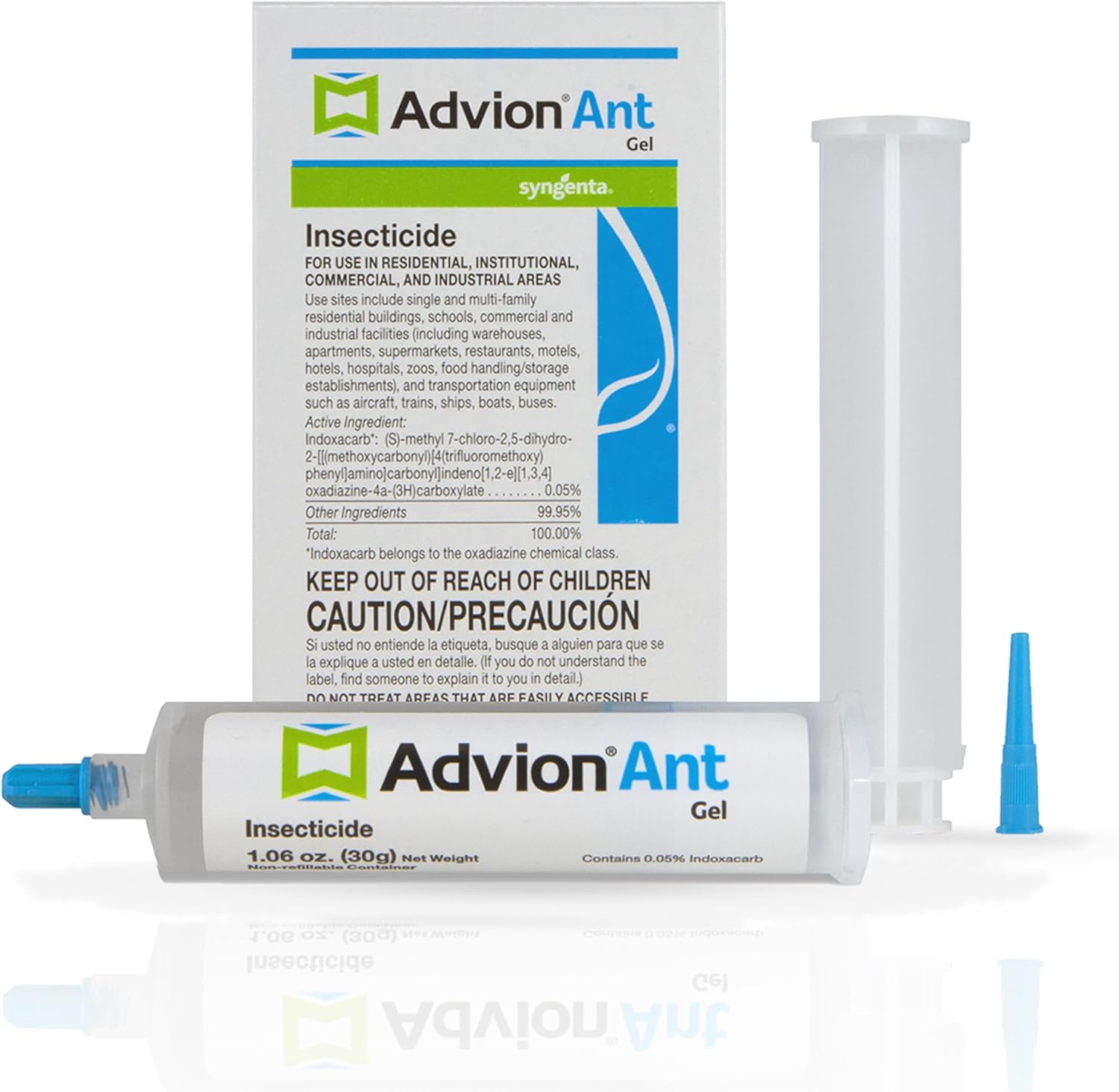
Syngenta Advion Ant Gel Bait, 30 g
| Item Form | Gel |
|---|---|
| Target Species | Insects |
| Active Ingredients | Indoxacarb |
Advion Ant gel is a ready-to-use bait designed to control a wide range of ants by attracting foragers to consume and carry bait back to the colony. You apply small dabs in areas where ants are active, such as along trails, near entry points, or close to nests; the gel is described as translucent, non-staining, and low-odor so it can be used discreetly indoors as well as outdoors. The active ingredient indoxacarb is a distinct chemistry that targets insects and is formulated to remain palatable over time, which helps maintain effectiveness between inspections. For reliable, ongoing control the product’s stable gel means fewer reapplications compared with fast-drying baits. Limitations to note are the small 30 g tube size, which may require multiple tubes for large or heavily infested properties, and that this bait targets sweet-feeding species so it may be less effective against protein-preferring ants or carpenter ants that do not forage on sugary baits.
Best for: Buyers who prioritize dependable, science-backed baiting for typical household ant problems and want a product that stays attractive between visits.
Less Ideal for: People managing large commercial infestations or colonies dominated by protein-feeding species should consider larger-capacity or alternate baits and control methods.
- Formulated with indoxacarb, a distinct active ingredient for effective ant control
- Translucent, low-odor gel that is discreet for indoor use
- Stable, homogenous formula that stays palatable over extended periods
- Labeled for both indoor and outdoor application
- Small 30 g tube may not cover large or heavy infestations
- Primarily attractive to sweet-feeding ants and may be less effective on protein-preferring species
Verdict: Choose this gel when you want a stable, science-based bait that remains attractive over time for dependable control of sweet-feeding ants.
Syngenta Advion Ant Gel (4 tubes, 30 g each)

| Item Form | Gel |
|---|---|
| Target Species | Insects |
| Unit Count | 4.23 Ounce |
| Active Ingredients | 0.05% indoxacarb |
| Included Components | 4 tubes, 1 plunger and 2 tips |
Advion Ant Gel is a bait-style ant control product designed for targeted placement along trails, in cracks, and near nest entrances to control foraging ants and the colonies they represent. The odorless gel uses a non-repellent active ingredient so worker ants consume and carry the bait back to the nest, which helps suppress queens and reduce entire colonies rather than only killing visible workers. The package includes four 30-gram tubes plus a plunger and tips for controlled application in tight spaces. It is suitable for indoor and outdoor use and is formulated to attract sugar-seeking species common in homes. Practical benefits include discreet application, minimal mess compared with sprays, and the ability to treat concealed infestations such as inside wall voids and behind appliances. Important limitations are that effective colony control still depends on correct placement and identifying trails, and it may take days to weeks to see full colony reduction; it is not a one-swipe surface spray for immediate large-scale knockdown.
Best for: For homeowners who want a discreet, evidence-backed bait to control carpenter ants and other common indoor/outdoor species and who prefer a measured application approach supported by strong product reviews and professional use.
Less Ideal for: Not ideal for users who need immediate visible knockdown over large open areas or who prefer broadcast sprays and surface contact insecticides.
- Non-repellent formula encourages ants to feed and share bait with nestmates
- Includes applicator plunger and tips for precise placement in cracks and crevices
- Odorless gel suitable for indoor use and discreet outdoor placement
- Specifically formulated to attract sugar-seeking ant species common in homes
- Requires correct identification of trails and careful placement to be most effective
- Colony elimination can take several days to weeks rather than providing instant kill
Verdict: Choose Advion Ant Gel when you want a professional, non-repellent bait that workers will carry back to the nest to reliably reduce carpenter ant colonies over time.
Terro Perimeter Ant Bait Plus Granules, 2-Pack Shaker Canisters

| Unit Count | 2 Count |
|---|---|
| Item Form | Granules |
| Target Species | Insects |
| Active Ingredients | Orthoboric Acid 5% |
| Specification Met | EPA |
Terro Perimeter Ant Bait Plus is a granular bait sold in easy-to-use shaker canisters intended for outdoor perimeter treatments and localized nest applications. You sprinkle a 2 to 4 foot band around structures, trees, stumps, firewood piles, or directly into cavities to target carpenter ants and other crawling pests. The active ingredient is orthoboric acid at 5% in weather-resistant granules, which lets it remain effective through light rain and provides protection for up to four weeks between applications. The shaker format makes spot treatment simple without a spreader, and the product description and directions include guidance for rates and repeat timing for gardens, yards, attics, and crawl spaces. Limitations to note are that it is a slow-acting bait, so visible results can take days as worker ants return to the colony, and it is for outdoor and perimeter use rather than direct indoor broadcast. Also follow safety directions carefully to avoid accidental exposure to people or pets.
Best for: Buyers who want a straightforward, low-maintenance perimeter bait to reduce carpenter ant activity before colonies establish indoors and who prefer a product with clear application instructions.
Less Ideal for: People seeking an immediate knockdown solution or indoor-wide broadcast treatment should look at fast-acting insecticides or indoor-specific baits instead.
- Weather-resistant granules provide up to four weeks of outdoor protection
- Easy-to-use shaker canister allows targeted perimeter bands and spot treatments
- Active orthoboric acid bait works slowly so worker ants can carry bait back to the colony
- Also labeled to control other outdoor pests such as cockroaches, earwigs, slugs, and snails
- Slow-acting method can take several days to reduce visible ant activity
- Not intended for broad indoor broadcast use; designed for perimeter and localized applications
Verdict: A simple, weather-resistant granular bait that is well suited for cautious homeowners who want to bait carpenter ants at the perimeter and target nests before they move indoors.
Choosing the Right Ant Bait for Carpenter Ants: Key Factors to Consider
Attractant Profile
Carpenter ants forage widely and switch food preferences by season and colony needs. A bait that matches the colony's current preference, whether carbohydrate, protein, or lipid-based, increases the chance that foragers will take it back to the nest. Consider baits that advertise blended attractants or offer separate sweet and protein options so you can adjust during a long control effort.
Attractant profile also affects placement decisions. Sugary gels work well where ants forage near kitchens and flowering plants, while protein-based baits can be more effective when colonies are rearing brood. Watch how ants interact with trial bait placements for 24 to 48 hours and be prepared to swap attractant types if activity declines.
Active Ingredient Mode and Delay
The active ingredient determines how quickly foraging workers die and whether they can transfer the toxicant through trophallaxis to nestmates. For carpenter ant elimination, delayed-action toxicants that allow foragers to return to the nest generally produce better colony-level control than fast-acting toxins that kill workers before they share bait.
Read label information on time-to-effect and expected transfer behavior. Longer delays may require more patience and repeated bait servicing, but they are often necessary to reach queens and immature ants hiding deep in wood galleries.
Formulation and Placement Options
Baits come as gels, stations, granules, or liquid concentrates. Gel and liquid formulations work well inside bait stations or along trails, while stations give added protection in occupied buildings. Granules can be useful around perimeter mulch beds and tree bases but are less suitable for inside-wall use.
Think about where carpenter ants are active: inside baseboards, attics, tree cavities, or under siding. Choose a formulation that matches those access points so you can place bait where foragers routinely travel without exposing children or pets.
Durability and Environmental Persistence
Some bait matrices dry out or lose palatability quickly in hot, dry conditions, while others remain attractive for weeks. In outdoor or unconditioned spaces, durability matters because frequent reapplication can be impractical. Conversely, overly persistent toxicants that remain active in the environment can increase non-target risk.
Balance longevity against environmental safety. Look for products with clear guidelines on how often to check and replace baits in different humidity and temperature conditions, and plan for more frequent servicing during peak summer foraging.
Safety and Non-target Exposure
Because carpenter ant infestations often touch indoor spaces, safety around people and animals is crucial. Bait stations, tamper-resistant packaging, and bait matrices that limit pickup by non-target insects reduce accidental exposure. Read label warnings and recommended placement distances from play areas and pet food.
Consider local wildlife too. Baits left in open trays can attract birds, mammals, or beneficial insects. Using enclosed bait stations or interior placements minimizes this risk while still allowing ant access.
Monitoring and Follow-up
Baiting is rarely a single-visit solution. Effective control requires monitoring ant activity, servicing bait stations, and sometimes rotating attractant types. Track how trails change after bait placement and be prepared to move stations closer to new activity or to replace spent bait.
Good monitoring also helps determine if the infestation is controlled or if additional exclusion and moisture-reduction steps are needed. Combine baiting with inspection of moist wood, trimming vegetation that contacts structures, and repairing leaks to reduce re-infestation risk.
Where Carpenter Ants Nest and How That Affects Baiting
Carpenter ants do not eat wood but excavate galleries in moist or decayed timber. Nests can be inside wall voids, roof eaves, hollow trees, or stacked lumber. The deeper and more inaccessible the nest, the more crucial it is that bait foragers can return to the colony before succumbing to the toxicant.
Because nests are often inside structures or high in trees, placing baits along active trails or at entry points is usually more effective than random broadcast placements. Look for sawdust-like frass, rustling sounds at night, or consistent worker traffic to locate trail corridors.
- Interior wall and baseboard trails call for tamper-resistant stations or gels placed in concealed locations.
- Perimeter and tree-base activity may be served by protected stations or anchored bait placements that resist weather and non-target access.
- If satellite colonies are present, plan multiple bait placements to reach separate foraging groups.
Practical Placement Tips for Long-Term Control
Place bait where worker ants are already traveling. Follow the trail at night or during cooler parts of the day to pinpoint the most used route. Avoid placing bait directly on high-traffic human surfaces or where pets can reach it.
Use shallow, sheltered sites for outdoor stations to prevent rain from washing out baits and to keep the matrix palatable. Indoors, tuck stations behind appliances, inside closets, or beneath baseboards where activity is consistent but human disruption is minimal.
- Check bait stations every 3 to 7 days initially, then weekly as activity declines.
- Move stations incrementally closer to nesting evidence if workers stop visiting the initial placements.
- Replace dried-out gels or spent liquid baits promptly to maintain attractiveness.
Combining Baiting With Moisture and Exclusion Work
Baiting controls existing colonies but will not fix the moisture or wood conditions that attracted carpenter ants in the first place. Long-term prevention requires repairing leaks, replacing water-damaged wood, and improving ventilation in crawl spaces and attics.
Physical exclusion helps too. Seal gaps around eaves, rooflines, and foundation penetrations to deny easy access for foragers. Trimming vegetation away from siding and keeping firewood off the ground reduce nearby nesting opportunities.
- Prioritize fixing active moisture sources before or while you bait to limit reinfestation.
- Use baiting as a targeted tool while structural repairs are planned and executed.
- Document inspection findings and bait activity to evaluate whether follow-up measures are needed.
Interpreting Bait Uptake and When to Change Strategy
Watch the number of workers visiting a station rather than occasional visits. High sustained visitation suggests the bait matches colony preference. If activity is low within 48 hours, switch to an alternative attractant type or try a different placement along the trail.
If you see dead workers near the bait but continued foraging elsewhere, that can indicate the toxicant is killing foragers too quickly or that multiple colonies are present. In those cases, increase the number of stations and focus on placements that intercept more foragers.
- Low visitation after 48 hours: try a protein-based bait if you used sugar, and vice versa.
- Dead workers at the station but ongoing activity: expand stations to other trail segments and monitor for a week.
Pet-Safe Practices and Reducing Non-target Risk
To minimize pet and child exposure, use enclosed bait stations and place them out of reach. Do not place open trays of liquid or granular bait on the ground where dogs or wildlife can access them. Label placements and inform household members of bait locations to avoid accidental disturbance.
For outdoor use, anchor stations or use tamper-resistant covers to keep curious animals out. Consider daytime placement in shaded spots to keep bait palatable and reduce insect competition from bees or wasps during bloom periods.
- Always follow label instructions for indoor vs outdoor placements and exposure precautions.
- Store unused bait in original packaging away from children and pets.
- If a non-target animal accesses bait, follow label first-aid guidance and contact a veterinarian if necessary.
How We Chose the Best Ant Bait for Carpenter Ants
We focused on attributes that matter in real carpenter ant situations where nests are in structural wood, landscape timbers, hollow trees, or wall voids. Key evaluation criteria included attractant profile and bait palatability to ensure foragers take the bait back to the colony; active ingredient persistence and delayed action to allow transfer within the nest; application options and placement flexibility for indoor, perimeter, and landscape use; and safety profile and exposure risk for pets, children, and non-target wildlife. We also assessed dose formulation, packaging that reduces accidental contact, and how easy the product is to refill or replace during multiweek control efforts. We excluded products designed only for outdoor broadcast granules or barrier sprays that do not rely on bait transfer, and we omitted experimental or professional-only formulations that lack homeowner labeling. The remaining selections were judged on measurable specs and real-world use characteristics rather than brand recognition. Scoring emphasized bait uptake potential, transferability to the nest, and practical safety in common garden and home settings.
FAQ
How long does it take for baiting to eliminate a carpenter ant colony?
It often takes several weeks to a few months depending on colony size, bait uptake, and how many satellite nests exist. Delayed-action baits require time for foragers to feed and transfer toxicant to nestmates before you see declines in activity.
Can I use sugar baits and protein baits at the same time?
Yes. Using different attractant types in separate stations can help identify what the colony prefers and increase the chance of uptake. Place stations far enough apart to avoid confusing trails and monitor visits to see which bait is chosen.
Are bait stations safe to use around pets and children?
Properly enclosed tamper-resistant stations greatly reduce exposure risk and are recommended for homes with pets or children. Avoid open trays and follow label placement and storage instructions to minimize accidental contact.
What should I do if bait dries out or is washed away by rain?
Replace dried or water-damaged bait promptly. For outdoor placements, use sheltered or anchored stations that protect the matrix from direct rain and sun. Check stations more frequently during hot or wet weather.
Will baiting prevent future carpenter ant problems?
Baiting controls existing colonies but does not address the underlying conditions that attract carpenter ants. Long-term prevention requires repairing moisture issues, removing decayed wood, and excluding entry points to reduce the chance of new colonies establishing.
How many bait stations should I deploy for a typical infestation?
Deploy multiple stations along active trails and around potential nesting structures. Several stations spread around a structure or along tree bases are usually more effective than a single placement because carpenter ants often forage in multiple directions.
Final Verdict
When selecting an ant bait for carpenter ants, prioritize attractant match, a delayed-action active ingredient that allows transfer, and placement options that reach foragers without exposing people or pets. Expect to monitor and service stations regularly and pair baiting with moisture reduction and exclusion to prevent reinfestation. By balancing bait palatability, persistence, and safety, you can choose a targeted approach that addresses both immediate activity and the conditions that allow carpenter ants to persist.
