

Note: This article contains affiliate links. If you click on these links and make a purchase, I may earn a small commission at no extra cost to you. This helps support my research and content. Read my full affiliate disclosure here.
When pests chew leaves, bore into stems, or tunnel under turf, the right insect control can mean the difference between a healthy landscape and recurring damage. You need a solution that controls the specific insects you face, covers the acreage you manage, and fits how you apply treatments in a yard, border, or container garden. This guide narrows the field to seven shortlisted lawn and garden insect killers suitable for common home-garden scenarios. We evaluated each option for how well it treats particular pests, how safe and easy it is to use around plants and people, and how it holds up under typical garden conditions. Read on to understand the tradeoffs and practical considerations that matter when choosing a product for your outdoor spaces.
Top Picks at a Glance
| Best Overall The best all-around choice for most situations | Spectracide Triazicide Insect Killer for Lawns & Landscapes, 32 oz |  |
| Best Quality Built to a higher standard if you want something more solid | Talstar One Insecticide Concentrate, 1 Gallon |  |
| Best Value The sweet spot between price and what you get | GardenTech Sevin Insect Killer Dust, 1 lb |  |
| Best Budget The cheapest option that still gets the job done reliably | BioAdvanced Rose & Flower Insect Killer Spray, 24 oz |  |
| Highest Rated A top-rated pick with lots of positive feedback | Monterey Spinosad Insecticide, 32 oz (concentrate) |  |
| Most Popular A crowd favorite that many people choose with confidence | Ortho BugClear Insect Killer for Lawns & Landscapes Ready-to-Spray, 32 oz |  |
| Best Seller A high-volume bestseller chosen again and again | Atticus Talak 7.9% Bifenthrin Indoor/Outdoor Insecticide Concentrate, 32 oz |  |
Spectracide Triazicide Insect Killer for Lawns & Landscapes, 32 oz
| Unit Count | 32 Ounce |
|---|---|
| Item Form | Spray |
| Target Species | Insects |
| Active Ingredients | Gamma-Cyhalothrin (0.08%) |
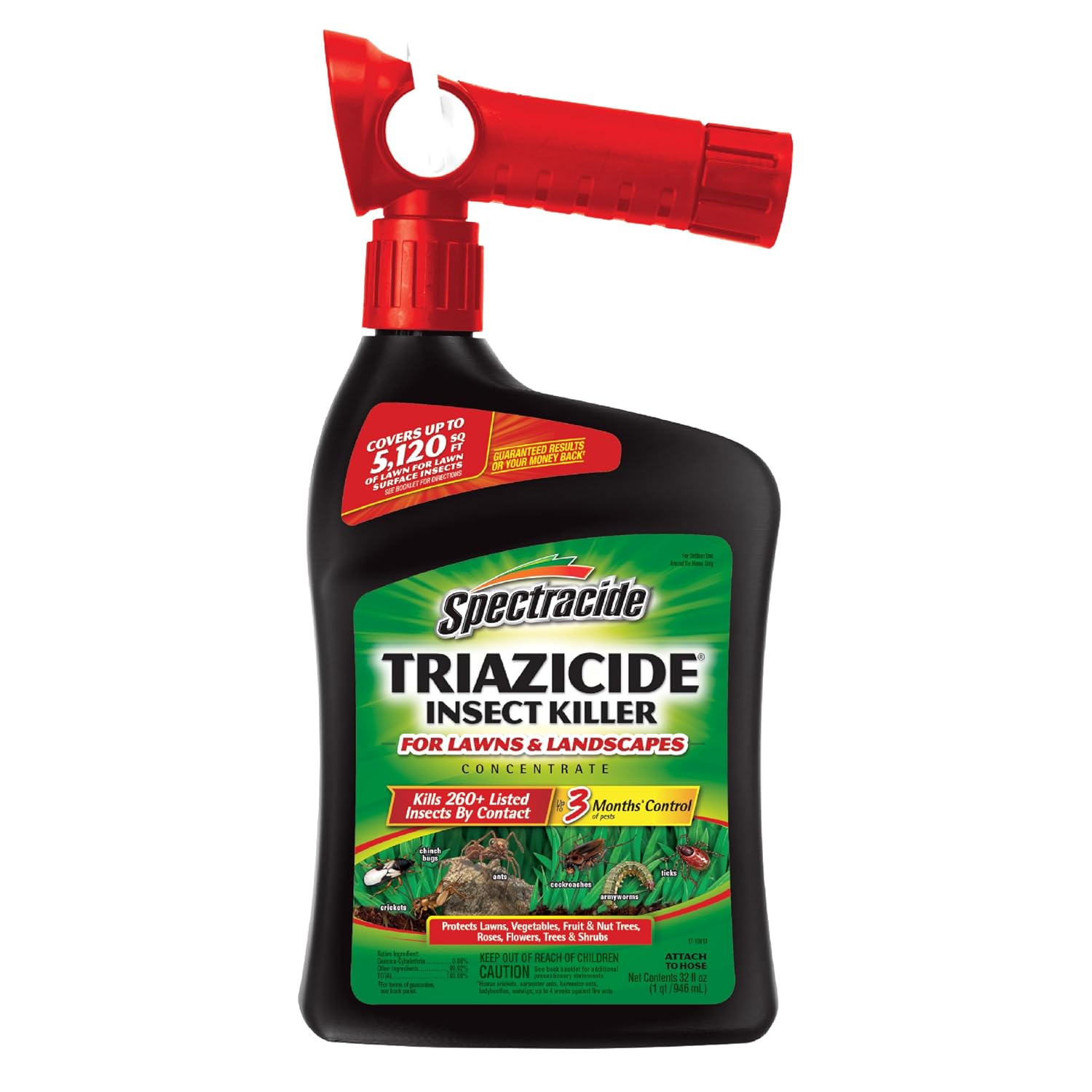
Spectracide Triazicide is a 32-ounce concentrate formulated to control more than 260 listed insects on lawns, flower beds, trees, shrubs and around vegetables. You mix the concentrate with water and apply it with a tank or hose-end sprayer; the ready-to-spray variant can attach to a garden hose for quicker application. The active ingredient, gamma-cyhalothrin, delivers fast contact kill for pests such as fleas, ticks, Japanese beetles and many surface insects, and the label claims protection for up to three months in some uses. It is non-staining when used as directed and can treat large areas, making it practical for whole-yard applications and targeted mound treatments like fire ants. Important limitations include toxicity to fish and bees, so it must not be applied near water or blooming plants, and the product requires careful handling and adherence to safety directions. Follow mixing rates and timing recommendations for best results and to minimize environmental risk.
Best for: Buyers who need an affordable, large-area solution to knock down common lawn and landscape pests and prefer a concentrate that stretches coverage when mixed.
Less Ideal for: People with small ornamental gardens near ponds, homeowners who prioritize pollinator-safe products, or those unwilling to follow pesticide safety precautions should consider gentler or targeted alternatives.
- Concentrate covers large areas so a single bottle treats many square feet when mixed correctly
- Fast-acting contact kill for a wide range of listed insects including fleas, ticks and Japanese beetles
- Versatile use on lawns, flower beds, trees, shrubs and around vegetables
- Non-staining when used as directed and available in hose-end ready-to-spray format for easier application
- Highly toxic to aquatic life and bees so it cannot be used near water or blooming plants
- Requires careful mixing and protective handling due to chemical toxicity
Verdict: A cost-effective, fast-acting concentrate for treating broad lawn and landscape pest problems when used with care and proper precautions.
Talstar One Insecticide Concentrate, 1 Gallon

| Active ingredient | Bifenthrin 7.9% |
|---|---|
| Formulation | Concentrate, water-based |
| Coverage intent | Perimeter and structural applications |
| Pest range | Controls 75+ pests including ticks |
Talstar One is a professional-strength bifenthrin concentrate designed to provide broad-spectrum control of ants, spiders, roaches, fleas, ticks, mosquitoes, and many other pests. You mix the concentrate with water and apply it as a perimeter spray around foundations, doors, and windows or to targeted cracks and crevices indoors. Notable features include a water-based, low-odor formula that dries clear and a residual effect that reduces the need for frequent reapplications on lawns, ornamentals, shrubs, and structural surfaces. For yards with tick pressure, treating perimeters and vegetation provides a dependable barrier that helps reduce tick encounters when applied according to label directions. The product is concentrated so one gallon treats large areas, which makes it efficient for seasonal maintenance across multiple structures. Important limitations are that it is a pesticide that requires careful handling and strict adherence to label rates and application restrictions, and it is not a ready-to-use spray so you will need appropriate mixing and application equipment for safe, effective coverage.
Best for: Buyers who prioritize reliable, residual pest control for yards and perimeters and who are comfortable using concentrated pesticides with proper safety practices.
Less Ideal for: Casual users who want a ready-to-use product or those unwilling to follow pesticide label precautions and use appropriate application equipment.
- Broad-spectrum control that includes ticks and common yard pests
- Concentrated formula covers large areas and is cost-efficient for seasonal treatments
- Water-based, low-odor formula dries clear and is suitable for outdoor living spaces
- Suitable for both perimeter and targeted indoor/structural applications
- Concentrate requires proper mixing and application equipment for safe use
- Contains bifenthrin so users must follow label precautions to protect people, pets, and beneficial insects
Verdict: Choose Talstar One when you need a concentrated, long-lasting perimeter treatment that reliably reduces tick pressure across yards and structures.
GardenTech Sevin Insect Killer Dust, 1 lb

| Item Form | Dust |
|---|---|
| Target Species | Insects |
| Active Ingredients | Bifenthrin |
| Unit Count | 1 Count |
Sevin Insect Killer Dust is a handheld dust formulation of bifenthrin for spot and perimeter treatment of garden pests, including Japanese beetles. You apply it by shaking a thin, uniform layer onto leaves, stems and around plants as a preventative or when you first see damage. The product kills by contact and lists more than 150 target insects, so it works across vegetables, fruit, ornamentals and turf. Practical features include a flip-open cap for easy dispensing and a 1 pound container sized for small-to-medium beds; the manufacturer states one pound treats about 2,000 sq. ft. The dust does not require mixing and settles quickly so treated areas can be reoccupied after it dries. Important limitations are typical for contact insecticides: it should not be applied to open blooms to protect pollinators and it provides little residual control if plants are watered or receive heavy rain within 24 hours of application. Users must follow label safety steps like avoiding the eyes and washing hands after use.
Best for: Gardeners who want a straightforward, no-mix contact treatment to quickly reduce visible beetle and chewing insect pressure in mixed vegetable, fruit and ornamental plantings.
Less Ideal for: People prioritizing pollinator-safe or long-residual biological controls should choose targeted or non-chemical methods instead.
- Kills by contact a wide range of garden pests including Japanese beetles and aphids
- Ready-to-use dust needs no mixing and is simple to apply with a flip-open cap
- Label lists use on vegetables, fruits, ornamentals and lawns so it fits mixed garden beds
- Contains bifenthrin which can harm beneficial insects if applied to open blooms or overused
Verdict: If you need a simple, ready-to-use contact treatment to quickly knock down Japanese beetles and other common garden pests, Sevin dust delivers fast, broad-spectrum control.
BioAdvanced Rose & Flower Insect Killer Spray, 24 oz

| Unit Count | 24 Fluid Ounces |
|---|---|
| Item Form | Spray |
| Target Species | Insects |
| Active Ingredients | Cyfluthrin |
| Specification Met | EPA |
This ready-to-use BioAdvanced spray is designed for quick spot treatment of roses, flowers, shrubs and vegetable gardens. The bottle delivers a fast-acting cyfluthrin formula that kills common pests such as aphids, whiteflies, Japanese beetles and caterpillars on contact, and the label claims protection for up to 14 days after application. Typical use is a direct spray to foliage until leaves are coated but not dripping, making it convenient for spot treatments or treating individual plants without mixing. The product is easy to apply and covers many common garden pests, which is helpful when you want an immediate reduction in visible damage. Important limitations are that it is a chemical insecticide with a synthetic active ingredient and is formulated for above-ground pests only, so it does not target soil-dwelling stages and should be used according to label precautions around beneficial insects and flowering pollinators. For gardeners needing occasional, effective knockdown of common pests, this is a practical ready-to-use option.
Best for: Gardeners who want an affordable, no-mix spray to quickly knock down visible pests on roses and ornamental plants and who prioritize convenience and immediate results.
Less Ideal for: People looking for organic or pollinator-safe options or those needing systemic or soil-targeted pest control should consider alternatives.
- Ready-to-use sprayer for easy spot application
- Kills a wide range of listed pests on contact
- Provides up to 14 days of residual protection as stated on the label
- Contains a synthetic pyrethroid active ingredient which can harm beneficial insects if applied to blooms
- Not intended for control of soil-dwelling pests or grubs
Verdict: A convenient, budget-friendly ready-to-use spray for rapidly reducing common above-ground garden pests on roses and flowers.
Monterey Spinosad Insecticide, 32 oz (concentrate)

| Unit Count | 32 Fluid Ounces |
|---|---|
| Item Form | Oil |
| Target Species | Insects |
Monterey Spinosad is a concentrated, spinosad‑based insecticide designed for home garden use to control caterpillars, leafminers, borers, thrips and many other chewing and crawling pests. Mixed into a trigger, backpack, or hose‑end sprayer, it can be applied to ornamentals, vegetables, lawns, citrus and fruit trees; the concentrate format makes it easy to cover larger areas on a schedule. The product is OMRI listed, fast acting, and practically odorless since spinosad is derived from naturally occurring bacteria. Safety directions on the label are clear and recommend protective clothing and thorough washing after handling. Limitations are that it is a broad contact toxin so beneficial insects like bees and predatory insects can be affected if applied during bloom or while pollinators are active, and you must follow label rates and reentry intervals for edible crops. For gardeners who prioritize reliable, organic‑approved control of chewing insects, this concentrate is a practical tool; those wanting an ant‑specific baiting strategy or systemic option will need a different product.
Best for: Gardeners who want a reliable, organic‑approved concentrate to quickly reduce chewing and boring insect populations across vegetables, ornamentals and fruit trees and who are comfortable following label safety and mixing instructions.
Less Ideal for: People seeking a targeted ant bait or a systemic insecticide for soilborne pests or those who need a product safe to spray during active bloom are better off with specialist ant baits or systemic products.
- OMRI listed for use in organic gardening
- Effective against a wide range of chewing and boring insects including caterpillars and leafminers
- Concentrate format works with trigger, backpack, or hose‑end sprayers for flexible coverage
- Fast acting and essentially odorless when applied properly
- Contact action can harm beneficial insects if applied when pollinators are active
- Requires mixing and careful adherence to label instructions for safe use
Verdict: Choose this OMRI‑listed spinosad concentrate when you need dependable, fast control of chewing garden pests across vegetables, ornamentals and fruit trees.
Ortho BugClear Insect Killer for Lawns & Landscapes Ready-to-Spray, 32 oz

| Item Form | Aerosol |
|---|---|
| Target Species | Ant |
| Liquid Volume | 32 fluid ounces |
Ortho BugClear Ready-to-Spray is a hose‑end insecticide designed for homeowners who want a fast, no-mix solution to reduce mosquitoes and many other yard pests. You attach the 32 oz. bottle to a garden hose and apply across lawns, foundation perimeters and ornamentals; one bottle covers up to about a 5,300 sq ft lawn or targeted perimeter areas. The formula lists bifenthrin and zeta‑cypermethrin and is described as non‑staining and odor free, with knockdown that starts within minutes and protection that can last for months. Practical benefits include quick application without measuring, broad-spectrum control of dozens of species including mosquitoes and ticks, and compatibility with turf, shrubs and listed edibles when used as directed. Important limitations are that it is a contact/residual insecticide so timing matters for weather and pollinator safety, and hose-end coverage is fixed so very large properties may need multiple bottles; follow label precautions for pets, people and bloom protection.
Best for: Homeowners who want an affordable, easy-to-use mosquito and general yard pest treatment they can apply themselves without mixing concentrates.
Less Ideal for: People who prefer organic or non-chemical mosquito control methods or those managing very large properties who need professional-scale coverage.
- Ready-to-spray hose-end design for quick, no-mix application
- Claims fast knockdown and long-lasting residual control
- Broad-spectrum label lists many outdoor pests including mosquitoes and ticks
- Non-staining and low odor for outdoor use near living spaces
- Contains synthetic pyrethroids that require careful timing and avoidance of blooming plants to protect pollinators
- Single bottle covers limited area for very large yards
Verdict: A budget-friendly, ready-to-spray option that makes quick, DIY mosquito and yard pest control simple for typical residential lawns.
Atticus Talak 7.9% Bifenthrin Indoor/Outdoor Insecticide Concentrate, 32 oz

| Active Ingredient | Bifenthrin |
|---|---|
| Formulation | Suspension Concentrate |
| Liquid Volume | 32 fluid ounces |
| Length of Control | Up to three months |
| Target Species | Insects |
Talak 7.9% is a liquid concentrate for treating lawns, landscaping, outdoor living areas and indoor perimeter spots like baseboards and cabinets. You dilute the concentrate with water to create a spray for barrier treatments, spot applications or lawn mixes; label rates explain how much to mix per gallon depending on the use. The product uses bifenthrin, a proven broad-spectrum active ingredient, and the manufacturer states it controls over 75 species and can give residual control for as long as three months. Its water-based formula dries clear, leaves no odor or visible residue, and is not phytotoxic on plants when used per label. Practical benefits include flexible indoor and outdoor use, clear drying, and a bottle designed for easier pouring. Important limitations are that solutions should be mixed only for same-day use, it is not registered for sale in a few states, and it is not approved for fogger application, so professional-style misting methods are not appropriate.
Best for: Buyers who want a single, reliable product to protect yards, patios and building perimeters from a wide range of common pests and prefer conservative, label-driven application practices.
Less Ideal for: People seeking ready-to-use sprays or fogger-compatible products or those in states where this formulation is not registered should look at alternatives.
- Broad-spectrum control listed for 75+ indoor and outdoor pest species
- Water-based formula that dries clear and leaves no odor or residue
- Flexible label directions for lawns, landscapes, hardscapes and indoor perimeter treatments
- Long residual activity up to three months when applied at recommended rates
- Mixed spray solutions cannot be stored and must be used the same day
- Not approved for fogger application and not available for sale in some states
Verdict: A versatile, water-based bifenthrin concentrate that delivers long-lasting, broad-spectrum outdoor (and perimeter indoor) control when used according to the label.
Choosing the Right Lawn and Garden Insect Killer: Key Factors to Consider
Target Pest Spectrum
Knowing which insects you need to control is the first step. Some products are formulated primarily for surface-feeding pests like caterpillars and beetles, while others are optimized for soil-dwelling grubs or sap-sucking insects. Choose a product whose labeled pests match what you observe in the lawn or garden, because using a product designed for a different pest will waste time and may not stop damage.
Target spectrum also affects timing. For example, grub treatments are most effective at specific larval stages, while foliar sprays are timed to active feeding. Match the chemistry and application window to the pest life cycle to get reliable results.
Application Method and Coverage
Application options include ready-to-use sprays, concentrates for hose-end or pump sprayers, granular spreaders, and systemic drenches. Each method influences how easily you can treat large lawns or precise planting beds. Granules and hose-end concentrates are efficient for broad coverage; backpack sprayers and hand-gun sprayers give better control around ornamentals and in tight beds.
Coverage uniformity matters. Some formulations require multiple passes or overlap to get even distribution. Consider the equipment you already own and whether the product's recommended spray volume and droplet size suit lawns versus delicate ornamentals.
Plant Safety and Phytotoxicity
Not all insect killers are equally safe for every plant. Concentrated sprays, high-salt products, or certain oils can scorch tender foliage or stress newly set transplants. Labels list temperature restrictions and plant sensitivities; follow them to avoid damage.
If you maintain mixed beds with fruiting vegetables, shrubs, and annuals, favor products with low phytotoxic risk and clear guidance for edible crops. When in doubt, test on a small area or wait until cooler parts of the day to reduce scorch risk.
Residual Activity and Reapplication Needs
Residual control determines how often you need to reapply. Some contact sprays kill pests on contact but offer little residual protection, requiring more frequent treatments. Systemic or residual chemistries provide longer intervals between applications, which is useful for sustained control of feeding pests.
Longer residuals reduce labor but can affect beneficial insects. Consider reapplication timing in relation to pollinator activity and weather events that can wash or dilute surface residues.
Environmental and User Safety
Safety extends beyond the garden bed. Look for products with clear personal protective equipment guidance, minimal drift potential, and controlled runoff risk. Water-soluble concentrates and hose-end applicators reduce handling of concentrated liquids, while granules can be easier for homeowners who prefer less mixing.
Also consider local regulations and proximity to water bodies. Choose options with lower aquatic toxicity if you garden near ponds or streams, and follow label buffer zone instructions to protect non-target wildlife.
Cost Per Area Treated and Practicality
Compare how much product is needed to treat a given square footage rather than only looking at the package size. Some concentrates treat large areas economically but require mixing and sprayer calibration. Granules are convenient for spot treatments but may cost more per treated area.
Think about storage and shelf life as well. If you treat only occasionally, a package that stores well without losing potency is more practical than a large container you must discard after one season.
When to Use Contact Sprays Versus Systemics
Contact sprays kill insects on contact and are best when you can directly hit visible pests on foliage or stems. They act quickly, making them useful for sudden outbreaks of chewing insects or for spot-treatment in vegetable rows. Contact products usually have little residual activity, so reapplication is common if pests are persistent.
- Use contact sprays for fast knockdown of visible pests
- Limit use during bloom to protect pollinators
- Expect shorter protection window compared with systemic options
Best Practices for Treating Lawns
For turf applications, timing and uniform coverage are critical. Treat for grubs when larvae are actively feeding near the soil surface, and apply foliar-active products early in the morning or evening to reduce heat stress on grass. Calibrate spreaders or sprayers to deliver the recommended rate across the whole lawn to avoid patchy control.
- Water-in requirements vary; check label for irrigation timing
- Avoid mowing immediately before or after application to preserve coverage
- Rotate active ingredients over seasons to limit resistance buildup
Protecting Pollinators and Beneficial Insects
Many insect control products can harm pollinators and beneficial predators. To reduce non-target impacts, avoid applications during bloom and target treatments to times when pollinators are least active. Use targeted spot treatments rather than broadcast applications when possible, and follow label restrictions about flowering plants.
- Apply late evening or early morning when bees are inactive
- Remove or cover bee hives temporarily if label mandates
- Prefer products with lower residual toxicity around pollinator plants
Application Equipment and Calibration Tips
Proper equipment and calibration ensure effective coverage without overapplying. For sprayers, verify nozzle type and pressure match label recommendations. For granular applications, check spreader settings against the product's coverage chart and walk at a steady pace to maintain even distribution. Rinse equipment promptly after use to avoid cross-contamination between different chemistries.
- Record settings and rates for repeatable applications
- Use a delivery check pattern to confirm even spread
- Wear recommended PPE during mixing, application, and cleanup
Timing Treatments Around Weather and Lawn Care Tasks
Weather affects both efficacy and plant safety. Avoid applying before heavy rain that will wash products away, and keep treatments out of the hottest part of the day to reduce phytotoxic risk. Coordinate applications with other tasks like fertilizing or seeding because some combinations can increase plant stress or reduce effectiveness.
- Check short-term forecast for rain within 24 hours
- Space treatments away from recent fertilization when label warns
- Wait for established roots after transplanting before applying stronger chemistries
How We Chose the Best Lawn and Garden Insect Killer
We selected the seven lawn and garden insect killers by focusing on real-world garden performance and practical safety for home landscapes. Our evaluation emphasized products with clear targeting for common yard pests, demonstrable application flexibility, and evidence of consistent coverage across turf and planting beds. We prioritized formulations and delivery methods that minimize plant injury risk when used according to label directions, and that offer dosage guidance appropriate for small and medium lawns. Key evaluation criteria included targeted pest spectrum, application method and coverage, plant safety and phytotoxicity risk, residual activity and reapplication interval, and user safety and PPE recommendations. We excluded products intended solely for indoor use, seed treatments, or those labeled only for agricultural or professional-only applications. We also filtered out options with ambiguous labeling about turf or ornamental use. The shortlist favors products with transparent labels, clear mixing rates, and practical instructions for common garden scenarios. That approach ensures the picks are useful to typical gardeners managing lawns, beds, and container plantings.
FAQ
How do I identify which insect is damaging my lawn or plants?
Look for visible insects, feeding patterns, and damage symptoms. Chewed leaves often indicate caterpillars or beetles, while yellowing and wilting with minimal visible insects can signal sap-suckers. For turf, brown patches with turf pulled up easily often point to grubs. Confirming the pest helps you pick the right control.
Can I use the same insect killer on vegetables and ornamental beds?
It depends on the product label. Some formulations are labeled for both ornamentals and edible crops, while others restrict use to ornamentals or turf. Always check label instructions for edible crop intervals and pre-harvest waiting periods before using on vegetables.
How soon after applying will I see results?
Contact sprays typically show knockdown within hours, while systemic products may take several days before treated insects decline. Residual and behavior of the pest also influence how quickly visible recovery occurs.
Is it safe to apply treatments when pollinators are active?
Applying during peak pollinator activity increases risk to bees and beneficial insects. Avoid spraying flowering plants during the day; target early morning or late evening applications and follow label guidance to protect pollinators.
How often should I reapply a product?
Reapplication frequency depends on the product's residual activity and the pest pressure. Contact products may require repeat treatments every 7 to 14 days, while longer-residual or systemic options can extend that interval. Follow label directions for recommended intervals.
What should I do if plants show signs of phytotoxicity after treatment?
Rinse foliage with water if label allows and stop further applications. Move future applications to cooler times of day and verify label temperature limits. For severe damage, prune affected growth and adjust product choice to a gentler formulation.
Final Verdict
Prioritize matching the insect killer to the pests and the area you need to treat. Think about application method, plant sensitivity, and the balance between quick knockdown and longer residual control. Factor in safety for people, pets, and pollinators when scheduling and placing treatments. With those priorities in mind, you can choose a product that fits your garden routines and delivers dependable control without unnecessary risk.
