

Note: This article contains affiliate links. If you click on these links and make a purchase, I may earn a small commission at no extra cost to you. This helps support my research and content. Read my full affiliate disclosure here.
If black ants are marching through planters, patios, or foundation cracks, the right pesticide can stop colony activity while limiting risks to plants and beneficial insects. You need a solution that reaches the nest or breaks foraging trails, is appropriate for outdoor and indoor use where needed, and is safe to apply around children, pets, and garden plants. This guide presents seven shortlisted pesticides selected for common homeowner and small-garden scenarios. We evaluate products on how quickly they reduce visible activity, how well they target nests, and how easy and safe they are to use. Read on to understand the practical tradeoffs before you choose a control method for your landscape or home perimeter.
Top Picks at a Glance
| Best Overall The best all-around choice for most situations | TERRO Liquid Ant Killer Bait Stations, 12-Pack (T300B) |  |
| Best Quality Built to a higher standard if you want something more solid | Syngenta Advion Ant Gel Bait, 30 g |  |
| Best Value The sweet spot between price and what you get | Raid Max Liquid Ant Killer Baits, 12-Count |  |
| Best Budget The cheapest option that still gets the job done reliably | Black Flag Ant & Roach Killer Unscented Aerosol, 17.5 oz |  |
| Highest Rated A top-rated pick with lots of positive feedback | NCSIFDD Ant Away Ant Repellent Gel, 6-Pack |  |
| Most Popular A crowd favorite that many people choose with confidence | Raid Ant Killer Baits, 8 Count (Child-Resistant) |  |
| Best Seller A high-volume bestseller chosen again and again | Ortho Home Defense Insect Killer for Indoor & Perimeter, 1.33 gal. with Comfort Wand |  |
TERRO Liquid Ant Killer Bait Stations, 12-Pack (T300B)

| Unit Count | 12 Count |
|---|---|
| Item Form | Liquid |
| Target Species | Insects |
| Active Ingredients | Sodium Tetraborate Decahydrate (Borax), 5.40% |
Terro Liquid Ant Killer bait stations are prefilled, single-use traps designed for indoor control of common sugar-loving ants. You place the small stations along baseboards, in corners, under appliances, or on countertops where you see ant activity. Worker ants are drawn to the sweet liquid, feed on it, and take it back to the nest so the borax-based active ingredient can eliminate the colony over days to weeks. The product is easy to use with no mixing or setup and the 12-pack gives coverage for several rooms. Because the bait is contained inside a low-profile plastic station, it reduces incidental contact risk compared with loose sprays or powders and lasts for weeks while ants continue to visit. Limitations are that the formula targets sugar-preferring species so very protein- or grease-attracted ants may ignore it, and control can take 2 to 4 weeks for larger infestations. Also stations should be placed away from pets and children despite the contained design since the bait contains borax.
Best for: Homeowners who prioritize an easy, low-hassle indoor solution and want a bait that works at the colony level with minimal hands-on pest handling.
Less Ideal for: People who need immediate knockdown of ants or who have pets or children that frequently access treated areas and cannot reliably keep them away from placed stations.
- Ready-to-use stations require no mixing or setup
- Designed to be carried back to the nest for colony-level control
- Low-profile enclosed bait reduces messy exposure compared with loose liquids or sprays
- 12 stations provide coverage for multiple rooms or hotspots
- Formulation is sugar-based so less effective on ants that prefer protein or grease
- Control can take 2–4 weeks for large or established colonies
Verdict: A simple, low-contact indoor bait system that reliably reduces sugar-loving ant infestations by getting worker ants to carry borax back to the colony.
Syngenta Advion Ant Gel Bait, 30 g

| Item Form | Gel |
|---|---|
| Target Species | Insects |
| Active Ingredients | Indoxacarb |
Advion Ant Gel is a concentrated, professional-style ant bait formulated around indoxacarb and a highly palatable gel matrix to lure foraging ants and carry toxicant back to the colony. You apply small dabs of the translucent, nonstaining gel in ant trails, near nesting sites, or in voids where ants forage; workers feed on the gel and transfer it through trophallaxis, which helps suppress entire colonies rather than just worker ants. The formulation is touted for lasting integrity with low odor and high attractiveness to sweet-feeding species, so you do not need frequent reapplication in protected spots. Because it is a targeted bait rather than a broadcast insecticide, it is practical for spot treatments in kitchens, pantries, and around baseboards as well as sheltered outdoor locations. Important limits are that it is a bait product requiring worker-mediated distribution so results are not instant and indoor use requires keeping it away from children and pets.
Best for: Buyers who prioritize effective colony-level control and want a concentrated, professional-style bait for spot treatments inside homes or in sheltered outdoor locations.
Less Ideal for: People needing immediate knockdown of visible ants or those who require a product for widespread outdoor perimeter treatments should consider different control methods.
- Contains indoxacarb, a potent active ingredient with a unique mode of action
- Highly palatable, translucent gel that attracts sweet-feeding ants
- Maintains formulation integrity for extended periods in sheltered application sites
- Suitable for indoor and sheltered outdoor spot treatments
- Relies on worker feeding and transfer so colony elimination can take several days to weeks
- Not intended for broad outdoor broadcast use or exposed wet areas
Verdict: Choose Advion Ant Gel when you want a high-performance, worker-transferred bait that targets colonies rather than just knocking down visible ants.
Raid Max Liquid Ant Killer Baits, 12-Count

| Unit Count | 12 Count |
|---|---|
| Item Form | Liquid Bait |
| Target Species | Insects |
| Active Ingredients | Spinosad |
Raid Max Liquid Ant Killer comes as ready-to-use, spill‑proof bait stations that are placed where you see ants to be carried back to the nest and shared with the colony. Typical use is simple: peel the activation film, set the station along baseboards, near trash, or at entry points, and replace multiple stations for larger infestations. The product targets many common ant species and uses spinosad as the active ingredient, which helps kill workers and the queen when ants feed and share the liquid. Practical benefits include easy placement, no mixing or spraying, and suitability for both indoor and outdoor spots where you want discrete control. Limitations: it does not work on fire ants, carpenter ants, harvester ants, or pharaoh ants, and effectiveness depends on ants finding and consuming the bait so very dry, hot, or heavily baited areas may reduce uptake. Also stations should be kept away from children and pets and monitored until activity stops.
Best for: Buyers who want a low‑effort, discrete ant control method to treat visible ant trails and likely colony locations around a home and yard. Ideal for people who prefer bait stations over sprays and who will monitor and replace stations as needed.
Less Ideal for: Those dealing primarily with fire ants, carpenter ants, or other excluded species or users who need immediate knockdown of large outdoor mounds should look for alternatives.
- Ready-to-use prefilled stations require no mixing or setup
- Works indoors and outdoors for flexible placement
- Spinosad-based liquid is carried back to colony to target queen and larvae
- Comes in a 12-count pack for coverage of multiple hotspots
- Not effective against fire ants, carpenter ants, harvester ants, or pharaoh ants
- Performance depends on ants choosing the bait so very large or competing food sources can slow results
Verdict: A convenient, ready-to-use liquid bait pack that kills common household ant colonies by being carried back to the nest, making it a practical choice for routine outdoor and indoor ant control.
Black Flag Ant & Roach Killer Unscented Aerosol, 17.5 oz

| Item Form | Spray |
|---|---|
| Target Species | Insects |
| Liquid Volume | 17 fluid ounces |
| Active Ingredients | lemon |
This Black Flag Ant & Roach Killer is an easy, no-frills aerosol for treating indoor ant problems. You use it as a direct-contact spray around baseboards, under appliances, and in cracks where ants travel; the active ingredients deliver quick knockdown and the formula claims residual control on German cockroaches for up to three months. The unscented, nonstaining formula makes it practical for use in kitchens and other living areas without leaving marks or strong odors. For a budget-focused buyer, the single aerosol can offers straightforward spot treatments and short-term perimeter control without specialized equipment. Important limitations are that aerosol cans treat localized infestations rather than colony-wide elimination and repeated applications may be required for persistent or large-scale ant problems. Also users should follow safety directions to avoid inhalation or surface contamination around food prep areas.
Best for: Buyers who need an affordable, easy-to-use spray for treating visible ant trails and small indoor infestations and who prioritize quick results and minimal mess.
Less Ideal for: Homeowners seeking long-term colony elimination across large yards or hidden nests should consider baits or professional treatments instead.
- Kills ants and roaches on contact with quick knockdown
- Unscented, nonstaining formula suitable for indoor use
- Claims residual control against German cockroaches for up to three months
- Simple aerosol application needs no extra equipment
- Aerosol can is best for spot treatments and may not control large or hidden colonies
- Contains conventional insecticides that require careful use around food and children
Verdict: A low-cost, easy aerosol for knocking down visible ants and treating indoor trouble spots quickly.
NCSIFDD Ant Away Ant Repellent Gel, 6-Pack

| Unit Count | 12 Count |
|---|---|
| Number of Pieces | 1 |
This ant repellent gel is a concentrated applicator product intended for targeted spot treatments around entry points, baseboards, window frames, and known ant trails. You remove the cap, attach the precision tip, and apply pea‑sized drops into crevices or along trails; the manufacturer notes it can take 3–5 days to work through a colony and helps keep ants away for up to 60 days in treated areas. Practical benefits include the narrow applicator for neat placement in tight gaps, suitability for both indoor and outdoor problem spots, and a formulation presented as family and pet safe when used as directed. Important limitations are that results are not instantaneous and multiple applications or placements may be needed to control larger or multiple colonies, and effectiveness depends on correctly locating trails and nest access points. For someone who wants a low‑mess, targeted solution rather than broad broadcast treatments, this gel is a convenient option.
Best for: Buyers who prioritize dependable, low‑mess spot treatment for recurring ant sightings and prefer a product they can place precisely where ants travel.
Less Ideal for: People needing rapid elimination of very large or widespread infestations or those who prefer broadcast sprays or professional colony eradication services.
- Precision applicator allows neat, pea‑sized placements in tight crevices and along ant trails
- Labeled for both indoor and outdoor use so the same product can treat kitchens, baseboards, and patios
- Formulation described as family and pet safe when used according to directions
- Single placements can provide protection in treated areas for up to 60 days
- Not an immediate knockdown—can take 3–5 days to affect a colony
- May require several placements and correct trail identification to fully control larger infestations
Verdict: Use this precision gel when you want a neat, family‑safe spot treatment that targets ant trails and entry points rather than a broad spray solution.
Raid Ant Killer Baits, 8 Count (Child-Resistant)
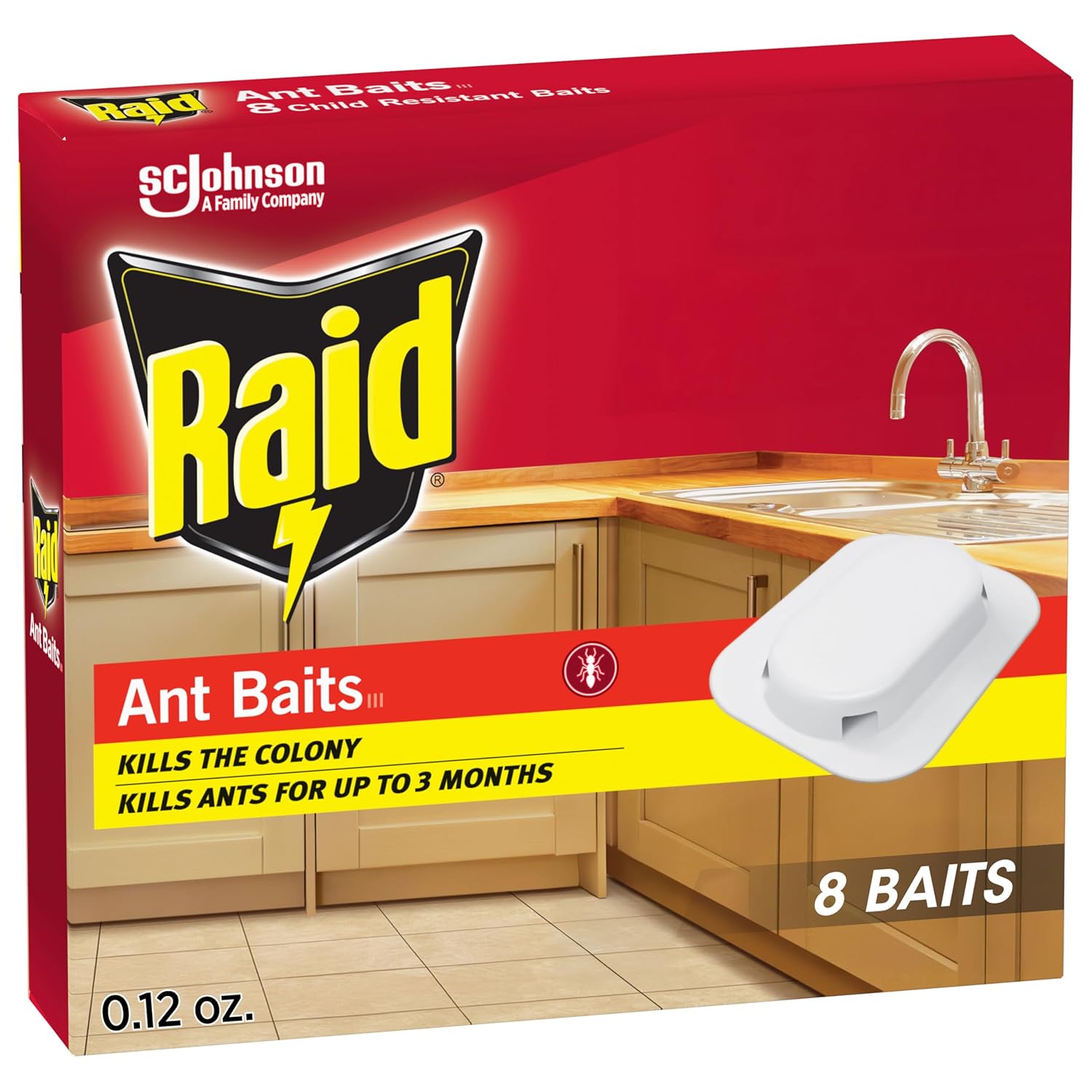
| Package quantity | 8 Count |
|---|---|
| Child safety | Child-resistant |
| Intended use | Indoor |
| Effect duration | Up to 3 months |
These Raid Ant Killer Baits are small, ready-to-use indoor stations that dispense an attractive liquid bait ants carry back to the colony, which can eliminate the nest over time. You place the bait along walls, in corners, and near entry points where small ants forage; after ants feed, the active ingredient is shared with other colony members, including the queen, and protection can last for weeks. The child-resistant design reduces accidental access in homes with children while the compact stations are low-profile and easy to position. Because they are prefilled and disposable, there is no mixing or measuring, which makes them convenient for quick treatment in kitchens, pantries, and baseboards. Limitations are that the product is for indoor use only and may be less effective if competing food sources are left available or if multiple heavy infestations require broader perimeter treatment. For someone looking for a simple, no-fuss bait to try first, these are a practical option.
Best for: Budget-minded homeowners or renters who want an easy, low-effort indoor solution to control small ant trails and try baiting before calling for broader treatments.
Less Ideal for: People needing immediate knockdown for very large or outdoor ant colonies or those who prefer non-chemical mechanical control methods.
- Ready-to-use prefilled bait stations that require no setup
- Child-resistant design reduces accidental access
- Bait formula is transferred through the colony to target the queen
- Compact, low-profile stations are easy to place along walls and entry points
- Intended for indoor use only, not suited for outdoor colony control
- May be less effective if other food sources are available or in very large infestations
Verdict: A low-cost, no-fuss indoor bait station that effectively targets small ant colonies by having foragers carry bait back to the nest.
Ortho Home Defense Insect Killer for Indoor & Perimeter, 1.33 gal. with Comfort Wand

| Item Form | Spray |
|---|---|
| Target Species | Insects |
| Liquid Volume | 1.33 gallons |
| Active Ingredients | Bifenthrin 0.05%, Zeta-Cypermethrin 0.0125% |
This 1.33 gallon Ortho Home Defense spray is designed to treat both indoor problem spots and the outdoor perimeter of a home to reduce ants, roaches, spiders and many other crawling and flying insects. It comes with a battery-powered Comfort Wand that delivers a continuous spray so you can apply a uniform band around foundations, patios and entry points without bending or pumping. The formula with bifenthrin and zeta-cypermethrin is intended to kill on contact and establish a barrier that the manufacturer says lasts up to 12 months for ants, roaches and spiders on non-porous indoor surfaces. In real-world use that means fewer repeat treatments in busy yard perimeters and around doors and windows. The spray dries clear with minimal fumes which helps for indoor use near kitchens and living areas. Limitations are that this is a chemical insecticide so users should follow safety directions around children, pets and plants and it is not a specific solution for pests not listed on the label. For homeowners focused on strong, perimeter-level protection this product simplifies application and covers a large area per container.
Best for: Homeowners who want a performance-focused perimeter treatment to reduce recurring yard and entry-point insect problems and prefer a ready-to-use product that is easy to apply.
Less Ideal for: People seeking organic or non-chemical control methods or those who need a targeted solution for pests not listed on the label should consider alternative products.
- Includes battery-powered Comfort Wand for continuous, fatigue-free application
- Ready-to-use 1.33 gallon container covers large perimeters without mixing
- Formula creates a barrier claimed to provide up to 12 months protection against ants, roaches and spiders on non-porous indoor surfaces
- Dries clear and gives off minimal fumes, making indoor use more practical
- Contains synthetic insecticides so precautions are required around children, pets and ornamentals
- Protection claims are specific to certain species and surfaces so results vary by pest and conditions
Verdict: A powerful, ready-to-use perimeter and indoor spray for homeowners who want long-lasting, performance-oriented protection against common yard and household insects.
Choosing the Right Pesticide for Black Ants: Key Factors to Consider
Colony Targeting and Bait Acceptance
How a pesticide reaches the queen and brood determines longer-term success. Baits rely on foragers carrying active ingredients back to the nest, so acceptability of the bait matrix to black ants is crucial. If pests ignore a bait because of seasonal food availability, colony-level control will be poor.
For contact products, direct treatment of trails or nest entrances can reduce visible activity quickly but may not eradicate the colony unless the active ingredient has transfer properties. Consider whether you need a product formulated specifically as a bait or a contact insecticide based on where you see ant activity and whether you can locate nest sites.
Speed of Suppression Versus Residual Control
Some products produce fast knockdown of foraging ants, providing immediate relief but limited residual activity. Others act slower but persist longer in soil or on surfaces, reducing re-infestation risk. Choose based on urgency and reappearance risk: a fast-acting spray can clear a visible infestation, while a slower bait with residual transfer helps prevent recurrence.
Think about seasonal pressures. During warm months with high ant foraging, a bait that spreads through the colony can be more effective, whereas a rapid-contact treatment is useful when you need to protect a newly vulnerable area quickly.
Safety Around Garden Plants, Pets, and People
Pesticides used around edible crops, flower beds, or turf should carry labeling that permits such use and specifies withholding periods for harvest if relevant. Consider formulation: granules and baits often pose lower immediate drift risk than sprays, but granular residues can persist in soil. Readability of label directions for pet and child safety is essential.
Also assess the potential impact on beneficial insects. Many ant controls can harm non-target insects, so apply treatments in targeted zones rather than broad blanket applications when pollinators or predatory insects are active.
Application Method and Practicality
Different formulations require different application skills. Ready-to-use baits are straightforward for most gardeners, while concentrated liquids need accurate dilution and proper protective equipment. Granular products may need broadcast spreaders or careful hand application for accuracy. Consider storage stability, how long baits remain attractive after placement, and whether the product requires reapplication after rain.
Practical factors like nozzle control, bait station design, and clear mixing rates influence whether you will apply the product correctly and consistently. Choose an option that matches your comfort level with garden chemical handling.
Environmental Persistence and Runoff Risk
Residual activity helps with longer-term control but can carry risk if the active ingredient moves off-target. Products with high persistence may accumulate in soil or be mobile with runoff, posing risks to aquatic life and non-target organisms. Evaluate label guidance on buffer zones, incorporation into soil, and restrictions near water features.
Prefer products with clear mitigation instructions and lower mobility when working near ponds, drains, or sensitive plantings.
Timing and Seasonal Behavior of Black Ants
Ant feeding preferences and colony dynamics change with season. In spring and early summer, protein-rich baits can be accepted, while carbohydrate baits may work better in late summer or during drought. Nesting behavior also shifts; some species nest in soil while others nest in wood or under stones. Correct timing improves bait uptake and treatment success.
Plan applications when foraging activity is high and weather conditions favor bait stability. Avoid placing baits immediately before heavy rain or during periods of abundant alternative food sources.
How Ant Baits Work in a Garden Setting
Baits combine an attractive food matrix with an active ingredient designed to move through the colony. Foragers collect the bait, carry it back to the nest, and feed nestmates. That transfer is the key advantage in a garden because it can suppress an entire colony rather than only the foragers you see.
Placement matters. Put bait stations along foraging trails, near nest entrances, and in sheltered locations where rain will not wash the bait away. Avoid scattering edible debris that competes with bait attractiveness.
- Place baits in shaded, dry spots near visible trails
- Check baits daily until consumption slows
- Replace or refresh baits after heavy rain
Using Contact Treatments Safely Near Plants
Contact sprays and dusts can reduce visible ant numbers quickly but require careful application to avoid plant injury and harm to beneficials. Spray contact products directly on trails, nest entrances, or structural entry points rather than blanket-spraying flower beds.
When treating near edible plants, follow label harvest intervals and avoid spraying open flowers. Use targeted application tools such as wand nozzles for spot treatments to limit drift and runoff.
- Target cracks, crevices, and nest entrances rather than foliage
- Avoid application during pollinator activity periods
- Rinse equipment away from storm drains and water features
Nonchemical and Cultural Controls to Pair with Pesticides
Improving sanitation, sealing entry points, and removing food sources reduces reliance on pesticides. Keep mulch pulled back from foundations, manage spilled bird seed, and store pet food indoors. These steps make chemical controls more effective and can reduce the required treatment frequency.
Physical disruption of small satellite nests, when safe and practical, can also lower ant pressure before applying baits or contact products. Combining cultural practices with targeted pesticide use is the most sustainable approach for long-term control.
- Seal foundation gaps and utility penetrations
- Keep compost and mulch layers managed
- Store attractants in sealed containers
Read and Follow Label Instructions
The label is the law and the best guide for safe, effective use. It specifies where the product can be applied, appropriate rates, protective equipment, and reentry or harvest intervals. Ignoring label directions leads to reduced effectiveness and safety risks.
If a situation is not described on the label, do not improvise. Choose a product whose labeled uses match the areas you need to treat, whether that is indoor kitchens, outdoor patios, ornamental beds, or vegetable gardens.
- Confirm labeled uses for edible plants before application
- Follow mixing and disposal instructions precisely
- Keep product containers in original packaging with labels intact
Long-Term Prevention Strategies
After active treatment, implement preventative measures to reduce future outbreaks. Maintain a tidy yard, repair moisture problems, and inspect new wood or mulch for nesting activity. Monitoring and early baiting can prevent small problems from becoming large infestations.
Rotate strategies as needed. If one bait type is not being accepted, try a different matrix or alter placement rather than increasing concentration. Persistence and observation are key to long-term success.
- Inspect common entry points monthly
- Use bait stations for ongoing low-level monitoring
- Adjust strategies seasonally based on ant behavior
How We Chose the Best Pesticide for Black Ants
We shortlisted products that offer reliable control of black ant populations in home and garden settings using a consistent set of practical filters. Selection prioritized demonstrated colony-level effectiveness, meaning options that either deliver baiting strategies to reach nests or registered contact treatments that rapidly reduce foraging numbers. Application safety was a second core criterion, with attention to labeled uses around edible plants, lawns, children, and pets. Persistence and environmental profile mattered as well: we favored products whose active ingredients have predictable residual activity without excessive soil accumulation. Ease of use and delivery format were included so gardeners with different skill levels can apply the treatment correctly. Finally, label clarity and availability of clear mixing and disposal instructions were required for inclusion. We excluded products lacking explicit ant labeling, non-registered garden formulations, and treatments that require specialized licensing or professional-only application. Metrics that actually determined inclusion were nest-targeting ability, speed of colony suppression, labeled safety around gardens and pets, residual activity, and application practicality. These evaluation points align with the scorecard metrics used across the shortlist.
FAQ
How long does it take for a bait to stop ant activity?
It often depends on bait acceptance and colony size. You may see reduced foraging within 24 to 72 hours, while full colony suppression can take one to several weeks as the bait moves through the nest.
Are granular pesticides safe around vegetable beds?
That depends on the product label. Some granular and bait formulations are labeled for use near ornamentals but not edible crops, while others permit use in certain vegetable beds with harvest intervals. Always check the label for specific allowances and waiting periods.
What should I do if rain washes away my bait?
Remove any contaminated bait and replace it once the area is dry. Choose sheltered placement for bait stations to reduce exposure to rain and replace consumable baits promptly if they become wet or moldy.
Can I use the same treatment indoors and outdoors?
Some formulations are labeled for both indoor and outdoor use, but many are restricted to one environment. Use only products explicitly labeled for indoor application inside the home and follow all indoor safety instructions.
Will ant treatments harm pollinators in my garden?
Treatments targeted at nests or trails and applied away from blooms are less likely to affect pollinators. Broad foliar sprays on flowering plants pose higher risk. Timing applications to avoid pollinator activity and using targeted methods reduces non-target exposure.
How often should I reapply a residual perimeter treatment?
Reapplication intervals depend on the product residual period and environmental conditions. Many labels specify reapplication every few weeks to a few months, but heavy rainfall or frequent irrigation can shorten residual effectiveness and require earlier re-treatment.
Final Verdict
Choose a pesticide that matches how and where you see black ant activity, balancing fast reduction of visible ants with a strategy that reaches the colony. Prioritize labeled safety around plants, children, and pets, and pick a formulation you will apply correctly and maintain until activity declines. Combine targeted chemical treatment with sanitation and exclusion to reduce future pressure and make any pesticide use more effective.
