

Note: This article contains affiliate links. If you click on these links and make a purchase, I may earn a small commission at no extra cost to you. This helps support my research and content. Read my full affiliate disclosure here.
A fertilizer spreader for lawns changes how you feed turf. The right spreader gives consistent coverage, cuts application time, and reduces the risk of uneven patches or fertilizer burn. Whether you manage a small yard or a larger property, choosing the right style and capacity matters for efficiency and results. This guide covers our seven top picks for lawn spreaders. We shortlisted options that suit different yard sizes and maintenance rhythms, then evaluated them on factors gardeners care about like spread accuracy, hopper capacity, and durability. Read on to match a spreader to your lawn size and feeding routine.
Top Picks at a Glance
| Best Overall The best all-around choice for most situations | John Deere 130 lb Push Broadcast Spreader |  |
| Best Quality Built to a higher standard if you want something more solid | EarthWay 2150 Commercial 50 lb Broadcast Fertilizer Spreader |  |
| Best Value The sweet spot between price and what you get | VEVOR 60 lb Push Broadcast Spreader |  |
| Best Budget The cheapest option that still gets the job done reliably | CHAPIN 8740A 64 oz Hand Shaker Spreader |  |
| Highest Rated A top-rated pick with lots of positive feedback | SmarketBuy 90 lb Walk-Behind Broadcast Spreader with 12.5-Inch Pneumatic Tires |  |
| Most Popular A crowd favorite that many people choose with confidence | Scotts Whirl Hand-Powered Spreader |  |
| Best Seller A high-volume bestseller chosen again and again | Scotts Turf Builder EdgeGuard Mini Broadcast Spreader |  |
John Deere 130 lb Push Broadcast Spreader

| Capacity | 130 lbs. |
|---|---|
| Approximate coverage | 25,000 sq ft |
| Spread width | 10 – 12 ft |
| Wheels | 13" x 4" pneumatic tires |
The John Deere 130 lb Push Broadcast Spreader is built for homeowners who need to cover larger lawns with fewer refills. It holds up to 130 pounds of seed, fertilizer or ice melt and delivers a broad spread pattern up to about 12 feet depending on walking speed and material, which speeds up applications on half-acre jobs. The direct rod control and adjustable flow stop let you open and close the hopper and fine-tune output for more even coverage and less waste. Durable touches include a rust-proof poly hopper, heat-treated gears inside an enclosed gearbox and large turf-tread pneumatic tires for easier pushing across uneven turf. Assembly is required and the unit is a walk-behind push design, so it is best for someone comfortable pushing a larger cart rather than expecting tow-behind convenience. For routine lawn feeding, seeding bare spots and winter ice-melt work this spreader cuts down trips back to the bag and gives consistent coverage across typical suburban yards.
Best for: Homeowners with mid-to-large lawns who want a durable, no-fuss spreader that covers more ground per fill and delivers consistent results across fertilizer, seed, and ice-melt applications.
Less Ideal for: People with very small yards who rarely spread material or those who need a tow-behind or motorized solution for very large properties.
- Large 130 lb rust-proof poly hopper reduces refills for up to about 25,000 sq ft
- Wide broadcast pattern (10–12 ft) speeds coverage on bigger lawns
- Direct rod control with adjustable flow stop for precise material output
- Heat-treated gears in an enclosed gearbox resist corrosive materials
- Turf-tread pneumatic tires improve maneuverability on uneven grass
- Push-only design requires physical effort for larger properties
- Some assembly required out of the box
Verdict: Choose this spreader if you want a heavy-capacity, durable push broadcast that covers up to half an acre per fill and delivers consistent, adjustable application for seasonal lawn care.
EarthWay 2150 Commercial 50 lb Broadcast Fertilizer Spreader

| Model Number | 2150 |
|---|---|
| Hopper Capacity | 50 lb |
| Tire Type | 13 inch pneumatic |
| Gearbox | Fully enclosed factory sealed gearbox |
| Linkage | Solid stainless-steel linkage |
The EarthWay 2150 is a professional-grade walk-behind broadcast spreader built for consistent, accurate fertilizer application on lawns. It uses EarthWay’s patented 3-hole drop system and side spread control to produce a near 50/50 pattern and feathered edging, and the drop rate is adjustable directly on the unit for precise calibration to different materials. The 50 lb rustproof poly hopper is easy to wash and sized for single-bag jobs, while the enclosed gearbox and stainless-steel linkage reduce corrosion and maintenance so the unit runs reliably in damp conditions. Large 13 inch pneumatic tires and a height-adjustable handle make the spreader comfortable to push across uneven turf. Practical limitations include its commercial build and weight, which make it less convenient for very small yards or for users who need a compact, lightweight handheld solution. Assembly and occasional calibration are required to achieve optimal uniformity across an entire lawn.
Best for: Buyers who prioritize consistent, professional-grade spread patterns and durable construction for routine lawn fertilization and larger residential properties. Ideal for homeowners or landscapers who want precise application and reduced maintenance over multiple seasons.
Less Ideal for: Casual users with very small yards, balcony growers, or those who need a lightweight handheld spreader for quick spot applications.
- Patented 3-hole drop system with side spread control for accurate, even coverage
- Durable enclosed gearbox and stainless-steel linkage for low maintenance in damp conditions
- Large 50 lb rustproof poly hopper holds a full bag and is easy to clean
- 13 inch pneumatic tires and adjustable handle improve comfort and maneuverability on rough turf
- Heavier commercial construction is less suitable for very small lawns or frequent lifting
- Not a compact or handheld option for quick spot treatments
Verdict: Choose the EarthWay 2150 when you need a durable, pro-level spreader that delivers repeatable, accurate coverage across larger lawns.
VEVOR 60 lb Push Broadcast Spreader

| Load capacity | 60 lb |
|---|---|
| Wheels | 8-inch pneumatic |
| Spread settings | 18 adjustable |
| Frame | Powder-coated steel |
The VEVOR 60 lb push broadcast spreader is a basic walk-behind unit built for routine lawn seeding and fertilizing. You fill the 60 lb hopper, set one of the 18 adjustable spread settings and push; the rotating disc and pellet controller meter material for a controlled 0 to 9.8 ft spread width. Its powder-coated steel frame and plastic hopper resist corrosion and UV, while 8-inch pneumatic tires make it easier to push across uneven turf, gravel, or lightly snowy surfaces. Assembly requires no tools and the large hopper reduces frequent refills on midsize lawns. Expect practical, even coverage for spring seeding and regular fertilizer applications, though the simple mechanical controls mean you should test settings on a small area to dial in application rate for specific products. This is a straightforward, value-oriented tool that prioritizes capacity and durability over precision electronic controls.
Best for: Buyers who want a durable, no-frills spreader that saves time on refill trips and performs reliable broadcast spreading for routine lawn seeding and fertilizing.
Less Ideal for: Precision applicators who need exact calibrated rates, very small urban lawns that need a handheld spreader, or users who prefer motorized tow-behind models for large acreage.
- Large 60 lb hopper cuts down on refills for medium-sized lawns
- 18 adjustable spread settings with disc pellet controller for range of materials
- Powder-coated steel frame and UV-resistant hopper for corrosion resistance
- 8-inch pneumatic tires provide smoother movement over uneven ground
- Tool-free assembly makes it quick to get running
- No electronic or calibrated rate readout, so users must calibrate by trial
- Relatively basic controls may unevenly apply very fine materials without testing
Verdict: A high-capacity, durable push spreader that speeds up routine lawn seeding and fertilizing for practical homeowners.
CHAPIN 8740A 64 oz Hand Shaker Spreader

| Capacity | 1.8 kg |
|---|---|
| Bottle Type | Shaker Bottle |
| Reusability | Reusable |
| Material Type | Plastic |
The CHAPIN 8740A is a no-frills hand shaker spreader built for small jobs where a full-size broadcast spreader is overkill. You fill the wide-mouth 64-ounce poly bottle, twist the lid to select one of three opening sizes, and distribute seed, granular fertilizer, ice melt, or sand with one hand. The large handle and lightweight plastic body make it easy to scoop, carry, and use while wearing gloves. Because it stands upright and is reusable, you can store it with product inside between uses. This unit excels for patching lawns, feeding shaded or tight areas, and treating sidewalks in winter. Expect straightforward, durable performance but not precise acreage calibration or mechanized delivery — it is a spot spreader, not a replacement for a push or tow-behind spreader when covering large lawns. Cleaning requires hand washing and the plastic construction is basic but serviceable for occasional use.
Best for: Homeowners who need an inexpensive, easy-to-use tool for small lawn patches, tight areas, or winter sidewalk treatment and prioritize low-cost, straightforward performance over acreage coverage.
Less Ideal for: People who need to cover large lawns quickly or require precise, calibrated fertilizer application should choose a broadcast or drop spreader instead.
- High 64-ounce capacity for fewer refills during spot jobs
- Three twist-to-select lid openings accommodate different granular sizes
- Large handle designed for easy scooping and one-handed use with gloves
- Reusable poly bottle that stands upright for convenient storage
- No calibrated spread rate or adjustable flow control for precise application
- Plastic construction and hand-wash care may wear with heavy professional use
Verdict: A budget-friendly, portable hand shaker that makes quick spot seeding and small-area fertilizing easy without the complexity of a full-size spreader.
SmarketBuy 90 lb Walk-Behind Broadcast Spreader with 12.5-Inch Pneumatic Tires

| Capacity | 90 lbs / 23 L hopper |
|---|---|
| Wheels | 12.5 x 4.5-inch pneumatic tires |
| Flow settings | 3-position control |
| Frame | Carbon steel with powder coating |
This SmarketBuy walk-behind broadcast spreader is built for routine lawn and property maintenance where consistent coverage and durability matter. The large 90 lb capacity and 23 L hopper let you cover sizable lawns without constant refilling, and the enclosed gearbox and carbon steel frame with powder coat are aimed at long-term use in outdoor conditions. It rolls on 12.5-inch pneumatic tires that smooth uneven terrain and make turns easier while a three-position flow control and lever let you dial in spread rate and pattern for seed, fertilizer, or ice melt. Assembly requires some time but the design is straightforward and the hopper opening simplifies refills. Expect a solid, utilitarian machine that excels at regular feeding and winter salt spreading, though it is a push-style unit so it relies on user effort and takes up more storage space than handheld options. If you need a dependable, no-frills spreader for seasonal and year-round tasks, this model delivers practical performance and durability.
Best for: Buyers who prioritize a dependable, long-lasting spreader for regular lawn maintenance and seasonal salt or seed applications and who prefer a simple, serviceable push unit over powered alternatives.
Less Ideal for: People with very large properties who prefer motorized or tow-behind spreaders to minimize physical effort or those needing a compact handheld option for small lawns.
- Large 90 lb capacity and 23 L hopper reduce refill frequency for medium to large lawns
- Enclosed gearbox and powder-coated carbon steel frame for enhanced durability and corrosion resistance
- 12.5-inch pneumatic tires provide smoother rolling over uneven turf and improved maneuverability
- Three flow settings with a control lever allow adjustable spread rates for seed, fertilizer, or salt
- Push-only design requires physical effort for large areas compared with tow-behind or motorized models
- Assembly is required and may take time before first use
Verdict: Choose this spreader if you want a sturdy, high-capacity push unit that reliably handles seasonal fertilizer, seed, and salt with minimal maintenance.
Scotts Whirl Hand-Powered Spreader

| Material Type | Metal, Plastic |
|---|---|
| Handle Material | Rubber |
| Capacity Coverage | Up to 1,500 sq. ft. |
The Scotts Whirl is a compact hand-powered spreader made for small lawns and targeted jobs like patch seeding, spot-fertilizing, or spreading ice melt on walkways. It arrives ready to use and features a simple hopper and flow mechanism engineered to give smooth, even coverage without complex settings. The adjustable arm support improves comfort during short sessions and the light, handheld design makes it easy to maneuver around flower beds, paths, and tight corners where a walk-behind spreader would be awkward. Because it is sized for up to 1,500 sq. ft., it shines on small yards or for touch-up work rather than whole-acre maintenance. The spreader works with granular fertilizers, grass seed, and salt, so it covers year-round tasks from spring overseeding to winter de-icing. Limitations are its capacity and manual operation: you will refill more often and it is slower to cover larger areas compared with push or tow spreaders, but for precision work and occasional use it is a practical, low-fuss option.
Best for: Homeowners with small lawns or gardeners who need precise spot-seeding, targeted fertilizing, or seasonal ice-melt application and who value simplicity and comfort for short jobs.
Less Ideal for: Owners of medium to large lawns who need to cover extensive areas quickly or professionals who require higher-capacity, mechanized spreaders for heavy use.
- Compact, handheld design ideal for small yards and spot treatments
- Engineered for smooth, even product coverage across applications
- Adjustable arm support improves comfort during use
- Ready to use out of the box with simple operation
- Small capacity (covers up to 1,500 sq. ft.) requires frequent refills on larger lawns
- Manual hand-powered operation is slower for whole-yard applications
Verdict: Choose the Scotts Whirl when you need a simple, comfortable handheld spreader for precise seed, fertilizer, or ice-melt work on small lawns.
Scotts Turf Builder EdgeGuard Mini Broadcast Spreader
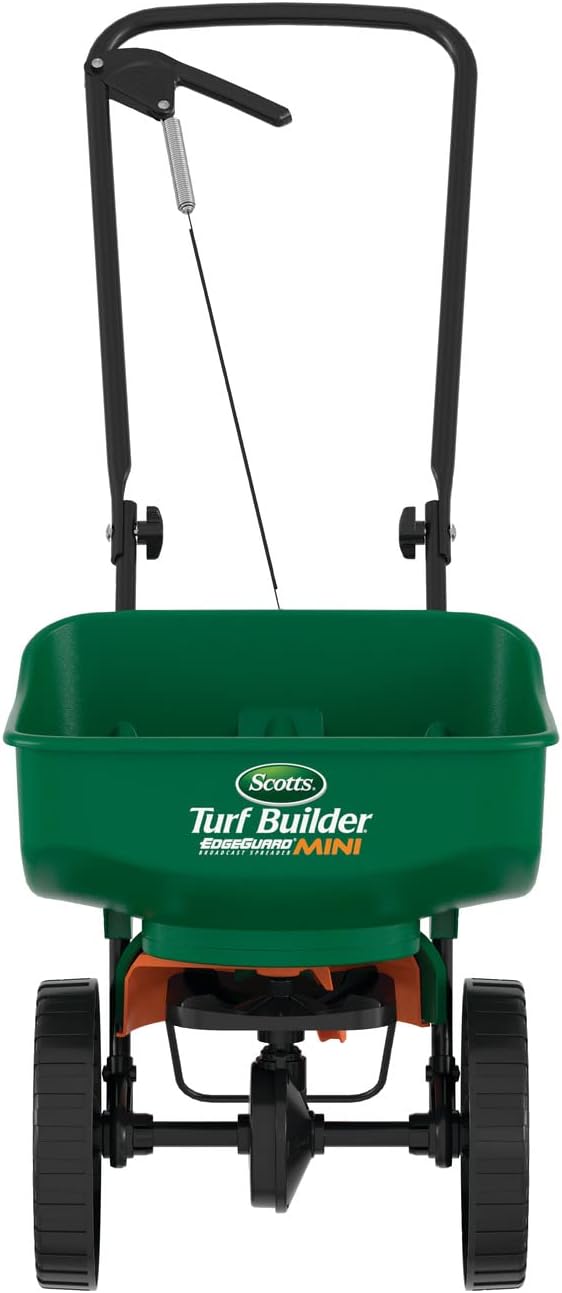
| Capacity | Up to 5,000 sq. ft. |
|---|---|
| Usage | Applies fertilizer, seed, granular weed control, salt, ice melt |
| Operation | Pre-calibrated with rate-control dial |
| Storage | Fold-down handle |
| Feature | EdgeGuard side shield |
The Scotts Turf Builder EdgeGuard Mini Broadcast Spreader is a pre-calibrated, ready-to-use push spreader for applying fertilizer, grass seed, granular weed control, salt, and ice melt on small lawns. It is typically used by walking the lawn while the rotating hopper distributes product; the included rate-control dial matches Scotts product settings so you can set it and go. Notable features include EdgeGuard technology to block the right-side spray and help avoid sidewalks and driveways, a redesigned curved hopper with a dual-bladed agitator for smoother product flow and consistent coverage, and fold-down handle for compact storage. Practical benefits are straightforward operation with no assembly, even distribution across up to 5,000 sq. ft., and durable open-spoke wheels that roll over common yard surfaces. Limitations are that it is sized for smaller yards so coverage and hopper capacity are modest compared with full-size models, and fine-tuning spread width is less precise than some professional spreaders. For a homeowner prioritizing ease of use and predictable results on a small lawn, this keeps lawn care simple and controlled.
Best for: A cautious homeowner who wants a simple, low-risk way to apply fertilizer and seed on a small to mid-size lawn without complicated setup or calibration.
Less Ideal for: Large properties, professional landscapers, or users needing high-capacity, highly adjustable commercial-grade spreading should consider a larger or pro-level spreader.
- Pre-calibrated and ready to use for common Scotts granular products
- EdgeGuard side shield prevents product from getting onto sidewalks and driveways
- Redesigned hopper and dual-blade agitator promote smooth, consistent flow
- Fold-down handle and compact size for easy storage
- Durable open-spoke wheels that do not go flat and roll over yard terrain
- Designed for smaller lawns so capacity and run time are limited compared with larger broadcast spreaders
- Less adjustable spread width compared with higher-end professional models
Verdict: A user-friendly, pre-calibrated mini broadcast spreader that gives reliable, controlled coverage and prevents product from hitting sidewalks and driveways, ideal for small lawns.
Choosing the Right Fertilizer Spreader for Lawns: Key Factors to Consider
Spread Pattern and Accuracy
How evenly a spreader distributes granules has a direct impact on lawn appearance and health. Uneven patterns leave streaks of over- and under-fed grass, which show up as color and growth inconsistencies. You should evaluate whether the unit offers a consistent broadcast arc or a drop pattern and if it includes adjustable deflectors to narrow the spread for edges and planting beds.
Calibration is part of accuracy. Good spreaders let you dial a specific output to match fertilizer application rates printed on product bags. A model that is easy to calibrate reduces guesswork and helps you follow label rates, which lowers the chance of burning turf. Look for clear markings and a reliable mechanism that does not slip while you walk.
Hopper Capacity and Refill Frequency
Hopper size determines how much area you can cover between refills. Larger hoppers save time on larger lawns but add weight and sometimes make a spreader less nimble. For smaller yards, a compact hopper is easier to store and handle; for medium to large lawns, choose a capacity that covers an entire pass without constant stopping.
Also consider how easy it is to refill. Wide openings, straightforward lids, and access to the flow gate make it quicker and less messy to top off the hopper. Some designs allow you to add product without bending low, which matters if you plan to do several applications per season.
Build Materials and Corrosion Resistance
Fertilizer corrodes metal and degrades some plastics over time. Materials and finishes therefore matter for longevity. Stainless or galvanized steel components resist rust better than bare steel, especially around fasteners and the spinner assembly. UV-stabilized plastics and reinforced housings hold up to sun exposure without cracking.
Also examine bearings, axle quality, and whether critical parts are serviceable. Replaceable spinner plates or flow controls extend usable life and mean you can keep a unit working rather than discarding it when a single part fails.
Flow Control and Application Features
Precise control over how much product is dispensed is essential for matching fertilizer label rates. Flow-control levers, variable gates, and indexed settings make it possible to repeat the same application across multiple passes or properties. Look for mechanisms that are not prone to clogging when using mixed or damp granules.
Additional features like side deflectors, shutoff valves for transport, and easy-to-see setting windows help you manage sensitive areas such as flower beds. The more control features a spreader has, the easier it is to avoid accidental over-application along sidewalks and driveways.
Maneuverability and Handling
How a spreader handles affects both comfort and the consistency of your application. Wheeled broadcast models need a smooth rolling action and an axle that resists bending. Lightweight handheld or push models are easier to steer around obstacles but may require more passes for larger areas. Consider handle ergonomics, whether the handle height is adjustable, and how the unit balances when full.
Large pneumatic tires roll better over rough lawns and reduce user fatigue. Compact wheels are fine on smooth turf but can create drag on thick or uneven grass. Choose a design that matches the terrain and your physical comfort during repeated use.
Cleaning, Maintenance, and Storage
Residual fertilizer left in a hopper or on metal parts causes rapid corrosion and can jam mechanisms. Models that open easily for rinsing, or that allow you to remove the spinner plate and gate without tools, simplify cleaning. Consider whether seals and moving parts are accessible for inspection and replacement.
Storage requirements are also relevant. A unit with a compact footprint or a folding handle will fit in small garden sheds. If you cannot store it under cover, prioritize materials and finishes rated for outdoor exposure to extend service life.
Which Spreader Type Fits Your Lawn
Different spreader designs suit different lawn sizes and user preferences. Walk-behind broadcast spreaders cover large areas faster and are good for medium to large yards. Drop spreaders provide a narrow, controlled placement ideal for precise fertilizing and for avoiding edging areas where you do not want granules to land.
For very small yards or tight spaces, handheld or small push models give the most control and are easy to store. Consider how the spread pattern and capacity of each type align with how often you want to refill and how comfortable you are pushing or pulling a heavier unit.
- Broadcast spreaders are faster and better for open lawns.
- Drop spreaders are more precise and reduce off-target application.
- Handheld units are best for spot applications and tight landscapes.
Calibrating Your Spreader for Accurate Application
Calibration aligns the spreader setting with the fertilizer bag rate so you apply the correct pounds per 1,000 square feet. Most spreaders have an indexed dial or lever; testing with a limited-volume run on a driveway and weighing the output helps confirm settings.
If you do not want to weigh product, use the manufacturer or extension service charts as a starting point and perform a small test strip on a non-critical area. Keep records of settings used for specific products so you can reproduce results in later seasons.
- Always read the fertilizer label for application rates.
- Test on a disposable surface to check actual output before treating the lawn.
Maintaining Even Coverage While Walking
Consistent walking pace and straight passes are as important as the machine itself. Overlapping passes slightly ensures edge-to-edge coverage without leaving gaps. To avoid streaks, plan a pattern such as parallel passes or a cross-hatch over a second application.
Watch for wind when using broadcast spreaders. Light wind can blow granules off course and create uneven application. When conditions are breezy, either slow down, use a drop spreader near sensitive areas, or schedule applications for calmer parts of the day.
- Keep a uniform walking speed for consistent spread.
- Overlap passes by a small margin to prevent gaps.
- Avoid applying in high wind to maintain placement accuracy.
Safety and Turf Health Considerations
Applying too much fertilizer in one spot can burn grass and stress soil biology. Accurate settings and even coverage minimize that risk. Also be careful near water features, storm drains, and planted beds to avoid runoff and nutrient pollution.
Wear gloves when loading and cleaning a spreader and rinse equipment soon after use. Store fertilizers and spreaders separately and out of reach of children and pets. Follow product label directions for timing and rates to protect turf and surrounding vegetation.
- Prevent runoff by avoiding slopes and wet conditions during application.
- Clean equipment promptly to reduce corrosion and cross-contamination.
Small-Lawn Strategies and Low-Volume Applications
If your lawn is very small, precise control and minimal payload matter more than capacity. A small drop spreader or handheld unit reduces waste and lets you target application to the grassy area without spilling onto walkways or patio stones. Smaller units also store easily and are simpler to calibrate for low rates.
For spot treatments or patch repair, use a unit that gives consistent, localized output. That helps avoid over-applying to surrounding healthy turf and makes it easier to blend treated patches into the rest of the lawn.
- Choose compact spreaders for terraces, yards with many obstacles, or tight storage spaces.
- Use smaller passes and lower settings when treating small squares of turf.
How We Chose the Best Fertilizer Spreader for Lawns
We prioritized practical, garden-focused criteria that affect real-world lawn results. Spread accuracy and calibration ability were key because uneven distribution is the most common cause of patchy growth and turf injury. Capacity and refilling convenience matter for time on the job and whether a single fill covers typical yard sizes. Durability of materials and corrosion resistance were assessed to predict how long a spreader will last outdoors when storing or using granular products. Control and application features such as adjustable flow settings, deflectors, and pattern control were included because they determine how precisely you can target edges, beds, and setbacks. Ease of cleaning and maintenance was considered since residual fertilizer accelerates corrosion and clogs mechanisms. We excluded tools that are strictly broadcast-only without any flow control or that are designed only for industrial or agricultural use beyond homeowner scale. Our short list emphasizes machines suitable for residential and light-commercial lawn care. The criteria described above guided selection and scoring, and are reflected in the per-product evaluation metrics.
FAQ
How often should I apply granular fertilizer with a spreader?
Frequency depends on the fertilizer type and lawn needs. Slow-release formulas are often applied two to four times per growing season, while quick-release products may be used less frequently or in smaller doses. Consider soil tests and turf growth patterns when planning applications.
Can I use the same spreader for seed and fertilizer?
Many spreaders handle both granules and grass seed, but particle size and flow characteristics differ. Clean the hopper and spinner thoroughly between uses to avoid cross-contamination and clogging. Check the spreader manual to confirm recommended materials.
What is the best way to avoid fertilizer burn when using a spreader?
Use accurate calibration to match bag rates, avoid applying on hot, drought-stressed turf, and water in according to product instructions when required. Uniform application and correct timing reduce burn risk.
Should I choose a drop or broadcast spreader for a medium-sized lawn?
It usually depends on priorities. Broadcast spreaders cover medium lawns faster and are efficient for open areas. Drop spreaders are more precise and reduce off-target application. If you have both open areas and borders, consider which trait is more important overall.
How do I store my spreader to prolong its life?
Empty and rinse the hopper after use, allow parts to dry, and store the unit in a dry, shaded location. If possible, elevate or hang the spreader to prevent wheel and axle contact with wet floors.
Final Verdict
Prioritize spread pattern accuracy and the level of control you need for your lawn size. Capacity, materials, and ease of calibration trade off against portability and storage. For large open lawns, a higher-capacity broadcast-style unit reduces trips, while smaller lawns benefit from precise drop or handheld models. Choose the spreader that matches your walking pattern, terrain, and willingness to perform routine cleaning. Focus on even application and a model you can maintain easily to protect turf health and get consistent results season after season.
