

Note: This article contains affiliate links. If you click on these links and make a purchase, I may earn a small commission at no extra cost to you. This helps support my research and content. Read my full affiliate disclosure here.
Choosing the right mulch can change how much insect pressure you see in beds, around foundation plantings, or near vegetable rows. The right materials limit pest hiding places, reduce attractive moisture patterns, and help plants stay vigorous so they resist pests naturally. This guide covers the top shortlisted mulches for preventing insects, explaining how each type behaves in a real garden setting and why it made the list. We evaluated options for moisture management, pest resistance, and garden compatibility so you can pick a mulch that reduces insect problems without harming soil life or plant health. Read on to learn which types work best for different planting situations.
Top Picks at a Glance
| Best Overall The best all-around choice for most situations | Cedarcide Insect-Repelling Cedar Granules (8 lb, 4-pack option) |  |
| Best Quality Built to a higher standard if you want something more solid | Wood Smith USA 100% Natural Cedar Shavings Mulch (8 Quart) |  |
| Best Value The sweet spot between price and what you get | Double Tree Forest Products Incense Cedar Wood Chips, 8 qt |  |
| Best Budget The cheapest option that still gets the job done reliably | Wood Smith USA 100% Natural Cedar Chips, 4 Quart Bag |  |
| Highest Rated A top-rated pick with lots of positive feedback | GranuCide Cedar Granules (8 lb) |  |
| Most Popular A crowd favorite that many people choose with confidence | Cedarcide Original Cedar Granules (8 lb) |  |
| Best Seller A high-volume bestseller chosen again and again | Cedarcide Cedar Granules Insect Repellent, 2 Bags (16 lbs) |  |
Cedarcide Insect-Repelling Cedar Granules (8 lb, 4-pack option)

| Manufacturer | Cedarcide |
|---|---|
| Material | 100% natural cedar shavings |
| Recommended reapply interval | Every 4–6 weeks |
| Effective against | Mosquitoes, fleas, ants, mites, chiggers |
Cedarcide cedar granules are a simple, chemical-free option for reducing insects around outdoor spaces by releasing the natural aroma of cedarwood. You use them by sprinkling granules around foundations, along fences, in flower beds, in potted plants, or across lawns; the product description recommends reapplying every 4 to 6 weeks or after heavy rain. Notable features are the 100 percent natural cedar composition, family and pet-safe formulation, and documented third-party testing for pests such as fleas, ants, mosquitoes, mites, and chiggers. Practical benefits include an easy, low-effort barrier for perimeter treatment and the ability to use the granules indoors in sachets for closets or houseplants. Limitations are that effectiveness depends on placement and weather so results are not instantaneous or absolute, and regular reapplication is needed to maintain protection; this is a preventative supplemental measure rather than a one-time fix for heavy infestations.
Best for: Gardeners who want a low-maintenance, natural perimeter repellent and prioritize family and pet safety for routine outdoor pest control.
Less Ideal for: If you need immediate elimination of an active infestation or a long-lasting, chemical treatment, choose a targeted insect control product or professional service instead.
- 100% natural cedar granules provide a nonchemical repellent option
- Safe for families and pets when used as directed
- Versatile application: use outdoors around foundations, beds, lawns and indoors in sachets
- Simple to apply and suitable for regular perimeter maintenance
- Third-party testing reported for common pests including fleas, ants and mosquitoes
- Requires reapplication every 4–6 weeks and after heavy rain to remain effective
- Not a standalone solution for severe infestations or active nests
Verdict: A safe, low-effort natural barrier for routine insect control around lawns and garden edges.
Wood Smith USA 100% Natural Cedar Shavings Mulch (8 Quart)

| Brand Name | Wood Smith USA |
|---|---|
| Item Type Name | Cedar Mulch |
| Volume | 8 quarts |
| Unit Count | 297.84 Ounce |
This 8-quart bag of 100% natural cedar shavings is a lightweight, versatile mulch useful for potted plants, hanging baskets and small garden beds. In practice it is most often used as a top layer to help the soil retain moisture and to reduce surface evaporation around plants like dahlias. The shavings also provide a mild cedar scent that can mask odors in animal bedding or planters and can be repurposed for sachets. Because the product is a natural shredded wood material, particle size varies and it will break down over time, slowly adding organic matter but requiring occasional replenishment. It is easy to spread by hand in small areas but the 8-quart volume is modest, so multiple bags are needed for larger beds. Note the safety warning about wood dust when cutting or sanding it; that is not relevant for normal mulching but matters if you process the material. Overall this is a practical, odor-mitigating mulch for gardeners who want a natural, aromatic option for containers and small dahlia plantings.
Best for: Gardeners who grow dahlias in containers or maintain a few small beds and want an easy-to-apply, natural mulch that helps retain moisture and adds a mild cedar aroma.
Less Ideal for: Those needing to cover large in-ground dahlia plots or who prefer uniform, long-lasting commercial mulches designed for bulk landscape use.
- 100% natural cedar provides a subtle scent that helps mask odors in planters and animal bedding
- Lightweight shavings hold surface moisture and reduce evaporation for potted plants and small beds
- Hand-packed 8 quart bag is convenient for container gardeners and hanging baskets
- Shavings break down over time and contribute organic matter to the soil
- Modest 8-quart volume means you will need several bags to cover larger dahlia beds
- Shredded particle size is variable, which may lead to uneven coverage compared with uniform mulches
Verdict: A convenient small-bag natural cedar mulch that helps container and small-bed dahlias retain moisture while adding a pleasant cedar scent.
Double Tree Forest Products Incense Cedar Wood Chips, 8 qt

| Material Type | Cedar |
|---|---|
| Item Form | Chip |
| Scent Name | Cedarwood |
| Package Size Name | 8 Quart |
These Double Tree incense cedar chips are a versatile loose wood-chip product intended for garden beds, potted plants, chicken coops and pet litter. The bag contains shredded cedar made from salvaged Sierra Nevada incense cedar that is kiln-dried and packed, so the chips are consistent in size and reasonably low in moisture for easy spreading. In the garden the chips work as a decorative mulch layer that helps retain soil moisture and can reduce minor weed germination when applied at typical mulch depths. The natural cedar scent also helps mask odors, which is why people use it in coops and litter boxes. Because this is a small 8-quart bag of chips it is best for spot applications, raised beds, container gardens or refreshes rather than large landscape projects. The product is 100 percent cedar and does not contain blended fillers, but expect the aromatic oil to be strong for sensitive pets or people until the chips weather. If you need bulk coverage you will need multiple bags or a larger size from the same brand.
Best for: Buyers who want a high-quality, multipurpose cedar chip for small-scale garden tasks, container beds, coop bedding or litter box use and who value a convenient, ready-to-use bag.
Less Ideal for: Landscapers or homeowners needing to mulch large areas should consider bulk mulch options or larger bag sizes instead.
- Made from real incense cedar salvaged and kiln-dried for consistent chips
- Multipurpose use: suitable for mulch, potted plants, chicken coop bedding and litter boxes
- Natural cedar scent helps control odors without added chemicals
- Small 8 quart size is easy to handle and convenient for spot improvements
- Small bag size means multiple bags are required for larger beds
- Strong cedar aroma may be overpowering for some people or sensitive animals
Verdict: A convenient small-bag, real-cedar chip that delivers moisture retention and natural odor control for spot gardening and bedding applications.
Wood Smith USA 100% Natural Cedar Chips, 4 Quart Bag
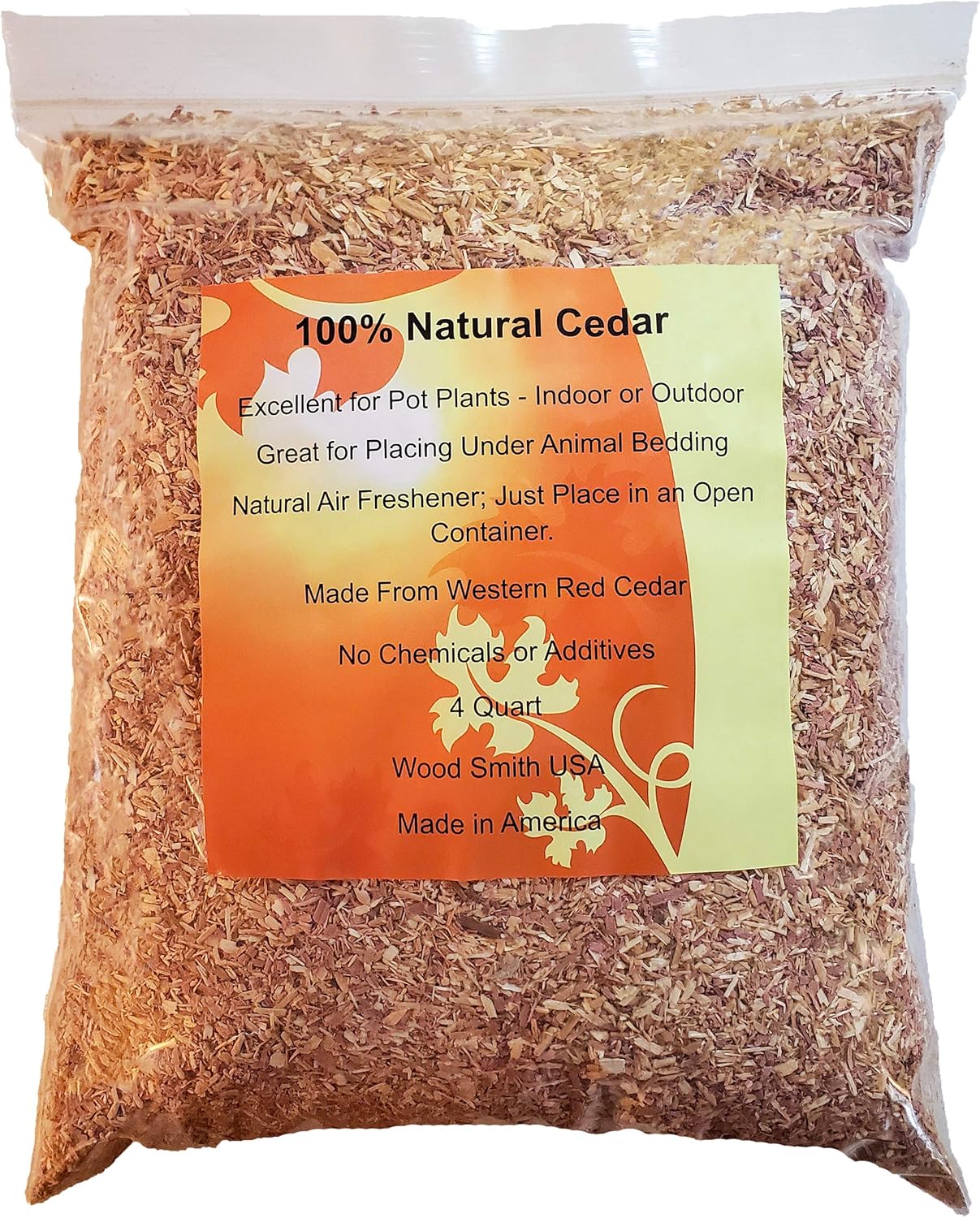
| Brand Name | Wood Smith USA |
|---|---|
| Unit Count | 148.92 Ounce |
| Number of Packs | 1 |
| Volume | 1 |
These 100% natural cedar chips are a lightweight, aromatic mulch sold in a 4-quart bag that works best as a top dressing for potted plants, hanging baskets, and small garden patches. The cedar scent helps deter some insects and can freshen indoor potting mixes, while the chips also help retain surface moisture and reduce light reaching weed seeds. Because the bags are hand sifted and packed, quality is generally consistent for small jobs, and the product is easy to spread with minimal tools. The obvious limitation is the small volume — a single 4-quart bag covers only a very small area, so multiple bags are required for beds or larger weed-control projects. The chips are also coarse compared with fine mulches, so they are better for decorative surface cover than for forming a dense, weed-suppressing mat. Handle the product carefully to avoid inhaling dust and follow guidance if using around animals.
Best for: Buyers looking for an inexpensive, small-quantity mulch to refresh pots, hanging planters, or to try cedar for insect control in limited areas.
Less Ideal for: Gardeners who need to cover large beds or who want a fine-textured mulch for dense weed-smothering should choose larger bulk bags or finer mulches instead.
- Natural cedar composition that repels some insects and adds a pleasant scent
- Small 4-quart bag useful for potted plants, hanging baskets, and spot treatments
- Helps retain surface moisture and reduces light to surface weed seeds
- Hand-sifted and hand-packed for generally consistent small-batch quality
- Very small volume so not cost-effective for large beds
- Coarse chip size offers less dense weed suppression than finer mulches
Verdict: A handy, low-cost 4-quart cedar chip bag for small-scale potting and spot weed control where you want a natural scent and insect-repellent benefits.
GranuCide Cedar Granules (8 lb)
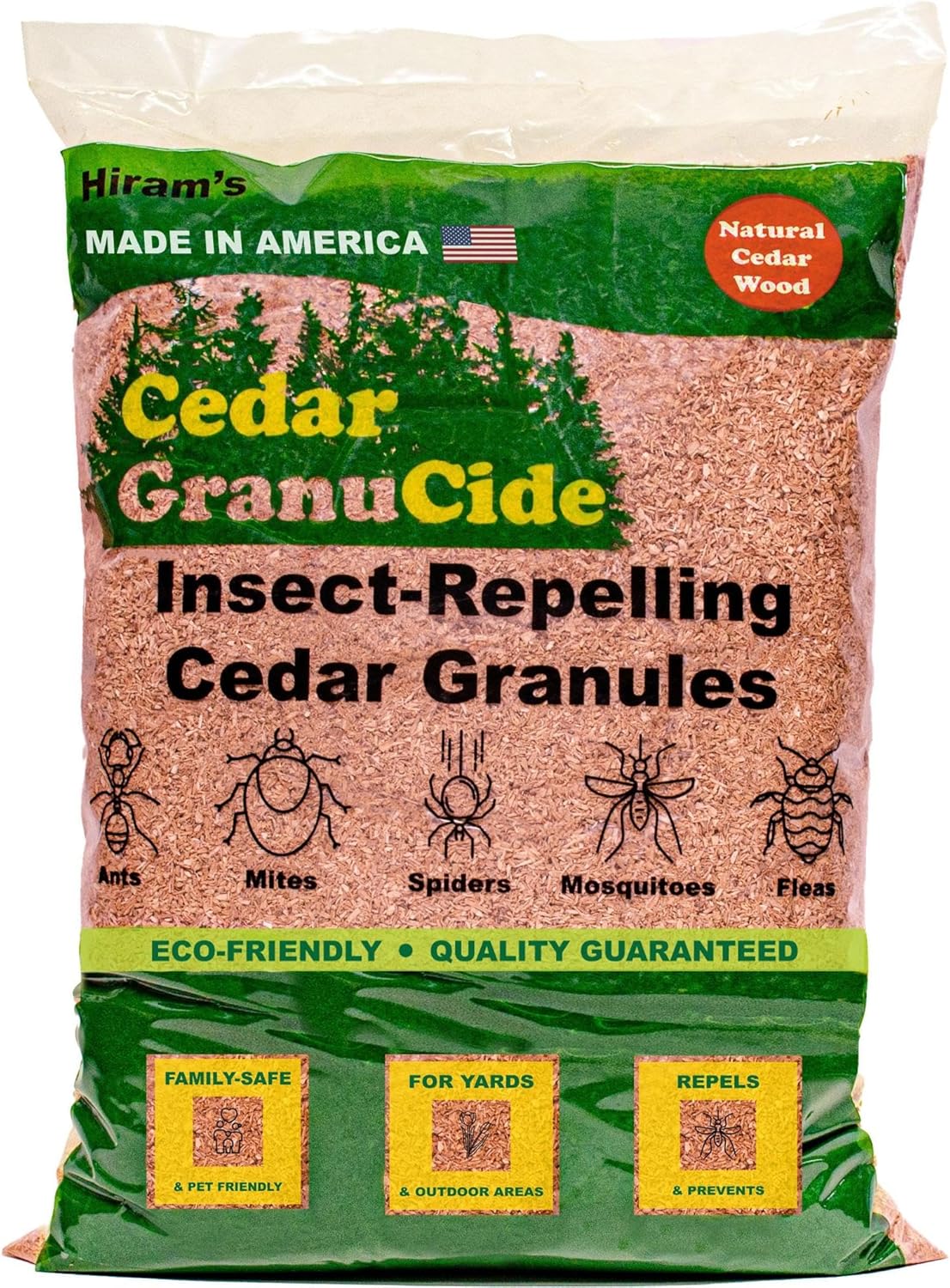
| Ingredients | 100% cedar granules |
|---|---|
| Directions | Sprinkle in indoor and outdoor areas such as potted plants, gardens, lawns, patios, and perimeters |
| Made in | America |
| Weight | 8 pounds |
GranuCide Cedar Granules are coarse cedar chip shavings sold as an easy-to-use, chemical-free option for deterring insects around yards, patios, and potted plants. You apply them by sprinkling a thin layer around garden beds, along foundations, in planters, or inside sheds where pests congregate. The product is made from untreated Pacific Northwest cedar and emits a natural aroma that repels mosquitoes, ants, spiders, fleas, chiggers and other common garden pests without pesticides. As a mulch the granules also serve decorative and moisture-conserving purposes while being safe for children and pets. Limitations to expect are that the scent fades with time and rain so reapplication is necessary after heavy watering or storms, and a single 8 lb bag covers a modest area compared with larger bulk mulches. For someone focused on nonchemical, maintenance-light pest reduction, the granules offer a low-risk, dual-purpose solution that is straightforward to use and fits small to medium areas where targeted insect control is desired.
Best for: Gardeners who prioritize effective, low-toxicity pest control and want a simple mulch-based solution for small to medium beds and container plantings.
Less Ideal for: Homeowners who need wide-area or long-lasting insect control without reapplication or those who prefer a fully maintenance-free approach.
- 100% natural untreated cedar provides a nonchemical insect deterrent
- Pleasant aroma that repels a broad list of common garden pests
- Safe for use around children and pets when applied as directed
- Also functions as a decorative mulch that helps retain soil moisture
- Scent and repellent effect diminish over time and after heavy watering requiring periodic reapplication
- 8 lb bag is relatively small so multiple bags are needed for larger beds
Verdict: Choose these cedar granules when you want a pet-safe, chemical-free mulch that reduces common garden pests while also improving soil cover.
Cedarcide Original Cedar Granules (8 lb)

| Unit Count | 128 Ounce |
|---|---|
| Item Form | Granules |
| Target Species | Insects |
| Special Features | Weather-Resistant |
| Active Ingredients | cedar granules |
Cedarcide Original Cedar Granules are loose cedar shavings you spread around lawns, flower beds, patios, and foundations to create an insect-repelling barrier. The granules release a natural cedar aroma that interferes with insect pheromones and is claimed to deter mosquitoes, fleas, ants, chiggers, mites, and spiders. Typical use is simple: sprinkle by hand or with a spreader, focus on perimeters, planters, and high-traffic outdoor living areas, and reapply every 4 to 6 weeks or after heavy rain. Notable features include 100 percent cedar content, weather-resistant formulation, and suitability for indoor uses like sachets for closets or potted plants. Practical benefits are a low-toxicity alternative to chemical sprays, easy application across large areas, and dual indoor/outdoor versatility. Limitations are that effectiveness depends on coverage and reapplication frequency, it is not a kill-on-contact insecticide so results can be gradual, and very wet conditions or heavy foot traffic will shorten the interval between treatments.
Best for: Buyers who prioritize low-toxicity, natural pest control and want an easy-to-use product to reduce nuisance insects around lawns, beds, and patios while keeping children and pets safe.
Less Ideal for: People who need fast knockdown or long-term insect elimination without frequent maintenance should consider conventional insecticides or targeted baits instead.
- 100% natural cedar granules provide a chemical-free repellent option
- Easy to apply by hand or with a seed/spreader and suitable for both indoor and outdoor uses
- Weather-resistant formulation intended for outdoor perimeter and garden use
- Requires regular reapplication (every 4–6 weeks or after heavy rain) to maintain effect
- Works as a repellent rather than an immediate insect kill so results may be gradual
Verdict: A simple, family- and pet-safe cedar-based repellent that lets you reduce outdoor nuisance insects without synthetic chemicals.
Cedarcide Cedar Granules Insect Repellent, 2 Bags (16 lbs)
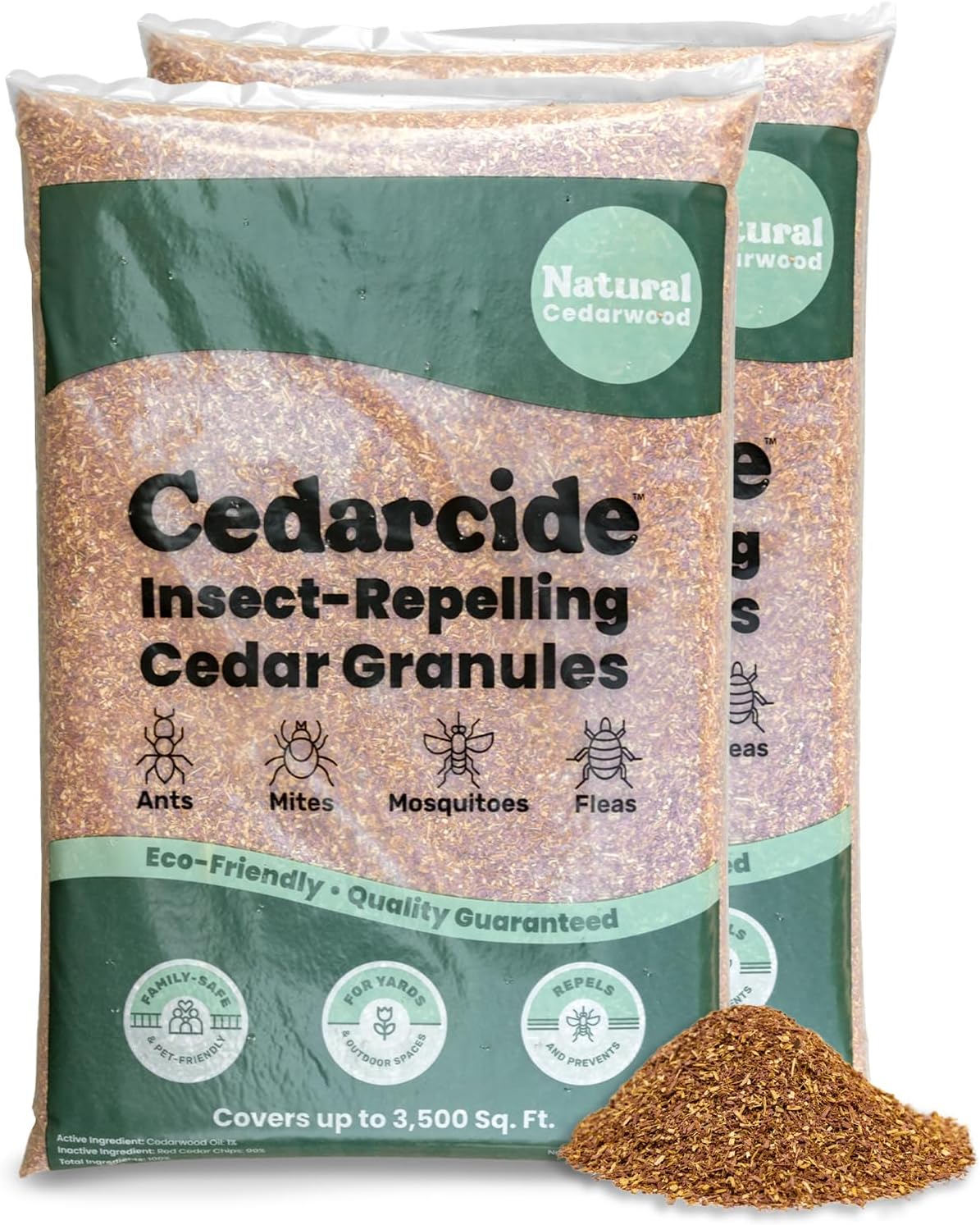
| Ingredients | cedar granules |
|---|---|
| Reapply | Every 4–6 weeks |
| Area of use | Lawns, gardens, outdoor |
| Family Safe | Yes |
| Pet Safe | Yes |
Cedarcide cedar granules are a simple, chemical-free option for reducing mosquitoes, fleas, ants, chiggers and similar pests around lawns, beds and foundations. You spread the granules by hand or with a seeder along borders, under shrubs, around patios and near entry points to create a fragrant barrier; reapplication is recommended every 4 to 6 weeks or after heavy rain. Because the product is 100% cedar shavings, the active effect comes from the wood aroma interfering with insect pheromones rather than toxic ingredients, which makes it suitable for yards where children and pets play. Practical benefits include easy application, multiple indoor and outdoor uses (sachets for closets or in plant pots), and a low environmental footprint from sustainably sourced cedar. Limitations are that results are gradual and variable by pest and weather, a single bag covers a limited area so larger properties require multiple bags, and cedar scent may be noticeable to people who prefer no fragrance.
Best for: Homeowners who want a low-toxicity, maintenance-friendly mulch that adds insect-repelling benefit across typical yard and garden areas while prioritizing safety for children and pets.
Less Ideal for: People dealing with severe infestations who need fast, high-efficacy control or those who need an odorless mulch solution.
- Made from 100% natural cedar shavings so no synthetic insecticides are applied to the lawn
- Safe for use around families and pets when applied as directed
- Versatile placement: lawns, flower beds, foundations, patios and indoor sachets
- Simple application with hand-spreading or a seed spreader and predictable 4–6 week reapplication interval
- Effectiveness is weather-dependent and may be inconsistent against heavy infestations
- Requires regular reapplication and multiple bags for larger yards
- Distinct cedar aroma may be noticeable or unwanted by some users
Verdict: Choose these cedar granules if you want a natural, family-safe mulch that helps repel common yard insects with simple, repeatable applications.
Choosing the Right Mulch to Prevent Insects: Key Factors to Consider
Moisture Regulation
How mulch manages water around plants directly affects insect habitat. Mulch that holds excessive moisture near stems or crowns can create breeding or hiding sites for slugs, root-feeding grubs, and moisture-loving insects. Conversely, a mulch that sheds surface water and allows air exchange reduces prolonged dampness and makes the microclimate less attractive to many pests.
Consider local climate and irrigation practices when choosing a material. In heavy clay soils, a more porous, coarse mulch helps prevent waterlogged conditions. In hot, dry climates, a mulch that retains moderate moisture without staying soggy supports plant health without encouraging pests.
Pest Resistance
Some mulches are inherently less attractive to insects due to texture, chemistry, or how they break down. Coarse materials tend to discourage small crawling insects and reduce continuous sheltered space. Certain organic mulches release compounds as they decompose that can deter specific pests, while inorganic mulches provide a physical barrier that pests cannot use as nesting material.
Evaluate whether a mulch will attract insects during breakdown. Fresh wood chips often have fewer immediate pest issues than piles of uncomposted bark or plant debris. Avoid mulches that include large amounts of decomposing green material, which can briefly attract flies and other scavengers.
Durability
Durability determines how long a mulch layer remains effective at suppressing pest habitat and protecting soil. Materials that break down quickly need frequent replenishment, which increases disturbance and can expose insects hiding below. Long-lasting mulches maintain a stable surface and reduce the need for repeated handling around plant bases.
Balance longevity against soil-building goals. If you want to increase organic matter quickly, choose a faster-decomposing mulch but accept more frequent replacement. For low-maintenance beds where minimizing insect disturbance is a priority, favor more durable options.
Soil Health Impact
Mulch choices influence soil temperature, microbial activity, and nutrient cycling, all of which affect plant vigor and susceptibility to insects. Materials that cause nitrogen tie-up or drastically change soil pH can weaken plants and indirectly increase pest problems. Conversely, mulches that support a healthy soil food web help plants resist or recover from insect damage.
Consider whether you want a mulch that builds organic matter over time or one that primarily serves as a physical barrier. Choose materials that complement your soil type and the needs of the plants being mulched.
Ease of Application and Maintenance
How easy a mulch is to spread, maintain, and refresh matters for keeping insect pressure low. Thick, uneven layers or messy materials that are difficult to rake can create small pockets that harbor pests. Mulches that compact or mat can trap moisture and shelter insects unless periodically loosened.
Select mulches that suit your capacity for upkeep. If you prefer low-effort beds, pick materials that lie flat, require minimal top-ups, and are simple to tidy around vulnerable stems and trunks.
How Mulch Affects Insect Behavior
Mulch changes the microclimate at the soil surface, and insects respond to those changes. Many pests seek cool, moist, and sheltered spots; altering moisture retention and surface texture makes an area more or less hospitable. For example, a coarse, airy mulch warms and dries faster after rain, discouraging moisture-loving pests, while dense, compacted layers can stay damp and attractive.
Mulch also influences predators and beneficial insects. A well-chosen material can support ground beetles, spiders, and other natural enemies by providing stable cover without creating overwintering refuges for pests. Think of mulch as habitat management rather than just a decorative layer.
- Airy, coarse mulches dry faster and reduce moisture-dependent pests.
- Dense, fine mulches can form mats that retain moisture and shelter insects.
- Mulch that supports beneficial predators helps long-term pest control.
Placement Tips to Minimize Insect Problems
How you apply mulch is as important as the material. Keep mulch pulled back a few inches from stems and trunks to reduce direct contact where insects or moisture can cause rot or create entry points. Create a smooth, even layer rather than piling mulch into volcanoes around trunks.
Maintain proper depth for the chosen material. Most mulches work well at 2 to 3 inches; deeper layers may stay too cool and moist, while very thin layers fail to suppress habitat. Adjust depth based on material particle size and the plants' needs.
- Leave a small gap at plant bases to prevent moisture buildup against stems.
- Spread mulch evenly and avoid overly thick layers that trap moisture.
- Replenish mulch in targeted areas rather than disturbing the entire bed at once.
Seasonal Considerations and Timing
Timing mulch application can affect insect populations. Applying fresh mulch in spring can suppress early-season pests and moderate soil temperature as roots become active. In late fall, avoid piling fresh organic material too close to plant crowns where overwintering insects may be sheltered.
Plan routine inspections after major seasonal changes. Check for signs of pests under the mulch, especially in spring when insects become active, and rake or thin layers if you notice excessive moisture or pest activity.
- Apply or refresh mulch in spring for a clean start and reduced pest overwintering sites.
- Thin or aerate mulches in wet seasons to improve drying.
- Inspect beneath mulch after storms or prolonged wet periods.
Integrating Mulch With Other Pest Management Practices
Mulch is one part of an integrated approach. Combine the right mulch with crop rotation, sanitation, and encouraging beneficial predators for best results. Removing plant debris, pruning to improve airflow, and managing irrigation all reduce the likelihood that mulch will become a refuge for pests.
Monitor regularly and respond to pest signs early. A good mulch choice reduces risk but does not eliminate the need for standard cultural controls and targeted interventions when populations build.
- Use mulch to complement sanitation and irrigation adjustments.
- Encourage predator habitat with mixed plantings and undisturbed areas away from high-value crops.
- Treat localized pest hotspots rather than disturbing entire beds indiscriminately.
Mulch Application Around Vegetables and Edibles
When mulching vegetable gardens, prioritize materials that do not introduce weed seeds or chemical residues. Edible beds benefit from mulches that moderate soil moisture without staying wet at crowns, and from those that are easy to remove or refresh during crop rotations.
Avoid mulches that decompose into fine, compacting layers directly on top of shallow-rooted crops. Consider using slightly coarser materials in rows and keeping aisles mulched with a stable, drier option to reduce insect movement into plant crowns.
- Choose seed-free, clean mulches in vegetable rows.
- Favor coarser particles for shallow-rooted crops to improve drainage.
- Keep mulch management simple for seasonal crop turnover.
How We Chose the Best Mulch to Prevent Insects
We focused on attributes that affect insect activity and plant health in real garden settings. Primary criteria included moisture control, because overly wet mulch creates habitat for many pests; pest resistance, meaning the material is less likely to attract or shelter insects; durability, which affects how often mulch needs replacing and how long it suppresses pest habitat; and soil health impact, since some mulches alter soil temperature or chemistry and can indirectly change pest pressure. We also considered ease of application and maintenance, looking for materials that are straightforward to install and manage without frequent disturbance that could expose pests. Environmental impact was included to favor mulches that support beneficial soil organisms and avoid introducing disease or invasive seeds. Exclusions included any material with known regulatory restrictions or documented harm to garden ecosystems. Products that performed well only under niche lab conditions but lacked real-world practicality were also excluded. These filters produced a shortlist of versatile mulches that balance insect suppression with garden-friendly performance, aligning with the scoring dimensions used in our per-product breakdowns.
FAQ
Does mulch always attract insects?
Not always. The effect depends on the type and condition of the mulch. Coarse, well-aged materials and inorganic mulches are less likely to provide shelter for pests than fresh, wet, or compacted organic material.
How close should mulch be to plant stems to avoid insect problems?
Keep mulch pulled back a few inches from stems and trunk collars to reduce moisture contact and hiding spots for insects. This small gap also helps you spot early signs of pests or disease.
Will mulch stop underground pests like grubs?
Mulch alone rarely eliminates subterranean pests. It can change soil conditions to make the environment less favorable, but effective control usually requires integrated practices like promoting healthy predators, monitoring, and targeted management.
Is inorganic mulch safer for preventing insects?
Inorganic mulches provide a physical barrier that many insects cannot use as nesting material, which can reduce aboveground shelter. However, they do not improve soil health and may require different irrigation adjustments.
How often should I refresh mulch to keep insect pressure low?
Refresh frequency depends on material durability. Faster-decomposing mulches may need topping annually, while longer-lasting options can go several years. Inspect the bed yearly and top up thin or compacted areas as needed.
Final Verdict
Pick a mulch that balances moisture management, pest resistance, and how much maintenance you want to do. Coarser, well-draining materials and stable inorganic surfaces tend to reduce insect harborage, while rapidly decomposing organic layers may require closer attention. Weigh tradeoffs between soil-building goals and immediate pest suppression. Prioritize materials that fit your climate, plant types, and maintenance rhythm so you can reduce insect problems while supporting long-term garden health.
