

Note: This article contains affiliate links. If you click on these links and make a purchase, I may earn a small commission at no extra cost to you. This helps support my research and content. Read my full affiliate disclosure here.
A tidy, well-managed fence line reduces habitat for pests, prevents weeds from encroaching on beds, and improves property appearance. Picking the right fence row herbicide matters because products vary in which weeds they control, how long they persist in the soil, and how they must be applied around desirable plants. This guide shortlists seven top-performing fence row herbicides suited to typical yard and rural boundary needs. We evaluate each option on knockdown efficacy, residual control, and ease of application so you can choose a product that fits your fence-line conditions and maintenance plan.
Top Picks at a Glance
| Best Overall The best all-around choice for most situations | RM43 Concentrated Extended Control Weed Killer (1 gallon) |  |
| Best Quality Built to a higher standard if you want something more solid | Garlon 4 Ultra Triclopyr Herbicide, 2.5‑gal |  |
| Best Value The sweet spot between price and what you get | Southern Ag Brush Weed Killer, 1 Quart |  |
| Best Budget The cheapest option that still gets the job done reliably | Compare-N-Save Glyphosate Concentrate Grass & Weed Killer, 16 oz |  |
| Highest Rated A top-rated pick with lots of positive feedback | Corteva Agriscience Remedy Herbicide |  |
| Most Popular A crowd favorite that many people choose with confidence | RM43 Total Vegetation Control 43% Glyphosate Plus Weed Preventer, 2.5-Gallon |  |
| Best Seller A high-volume bestseller chosen again and again | Roundup Weed & Grass Killer with Comfort Wand, 1.33 gal. |  |
RM43 Concentrated Extended Control Weed Killer (1 gallon)

| Unit Count | 128 Fluid Ounces |
|---|---|
| Item Form | Spray |
| Coverage | 17297 square feet |
| Active Ingredients | glyphosate |
RM43 is a concentrated glyphosate‑based weed killer blended for broad, long‑lasting vegetation control on noncrop areas. You mix it with water and apply through a sprayer to drive down perennial weeds, fence lines, gravel areas, and other places where you want no plant growth. The formula pairs glyphosate with a second herbicide and a surfactant so it kills to the root and claims prevention of new growth for up to a year while becoming rainfast in about two hours. A single gallon treats a large area, making it suitable for larger properties or professional use. Important practical limits are safety and site restrictions: it must not be used near desirable plants or crops and requires cautious handling to avoid drift and contact with skin and eyes. For routine spot treatments it is concentrated enough that careful measuring is needed, and it is intended only for areas where total vegetation removal is acceptable.
Best for: Buyers who need a powerful, long‑lasting solution for clearing and keeping large nonplant areas free of vegetation, including property managers and professional landscapers focused on durable results.
Less Ideal for: Gardeners who need selective weed control around ornamentals or vegetable beds or those who want an organic or low‑toxicity option should choose a different product.
- Concentrated one‑gallon formula treats large areas, reducing trips to refill
- Combination of glyphosate and a second herbicide for deeper, longer control
- Rainfast in about two hours so results are less affected by light rainfall
- Designed for total vegetation control and claims up to 12 months of prevention
- Not selective so will kill desirable plants and must be applied only to noncrop areas
- Requires careful mixing and handling because of strong active ingredients
Verdict: Choose RM43 when you need a concentrated, professional‑strength herbicide that kills to the root and provides long‑term vegetation control on noncrop areas.
Garlon 4 Ultra Triclopyr Herbicide, 2.5‑gal

| Unit Count | 320 Fluid Ounces |
|---|---|
| Liquid Volume | 2.5 gallons |
| Item Form | Spray |
| Active Ingredients | triclopyr |
| Coverage | Broad-spectrum for woody plants, broadleaf weeds, and brush |
Garlon 4 Ultra is a professional-strength triclopyr herbicide sold in a 2.5-gallon jug for large fence rows, rights-of-way, and other non-crop sites. It is typically mixed to label rates for foliar sprays or combined with oil for basal bark and cut-stump applications, giving flexibility to tackle trees, brush, and perennial broadleaf weeds. The high active ingredient concentration and broad-spectrum coverage mean fewer applications are usually needed on established woody species like sumac, locust, and buckthorn. Practical benefits include suitability for large acreage work, compatibility with oil mixes for targeted stump or bark treatments, and clear label directions for specific grass and woody targets. Important limitations are that it is intended for non-crop areas only, requires careful handling and PPE because of its potency, and local regulations may restrict use in some states; it is not formulated for home-vegetable gardens or areas where sensitive plants may be affected. Follow label rates and safety instructions to avoid off-target damage.
Best for: Buyers who need a heavy-duty herbicide for long fence rows, rights-of-way, or large non-crop areas and prioritize reliable control of woody brush and persistent broadleaf weeds.
Less Ideal for: Home gardeners treating small beds, vegetable plots, or ornamental landscapes with sensitive plants should choose a product formulated for those settings or nonchemical methods.
- High concentration of triclopyr effective on woody plants and perennial broadleaf weeds
- Versatile application options: foliar spray, basal bark, and cut-stump when mixed with oil
- Large 2.5-gallon volume suitable for treating long fence lines and extensive rights-of-way
- Label provides specific application rates for different targets, aiding accurate use
- Not labeled for use in crop or home edible gardens and restricted in some states
- Requires protective equipment and careful handling due to chemical potency
Verdict: Choose Garlon 4 Ultra when you need a powerful, professional-grade herbicide to control woody brush and broadleaf weeds along long fence lines and rights-of-way.
Southern Ag Brush Weed Killer, 1 Quart

| Unit Count | 32 Fluid Ounces |
|---|---|
| Item Form | Spray |
| Coverage | 512-1024 square feet per gallon |
| Active Ingredients | Herbicide, triclopyr |
Southern Ag Brush Weed Killer is a liquid herbicide built for treating fence lines, pastures, roadsides and other non-crop areas where woody brush and vines are a problem. It is typically applied as a foliage spray diluted at about 4–8 ounces per gallon for general brush control, or used undiluted for stump treatment to prevent resprouting. The product contains 8.8% triclopyr, the same active ingredient found in professional brush killers, which makes it effective on tougher species that common glyphosate mixes struggle with. A practical benefit is the clear application guidance for foliage and stump use and its stated coverage rate, which helps estimate how much area a quart will treat. Limitations are that it is intended only for non-crop areas and targets woody plants rather than broadleaf weeds or lawn grass, and standard chemical-safety precautions are required when mixing and applying. For fence-line work it delivers focused brush control without needing specialized equipment beyond a sprayer.
Best for: Buyers who need an affordable, no-frills herbicide to clear and prevent regrowth along fence lines and other non-crop boundaries and who prioritize effective brush control over general weed control.
Less Ideal for: Homeowners seeking a product for lawns, gardens, or edible-plant areas should avoid this and choose a broadleaf or turf-safe herbicide instead.
- Contains 8.8% triclopyr, effective on woody brush and vines
- Can be used diluted as a foliage spray or undiluted for stump treatments
- Clear application rates and estimated coverage per gallon aid planning
- Formulated for non-crop areas only and not suitable for lawn or garden spot treatments
- Contains a strong herbicide that requires careful handling and PPE during use
Verdict: A cost-conscious, effective brush killer for clearing and preventing woody regrowth along fence lines and other non-crop boundaries.
Compare-N-Save Glyphosate Concentrate Grass & Weed Killer, 16 oz

| Active Ingredients | Glyphosate |
|---|---|
| Liquid Volume | 16 fluid ounces |
| Coverage | 3000 square feet |
| Makes up to | 10 gallons of spray solution |
| Rainproof time | 2 hours |
This 16-ounce concentrate uses glyphosate to kill unwanted grasses, annuals, and many perennials by absorption through foliage and translocation to the root. It is mixed with water to create a ready-to-use spray and is meant for spot treatments around driveways, walkways, fences, and for site preparation where you want to remove existing vegetation. The label lists a general mix rate for light weeds and a stronger rate for tougher perennials or brush, and one bottle can treat up to roughly 3,000 square feet when diluted as directed. Practical benefits include fast visible browning in a few days and the ability to replant most ornamental areas quickly because glyphosate has no long soil residual. Important limitations are that glyphosate will kill any green plant it contacts so careful application and protective gear are required, and some persistent woody bamboos or rhizomes may need repeated applications or complementary mechanical removal for full eradication.
Best for: Buyers on a budget who need an economical, systemic herbicide for clearing large patches of unwanted vegetation and preparing sites for replanting. Ideal for homeowners willing to apply a concentrated product carefully and follow safety directions.
Less Ideal for: Not a good choice for gardeners who need a selective product that spares surrounding plants or for those unwilling to use chemical controls around edible gardens without following label restrictions.
- Concentrated formulation stretches to make up to 10 gallons of ready-to-use spray.
- Contains glyphosate which provides systemic control that moves to roots for effective kill.
- Fast visible results within 2 to 4 days after application.
- No soil residual so treated ornamental areas can be replanted quickly when label allows.
- Will damage or kill any desirable green plant contacted, requiring careful spot application and drift control.
- May require multiple applications or mechanical removal to control aggressive or established bamboo rhizomes.
Verdict: A cost-effective glyphosate concentrate that makes a lot of spray and delivers quick systemic weed control for budget-conscious clearing and site preparation.
Corteva Agriscience Remedy Herbicide

| Manufacturer | Corteva Agriscience |
|---|---|
| Part Number | Remedy |
| Coverage | 1 acre |
Corteva Remedy is a targeted herbicide designed for controlling woody plants and broadleaf weeds on rangeland, permanent grass pastures, CRP acres, fence rows, and non-irrigation ditch banks. It is typically mixed and applied with standard ground equipment by land managers, ranchers, or contractors to treat large areas up to the labeled coverage. Notable features include professional-grade formulation and one-acre coverage per unit as stated by the manufacturer, plus labeled directions for specific noncropland uses. In practice Remedy delivers effective broadleaf and woody plant control when applied according to label directions, and the product's concentrated form reduces the number of trips required to treat a field. Important limitations are that it is intended for noncropland settings only and requires protective equipment during application, so it is not suitable for casual home-garden use and needs someone comfortable with herbicide handling and compliance with label restrictions.
Best for: Buyers who need a reliable, professional herbicide for managing weeds and woody plants across pasture, rangeland, or conservation acres and who follow labeled application practices.
Less Ideal for: Casual gardeners, homeowners, or anyone seeking a multipurpose home garden weed killer or a product for irrigated turf should look for consumer-labeled alternatives.
- Professional-strength formulation for woody plant and broadleaf weed control
- Labeled for large-area uses such as rangeland, pastures, and CRP acres
- Concentrated product covers one acre per unit as indicated by manufacturer
- Clear label directions for the specified noncropland applications
- Not formulated or labeled for general home or ornamental garden use
- Requires use of protective equipment and familiarity with herbicide handling
Verdict: Choose Remedy when you need a dependable, professional-strength herbicide for managing woody plants and broadleaf weeds on pasture and rangeland.
RM43 Total Vegetation Control 43% Glyphosate Plus Weed Preventer, 2.5-Gallon
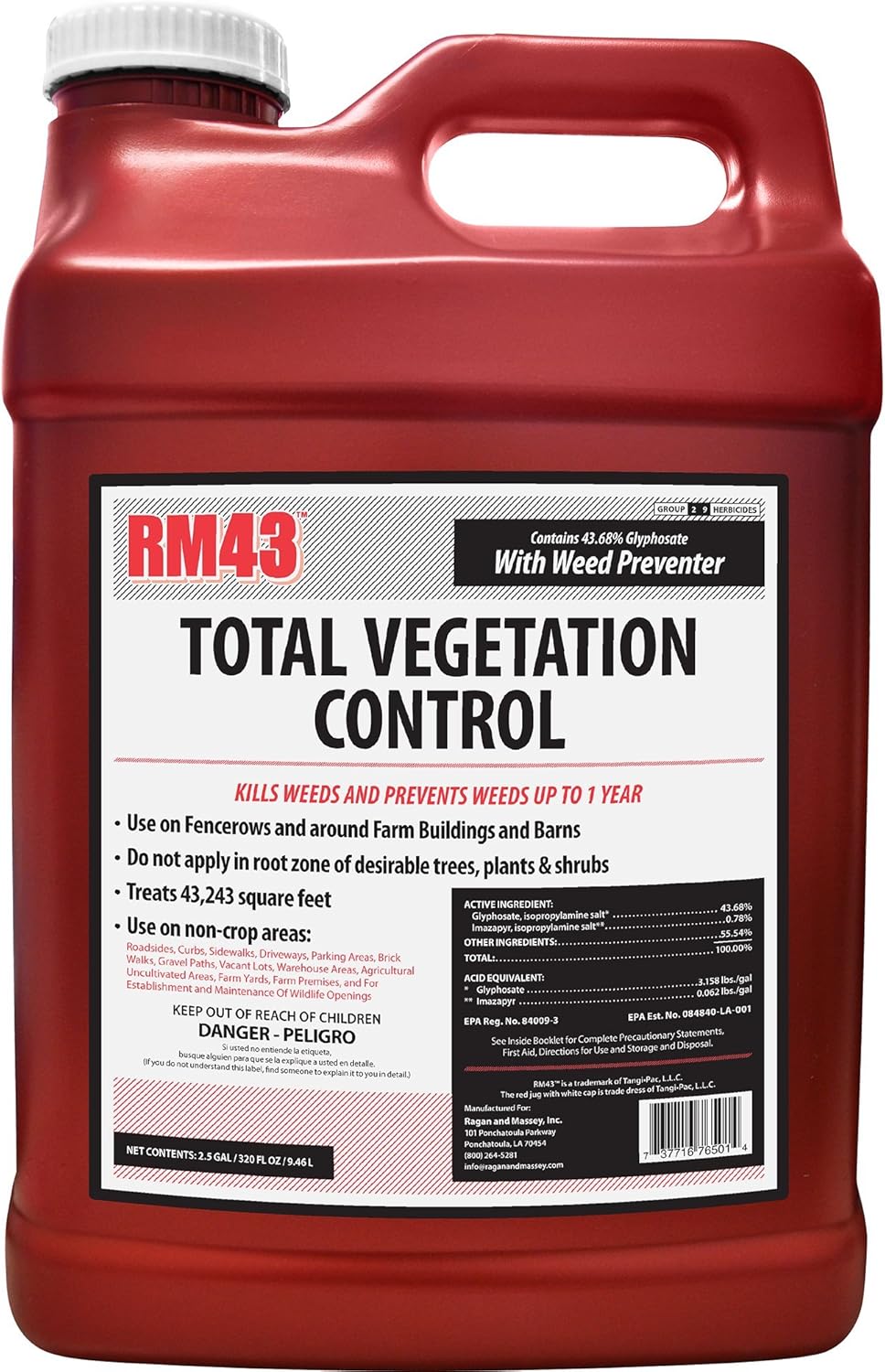
| Unit Count | 320 Fluid Ounces |
|---|---|
| Liquid Volume | 320 fluid ounces |
| Coverage | 243 243 square feet |
| Active Ingredients | Glyphosate isopropylamine salt, Imazapyr isopropylamine salt |
RM43 Total Vegetation Control is a concentrated 2.5‑gallon herbicide intended for killing existing growth and preventing regrowth for up to a year on areas where no vegetation is desired. You mix it into spray solution and apply to hardscape edges, gravel driveways, fence rows, and around buildings as either spot treatments or blanket applications on bare ground. The formula pairs glyphosate and imazapyr with a surfactant so it kills grasses, broadleaf weeds, vines, brush and some woody growth and becomes rainfast in about two hours. Practical benefits for driveway use include long residual control that reduces repeat spraying and a large coverage rate that treats many square feet from one container. Important limitations are that it is for non‑crop areas only and will damage desirable plants if sprayed over roots or drift occurs, and the active ingredient blend makes it persistent so care is required where you may later want vegetation to return. Follow label directions for mixing, application timing and safety precautions when using near soil that will be planted later.
Best for: Gardeners, property owners, and maintenance crews who prioritize strong, long‑lasting weed eradication on gravel driveways and other non‑crop hardscape areas and want to minimize repeat applications.
Less Ideal for: Homeowners planning to replant treated areas soon or those needing selective weed control near desirable plants should choose a less persistent or more targeted product.
- Combination of glyphosate and imazapyr for both knockdown and long residual control
- Concentrated 2.5‑gallon container covers large areas without frequent refills
- Rainfast in about two hours so light rain soon after application is less likely to reduce effectiveness
- Suitable for total vegetation control on gravel driveways, fence rows and other non‑crop areas
- Persistent active ingredients that can prevent desirable vegetation from reestablishing for an extended period
- Not safe for use where desirable plant roots may be exposed or where drift could contact nearby plants
Verdict: Choose RM43 when you need a single, heavy‑duty application that delivers broad spectrum kill and up to a year of weed prevention on gravel driveways and other non‑crop surfaces.
Roundup Weed & Grass Killer with Comfort Wand, 1.33 gal.

| Item Form | Liquid |
|---|---|
| Coverage | 400 sq. ft. |
| Liquid Volume | 1.33 gallons |
This Roundup package pairs a 1.33 gallon liquid formulation with a Comfort Wand for easier spraying around beds, walkways, and foundations. It is formulated to kill common broadleaf weeds and grasses down to the root, with visible wilting in hours and rainfast protection in about 30 minutes, so treated areas are less likely to wash away after a brief rain. The wand offers one-touch continuous spray, which reduces hand fatigue during spot treatments and makes edging and targeted applications simpler than using a separate sprayer. Coverage is listed at about 400 sq. ft., appropriate for small yards, beds, or multiple spot-treatment sessions. Important limitations are that this is a nonselective herbicide so it will damage desirable plants if contacted and the product directions include replanting wait times of 1 to 30 days depending on use. Users should follow label precautions about keeping people and pets away until spray has dried and applying only in calm conditions to avoid drift.
Best for: Buyers who want a straightforward, ready-to-use herbicide for targeted spot treatments and edging where quick, reliable weed control is the priority and minimizing application fuss matters.
Less Ideal for: Large properties or users who need selective lawn-safe control should consider professional application methods or products formulated specifically for turf.
- Fast visible results in hours and rainproof in as fast as 30 minutes
- Comfort Wand with one-touch continuous spray reduces hand fatigue and improves targeting
- Kills a wide range of broadleaf weeds and grasses to the root
- Ready-to-use liquid requires no mixing and covers up to 400 sq. ft.
- Nonselective formula will damage desirable plants if contacted
- Container and wand limit treatment area per refill compared with larger tank sprayers
Verdict: A convenient, ready-to-use herbicide with a Comfort Wand that delivers fast, reliable spot control of broadleaf weeds and grasses for homeowners who want an easy, low-fuss solution.
Choosing the Right Fence Row Herbicide: Key Factors to Consider
Spectrum of Weeds Controlled
Know which species are most problematic along your fence line because herbicides differ in what they kill. Some act mainly on broadleaf weeds while others target grasses; certain products include active ingredients effective on woody regrowth and brush. Match the product to the common weeds present so you do not waste repeated applications on plants that are tolerant.
Also consider seasonal growth stages. Young annuals are often easier to control than well-established perennials or woody suckers, so a product with root-uptake activity is valuable where perennial regeneration is expected.
Residual Activity and Persistence
Residual life determines how long treated areas stay clean and influences replanting windows near the fence. Short-residual products give quick cleanup but allow regrowth sooner and permit nearby planting sooner. Long-residual formulations suppress seedlings for weeks or months but can restrict planting and risk off-target movement under certain conditions.
Think about soil type and rainfall patterns in your area, since heavy rain can move soil-active herbicides and change effective persistence. Also plan maintenance timing around residual behavior to avoid unnecessary overlap or gaps in control.
Application Method and Equipment Needs
Fence-line work can be done by spot-spraying, banding, or treating wide swaths. Choose formulations that fit the equipment you have: pump-up sprayers, backpack sprayers, hose-end applicators, or pre-mixed trigger sprays. Concentrates save storage space but require accurate mixing; ready-to-use sprays reduce mixing error and are convenient for small jobs.
Consider nozzle selection and spray pressure for drift control, and whether the product is compatible with common adjuvants or surfactants that improve uptake on waxy leaves.
Non-target and Environmental Safety
Fence rows often sit next to desirable plants, pollinator habitat, or water features. Review label restrictions on buffer zones, runoff risk, and when to avoid application due to wind or rain. Products with clear guidance on preventing drift and protecting non-target vegetation make it easier to apply safely along mixed-use boundaries.
Also take into account pollinator risk and whether the label suggests treated areas should be left undisturbed for a period to reduce exposure.
Control of Perennials and Root Regrowth
Many fence-line targets are perennials that resprout from roots or rhizomes. Herbicides that translocate to roots or are formulated for systemic uptake are typically more effective at long-term control of these species. Mechanical clearing alone often prompts resprouting, so pairing physical removal with a systemic option can lower future labor needs.
Timing matters for translocation. Late-season treatments, when plants are moving carbohydrates to roots, often improve uptake into persistent root systems.
Legal Label Use and Local Regulations
Herbicide labels are legal documents that dictate where, when, and how a product may be applied. Ensure the chosen product is labeled for fence-line, right-of-way, or similar uses in your jurisdiction. Some active ingredients have restrictions or require additional permits for large-scale use.
Check local rules about application near waterways, wetlands, or protected habitats. Following label directions and local regulations reduces environmental risks and potential liability.
Preparing a Fence Line Before Chemical Treatment
Start by removing large debris, clipped woody material, and heavy trash that could intercept spray. Physical clearing of tall brush with pruning tools or brush cutters improves herbicide contact with target foliage and reduces the amount of chemical needed.
Map sensitive areas such as garden beds, watercourses, and desirable shrubs before you spray. Marking these zones helps maintain safe buffer distances and prevents accidental drift onto non-target plants.
If dense perennial stands remain after cutting, consider a follow-up plan that uses a systemic herbicide timed for active growth to reduce regrowth from roots rather than relying on repeated foliar-only treatments.
- Trim vegetation so sprays reach leaves rather than being blocked by tall stems
- Work upwind when treating to reduce exposure
- Keep a water source or neutralizing material on hand for accidental spills
Best Timing and Seasonal Considerations
Apply when target species are actively growing and not drought-stressed. For many perennials and woody regrowth, late summer to early fall is when plants translocate chemicals to roots, improving long-term control.
Avoid spraying during high wind, temperature inversions, or heavy rain forecasts to limit drift and runoff. For warm-season annuals, earlier season applications can prevent seed set and reduce seedbank replenishment.
- Treat new seedlings early for easier control
- Delay application after cutting to allow regrowth foliage for better uptake
- Observe local weather for at least 24 hours before and after spraying
Safe Application Practices Along Mixed-Use Boundaries
When fences border garden beds or landscaped areas, use shielded or low-drift nozzles and apply at lower spray pressures to reduce off-target movement. Spot treatments with a wand give more control than broadcast spraying and limit exposure to nearby desirable plants.
Wear appropriate personal protective equipment and follow label requirements for handling and reentry intervals. Rinse equipment thoroughly after use, and dispose of leftover mix according to label directions and local regulations.
- Use a boomless nozzle or shielded sprayer near sensitive areas
- Keep pets and people away until treated areas are dry
- Calibrate sprayers to ensure correct application rates
Combining Mechanical and Chemical Control
Mechanical removal reduces bulk and can expose roots for herbicide contact when needed. For woody stumps and large regrowth, cutting followed by a targeted basal or cut-stump application can be more effective than foliar sprays alone.
Use herbicides with systemic activity after cutting to target root systems. For light maintenance, frequent mowing or trimming combined with selective herbicide spot treatments keeps the fence line clear with less chemical use.
- Cut large stems low and apply herbicide to the stump surface where labeled
- Use hand tools and selective spot-spray for small problem patches
- Schedule mechanical work to maximize subsequent herbicide uptake
Minimizing Environmental Impact
Choose application methods and timings that limit runoff into ditches and streams. Avoid broadcast treatments uphill of water bodies and keep treated buffer zones free of heavy rainfall for at least 24 to 48 hours when possible.
Consider rotational use of different active ingredients over multiple seasons to reduce selection pressure on target weed populations, and adopt integrated practices that reduce reliance on chemicals over time.
- Respect buffer distances noted on the label
- Store and dispose of containers according to local hazardous waste rules
- Monitor treated areas for non-target effects and adjust practices accordingly
How We Chose the Best Fence Row Herbicide
We prioritized products that are formulated for fence-line and right-of-way use and that balance immediate control with predictable residual behavior. Selection criteria focused on the herbicide active ingredients and their labeled weed spectra, documented residual life under typical garden and roadside soils, and application flexibility for both spot treatments and broader fence-line swaths. We also assessed label directions for buffer distances and non-target protection, tank-mix compatibility for combined broadleaf and grass control, and physical formulations that affect handling such as ready-to-use sprays versus concentrates. Excluded items included general-purpose lawn herbicides not labeled for fence rows, products intended only for aquatic use, and granular formulations designed for broadcast turf care rather than targeted fence-line suppression. The final shortlist reflects options that work across common fence-line scenarios: new growth suppression, perennial root control, and periodic maintenance of cleared borders.
FAQ
Can I use a fence row herbicide right next to flower beds?
It depends on the product label. Many fence-line herbicides require buffer zones or recommend shielded applications to avoid drift. Spot treatments and lower-pressure nozzles help minimize risk to nearby flowers.
How long after treatment will weeds be controlled?
Visible knockdown can occur within days for fast-acting products, but residual suppression varies from weeks to months depending on the active ingredient and soil conditions. Expect different timelines for annual seedlings versus perennial root dieback.
Is it safe to plant near a treated fence line?
Safe replanting intervals are product-specific and listed on the label. Short-residual options typically allow sooner planting, while longer-residual chemistries may require waiting to avoid damage to new vegetation.
Do I need special equipment to apply fence row herbicides?
Common garden sprayers such as pump-up or backpack sprayers are often sufficient. For larger areas, commercial sprayers are useful. The key is proper calibration, appropriate nozzles for low drift, and following label mixing instructions.
How should I manage perennial weeds that keep coming back?
Combine mechanical removal with a systemic herbicide timed for active growth to reach roots. Multiple follow-up treatments and monitoring may be necessary, and altering cultural practices to reduce moisture or shade can help limit regrowth.
What precautions protect pollinators near fence rows?
Avoid spraying when flowers are in bloom and when pollinators are active. Use targeted spot applications, and maintain unsprayed refuges of flowering plants away from treatment zones to support pollinator habitat.
Final Verdict
When selecting a fence row herbicide, prioritize the spectrum of control you need, whether quick knockdown or longer residual suppression, and choose an application method that protects adjacent vegetation and water. Balance systemic action for perennial root problems with environmental and label constraints. By matching active ingredient behavior to your fence-line weeds and planning timing and equipment carefully, you can maintain a cleaner, lower-maintenance boundary while minimizing off-target effects.
