

Note: This article contains affiliate links. If you click on these links and make a purchase, I may earn a small commission at no extra cost to you. This helps support my research and content. Read my full affiliate disclosure here.
If you need selective control of tough broadleaf weeds, choosing the right Dicamba Herbicide matters for both efficacy and crop safety. In garden beds, small-acreage farms, or beyond, dicamba products behave differently depending on formulation, spray timing, and tank-mix partners. Picking an appropriate option reduces drift risk, avoids crop injury, and delivers the control window you need. This guide covers our five shortlisted dicamba herbicide options and explains the real-world factors that matter for growers and gardeners. We evaluate knockdown speed, residual activity, and compatibility with common spray practices to help you select the right product for your situation.
Top Picks at a Glance
| Best Overall The best all-around choice for most situations | Liquid Harvest Concentrated Lawn Weed Killer, 1 Gallon |  |
| Best Quality Built to a higher standard if you want something more solid | Range Star Herbicide 2.5 Gallon (2,4-D and Dicamba) |  |
| Best Budget The cheapest option that still gets the job done reliably | Liquid Harvest Lawn Weed Killer Concentrate (32 fl oz) |  |
| Highest Rated A top-rated pick with lots of positive feedback | Nufarm Weedmaster Herbicide (2,4‑D & Dicamba) |  |
| Most Popular A crowd favorite that many people choose with confidence | ALLIGARE Dicamba 4 Water-Soluble Herbicide, 2.5 Gallons |  |
Liquid Harvest Concentrated Lawn Weed Killer, 1 Gallon

| Unit Count | 128 Fluid Ounces |
|---|---|
| Item Form | Liquid |
| Coverage | 1.5 ounces covers 1000 sq. ft. |
| Active Ingredients | 2,4-D, MCPA, Dicamba |
Liquid Harvest Concentrated Lawn Weed Killer is a one-gallon turf herbicide formulated for broad-spectrum control of common lawn broadleaf weeds such as dandelion, clover, and plantain. It is mixed with water at low rates (about 0.67 to 1.5 fl. oz. per gallon to treat roughly 1,000 sq ft) and applied with a pump sprayer or hose-end sprayer. The product combines three active ingredients that absorb on contact and begin acting quickly, and the low-odor formulation makes treating larger areas more tolerable. Practical benefits include long-lasting control on both cool- and warm-season grasses and flexible dosing for different weed pressures. Important limitations are that it is a selective herbicide only for non-crop turf areas and requires careful handling and adherence to label directions to avoid off-target damage, especially near desirable ornamentals. The product is effective for routine lawn weed management but should be used with caution around sensitive plants and according to reentry and drying guidance on the label.
Best for: Homeowners and lawn caretakers who want a reliable, broad-spectrum selective herbicide to maintain a clean turf and are comfortable following label directions and using a sprayer.
Less Ideal for: Gardeners who primarily manage ornamental beds, vegetable gardens, or landscapes with many sensitive plants should avoid this product and choose spot treatments or non-chemical options instead.
- Three active ingredients (2,4-D, MCPA, dicamba) provide broad control of hard-to-kill broadleaf weeds.
- Concentrated formula treats large areas from one gallon when mixed at recommended rates.
- Works on both cool- and warm-season turf and is labeled for common non-crop turf uses.
- Low-odor formulation reduces unpleasant smell during application.
- Contains potent systemic herbicides that can harm nearby sensitive plants if drift or misapplication occurs.
- Requires precise mixing and protective handling per label; not suitable for casual, unprepared use.
Verdict: Choose this concentrated three-way dicamba herbicide when you need dependable, broad-spectrum control of broadleaf lawn weeds across large turf areas.
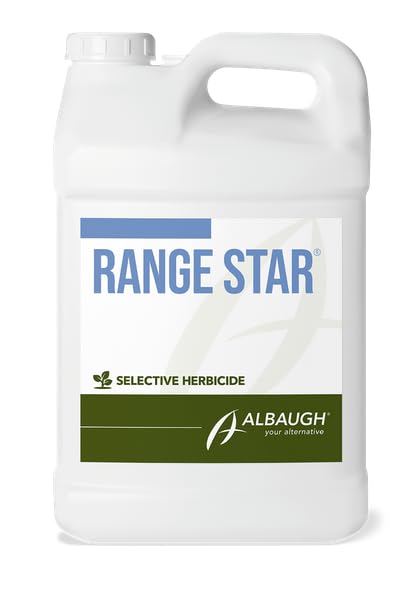
Range Star Herbicide 2.5 Gallon (2,4-D and Dicamba)
| Unit Count | 320 Fluid Ounces |
|---|---|
| Included Components | (1) 2.5 Gallon Jug of Range Star Herbicide |
| Item Form | Liquid |
| Coverage | broadleaf weeds |
Range Star is a concentrated postemergence herbicide combining 2,4-D and dicamba designed for broadleaf weed control across pasture, rangeland, CRP, and select row crops. It is applied as a broadcast, band, aerial, or spot spray and can be mixed with water or sprayable fertilizer per label directions. The formulation is readily absorbed through shoots and roots and moves within the plant to growth points, which makes it effective on tough targets such as ragweeds, pigweeds, thistles, bindweed, and dandelion. Practical benefits include broad target spectrum, flexible application methods for both large and targeted areas, and suitability for use on forage grasses and fallow systems. Important limitations are that it is selective only to broadleaf species so grasses and grassy weeds are not controlled, and proper application requires careful attention to buffer, timing, and label restrictions because dicamba and 2,4-D can injure sensitive broadleaf crops and non-target plants if misapplied. Users should follow label directions for carrier choice and application rates to achieve the best performance.
Best for: Buyers who need a performance-oriented broadleaf herbicide for large-area weed control in pastures, rangeland, or forage systems and who prioritize efficacy and flexible application methods.
Less Ideal for: Homeowners or small-plot gardeners seeking a general-purpose weedkiller for lawns or grassy weeds should consider products targeting grasses or smaller container sizes instead.
- Broad-spectrum control of many annual, biennial, and perennial broadleaf weeds
- Translocates within plants for activity on deep-rooted and systemic weeds
- Flexible application options including aerial, broadcast, band, and spot sprays
- Suitable for use on pasture, rangeland, CRP land, and certain row crops
- Does not control grassy weeds or grasses
- Requires strict adherence to label restrictions to avoid off-target dicamba or 2,4-D damage
Verdict: Choose Range Star when you need a robust, application-flexible dicamba and 2,4-D blend for reliable broadleaf weed control across pastures and rangeland.
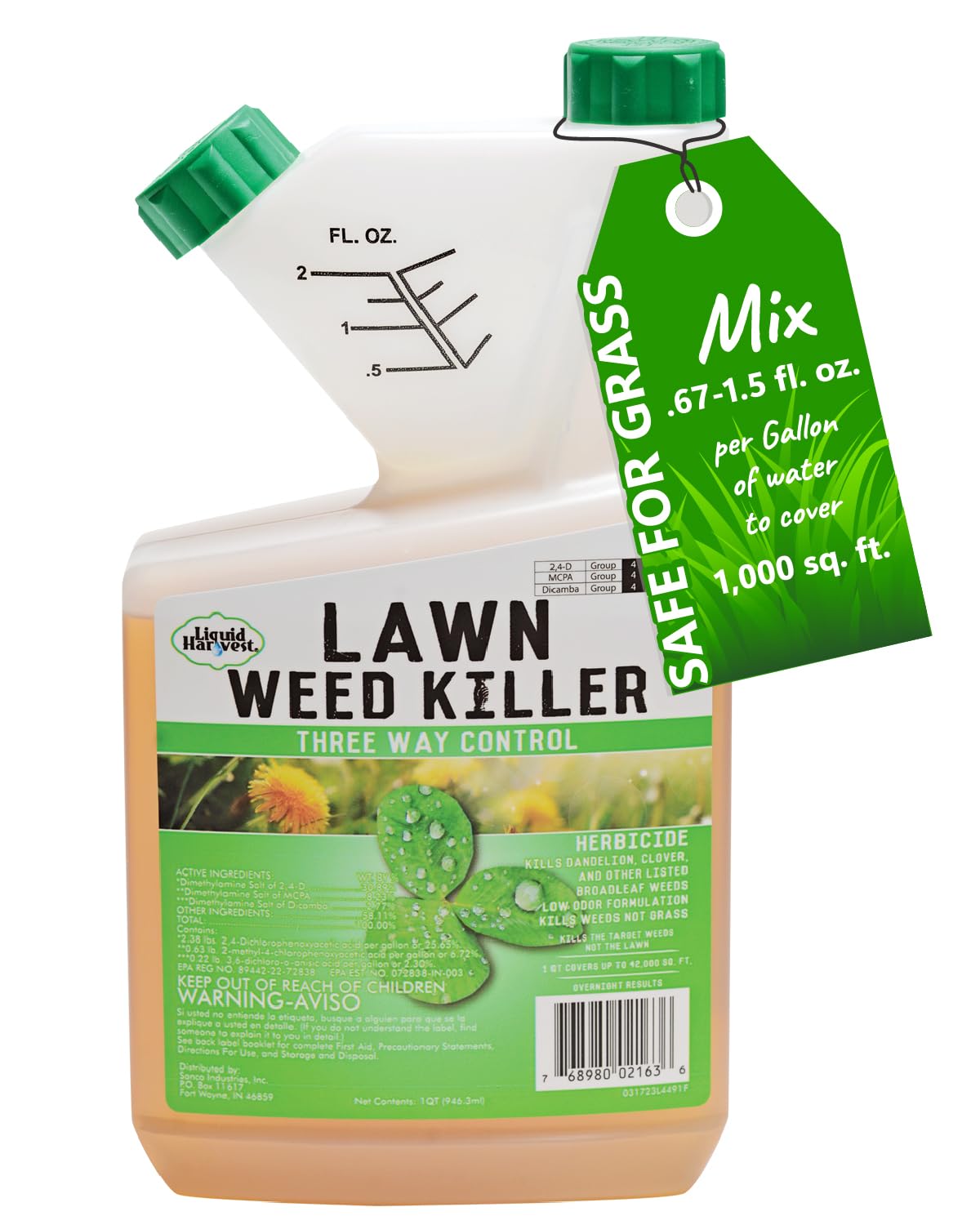
Liquid Harvest Lawn Weed Killer Concentrate (32 fl oz)
| Unit Count | 32 Fluid Ounces |
|---|---|
| Coverage | 1.5 ounces covers 1000 sq. ft. |
| Item Form | Liquid |
| Active Ingredients | 2,4-D, MCPA, Dicamba |
Liquid Harvest Lawn Weed Killer is a 32‑ounce concentrate that uses a mix of 2,4‑D, MCPA, and dicamba to control common broadleaf weeds such as dandelion, clover, and plantain. You dilute a small amount into water (about 0.67–1.5 fl oz per gallon) and spray over turf; the product is labeled for both cool and warm season grasses and starts working on contact. Practical benefits include broad spectrum control from the three active ingredients, a low‑odor formula that makes application more pleasant, and a coverage rate that stretches a quart over large areas when mixed at low rates. Important limitations are the usual safety precautions for synthetic auxin herbicides: keep children and pets off treated areas until dry, follow label rates for sensitive turf types, and avoid use near desirable broadleaf plants. This is a straightforward selective lawn herbicide for spot treatments or whole‑lawn applications when you need reliable control of perennial and annual broadleaf weeds rather than a nonselective burndown.
Best for: Buyers who need an affordable, reliable selective herbicide to control broadleaf lawn weeds across typical home lawns and prioritize effectiveness and coverage per bottle.
Less Ideal for: Not a good choice for gardeners wanting an organic or nonchemical option or for those needing a nonselective brush or grass killer for hardscape clearance.
- Three active ingredients (2,4‑D, MCPA, dicamba) provide broad control of common broadleaf weeds.
- Concentrated formula covers a large area when mixed at recommended rates.
- Low odor formulation reduces unpleasant smell during application.
- Labeled for use on both cool and warm season turf grasses.
- Contains synthetic auxin herbicides that require strict adherence to safety and label directions.
- Not suitable for killing grass or nonselective clearing of vegetation.
Verdict: A concentrated, budget‑friendly three‑way selective herbicide that delivers dependable broadleaf weed control for typical home lawns.
Nufarm Weedmaster Herbicide (2,4‑D & Dicamba)

| Active Ingredients | 2,4‑D and dicamba |
|---|---|
| Item Form | Spray |
| Coverage | Various crops, lands, and non‑crop areas |
| Unit Count | 1 Count |
Nufarm Weedmaster mixes 2,4‑D and dicamba into a spray formulation designed to kill tough broadleaf weeds and brush while leaving desirable grasses intact. It is typically used on pastures, rangeland, hay fields, and labeled non‑crop areas such as fence rows, rights‑of‑way, and industrial sites. The product advertises pre‑emergence residual activity, so a single application can suppress new weed flushes in addition to controlling existing plants. Practical benefits include broad species coverage that lists hard targets like thistles, horsenettle, and blackberry, and flexible labeling for both crop and non‑crop settings. Trade-offs to consider are that it is a concentrated agricultural herbicide intended for labeled uses only and requires careful application timing and adherence to safety and drift precautions; it is not a general homeowner spot treatment. It also requires correct mixing and equipment suitable for broadcast or spot spraying to realize the advertised residual control.
Best for: Buyers who need a dependable, broadleaf herbicide for pasture, rangeland, hay fields, or labeled non‑crop areas and who prioritize consistent, long‑term weed control.
Less Ideal for: Casual gardeners or homeowners seeking a small‑scale spot spray solution or those unwilling to follow agricultural labeling and safety procedures.
- Broad spectrum control of annual, biennial, perennial broadleaf weeds and brush
- Formulated to be safe on desirable grasses for selective applications
- Labeled for a wide range of agricultural and non‑crop sites for flexible use
- Provides pre‑emergence residual activity to help prevent new weed emergence
- Intended for labeled agricultural and non‑crop uses so not ideal for small‑scale homeowner spot treatments
- Requires careful handling, mixing, and application equipment to avoid off‑target damage
Verdict: Choose Nufarm Weedmaster when you need a reliable, selective dicamba/2,4‑D solution for consistent broadleaf and brush control across pastures and non‑crop sites.
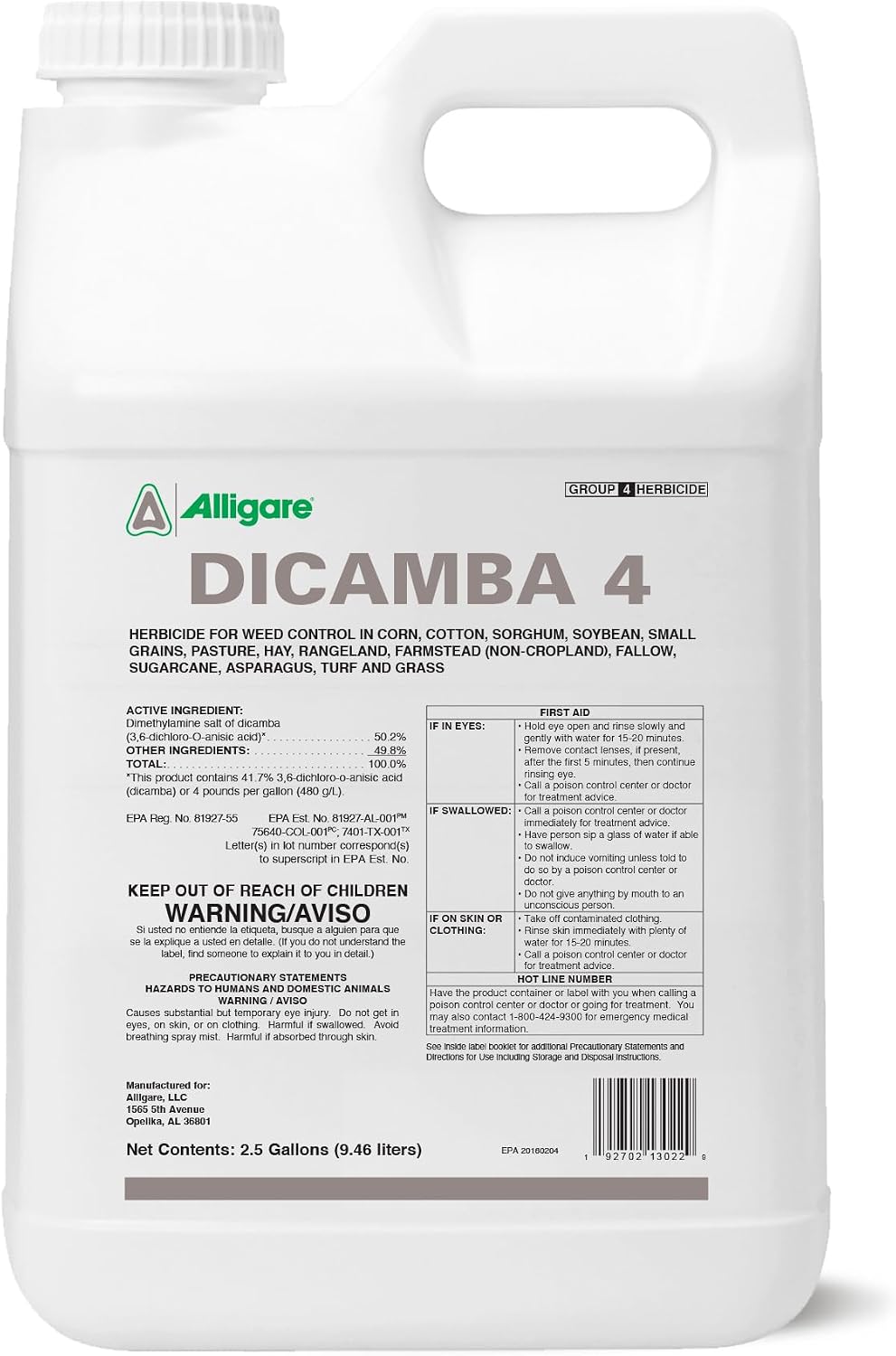
ALLIGARE Dicamba 4 Water-Soluble Herbicide, 2.5 Gallons
| Item Form | Liquid |
|---|---|
| Liquid Volume | 2.5 gallons |
| Coverage | Broadleaf weeds (listed species) |
| Active Ingredients | Dicamba, dimethylamine salt |
This 2.5 gallon ALLIGARE dicamba concentrate is built for commercial and large-acreage weed control where broadleaf species are the target. It mixes with water or sprayable fertilizer and can be applied by ground or aerial equipment, making it practical for farm fields, pastures, and turf. The formula lists dicamba (dimethylamine salt) as the active ingredient and specifically controls many common broadleaf weeds such as pigweed, morning glory, clover, poison ivy and others named on the label. Practical benefits include flexible application methods, straightforward mixing for uniform coverage, and a volume suited to repeated treatments across sizeable areas. Important limitations are that it is designed only for labeled crops and situations so reading label directions and safety warnings is essential, and because it is a volatile herbicide users must manage drift risk and timing carefully to avoid damage to sensitive neighboring plants. For buyers relying on peer experience, the product has a strong satisfaction record for effective broadleaf control when applied according to label instructions.
Best for: Farmers, acreage owners, and commercial applicators who need a concentrated, label-directed broadleaf herbicide for large fields or pastures and who prioritize proven performance and application flexibility.
Less Ideal for: Home gardeners with small lawns or ornamental beds should consider lower-volume, less volatile options designed for residential use.
- Water-soluble concentrate mixes with water or sprayable fertilizer for easy preparation
- Compatible with ground and aerial applications for flexible coverage of large areas
- Specifically labeled to control a wide list of common broadleaf weeds
- Large 2.5 gallon unit suitable for repeated treatments on farms or acreage
- Must be used only on labeled crops and sites and requires careful adherence to safety directions
- Risk of off-target movement and crop damage if drift or timing is not managed
Verdict: Choose this product if you need a concentrated, field-proven dicamba concentrate for flexible large-acreage broadleaf weed control applied by ground or air.
Choosing the Right Dicamba Herbicide: Key Factors to Consider
Formulation and Volatility
Dicamba comes in different formulations that influence volatility and off-target movement. Low-volatility formulations reduce the risk of vapor drift hours after application, which matters when there are nearby sensitive crops, gardens, or ornamentals.
Choose a formulation with a documented low-volatility profile if you work near susceptible plants. Follow label directions on spray timing and temperature limits because even low-volatility products can move under high heat. Application technique and adjuvant choice also affect how much active ingredient becomes airborne.
Labeled Uses and Crop Restrictions
Labels determine where and when a dicamba product can be used and which crops are protected from injury. Some formulations are labeled for specific tolerant crops or preplant burndown only, while others allow in-season use on tolerant varieties.
Read label restrictions carefully to confirm the product is legal for your intended crop and use window. Pay attention to required buffer distances, sensitive crop lists, and any state-specific limitations. Using a product outside labeled conditions increases the risk of damage and regulatory consequences.
Application Timing and Environmental Conditions
The time of day, temperature, and wind conditions at application strongly affect both efficacy and off-target movement. Dicamba uptake is best when weeds are actively growing, typically in cooler morning or evening hours rather than midday heat.
Avoid applying on hot, windy days or when temperature inversions are likely. Labels often specify temperature thresholds and wind speed limits for safe use. Proper timing maximizes weed control and minimizes the chance of drift or volatility-related movement.
Tank-Mix Partners and Adjuvants
Tank mixes can broaden weed spectrum and improve control, but not every herbicide or adjuvant is compatible with dicamba formulations. Some adjuvants can increase volatility or cause antagonism, reducing control of certain species.
Verify compatibility through label guidance or compatibility charts and consider jar tests for new mixes. Use adjuvants recommended on the label to improve spray deposition and uptake while avoiding additives that increase vapor risk.
Spray Equipment and Application Technique
Nozzle choice, pressure, and boom height change droplet size and coverage, which in turn affect drift and efficacy. Larger droplets reduce drift but may sacrifice canopy penetration; smaller droplets improve coverage but increase off-target risk.
Select nozzles and settings that match label recommendations for dicamba products and the target weeds. Maintain pumps and check spray patterns regularly. Calibrate equipment to ensure labeled rates are applied uniformly across the treated area.
Reentry Intervals and Worker Safety
Labels provide reentry intervals and personal protective equipment requirements to protect handlers and workers after application. These intervals vary by formulation and affect when you can safely enter treated areas for planting, maintenance, or harvest tasks.
Plan applications around labor schedules and tasks that require entry into fields or beds. Follow PPE instructions and decontamination steps closely to avoid skin or respiratory exposure during mixing, loading, and cleanup.
Managing Drift and Protecting Sensitive Plants
Minimizing off-target movement is the top practical concern when using dicamba. Buffer zones, reduced boom height, and choosing the right droplet spectrum all lower drift potential. Pay attention to nearby vegetation that could show symptoms at very low exposure levels.
If ornamentals, vegetable gardens, or non-target crops are nearby, plan applications for low-wind, cool conditions and consider non-chemical or spot treatments in close buffer areas. Communication with neighboring growers and clear marking of sensitive zones can prevent accidental damage.
- Use nozzle and pressure combinations that produce larger droplets.
- Avoid applications during temperature inversions or hot afternoons.
- Establish and respect labeled buffer distances around sensitive vegetation.
Integrating Dicamba Into a Weed Management Program
Dicamba is most effective as part of an integrated program, not as a standalone long-term solution. Rotate modes of action to delay resistance and combine mechanical controls, crop competition, and timely cultural practices to reduce reliance on any single herbicide.
Use dicamba strategically for target species and growth stages where it offers clear advantages, such as controlling broadleaf escapes or in preplant burndown. Document applications and monitor treated areas for regrowth so you can adjust subsequent steps.
- Rotate herbicide classes to manage resistance risk.
- Use cultural tactics like cover crops and timely cultivation to reduce weed pressure.
- Scout treated areas regularly and record outcomes for future planning.
Safe Mixing, Loading, and Cleanup Procedures
Proper handling during mixing and loading reduces contamination risk. Prepare mixes in well-ventilated areas away from water sources, and use labeled personal protective equipment to limit skin and inhalation exposure.
Clean equipment thoroughly after use to prevent residues from affecting the next application. Follow label disposal instructions for rinse water and empty containers to comply with environmental safety standards.
- Wear specified gloves, eye protection, and respiratory protection when required.
- Triple-rinse containers and manage rinse water according to label guidance.
- Keep spill kits and decontamination supplies accessible during application.
Understanding Residual Activity and Timing Follow-Up
Some dicamba formulations provide only postemergence control with limited residual activity, while others deliver several weeks of suppression. Knowing the expected residual window helps plan follow-up applications and crop planting schedules.
If you expect new weed flushes, schedule follow-up scouting and choose follow-up tactics that complement the residual length. Overlapping residual control windows across different products can increase overall season-long suppression when done correctly.
- Check label statements on residual expectations and rainfastness.
- Plan scouting intervals to catch escapes before they set seed.
- Coordinate follow-up treatments to avoid stacking incompatible chemistries.
Recordkeeping and Compliance
Accurate records of application date, weather conditions, tank mixes, and treated acreage support both stewardship and legal compliance. Good records make it easier to respond to drift complaints and verify adherence to label restrictions.
Include notes on sensitive neighbors, buffer enforcement, and any mitigation steps taken. This documentation helps demonstrate conscientious use and can inform better choices in subsequent seasons.
- Log weather conditions and application parameters for each job.
- Keep copies of current labels and any state-specific guidance on hand.
- Note any observed off-target effects and corrective actions taken.
How We Chose the Best Dicamba Herbicide
We selected products that matched practical weed-control needs and regulatory constraints for dicamba chemistry. Key editorial filters included formulation type and volatility risk, labeled crop and noncrop uses, and the documented effective use window for controlling common broadleaf species. We also prioritized products with clear application guidance on buffer zones and recommended adjuvants, since those details materially affect drift management. Other evaluation criteria were tank-mix compatibility with commonly used herbicides and fertilizers, labeled rates and reentry intervals, and the balance between quick foliar uptake and useful residual activity. We excluded any formulations without clear label instructions or that lack region-appropriate application directions. The items that made the list scored well on predictable field performance, practical application requirements, and safety measures needed to protect nearby sensitive plants and crops.
FAQ
Can I apply dicamba when nearby fields have sensitive crops?
It often depends on the label restrictions and local regulations. Use low-volatility formulations, observe buffer zones, and avoid applications during inversion conditions to reduce risk to nearby sensitive crops.
How soon after rain can I expect dicamba to be effective?
Rainfastness varies by formulation, but many products require a few hours to become rainfast. Labels provide specific rainfast intervals; waiting until sprays have dried and avoided wash-off improves efficacy.
Are all dicamba formulations safe to tank-mix with glyphosate?
Tank-mix compatibility depends on both products and label guidance. Some mixtures are commonly used for burndown, but you should check compatibility charts and perform jar tests where guidance is not explicit.
What application equipment best reduces drift with dicamba?
Low-drift nozzles, reduced boom height, and operating at recommended pressures produce larger droplets and lower drift potential. Calibrating equipment and following label spray parameters is essential.
How does dicamba affect crop rotation timing?
Rotation intervals are specified on labels and depend on formulation and rates used. Some labels restrict planting of sensitive crops for a set period; follow label instructions to avoid injury to rotational crops.
What should I do if I suspect off-target injury occurred?
Document the symptoms, take photos, and record recent application details including weather and tank mixes. Notify appropriate local authorities if required and follow label guidance for reporting incidents.
Final Verdict
Prioritize formulation choice, application timing, and spray technique when selecting a dicamba herbicide. Balancing knockdown speed with low volatility and clear label directions will protect nearby sensitive plants while delivering reliable broadleaf control. Decide first on the labeled uses that fit your cropping system and nearby exposures, then match equipment and adjuvants to the product. With careful planning and good stewardship, you can use dicamba effectively while minimizing risk and preserving long-term options.
