

Note: This article contains affiliate links. If you click on these links and make a purchase, I may earn a small commission at no extra cost to you. This helps support my research and content. Read my full affiliate disclosure here.
Choosing the right mulch can change how often you battle ants, slugs, and soil-borne pests. The right material not only suppresses weeds and conserves moisture but also creates surface conditions that discourage common garden insects. This guide looks at six shortlisted mulches chosen for their pest-reduction properties and real-garden durability. We examine how each type handles pest resistance, moisture management, and garden safety so you can pick a mulch suited to your plants and maintenance style. Below are the top mulch options selected for pest management, followed by practical buying guidance and answers to common gardener questions.
Top Picks at a Glance
| Best Overall The best all-around choice for most situations | Cedarcide Cedarwood Insect-Repelling Granules (8 lb) |  |
| Best Quality Built to a higher standard if you want something more solid | GranuCide Cedar Granules (8 lb) |  |
| Best Budget The cheapest option that still gets the job done reliably | Wood Smith USA 100% Natural Cedar Shavings Mulch (4 Quart) |  |
| Highest Rated A top-rated pick with lots of positive feedback | Capital Forest Products Cedar Mulch 3.0 Cu Ft |  |
| Most Popular A crowd favorite that many people choose with confidence | Cedarcide Original Cedar Granules (8 lb) |  |
| Best Seller A high-volume bestseller chosen again and again | Wood Smith USA 100% Natural Cedar Chips, 4 Quart Bag |  |
Cedarcide Cedarwood Insect-Repelling Granules (8 lb)

| Active Ingredient | Cedarwood Oil 1% |
|---|---|
| Main Ingredient | Red Cedar Chips 99% |
| Reapplication Interval | Every 4–6 weeks |
| Area of Use | Lawns, gardens, patios, planters, foundations |
These cedarwood granules are designed to act as a natural insect-repellent mulch you can scatter around lawns, flower beds, foundations, patios and planters. The product is essentially 99% cedar chips with 1% cedarwood oil so it works by releasing a scent that disrupts insect pheromones; use is simple—spread by hand or with a seed spreader and reapply every 4 to 6 weeks or after heavy rain. Practical benefits include family- and pet-safe pest control without synthetic pesticides, an easy application for large areas, and biodegradable material that also freshens outdoor spaces. Limitations to expect are modest active ingredient concentration so it will not eliminate heavy infestations or replace targeted chemical treatments, and effectiveness depends on regular reapplication and coverage. Also granular mulch can migrate or decompose over time, requiring periodic top-ups to maintain a consistent barrier.
Best for: Ideal for gardeners and homeowners who prioritize natural, low-toxicity pest control and want an easy-to-apply mulch-style repellent for routine perimeter and bed protection.
Less Ideal for: Not the best choice for users needing immediate knockdown of large infestations or sustained year-round control without frequent maintenance.
- All-natural cedar composition safe for use around people and pets
- Simple application across lawns, beds, foundations and patios
- Biodegradable material that doubles as a mulch and aromatic deterrent
- Reapply schedule provided so users can maintain protection every 4–6 weeks
- Low active ingredient level means it is better for prevention and light pressure, not heavy infestations
- Granules break down and may require frequent replenishing after rain or seasonal decomposition
Verdict: A family- and pet-safe cedar mulch that provides an easy, natural preventive barrier against common yard insects when used and replenished regularly.
GranuCide Cedar Granules (8 lb)
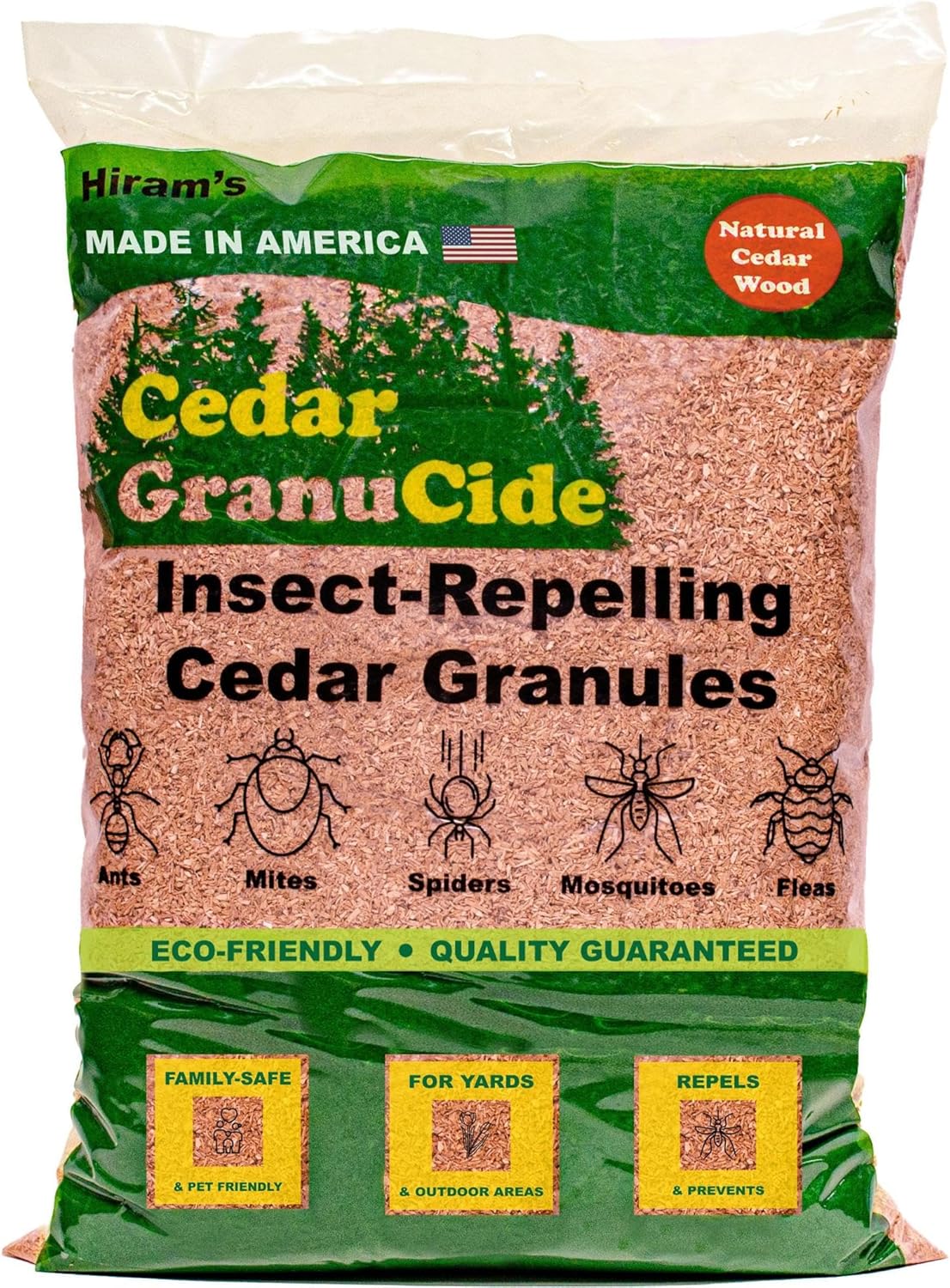
| Ingredients | 100% cedar granules |
|---|---|
| Directions | Sprinkle in indoor and outdoor areas such as potted plants, gardens, lawns, patios, and perimeters |
| Made in | America |
| Weight | 8 pounds |
GranuCide Cedar Granules are coarse cedar chip shavings sold as an easy-to-use, chemical-free option for deterring insects around yards, patios, and potted plants. You apply them by sprinkling a thin layer around garden beds, along foundations, in planters, or inside sheds where pests congregate. The product is made from untreated Pacific Northwest cedar and emits a natural aroma that repels mosquitoes, ants, spiders, fleas, chiggers and other common garden pests without pesticides. As a mulch the granules also serve decorative and moisture-conserving purposes while being safe for children and pets. Limitations to expect are that the scent fades with time and rain so reapplication is necessary after heavy watering or storms, and a single 8 lb bag covers a modest area compared with larger bulk mulches. For someone focused on nonchemical, maintenance-light pest reduction, the granules offer a low-risk, dual-purpose solution that is straightforward to use and fits small to medium areas where targeted insect control is desired.
Best for: Gardeners who prioritize effective, low-toxicity pest control and want a simple mulch-based solution for small to medium beds and container plantings.
Less Ideal for: Homeowners who need wide-area or long-lasting insect control without reapplication or those who prefer a fully maintenance-free approach.
- 100% natural untreated cedar provides a nonchemical insect deterrent
- Pleasant aroma that repels a broad list of common garden pests
- Safe for use around children and pets when applied as directed
- Also functions as a decorative mulch that helps retain soil moisture
- Scent and repellent effect diminish over time and after heavy watering requiring periodic reapplication
- 8 lb bag is relatively small so multiple bags are needed for larger beds
Verdict: Choose these cedar granules when you want a pet-safe, chemical-free mulch that reduces common garden pests while also improving soil cover.
Wood Smith USA 100% Natural Cedar Shavings Mulch (4 Quart)

| Indoor Outdoor Usage | Indoor, Outdoor |
|---|---|
| Other Special Features of the Product | Pet Friendly |
| Material Features | Natural, Organic |
| Sunlight Exposure | Full Sun |
| Moisture Needs | Moderate Watering |
This bag of 100% natural cedar shavings is designed for use as mulch in pots, hanging planters, beds around shrubs, or as animal bedding and odor control. The loose shavings sit on top of soil to help retain moisture and add a light cedar scent that can deter some pests and mask odors. Because it is a natural product, particle size varies, which helps it settle well around stems and in containers but means appearance is rustic rather than uniform. Practical benefits include easy application, suitability for indoor and outdoor use, and a pleasant aroma that can freshen small spaces or sachets. Limitations are that it is a lightweight, decorative mulch not formulated with long-term binding or slow decomposition, so it will break down faster than heavier mulches and needs periodic topping up. It is best used in small areas, potted plants, or where a cedar scent and modest moisture retention are desired rather than for large-scale landscaping where durability is a priority.
Best for: Buyers who want an affordable, natural mulch or bedding for potted plants, small garden beds, or pet areas and value a mild cedar scent and easy application.
Less Ideal for: People needing a long-lasting, heavy-duty landscape mulch for large beds or erosion control should choose a denser, longer-lasting product instead.
- 100% natural cedar shavings suitable for indoor and outdoor use
- Light cedar aroma that helps freshen spaces and can repel certain insects
- Helps retain soil moisture in pots and planters
- Can double as pet bedding or sachet filler
- Shavings are lightweight and decompose faster than heavier mulches, requiring more frequent replenishment
- Variable particle sizes produce a rustic look that may not suit formal beds
Verdict: An inexpensive, natural cedar mulch that freshens small planting areas and helps deter insects while keeping soil moist in pots and planters.
Capital Forest Products Cedar Mulch 3.0 Cu Ft

| Unit Count | 1 Count |
|---|---|
| Manufacturer | CAPITAL FOREST PRODUCTS |
| Item model number | CFD_1301215 |
| UPC | 742638888222 |
This cedar mulch is a straightforward, naturally aromatic ground cover intended for garden beds, foundations, and patios. Made from processed cedar, it lays down easily to help block light, reduce weed germination, slow erosion, and hold soil moisture for planted areas. Typical use is spreading a 2 to 3 inch layer around perennials, shrubs, and foundation plantings where weed suppression and moisture retention are priorities. The cedar material also gives a clean, natural appearance and a pleasant scent while resisting rapid decomposition compared with some softer mulches. Limitations are that cedar does not form the tight mat that some synthetic weed barriers provide and will need occasional replenishing as it breaks down and settles; it also does not replace mechanical weeding or pre-emergent herbicides in heavy weed situations. For gardeners seeking a low-maintenance, natural mulch that contributes to healthier soil and fewer surface weeds, this is a reliable choice.
Best for: Gardeners who prioritize a durable, natural mulch to reduce weeding and conserve moisture around beds and shrubs and who prefer a low-maintenance, long-lasting organic option.
Less Ideal for: People who need an immediate, maintenance-free impermeable barrier against weeds or who prefer a non-organic, permanent solution for high-traffic mulched areas.
- Natural cedar composition helps suppress weed germination and retain soil moisture
- Pleasant cedar scent and attractive natural appearance for beds and foundations
- Resists rapid breakdown compared with softer mulches, so it lasts longer between refreshes
- Helps reduce erosion on slopes and around plantings when applied evenly
- Does not form a solid barrier like landscape fabric and will require periodic top-up
- May be less effective alone against aggressive perennial weeds without additional control methods
Verdict: Choose this cedar mulch if you want a natural, longer-lasting organic layer that reduces surface weeds and helps retain soil moisture in garden beds.
Cedarcide Original Cedar Granules (8 lb)

| Unit Count | 128 Ounce |
|---|---|
| Item Form | Granules |
| Target Species | Insects |
| Special Features | Weather-Resistant |
| Active Ingredients | cedar granules |
Cedarcide Original Cedar Granules are loose cedar shavings you spread around lawns, flower beds, patios, and foundations to create an insect-repelling barrier. The granules release a natural cedar aroma that interferes with insect pheromones and is claimed to deter mosquitoes, fleas, ants, chiggers, mites, and spiders. Typical use is simple: sprinkle by hand or with a spreader, focus on perimeters, planters, and high-traffic outdoor living areas, and reapply every 4 to 6 weeks or after heavy rain. Notable features include 100 percent cedar content, weather-resistant formulation, and suitability for indoor uses like sachets for closets or potted plants. Practical benefits are a low-toxicity alternative to chemical sprays, easy application across large areas, and dual indoor/outdoor versatility. Limitations are that effectiveness depends on coverage and reapplication frequency, it is not a kill-on-contact insecticide so results can be gradual, and very wet conditions or heavy foot traffic will shorten the interval between treatments.
Best for: Buyers who prioritize low-toxicity, natural pest control and want an easy-to-use product to reduce nuisance insects around lawns, beds, and patios while keeping children and pets safe.
Less Ideal for: People who need fast knockdown or long-term insect elimination without frequent maintenance should consider conventional insecticides or targeted baits instead.
- 100% natural cedar granules provide a chemical-free repellent option
- Easy to apply by hand or with a seed/spreader and suitable for both indoor and outdoor uses
- Weather-resistant formulation intended for outdoor perimeter and garden use
- Requires regular reapplication (every 4–6 weeks or after heavy rain) to maintain effect
- Works as a repellent rather than an immediate insect kill so results may be gradual
Verdict: A simple, family- and pet-safe cedar-based repellent that lets you reduce outdoor nuisance insects without synthetic chemicals.
Wood Smith USA 100% Natural Cedar Chips, 4 Quart Bag
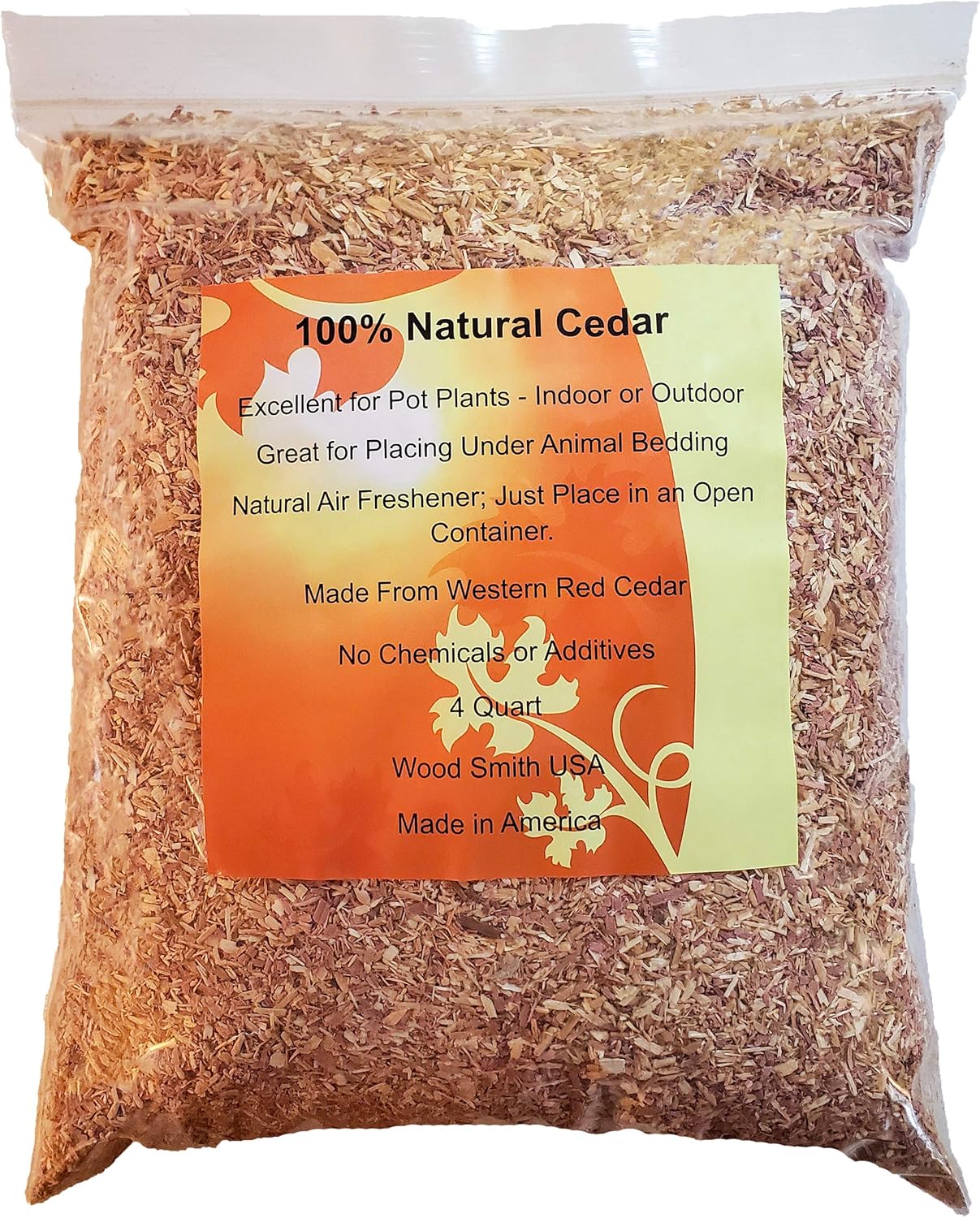
| Brand Name | Wood Smith USA |
|---|---|
| Unit Count | 148.92 Ounce |
| Number of Packs | 1 |
| Volume | 1 |
These 100% natural cedar chips are a lightweight, aromatic mulch sold in a 4-quart bag that works best as a top dressing for potted plants, hanging baskets, and small garden patches. The cedar scent helps deter some insects and can freshen indoor potting mixes, while the chips also help retain surface moisture and reduce light reaching weed seeds. Because the bags are hand sifted and packed, quality is generally consistent for small jobs, and the product is easy to spread with minimal tools. The obvious limitation is the small volume — a single 4-quart bag covers only a very small area, so multiple bags are required for beds or larger weed-control projects. The chips are also coarse compared with fine mulches, so they are better for decorative surface cover than for forming a dense, weed-suppressing mat. Handle the product carefully to avoid inhaling dust and follow guidance if using around animals.
Best for: Buyers looking for an inexpensive, small-quantity mulch to refresh pots, hanging planters, or to try cedar for insect control in limited areas.
Less Ideal for: Gardeners who need to cover large beds or who want a fine-textured mulch for dense weed-smothering should choose larger bulk bags or finer mulches instead.
- Natural cedar composition that repels some insects and adds a pleasant scent
- Small 4-quart bag useful for potted plants, hanging baskets, and spot treatments
- Helps retain surface moisture and reduces light to surface weed seeds
- Hand-sifted and hand-packed for generally consistent small-batch quality
- Very small volume so not cost-effective for large beds
- Coarse chip size offers less dense weed suppression than finer mulches
Verdict: A handy, low-cost 4-quart cedar chip bag for small-scale potting and spot weed control where you want a natural scent and insect-repellent benefits.
Choosing the Right Mulch to Prevent Bugs: Key Factors to Consider
Pest Deterrence and Habitat Effects
How a mulch influences insect activity is mostly about the habitat it creates. Coarse, well-draining mulches reduce damp sheltered pockets that slugs and some soil pests prefer, while very fine or compacting mulches can trap moisture and attract pests. Certain materials also have natural repellant properties or odors that some insects dislike.
Consider whether you need a mulch that simply makes the surface less hospitable for pests, or one that actively repels them. Think about the local pest pressures in your area and seasonal humidity patterns, because a mulch that works well in a dry climate may fail in a wet one.
Moisture Regulation and Microclimate
Mulch affects soil moisture and surface humidity, which in turn determines which pests thrive near plant stems. A mulch that maintains even moisture reduces plant stress and can make crops less attractive to sap-feeding insects, but overly wet mulch promotes slugs and certain fungi.
Assess how much water retention your soil needs and balance that with pest concerns. In high-rainfall areas you may favor chunky, fast-draining mulches; in dryer sites, a mulch that holds some moisture without compacting is a better compromise.
Particle Size, Layering, and Compaction
Particle size determines how a mulch beds together and whether it forms crevices that shelter insects. Larger bark chips allow air circulation and dry quickly on the surface, while shredded or fine mulches can bind together and create insulated, damp layers.
When installing mulch, layer thickness matters. Too thin a layer fails at weed suppression; too thick a compacting layer can trap moisture and harbor pests. Aim for a depth that matches the material type and the plants you are protecting.
Nutrient Release and Soil Biology Impact
Organic mulches break down and contribute carbon to the soil, but different materials decompose at different rates and can temporarily affect nitrogen availability. Rapidly decomposing mulches may draw soil nitrogen during breakdown, which can impact leafy growth and indirectly affect pest susceptibility.
Choose a mulch that complements your soil-building plans. If you rely on beneficial soil organisms, pick materials that support a healthy microbial community rather than materials that smother or sterilize the surface.
Safety for Plants, Pollinators, and Pets
Some mulches can be irritating to pets or toxic if treated with chemicals. Also consider whether mulch odors or dust might deter pollinators or beneficial insects that you want to encourage. Natural alternatives that avoid added pesticides are generally safer for a diverse garden.
Verify the source and processing of any mulch, and prefer products labeled as untreated and free of contaminants. For edible beds, choose materials that will not introduce off-flavors or harmful residues to root crops.
Durability and Maintenance Needs
Different mulches require different upkeep. Long-lasting woody mulches need less frequent top-up but can migrate or form mounds around trunks if not managed. Short-lived mulches require more frequent replenishing but may integrate into the soil and improve structure.
Factor in how much time you want to spend on mulch maintenance and whether you prefer a low-intervention option. Durable mulches may be better for paths and perennial beds, while quick-return organic mulches can suit annual vegetable plots.
How Mulch Type Affects Common Garden Pests
Different mulch materials change the soil surface in predictable ways that influence pest species. For example, bark chips and coarse woody mulch tend to dry at the surface and discourage slugs and sowbugs. Fine shredded materials may hold moisture and shelter pests unless regularly disturbed. Knowing which pests are most problematic in your garden helps narrow the best material type.
- Coarse chips reduce surface humidity and shelter fewer soft-bodied pests.
- Shredded or fine-texture mulches retain more moisture and need closer monitoring.
- Mineral mulches do not decompose and therefore do not provide habitat for soil-feeding insects.
Using Mulch Strategically Around Plants
Placement and depth are as important as material. Keep mulch pulled back a few inches from woody trunks and plant crowns to avoid creating a continuous moist contact zone that invites boring insects and rot. For vegetables and young perennials, a thinner layer allows soil warmth and permits predators like ground beetles to move under plants.
- Maintain a gap of a few inches between mulch and stems to reduce pest access.
- Apply thicker layers around established shrubs where root oxygenation is less of a concern.
- Refresh mulch in spring to break pest life cycles and allow predators to re-establish.
Combining Mulches for Balanced Protection
Mixing mulch types can deliver balanced benefits. For example, a top dressing of coarse material over a finer base can limit surface moisture while still offering weed suppression and organic matter below. Layering also helps keep mulch from compacting into a pest-friendly mat during rainy seasons.
- Use a coarse top layer where slug pressure is high.
- Reserve fine compost or leaf mulch near root zones that benefit from nutrient release.
- Avoid mixing unknown recycled materials that might introduce pests or weed seeds.
Seasonal Mulch Management to Interrupt Pests
Mulch needs change with seasons. Refreshing or thinning mulch in early spring can disrupt overwintering sites for some insects and allow beneficial predators to move in. In late summer, avoid adding thick new mulch that will trap summer humidity and increase slug activity.
- Inspect and turn mulch in spring to expose and reduce pest refuges.
- Delay heavy mulching in hot, wet periods when pests are most active.
- Use targeted spot treatments rather than blanket layers to manage localized infestations.
Mulch and Integrated Pest Management
Mulch should be one tool within an integrated pest management plan. Combine mulch choice with sanitation, crop rotation, and encouraging beneficial insects to create a resilient system. Good cultural practices reduce reliance on reactive measures and keep both pests and predators in balance.
- Remove infested plant material promptly to reduce population build-up.
- Provide habitat for predators like ground beetles by avoiding sterilizing treatments.
- Pair mulch selection with soil health practices for long-term pest suppression.
How We Chose the Best Mulch to Prevent Bugs
We focused on practical, verifiable traits that affect how a mulch performs against insects in real gardens. Selection began with commonly available mulch types used in residential and urban gardening, then narrowed to materials with reported pest-deterring characteristics and sound horticultural performance. Key evaluation criteria included how the mulch alters surface humidity and temperature, its particle size and compaction tendency, longevity and breakdown rate, safety for plants and pets, and compatibility with soil biology. Products were excluded if they relied on added chemical insecticides, had inconsistent supply or unclear composition, or presented known hazards to beneficial insects and soil life. We also filtered out mulches that are purely decorative but lack practical resilience in outdoor conditions. The final shortlist balances pest resistance, moisture control, ease of installation, and long-term garden health. These dimensions directly informed the scoring metrics used in our product scorecards.
FAQ
Will any mulch completely stop garden pests?
No mulch alone completely prevents pests. Mulch changes habitat and can make conditions less favorable for some pests, but it works best combined with sanitation, proper planting, and encouraging predators.
How thick should mulch be to discourage slugs?
A thinner, coarse-textured layer is usually best against slugs because it dries more quickly at the surface. Very thick, fine mulch can hold moisture and actually encourage slug activity.
Is it safe to use mulch in vegetable beds?
Yes, but choose untreated, clean organic materials and avoid placing mulch directly against plant stems. Some mulches decompose quickly and should be refreshed more often in annual beds.
Can mulch attract beneficial insects as well as pests?
Often yes. Organic mulches can provide habitat and resources for predators and pollinators if managed properly. The goal is to strike a balance that favors beneficial species over pests.
How often should I replace or refresh mulch to manage pests?
Refresh intervals depend on the material. Fast-breaking mulches may need annual top-ups, while durable woody mulches require topping every few years. Regular spring inspections are useful to interrupt pest life cycles.
Final Verdict
Pick a mulch that matches the pest pressures and moisture dynamics of your garden. Prioritize materials that limit sheltered, damp surface conditions if slugs or soil-surface pests are the main concern, or choose nutrient-releasing options if soil building is the priority. Manage depth and placement to avoid contact with stems and refresh or disturb mulch seasonally to interrupt pest refuges. With the right combination of material and maintenance, mulch becomes an effective part of a broader pest-management approach.
