

Note: This article contains affiliate links. If you click on these links and make a purchase, I may earn a small commission at no extra cost to you. This helps support my research and content. Read my full affiliate disclosure here.
If your turf looks pale or yellow in patches, choosing the right iron lawn fertilizer can make a visible difference without overfeeding. You want a product that delivers the corrective iron dose gardeners need, applies cleanly with your equipment, and avoids scorch or staining on walkways. This guide shortlists the top options for common lawn situations and explains how we judged them. Each product here passed our horticultural criteria for iron strength, formulation type, and practical application. Below you will find concise reasons why a given option might suit your yard along with the evaluation factors we used to compare them.
Top Picks at a Glance
| Best Overall The best all-around choice for most situations | Simple Lawn Solutions Darker Green Liquid Iron Fertilizer (1 Gallon) |  |
| Best Quality Built to a higher standard if you want something more solid | The Andersons Professional PGF Complete 16-4-8 Granular Lawn Fertilizer (covers 5,000 sq ft) |  |
| Best Value The sweet spot between price and what you get | Earth Science IronPro Fast-Acting Iron Supplement, 5 lb |  |
| Best Budget The cheapest option that still gets the job done reliably | Bloom City Chelated Liquid Iron Supplement for Lawns & Plants, 8 oz |  |
| Highest Rated A top-rated pick with lots of positive feedback | Espoma Iron-Tone Organic Iron Fertilizer, 20 lb |  |
| Most Popular A crowd favorite that many people choose with confidence | LawnStar Liquid Chelated Iron 32 oz |  |
| Best Seller A high-volume bestseller chosen again and again | Scotts Green Max Lawn Food (16.67 lb) |  |
Simple Lawn Solutions Darker Green Liquid Iron Fertilizer (1 Gallon)

| Item Form | Liquid |
|---|---|
| Specific Uses For Product | Lawn |
| Application Method | Spray |
| Liquid Volume | 1 gallons |
| Mixing Ratio | 1 gallon:1 gallon |
Simple Lawn Solutions Darker Green is a concentrated liquid fertilizer formulated to darken turf and correct suspected iron deficiencies. It is applied as a spray after diluting per the label and is suitable for all common turf grasses and many ornamentals. The formula highlights chelated iron (6%), a small amount of nitrogen (0.75%), and manganese (0.8%) so it both enhances leaf color and supports chlorophyll production. In practice this product works best as a targeted booster when lawns show pale or yellowing turf rather than as an all-purpose granular fertilizer. The one-gallon concentrate and full-coverage spray application make it convenient for homeowners with medium to large lawns or for spot-treating trouble areas. Important limitations are that it will not produce visible results on lawns that already have adequate iron levels and it is not a balanced NPK feed for sustained fertility management. Follow mixing instructions carefully to avoid over-application and always test or observe plant response before broad use.
Best for: Homeowners who want a fast-acting color booster to correct or prevent iron deficiency and who prefer a concentrated, spray-applied product for medium to large lawns.
Less Ideal for: Gardeners seeking an all-in-one, long-term granular fertilizer program or those who need comprehensive macronutrient feeding across seasons.
- Concentrated one-gallon liquid for broad coverage or multiple treatments.
- Contains chelated iron to improve turf greening where iron is deficient.
- Includes manganese and a small amount of nitrogen to support chlorophyll production and vigor.
- Spray-application format allows spot treatments and quicker foliar uptake.
- Not a balanced complete lawn fertilizer so it will not replace routine NPK feeding.
- Limited visible benefit if soil already has sufficient iron levels.
Verdict: Use this concentrated liquid iron booster when you need a targeted, spray-applied product to quickly darken and revive turf showing signs of iron deficiency.
The Andersons Professional PGF Complete 16-4-8 Granular Lawn Fertilizer (covers 5,000 sq ft)

| Item Form | Granules |
|---|---|
| Specific Uses For Product | Soil Conditioning |
| Target Species | lawn grasses |
| Unit Count | 288 Ounce |
| Mixing Ratio | 4-1-2 ratio |
This granular fertilizer is built to boost turf performance with a 16-4-8 N-P-K ratio that delivers both immediate and extended nitrogen release for up to eight weeks. It is typically applied with a broadcast spreader at the recommended rate on dry foliage, then lightly watered to activate the Humic DG technology that helps nutrients move into the root zone. Notable features include super-fine particles for even coverage, added iron and micronutrients for richer color, and a mix of quick and slow-release nitrogen for steady growth without frequent reapplication. Practical benefits for a performance-focused buyer are visibly greener turf, reduced application frequency, and improved soil conditioning from humic acids. Important limitations are that it is a granular product so precise spreader calibration and steady walking are required for uniform results, and it is not labeled for sale in California which restricts availability in that state.
Best for: Gardeners focused on high-performance, visibly greener lawns who want a single application product that delivers both immediate and extended feeding and supports soil health.
Less Ideal for: Small container gardeners or people who prefer liquid or organic-only fertilizer programs should consider other formats or formulations.
- Balanced 16-4-8 N-P-K with both quick- and slow-release nitrogen for immediate color and sustained feeding
- Super-fine particles designed for even distribution across the lawn
- Includes iron and multiple micronutrients to improve turf color and overall plant nutrition
- Humic DG additive to help move nutrients into the soil and support soil conditioning
- Requires correct spreader settings and consistent walking speed to avoid streaking
- Not available for sale in California
Verdict: Choose this fertilizer when you want a performance-focused granular formula that delivers quick color boost plus up to eight weeks of sustained feeding for greener grass.
Earth Science IronPro Fast-Acting Iron Supplement, 5 lb

| Item Form | Granules |
|---|---|
| Specific Uses For Product | Lawns |
| Application Method | spreader |
| Target Species | grass, flowers, shrubs, vegetables, or trees |
| Unit Count | 80 Ounce |
Earth Science IronPro is a granular, fast-acting iron supplement designed to quickly boost turf color without promoting excess top growth. It is applied with a standard broadcast spreader and covers up to about 1,600 sq ft per application, making it useful for routine lawn maintenance or spot treatments around beds and shrubs. The formula uses a chelating agent to improve iron uptake and the brand says results are visible in days; because it is iron-rich but not high in nitrogen it darkens foliage rather than forcing rapid leaf growth. Notable features include a non-staining, non-burning granule that is safe for people and pets to re-enter the lawn after application and claims of benefiting soil microbes for longer-term availability of iron. Practical benefits are fast cosmetic improvement and simple spreader application without special equipment. Limitations are that it is primarily a color and iron supplement rather than a full fertilizer, so it will not address broad nutrient or pH problems by itself and repeated use may be needed for persistent deficiencies.
Best for: Gardeners who prioritize quick, visible turf color improvement and want an easy-to-apply iron boost for lawns, beds, and shrubs.
Less Ideal for: Homeowners seeking an all-in-one fertilizer or those with complex soil nutrient or pH issues that require tailored soil testing and amendment plans.
- Fast acting formula that can visibly deepen green color within days
- Chelation technology to improve iron uptake for better efficiency
- Granular form works with standard spreaders for easy, even application
- Non-staining and non-burning so it can be used safely around people and pets
- Not a complete fertilizer so it will not correct all nutrient deficiencies or replace balanced feeding
- Does not provide detailed pH adjustment or soil test guidance
Verdict: Choose this product when you want a fast, easy way to darken lawn and plant foliage without encouraging excessive growth.
Bloom City Chelated Liquid Iron Supplement for Lawns & Plants, 8 oz

| Net volume | 8 oz |
|---|---|
| Formulation | Chelated liquid iron |
| Made in | USA |
This 8 oz Bloom City chelated liquid iron is formulated to treat iron deficiency and reduce yellowing in lawns and landscape plants. You mix the liquid for root uptake or apply it in a watering routine to deliver bioavailable iron that helps reverse chlorosis and deepen leaf green. The chelated formulation improves absorption compared with plain iron products, and the small bottle is easy to store and measure for spot treatments or small yards. Practical benefits include faster visible greening on iron-deficient turf and convenience for repeat applications without heavy equipment. Limitations are the small volume, which means multiple bottles or frequent purchases for larger lawns, and it is focused solely on iron correction so it will not address nutrient issues like nitrogen deficiency or soil compaction that also cause yellowing. Expect best results when used as part of a broader lawn care plan that addresses mowing, watering, and soil health.
Best for: Homeowners or renters with small lawns or spotty yellowing who want a simple, targeted iron treatment on a tight budget.
Less Ideal for: Owners of large lawns or those seeking an all-in-one fertilizer solution should choose a larger-capacity or multi-nutrient product instead.
- Chelated iron formula for easier plant uptake and quicker greening
- Liquid form allows simple mixing and spot or broadcast applications
- Compact 8 oz bottle is easy to store and measure for small-area treatments
- Small 8 oz volume may be insufficient for medium to large lawns without repeated purchases
- Targets only iron deficiency and will not correct other causes of yellowing such as low nitrogen
Verdict: A compact, easy-to-use chelated iron liquid that delivers fast greening for small lawns and spot treatments.
Espoma Iron-Tone Organic Iron Fertilizer, 20 lb

| Item Form | Granules |
|---|---|
| Specific Uses For Product | Gardening |
| Coverage | 20 |
| Target Species | lawns, shrubs, trees, annual and perennial flowers |
| Unit Count | 320 Ounce |
Espoma Iron-Tone is a ready-to-use granular iron fertilizer designed to correct iron chlorosis and bring yellowing foliage back to green. You apply it directly to lawns, shrubs, trees and annual or perennial flowers at the first sign of iron deficiency; no mixing is required. The formula combines a 3-0-3 NPK profile with a high iron content plus sulfur and organic inputs, which supports chlorophyll production and can improve overall plant vigor while being approved for organic gardening. Practical benefits include broad applicability across turf and ornamentals, nonstaining granules that are safe around patios and walkways when used as directed, and a large 20 lb bag that covers multiple applications. Limitations are that results depend on correct diagnosis of iron deficiency versus other nutrient or pH issues, and it should not be applied before heavy rain or near water sources. Follow label safety guidance and timing recommendations for best, reliable results.
Best for: Gardeners who prioritize a dependable, organic solution for recurring or seasonal iron chlorosis and want a straightforward, ready-to-use product for lawns and mixed plantings.
Less Ideal for: Gardeners seeking a fast-acting synthetic chelated iron treatment or those needing a product that also adjusts soil pH should consider alternatives better suited to those specific needs.
- High iron content formulated specifically to correct chlorosis in lawns and ornamentals
- Ready-to-use granular form requires no mixing and is simple to apply
- Approved for organic gardening and made from organic ingredients
- Nonstaining granules safe for use around patios and walkways when applied properly
- Only addresses iron deficiency and will not correct issues caused by incorrect soil pH or other nutrient imbalances
- Should not be applied near water or before heavy rain which limits flexible timing
Verdict: Choose Espoma Iron-Tone when you want a reliable, organic granular fertilizer that consistently corrects iron chlorosis across lawns and ornamentals.
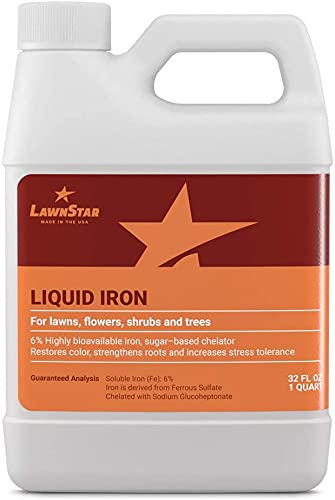
LawnStar Liquid Chelated Iron 32 oz
| Item Form | Liquid |
|---|---|
| Specific Uses For Product | Plant Growth, Root Development |
| Application Method | foliar spray, root drench |
| Liquid Volume | 32 fluid ounces |
LawnStar Liquid Chelated Iron is a concentrated, EDTA-free liquid iron designed for foliar sprays and root drenches to correct iron chlorosis and boost plant color and root development. It is formulated to remain effective in alkaline soils up to about pH 9.5, so it works where some other iron products fade. Typical use is mixing small measured amounts into water for maintenance misting or stronger corrective drenches across lawns, ornamental beds, shrubs, and small to large trees using the recommended rates and application methods. The product is easy to apply with a sprayer or watering can and offers visible greening by supporting chlorophyll production. Because it is concentrated, a little goes a long way, which helps treat larger areas economically. Limitations to consider are that repeated foliar applications are needed for maintenance rather than a one-time cure and correct diagnosis of iron deficiency is important since other nutrient or pH issues can mimic yellowing. Users should follow mixing instructions closely and apply during cooler parts of the day to avoid leaf burn.
Best for: Gardeners who want a proven, science-backed iron treatment to restore green color in lawns and landscape plants and who value products with visible user results and clear usage guidance.
Less Ideal for: People seeking an all-in-one fertilizer solution for broad nutrient deficiencies or those who prefer granular slow-release products instead of liquid, foliar treatments.
- EDTA-free chelated iron effective in alkaline soils up to pH 9.5
- Dual application methods: foliar spray or root drench for flexible treatment
- Concentrated formula stretches to cover larger areas when mixed per directions
- Targets both turf and ornamentals so one product serves multiple landscape needs
- Not a one-time fix; requires periodic maintenance applications
- Works only for iron deficiency symptoms and will not correct non-iron nutrient problems
Verdict: Choose this concentrated, EDTA-free liquid iron when you need a reliable, fast-acting treatment that restores green color in lawns and ornamentals even in alkaline soils.
Scotts Green Max Lawn Food (16.67 lb)

| Item Form | Granules |
|---|---|
| Coverage | 5000 square feet |
| Specific Uses For Product | Lawn |
| Target Species | lawn grass |
Scotts Green Max Lawn Food is a granular, all-purpose lawn fertilizer formulated to deliver fast greening with a 2-in-1 feed plus 5% iron supplement. It is applied with a broadcast or drop spreader to any grass type and is recommended for routine spring, summer, or fall applications. Notable features include a guaranteed nonstaining formula when used as directed and settings provided for Scotts spreaders to help get an even application across the advertised 5,000 sq ft coverage. The iron content speeds visible greening in as little as three days and the granules are ready to water in for faster uptake. For a risk-averse homeowner growing fescue in spring, the product is straightforward to use and safe to re-enter the lawn immediately after application. Limitations are that proper spreader settings and sweeping up excess product are important to avoid runoff and that it is a general lawn food rather than a specialized product for nutrient-deficient soils, so a soil test is still useful for targeted corrections.
Best for: Homeowners who want a low-risk, easy-to-apply lawn food that produces quick green results on fescue lawns in spring and prefer established brand guidance for application.
Less Ideal for: Gardeners seeking a product to correct a specific nutrient imbalance or those who prefer liquid or organic-only fertilizing approaches.
- Includes 5% iron for faster, deeper greening visible in about three days
- Premeasured granular form covers up to 5,000 sq ft from one bag
- Manufacturer provides spreader settings to simplify even application
- Formulated not to stain concrete or driveways when used as directed
- Not a tailored corrective fertilizer for specific soil deficiencies
- Requires correct spreader settings and cleanup to prevent runoff
Verdict: A simple, fast-acting granular lawn food with added iron that reliably greens fescue lawns when applied with a spreader.
Choosing the Right Iron Lawn Fertilizer: Key Factors to Consider
Iron Concentration and Bioavailability
The percentage of elemental iron and the chemical form matter because they dictate how much usable iron reaches grass blades and roots. Chelated or soluble iron sources are typically more available quickly than raw elemental powders, so they produce faster green-up in chlorotic lawns.
Concentration affects dosing. Higher-iron products require smaller doses but raise the risk of overapplication if you follow granular fertilizer rates without adjustment. Always check the label for how much elemental iron is present and whether the product lists iron as ferrous sulfate, iron chelate, or another compound, since that clarifies expected speed and persistence.
Formulation Type and Speed of Action
Liquid and chelated iron formulations usually act faster because they dissolve readily and coat leaf tissue for rapid uptake. Granular or slow-release forms can provide a steadier correction over weeks but may take longer to change lawn color visibly.
Your choice depends on whether you need immediate cosmetic improvement before an event or gradual correction to avoid repeated treatments. Also consider whether the formulation mixes cleanly and leaves minimal residue, which matters for sidewalks, patios, and nearby plants.
Application Method Compatibility
Different lawns and gardeners require different application tools. Some iron fertilizers are designed for broadcast spreaders, others for hose-end sprayers or hand sprayers. Compatibility affects evenness of distribution and the chance of staining hard surfaces.
If you plan to use a spreader, look for granules designed for uniform flow. For liquid products, verify dilution ratios and whether the product passes through common nozzle sizes. Ease of rinsing from nonporous surfaces and clear instructions reduce the risk of staining driveways or decks.
Turf Safety and Burn Risk
Iron corrects deficiencies but can also cause localized burn if applied too concentrated or in hot, sunny conditions. Products labeled for turf will include maximum application rates and reapplication intervals to minimize scorch risk.
Check label guidance for tolerance on close-mown turf and for sensitive grass species. Timing applications for cooler parts of the day and following recommended irrigation practices can mitigate burn potential while improving uptake.
Coverage, Container Size, and Cost Efficiency
Coverage per container determines how often you need to reapply and affects overall convenience. Larger containers or concentrated liquids typically treat more square footage per purchase, lowering labor and repetition.
Think about the size of your lawn and storage. A high-concentration product may be more economical by weight but requires precise measuring. Products with clear area coverage charts for common lawn sizes simplify planning and reduce the chance of under- or overdosing.
Environmental and Nearby-Plant Considerations
Iron applications can run off or wash into planting beds and water features, so consider formulation behavior around flower beds, vegetable gardens, and storm drains. Granules that remain in soil are less likely to stain hardscape but may take longer to correct lawn color.
Read labels for cautions about application near sensitive plantings, follow buffer recommendations, and avoid overapplication that could alter soil pH or nutrient balances in adjacent beds.
When to Use an Iron-Only Treatment
Iron-only treatments are appropriate when your lawn shows iron deficiency symptoms such as uniform yellowing between leaf veins while the soil nitrogen level is adequate. A soil test or quick tissue inspection can confirm that iron is the lacking element rather than a broader nutrient deficit.
If chlorosis is patchy and tied to compaction, poor drainage, or high pH, iron can provide visible symptom relief even while you address the underlying soil condition. Use iron as a corrective aid rather than a substitute for comprehensive soil management.
- Best for rapid cosmetic green-up in confirmed iron-deficient turf
- Not a substitute for balanced fertilization when multiple nutrients are low
- Useful as a spot treatment for localized yellowing
Spot Treatment Vs Whole-Lawn Applications
Spot treating small chlorotic areas saves product and reduces staining risk on walkways. Use a sprayer or hand-applied granular product at label rates and avoid overlapping applications that concentrate iron on a single patch.
Whole-lawn treatments are more efficient for widespread deficiency. When applying across the yard, calibrate your spreader or sprayer to ensure even coverage and consider starting with a lighter rate to observe turf response before repeating applications.
- Spot treatments: faster, less product, lower staining risk
- Whole-lawn: consistent appearance, better for systemic deficiencies
- Always follow reapplication intervals on the label
Avoiding Stains and Handling Safely
Iron products can stain concrete, stone, and clothing. To avoid stains, protect hardscape with tarps or rinse any overspray immediately with water. Wear gloves and eye protection when mixing concentrated liquids or powders.
Clean application tools and equipment after use to prevent rust-colored residues. If you get product on a nonporous surface, rinse promptly with water and a mild detergent to minimize permanent staining.
- Protect hardscape and vehicles during application
- Rinse equipment and surfaces immediately after contact
- Store products in a dry, ventilated area away from children and pets
Timing Applications for Best Uptake
Apply iron treatments during active turf growth for best uptake, typically in spring or fall for cool-season grasses and in late spring through summer for warm-season varieties. Avoid applying during drought stress or extreme heat to reduce burn risk.
If using granular products, irrigate lightly after application per label directions to move iron into the root zone. For foliar sprays, choose a calm, overcast morning or late afternoon to reduce evaporation and improve leaf contact time.
- Best uptake occurs during active growth periods
- Avoid midday heat and drought conditions
- Follow irrigation guidance provided on the label
Managing Expectations and Follow-Up Care
Iron treatments can deliver rapid aesthetic improvement but may not fix root causes like high pH or poor soil structure. Use iron alongside soil testing, pH adjustments, and aeration when needed.
Track treated areas and wait the recommended interval before repeating applications. If green-up is temporary, investigate soil conditions rather than increasing iron rates, which can stress grass and nearby plants.
- Use iron as part of an integrated lawn care plan
- Monitor results and adjust cultural practices if symptoms return
- Perform a soil test for persistent chlorosis
How We Chose the Best Iron Lawn Fertilizer
We evaluated candidates based on measurable, garden-relevant criteria that predict real-world results. Primary considerations included iron concentration and bioavailability, because the amount of plant-available iron determines how quickly chlorotic areas regain green color. We also assessed formulation type and solubility to distinguish fast-acting liquid or chelated options from slower granular forms. Application ease and compatibility were critical. We favored products that work with common spreaders, hose-end applicators, or sprayers and that include clear mixing and safety instructions. Turf safety and burn risk were reviewed by checking application rates and whether the formulations are labeled for close-mown grasses. Coverage and cost-per-area were considered so products that cover more turf per container scored better for convenience. We excluded experimental blends lacking clear iron spec sheets and any products with incomplete labeling or restricted-use designations. The final picks balance corrective strength, user-friendly application, turf safety, and reliable coverage information.
FAQ
How quickly will iron fertilizer green up my lawn?
Often you can see leaf-level darkening within a few days with soluble or chelated iron, while granular forms may take one to three weeks. Speed depends on formulation, turf vigor, and environmental conditions.
Can I use iron fertilizer with my regular fertilizer program?
Usually yes. Iron products are often applied alongside routine fertilization but follow label guidance about tank-mixing and recommended intervals. Avoid overlapping high nitrogen applications immediately after concentrated iron treatments to reduce burn risk.
Will iron fertilizer stain sidewalks and driveways?
Yes, iron can stain concrete and stone if overspray or granules land on hard surfaces. Minimize risk by protecting hardscape, avoiding windy application, and rinsing surfaces promptly after contact.
How often should I apply iron to maintain color?
It depends on product concentration and lawn needs. Some soluble applications can be repeated every 4 to 6 weeks, while granular corrective treatments might be applied once or twice per season. Always follow label reapplication intervals.
Is iron safe for all grass types?
Most turf species tolerate recommended iron rates, but sensitivity varies. Check label directions for close-mown grasses and test a small area if you are unsure about burn risk on a particular variety.
Should I test my soil before using iron?
Soil testing is advisable when symptoms are widespread or persistent. A test can reveal high pH or other nutrient imbalances that make iron less available and help you choose the right corrective approach.
Final Verdict
Prioritize the iron concentration, formulation, and how you will apply the product when choosing an iron lawn fertilizer. Faster-acting liquids and chelates give rapid cosmetic green-up while granular options offer simpler whole-lawn coverage. Balance corrective strength with turf safety, coverage needs, and the underlying soil conditions to decide whether spot treatment or a lawn-wide application is best. If you confirm iron deficiency, pick a product that matches your spreader or sprayer and follow label rates carefully. That approach delivers reliable color correction without risking burn or staining, and it keeps your overall lawn program on track.
