

Note: This article contains affiliate links. If you click on these links and make a purchase, I may earn a small commission at no extra cost to you. This helps support my research and content. Read my full affiliate disclosure here.
Midseason care can make or break summer turf health, and choosing the right July lawn fertilizer matters when temperatures rise and moisture becomes inconsistent. In July you want a formula that supports color and recovery without forcing excessive top growth or increasing burn risk. The products shortlisted here represent leading options suited to common summer conditions and different grass types. This guide walks you through why timing, release type, and nutrient ratios matter, and it outlines practical factors that helped us pick these top choices. Read on for what to expect from midseason feeding and how to match a product to your lawn's needs before the product list below.
Top Picks at a Glance
| Best Overall The best all-around choice for most situations | Scotts Turf Builder Lawn Food, 37.5 lb. |  |
| Best Quality Built to a higher standard if you want something more solid | The Andersons Professional PGF Complete 16-4-8 Fertilizer with Humic (40 lb) |  |
| Best Value The sweet spot between price and what you get | Scotts Turf Builder Lawn Food, 12.5 lb |  |
| Best Budget The cheapest option that still gets the job done reliably | O.M. Scott & Sons Natural Grass Food, 12.72 lb |  |
| Highest Rated A top-rated pick with lots of positive feedback | Espoma Turf-Tone All Season Organic Lawn Food with Bio-Tone, 28 lb |  |
| Best Seller A high-volume bestseller chosen again and again | Scotts Turf Builder Weed & Feed (42.87 lb) |  |
Scotts Turf Builder Lawn Food, 37.5 lb.

| Item Form | Granules |
|---|---|
| Specific Uses For Product | Lawn |
| Coverage | 15000 |
| Mixing Ratio | 32:0:4 |
Scotts Turf Builder Lawn Food is a granular, all-purpose lawn fertilizer formulated to thicken and green lawns while building deeper roots. It is used by broadcasting with a spreader or dropping with a drop spreader; Scotts gives specific spreader settings for easy, repeatable application. The bag covers a large area so it is convenient for whole-yard spring feeding routines. Practical benefits include improved root strength and better nutrient and water uptake compared with unfed turf, plus flexible timing since it can be applied to wet or dry grass and lightly watered in for faster greening. The product is pesticide-free and intended for any grass type, so it can fit into a seasonal program for warm-season grasses like Zoysia. Limitations are that it is a straight lawn food without weed control or insect ingredients, so you will need separate products for weeds or pests, and handling a 37.5 lb bag can be bulky for small yards or single-application needs.
Best for: Homeowners who want a straightforward, high-coverage spring fertilizer to strengthen and green their Zoysia lawn as part of a planned feeding routine.
Less Ideal for: Gardners who need one-step weed and feed or combined pest control solutions or those with very small lawns who prefer smaller package sizes.
- Covers up to 15,000 sq. ft. from one 37.5 lb. bag
- Formulated to build stronger roots and improve nutrient uptake
- Can be applied to wet or dry lawns and used with common spreaders
- Pesticide-free lawn food suitable for any grass type
- Does not include weed or insect control so additional products may be required
- Large bag size may be awkward for small properties or single applications
Verdict: A simple, high-coverage lawn food that reliably builds root strength and greens Zoysia when used as part of a seasonal feeding plan.
The Andersons Professional PGF Complete 16-4-8 Fertilizer with Humic (40 lb)

| N-P-K | 16-4-8 |
|---|---|
| Item Form | Granules |
| Specific Uses For Product | Lawn Care |
| Target Species | lawn grasses |
| Coverage | 40 |
This 40 lb bag of The Andersons Professional PGF Complete is a granular 16-4-8 lawn fertilizer designed to deliver both immediate and extended feeding for turf. It combines quick- and slow-release nitrogen so you get a mid-season green-up plus continued nutrition for up to eight weeks, while iron and micronutrients help deepen color. The super-fine particle size promotes even spread when applied with a broadcast or drop spreader and the included humic DG supports soil biology and nutrient uptake. Typical use is a spring application on established cool-season grasses like fescue, followed by watering to activate the granules. Practical benefits are consistent coverage, longer feeding intervals between applications, and visible color improvement. Important limitations are the strong safety warnings for eye and skin irritation and that the 16-4-8 ratio is a high-nitrogen formula best suited for growth and color rather than slow, low-nitrogen maintenance. It is not formulated for sale in certain states and requires careful handling and correct spreader settings to avoid overapplication.
Best for: Gardeners who prioritize strong, visible spring performance and want a product that delivers both immediate and sustained feeding for established fescue lawns.
Less Ideal for: People managing newly seeded turf, low-nitrogen maintenance programs, or those who prefer organic fertilizers should consider gentler or alternative products.
- Balanced quick- and slow-release nitrogen delivers immediate green-up plus up to eight weeks of feeding
- Includes iron, micronutrients, and humic DG to improve color and nutrient uptake
- Super-fine granules enable more even distribution with a spreader
- Large 40 lb bag covers significant lawn area between applications
- Causes skin, respiratory and serious eye irritation and requires protective handling
- High nitrogen ratio may be too strong for fine maintenance or newly seeded lawns
Verdict: Choose this product when you want a performance-focused spring fertilizer that gives fast green-up plus extended feeding for established fescue.
Scotts Turf Builder Lawn Food, 12.5 lb

| Item Form | Powder |
|---|---|
| Specific Uses For Product | Lawn |
| Coverage | 5,000 sq. ft. |
| Mixing Ratio | 32:0:4 |
Scotts Turf Builder Lawn Food is a general-purpose granular fertilizer formulated for use on any grass type to thicken turf and improve root strength. You spread it with a broadcast or drop spreader (Scotts provides recommended settings) and can apply it to wet or dry lawns in spring, summer, or fall. The formula is pesticide-free and emphasizes building deeper roots so the lawn better absorbs water and nutrients, which helps turf resist stress over the season. One 12.5 lb bag covers about 5,000 sq. ft., making it a simple option for small to medium yards or spot treatments. Practical benefits include clear application guidance, compatibility with common spreaders, and the option to water in for faster greening. Limitations are that this single bag covers a modest area compared with larger homeowner bags and it does not include weed control or insect protection, so you may need additional products for comprehensive lawn care.
Best for: Buyers who want a reliable, easy-to-apply granular fertilizer to strengthen and green a small to medium lawn and prefer products with widespread user approval and clear instructions.
Less Ideal for: Homeowners needing one-step weed or pest control, or those with large properties who want a single bag to cover many thousands of square feet.
- Works on all common grass types so one product fits mixed lawns
- Builds stronger, deeper roots to improve water and nutrient uptake
- Clear spreader settings and can be applied to wet or dry turf for flexibility
- Pesticide-free formula suitable when you only want fertilization
- Covers only about 5,000 sq. ft. per bag, requiring multiple bags for larger yards
- Does not include weed or insect control so additional products may be needed
Verdict: A reliable, easy-to-use granular lawn food that builds stronger roots and is a solid choice for feeding small to medium lawns.
O.M. Scott & Sons Natural Grass Food, 12.72 lb

| Feeds up to | 10 weeks |
|---|---|
| Coverage | Up to 2,000 sq. ft. |
| Usage | Outdoor |
| Unit count | 203.52 Ounce |
O.M. Scott & Sons Natural Grass Food is a straightforward, natural lawn fertilizer meant for routine spring and seasonal feedings. You use it by filling a spreader, setting the dial per the bag directions, walking the lawn to apply, then lightly watering so the nutrients start working right away. The formula contains no added artificial ingredients or pesticides and is marketed as safe for people and pets when directions are followed. A single 12.72 lb. bag covers about 2,000 square feet and is formulated to feed for up to 10 weeks, so one bag can support a small-to-medium yard through the main growing season. The recyclable paper bag is a small eco-friendly plus. Limitations are its coverage and frequency: homeowners with larger lawns will need multiple bags and repeat applications every 8 to 10 weeks, and the product is not presented as a targeted solution for specific problems like weed control or soil pH correction. Still, for routine spring feeding on common grass types it delivers predictable, easy-to-follow results.
Best for: Homeowners who want a simple, natural spring feed for a small to medium lawn and prioritize easy application and pet-safe ingredients.
Less Ideal for: Those with large lawns, persistent weed issues, or who need specialty fertilizers for nutrient-deficient or pH-imbalanced soils should consider more targeted products.
- Natural formula without added artificial ingredients or pesticides
- Feeds immediately after watering and continues feeding up to 10 weeks
- Easy to apply with a standard spreader using bag dial settings
- Covers up to 2,000 sq ft per 12.72 lb. bag suitable for small to medium yards
- Recyclable paper packaging
- Limited coverage per bag so larger lawns require multiple purchases
- Not formulated to handle weeds or specific soil deficiencies
Verdict: A simple, pet-safe natural lawn food that makes spring feeding easy for small to medium yards.
Espoma Turf-Tone All Season Organic Lawn Food with Bio-Tone, 28 lb

| Item Form | Granules |
|---|---|
| Application Method | Spread evenly on a dry, mowed lawn |
| Target Species | Lawn Grass |
| Unit Count | 448 Ounce |
Espoma Turf-Tone is a 28 lb granular, slow-release lawn fertilizer designed for routine feeding of lawns including Kentucky bluegrass. It supplies a low-rate nitrogen formula that releases slowly to encourage steady greening and reduced frequency of applications. The product is intended to be applied with a drop or broadcast spreader to a dry, mowed lawn and claims coverage up to about 5,000 sq ft. Notable features are its organic ingredients and Bio-Tone microbial formula, which aim to support soil biology while minimizing risk of burn or leaching compared with high-salt synthetic feeds. Practical benefits for bluegrass include gentler, longer-lasting color improvement and less chance of creating quick flushes of top growth that demand more mowing. Important limitations are that its nutrient numbers are modest (9-0-1) so it is not a quick corrective for severe nitrogen deficiency and may require multiple seasonal applications to build vigor; large or very depleted lawns may need supplemental treatments or higher-analysis products for rapid recovery.
Best for: Homeowners who prioritize reliable, low-risk feeding and steady seasonal improvement for cool-season lawns like Kentucky bluegrass and who prefer organic products over synthetic quick fixes.
Less Ideal for: Gardeners needing a fast green-up or immediate corrective treatment for very nutrient-deficient or large commercial lawns should consider higher-analysis or targeted products instead.
- Slow-release nitrogen that promotes steady greening without rapid top growth
- Organic and natural ingredient base that reduces burn risk and supports soil health
- Formulated with Bio-Tone microbes to help root and soil biology
- Easy to apply with a broadcast or drop spreader and suitable for all-season use
- Lower analysis (9-0-1) so it is not ideal for rapid correction of severe nutrient deficiencies
- Coverage claim depends on even spread; may require multiple bags for large or thin lawns
Verdict: Choose this organic, slow-release Turf-Tone when you want dependable, low-risk seasonal feeding that supports Kentucky bluegrass and soil biology.
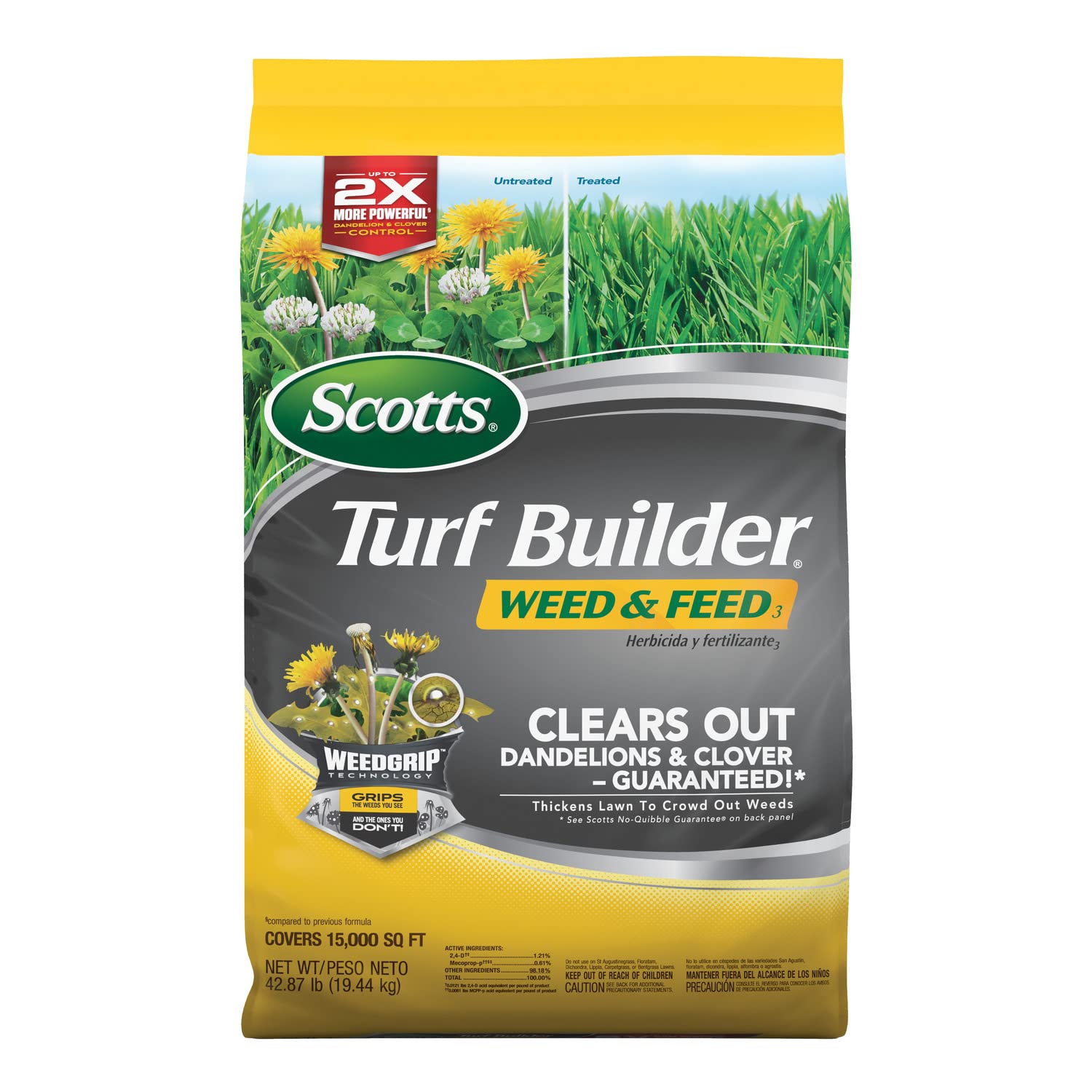
Scotts Turf Builder Weed & Feed (42.87 lb)
| Item Form | Granule |
|---|---|
| Coverage | 15000 square_feet |
| Active Ingredients | 24-D Mecoprop-p |
Scotts Turf Builder Weed & Feed is a granular lawn treatment that kills broadleaf weeds while feeding grass to encourage thicker turf. It is applied with a spreader when weeds are actively growing and temperatures are between 60°F and 90°F; the label recommends applying to a wet lawn so granules stick to weed leaves and waiting 24 hours before watering. The formula uses WeedGrip technology and lists active ingredients including 2,4-D and Mecoprop-p, and the 42.87 lb bag covers about 15,000 square feet. In practice this product is straightforward to broadcast across medium to large lawns and gives visible reduction of common weeds like dandelions and clover while supplying nutrients to help crowd out future weeds. Important limitations are application timing and grass restrictions: do not use on St. Augustinegrass, bentgrass, carpetgrass, dichondra, or lippia, and do not apply if rain is expected within 24 hours. Also keep people and pets off treated turf until dust settles. For homeowners who follow label directions, it is an efficient one-step option for late spring weed control and feeding.
Best for: Homeowners who want a single product to both reduce common broadleaf weeds and feed a cool- or warm-season lawn and who prefer a proven brand with clear label instructions and wide user adoption.
Less Ideal for: People with lawns made of excluded grass types or those needing immediate spot treatment for individual weeds should consider alternatives designed for those specific situations.
- Combines selective broadleaf weed control and fertilizer in one application
- Large bag covers up to 15,000 sq. ft., suitable for medium to large lawns
- WeedGrip technology helps granules adhere to weed leaves for better control
- Granular form is compatible with common broadcast or drop spreaders
- Not safe for several grass types including St. Augustine and bentgrass
- Requires specific temperature and moisture conditions for best results
Verdict: A convenient, proven one-step weed-and-feed for homeowners who want broadleaf weed control plus lawn feeding across large yards.
Choosing the Right July Lawn Fertilizer: Key Factors to Consider
Nitrogen Release Type
How nitrogen is delivered matters more in July than in spring. A quick-release surge can green the lawn fast but also raises the risk of leaf scorch and increased irrigation need during hot weather. A slow- or controlled-release nitrogen gives steadier color and growth with less sudden stress on turf and lower fertilizer runoff risk.
Look for products that specify the percentage of nitrogen in a soluble versus controlled-release form. Those labels let you estimate how much immediate greening you will get and how long the feeding effect will last.
Nutrient Ratio for Midseason Feeding
Midseason applications usually benefit from a moderate nitrogen number with balanced potassium to help heat and drought tolerance. Excessive nitrogen in July often produces tender top growth that uses water quickly and becomes vulnerable to heat or disease. Potassium supports cell strength and stress resilience, so choose ratios that do not ignore potassium entirely.
Also consider whether the formula includes iron or minor elements; small amounts of iron can improve color without pushing excessive shoot growth, which is useful during hot months.
Scorch Risk and Application Timing
Even the right fertilizer can damage turf if applied during heat spikes or without adequate watering. Scorch risk depends on both product formulation and timing. Apply in the cooler part of the day and follow label water-in instructions; some formulations require immediate irrigation while others release gradually.
Avoid applying during prolonged drought or when daytime highs are extreme. If rainfall is unlikely, plan for light irrigation after application according to the product guidance to reduce salt buildup and leaf burn.
Grass Type Compatibility
Warm-season and cool-season grasses respond differently to midsummer feeding. Warm-season lawns can often handle a midseason boost if the product is formulated for their growth cycle, while cool-season grasses typically need more conservative summer feeding to avoid stress.
Match the label recommendations to your grass species and regional climate. If a product provides guidance by grass type, that increases the likelihood of predictable results.
Application Method and Equipment Needs
How you apply fertilizer affects coverage uniformity and the risk of streaking or overapplication. Granular broadcast spreaders, drop spreaders, and hose-end or pump sprayers each have different accuracy and convenience levels. Some granular products are designed to flow well through common spreaders, while others require careful calibration.
Consider if you will hand-apply to small areas or need a spreader for larger lawns. Ease of calibration and clear application rates on the label are important for consistent results.
Environmental Impact and Runoff Risk
Summer storms and irrigation can move soluble nutrients off the lawn and into storm drains. Controlled-release formulas reduce soluble nitrogen peaks and lower immediate runoff potential. Proper timing and following recommended rates also minimize environmental impact.
Inspect product instructions for buffer zone guidance near water features and choose formulations with lower soluble phosphorus content unless a soil test indicates a deficiency.
When To Hold Off On July Feeding
There are times when skipping a July application is the smarter choice. If your lawn is already stressed by drought, pests, or disease, adding fertilizer can push growth that the turf cannot sustain and worsen decline. Also avoid feeding during heat waves or when the forecast predicts no water for several days. In these scenarios focus on conserving soil moisture and addressing stressors first.
- Delay feeding during prolonged drought periods
- Treat pests or disease problems before adding fertilizer
- Resume midseason feeding only after recovery or adequate irrigation is available
Testing Soil Before Midseason Applications
A soil test is the most reliable way to decide what your lawn needs in July. The test shows existing nutrient levels and pH, which tells you whether nitrogen is the priority or if potassium or iron are more important. Many issues that look like nutrient deficiency are actually pH or moisture problems, and a test avoids unnecessary applications.
- Aim for a recent soil test if you have not tested in the last two years
- Use test results to select the appropriate nutrient ratio and any needed lime or sulfur adjustments
Summer Watering Best Practices After Fertilizing
Proper watering after application reduces scorch risk and helps nutrients move into the root zone. For most granular products a light irrigation immediately after application follows label directions and prevents salt buildup on grass blades. Controlled-release products may not require heavy watering but still benefit from consistent soil moisture for microbial activity that releases nutrients.
],
bullets:[
Follow label irrigation instructions precisely
Water deeply but infrequently to encourage deeper roots rather than frequent shallow watering
- Follow label irrigation instructions precisely
- Water deeply but infrequently to encourage deeper roots rather than frequent shallow watering
Managing Spot Treatments and Small Lawns
Small patches of thin turf or high-traffic areas may need targeted treatment rather than lawnwide feeding. Using a handheld spreader or carefully applying a small granular quantity can correct localized deficiencies without overfeeding the rest of the lawn. For spot treatments adjust rates proportionally to avoid local scorch.
- Use a handheld spreader or scoop for precision
- Calibrate rates to the area to avoid hot spots
Organic Versus Synthetic Options In July
Organic products release nutrients more slowly and rely on microbial activity, which can be slower in hot, dry soils. They are gentler with lower scorch risk but may not produce quick color changes. Synthetic controlled-release formulas can offer predictable midseason feeding with moderate scorch risk when used correctly.
],
bullets:[
Consider organic options for slow, steady feeding and lower runoff potential
Choose synthetic controlled-release if you need quicker, predictable results
- Consider organic options for slow, steady feeding and lower runoff potential
- Choose synthetic controlled-release if you need quicker, predictable results
How We Chose the Best July Lawn Fertilizer
Our shortlist focused on formulas and application characteristics that make the biggest practical difference for lawns fed in July. We prioritized clearly stated nutrient ratios relevant for midseason use, predictable release mechanisms, and guidance for safe summer application. Turfgrass response and scorch risk were judged by nutrient balance and release type rather than promotional claims. Ease of application and label clarity were included because homeowners often need straightforward directions under summer time pressure. We also considered suitability across common grass types and whether the product provided iron or minor nutrients useful for summer color without overfeeding nitrogen. Exclusions included any products that lacked clear analysis, had unspecified release technology, or whose labels recommended against summer use. We excluded experimental blends and specialty formulations aimed at turf professionals only. The final evaluation used these concrete dimensions: nitrogen release behavior, nutrient balance for summer use, label instructions and safety margin, inclusion of useful secondary nutrients, and general ease of application for homeowners.
FAQ
Can I apply a July lawn fertilizer during a heat wave?
Usually you should avoid applying fertilizer in the middle of a heat wave. High temperatures increase scorch risk and reduce the turf's ability to use nutrients. If you must apply, do so in the cooler evening or early morning and follow label irrigation instructions.
How often should I fertilize my lawn during summer?
It depends on the product's release type and your grass. Controlled-release products can provide effective feeding without frequent reapplication, while quick-release formulas may require more cautious intervals. Refer to label timing and your soil test results.
Will a midseason application help with drought stress?
Fertilizer does not relieve drought; it supports turf vigor when moisture is adequate. Potassium in the formula helps stress tolerance, but feeding without water can increase scorch risk. Prioritize soil moisture before applying.
Is iron safe to use in July for color?
Small amounts of iron can darken turf without encouraging rapid top growth, which is useful in summer. Use products with modest iron levels and follow application rates to avoid leaf burn.
Final Verdict
For July feeding the priority is predictable nutrient delivery with low scorch risk. Focus on formulations that specify controlled-release behavior or balanced ratios that include potassium and modest secondary nutrients. Match the product guidance to your grass type, soil test results, and local watering conditions. When in doubt, err on the side of conservative rates and timing; midseason feeding is about maintaining turf health and color through stress, not forcing rapid growth. Use the evaluation criteria above to choose a product that delivers steady results and fits your lawn care routine.
