

Note: This article contains affiliate links. If you click on these links and make a purchase, I may earn a small commission at no extra cost to you. This helps support my research and content. Read my full affiliate disclosure here.
Telescopic bypass loppers are an essential tool when you need to prune higher limbs without climbing or constantly repositioning a ladder. The right pair extends reliably, gives clean bypass-style cuts that promote shrub and tree health, and balances reach with manageable weight so you can work longer with less fatigue. This guide shortlists the top-performing options gardeners tend to choose for home yards, small orchards, and larger landscapes. Below you will find our top picks and the evaluation criteria we used, including reach, cutting performance, and build durability. Use the quick sections to match a lopper to your pruning style and site conditions before you scroll to the product details.
Top Picks at a Glance
| Best Quality Built to a higher standard if you want something more solid | WOLF Garten Power Cut Telescoping Bypass Lopper RR900T |  |
| Best Value The sweet spot between price and what you get | Kings County Tools Extendable Double-Ratcheting Bypass Loppers (26"–40") |  |
| Best Budget The cheapest option that still gets the job done reliably | GARTOL Gear-Driven Telescopic Bypass Loppers, 2" Cutting Capacity |  |
| Highest Rated A top-rated pick with lots of positive feedback | Fiskars Extendable Bypass Loppers, 24.5"–37" Reach, 1.5" Cut Capacity |  |
| Most Popular A crowd favorite that many people choose with confidence | Spear & Jackson Razorsharp Telescopic Bypass Lopper |  |
WOLF Garten Power Cut Telescoping Bypass Lopper RR900T

| Cutting width | 50 millimeters |
|---|---|
| Blade Type | Bypass |
| Blade Edge | Serrated |
| Handle Material | Alloy Steel |
| Size | 25.6" – 35.5" |
The WOLF Garten RR900T is a performance-focused telescoping bypass lopper that extends from about 25.6 to 35.5 inches to reach higher branches or reduce bending when cutting on the ground. It uses a dual‑pivot cutting head and serrated, German steel blades to deliver strong, clean cuts on stems up to 50 mm (1.97 inches) in diameter. The anodized aluminum and steel construction keeps the tool relatively light for long sessions while the soft-lined grips improve control and reduce hand fatigue. Telescopic, individually adjustable aluminum handles let you fine tune reach and leverage for different cuts. Practical benefits include easier access to mid-height canopy and a lighter feel than many full-length loppers, which helps when making repeated cuts. Important limitations are its maximum cutting capacity—it is not suited for very large hardwood limbs—and the telescopic joints add moving parts that require occasional tightening and care to maintain alignment.
Best for: Buyers who prioritize cutting performance and a lightweight, adjustable reach for regular pruning of small to medium branches will appreciate this tool.
Less Ideal for: Not a good fit for gardeners who need to prune large-diameter hardwoods or who prefer fixed, heavy-duty loppers for very high leverage jobs.
- Telescoping handles provide adjustable reach for higher branches and reduced stooping.
- Dual‑pivot head and serrated German steel blade deliver strong, clean cuts up to 50 mm.
- Lightweight construction reduces fatigue during extended use.
- Ambidextrous design and soft-lined grips improve comfort and control.
- Maximum cut capacity of 50 mm limits use on larger hardwood limbs.
- Telescopic mechanism requires periodic maintenance to prevent play or misalignment.
Verdict: Choose the RR900T if you want a lightweight, performance-oriented telescoping bypass lopper that delivers strong, precise cuts on branches up to 50 mm.
Kings County Tools Extendable Double-Ratcheting Bypass Loppers (26"–40")
| Cutting width | 2 inches |
|---|---|
| Blade Type | Bypass |
| Blade Edge | Serrated |
| Telescoping Handle | 26" – 40" |
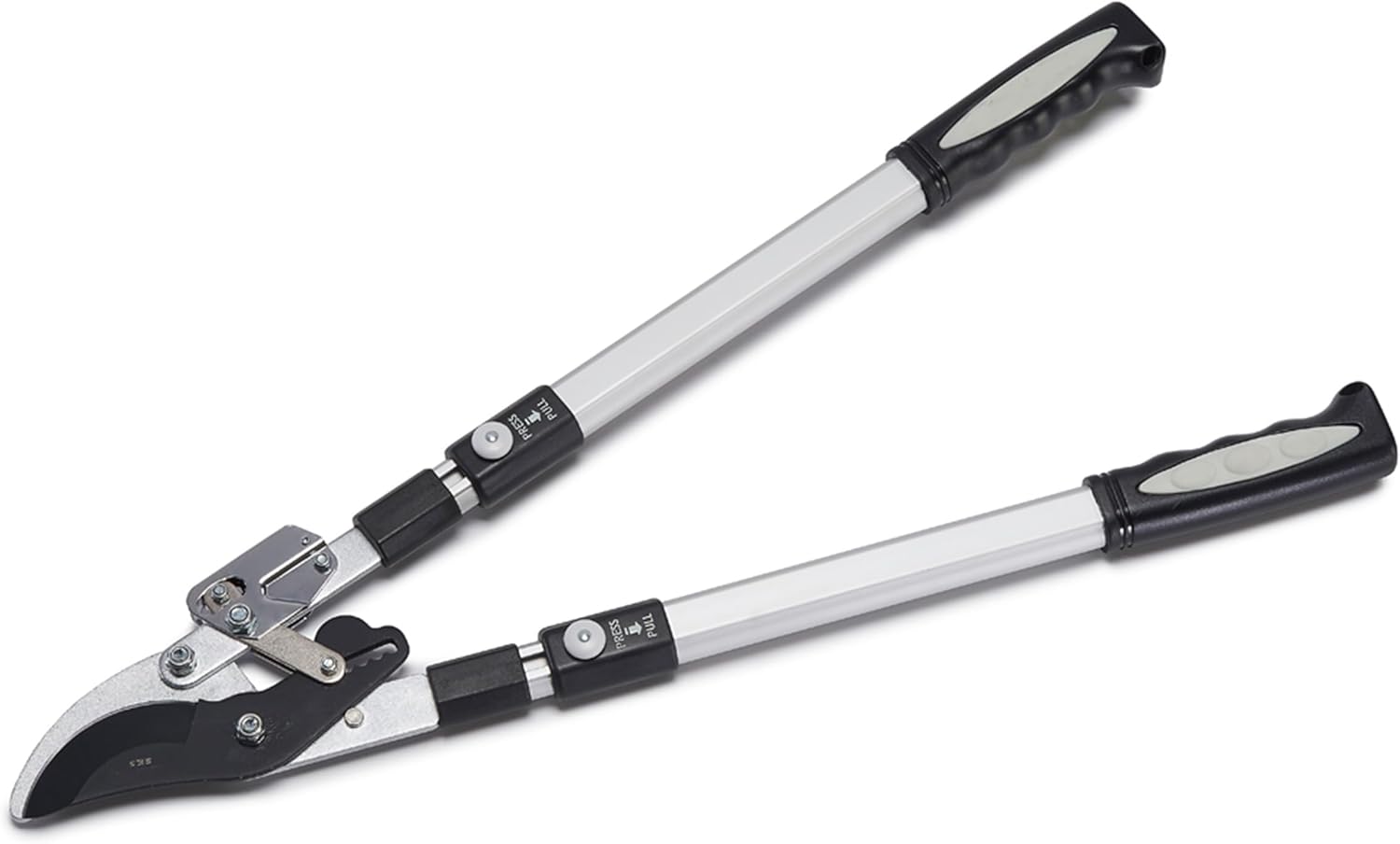
These Kings County Tools loppers are built for trimming living branches and reaching higher limbs without a ladder. The bypass blades and serrated edge make clean cuts on green wood, while the double‑ratcheting mechanism multiplies cutting force so you can tackle up to 2‑inch branches with less effort. Telescoping handles extend from 26 to 40 inches to add reach and leverage, and ambidextrous grips with rubberized handles improve control. Construction uses alloy steel blades with steel and wood handles for durability in typical yard use. Expect the tool to be well suited for homeowners and gardeners who prune small-to-medium limbs and want a durable manual tool rather than a powered saw. It is heavier than compact hand pruners, so prolonged overhead work can be tiring, and ratcheting loppers require slightly more time per cut on very large limbs than a powered option. The design is optimized for green wood rather than dry, dead wood where an anvil-style cutter or saw may perform better.
Best for: A practical gardener who values leverage and reliable manual cutting power for regular pruning of living branches and wants an extendable tool to reach higher limbs without power tools.
Less Ideal for: People who need a lightweight tool for frequent overhead repetitive cutting or those who primarily cut large deadwood and would prefer a saw or anvil pruner.
- Double‑ratcheting mechanism increases cutting power for thicker live branches
- Telescoping 26"–40" handles add reach and leverage without a ladder
- Bypass, serrated blades give cleaner cuts on green wood
- Ambidextrous design and rubber grips improve comfort and control
- Alloy steel blade construction for durability in regular garden use
- Relatively heavy compared with hand pruners, tiring for long overhead sessions
- Less effective on very dry or dead wood compared with anvil cutters or saws
Verdict: Buy this if you want a sturdy, extendable bypass lopper that uses a double‑ratcheting mechanism to make clean, powerful cuts on live branches up to 2 inches.
GARTOL Gear-Driven Telescopic Bypass Loppers, 2" Cutting Capacity

| Blade Material | High Carbon Steel |
|---|---|
| Cutting width | 2 inches |
| Handle Material | Aluminum, Thermoplastic Rubber (TPR) |
| Extendable Reach | 26 to 33 inches |
| Blade Edge | Bypass |
These GARTOL loppers combine a compound gear drive with telescopic handles to make pruning thicker live branches easier from the ground. The gear-driven mechanism multiplies your force so 2-inch branches slice through with noticeably less effort, which is useful for extended trimming sessions or users with limited hand strength. Telescoping aluminum handles lock into five positions between 26 and 33 inches to add reach for higher cuts while keeping the tool balanced. The precision-ground high carbon steel blade has a black Teflon coating that resists sap and rust and holds an edge longer than plain steel. Ergonomic non-slip TPR grips and a lightweight aluminum construction reduce vibration and fatigue during repetitive use. Important limitations are the 2-inch maximum cutting width, which is not suitable for large deadwood, and the telescopic range is modest so very tall branches may still require a pole saw or ladder. For routine pruning of fruit trees, hedges, and small hardwoods this is a practical, labor-saving choice.
Best for: Buyers who want a professional-feeling, labor-saving lopper for routine pruning and hedge maintenance and who prioritize efficient, comfortable cutting over maximum diameter capacity.
Less Ideal for: Not a good choice for arborists or owners who need to remove large deadwood or very tall canopy work; they should look at pole saws or heavy-duty anvil loppers.
- Gear-driven compound mechanism increases cutting power with less hand force
- Teflon-coated high carbon steel blade resists sap and holds a sharp edge
- Telescopic aluminum handles lock at five lengths to extend reach without a ladder
- Ergonomic non-slip TPR grips reduce vibration and improve comfort during long jobs
- 2-inch cutting capacity limits use on large dead or very old hardwood limbs
- Telescopic reach tops out at 33 inches which may not be enough for very high branches
Verdict: If you want a lightweight, gear-assisted lopper that reduces effort and improves comfort for routine professional pruning, this tool delivers efficient 2-inch cuts from the ground.
Fiskars Extendable Bypass Loppers, 24.5"–37" Reach, 1.5" Cut Capacity

| Cutting width | 1.5 inches |
|---|---|
| Blade Material | Alloy Steel |
| Handle Material | Alloy Steel |
| Size | Extendable |
The Fiskars extendable bypass loppers are built for dependable pruning of small tree limbs and thicker garden branches. The blades are precision-ground from alloy steel with a low-friction coating that helps resist rust and reduce gumming while producing clean cuts through stems up to 1.5 inches thick. Handles telescope from about 24.5 to 37 inches so you can reach higher or stand farther from stubborn branches, and the SoftGrip touchpoints with bumpers make extended use more comfortable and reduce hand fatigue. The single-pivot design and ambidextrous orientation keep operation straightforward for most gardeners. Because the construction uses steel handles, the tool feels solid and durable but is heavier than aluminum alternatives, which may be noticeable during long sessions. The lopper is best used for routine tree and shrub maintenance rather than heavy-duty cutting of very large limbs. For someone who values a long-lasting, well-made pruning tool that delivers consistent, precise cuts, this Fiskars model is a reliable choice.
Best for: Gardeners who prioritize a durable, dependable pruning tool for regular tree and shrub maintenance and who prefer a solid-feeling, long-lasting lopper over the lightest possible option.
Less Ideal for: Users who need the lightest telescopic lopper for frequent long-duration pruning or who regularly cut branches larger than 1.5 inches should consider other options.
- Hardened alloy-steel bypass blades with low-friction coating for cleaner cuts and improved rust resistance
- Telescoping handles extend reach from roughly 24.5 to 37 inches for cutting higher or harder-to-reach branches
- SoftGrip handles and bumpers improve comfort and reduce hand strain during extended use
- Solid steel construction feels durable and built for long-term use
- Steel handles make the tool heavier than aluminum telescoping loppers, which can cause fatigue in long sessions
- 1.5 inch cutting capacity limits use to small and medium branches, not large limbs
Verdict: A solid, reliability-first telescopic bypass lopper that delivers clean 1.5-inch cuts and feels built to last.
Spear & Jackson Razorsharp Telescopic Bypass Lopper

| Cutting width | 42 millimeters |
|---|---|
| Blade Material | Carbon Steel |
| Handle Material | Alloy Steel |
| Blade Edge | Convex |
| Hand Orientation | Ambidextrous |
This Spear & Jackson telescopic bypass lopper is designed for pruning live woody growth where a clean scissor‑style cut matters. It uses polished, lacquered carbon steel blades to resist rust and give smooth cutting action, while the tubular alloy handles extend with a twist‑and‑lock mechanism to reach higher or deeper into the hedge. Soft grips and ambidextrous orientation make it comfortable for extended use and the bypass action is best for green stems and precision pruning. Practical benefits include improved reach without a ladder and corrosion resistance from the blade finish and PVC coated handles. Limitations are inherent to bypass loppers: they are not ideal for heavy deadwood where an anvil design or a saw would perform better, and the telescopic locking mechanism may require occasional tightening and care to avoid slippage under heavy leverage. The lopper is a straightforward choice for routine shrub and hedge maintenance, offering solid construction and user comfort for seasonal pruning tasks.
Best for: Gardeners who prioritize clean, precise cuts on living shrubs and want added reach without a ladder, and who value proven construction and easy handling for regular pruning.
Less Ideal for: People who frequently cut large diameter dead branches or require a dedicated anvil lopper or pruning saw for heavy duty woody material.
- Polished, lacquered carbon steel blades for smoother cuts and rust resistance
- Twist‑and‑lock telescopic handles extend reach without carrying a separate pole
- Comfortable soft grips and ambidextrous design for longer use
- Tubular alloy construction offers strength while remaining manageable in weight
- Bypass design is not suited to cutting thick dead wood where blade distortion can occur
- Telescopic locking mechanism can loosen over time and needs periodic checking
Verdict: A reliable telescopic bypass lopper that gives clean cuts and extra reach for routine pruning of live shrubs.
Choosing the Right Telescopic Bypass Loppers: Key Factors to Consider
Reach and Extension Mechanism
How far a lopper extends and how securely it locks in place determine the branches you can prune from the ground. Longer reach opens up higher limbs and deeper interior canopy work, but every extra inch amplifies flex and torque. A well-designed telescoping mechanism should lock firmly at common extension points and resist slipping under lateral loads.
Consider how the mechanism is adjusted. Twist-locks are simple but may loosen over time or under heavy leverage. Lever clamps and positive locking pins tend to feel more secure but add a bit of weight. Think about your typical pruning height and choose reach lengths that let you work safely without overextending your spine or straining your shoulders.
Bypass Blade Geometry and Cutting Action
Bypass blades cut like scissors, shearing live wood cleanly rather than crushing it. That clean cut is better for plant health, so blade shape, bevel angle, and blade overlap matter. A sharp, thin edge with tight blade closure will slice through green wood with minimal tearing.
Check whether the blades are hardened steel and whether the cutting action stays aligned as you close the handles. Misaligned blades or excessive play lead to ragged cuts that slow healing and increase disease risk. For occasional heavy cutting, look for blades that maintain edge geometry and allow resharpening when needed.
Shaft Strength, Materials, and Rigidity
Telescopic shafts must be strong enough to transmit cutting force without bending excessively. Aluminum offers a good balance of lightness and stiffness, while thicker-walled shafts resist flex better. Composite or reinforced shafts can reduce weight but vary widely in stiffness and durability.
Pay attention to the connection points and how the inner and outer tubes interact. Sloppy fits allow wobble, which reduces cutting accuracy and can cause user fatigue. Reinforced collars or thicker overlapping sections at common lock points improve stiffness where you need it most.
Ergonomics and User Comfort
Pruning higher branches with a long tool quickly amplifies wrist and shoulder strain. Handle design, grip texture, and overall balance influence how long you can work before stopping. Softer, shaped grips reduce slipping and distribute pressure across the palm, while long handles give leverage for larger limbs.
Also consider how the extended weight feels. A light tool is easier to hold extended for precise cuts, but if it lacks torsional stiffness you will fight flex. Look for a balance between a manageable mass and a shape that keeps hands aligned with the blades to minimize twisting.
Cutting Capacity and Intended Use
Telescopic bypass loppers come with rated cutting diameters. The maximum capacity affects what jobs you can reasonably expect to complete without switching to saws or pruning shears. For routine pruning and small branches, a moderate capacity is fine; for thicker deadwood or small limbs, higher capacity and stronger blades are necessary.
Note that extension length changes leverage. A long-reach tool may have reduced effective cutting force at full extension. If you frequently tackle larger branches at height, consider whether the lopper maintains cutting efficiency when extended or if you will need to reposition closer.
Maintenance and Replaceability
Sharp, well-aligned blades perform best and last longer, but they need periodic maintenance. Blades that are easy to remove or that accept standard sharpening angles simplify upkeep. Corrosion-resistant coatings or stainless components reduce cleaning time, especially in humid climates.
Also check for replaceable parts such as locking pins, grips, or blade sets. A tool that allows simple replacement of wear items extends usable life and can be a better long-term investment for active gardeners.
When to Use Telescopic Bypass Loppers
Telescopic bypass loppers are ideal when you need to reach higher branches without a ladder, perform selective thinning in a large shrub, or prune small limbs within a tree canopy. They work best on live or green wood up to the tool's rated cutting diameter, leaving cleaner wounds than anvil-style cutters.
Use them for routine maintenance pruning, shaping hedges where cutting points are recessed, and removing crossing branches. For very large limbs or deadwood beyond the lopper's capacity, pair them with a pruning saw to avoid damaging the tool or creating ragged wounds.
- Good for reach-based tasks and selective pruning
- Best for green wood and small to moderate diameter limbs
- Not intended to replace a pruning saw for large branches
Safe Pruning Posture and Technique
Keep your feet stable and avoid leaning or overreaching when cutting above shoulder height. Move your body and reposition rather than overstretching the tool, and use shorter extension settings for heavier cuts to preserve stiffness.
Support the branch when possible and make clean bypass cuts close to the node or branch collar. For multi-step cuts on thicker limbs, use a saw to prevent binding and to control the fall of the limb.
- Keep shoulders relaxed and use both hands for control
- Cut small sections when in doubt rather than forcing a single big cut
- Wear eye protection to guard against falling debris
Maintaining Blades and Moving Parts
Regularly clean sap and debris from blades and telescoping sections to prevent corrosion and sticky movement. Light oil on sliding parts and pivot points keeps the mechanism operating smoothly and extends the life of locks and fasteners.
Sharpen blades as needed with a file or sharpening stone following the original bevel. After sharpening, realign and test the bypass action to confirm clean closure. Replace worn bolts or pins promptly to maintain correct blade alignment.
- Wipe blades after use and lubricate moving parts
- Sharpen at the original bevel and check alignment
- Inspect locks and pins for wear and replace when loose
Matching Lopper Reach to Your Landscape
Measure the typical height you need to reach from the ground and add a margin for comfortable clearance. For trimming low to mid-height shrub interiors, a modest extension will suffice. For trees or tall hedges, prioritize a longer reach but verify the tool's stiffness at that length.
If you often work on slopes or with uneven footing, shorter, stiffer settings increase safety and control. Consider whether you will frequently change extension length in the field and choose a locking system that is quick to adjust while remaining secure.
- Shorter reach for heavier, more controlled cuts
- Longer reach for canopy work but check for flex
- Prefer quick, secure locks if you adjust often
Storing and Transporting Telescopic Loppers
Collapse telescopic loppers for storage to protect blades and reduce the chance of accidental injury. Hang them in a dry shed or store them blade-side down in a secure location away from moisture to limit corrosion.
When transporting, secure the tool so the extension cannot slide free and damage the shaft or nearby items. A simple wrap of the handles or a strap across the collapsed tubes prevents movement and extends the life of locking components.
- Collapse and lock before storing
- Keep dry and off the ground to avoid rust
- Secure during transport to prevent telescoping damage
How We Chose the Best Telescopic Bypass Loppers
We selected telescopic bypass loppers by focusing on the features that actually affect pruning outcomes and day-to-day use in a garden. Key evaluation criteria included reach and extension stability, because a telescoping mechanism that slips or flexes changes where you can safely cut. Cutting performance and bypass blade geometry were assessed to ensure clean wounds that heal quickly for trees and shrubs. Build durability covered shaft strength, corrosion resistance of metal parts, and the quality of fasteners and joints. Ergonomics and weight mattered for extended work: comfortable grips, balanced feel, and mechanisms that reduce wrist torque make pruning less tiring. Finally, maintenance and serviceability were considered, including blade sharpening accessibility and replaceable parts. We excluded tools that rely solely on anvil cuts, non-telescoping models, or designs intended only for light floral work because they do not meet the telescopic bypass pruning needs described in the scope. The shortlisted loppers all met minimum reach and blade geometry requirements and showed robust construction appropriate for frequent garden use.
FAQ
How long should the reach be for general yard pruning?
It depends on your average pruning height. For most homeowners, a reach that lets you cut limbs 8 to 12 feet overhead from ground level covers typical hedges and small trees. Taller trees or orchard work may require longer reach but remember extension increases flex and reduces effective cutting force.
Can telescopic bypass loppers cut dead wood as well as live branches?
They can cut dead wood within their rated capacity, but very hard or brittle dead limbs may tear rather than shear cleanly. For thick deadwood, a pruning saw often produces safer, cleaner results and reduces stress on the lopper mechanism.
How often should I sharpen the blades?
Frequency depends on use and wood types. Light home pruning may need a touch-up once or twice a season, while heavy or frequent work requires more regular sharpening. Sharpen when you notice crushing instead of slicing or when the blade drags rather than cuts smoothly.
Are lighter telescopic loppers always better for reach work?
Not necessarily. Lighter tools are easier to hold extended, but if they lack shaft rigidity you will fight flex and lose cutting accuracy. Choose a model that balances weight with sufficient stiffness for the cuts you commonly make.
Is it safe to use telescopic loppers from a ladder?
Using long tools from a ladder increases risk because leverage multiplies and balance can be compromised. If you must work from a ladder, keep extensions short, have a stable stance, and avoid cutting heavy limbs overhead. Whenever possible, prune from the ground or use professional assistance for high work.
Final Verdict
Prioritize reach, blade quality, and shaft rigidity when choosing telescopic bypass loppers. The right balance depends on the heights you need to access, the diameter of branches you cut, and how long you will be working with the tool extended. Expect tradeoffs between weight and stiffness: lighter tools reduce arm fatigue but may flex more at full extension. Focus on secure locking mechanisms, sharpenable bypass blades, and comfortable grips to get the most reliable, long-term performance. With those priorities in mind, you can select a lopper that lets you prune safely and cleanly from the ground, keeping shrubs and trees healthier while reducing the need to climb or use a ladder.
