

Note: This article contains affiliate links. If you click on these links and make a purchase, I may earn a small commission at no extra cost to you. This helps support my research and content. Read my full affiliate disclosure here.
Growing garlic that produces large, well-storing bulbs starts with the right feeding approach. Garlic responds to steady, balanced nutrients and improved soil biology more than heavy, sporadic feeding. In this guide we shortlisted six top organic fertilizer options suitable for garlic beds, focusing on how they affect bulb development, soil structure, and pest resilience. You will see practical notes on nutrient ratios, application timing, and how each choice fits common garden situations from raised beds to in-ground rows. Read on for clear guidance that helps you pick a feeding strategy that matches your soil and season.
Top Picks at a Glance
| Best Quality Built to a higher standard if you want something more solid | Neptune's Harvest Organic Crab & Lobster Shell Plant Food (5-3-0), 4 lb |  |
| Best Value The sweet spot between price and what you get | True Organic Bone Meal Organic Fertilizer, 3 lb |  |
| Best Budget The cheapest option that still gets the job done reliably | Down To Earth Blood Meal Organic Fertilizer 12-0-0, 0.5 lb |  |
| Highest Rated A top-rated pick with lots of positive feedback | Gardenera Liquid Power Garlic Fertilizer Concentrate, 8 oz |  |
| Most Popular A crowd favorite that many people choose with confidence | Burpee Bone Meal Fertilizer, 3 lb |  |
| Best Seller A high-volume bestseller chosen again and again | True Organic Prilled Sulfur — Prilled Elemental Sulfur Granules, 5 lb |  |
Neptune's Harvest Organic Crab & Lobster Shell Plant Food (5-3-0), 4 lb

| Item Form | Flake |
|---|---|
| Specific Uses For Product | Plant Growth, Root Development, Seed Development, Soil Conditioning |
| Application Method | Broadcast spreader |
| Mixing Ratio | 5-3-0 |
Neptune's Harvest Crab & Lobster Shell is a dry, slow-release organic fertilizer made from ground crab and lobster shells that supplies calcium, magnesium, and modest nitrogen to soil. It is typically worked into planting beds or used as a top dressing around established plants and can be applied with a broadcast spreader on lawns or garden rows. The product’s high calcium content and chitin-rich shell meal help improve soil structure, encourage deeper roots, and can suppress some soil pests such as nematodes and grubs. Because it breaks down slowly, it provides longer-term soil conditioning rather than an immediate nitrogen spike, making it suited to crops that benefit from steady nutrition and improved rooting. Important limitations are the low NPK numbers for gardeners seeking quick, high-nitrogen feeding and the inclusion of phosphorus which may be restricted by local turf regulations. For corn specifically this works best as a soil conditioner and calcium source when used alongside a higher-nitrogen fertilizer rather than as the sole feed.
Best for: Gardeners who prioritize long-term soil health and steady nutrient delivery and want an organic amendment to strengthen roots and correct calcium deficiencies while managing soil pests.
Less Ideal for: Growers who need fast, high-nitrogen feeding or a single-product solution for heavy-feeding crops should choose a higher-N fertilizer or combine this product with a concentrated nitrogen source.
- High calcium content supports strong stalk and root development
- Slow-release shell meal improves soil structure and organic matter over time
- Chitin and mineral profile can help reduce certain soil pests
- Resealable bag and flake form are easy to apply and incorporate
- Low overall nitrogen level so it will not deliver rapid green-up on its own
- Contains phosphorus which may be restricted for some turf or local regulations
Verdict: A performance-minded organic choice to improve soil structure and supply calcium for stronger corn roots when paired with a higher-nitrogen feed.
True Organic Bone Meal Organic Fertilizer, 3 lb

| Item Form | Granules |
|---|---|
| Unit Count | 48 Ounce |
| Mixing Ratio | 7:7:0 |
| Coverage | Medium |
| Included Components | 100% Made in the USA with Organic Inputs |
True Organic Bone Meal is a simple, low-risk granular fertilizer aimed at improving flowering and fruit set by supplying nitrogen, phosphate, and calcium in an organic form. You apply it to bulbs, beds, or containers—work a light dressing into soil around plants or mix into potting mix; the manufacturer recommends twice-yearly use in spring and fall. The formula lists 7% nitrogen (about 5.25% slow-release), 7% phosphate, and 7% calcium, so it steadily feeds bulbs and helps strengthen cell walls for better blooms. Practical benefits include organic inputs that support soil microbial activity and reduce reliance on synthetic chemicals, plus coverage suitable for small to medium areas from a 3 lb bag. Limitations are that bone meal releases nutrients slowly, so it is not a quick fix for severely deficient soils, and it must be applied responsibly around pets and children since it is not for ingestion. For gardeners who prefer straightforward, organic feeding for spring bulbs like tulips, this product is easy to use and fits into an annual maintenance routine.
Best for: Gardeners who prioritize safe, organic feeding for spring-flowering bulbs and want a low-maintenance, seasonal fertilizer to encourage stronger blooms without synthetic inputs.
Less Ideal for: Gardeners needing a fast-acting phosphorus boost or corrective fertilizer for severely depleted soils should consider a soluble or formulated quick-release product instead.
- 100% organic bone meal supports soil microbial activity and long-term soil health
- Balanced nutrient profile (7% N, 7% P, 7% Ca) tailored to support flowering and bulb development
- Granular form is easy to apply around bulbs and in containers
- Recommended twice-yearly application simplifies seasonal maintenance
- Slow nutrient release makes it unsuitable as an immediate correction for nutrient-deficient soil
- Not safe for ingestion so it requires cautious storage away from pets and children
Verdict: A dependable organic bone meal that provides steady nutrients to boost tulip flowering and overall bulb health with minimal fuss.
Down To Earth Blood Meal Organic Fertilizer 12-0-0, 0.5 lb

| Item Form | Powder |
|---|---|
| Specific Uses For Product | Organic,Potting, Plant Growth |
| Target Species | corn, spinach, salad greens, garlic, tomatoes, peppers, melons |
| Mixing Ratio | 3-0-0 |
This half-pound box of Down To Earth Blood Meal is a concentrated organic nitrogen source (12-0-0) meant to quickly correct nitrogen deficiencies and drive leafy growth in heavy feeders like pumpkins. It is a dried powder intended for soil application: broadcast lightly, mix into the soil or compost, and water in so microbes can convert the meal into plant-available nitrogen. Practical benefits include rapid response in young vines and foliage, suitability for targeted applications in small plots or containers, and OMRI-listed organic formulation for use in organic gardens. Because it is fast acting, use should be measured to avoid leaf burn; follow the recommended application rates and avoid applying directly against stems or roots. It is not water soluble and relies on soil biology, so results depend on active microbial activity and adequate moisture. The compact size is convenient for trialing on a few plants or supplementing a fertilizer program, but gardens needing regular or large-scale feeding will require larger quantities or complementary feeds for balanced nutrition beyond nitrogen alone.
Best for: Gardeners focused on maximizing vine and foliage growth for fruit-setting crops who want a fast, organic nitrogen boost for a few pumpkin plants or starter beds.
Less Ideal for: Those managing large acreage pumpkin plantings or seeking a balanced all-in-one fertilizer for flowering and fruit development should consider bulk or complete NPK products instead.
- High 12-0-0 nitrogen analysis delivers quick correction of nitrogen deficiency
- OMRI-listed organic ingredient (dried blood meal) suitable for organic pumpkin production
- Convenient small package for targeted applications or container-grown plants
- Powder form mixes into soil or compost and is easy to apply by hand
- Can burn foliage or roots if overapplied because of concentrated nitrogen
- Not water soluble and depends on soil microbes and moisture to release nutrients
- Small 0.5 lb size may be insufficient for larger pumpkin patches
Verdict: Use this fast-acting organic blood meal when you need a quick, high-nitrogen boost to build strong pumpkin vines and foliage before fruit set.
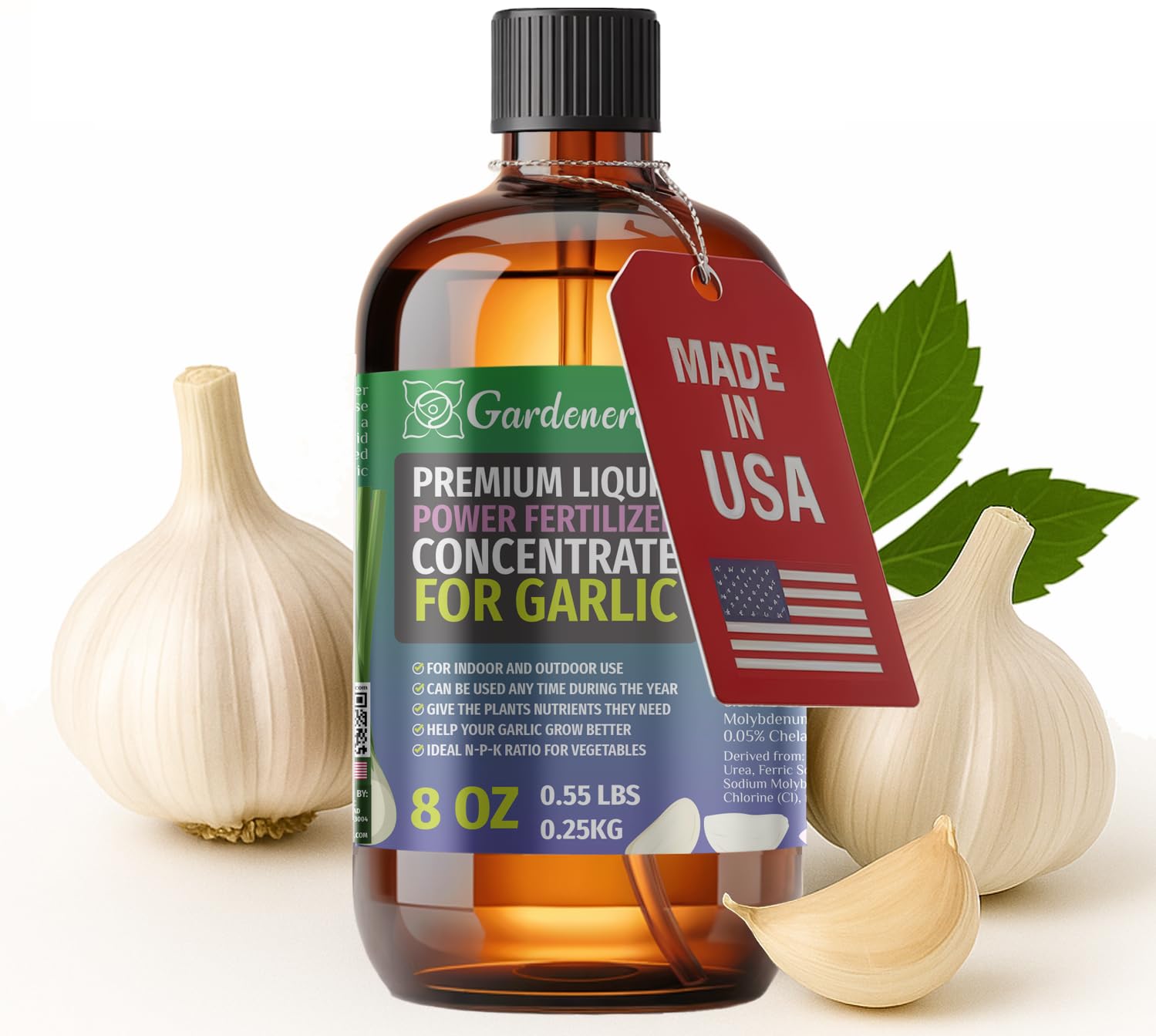
Gardenera Liquid Power Garlic Fertilizer Concentrate, 8 oz
| Item Form | Liquid |
|---|---|
| Application Method | root drench, hose sprayer, or foliar mist |
| Coverage | Low |
| Target Species | Garlic |
| Liquid Volume | 8 fluid ounces |
Gardenera Liquid Power is a focused liquid fertilizer made specifically for garlic, offered as an 8 ounce concentrate for root drenches, hose sprayers, or foliar misting. In practice you dilute and apply it during key growth stages to encourage vigorous tops, bigger cloves, and stronger root systems. The formula combines NPK with chelated micronutrients and an acidic profile to free locked-up elements in alkaline soils, which can help correct common nutrient deficiencies and improve flavor development. Its small concentrated bottle is convenient for hobby beds, containers, or small plots and makes targeted feeding straightforward. Because coverage is listed as low, this product is best for seasonal applications or for growers who treat specific plants rather than wide-area feeding. The low pH and concentrated nutrition mean you should follow dilution guidance to avoid overfeeding or foliar burn, and the 8 ounce volume may require multiple purchases for larger gardens. For growers seeking a garlic-tailored feed that acts quickly and supports bulb quality, this is a practical, reliable option.
Best for: Gardeners who prioritize predictable, crop-specific feeding for garlic beds and value a product engineered to support bulb size and flavor in small plots or containers.
Less Ideal for: Large-scale growers or those who need broad coverage from a single purchase should consider bulk or landscape-grade fertilizers instead.
- Formulated specifically for garlic with a balanced NPK and chelated micronutrients
- Multiple application methods: root drench, hose sprayer, or foliar mist
- Acidic formula helps unlock micronutrients in alkaline soils
- Concentrated 8 oz bottle is easy to store and transport
- Coverage rated as low so not suited for treating large areas in a single bottle
- Very acidic pH requires careful dilution to avoid plant or foliar damage
Verdict: Buy this if you want a garlic-specific, fast-acting concentrate that reliably promotes bigger bulbs and stronger roots in small-scale gardens.
Burpee Bone Meal Fertilizer, 3 lb

| Item Form | Powder |
|---|---|
| Specific Uses For Product | Plant Growth, Root Development |
| Coverage | 240 Sqaure Feet |
| Target Species | tomatoes, peppers, and bulbs |
Burpee Bone Meal is a slow-release granular fertilizer designed to boost early root development and flowering in root and bulb crops. Gardeners typically work it into planting holes for bulbs or mix it into soil and potting media when starting seeds or transplanting vegetables like carrots, beets, and onions. The product is OMRI listed for organic gardening and provides phosphorus and calcium that support stronger root systems and better early-season growth. Its fine granular texture makes it easy to apply evenly, and because it breaks down slowly it feeds plants over the season without burning them. Practical benefits include targeted support for root vegetables and an easy application method for beds and containers. Limitations are that it supplies mainly phosphorus and calcium rather than a balanced NPK profile, so it is best used alongside a nitrogen source if foliage development is needed, and results are gradual rather than immediate because of the slow-release nature.
Best for: Gardeners focused on improving root development and bulb planting who prefer organic inputs and want a simple amendment to add at planting or during bed preparation.
Less Ideal for: Growers seeking an all-in-one balanced fertilizer for both foliage and root development or those who need fast-acting, soluble nutrients for immediate correction.
- OMRI listed for organic gardening, suitable for certified organic beds
- Fine granular form that is easy to spread and incorporate
- Provides phosphorus and calcium to encourage strong root and bulb development
- Slow-release action reduces risk of burning plants and supplies season-long support
- Not a complete fertilizer profile so additional nitrogen may be needed for leafy growth
Verdict: A reliable organic bone meal to strengthen roots and jump-start bulbs and root vegetables when added at planting.
True Organic Prilled Sulfur — Prilled Elemental Sulfur Granules, 5 lb

| Item Form | Granules |
|---|---|
| Specific Uses For Product | Agriculture, Gardening |
| Coverage | Medium |
| Unit Count | 80 Ounce |
| Target Species | Plants |
True Organic Prilled Sulfur is a granular elemental sulfur product intended to acidify soil and improve nutrient availability for in-ground gardens. It is typically broadcast or worked into soil one to two weeks before planting to gradually lower pH and support better flowering and fruiting. The prilled form makes it easy to spread evenly over beds, and a 5 lb bag advertises coverage up to about 1,333 sq. ft., which suits larger blueberry patches or multiple planting areas. Because it is pure elemental sulfur, results are gradual and best for long-term pH adjustment rather than an immediate fix. The product is made with organic inputs and is presented for gardening and agricultural use, which may appeal to buyers avoiding synthetic acidifiers. Important practical limits are that you must test soil pH first and calculate application rates carefully to avoid over-acidifying, and it does not provide nutrients beyond its pH effect, so plan a complementary fertilizer program for blueberry-specific needs.
Best for: Gardeners who test soil and want a conservative, organic-compatible way to lower pH for acid-loving plants like blueberries and are comfortable planning applications ahead of planting.
Less Ideal for: People needing rapid pH change immediately before harvest or those who want an all-in-one fertilizer that also supplies macronutrients.
- Prilled granular form spreads evenly for straightforward application to beds
- Formulation is elemental sulfur, which reliably lowers soil pH over time
- 5 lb bag claims wide coverage suitable for multiple blueberry planting areas
- Made with organic inputs and presented for garden use
- Acts slowly so it is not a quick pH correction
- Contains only sulfur and does not supply other nutrients blueberries need
Verdict: A practical organic-compatible sulfur granule for gardeners who plan ahead to safely acidify soil for blueberries and other acid-loving plants.
Choosing the Right Organic Fertilizer for Garlic: Key Factors to Consider
Nutrient Balance and Timing
Garlic has shifting nutrient needs across its life cycle. Early in growth it benefits from modest nitrogen to support leaf development, but excessive nitrogen late in the season can reduce bulb size and storage life. Phosphorus and potassium are important for root establishment and bulb formation, so a fertilizer with adequate potassium and available phosphorus is helpful at pre-planting and during bulbing.
Timing matters because garlic is sensitive to late-season pushes that keep foliage too lush. Plan for soil amendments before planting and a measured top-dress or low-strength side-dress in spring. Match product release rates to those windows so nutrients are available when bulbs set rather than locked up or leached earlier.
Source of Nutrients
Organic fertilizers supply nutrients from varying sources, and those sources affect availability. Compost and well-rotted manure release nutrients slowly and build soil structure, while mineral sources like rock phosphate or sulfate of potash supply specific nutrients more predictably. Seaweed and fish-based amendments add micronutrients and natural growth stimulants but can be higher in salt or smellier.
Choose products whose ingredient profile aligns with soil test results. For example, if soil tests show low potassium, favor an amendment with a reliable potassium source. If overall organic matter is low, prioritize compost-style or manure-based fertilizers that improve tilth and water retention.
Release Pattern and Predictability
How quickly a fertilizer releases its nutrients affects both performance and risk. Fast-release organic liquids can green up foliage quickly, which is useful in early spring recovery, but they can also cause uneven growth if used late. Slow-release granules or mineral amendments provide more predictable, longer-lasting supply suited to the months-long bulbing process of garlic.
Consider your climate and irrigation routine. In cool soils, slow mineralization can delay availability, so a blend with some readily available forms plus a sustained-release component is often the most reliable approach for consistent bulb development.
Application Method and Labor
Different fertilizers require different application methods and effort. Granular side-dressing is simple for small beds and allows placement away from cloves to avoid burn. Liquid feeds are quick and uniform but usually require mixing and more frequent applications. Top-dressing under mulch can save labor but may slow nutrient entry into the root zone.
Think about how much time you will spend feeding and whether you need compatibility with irrigation or drip systems. Ease of measuring, spreading, and storing the product also affects its practicality for home gardeners.
Impact on Soil Biology
Healthy soil biology improves nutrient cycling and water retention, both important for garlic. Organic fertilizers that feed microbes and add organic matter help create a resilient root environment and reduce dependency on repeat feeding. Some inputs include beneficial microbes or humic substances that accelerate decomposition and nutrient availability.
If soil structure or tilth is a concern, favor products that explicitly build organic matter. In contrast, highly concentrated mineral inputs can correct specific deficiencies quickly but do less to improve long-term soil function.
Crop Safety and Residue Considerations
Because garlic is an edible crop with long storage potential, choose fertilizers that minimize residue risks and excessive salts. Low-salt amendments reduce the chance of root damage and avoid uptake issues that could affect bulb flavor or storage. Also consider odor and wash-off risks when using manures or fish-based products near harvest.
Check that the fertilizer is labeled for use on edible root and bulb crops and follow recommended withholding periods if any. For gardeners selling at market or giving bulbs away, conservative choices that prioritize food-safety characteristics are prudent.
Soil Testing and Simple Amendments
Start with a soil test to identify major nutrient gaps and pH issues before choosing an organic fertilizer for garlic. A basic test informs whether you need a potassium boost, extra phosphorus for root development, or simply more organic matter to improve structure.
If the test shows modest deficiencies, simple amendments such as well-rotted compost or a balanced organic granular fertilizer can correct them while improving tilth. For low pH soils, address liming needs before planting since pH influences nutrient availability.
- Collect a soil sample from the planting zone and test for pH, P, and K.
- Blend compost into the topsoil in the fall or several weeks before planting.
- Avoid heavy nitrogen applications late in the season to prevent floppy tops.
Pre-Plant Soil Building Vs Spring Top-Dress
Many successful garlic growers focus on improving soil the season before planting. Incorporating organic matter and correcting deficiencies in the fall gives nutrients time to stabilize and improves bulb outcomes the following summer.
Spring top-dressing provides a targeted boost as shoots green up but should be modest. Use a low-strength organic feed or a banded mineral amendment applied away from cloves to encourage steady bulbing rather than leaf flush.
- Fall: add compost, manure, or slow mineral sources.
- Spring: apply a light side-dress when shoots are 4 to 6 inches tall.
Using Liquid Feeds and Foliar Sprays
Liquid organic feeds and foliar sprays can correct temporary nutrient shortages quickly and are easy to deliver to small beds or containers. They are particularly useful in early spring when soil temperatures limit microbial mineralization.
Use liquids as supplements rather than the main fertility plan. Overreliance on foliar feeding can mask poor soil health and requires more frequent applications for sustained results.
- Apply dilute liquid feeds during active green-up for a quick nutrient pulse.
- Avoid foliar sprays late in the season to prevent promoting late vegetative growth.
Mulch, Irrigation, and Nutrient Movement
Mulch affects how fertilizers reach the bulb zone. Organic mulches conserve moisture and moderate soil temperature but can slow nutrient movement from top-dressed applications. Incorporate amendments before laying thick mulches or plan for longer mineralization periods.
Irrigation frequency influences nutrient availability. Regular, even moisture supports microbial activity and steady nutrient release, but heavy irrigation risks leaching soluble salts. Match your feeding schedule to irrigation patterns to optimize uptake.
- Apply amendments before mulching for best root access.
- Use steady irrigation to aid slow-release fertilizer mineralization.
Adjusting for Climate and Growing Zones
Cool climates slow organic mineralization and may require more readily available nutrient sources in spring. In warmer regions, slow-release organic materials can be sufficient because microbial activity liberates nutrients earlier.
Tailor product choice and timing to your growing zone. In colder soils consider a small early liquid feed to jump-start growth followed by a slow-release amendment for bulbing.
- Cool climates: plan for earlier spring supplements.
- Warm climates: rely more on slow-release organics and fall soil preparation.
How We Chose the Best Organic Fertilizer for Garlic
We selected products based on criteria that matter to gardeners growing garlic. First, nutrient profile clarity was required: candidates needed a clearly labeled N-P-K balance and obvious sources of those nutrients so we could judge suitability for garlic's growth stages. Second, soil-improvement impact was considered, including whether the fertilizer supported organic matter, microbial activity, or provided slow-release forms that reduce burn risk. Third, application practicality was important: granular versus liquid, ease of side-dressing, and compatibility with mulches and transplanting. Fourth, safety and suitability for edible crops guided the list; only fertilizers with organic-appropriate ingredients and low risk of heavy metal contamination were included. We also assessed compatibility with common garlic schedules, such as pre-plant soil building and spring top-dressing. Exclusions included products lacking clear ingredient lists, non-organic synthetics, or those intended strictly for large-scale commercial use rather than home or small-scale market gardening. The result is a set of options that prioritize nutrient balance for bulb formation, soil health benefits, and straightforward garden use.
FAQ
When should I apply organic fertilizer to garlic?
Apply the main soil-building amendments in the fall or several weeks before planting to allow nutrients to stabilize. Use a light spring side-dress when shoots are 4 to 6 inches tall. Avoid heavy feeding close to harvest to prevent late-season lush growth.
How much nitrogen does garlic need?
Garlic needs modest nitrogen early to support foliage, but too much late in the season can reduce bulb quality and storage. Aim for balanced feeding and follow product directions for application rates, reducing nitrogen as the bulbs begin to form.
Can I use compost alone for garlic fertility?
Compost alone can supply many needs, especially if applied generously in the fall and mixed into the planting zone. However, if soil tests show specific nutrient deficiencies, supplement with an organic source that supplies the lacking element, such as potassium or phosphorus.
Are fish-based fertilizers safe for edible bulbs?
Fish-based fertilizers provide soluble nutrients and micronutrients, and they are generally safe when used according to directions. Be mindful of odor and salt content, and avoid heavy applications right before harvest to prevent wash-off or flavor concerns.
How do I avoid fertilizer burn with organic products?
Organic fertilizers burn risk is lower than with synthetic salts, but concentrated products can still damage roots. Apply granular materials at recommended distances from cloves and dilute liquid feeds. Incorporating amendments into the soil before planting reduces direct contact with delicate roots.
Should I change fertility between hardneck and softneck garlic?
Both types have similar broad needs, but cultivar vigor and clove size can affect how much fertility they use. Monitor growth and adjust feedings if foliage is excessively lush or plants are pale. Use soil tests to fine-tune nutrient additions rather than changing approach solely by garlic type.
Final Verdict
Choose an organic fertilizer strategy for garlic by matching nutrient sources and release patterns to your soil test and climate. Prioritize building soil organic matter in the offseason, then use modest, targeted spring feeds timed to green-up and bulb set. Balance the need for available phosphorus and potassium with slow-release inputs that maintain steady supply and protect bulb storage. Focus on predictable nutrient timing, soil biology benefits, and simple application methods. With those priorities you can select a fertilizer approach that reliably produces firm, well-storing garlic bulbs without unnecessary late-season push.
