

Note: This article contains affiliate links. If you click on these links and make a purchase, I may earn a small commission at no extra cost to you. This helps support my research and content. Read my full affiliate disclosure here.
When you choose a liquid lawn fertilizer for fall you are investing in next spring's vigor more than immediate green-up. In cooler months turfgrass shifts energy into roots and carbohydrate storage, so the right fall-focused liquid feed helps crowns survive cold, recover from summer stress, and green up earlier next year. This guide covers our six shortlisted liquid options for fall lawn care and explains the practical differences gardeners need to weigh. We evaluate nutrient ratios, application ease, and safety for common turf types to help you pick the best fit for your yard.
Top Picks at a Glance
| Best Overall The best all-around choice for most situations | GS Plant Foods Green Envy Liquid Lawn Fertilizer, 1 Gallon |  |
| Best Quality Built to a higher standard if you want something more solid | TPS NUTRIENTS Fall Liquid Fertilizer, 1 Gallon |  |
| Best Value The sweet spot between price and what you get | SUNDAY Green Machine Liquid Lawn Fertilizer, 2-Pack (84 fl oz) with Hose-End Sprayer |  |
| Best Budget The cheapest option that still gets the job done reliably | Scotts Turf Builder Liquid Lawn Food Refill, 32 fl. oz. |  |
| Most Popular A crowd favorite that many people choose with confidence | Scotts Liquid Turf Builder Plus 2 Weed Control, Ready‑to‑Spray, 32 fl. oz. |  |
| Best Seller A high-volume bestseller chosen again and again | Scotts Turf Builder Liquid Lawn Food, Ready‑to‑Spray, 32 fl. oz. (covers 2,000 sq. ft.) |  |
GS Plant Foods Green Envy Liquid Lawn Fertilizer, 1 Gallon

| Item Form | Liquid |
|---|---|
| Specific Uses For Product | Lawn Fertilizer |
| Application Method | Spray |
| Mixing Ratio | 1:32 to 1:64 |
| Target Species | lawn grasses |
GS Plant Foods Green Envy is a 1-gallon liquid concentrate meant to be mixed and sprayed over lawns to improve root growth, stress resilience, and nutrient uptake. It contains 4.3% humic acid, 6.7% fulvic acid, 22% organic carbon and two Bacillus strains, and is applied every 4 to 6 weeks at 2 to 4 ounces per gallon of water. Typical use is tank-mixing with a liquid fertilizer or applying between feedings with a hose-end or pump sprayer; one gallon of concentrate yields up to 64 gallons of finished mix and covers about 1,000 sq ft per gallon of prepared solution. The practical benefits are stronger root systems, improved soil microbial activity, and easier integration into existing feeding programs. Important limitations are that it is not an N-P-K fertilizer so it will not supply significant nitrogen on its own, and users need to follow dilution and stirring instructions to avoid sprayer clogging and ensure even coverage. It is best used as a supplemental root and soil health boost rather than a standalone quick-green feed.
Best for: Buyers who prioritize turf performance and long-term root health for large lawns and want a product that integrates with a regular liquid-feeding program.
Less Ideal for: Homeowners looking for an all-in-one fertilizer that supplies noticeable quick green-up on its own should consider a balanced N-P-K product instead.
- Concentrated formula yields up to 64 gallons of spray so a single jug treats large areas
- Contains humic and fulvic acids plus organic carbon to improve nutrient uptake and root growth
- Includes two Bacillus strains to boost beneficial soil microbial activity
- Can be tank-mixed with regular liquid fertilizers or used between feedings for flexible programing
- Does not contain an N-P-K guarantee so it will not replace a primary fertilizer feed
- Label recommends stirring and pre-mixing to prevent sprayer clogging which adds prep time
Verdict: A concentrated soil- and root-focused supplement that stretches far and pairs with liquid fertilizer programs to boost turf resilience on large lawns.
TPS NUTRIENTS Fall Liquid Fertilizer, 1 Gallon

| Item Form | Liquid |
|---|---|
| Target Species | Lawn Grass |
| Liquid Volume | 128 fluid ounces |
This one-gallon liquid fall fertilizer from TPS NUTRIENTS is designed to be applied in autumn to promote root development and help lawns, shrubs, flowers, and trees recover before winter. It is used like other liquid feeds: dilute according to directions and apply with a hose-end sprayer or broadcast spray for even coverage. Key features are a formulation targeting root strength and seasonal recovery and broad compatibility with lawn grass and landscape plants. In practice the product delivers readily absorbable nutrients that support deeper root systems and improve plant resilience going into cold weather. The liquid format makes it quick to apply over large areas and easier to mix for precisely dosed treatments than granular feeds. Limitations are that specific nutrient analysis and application rates are not stated on the provided listing so you will need to consult the label for timing and dilution, and liquid fertilizers require proper spraying equipment and careful calibration to avoid uneven application.
Best for: Buyers focused on measurable seasonal performance who want a targeted autumn feed to improve root depth and winter resilience for established lawns and landscape plants.
Less Ideal for: Gardeners who prefer granular, slow-release fertilizers or who lack a sprayer and do not want to manage liquid mixing and application.
- Liquid formula allows fast uptake and even coverage when applied correctly
- Formulation aimed at promoting root strength and seasonal recovery
- Versatile for use on lawns, shrubs, flowers, and trees
- One-gallon size suitable for treating medium to large lawns
- Listing does not include a full nutrient analysis or recommended application rates
- Requires spray equipment and careful mixing for consistent results
Verdict: Choose this concentrated liquid fall fertilizer when you want a fast-acting, root-focused autumn treatment to boost lawn and landscape resilience before winter.
SUNDAY Green Machine Liquid Lawn Fertilizer, 2-Pack (84 fl oz) with Hose-End Sprayer

| Item Form | Liquid |
|---|---|
| Application Method | hose sprayer |
| Coverage | 10,000 Sq Ft |
| Specific Uses For Product | Lawn Care |
The SUNDAY Green Machine liquid lawn fertilizer is a hose-end concentrate designed to green up turf quickly with minimal effort. You attach the included universal sprayer to a hose, spray the product across the yard, and reapply every 4 to 6 weeks during active growth. The 22-0-3 NPK formula supplies a high dose of nitrogen for fast green-up while seaweed, iron, and potassium support root strength and color. Two 42.3 oz bottles are combined to cover roughly 10,000 square feet, making this a practical option for medium to large suburban lawns. Notable conveniences are the liquid format for uniform coverage and the ready-to-use hose sprayer that removes measuring and mixing for most users. Important limitations are that it is a high-nitrogen, non-balanced formula so it is targeted at greening rather than broad soil amendment, and results depend on correct application timing and water use. Users in cooler or dormant periods will not see benefit until grass is actively growing.
Best for: Homeowners who want a straightforward, low-effort way to green up medium to large lawns and prefer hose-end liquid applications over granular or measured mixes.
Less Ideal for: Gardeners seeking a long-term soil amendment plan or a balanced fertilizer targeted at phosphorus or micronutrient correction should consider other products.
- High nitrogen 22-0-3 formula produces noticeable green-up and improves turf color.
- Includes a universal hose-end sprayer for fast, even application without manual mixing.
- Two-bottle pack covers up to 10,000 sq ft, reducing the need for multiple purchases for larger lawns.
- Contains supplemental ingredients (seaweed and iron) that support root health and deeper color.
- Focused on nitrogen-driven greening rather than a balanced nutrient program for long-term soil rebuilding.
Verdict: A practical, fast-acting hose-end liquid for homeowners who want easy, visible green-up across larger lawns.
Scotts Turf Builder Liquid Lawn Food Refill, 32 fl. oz.
| Unit Count | 32 Fluid Ounces |
|---|---|
| Item Form | Liquid |
| Application Method | Hose-end sprayer |
| Item Highlight | 29-0-3 NPK |
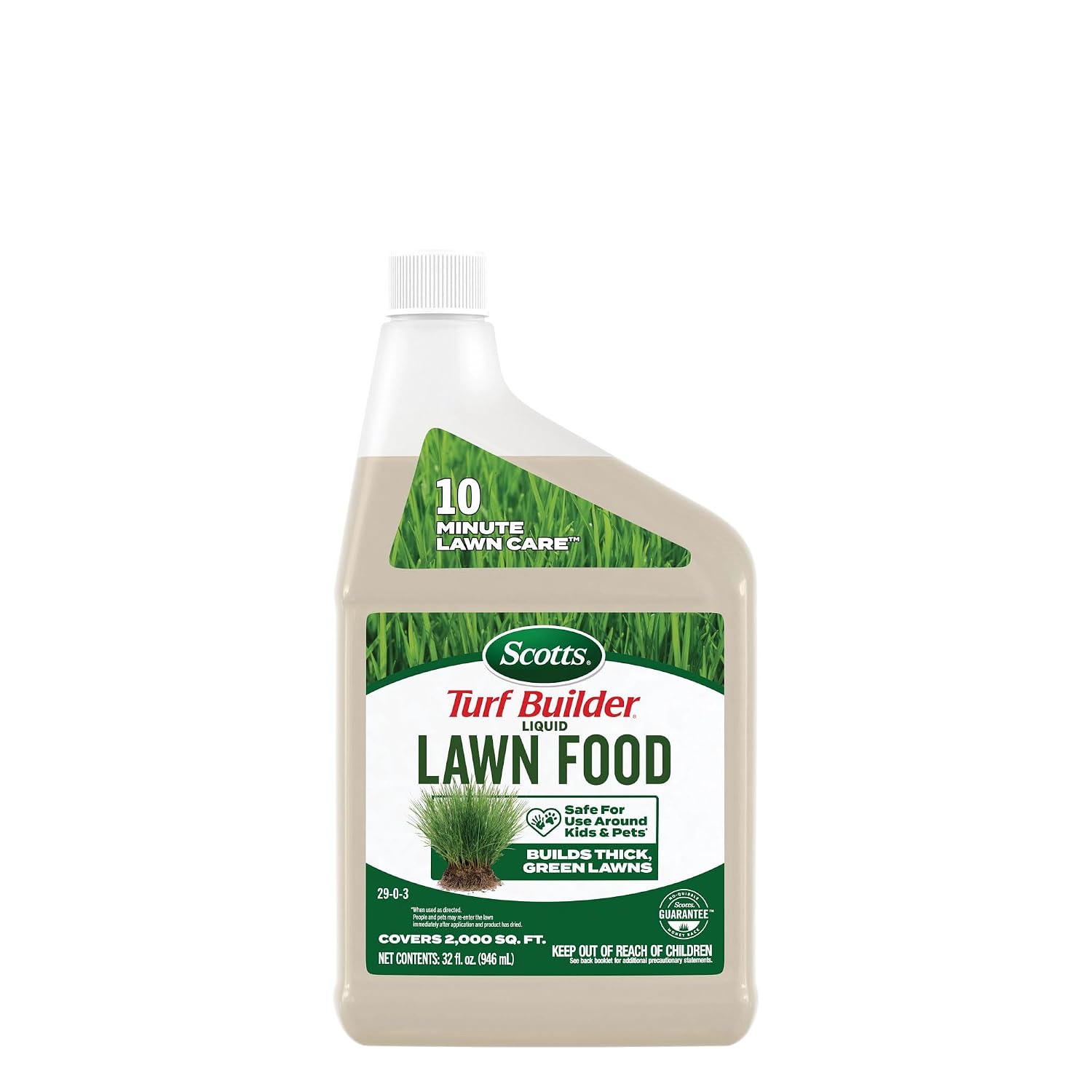
This Scotts Turf Builder Liquid Lawn Food Refill is a simple, time-saving fertilizer for established lawns that connects to a reusable hose-end applicator so you can feed and water at the same time. The 29-0-3 NPK formulation is high in nitrogen for green-up and includes potassium to help turf withstand everyday stress, and a 32 fl. oz. bottle treats roughly 2,000 sq. ft. in about 10 minutes. Typical use is spraying during active growth seasons up to four times a year — early spring, late spring, summer, and fall — when temperatures are between 60°F and 85°F. Practical benefits include fast, even coverage via the hose-end sprayer, a translucent bottle to monitor remaining liquid, and a refill format that reduces single-use plastic if you already own the applicator. Limitations are that it is intended only for established lawns (not starter/forming turf) and the 32 fl. oz. size may require multiple refills on larger yards. Also you must already have or buy the compatible reusable applicator to use this bottle as packaged.
Best for: Buyers who want an easy, fast way to feed an established small to medium lawn in the fall and prefer straightforward, no-mess hose-end application.
Less Ideal for: Those establishing new turf, managing very large properties that need bulk fertilizer, or anyone who prefers granular slow-release formulas for long-term feeding.
- Ready-to-spray liquid feeds and waters simultaneously with a hose-end applicator
- High-nitrogen 29-0-3 formula promotes quick green-up and thicker turf
- 32 fl. oz. bottle covers about 2,000 sq. ft. for fast application
- Translucent bottle lets you see remaining product while spraying
- Requires a reusable hose-end applicator to use the refill bottle
- Not formulated for new or newly seeded lawns
Verdict: A quick, no-fuss liquid refill that lets you spray-feed an established lawn for a visible fall green-up without complex mixing.
Scotts Liquid Turf Builder Plus 2 Weed Control, Ready‑to‑Spray, 32 fl. oz.

| Liquid Volume | 32 fluid ounces |
|---|---|
| Coverage | 6000 square_feet (warm-season); 4000 square_feet (cool-season) |
| Item Form | Spray |
| Active Ingredients | Nitrogen |
This ready-to-spray bottle combines a quick nitrogen boost with broadleaf weed control for an easy lawn maintenance step. You attach the hose, spray evenly across the lawn when weeds are actively growing, then avoid watering for 48 hours so the product can work. The formula lists a 25-0-2 NPK balance and targets common weeds such as dandelions, clover, chickweed, and ground ivy, making it useful for both warm- and cool-season grasses. Coverage is generous for a single 32 fl. oz. bottle: up to 6,000 sq ft on warm-season lawns and 4,000 sq ft on cool-season lawns. Practical benefits include fast visible weed curl within days and no need for separate fertilizer and weed-killer steps, which simplifies care for homeowners who want predictable results. Limitations to note are the restricted list of safe grass types and the need to avoid application above 85°F or watering for two days, plus some stubborn weeds may require a repeat treatment in 3 to 4 weeks.
Best for: Homeowners who want a simple, low‑effort way to feed their lawn and control common broadleaf weeds without separate products and who prefer predictable, do‑it‑yourself lawn care steps.
Less Ideal for: Gardens with mixed planting beds or users who need a product safe around vegetables and ornamentals should choose a different targeted solution.
- Hose-end ready-to-spray design requires no measuring or mixing
- Combines fertilizer and weed control in one application
- Covers large areas per bottle for typical home lawns
- Works on a wide range of warm- and cool-season turf grasses
- Visible weed decline within a few days for many common broadleaf weeds
- Not safe for use on garden beds or non-listed plants
- May cause temporary injury on some bermudagrass varieties and is restricted to listed grasses
- Stubborn weeds may require a second application within a month
Verdict: A single ready-to-spray bottle that simplifies feeding and broadleaf weed control for risk-averse homeowners who want dependable, low-effort lawn results.
Scotts Turf Builder Liquid Lawn Food, Ready‑to‑Spray, 32 fl. oz. (covers 2,000 sq. ft.)

| Item Form | Liquid |
|---|---|
| Coverage | 2,000 sq. ft. |
| Unit Count | 32 Fluid Ounces |
| NPK | 29-0-3 |
Scotts Turf Builder Liquid Lawn Food is a hose‑end ready fertilizer designed to feed and water established lawns in one step. The bottle connects to a standard garden hose and sprays an NPK 29-0-3 formula across the turf, so you can apply fertilizer while irrigating without mixing or measuring. It is intended for actively growing grass of any type and can be applied up to four times a year for seasonal maintenance. The main benefits are speed and convenience: application is quick, the built‑in sprayer makes coverage straightforward, and the high nitrogen content promotes rapid greening and thickening. Practical limits to note are that it is not a starter product for new seedings and should not be used when temperatures exceed 85°F; the coverage is about 2,000 sq. ft. per bottle so larger lawns require multiple bottles. For buyers who prefer predictable, simple lawn care, this product reduces application fuss but still requires timing applications to active growth periods and following the watering and mowing guidance on the label.
Best for: Buyers who want a low‑risk, simple maintenance fertilizer they can apply quickly without special equipment and who prioritize predictable, seasonal greening for established lawns.
Less Ideal for: Do not choose this if you are establishing new grass from seed, need temperature‑flexible products for very hot climates, or want a single bottle to cover a large property.
- Ready‑to‑spray hose‑end applicator eliminates measuring and mixing
- High nitrogen formula (NPK 29-0-3) promotes quick greening and thicker turf
- Covers up to 2,000 sq. ft. per 32 fl. oz. bottle for straightforward planning
- Suitable for all grass types when turf is actively growing
- Not formulated for newly seeded lawns or starter needs
- Should not be applied when temperatures exceed 85°F which limits use on very hot days
- Single bottle covers modest area so multiple bottles needed for larger yards
Verdict: A no‑fuss, ready‑to‑spray liquid fertilizer that reliably greens and strengthens established lawns with minimal setup.
Choosing the Right Liquid Lawn Fertilizer for Fall: Key Factors to Consider
Nutrient Ratio and Nitrogen Form
The balance of nitrogen, phosphorus, and potassium matters most for fall feeding. Fall formulas typically favor moderate nitrogen with a higher proportion of slow-release or ammoniacal and organic nitrogen forms that encourage root growth instead of lush top growth.
Choosing a product with the right nitrogen form reduces the risk of tender, frost-prone blades while still supplying energy to the crown. Look for clear labeling of soluble versus slow-release nitrogen and consider products that specify timing or controlled-release percentages to match the cooling window in your region.
Potassium Level for Winter Hardiness
Potassium improves cell strength, drought recovery, and cold tolerance in lawn grasses. In the fall, adequate potassium helps plants withstand freeze-thaw cycles and fungal stress through winter.
When shopping for a fall liquid fertilizer, check the potassium (K) number. A higher K relative to nitrogen can be more beneficial in late-season feeds. Because liquid formulations vary, consider how much K is delivered per recommended application and whether repeat applications are needed to build adequate reserves.
Compatibility With Application Equipment
Liquids shine when they match the sprayer or spreader you already own. Some concentrated liquids require dilution and a pump sprayer or hose-end applicator; others come ready to use. Viscosity, settling tendencies, and compatibility with common tank-mix partners affect how evenly fertilizer distributes across the lawn.
If you plan to treat large areas, evaluate the product's required dilution rate and run test coverage on a small area to watch for streaking. Also check whether the formula is safe to tank-mix with herbicides or seed-starting amendments if overseeding is part of your fall program.
Timing and Temperature Window
Fall applications are most effective when daytime and nighttime temperatures allow grass to take up nutrients without triggering new top growth. For cool-season lawns, early to mid-fall is often ideal; for warm-season lawns, late fall after dormancy begins may be better.
Product guidance on temperature ranges and recommended application intervals helps you schedule feeds to maximize root storage. Avoid applying high-soluble-nitrogen liquids right before hard freezes, and follow label timing to prevent wasted fertilizer or turf stress.
Safety for Overseeding and New Seed
If you plan to overseed while fertilizing, choose liquids designed to be safe for seedlings or follow a separate seeding timeline. Some fall fertilizers contain salt levels or high soluble nitrogen that can inhibit germination or burn tender new grass.
Read application instructions for guidance on seeding windows and any required dilution adjustments. When in doubt, delay fertilizer until seedlings have established a few true leaves, or use a labeled starter fertilizer designed for seed establishment.
Environmental Impact and Runoff Risk
Liquids can move quickly into soil and, if overapplied or applied before heavy rain, contribute to nutrient runoff. Fall feeding is generally lower risk than spring heavy feeds, but timing and application rate still matter to protect waterways.
Choose products with clear application rates and follow local regulations for nutrient management. Using buffer strips near water, avoiding application before storms, and calibrating sprayers can reduce environmental impact while still delivering fall benefits.
When To Apply Liquid Fertilizer In Fall
Timing your fall application depends on grass type and local climate. For cool-season grasses aim for a window after the final summer heat but before hard freezes so roots can take up nutrients and store carbohydrates.
Apply late enough that top growth slows but early enough that roots remain active. In many temperate regions that means a main application in early to mid-fall with an optional light follow-up several weeks later if temperatures remain moderate.
- Cool-season grasses: apply when daytime temps drop consistently into the 60s Fahrenheit.
- Warm-season grasses: apply after dormancy signals or follow region-specific guidance.
- Avoid applications immediately before heavy rain or an expected hard freeze.
How To Mix And Apply Liquid Formulas
Follow label dilution rates and mix in clean water to ensure even distribution. Agitate concentrated products before and during application to keep suspended micronutrients from settling out.
Use a calibrated hose-end sprayer or pump sprayer for small yards and a motorized boom or tow-behind applicator for larger lawns. Walk at a steady pace and overlap spray patterns slightly to avoid streaks.
- Test spray a small area to verify coverage and adjust dilution if streaking occurs.
- Rinse equipment after use to prevent residue buildup and avoid cross-contamination with other lawn chemicals.
Overseeding And Fall Fertilizer Timing
If overseeding, coordinate fertilizer choice with seeding needs. Gentle starter feeds or reduced-rate liquids are often safer for new seedlings than full-strength fall formulas.
Seed needs differ from established turf needs; prioritize starter nutrients and light irrigation until seedlings establish, then transition to a fall-strength fertilizing schedule to build root reserves.
- Delay stronger fall feeds until seedlings have several true leaves unless the product is labeled safe for seeding.
- Apply seed and keep soil moist for germination, using low-rate liquid applications to avoid wash-off.
Common Application Mistakes To Avoid
Over-application is a frequent error with liquids because it is easy to misjudge concentration or overlap spray passes. Excess nitrogen in fall can push tender top growth that is vulnerable to frost.
Another mistake is applying before heavy rain or when ground is saturated, increasing runoff risk and reducing uptake. Also avoid applying incompatible tank-mix partners without checking label compatibility.
- Calibrate your sprayer and measure product carefully.
- Avoid tank mixes unless compatibility is confirmed on the product label.
How Liquid Fall Feeds Compare To Granular Options
Liquid fertilizers are faster to apply and can deliver nutrients more uniformly when mixed and applied correctly. They are particularly useful for spot treatments and for ensuring immediate availability to roots before dormancy.
Granulars may provide longer residual release and can be easier to apply at precise per-area rates by broadcast spreaders. Your choice depends on how quickly you want uptake, the size of the lawn, and whether you need the convenience of liquids for spot or targeted applications.
- Use liquids for fast uptake and precision; choose granulars for convenience on very large areas and longer residual feed.
How We Chose the Best Liquid Lawn Fertilizer for Fall
To build this list we focused on attributes that matter for fall lawn feeding rather than general-season formulas. Key evaluation criteria included nitrogen form and ratio, because a lower quick-green nitrogen and higher soluble or slow-release nitrogen helps root development without forcing excessive top growth. We assessed phosphorus and potassium levels where allowed, since phosphorus supports root systems and potassium improves cold tolerance. Application method and compatibility with common sprayers mattered for real-world convenience and coverage. Absorption speed and leaf burn risk were evaluated to find formulas that deliver carbohydrate storage benefits without harming turf when temperatures drop. Safety guidance for overseeding and for cool-season versus warm-season grasses was considered to keep recommendations practical. We excluded summer-focused high-nitrogen concentrates and any products intended solely as turf colorants. The result is a short list of fall-oriented liquid fertilizers chosen for nutrient balance, application practicality, and winter-readiness.
FAQ
Can I apply liquid fertilizer right before the first frost?
It usually depends on turf activity. Applying immediately before a hard freeze risks limited uptake and possible leaf burn. Aim to fertilize when roots are still active and avoid treatments within a few days of expected hard freezes.
How often should I apply a liquid fall fertilizer?
Often a single main application with an optional lighter follow-up is sufficient. Frequency depends on product concentration and label instructions, as well as your grass type and soil fertility levels.
Is liquid fertilizer safe to use on newly seeded lawns?
Not always. Many fall formulas are too strong for seedlings. Use a starter-labeled liquid at reduced rates or wait until seedlings show several true leaves before applying a standard fall feed.
Will liquid fertilizer help my lawn survive winter better?
Properly timed fall fertilization that emphasizes root-building nutrients can improve winter survival by boosting carbohydrate reserves and cold tolerance. The benefit depends on timing, nutrient balance, and correct application.
Can I mix a liquid fertilizer with a herbicide or fungicide?
Sometimes, but compatibility varies. Check both product labels for tank-mix guidance and perform a small jar test when in doubt. Incompatible mixes can reduce effectiveness or harm turf.
How do I avoid runoff when applying liquid fertilizer?
Apply at recommended rates, avoid treating before heavy rain, and use buffer zones near waterways. Light, multiple applications rather than one heavy dose can also reduce runoff risk.
Final Verdict
Fall is the season to direct lawn energy into roots rather than top growth. Prioritize liquid formulas with nutrient ratios that favor root development and potassium for winter hardiness, and schedule applications when turf is still actively taking up nutrients. Balance convenience and coverage by matching the product to your sprayer and lawn size. With attention to timing, dilution, and seed safety, a well-chosen fall liquid fertilizer will strengthen crowns and improve spring performance. Focus on the tradeoffs between quick uptake and burn risk to pick the right approach for your yard.
