

Note: This article contains affiliate links. If you click on these links and make a purchase, I may earn a small commission at no extra cost to you. This helps support my research and content. Read my full affiliate disclosure here.
A tow behind seed spreader changes how you handle overseeding, renovation, and large-area seeding. If you manage an acreage, a municipal lawn, or a big suburban yard, the right spreader helps you cover ground faster while keeping seed rates consistent and reducing waste. This guide shortlists six top options that suit different hopper sizes, tow vehicles, and seeding tasks. We evaluated each for capacity, spread pattern control, durability, and ease of hookup so you can match a model to your acreage and seeding goals. Read on for practical notes that make choosing easier before you review the detailed product entries.
Top Picks at a Glance
| Best Overall The best all-around choice for most situations | Agri-Fab 45-0288 175 lb Tow-Behind Drop Spreader, 42" Spread |  |
| Best Quality Built to a higher standard if you want something more solid | Brinly 40" Tow-Behind Combination Aerator Spreader with Weight Tray |  |
| Best Value The sweet spot between price and what you get | AugFir Tow-Behind Broadcast Spreader — 130 lb Capacity, 12 ft Spread Width |  |
| Best Budget The cheapest option that still gets the job done reliably | Takywep 80 lb Tow-Behind Broadcast Spreader with 10" Pneumatic Tires |  |
| Highest Rated A top-rated pick with lots of positive feedback | MAXSA 150 lb Tow-Behind Broadcast Spreader with 30 Adjustable Settings |  |
| Most Popular A crowd favorite that many people choose with confidence | Agri-Fab 130 lb Pull-Behind Broadcast Spreader (Model 45-0463) |  |
Agri-Fab 45-0288 175 lb Tow-Behind Drop Spreader, 42" Spread

| Capacity | 175 pounds |
|---|---|
| Spread width | 42" controlled spread width |
| Coverage | Approximately 40,000 sq ft |
| Wheels | 12" x 3.5" pneumatic tires |
| Construction | Poly hopper with galvanized steel agitator |
The Agri-Fab 45-0288 is a tow-behind drop spreader made to cover roughly one acre per fill and simplify large-lawn maintenance. It is typically hitched to a lawn or garden tractor and used for spreading seed, fertilizer, ice melt, or salt across lawns and driveways; the on/off control is accessible from the tractor seat for convenient operation. Notable features include a rustproof poly hopper with a 175 lb (17 gallon) capacity that reduces refill interruptions, a 42 inch controlled spread width for precise placement, and 12" pneumatic tires that help with smooth towing over uneven turf. Construction uses galvanized steel components for the agitator and an alloy frame to stand up to regular outdoor use. Expect straightforward assembly and durable year-round performance, though this model requires a tractor or tow vehicle and is sized for larger properties rather than small yards. It does not include integrated spiking or powered agitation, so very heavy or damp materials may need checking for flow consistency.
Best for: Buyers who manage medium to large lawns and prioritize reliable, proven equipment that reduces time spent refilling and gives consistent, precise drop spreading when towed behind a tractor.
Less Ideal for: Homeowners with small yards, those who need a push spreader, or anyone wanting built-in spiking or powered agitation should consider other options.
- Large 175 lb (17 gallon) hopper reduces frequency of refills for acre-sized jobs
- 42 inch controlled spread width delivers more precise material placement
- Rustproof poly hopper and galvanized components resist corrosion for longer life
- On/off control accessible from the tractor seat makes operation convenient while towing
- Requires a tow vehicle such as a garden tractor, so not suitable for walk-behind use
- No powered agitation or spiker attachment included which can limit flow with damp or clumping materials
Verdict: Choose this Agri-Fab tow-behind drop spreader when you need a durable, high-capacity unit that delivers precise, acre-sized coverage with minimal refills.
Brinly 40" Tow-Behind Combination Aerator Spreader with Weight Tray

| Spreading capacity | 100 lb (1.74 cu. ft.) |
|---|---|
| Weight tray capacity | Up to 75 lb |
| Tine type | Galvanized 3-D steel tines |
| Tine depth | Up to 2 inches |
| Tire type | 10" pneumatic turf tires |
The Brinly 40" tow-behind aerator-spreader pairs a heavy-duty steel spreader with a robust aerator so you can perforate compacted soil and drop seed or fertilizer in a single pass. Typical use is behind a lawn tractor or zero-turn mower where the 10" pneumatic turf tires and transport lever make it easy to move between beds and across driveways. Notable features include a 100 lb steel hopper with calibrated flow control for accurate spreading, a rigid weight tray that accepts up to 75 lb of extra ballast for deeper penetration, and galvanized 3-D tine stars that resist bending and reach about 2" deep. Practical benefits are faster overseeding and reduced material washout because seed is deposited into aeration holes, plus a durable tubular steel frame built for repeated seasonal use. Important limitations are its size and weight, which make it best suited to tractors rather than walk-behind mowers, and assembly and storage will require space; it also does not include powered agitation so very wet or clumping materials may need attention. For larger properties or commercial mowing fleets this unit speeds the job while staying simple to operate.
Best for: Buyers running medium to large lawns or a small commercial crew who prioritize efficiency and durability and want to combine aeration and spreading in one pass behind a tractor or ZTR.
Less Ideal for: Homeowners with small yards, those who only use a walk-behind mower, or anyone needing a compact, lightweight handheld solution should consider smaller dedicated units.
- 2-in-1 design aerates and spreads seed or fertilizer in a single pass to save time
- All-steel 100 lb hopper with calibrated flow control ensures consistent material delivery
- Included steel weight tray accepts up to 75 lb to improve tine penetration in hard soil
- Galvanized 3-D tine stars resist bending and perforate soil up to about 2 inches
- 10" pneumatic turf tires and transport lever ease movement across varied terrain
- Weight and physical size require a tractor or large mower to tow effectively
- No powered agitation for very wet or clumping materials which can cause flow issues
Verdict: Combines heavy-duty aeration and accurate spreading in one tow‑behind unit to save time on medium to large lawns and small commercial properties.
AugFir Tow-Behind Broadcast Spreader — 130 lb Capacity, 12 ft Spread Width

| Hopper capacity | 130 lb |
|---|---|
| Spread width | Up to 12 ft |
| Tire type | 12.5 in pneumatic |
| Frame | Powder-coated steel |
This AugFir tow-behind broadcast spreader is built for covering large lawns quickly without constant refills. It mounts to most riding mowers, tractors, ATVs and UTVs via a universal hitch and includes an extender and handle rod so you can open the hopper from the seat. The trapezoidal 130 lb hopper and five-position flow control give precise, even distribution for seed, fertilizer, salt or ice melt across up to a 12 foot swath, which reduces passes and saves time on bigger properties. Rugged powder-coated steel construction, a gearbox and 12.5 inch pneumatic tires make it suitable on grass, gravel and light snow. Assembly is supported by step-by-step instructions and a video. Expect a bit of setup and the need to avoid overfilling the hopper to maintain consistent flow, and the unit does require a tow vehicle rather than hand operation. For a practical lawn owner focused on efficiency, this spreader turns several refill trips into one and handles varied seasonal tasks reliably.
Best for: Owners of large lawns, small farms, or properties who prioritize efficiency and want a tow-behind spreader that covers wide passes and reduces refill frequency while handling seasonal tasks.
Less Ideal for: If you have a small yard, need a handheld spreader, or want a unit for occasional sidewalk-only work, this tow-behind model is more capacity and setup than needed.
- Large 130 lb hopper reduces the number of refills on big lawns
- Adjustable five-position flow control and trapezoidal hopper deliver more even spreading up to 12 ft wide
- Universal hitch plus hitch and handle extenders allow convenient operation from the vehicle seat
- Powder-coated steel frame and gearbox with 12.5 in pneumatic tires for durable use on varied terrain
- Requires a tow vehicle so not usable for small yards or by hand
- Hopper must not be overfilled to avoid uneven application
Verdict: A high-capacity, tow-behind spreader that saves time on large lawns by delivering wide, even application across multiple seasonal tasks.
Takywep 80 lb Tow-Behind Broadcast Spreader with 10" Pneumatic Tires

| Hopper capacity | 80 lb (30 L) |
|---|---|
| Tire size | 10 in pneumatic |
| Frame material | Powder-coated carbon steel |
| Compatible tow | Riding mowers, ATVs, UTVs via pin-style hitch |
| Control | Adjustable rate-control lever |
The Takywep 80 lb tow-behind broadcast spreader is a basic, workmanlike machine for seeding, fertilizing, and winter de-icing on medium to large lawns. It mounts to riding mowers, ATVs, UTVs, and similar equipment using a pin-style hitch and rolls on large 10-inch pneumatic tires that handle uneven turf and light mud with less slipping. The rust-resistant poly hopper holds 80 pounds of granular material to reduce refills, and an accessible rate-control lever lets you dial coverage from light seed to heavier fertilizer or ice melt. A powder-coated carbon steel frame provides structural strength for regular seasonal use. Expect straightforward setup and operation but limited refinement: the unit is utilitarian rather than precision-engineered, and assembly and parts fit may require basic mechanical patience. For homeowners who want a simple tow-behind spreader that covers ground quickly without specialty features, this model delivers reliable performance for routine lawn and winter maintenance.
Best for: Buyers who want an affordable, no-frills tow-behind spreader to cover medium to large lawns quickly and handle seasonal seeding, fertilizing, and de-icing while keeping costs down.
Less Ideal for: Professional contractors or users who need precise commercial-grade calibration, premium fit and finish, or advanced spread pattern controls should consider higher-end models.
- Large 80 lb poly hopper reduces frequency of refills for bigger jobs
- 10" pneumatic tires improve traction and roll smoothly over uneven ground
- Adjustable rate-control lever for quick changes between seed, fertilizer, and ice melt
- Powder-coated carbon steel frame resists weather and adds durability
- Basic design with limited refinement in fit and finish compared with higher-end models
- Tow hitch and assembly may require time and basic tools to install properly
Verdict: A straightforward, budget-friendly tow-behind spreader that covers large lawns efficiently with a high-capacity hopper and all-terrain tires.
MAXSA 150 lb Tow-Behind Broadcast Spreader with 30 Adjustable Settings

| Capacity | 150 LBS |
|---|---|
| Adjustable settings | 30 settings |
| Spreading width | 9.8 FT |
| Tire type | 13-inch pneumatic tires |
The MAXSA tow-behind broadcast spreader is built for heavy residential and small-farm use where reliable, repeatable coverage matters. Its 150 lb hopper accepts large batches of seed or fertilizer so you refill less often, while 30 adjustable flow settings let you dial in the output rate for different materials. The unit offers a wide 9.8 ft spreading swath and a clog-resistant hopper to promote even distribution and reduce stops for clearing. Construction combines a powder-coated steel frame with corrosion-resistant aluminum gears and 13-inch pneumatic tires, which helps it tow smoothly over lawn, gravel and dirt and resist weather exposure. It can be towed behind ATVs, UTVs and tractors or used as a push spreader for smaller jobs, giving flexibility in how you work. Expect a straightforward assembly and maintenance routine, but note the product is a basic mechanical spreader without electronic rate control or very fine metering for specialty lawn-care tasks. For buyers who prioritize durability and consistent coverage, this is a practical, no-frills choice.
Best for: Gardeners and small-farm owners who want a dependable, low-maintenance spreader that delivers consistent coverage across lawns and acreage and minimizes refill and downtime.
Less Ideal for: Professional applicators who require electronic rate control, GPS mapping, or ultra-fine calibrated output for specialized turf work should consider commercial-grade units instead.
- Large 150 lb hopper reduces refill frequency for bigger jobs
- 30 adjustable flow settings for matching different materials and application rates
- Powder-coated steel frame and aluminum gears for corrosion resistance and tougher outdoor use
- 13-inch pneumatic tires provide smoother towing over varied terrain
- Universal hitch lets you tow behind ATVs, UTVs or tractors and also use as a push spreader
- No electronic or graduated metering for ultra-precise commercial-rate applications
- Relatively basic feature set compared with professional broadcast spreaders
Verdict: Choose this spreader if you need a rugged, high-capacity tow-behind that delivers consistent, wide coverage with minimal fuss.
Agri-Fab 130 lb Pull-Behind Broadcast Spreader (Model 45-0463)
| Weight Capacity Maximum | 130 pounds |
|---|---|
| Spread Width | 10-12 ft |
| Tire Type | Pneumatic |
| Material Type | Alloy Steel, Polypropylene (PP), Rubber |
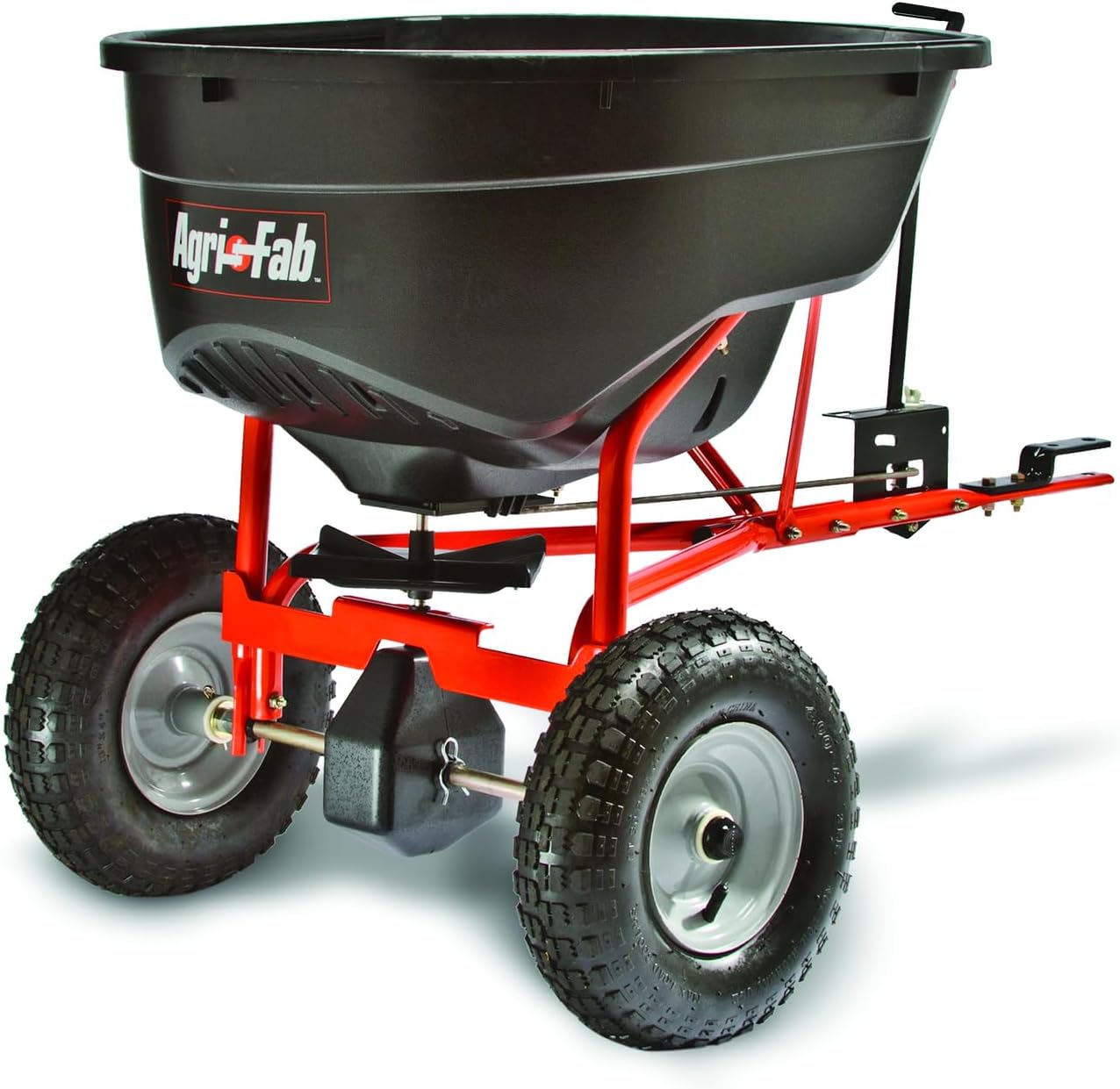
The Agri-Fab 130 lb pull-behind broadcast spreader is built for straightforward, dependable lawn care on larger yards. It mounts to most riding mowers with a universal hitch and holds up to 130 pounds, letting you cover roughly half an acre per fill to reduce interruptions. The wide 10 to 12 foot spread pattern and enclosed gear box promote more even dispersal and protect internal parts from dirt and moisture. A simple steel-rod flow control is reachable from the tractor seat so you can change application rates without stopping. The construction combines a poly hopper with alloy steel frame tubing and pneumatic tires for durability and smoother towing over uneven ground. Expect easy seasonal use for grass seed, fertilizer, granular lawn treatments, and salt. The main limitations are that it is a basic broadcast design, so very precise banding or ultra-fine calibration for specialty seed mixes may require additional passes or a different spreader type, and some assembly is required before first use.
Best for: Homeowners or property managers who want a reliable, no-nonsense tow-behind spreader to cover medium to large lawns efficiently and with minimal fuss.
Less Ideal for: Gardeners who need highly precise application patterns or small-plot users who prefer a handheld or walk-behind drop spreader for tight spaces.
- Large 130 lb hopper covers up to about 25,000 sq ft per fill to reduce refills on bigger lawns
- Universal hitch fits most riding mowers and lawn tractors for quick hookup
- Wide 10–12 ft spread width delivers even coverage with fewer passes
- Enclosed gear housing and steel frame improve durability and protect moving parts
- Seat-accessible steel-rod flow control lets you change settings without dismounting
- Broadcast design is less suited to precision banding or very narrow applications
- Requires assembly before first use
Verdict: A durable, easy-to-use tow-behind spreader that reliably covers larger lawns with fewer refills and minimal operator adjustments.
Choosing the Right Tow Behind Seed Spreader: Key Factors to Consider
Hopper Capacity and Material
Hopper size determines how often you stop to refill and directly affects how efficiently you can cover large areas. Larger hoppers cut downtime but increase overall weight and towing demands. Consider what vehicle you will use and whether adding a full hopper makes maneuvering or storage more difficult.
Material matters for longevity and seed protection. Rotomolded polyethylene resists dents and corrosion and keeps seed dry when paired with a tight lid. Metal hoppers can be robust but need good coatings or stainless components to avoid rust. Look for easy-access lids and wide openings to speed refills and reduce spills.
Spread Pattern Control and Calibration
Consistent germination depends on even distribution, so the ability to fine-tune the spread pattern is critical. Models with adjustable spread width settings and clear calibration charts let you match application rate to seed type and ground speed. A spread pattern that fans evenly across the path reduces missed strips and avoids over-seeding in concentrated lines.
Calibration should be straightforward with accessible controls and documented rates for common seed sizes. If you often switch between seed types or use fertilizer with seed, choose a spreader with precise settings and a reliable meter to maintain consistency.
Seed Flow and Metering Reliability
How the seed exits the hopper affects accuracy more than raw hopper size. An effective agitator or flow gate prevents bridging and keeps small seeds from compacting. Look for adjustable gates and durable metering mechanisms so you can maintain steady flow with fine seeds, pelletized products, or mixes that include fines.
A clogged or sticky meter leads to uneven application and wasted seed. Components that are easy to access and clean improve uptime, especially when switching materials or operating in wet conditions.
Tow Compatibility and Ground Maneuverability
Tow spreaders vary in hitch style, tongue length, and wheel track, which affects how they follow tractors, ATVs, or garden tractors. A spreader that tracks behind your tow vehicle without fishtailing produces a more uniform pass and reduces operator fatigue. Verify hitch type and tongue length match your vehicle and that loading a full hopper will not overload the hitch or axle.
Consider turning radius and how the unit handles uneven ground. Wider wheelbases increase stability on slopes, while narrow units are easier to navigate through gates and between landscape features. Balance stability with the vehicle you plan to use.
Build Quality and Maintainability
Durable frames, corrosion-resistant hardware, and replaceable wear parts extend the useful life of a spreader. Steel frames should have a good protective finish or stainless fasteners at pivot points. Plastic components exposed to UV and wear need to be tough and serviceable.
Maintenance matters in the seasons when you store and prepare equipment. Easy-to-access bearings, greasable pivot points, and straightforward replacement of agitators or metering parts make routine care quicker and keep performance consistent year after year.
Coverage Rate and Application Versatility
Know how much ground you can cover per hopper and how the spreader handles different application targets. Some models are sized for heavy-duty tasks like seeding large fields or applying bulk mixes, while others are built for lighter turf work. Coverage rate ties back to hopper size, metering options, and the recommended travel speed.
Versatility also means handling different materials. If you plan to use fertilizer, lime, or multiple seed sizes, choose a spreader with a metering system and agitator designed for mixed loads and easy adjustments.
Preparing Your Tow Vehicle and Hitch
Match the spreader to the towing equipment you already own. Verify the hitch type, tongue load, and tow capacity of your tractor, ATV, or riding mower before filling a hopper. A properly matched setup prevents overstressing the tow vehicle and improves tracking when making passes.
Check tire pressure, wheel bearings, and hitch pins before the first run. Small maintenance tasks performed before seeding save time in the field and maintain a consistent application rate because the spreader will tow smoothly and follow the vehicle path more predictably.
- Confirm tongue weight limits for your tow vehicle
- Use the correct hitch pin and safety chain configuration
- Inflate tires to the recommended pressure for even tracking
Calibration and Test Passes
Perform a calibration test on a measured strip before treating your whole lawn. Calibration translates the spreader settings into pounds per acre or pounds per 1,000 square feet, helping you avoid under- or over-application.
Walk or drive at the same speed you plan to use and collect the material dispensed over a timed pass. Repeat with any different seed or mixed materials to build a quick reference for each application rate.
- Use a measured test area to calculate actual coverage
- Record settings for each material and speed for future jobs
- Adjust gate and agitator settings when mix composition changes
Routine Maintenance and Winter Storage
After seeding, empty the hopper completely and brush out remaining seed and dust. Residual materials can attract pests or retain moisture and damage components over time. Rinse plastic hoppers if needed and dry before storage.
Lubricate bearings and inspect tires, axles, and fasteners annually. Replace worn agitators or meter parts before the next season. Store the spreader under cover or in a dry shed to protect metal components from prolonged exposure to moisture and UV.
- Empty and clean hopper after each use
- Grease wheel bearings and inspect hitch hardware
- Store off the ground under cover during winter
Using Spreaders on Slopes and Uneven Ground
Tow spreaders can handle gentle slopes, but steep grades introduce risks of tipping and uneven distribution as the hopper angle changes. When operating on inclines, reduce speed, load less seed, and make pass patterns that minimize cross-slope tilt.
Consider a model with a wider wheelbase or lower center of gravity if you routinely work hilly terrain. For very uneven ground, smaller loads and shorter passes give more consistent results and reduce stress on the frame and hitch.
- Avoid operating on slopes beyond the manufacturer's recommended angle
- Make shorter, controlled passes on uneven terrain
- Reduce hopper load when seeding steep areas
Seed Types and Mixtures That Work Best
Fine turfgrasses, cover crop seeds, and pelletized mixes all behave differently in a metering system. Fine seeds are more likely to bridge without an effective agitator, while coarse or pelletized products may require wider gate openings to maintain flow.
If you plan to apply multiple materials together, test the mix beforehand. Heavier fragments settle differently than fine seed and can affect flow and spread pattern. Adjust the meter and travel speed to suit the mix and keep a consistent application.
- Test each seed type for flow before a full application
- Adjust settings for pelletized or mixed materials
- Consider separate passes for very different materials to ensure accuracy
How We Chose the Best Tow Behind Seed Spreader
We selected products that consistently perform in real-world seeding tasks gardeners and turf managers commonly face. Our criteria focused on the features that affect work rate and outcome in the field: hopper capacity and material, spread pattern control and adjustability, meter and agitator reliability for seed flow, tow and hitch compatibility plus tow-vehicle demands, and overall build durability for repeated outdoor use. Each candidate had to demonstrate secure seed flow across a range of seed sizes and densities and provide clear means to adjust application rate. We excluded single-use or purely handheld devices and any units without open replacement parts or documentation for common maintenance items. We also filtered out models lacking basic corrosion resistance or with fragile axle and wheel components that limit field longevity. The final list balances capacity, control, and serviceability to reflect what gardeners and landscape teams actually need when seeding large areas.
FAQ
What travel speed should I use with a tow behind seed spreader?
Travel speed usually depends on the spreader's calibration chart and the material being applied. Most lawn-oriented setups work in the 3 to 6 mph range. Perform a test pass at your intended speed to confirm the actual application rate.
Can I use the same spreader for seed and fertilizer?
Often you can, but performance depends on the metering system and agitator. Heavier or coarser fertilizers may require different gate settings and could increase wear. Clean the hopper between uses and verify calibration for each material.
How do I prevent seed bridging in the hopper?
An agitator or internal paddle that keeps seed moving reduces bridging. Also check for damp or clumped materials that are more likely to bridge and avoid overfilling. If bridging persists, reduce hopper depth or use a product-specific flow aid.
Is a wider wheelbase always better for stability?
A wider wheelbase generally improves stability and tracking, especially on slopes, but it can make the spreader harder to maneuver through gates or tight spaces. Match wheel width to your typical operating environment.
How often should I calibrate my spreader?
Calibrate at the start of each season and whenever you change materials or towing speed. Routine checks after heavy use or after repairs help maintain consistent application rates.
What maintenance extends the life of a tow spreader?
Regular cleaning, drying, and lubrication of bearings keep parts moving freely. Inspect fasteners and replace worn agitators or meter parts promptly. Protect metal components from long-term moisture by storing the unit under cover.
Final Verdict
For large lawns and acreage, prioritize a spreader with the right hopper capacity for your routine and precise spread pattern controls to ensure even germination. Balance capacity with tow-vehicle limits and choose a metering system that handles the seed sizes and mixes you use most often. Routine calibration, maintenance, and proper hitch matching will keep a spreader performing reliably so you can seed efficiently and avoid rework.
