

Note: This article contains affiliate links. If you click on these links and make a purchase, I may earn a small commission at no extra cost to you. This helps support my research and content. Read my full affiliate disclosure here.
Getting seedlings off to a healthy start is one of the simplest ways to improve your summer vegetable harvest. A good vegetable seed starting kit gives you the environmental controls seedlings need during the vulnerable germination and early growth stages so you waste less seed and transplant sturdier plants. This guide covers the top shortlisted kits gardeners rely on for consistent warmth, humidity management, and adjustable lighting. Below we evaluate each kit on the practical features that matter in a home greenhouse, sunroom, or countertop setup so you can pick the one that fits your space and growing style.
Top Picks at a Glance
| Best Overall The best all-around choice for most situations | Patigrow 120-Cell Self-Watering Seed Starter Kit with LED Grow Light and Humidity Dome |  |
| Best Quality Built to a higher standard if you want something more solid | SOLIGT 60-Cell Seed Starter Kit with Grow Light and Heat Mat |  |
| Best Value The sweet spot between price and what you get | Burpee 72-Cell Self-Watering Seed Starter Kit |  |
| Best Budget The cheapest option that still gets the job done reliably | Kimdozee 120-Cell Peat Seed Starter Trays, 12-Pack Kit |  |
| Highest Rated A top-rated pick with lots of positive feedback | RAINPOINT 12-Cell Seed Starter Tray Kit with Full-Spectrum LED Grow Light (2-Pack) |  |
| Most Popular A crowd favorite that many people choose with confidence | Bonviee 5-Pack Seed Starter Trays with 12-LED Grow Lights |  |
Patigrow 120-Cell Self-Watering Seed Starter Kit with LED Grow Light and Humidity Dome

| Cell count | 120 |
|---|---|
| Material | PET (BPA-free) |
| Special features | Self Watering, Grow Light Bar, Aeration |
| Included components | Humidity dome, capillary mat, LED light, seed trays |
The Patigrow 120-Cell Seed Starter Kit is a complete indoor germination system aimed at getting lots of seedlings started with minimal fuss. The kit pairs a self-watering base and capillary mats with 120-cell seed trays and humidity domes so you can water once and maintain consistent moisture through germination. Integrated LED grow light bars with adjustable brightness and a timer provide supplemental light to prevent leggy seedlings when natural light is limited. Practical extras such as ventilation ports, enlarged drainage holes and plant labels make staging and monitoring seedlings straightforward. The kit is made from BPA-free PET and includes stands, spare vents and two full tray sets so it suits larger windowsill or bench projects and sharing between two growers. Limitations to note are that this is designed for indoor seed starting only and the built-in light covers a tray-sized footprint so larger setups will need additional lighting; also the PET parts are durable but are still plastic so expect some wear over multiple seasons. For someone who wants a turnkey, tidy way to start many seedlings indoors, this kit covers the bases well.
Best for: Gardeners who want an all-in-one, low-maintenance indoor seed starting solution to raise many seedlings at once without fussing daily over water and light.
Less Ideal for: Growers who need outdoor-ready propagation or who plan to scale to greenhouse-sized production should choose modular bench systems or standalone lights instead.
- Self-watering base with capillary mat reduces need for daily watering and helps prevent overwatering
- Adjustable LED grow light bars with timer and brightness control support healthy, compact seedlings
- Includes two full tray sets, humidity domes, vents and labels so it is ready to use out of the box
- Enlarged drainage holes and ventilation allow good air circulation to reduce damping-off risk
- Designed for indoor tray-sized setups so expanding to larger bench systems requires extra lighting
- Plastic components can show wear after repeated multi-season use
Verdict: If you want a ready-to-use indoor seed starting system that combines reliable self-watering with built-in LED lighting to raise large numbers of seedlings easily, this kit is a strong, practical choice.
SOLIGT 60-Cell Seed Starter Kit with Grow Light and Heat Mat
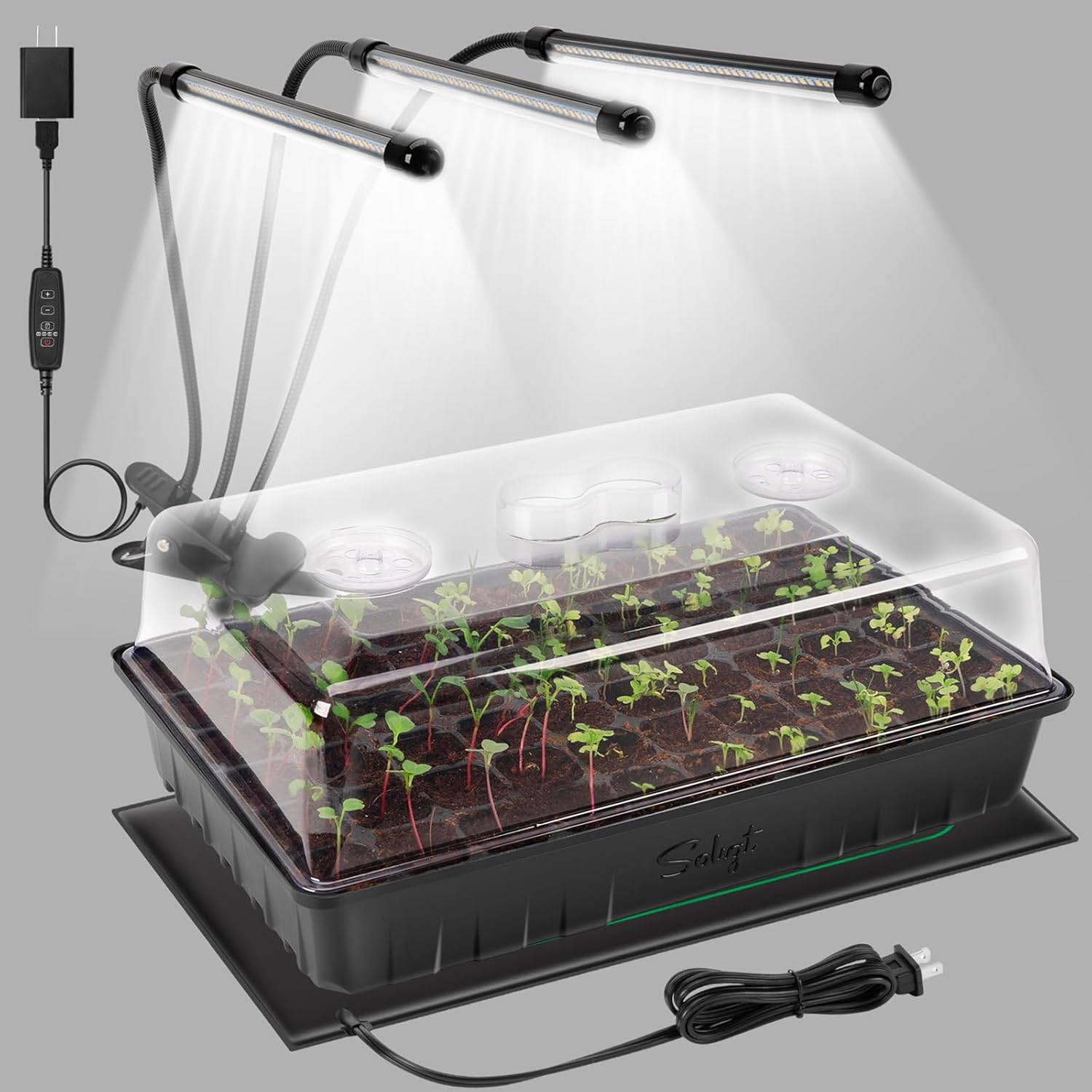
| Included Components | 1020 Seedling heat mat, 4500K grow lights, 60-cell seedling tray, humidity dome, propagation tray |
|---|---|
| Unit Count | 60 Count |
| Other Special Features of the Product | Corded |
| Mounting Type | Tabletop |
| Indoor Outdoor Usage | Indoor |
This SOLIGT kit provides a complete, beginner-friendly setup for indoor seed starting by combining a 60-cell seed tray, tall humidity dome, waterproof heat mat and a flexible full-spectrum grow light. You set seedlings in the 60-cell tray, cover with the adjustable-vent dome to hold humidity, then use the heat mat to give consistent bottom heat for faster, more even germination. The included 4500K LED light has multiple brightness levels, four timer settings and a three-head gooseneck so you can raise or angle light as seedlings grow or remove the dome and continue using the light on its clip or stand. Trays are described as heavy-duty plastic for reuse and the mat is waterproof for easy cleaning. Practical benefits are quicker, more reliable germination, reduced need for separate equipment and versatile light control for different crops. Limitations are that the kit is designed for tabletop indoor use only and the product listing lacks detailed power specs and exact light output numbers so advanced growers who need quantified PPFD or larger capacity may want a dedicated lighting solution.
Best for: Buyers who want a balanced, ready-to-use indoor seed starting system that saves time by combining heat, humidity control and a configurable grow light in one package.
Less Ideal for: Growers needing a high-capacity or commercial setup or those who require precise, measured light intensity for advanced propagation.
- Complete kit includes seed tray, humidity dome, waterproof heat mat and adjustable full-spectrum LED light
- Grow light offers 5 brightness levels and four timer options plus flexible gooseneck and clip or stand mounting
- Waterproof heat mat provides consistent bottom heat for faster, more even germination
- Tall dome with adjustable vents and drainage holes helps control humidity and root health
- Durable, reusable heavy-duty plastic trays suitable for multiple seasons
- Designed for tabletop indoor use only, not suited for larger or outdoor setups
- Light output is described by color temperature and LED count but lacks quantified PPFD or lumen figures for precision growers
Verdict: If you want a single, user-friendly indoor seed starting system that covers heat, humidity and adjustable lighting, this kit gives everything a balanced home gardener needs to get reliable seedlings.
Burpee 72-Cell Self-Watering Seed Starter Kit

| Unit Count | 72 Count |
|---|---|
| Capacity | 9 quarts |
| Material Type | Plastic |
| Other Special Features of the Product | Self Watering |
| Indoor Outdoor Usage | Indoor |
This Burpee 72-Cell Self-Watering Seed Starter Kit is a turn-key solution for starting vegetable and herb seedlings indoors. The kit bundles two 36-cell trays with a water reservoir tray and a self-watering mat so seedlings draw moisture from below instead of frequent hand-watering. Included coir pellets expand with warm water to create individual plug cells, and the clear dome helps retain humidity during germination. Practical extras like two plant stands, six markers and Plant-O-Gram diagrams keep trays organized and easier to manage. For vegetable growers the 72-cell format lets you start many varieties at once without needing separate pots. The main limitations are the plastic construction, which is not the most durable long term, and the fixed cell size that may be small for crops that need larger starter roots; you may need to transplant earlier or repot into larger cells. It also assumes indoor use and benefits from an external heat mat for faster germination. For someone who wants a low-fuss, organized way to start dozens of vegetable seedlings, this kit covers the essentials.
Best for: Buyers who want an efficient, no-fuss indoor seed-starting system to raise many vegetable or herb seedlings at once and value organization and moisture control.
Less Ideal for: Growers who prefer durable, long-lasting materials or who routinely start large-seeded or deep-rooted vegetables that need bigger starter cells.
- Complete kit with trays, reservoir, self-watering mat and dome so no separate accessories are required
- 72 coir pellets provide uniform individual plug cells for neat, space-efficient seed starting
- Self-watering system reduces overwatering and helps maintain consistent moisture for healthier roots
- Includes organizational aids: plant stands, Plant-O-Gram diagrams and plant markers to track varieties
- Plastic construction may wear or crack over many seasons
- Fixed 72 small cells limit root volume and require early transplanting for larger vegetable seedlings
Verdict: A practical all-in-one self-watering kit for growers who want to start a large batch of vegetable seedlings indoors with minimal fuss.
Kimdozee 120-Cell Peat Seed Starter Trays, 12-Pack Kit

| Material Type | Wood pulp |
|---|---|
| Number of Pieces | 12 |
| Capacity | 16 ounces |
| Plant or Animal Product Type | Vegetable, Fruit, Flower |
| Indoor Outdoor Usage | Indoor, Outdoor |
These Kimdozee peat seed starter trays are a budget-friendly kit for beginning seeds and small-scale vegetable, herb, or flower propagation. Each pack includes 12 trays that together provide 120 individual peat pots; the pots are breathable and designed to be planted directly into soil so seedlings experience less root disturbance at transplanting. The kit also includes 100 plant labels and two simple transplant tools to keep small setups organized. Made from natural wood pulp, the cells decompose in the ground and add organic matter as they break down. Practical benefits include easy separation of trays into smaller sections and built-in drainage to avoid waterlogging. Limitations are the small individual cell size, which is best suited to herbs, microgreens, or early-stage seedlings rather than large vegetables, and the disposable nature of peat means they are single use compared with durable plastic trays. Overall this is a straightforward, low-cost option for starting many small plants at once without needing extra pots or a lot of equipment.
Best for: Gardeners on a tight budget who want an all-in-one, low-fuss kit to start large numbers of herbs, flowers, or small vegetable seedlings and minimize transplant shock.
Less Ideal for: Growers who need larger cells, reusable trays, or long-term seedling staging should choose durable plastic systems or larger peat pots instead.
- Biodegradable wood pulp peat pots that can be planted directly to reduce transplant shock
- Includes 12 trays totaling 120 cells, allowing many seedlings per kit
- Comes with 100 plant labels and 2 transplant tools for organized sowing
- Drainage holes in cells help prevent waterlogging during germination
- Cells are small and suited only for early-stage seedlings or small plants
- Peat pots are single use and will not last multiple seasons
Verdict: If you need an inexpensive, ready-to-use kit to start many small seedlings and plant the pots directly into garden soil, this peat tray set delivers great value.
RAINPOINT 12-Cell Seed Starter Tray Kit with Full-Spectrum LED Grow Light (2-Pack)

| Unit Count | 2 Count |
|---|---|
| Planting Cells | 12 per tray |
| Material Type | Polycarbonate (PC), Silicone |
| Indoor Outdoor Usage | Indoor |
| Other Special Features of the Product | Drainage Hole, Lightweight, Scratch Resistant |
This RAINPOINT kit combines two 12-cell starter trays with flexible silicone cells, a clear adjustable humidity dome, and an integrated full-spectrum LED to make indoor seed starting straightforward and repeatable. You set seeds in the pop-out silicone cells, close the dome to control humidity, and position the included LED light above the tray to provide even light for seedlings. The silicone cells let you gently press seedlings out for transplanting without damaging roots, while multiple drainage holes and raised base grooves reduce waterlogging and simplify lifting. The trays are made from high-strength polycarbonate so they resist deformation and clean up for reuse season after season. Practical downsides are that the kit is optimized for tabletop indoor use only and the light is fixed to these trays rather than a larger adjustable stand, so you may need additional lighting or space for larger seed-starting setups. For gardeners seeking a compact, durable starter system with an integrated light, this kit delivers consistent, low-maintenance performance.
Best for: Gardeners who prioritize a reliable, low-fuss indoor seed-starting solution that protects seedlings during transplant and can be reused across seasons. Ideal for people who want consistent germination without managing separate lights and domes.
Less Ideal for: Growers who need a large-capacity or fully adjustable lighting rig for many trays or taller seedlings should consider modular systems with separate grow lights and stands.
- Flexible silicone pop-out cells allow transplanting without root damage
- Full-spectrum 18-LED grow light provides even, seedling-friendly illumination
- Clear adjustable humidity dome enables easy humidity and temperature control
- Durable polycarbonate tray construction cleans easily and resists deformation
- Drainage holes and base grooves improve aeration and reduce overwatering risk
- Designed for indoor tabletop use so it is not suited to large-scale or outdoor seed starting
- Light is integrated to the tray system and not a fully adjustable external fixture
Verdict: A compact, durable two-tray starter kit with pop-out silicone cells and an integrated full-spectrum LED that makes reliable indoor germination and easy transplanting simple.
Bonviee 5-Pack Seed Starter Trays with 12-LED Grow Lights

| Unit count | 5 Count |
|---|---|
| Planting cells | 5 × 12-cell inserts (60 cells total) |
| Light type | 12-LED full-spectrum per cover |
| Materials | PET, PP |
| Indoor usage | Indoor |
These Bonviee seed starter units are a compact, all-in-one solution for beginning vegetable seedlings indoors. Each of the five kits includes a clear 12-cell insert, a green base tray that catches runoff, an elevated humidity dome with an adjustable vent, and a vented cover fitted with 12 full-spectrum LED beads powered by a single 1-to-5 USB cable. The transparent inserts make it easy to monitor moisture and early root growth, while the drainage holes and saucer support bottom-watering and reduced overwatering risk. The adjustable vents let you control humidity as seedlings emerge. In practice the lights give supplemental illumination for windowsill or small-tent setups, but there is no built-in timer and a separate 5V/2A USB adapter is required. The units are small and best for starters or growers with limited space rather than large-scale production. Durability is typical of molded PET/PP plastic and the kit works well paired with a heat mat or external timer if you need more control.
Best for: Buyers who want a ready-to-use, space-efficient kit to reliably germinate vegetables and herbs indoors and who prefer visible moisture and root monitoring for risk-averse seed starting.
Less Ideal for: Gardeners planning large-scale propagation or growing larger transplants who need bigger cells, integrated timers, or heavier-duty materials should consider alternatives.
- Five complete starter units provide 60 planting cells for herbs and vegetables
- Integrated 12-LED full-spectrum lights per tray supply consistent supplemental illumination
- Clear inserts allow root and moisture observation without disturbing seedlings
- Drainage holes and base trays support bottom watering and help prevent overwatering
- Adjustable vented domes give simple humidity control during germination
- Requires an external 5V/2A USB power adapter and has no built-in timer
- Small cell size limits transplant size and is not ideal for larger seedlings
Verdict: A compact, low-risk starter kit that gives visible root monitoring, drainage, humidity control, and built-in LED light across five trays—ideal for reliable indoor vegetable seed starting.
Choosing the Right Vegetable Seed Starting Kit: Key Factors to Consider
Temperature Control
Seedlings germinate and develop best within a narrow temperature range that varies by species. For many common vegetables, maintaining consistent bottom heat speeds germination and improves uniformity across cells. A kit with an adjustable heat mat or thermostat lets you dial in temperatures for warm-season crops like tomatoes and peppers or lower temperatures for cool-season greens.
Inconsistent temperatures slow germination, increase damping-off risk, and can produce leggier seedlings as they struggle for stable conditions. When assessing kits, look for even heat distribution across the tray and a reliable control that holds a set point rather than fluctuating wildly.
Light Spectrum and Adjustability
Seedlings need strong, appropriately balanced light to develop stocky stems and compact leaves. A kit that includes a grow light with a full spectrum or a spectrum tuned toward blue light reduces stretching and produces a sturdier root-to-shoot ratio. Adjustable height and dimming let you move lights up as seedlings grow and prevent leaf burn for sensitive seedlings.
Insufficient light forces seedlings to elongate and weakens them for transplanting. Consider whether the included light covers the entire tray uniformly and whether the mounting or arm allows easy height adjustment to keep seedlings close to the light source without crowding.
Humidity and Ventilation
A clear dome helps maintain humidity during germination, preventing soil from drying out before roots establish. However, prolonged high humidity without ventilation promotes fungal issues. Kits with vent options or easily removable domes give you control to start with high humidity and then gradually increase airflow as seedlings develop.
Good ventilation also reduces the chance of condensation dripping onto seedlings, which can damage delicate stems. Look for domes with adjustable vents and a design that is easy to lift for daily checks and watering.
Cell Size and Tray Layout
Cell size determines how long you can keep seedlings in a tray before needing to transplant. Larger cells give seedlings more root space and reduce early root binding, which is useful for larger vegetables. Smaller cells allow more seedlings per tray and are fine for quick-growing microgreens or small herbs.
Tray material and drainage matter too. Sturdy trays resist warping under repeated use and allow consistent watering. Good drainage reduces the risk of oversaturation while still holding enough moisture for germination.
Ease of Use and Maintenance
Simple, reliable controls and components you can clean and reuse extend the kit's usefulness. Removable trays, dishwasher-safe parts, and easy-to-read thermostats reduce the friction of seasonal use. Kits that require minimal setup and include clear instructions will save time during the busiest planting windows.
Consider how easy it is to transplant seedlings from the cells without damaging roots. A design that facilitates firm yet gentle removal reduces transplant shock and makes the whole process more enjoyable.
Choosing the Right Setup for Your Space
Match the kit size to the space you have available. A countertop kit with a small footprint works well for windowsills and small apartments, while a larger tray with a full-width LED is better for a sunroom or garage seed-starting bench. Think about light clearance above the kit so you can raise lights as plants grow.
Consider power availability and cord routing if you plan to run heat mats and lights for extended periods. If you need a portable option for moving seedlings outdoors on warm days, choose a lighter kit with snap-on domes and no hard-mounted fixtures.
- Small tray footprints fit limited spaces and are easier to move.
- Larger trays reduce the number of separate units you must manage.
- Look for adjustable light mounts if you expect to grow seedlings for several weeks.
Preparing Seed Mix and Sowing Depth
Use a sterile, fine-textured seed-starting mix rather than garden soil. These mixes retain moisture while offering good drainage and a light structure that encourages root penetration. Moisten the mix before filling cells so you do not overcompress the media when sowing.
Check seed packets for recommended sowing depth. Tiny seeds often need surface contact and light to germinate, while larger seeds require a deeper covering. Uniform sowing depth across a tray improves synchronous germination and makes follow-up watering simpler.
- Pre-moisten mix to avoid compacting soil during sowing.
- Label rows or cells with planting dates and variety to track growth.
- Fill cells evenly to ensure consistent moisture and root space.
Germination and Early Care Routine
Start with the dome closed and the heat mat set to the recommended temperature for the crop. Check daily for condensation and signs of germination. Once most seedlings emerge, begin introducing airflow by opening vents or partially removing the dome to reduce humidity.
Light should be on for 12 to 16 hours a day depending on species. Use a timer to maintain consistent photoperiods so seedlings develop predictable growth patterns. Water from below when possible to encourage downward root growth and avoid wetting foliage which can invite disease.
- Use a seed heating schedule tailored to cool- or warm-season crops.
- Employ a timer for consistent light cycles.
- Bottom-water trays to reduce damping-off risk.
Managing Common Early Problems
Stretching, or legginess, is usually a light issue. Raise light intensity or lower the fixture closer to seedlings, and increase blue-rich spectrum exposure when possible. If stretching occurs early, pinch or transplant seedlings while they are still small to encourage stronger stems.
Damping-off and mold come from excessive moisture and poor airflow. Reduce dome humidity, improve ventilation, and avoid overwatering. If fungal issues appear, remove affected seedlings promptly and sterilize trays between uses.
- Adjust light position to correct legginess quickly.
- Increase ventilation at the first sign of mold.
- Clean and dry trays thoroughly between growing cycles.
Transplanting and Hardening Off
Transplant seedlings when they have a sturdy stem and at least their first true leaves. Handle seedlings by leaves rather than stems to avoid crushing the stem. If cells are deep enough, you can transplant the whole plug to reduce root disturbance.
Harden off seedlings by gradually introducing them to outdoor conditions over 7 to 10 days. Start with a few hours of sheltered sun and low wind, then increase exposure daily. Proper hardening off prevents shock and improves establishment in the garden.
- Transplant into prepared soil with sufficient fertility and moisture.
- Start hardening off in sheltered conditions to avoid wind damage.
- Acclimate for at least a week for sensitive crops like tomatoes and peppers.
How We Chose the Best Vegetable Seed Starting Kit
We selected kits that help gardeners reliably germinate and nurse vegetable seedlings through the first 4 to 6 weeks. Our editorial filters prioritized components that directly affect early seedling success: consistent bottom heat, adjustable grow lighting, humidity control, tray and cell quality, and ease of transplanting. We also considered build durability for repeated seasonal use and straightforward maintenance. Excluded were single-use or novelty items that lack temperature or light control, and kits with fragile components unlikely to survive multiple seasons. We favored products that paired clear, usable controls with standard tray sizes and cells gardeners can reuse or refill. The specific evaluation criteria used across picks include heat mat performance, light spectrum and adjustability, humidity dome design, cell and tray durability, and overall user ergonomics. Those factors guided what made the final shortlist and what was left out.
FAQ
When should I start seeds indoors for summer vegetables?
It depends on the vegetable and your last frost date. Many warm-season crops like tomatoes and peppers are started 6 to 8 weeks before transplanting, while cool-season crops can be started closer to transplant time. Check the seed packet and count back from your expected transplant date.
Do I need both a heat mat and grow light?
Often both are useful. A heat mat speeds and evens germination for warmth-loving seeds, while a grow light prevents legginess after emergence. Some cool-season crops do fine without extra heat, but light is almost always beneficial for strong seedlings.
How often should I water seedlings in a kit?
Frequency depends on mix and environment. Check moisture daily; water when the surface begins to dry but before cells wilt. Bottom-watering is a reliable method because it encourages roots to grow downward and reduces wet foliage that can promote disease.
Can I reuse the trays and domes from a kit next season?
Yes, with cleaning. Remove organic residue, scrub with a mild bleach solution or horticultural disinfectant, rinse thoroughly, and let items dry before storage. Proper cleaning reduces disease carryover between seasons.
What cell size is best for vegetable seedlings?
It depends on how long you plan to grow before transplanting. Larger cells give more root space for longer nursery periods and for larger crops. Smaller cells maximize seed count per tray but may require earlier potting up.
How do I prevent seedlings from becoming root-bound in the kit?
Choose a tray with sufficiently deep cells for the crop and transplant on schedule. If seedlings need extra time, pot up into larger cells or small pots to give roots additional room and avoid constriction before planting out.
Final Verdict
A vegetable seed starting kit is a practical investment for gardeners who want more control over germination and seedling quality. Prioritize consistent heat for warm-season crops, full-spectrum lighting you can adjust as plants grow, and domes with ventilation so you can manage humidity. Consider tray and cell size to match how long you plan to keep seedlings in the nursery and choose a design that is easy to clean and reuse. Balancing these tradeoffs will help you pick a kit that fits your space and growing rhythm so you get sturdy transplants and a smoother transition to the garden.
