

Note: This article contains affiliate links. If you click on these links and make a purchase, I may earn a small commission at no extra cost to you. This helps support my research and content. Read my full affiliate disclosure here.
A sidewalk needs a sprinkler head that delivers precise coverage without blasting water onto pavement. You want consistent arcs, reliable retraction, and predictable wetting so walkers stay safe and concrete stays clean. This guide covers six shortlisted sprinkler heads selected for sidewalk use and explains the features that matter in real yards and urban edges. Below we summarize how each option performs on spray control, build durability, and ease of installation so you can pick a head that keeps watering on the grass and off the path.
Top Picks at a Glance
| Best Overall The best all-around choice for most situations | Rain Bird 1804HDSP PRS Dual Spray 4" Pop-Up Sprinkler (180° Half Circle, 8–15 ft) |  |
| Best Quality Built to a higher standard if you want something more solid | Rain Bird 1804APPR25 1800 Series PRS Pressure-Regulating 4" Pop-Up Sprinkler |  |
| Best Value The sweet spot between price and what you get | Hunter Pro 4" Pop-Up Lawn Sprinkler Head (8–15 ft adjustable, 0°–360°) |  |
| Best Budget The cheapest option that still gets the job done reliably | Orbit Professional Hard Top Pressure-Regulating Pop-Up Spray Head with 15' Adjustable Nozzle |  |
| Highest Rated A top-rated pick with lots of positive feedback | Rain Bird 15SSTC1 Side Strip Spray Nozzle, 5-Pack |  |
| Most Popular A crowd favorite that many people choose with confidence | Rain Bird 1804VAN 1800 Series 4-inch Pop-Up Sprinkler Head (4 pack) |  |
Rain Bird 1804HDSP PRS Dual Spray 4" Pop-Up Sprinkler (180° Half Circle, 8–15 ft)

| Pop-up height | 4" |
|---|---|
| Pattern | 180° half circle |
| Spray distance | 8' – 15' |
| Inlet size | 1/2" |
| Pressure regulator | Built-in 30 psi PRS |
The Rain Bird 1804HDSP PRS is a performance-focused 4" pop-up spray head that combines an internal pressure regulator with a dual-spray nozzle to deliver consistent coverage and reduce water waste. It is typically installed in in-ground irrigation zones where fluctuating or high supply pressure causes misting and uneven distribution. The built-in PRS maintains about 30 psi at the nozzle, which helps preserve nozzle pattern integrity and reduces wind drift, while the dual-spray nozzle waters both close-in areas and the outer radius to avoid brown spots. Installation and maintenance are practical for a homeowner or a pro: the top-accessible components, stainless-steel spring, and mesh filter simplify flushing, adjustments, and repairs without specialty tools. The nozzle adjusts from roughly 8 to 15 feet and offers a Matched Precipitation Rate so it works with other Rain Bird fixed and adjustable sprays. On the downside this is a fixed 180° half-circle model, so you need the correct location or additional models for full or quarter coverage and you must match pop-up height to your landscape needs. For a low-pressure focused system it delivers reliable, efficient performance.
Best for: Owners who prioritize consistent, efficient watering and want a durable pop-up head that reduces waste and performs well on systems with variable or high pressure.
Less Ideal for: People who need fully adjustable arc coverage from a single head or those replacing heads where a different pop-up height is required and matching variants are not available.
- Built-in PRS pressure regulator maintains ~30 psi to prevent misting and improve uniformity
- Dual-spray nozzle provides close-in and outer-radius coverage to eliminate brown spots
- Top-serviceable design and stainless-steel spring allow easy maintenance and reliable retraction
- Matched Precipitation Rate nozzle enables consistent watering with other Rain Bird heads
- Fixed 180° half-circle pattern limits versatility unless paired with other arc options
- Pop-up height and spray radius are fixed by model choice so multiple variants may be needed for a full system
Verdict: Choose this Rain Bird head when you need a durable, low-pressure-friendly pop-up that delivers reliable, water-saving coverage in half-circle lawn zones.
Rain Bird 1804APPR25 1800 Series PRS Pressure-Regulating 4" Pop-Up Sprinkler

| Maximum Pressure | 30 psi |
|---|---|
| Maximum Flow Rate | 15 liters per minute |
| Material Type | Plastic, Stainless Steel |
| Spray Distance | 8' – 15' |
| Pop-Up Height | 4" |
The Rain Bird 1804APPR25 is a professional 4 inch pop-up spray head that keeps nozzle pressure steady at 30 psi to improve uniformity and cut misting and overspray. It is used in standard in-ground irrigation zones where mid-range spray distance (8 to 15 feet) is needed, and the adjustable collar lets you set the arc from 0° to 360° for corners or full-circle coverage. The integrated PRS regulator and matched precipitation nozzle reduce pressure-related variability across a zone so heads perform more evenly even when system pressure fluctuates. Durable construction — plastic body with stainless-steel spring and a co-molded wiper seal — makes retraction and sealing reliable and simplifies maintenance since components can be removed from the top. Practical benefits include measurable water savings, easier nozzle alignment with the ratchet mechanism, and fewer issues from wind or misting. Important limitations are that it is a fixed spray-style head so it is best for lawns and beds rather than long-distance rotary coverage, and you must choose the correct nozzle type and pop-up height for the exact layout of your system.
Best for: Homeowners or landscapers who want reliable, water-efficient fixed-spray coverage for lawns, beds, and irregular edges and value consistent performance when system pressure varies.
Less Ideal for: Large properties that need long-range rotary rotors or users who prefer variable-flow rotor heads for very wide turf areas.
- Built-in pressure regulator maintains 30 psi at the nozzle for consistent spray performance and reduced misting
- Adjustable 0°–360° arc and top-access distance adjustment provide precise placement without digging
- Durable materials with stainless-steel spring and co-molded wiper seal for reliable retraction and long life
- Matched precipitation nozzle options and ratchet alignment allow uniform coverage across mixed heads
- Spray head design is limited to short-to-mid range fixed spray patterns, not suitable for long-distance rotary needs
- Requires selecting the right nozzle/pop-up height for specific zones which adds planning during installation
Verdict: Choose this Rain Bird PRS pop-up if you need dependable, water-smart fixed-spray coverage with consistent pressure and reduced misting across a lawn zone.
Hunter Pro 4" Pop-Up Lawn Sprinkler Head (8–15 ft adjustable, 0°–360°)

| Maximum Pressure | 80 psi |
|---|---|
| Inlet Connection Size | 0.5 inches |
| Material Type | Plastic |
The Hunter Pro 4" Pop-Up is a professional-grade spray head designed for standard in-ground irrigation zones. It installs on a 1/2" NPT inlet and is typically used for lawn, garden, and flower-bed zones where a fixed or adjustable spray pattern is required. Key features include a fully adjustable arc from 0° to 360°, a user-adjustable radius from about 8 to 15 feet, a pull-ring flush cap to help clear debris, and a heavy-duty ribbed body and spring for reliable pop-up and retraction. In real use this translates to straightforward hand adjustments without tools, easy servicing of clogged nozzles, and a stable fit in softer soils. The head is compatible with most Hunter nozzles so you can swap in MP Rotators or specialty patterns to improve water distribution or efficiency. Limitations are that it is not pressure-regulated and maximum pressure is 80 psi, so you may need pressure regulation elsewhere for optimal performance, and plastic construction means extreme-impact resistance is lower than for metal-bodied rotors.
Best for: Homeowners and DIYers looking for a reliable, low-cost replacement or upgrade for standard in-ground spray zones who value easy installation and straightforward manual adjustment.
Less Ideal for: Those who need built-in pressure regulation or heavy-duty metal bodies for commercial applications should consider pressure-regulated or rotor-style alternatives.
- Adjustable arc and radius let you target irregular areas and reduce overspray
- Flush-cap pull ring simplifies clearing debris and routine maintenance
- Ribbed body and strong spring give stable installation and reliable pop-up/retraction
- Compatible with all Hunter nozzles for easy performance tuning and upgrades
- Not pressure-regulated so may need a separate pressure regulator for high-pressure systems
Verdict: A dependable, easy-to-adjust pop-up spray head that delivers professional performance for typical lawn and garden zones at a budget-friendly level.
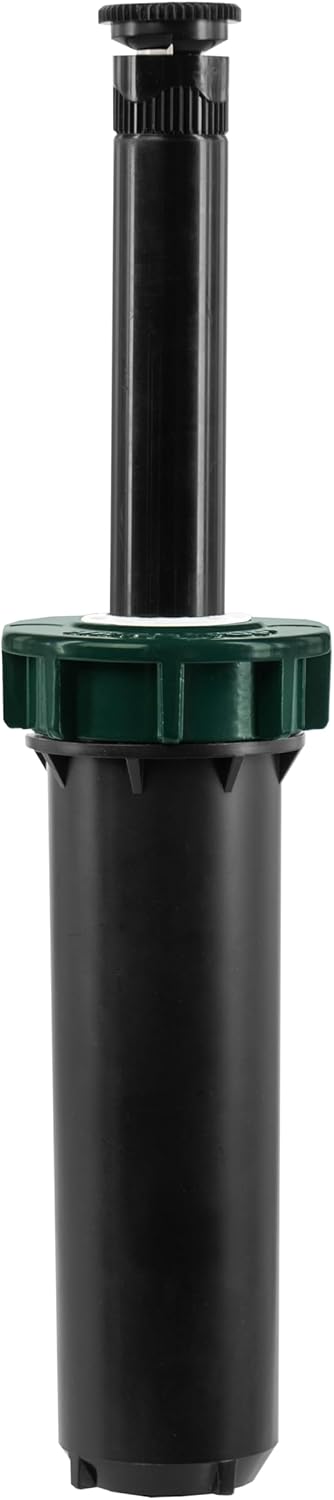
Orbit Professional Hard Top Pressure-Regulating Pop-Up Spray Head with 15' Adjustable Nozzle
| Maximum Pressure | 70 psi |
|---|---|
| Inlet Connection Size | 0.5 inches |
| Material Type | Plastic |
| Style Name | Pressure Regulating |
The Orbit Professional hard-top pop-up spray head is a durable, budget-friendly sprinkler head intended for in-ground residential irrigation near sidewalks and lawns. It installs on standard 1/2-inch female pipe threads and delivers an adjustable 0-to-360-degree spray with a 15-foot rated radius and an adjustment screw to reduce pattern distance. The unit's pressure regulator can be set to 30 or 40 psi before or after installation to match spray or rotator nozzles, which helps maintain consistent coverage on uneven water supplies. A metal cap protects the body from lawn equipment damage, and the stainless steel riser spring and over-molded wiper seal support reliable pop-up/retraction over time. It also includes a filter and integral silt trap to reduce clogging. Limitations are typical for plastic-bodied spray heads: extreme impacts or frozen conditions can still damage components, and finer tuning of spray arc requires manual ratcheting of the riser after installation. For its price and features this model gives a solid balance of protection, adjustability, and simple maintenance.
Best for: Homeowners looking for a cost-conscious, reliable pop-up sprinkler for sidewalks and lawn edges who value protection from lawn equipment and easy pressure control.
Less Ideal for: Landscape professionals or sites requiring heavy-duty metal-bodied heads or systems that need advanced hydraulic flow control and high-pressure industrial use.
- Pressure regulator adjustable to 30 or 40 psi for consistent performance
- Durable metal top protects the head from mower and trimmer damage
- Includes filter and integral silt trap to reduce clogging
- Stainless steel riser spring and over-molded wiper seal for reliable retraction
- Plastic body still vulnerable to heavy impacts or freeze damage
- Fine spray direction adjustments require manual ratcheting after installation
Verdict: A practical, budget-friendly pop-up spray head that protects against mower damage and lets you regulate pressure for steady sidewalk and lawn irrigation.
Rain Bird 15SSTC1 Side Strip Spray Nozzle, 5-Pack

| Manufacturer | Rain Bird |
|---|---|
| Coverage Dimensions | 4 ft. x 15 ft. |
| Adjustable Spray Distance | Approx. 3' x 20' to 4' x 30' |
| Item model number | 15SSTC1 |
The Rain Bird 15SSTC1 side strip nozzle is built to give precise watering along sidewalks, narrow beds, and strip zones where overspray is a concern. It installs into standard spray heads and provides a controlled side-strip pattern that concentrates flow along edges while keeping adjacent surfaces drier. The nozzle uses matched precipitation rate technology so it works with other nozzle patterns in the same zone without changing the system run time, and a stainless steel adjustment screw lets you fine tune radius from about 3' x 20' to 4' x 30' to match real site conditions. A stainless insert and mesh filter reduce clogging and the black non-corrosive plastic construction is aimed at long service life. In practice this is a simple, low-maintenance way to convert general spray heads into edge-focused watering for sidewalks and narrow strips, but you will still need to set the screw carefully and check for debris periodically to maintain the intended pattern.
Best for: Homeowners or landscapers who prioritize dependable, low-maintenance edge watering for sidewalks and narrow landscape strips and want components that play well with existing irrigation zones.
Less Ideal for: Those needing wide-area coverage or rotary-style sprinklers for large lawns should choose a different nozzle type designed for broader radii.
- Targeted side-strip spray pattern keeps water off sidewalks and driveways
- Adjustable stainless steel screw lets you fine tune spray distance for varied strip lengths
- Matched precipitation rate technology allows mixed-nozzle zones to run uniformly
- Mesh filter and corrosion-resistant materials reduce clogging and extend service life
- Requires occasional cleaning and adjustment to keep the edge pattern accurate
Verdict: Choose this nozzle when you need a reliable, adjustable side-strip spray that protects sidewalks and delivers consistent watering with minimal fuss.
Rain Bird 1804VAN 1800 Series 4-inch Pop-Up Sprinkler Head (4 pack)

| Material Type | Stainless Steel |
|---|---|
| Item Highlight | Adjustable 0-360 Degree Arc Nozzle; Up to 15 Ft Spray Distance; 1/2in NPT Threaded Inlet |
| Maximum Flow Rate | 176.71 cfm |
| Inlet Connection Size | 4 inches |
The Rain Bird 1804VAN is a compact 4-inch pop-up sprinkler head intended for lawns, garden beds, and landscaped zones where precise, matched precipitation is needed. Install it on a 1/2-inch female inlet and use the textured adjustment collar to set any arc from 0 to 360 degrees without tools, which simplifies corner and strip watering and reduces overspray. The head is built with UV- and weather-resistant components, a stainless-steel spring for reliable retraction, and a pressure-activated wiper seal to minimize leakage and prolong life. It delivers spray distances up to about 15 feet, making it suitable for small to medium turf areas and perimeter runs. Limitations are that it is a fixed spray pop-up rather than a pressure-regulated or multi-stream rotor, so it best serves zones designed for fixed-pattern spray heads and may require careful pressure and spacing planning to avoid misting or runoff. For gardeners focused on dependable, widely used components, these Rain Bird heads offer straightforward performance and long-term durability.
Best for: Buyers who prioritize proven, widely used irrigation parts and want reliable, easy-to-adjust spray heads for conventional lawn or landscape zones.
Less Ideal for: Those planning high-efficiency pressure-regulated or rotor-based zones for large turf areas should consider heads designed for pressure regulation or multi-stream rotors instead.
- Adjustable 0–360 degree nozzle for precise arc control without tools
- Durable construction with stainless-steel spring and UV-resistant materials for long service life
- Pressure-activated wiper seal to reduce leakage and conserve water
- Compatible 1/2-inch female inlet common to residential irrigation systems
- Not pressure-regulated so performance depends on system pressure and proper spacing
Verdict: A dependable, easy-to-adjust pop-up spray head that delivers proven durability and precise arc control for typical lawn and landscape irrigation needs.
Choosing the Right Sprinkler Head for Sidewalk: Key Factors to Consider
Spray Pattern Precision
Precise spray patterns are essential when a sprinkler sits next to a sidewalk. Adjustable arcs and distance control let you shave back throw so water lands on turf and not on concrete. A head with incremental arc stops or a dial-style adjustment helps you set narrow sectors for short runs and avoids the need to angle heads awkwardly.
Fine tuning reduces runoff from saturated pavement and lowers slip risk for pedestrians. When spray is predictable it also simplifies head-to-head spacing, so each head contributes to uniform turf moisture without blasting the walkway.
Pop-Up Height and Retraction
The pop-up height determines how well a head clears grass while closed heads stay flush to the sidewalk edge. For sidewalks, a low-profile pop-up that retracts fully prevents tripping and mower damage. Retraction reliability matters because a head that sticks up can break or leave a water source on the walking surface.
Look for stems and seals rated for repeated cycling. Smooth, consistent retraction keeps the sidewalk clear and reduces maintenance trips to reset or replace damaged heads.
Nozzle Options and Flow Control
Interchangeable nozzles and built-in flow control let you match output to a narrow strip of turf next to a sidewalk. Flow control reduces over-throw at higher pressure and lets nearby heads balance water distribution without excessive overlap onto pavement.
Compatibility with a range of nozzle sizes also makes it easier to tune systems when pressure varies along a run. Heads that accept standard nozzles simplify future adjustments as landscaping or water pressure changes.
Durability Against Weather and Debris
Materials that resist UV, corrosion, and grit extend service life when heads sit in exposed sidewalk edges. Plastic grades, brass components, and sealed internals all influence how well a head survives freeze-thaw cycles, irrigation grit, and fertilizer exposure.
Durable seals and screens reduce clogging from soil and grass, so the sprinkler keeps an even pattern rather than developing gaps or unpredictable throw near the sidewalk.
Ease of Installation and Alignment
Installing and aligning a head beside a sidewalk requires accurate lateral placement and often trimming of the turf strip. Quick-adjust screwdrivers, clearly marked degree sectors, and reversible nozzles make fine alignment faster.
Heads that allow in-place arc adjustment avoid repeated digging. Easy installation reduces the risk of misalignment that causes overspray and simplifies seasonal adjustments or repairs.
Maintenance and Serviceability
A head that is easy to service saves time when clogs or wear occur. Removable nozzles, accessible filters, and straightforward field-repair parts keep sidewalk irrigation reliable without pulling the head out of the ground.
Frequent access points for cleaning, plus compatibility with common replacement seals and risers, make it practical to keep heads performing precisely along high-traffic edges.
Positioning Heads Near Sidewalks
Place heads slightly back from the pavement edge so the primary wetted area falls on turf rather than concrete. If space is tight, offset the head laterally and use a narrow arc or flocking nozzle to shape the spray away from the walkway.
When aligning a run, start with the furthest head and work back toward the water source, checking overlap at low pressure. Small positional changes at the base can significantly reduce sidewalk wetting without compromising turf coverage.
- Set pop-up height so the nozzle clears grass blades but stays below the top of the sidewalk surface when retracted
- Use temporary flags or strings during installation to visualize throw and arc
- Test adjustments at the system's normal operating pressure for realistic results
Managing Water Pressure for Edge Control
High pressure increases throw and misting, which easily sprays pavement. Use pressure regulators or built-in flow control on individual heads to reduce overspray while maintaining adequate reach across the turf strip.
If pressure varies along the line, match nozzle size to local pressure or install a pressure-compensating device. This keeps sidewalk edges drier and prevents fine mist that wanders onto hard surfaces.
- Consider a lower-pressure nozzle with a tighter droplet distribution for windy areas
- Install pressure regulators near zones that include sidewalks
Seasonal Care and Winter Considerations
Before freezing weather arrives, depressurize and winterize heads that sit at sidewalk edges. A jammed or cracked head is more likely to sit proud of the turf and be hit by foot traffic or mowers.
In spring, check seals and retraction; debris and grit collected over winter can change spray patterns and make heads stay partially raised, increasing the chance of sidewalk wetting.
- Flush lines before winterizing to remove sediment
- Inspect pop-up stems for smooth operation after thaw
Retrofits and Upgrades for Existing Runs
If your current heads overspray onto sidewalks, consider retrofitting with adjustable nozzles, shorter risers, or nozzles designed for narrow strips. Sometimes a nozzle swap and a small lateral repositioning fixes the problem without replacing the whole unit.
Upgrades that improve arc control or add flow restriction can be more cost-effective and less disruptive than reworking the pipe layout.
- Test nozzle changes on a single head before applying across the zone
- Keep spare nozzles on hand for seasonal tuning
Dealing With Wind and Microclimates
Sidewalks often sit in microclimates where wind funnels and increases drift. Where wind is common, favor lower trajectory sprays and coarser droplet nozzles to reduce misting onto pavement.
Sheltering heads with low vegetation or choosing heads with pressure control helps keep droplets larger and less susceptible to drift across the walkway.
- Schedule watering for calmer times of day
- Use coarser droplet nozzles in exposed areas
How We Chose the Best Sprinkler Head for Sidewalk
We prioritized features that matter for watering near hard surfaces and pedestrian areas. Key evaluation criteria included spray control for tight arcs and adjustable nozzles, pop-up retraction reliability to avoid tripping hazards and lawn damage, and build materials that resist corrosion from constant outdoor exposure. We also assessed ease of installation and alignment because precise placement and easy adjustments reduce overspray. Flow characteristics and nozzle compatibility were evaluated to ensure consistent head-to-head coverage along sidewalks and edges. Durability under repeated cycles and resistance to clogging from turf debris were additional filters. Products were excluded if they lacked fine spray adjustment, had unreliable retraction mechanisms, or were designed only for large open turf where precise edge control is irrelevant. We focused on options that allow gardeners to tune spray distance and arc so sidewalks remain dry while turf receives even irrigation.
FAQ
How close should a sprinkler head be to a sidewalk?
It depends on nozzle throw and arc control, but typically place the head slightly back from the edge so most water lands on turf. If space is tight, use a narrow arc or offset the head laterally to avoid pavement.
Can I reduce overspray without moving the sprinkler line?
Often yes. Try a smaller nozzle, add flow control, lower operating pressure, or switch to a nozzle designed for narrow-strip irrigation. These changes can reduce throw and misting without relocating pipe.
What pop-up height is best next to a sidewalk?
A low-profile pop-up that still clears the grass is ideal. It should retract fully below sidewalk level when closed to prevent tripping and mower damage while still rising enough to clear turf when active.
Will wind make sidewalk wetting worse?
Yes. Wind increases drift and fine mist can blow onto pavement. Use lower trajectory sprays, coarser droplets, or water at calmer times to limit wind-driven overspray.
How often should I check heads near sidewalks?
Check these heads seasonally and after any freeze-thaw events. Also inspect after mowing or landscape changes. Regular checks catch stuck stems, clogged nozzles, or misalignment before sidewalks become chronically wet.
Are there nozzle types better suited for narrow strips?
Nozzles with adjustable arcs, strip patterns, or reduced throw are usually best. Pressure-compensating and coarse-droplet nozzles also help by delivering predictable coverage while minimizing mist.
Final Verdict
When watering next to sidewalks, prioritize precise spray control, reliable retraction, and compatible nozzles. Those three areas determine whether water stays on turf or ends up on pavement. Expect tradeoffs between ease of adjustment and the most durable components; selecting heads with good material seals and accessible nozzles makes seasonal tuning simpler. Focus on heads that allow fine arc and distance adjustment, pair them with appropriate pressure control, and schedule watering during calmer conditions. That approach will keep sidewalks drier, reduce slip risk, and deliver even irrigation to the adjacent turf.
