

Note: This article contains affiliate links. If you click on these links and make a purchase, I may earn a small commission at no extra cost to you. This helps support my research and content. Read my full affiliate disclosure here.
An automatic irrigation system can change how you maintain a lawn, garden beds, or mixed planting areas by delivering consistent watering on a schedule. Picking the right auto sprinkler system matters because rotor choice, zone layout, and controller features determine how evenly your landscape is watered and how much gardener time you save. This guide looks at seven shortlisted auto sprinkler systems suited for typical home landscapes and patios. We focus on practical performance factors gardeners notice in the yard-coverage uniformity, water efficiency, and installation and maintenance demands-so you can match a system to your site and skills. Read on for the evaluation criteria used and the highlights that led to our top picks.
Top Picks at a Glance
| Best Overall The best all-around choice for most situations | Rachio 3 Smart Sprinkler Controller, 8-Zone |  |
| Best Quality Built to a higher standard if you want something more solid | Rain Bird OtO Smart Sprinkler — Solar-Powered App-Controlled Irrigation (covers up to 5,000 sq ft) |  |
| Best Value The sweet spot between price and what you get | Orbit All-in-One Automatic In-Ground Sprinkler System Kit (1-Zone) with Blu-Lock Tubing and Digital Timer |  |
| Best Budget The cheapest option that still gets the job done reliably | Orbit Mechanical Water Timer (Model 62034) |  |
| Highest Rated A top-rated pick with lots of positive feedback | HiOazo Outdoor Smart Sprinkler Controller, Wi‑Fi, 12‑Zone |  |
| Most Popular A crowd favorite that many people choose with confidence | Orbit Programmable Digital Hose Watering Timer (1-Outlet) |  |
| Best Seller A high-volume bestseller chosen again and again | Rachio 3 Smart Sprinkler Controller, 16-Zone |  |
Rachio 3 Smart Sprinkler Controller, 8-Zone

| Item Highlight | 8 Zones, App Control, Rain Skips, Local Weather Scheduling |
|---|---|
| Voltage | 120 volts |
| Display Type | LED |
| Operating Temperature | 4 °F |
The Rachio 3 Smart Sprinkler Controller gives you app-first control of an existing 8-zone irrigation system and uses local weather data to adjust watering automatically. You set schedules in the Rachio app for iOS or Android, then let the controller skip runs for rain, freeze, wind or saturated soil and make seasonal adjustments so you do not overwater. Typical use is straightforward: mount the indoor unit, wire it to zone valves, connect Wi-Fi and configure zones in the app; Quick Run buttons let you manually water a zone from the controller when needed. Notable features include dual-band Wi-Fi, compatibility with Alexa, Google Home and IFTTT, LED status display and grow-in scheduling for new lawns. Practical benefits are reduced water use, simpler remote management, and easier setup compared with legacy dial timers. Limitations: the unit is indoor rated so outdoor installs require a weatherproof enclosure and some advanced setups such as well systems may need a pump for proper pressure. The controller also relies on the app for detailed schedule edits rather than full on-device programming.
Best for: Homeowners who want to reduce water use and move away from manual dial timers, and who prefer a proven smart-home controller with easy app-based setup and integrations.
Less Ideal for: People who need a fully outdoor-rated controller without adding an enclosure or who want complete on-device programming without using a smartphone app.
- Weather Intelligence automatically skips watering for rain, freeze, wind and saturation
- App-based scheduling with Quick Run and grow-in options simplifies remote control
- Works with voice assistants and IFTTT for smart-home integration
- Fast DIY install that fits most existing 8-zone systems
- Indoor-rated unit requires a separate weatherproof enclosure for outdoor mounting
- Relies on the mobile app for most scheduling tasks rather than full on-device controls
Verdict: Choose the Rachio 3 if you want a reliable, app-driven 8-zone controller that cuts wasted watering with automatic weather-aware schedules.
Rain Bird OtO Smart Sprinkler — Solar-Powered App-Controlled Irrigation (covers up to 5,000 sq ft)
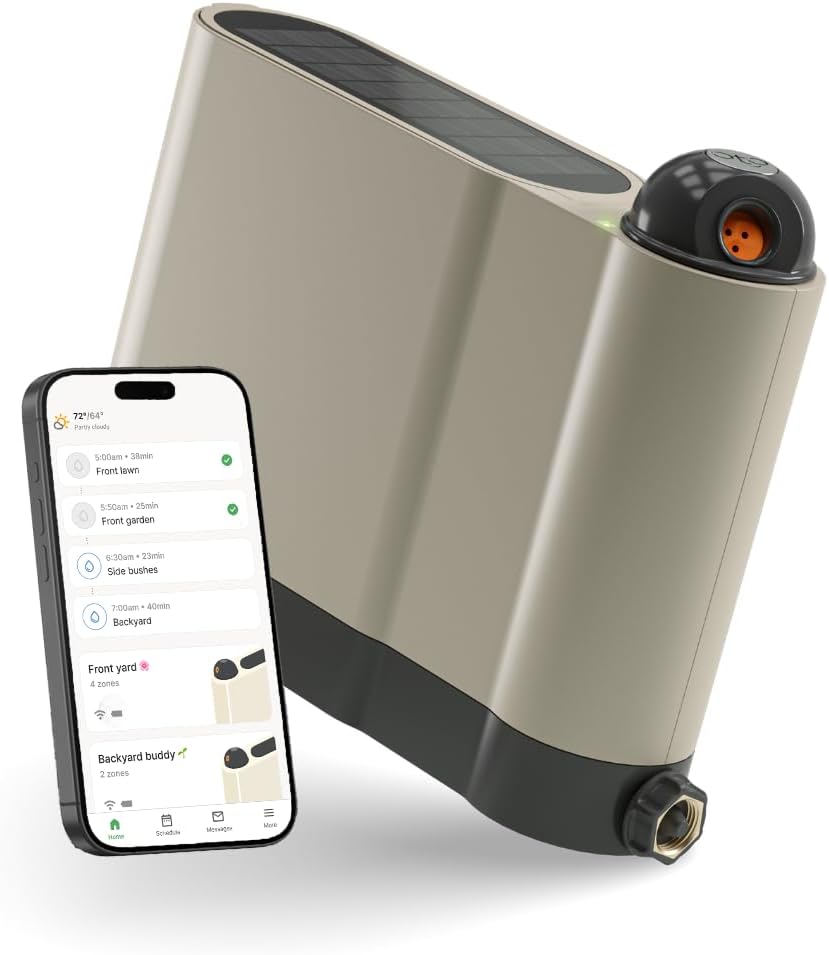
| Brand | OtO (Rain Bird) |
|---|---|
| Coverage per unit | Up to 5,000 sq ft |
| Power source | Solar powered |
| Weather control | Weather‑intelligent scheduling |
| Connectivity | Wi‑Fi and app control |
The Rain Bird OtO Smart Sprinkler is a self-contained irrigation unit that connects to your hose and Wi-Fi to automate precise watering across lawns, gardens, potted plants and trees. Setup is DIY: attach a hose, connect in the app, and position the unit without digging or wiring. Key features include solar power so it runs without batteries or an outlet, weather-intelligent scheduling that skips watering when conditions call for it, and unlimited customizable spray zones so you can target turf, beds and containers without overspray. One unit covers up to 5,000 square feet and multiple units can be daisy-chained for larger yards. Practical benefits are water savings, less manual fussing with hoses or timers, and remote control from the OtO app for on‑the‑go adjustments. Important limitations are that it relies on a stable Wi‑Fi connection for full functionality and placement is constrained by hose reach and line-of-sight for solar charging, so large or irregular properties may need several units to match a full in-ground system.
Best for: Buyers who prioritize automated, water-efficient performance and want a fast DIY smart irrigation solution they can control remotely without running electrical lines.
Less Ideal for: Homeowners who need a fully buried, high-pressure in-ground sprinkler setup or who lack consistent Wi‑Fi coverage across their property.
- Solar powered operation removes the need for batteries or electrical wiring
- Weather‑intelligent scheduling reduces unnecessary watering by skipping rain or high wind events
- Customizable precision zones let you avoid overspray and target lawns, beds and containers
- Covers up to 5,000 sq ft per unit and supports daisy-chaining for larger yards
- Quick DIY install with no trenching or professional plumbing required
- Requires reliable Wi‑Fi for remote control and full smart features
- Coverage depends on hose reach and unit placement so multiple units may be needed for complex yards
Verdict: Choose the OtO Smart Sprinkler if you want a high‑performance, water‑saving smart irrigation unit that installs without digging and runs on solar power.
Orbit All-in-One Automatic In-Ground Sprinkler System Kit (1-Zone) with Blu-Lock Tubing and Digital Timer

| Power Source | Battery Powered |
|---|---|
| Hose Length | 125 feet |
| Maximum Pressure | 100 psi |
| Included Components | Poly Cutter, Gauge, 15 Blu-Lock Fittings, 6 Saturn III, Timer, Instructions |
| Material | Stainless Steel |
The Orbit All-in-One Automatic Sprinkler System kit turns a standard hose faucet into a simple one-zone underground-style irrigation system without tapping into household plumbing. It uses the Blu-Lock tubing and stainless steel retaining ring to speed installation and reduce leaks, and the kit includes six adjustable pop-up gear-drive sprinkler heads intended to give head-to-head coverage for small to medium lawns. A battery-powered digital timer with oversized controls handles scheduling and rain delay so you can set and forget routine watering. Practical benefits include substantially faster assembly than barb fittings, adjustable heads that can be fine-tuned in place, and a weatherproof timer that adds programmability without needing Wi-Fi. Limits to expect are single-zone coverage only, so larger or multi-zone properties will need additional kits or a different controller, and some buyers may prefer a hard-plumbed valve for a permanent installation. Overall the kit is a tidy, durable option for homeowners who want reliable automated watering with an easier install process.
Best for: Homeowners who want an efficient, easy-to-install automatic watering solution for a single lawn zone and prefer to optimize time and water use with programmable scheduling.
Less Ideal for: Large properties, multi-zone irrigation needs, or users who want a fully integrated Wi-Fi smart controller or a permanent hard-plumbed system should consider other options.
- Blu-Lock tubing with stainless steel retaining ring for quicker, stronger fittings and fewer leaks
- Six adjustable pop-up gear-drive sprinkler heads for uniform head-to-head coverage
- Includes battery-powered digital timer with programmable runtime and rain delay
- Kit ships with common installation tools and fittings so no extra parts are usually required
- Designed for a single zone only, so it does not cover larger multi-zone lawns by itself
- Not intended as a permanent hard-plumbed system to in-ground water mains
Verdict: A practical, faster-to-install one-zone automatic sprinkler kit that gives reliable, programmable watering without plumbing changes.
Orbit Mechanical Water Timer (Model 62034)

| Material Type | Plastic |
|---|---|
| Watering Duration | 15-120 minutes |
| Power Source | No batteries required |
| Included Components | Timer |
The Orbit Mechanical Water Timer is a simple, reliable hose faucet timer that works like an egg timer: twist the oversized dial to set watering from 15 to 120 minutes and the clockwork mechanism shuts the water off when the time is up. It installs directly on an outdoor faucet with a swivel coupling for quick hose connection and includes a manual bypass so you can water without removing the unit. Because it is fully mechanical there are no batteries or electronics to fail, which makes it low maintenance and dependable for routine lawn or garden watering. The clear, easy-grip dial is usable with wet or gloved hands, and the plastic housing is rust-proof for outdoor use. Limitations are its single fixed-duration runs and lack of programmable schedules or remote control, so it is best for straightforward tasks like run-once lawn watering, filling a watering can, or timed sprinkler sessions rather than automated multi-day schedules.
Best for: Buyers who want a low-cost, low-maintenance way to time single watering sessions for lawns or garden beds and prefer a straightforward mechanical solution over smart features.
Less Ideal for: Users who need multi-day automated schedules, app control, or multiple zone programming should consider programmable or smart timers instead.
- Battery-free mechanical operation eliminates the need for replacements or electronics maintenance
- Oversized, easy-grip dial that is usable with wet or gloved hands
- Manual bypass allows instant faucet use without removing the timer
- Swivel coupling for quick and secure hose and faucet connection
- Not programmable for recurring schedules or multiple daily runs
- No remote, app, or smart connectivity for off-site control
Verdict: Choose this if you want an inexpensive, maintenance-free mechanical timer that reliably times single watering runs without batteries or electronics.
HiOazo Outdoor Smart Sprinkler Controller, Wi‑Fi, 12‑Zone

| Wi‑Fi frequency | 2.4GHz |
|---|---|
| Zones supported | 12 zones |
| Programmable plans | 16 plans |
| Irrigation modes | Standard and Soak |
The HiOazo Outdoor Smart Sprinkler Controller replaces a traditional timer with a cloud‑connected controller you manage from the HiOazo app over 2.4 GHz Wi‑Fi. It is typically installed at the irrigation control panel and used to schedule watering across multiple zones, with options for Standard or Soak irrigation modes. Notable features include support for up to 12 zones and 16 separate watering plans so you can tailor schedules for different plant beds, plus automatic skipping for rain, freeze, and wind to avoid unnecessary runs. The app control makes remote adjustments and monitoring straightforward, and the company advertises a quick DIY install that should fit most existing systems. Limitations to consider are dependence on 2.4 GHz Wi‑Fi and the app ecosystem for smart features, so local manual control is less convenient if your network is unreliable. The controller appears aimed at homeowners who want flexible, weather‑aware scheduling without professional setup, but expect connectivity and app reliance to be central to day‑to‑day use.
Best for: Homeowners who prioritize a dependable, weather‑smart irrigation schedule and want remote control to reduce overwatering without hiring a pro.
Less Ideal for: People with unreliable Wi‑Fi, those who need purely local/manual controllers, or users who prefer controllers that operate without any app dependency.
- Supports up to 12 irrigation zones and 16 separate watering plans for flexible scheduling
- Weather‑aware auto skip for rain, freeze, and wind helps conserve water and protect plants
- App control over 2.4 GHz Wi‑Fi lets you monitor and adjust schedules remotely
- Two irrigation modes (Standard and Soak) allow better soil absorption management
- Requires a 2.4 GHz Wi‑Fi network and app for full smart functionality
- Relies on cloud/app ecosystem so offline/manual operation is limited
Verdict: Choose this controller if you want a dependable, weather‑sensing Wi‑Fi system that simplifies hands‑off irrigation across many zones.
Orbit Programmable Digital Hose Watering Timer (1-Outlet)

| Power Source | 2 AA batteries (not included) |
|---|---|
| Watering Duration | 1-240 minutes |
| Watering Frequency | Every 6 hours to once every 7 days |
| Rain Delay | 24, 48, or 72 hours |
The Orbit programmable digital hose timer converts a standard outdoor faucet into a simple, dependable automated watering station. You program start times, watering duration (1 to 240 minutes) and frequency (every 6 hours up to once every 7 days) on the oversized LCD and single dial, then let it run the schedule. Useful features include a manual water button for instant watering without reprogramming and a 24/48/72-hour rain delay to pause cycles after rainfall. The unit is water-resistant for outdoor use and runs on two AA batteries, making placement flexible where no power is available. Practical benefits are consistent, repeatable watering for lawns, beds, and containers and measurable water savings by avoiding overwatering. The main limitations are that it is a basic non-networked timer with only one outlet and no remote or app control, so managing multiple zones requires additional units and on-site programming for changes.
Best for: Buyers who prioritize a proven, straightforward timer with clear on-device controls and want reliable automated watering without needing smart-home features.
Less Ideal for: Gardeners who want central control of multiple zones or remote app scheduling should consider multi-outlet or smart Wi‑Fi-enabled controllers instead.
- Wide watering duration range (1–240 minutes) for flexible run times
- Clear, oversized LCD and single-dial controls for easy programming
- Built-in rain delay and manual watering button to conserve water and handle exceptions
- Water-resistant construction suitable for outdoor faucet mounting
- Battery power allows installation without external power source
- Single outlet only so multiple watering zones need extra timers or splitters
- No Wi-Fi or app control for remote scheduling or notifications
- Plastic construction may feel less durable than metal alternatives
Verdict: A dependable, easy-to-program single-outlet timer that saves water and removes guesswork when you want reliable on-site automation without smart features.
Rachio 3 Smart Sprinkler Controller, 16-Zone

| Zones supported | 16 |
|---|---|
| Voltage | 110 volts AC |
| Display type | LED |
| Operating temperature | 15 °C |
The Rachio 3 is a WiFi-enabled sprinkler controller designed to replace conventional dial timers and automate watering across up to 16 zones. It is typically wall-mounted indoors or placed in a weatherproof enclosure outdoors and is set up through the Rachio mobile app, which walks you through wiring, zone naming, and schedule creation. Key features include patented Weather Intelligence that skips runs for rain, freeze, wind and soil saturation, grow-in schedules for new grass, Quick Run buttons for manual zone activation, and compatibility with Alexa, Google Home and IFTTT. In practice this delivers consistent, hands-off watering, fewer unnecessary runs, and easier seasonal adjustments compared with manual timers. Installation is straightforward for anyone comfortable with basic wiring and the app makes troubleshooting and remote control simple. Limitations are that scheduling is primarily app-driven so basic on-device customization is limited, and systems on well pumps may need an additional pump start relay to work reliably. The controller is indoor rated unless you buy a separate weatherproof enclosure.
Best for: Homeowners who want a reliable, low-maintenance irrigation controller that reduces wasted water and simplifies seasonal scheduling without constant manual intervention.
Less Ideal for: Users who need full control from the device itself or who prefer a completely offline mechanical timer; those with specialized commercial irrigation needs should consider professional controllers.
- Local Weather Intelligence automatically adjusts and skips watering for rain, freeze, wind and saturation
- Supports large systems with up to 16 zones for flexible yard layouts
- Dual-band WiFi and wide smart-home compatibility for remote control and voice assistants
- Quick Run manual buttons let you run zones on demand without the app
- App-guided setup and grow-in schedules simplify installation and establishing new turf
- Most scheduling and advanced controls require the mobile app rather than on-device menus
- Indoor-rated unit requires a separate weatherproof enclosure for outdoor mounting
- May need an external pump start relay for some well systems
Verdict: If you want dependable, water-saving automatic irrigation for a typical home landscape, the Rachio 3 delivers smart weather-driven schedules and easy app control for up to 16 zones.
Choosing the Right Auto Sprinkler System: Key Factors to Consider
Zone Layout and Number
How you divide your landscape into zones dictates pipe sizing, valve count, and controller capacity. Group plants with similar water needs together so each zone can be scheduled appropriately. A larger number of zones gives finer control but increases valve boxes, wiring runs, and complexity.
Think about sun exposure, slope, and soil type when planning zones. Areas with heavy clay or steep grades may need shorter run times and more soak cycles. Also plan for future changes like adding new planting beds so your system can expand without major rework.
Spray Pattern and Nozzle Options
Different sprinkler heads-fixed spray, rotary, or micro-spray-have distinct ranges and droplet sizes that affect coverage and runoff. Rotary heads usually cover larger areas with lower precipitation rates, which helps prevent runoff on slopes. Fixed sprays are better for small or irregular beds where close spacing is needed.
Look for systems that offer multiple nozzle sizes and easily adjustable arcs. The ability to swap nozzles on-site lets you fine-tune distribution as plants mature or bed shapes change. Smaller droplet or micro-spray options work well for densely planted flower beds or containers.
Controller Features and Programmability
The controller is the heart of an auto sprinkler system. Basic timers are adequate for simple lawns, but more advanced controllers offer multiple start times, station-based runtimes, and seasonal adjust to match changing evapotranspiration. Smart controllers that accept local weather or soil moisture input can reduce unnecessary watering.
Consider how many zones you need now and whether you might add more. Evaluate how intuitive the programming interface is for routine seasonal changes. Backup power and easy day/time retention during outages are practical conveniences that reduce reprogramming after a power loss.
Water Pressure and Flow Compatibility
Sprinkler performance depends on available household water pressure and supply flow. High-flow rotary heads need more gallons per minute than small spray nozzles. Measure available flow at the irrigation supply or plan to split high-demand zones into multiple circuits.
Incorrect pairing of nozzle type and water supply leads to poor throw distances or misting that wastes water. A pressure regulator, flow sensor, or a simple flow test during planning can prevent mismatches and ensure heads operate in their intended range.
Durability and Ease of Maintenance
Outdoor irrigation components face UV exposure, freeze-thaw cycles, and physical damage from gardening activity. Choose systems with durable head materials and accessible valves that are easy to service or replace in the field. Valve boxes should provide room for wiring and allow simple access for troubleshooting.
Routine maintenance tasks include cleaning nozzles, checking filter screens, winterizing, and running valve tests. Systems designed with modular replacement parts reduce downtime and keep service simple for a homeowner or local technician.
Installation Requirements and DIY Feasibility
Installation scope is a major factor for cost and time. Some systems can be assembled with a shovel, PVC solvent, and basic wiring tools, while others require trenchers, pipe fusion tools, or licensed excavation. Evaluate whether you are comfortable with digging, wiring, and making reliable fittings.
If hiring help, consider systems with readily documented plans and common parts so contractors can bid accurately. For DIYers, modular kits and clear wiring diagrams reduce mistakes that lead to poor performance or leaks.
Matching System Types to Yard Sizes
Small urban yards and balcony planters often do better with micro-spray or drip-based add-ons rather than full-rotor systems. These deliver low-volume, targeted water where root zones need it and cut down on overspray that wastes water or promotes fungal problems.
Medium lawns typically benefit from a mixed approach: rotors or larger spray heads where open turf exists, paired with micro-sprays for beds and borders. Larger properties usually require multiple rotor zones and a controller capable of handling higher station counts and flow management.
- Micro-spray and drip for tight spaces and containers
- Mixed head types for medium yards to balance coverage
- Multiple rotor zones for expansive lawns and properties
Smart Controls and Weather Integration
Controllers that accept weather data or soil moisture probes reduce excess watering during cool, wet periods. For gardeners who want hands-off management, this prevents accidental overwatering that stresses plants and wastes water.
Even basic controllers benefit from seasonal adjust and multiple start times. Consider whether the controller supports remote programming or simple local adjustments so you can tweak schedules during planting, summer heat, or drought restrictions.
- Weather or soil inputs reduce unnecessary cycles
- Remote access adds convenience for frequent schedule changes
- Seasonal adjust simplifies broad runtime changes
Winterization and Off-Season Care
Preparing an auto sprinkler system for winter depends on climate. In freeze-prone areas, draining lines or using compressed air to blow out systems prevents cracked pipes and damaged heads. In milder regions, simply isolating and draining zones may be sufficient.
Off-season checks also include inspecting valve boxes for water pooling, testing controller backups, and cleaning or replacing worn nozzles. Regular end-of-season maintenance reduces spring startup problems and extends component life.
- Blowout or drain lines in freezing climates
- Inspect valves and clean nozzles before winter
- Test controller memory and backups
Simplifying Repairs and Part Replacement
Plan an installation layout that keeps critical components accessible. Valve boxes placed near bed edges or along pathways make servicing easier than burying everything under turf. Use standard pipe sizes and fittings to keep parts available from local suppliers.
Documenting your zone map, wiring colors, and valve identities when you install saves hours when diagnosing issues later. Labeling controller stations to match physical zones makes routine repairs and adjustments straightforward.
- Place valves and boxes for easy access
- Use standard parts where possible
- Label wiring and keep a simple zone map
Water Conservation Strategies with Automated Systems
Beyond installing efficient heads, adjust run times and start times to match evapotranspiration patterns. Shorter, repeated cycles reduce runoff on slopes and in compacted soil. Use early morning schedules to minimize evaporation losses.
Pair an auto sprinkler system with soil moisture sensors or smart controllers that factor in recent rainfall. These small additions often produce meaningful reductions in weekly water use without sacrificing plant health.
- Cycle and soak to prevent runoff
- Schedule early morning watering
- Use sensors or weather-based adjustments
How We Chose the Best Auto Sprinkler System
Our selection process prioritized features and real-world behavior that matter in routine garden and lawn irrigation. We evaluated systems for distribution uniformity based on nozzle and rotor options, because consistent coverage prevents dry spots and overwatering in mixed planting beds. Water efficiency was judged by available spray adjustments, nozzle choices, and compatibility with flow-sensing or rain shutoff devices. Installation complexity was measured by the scope of required trenching, controller wiring, and whether systems work with common homeowner tools. Durability and maintenance needs were assessed from component materials, ease of servicing valves and heads, and accessibility of replacement parts. Controller functionality looked at programming flexibility, number of zones supported, and smart features like soil-moisture integration or simple seasonal adjustment. We excluded systems that are strictly for commercial irrigation or that require specialized contractor-only equipment. Systems that rely on uncommon proprietary parts with limited garden-supply availability were also screened out. The final list contains options that balance reliable on-site performance, manageable installation for a competent DIYer or small contractor, and sensible maintenance demands for home landscapes.
FAQ
How do I know how many zones my yard needs?
Zone count depends on plant water needs, sun exposure, and available flow. Group similar plants together and separate turf from beds. If flow is limited, split high-demand areas into additional zones to avoid overloading supply.
Can I install an auto sprinkler system myself?
Many homeowners can handle basic installations with planning, common tools, and proper safety. More complex sites, deep trenching, or electrical hookups may require professional help. Assess your skills and check local codes before starting.
What maintenance does an automatic sprinkler system need?
Routine tasks include cleaning or replacing nozzles, checking valve operation, and testing the controller. Seasonal maintenance such as winterizing and spring startup inspections helps avoid component failures and uneven watering.
Will a smart controller save water?
Often yes. Smart controllers that use weather data or soil moisture information typically reduce unnecessary cycles during wet periods. Savings depend on initial scheduling practices and local climate patterns.
How do I prevent runoff and pooling during irrigation?
Use cycle-and-soak scheduling to allow water to infiltrate, reduce individual station runtimes on slopes, and check nozzle distribution for even coverage. Adjust head types and spacing if water consistently runs off or ponds.
What should I check if heads are spraying unevenly?
First inspect nozzles for clogs and clean filter screens. Check water pressure and ensure heads are set to the correct arc and height. Damaged or misaligned heads may need repositioning or replacement to restore even coverage.
Final Verdict
Choose an auto sprinkler system by prioritizing how your landscape is zoned and what water supply you have. Focus on matching head types to planting areas, ensuring the controller supports the number of zones you need, and selecting a system with accessible valves and standard components for easy servicing. Expect tradeoffs between simplicity and flexibility: simpler systems are easier to install and maintain, while more capable controllers and specialized heads improve efficiency and coverage. Pick the option that balances installation skill, future expansion, and the level of automation you want so your yard gets reliable, even irrigation with minimal fuss.
