

Note: This article contains affiliate links. If you click on these links and make a purchase, I may earn a small commission at no extra cost to you. This helps support my research and content. Read my full affiliate disclosure here.
A smart lawn sprinkler system changes how you water by matching schedules to weather, soil, and actual lawn needs. Choosing the right system matters because irrigation choices affect turf health, water bills, and landscape longevity. In this guide we shortlist the top options suited to different yard sizes and technical comfort levels. We evaluated systems for how well they cover irregular lawns, how much water they actually save, and how easy they are to install and maintain. Below you will find the top picks and guidance to help match a system to your yard and watering goals.
Top Picks at a Glance
| Best Overall The best all-around choice for most situations | ImoLaza ET Master 8-Zone Wi‑Fi Smart Sprinkler Controller |  |
| Best Quality Built to a higher standard if you want something more solid | Rain Bird OtO Smart Sprinkler — Solar-Powered App-Controlled Irrigation |  |
| Best Value The sweet spot between price and what you get | Orbit B-hyve Smart 6-Zone Indoor/Outdoor Sprinkler Controller |  |
| Best Budget The cheapest option that still gets the job done reliably | HiOazo Smart Sprinkler Controller (4-Zone, App-Controlled) |  |
| Highest Rated A top-rated pick with lots of positive feedback | HiOazo Outdoor Smart Sprinkler Controller, 6-Zone WiFi |  |
| Most Popular A crowd favorite that many people choose with confidence | Rachio 3 Smart Sprinkler Controller, 8-Zone |  |
| Best Seller A high-volume bestseller chosen again and again | Rachio 3 Smart Sprinkler Controller, 16-Zone |  |
ImoLaza ET Master 8-Zone Wi‑Fi Smart Sprinkler Controller

| Zones | 8 |
|---|---|
| Voltage | 120 volts |
| Connectivity | 2.4 GHz Wi‑Fi |
| Operating Temperature | -13°F to 140°F |
| Included | Controller, power adapter, wall screws, screwdriver |
The ImoLaza ET Master 8‑zone controller replaces a conventional timer with a connected unit that automatically adjusts watering using real‑time evapotranspiration and local weather intelligence. Installation is designed for DIY: mount the unit, transfer pre‑labeled wires and connect to the ImoLaza app over built‑in 2.4 GHz Wi‑Fi. Once set up you can choose Smart ET, fixed cycle, or a New Grass schedule with many start times for seeding or sod. The system skips watering for rain, high wind, freeze or saturated soil days and sends fault and leak alerts when abnormal flow or electrical issues are detected. The controller supports remote app control plus Alexa and Google Assistant voice commands and receives OTA firmware upgrades so algorithms improve over time without extra cost. Practical benefits include potential water savings and convenience for managing multiple zones remotely, but truly outdoor mounting requires a separate waterproof case and very advanced claims about savings depend on correct setup and local conditions.
Best for: Homeowners who want an easy DIY upgrade from a mechanical timer to an intelligent, water‑saving controller and who value remote control plus automated weather‑based adjustments.
Less Ideal for: People who need a factory‑rated outdoor enclosure included or those who prefer completely standalone, nonconnected controllers without app dependence.
- Real‑time ET and hyperlocal weather data automatically adjust schedules to save water
- Built‑in 2.4 GHz Wi‑Fi with app control and Alexa/Google Assistant voice integration
- Multiple program options including a high‑frequency New Grass schedule for seeding or sod
- Fault detection and leak/flow alerts reduce risk of unnoticed failures or water waste
- OTA updates keep features and algorithms evolving without buying new hardware
- Not rated for permanent outdoor wall mounting without buying a separate waterproof enclosure
- Claims about up to 60% water savings will vary by landscape and require correct configuration
Verdict: A feature‑rich, app‑controlled 8‑zone controller that modernizes irrigation with real‑time ET and automated weather skips for hands‑off water savings.
Rain Bird OtO Smart Sprinkler — Solar-Powered App-Controlled Irrigation
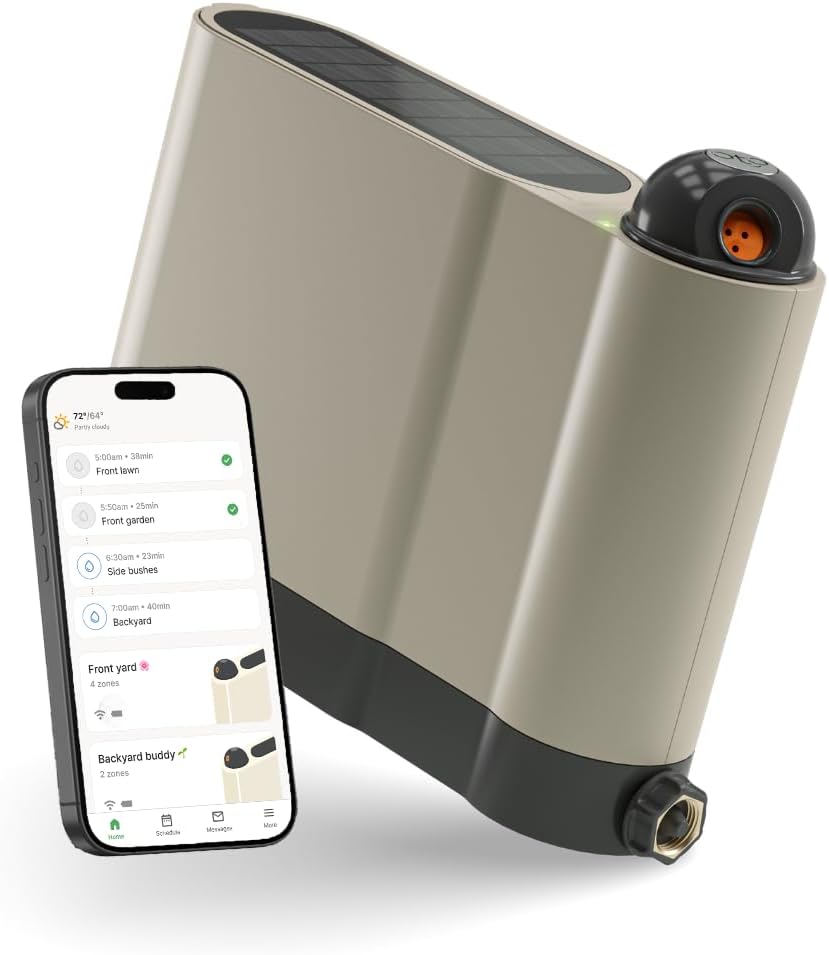
| Coverage per unit | Up to 5,000 sq ft |
|---|---|
| Power | Solar-powered |
| Weather features | Weather-intelligent scheduling (rain and wind skips) |
| Housing | UV-resistant, weatherproof (32°–149°F) |
| Fittings | Solid brass fittings |
The Rain Bird OtO Smart Sprinkler is a standalone, solar-powered irrigation unit designed to replace dragging hoses and manual timers by creating precision spray zones you control from a smartphone app. Installation is a quick DIY: attach a garden hose, connect to your Wi-Fi, position the unit in the yard and define unlimited custom zones in the app. Notable features include on-device weather intelligence that skips watering for rain or high wind, a UV-resistant, weatherproof housing built for seasonal use, and brass fittings for durability. One unit covers up to 5,000 square feet and additional units can be daisy-chained for full-yard coverage, which makes scaling straightforward for larger properties. Practical benefits are consistent, targeted watering that reduces overspray and runoff and remote control when you are away. Limitations to keep in mind are the reliance on Wi-Fi for advanced scheduling and app control and the need to purchase multiple units for complete automatic coverage of very large or oddly shaped lawns.
Best for: Gardeners who prioritize efficient, precise watering and want a performance-focused, low-maintenance system they can control remotely to optimize water use and lawn health.
Less Ideal for: People without reliable home Wi-Fi or those who need an all-in-one underground irrigation system driven by a central controller.
- Solar-powered operation eliminates batteries and wiring for flexible placement
- App control and remote scheduling let you adjust watering from anywhere
- Weather-intelligent scheduling reduces unnecessary runs during rain or wind
- Covers up to 5,000 sq ft per unit with daisy-chaining for expanded coverage
- Durable, weatherproof design with UV-resistant body and brass fittings
- Depends on a stable Wi-Fi connection for full feature access
- Full-yard automation requires buying multiple units for larger or segmented lawns
Verdict: Choose the OtO if you want a high-performing, scalable smart sprinkler that delivers targeted, weather-aware watering with minimal installation fuss.
Orbit B-hyve Smart 6-Zone Indoor/Outdoor Sprinkler Controller

| Item Type Name | B-hyve Smart 6-Zone Indoor/Outdoor Sprinkler Controller |
|---|---|
| Display Type | LCD or LED |
| Voltage | 110 volts |
| Operating Temperature | 75 °C |
The Orbit B-hyve Smart 6-Zone controller automates landscape watering for small to medium yards by letting you program schedules from a waterproof wall-mounted panel or the mobile app. It supports zone-by-zone scheduling so lawns, flower beds, and drip lines can have tailored run times, and its WeatherSense feature automatically adjusts watering based on local weather so you do not overwater after rain or under-water during dry spells. Setup is typical for an indoor/outdoor timer and connects to 2.4 GHz Wi-Fi for remote control and voice commands through smart assistants. Practical benefits include clear on-unit display, app access to start/stop or edit programs from anywhere, and multi-zone flexibility that improves water efficiency. Limitations are that it is a 6-zone model so larger systems will need a higher-zone controller or multiple units, and full smart features require a stable home Wi-Fi connection. For homeowners who want reliable automated watering without complex professional systems, the B-hyve is a straightforward, water-saving option.
Best for: Homeowners who want to optimize water use and simplify routine irrigation for a small to medium yard using automation and weather-based adjustments.
Less Ideal for: Owners of large properties with many irrigation zones or users who need a controller that works offline without Wi-Fi connectivity.
- WeatherSense automatically adjusts schedules based on local weather to reduce overwatering
- App and on-unit control allow remote scheduling and zone management
- Waterproof wall-mounted enclosure supports indoor or outdoor installation
- Zone-based programming for tailored irrigation across up to six zones
- Only supports six zones, which may be insufficient for larger properties
- Requires reliable 2.4 GHz Wi-Fi for full remote and smart features
Verdict: If you want a practical, weather-adaptive smart controller to cut wasted watering and manage a small to medium yard remotely, the Orbit B-hyve 6-zone delivers that capability simply and reliably.
HiOazo Smart Sprinkler Controller (4-Zone, App-Controlled)

| Zones | 4 |
|---|---|
| Watering Plans | Up to 16 |
| Connectivity | 2.4 GHz WiFi |
| Power | 24VAC |
The HiOazo Smart Sprinkler Controller connects to 2.4 GHz WiFi and lets you run up to four zones from the companion app, with space for 16 distinct watering plans. It is designed for DIY replacement of an existing controller and claims a quick install in about 10 minutes using the included screws, wire connectors, and power adapter. The app-led display and schedule editor make daily, intermittent, or soak irrigation simple to set up, and automatic skip logic for rain, freeze, and high wind helps reduce wasted water. Practical benefits include remote control of schedules, multiple program presets for different plant needs, and weather-adaptive watering that can lower runoff and overwatering. Limitations are the 4-zone capacity, which is small for larger yards, and reliance on 2.4 GHz WiFi so homes with only 5 GHz networks will need a compatible router or extender; advanced users may miss granular flow or evapotranspiration integration. Overall this is a straightforward, budget-friendly smart controller for typical residential landscapes that need basic weather-aware automation.
Best for: Homeowners who want an inexpensive, easy-to-install smart controller to automate a small to medium yard and prioritize simple water savings and remote control.
Less Ideal for: Large properties with many irrigation zones or users who need advanced ET-based or flow-monitoring features should consider controllers with higher zone counts and more irrigation telemetry.
- App-based control for remote scheduling and real-time monitoring
- Automatic weather-based skip for rain, frost, and wind to conserve water
- Supports up to 16 distinct watering plans for flexible programming
- Quick DIY installation with included hardware and wide controller compatibility
- Only controls four zones which may be insufficient for larger properties
- Requires a 2.4 GHz WiFi network so it may need network adjustments in some homes
Verdict: A straightforward, budget-friendly 4-zone smart controller that adds remote app control and weather-aware watering to typical residential irrigation systems.
HiOazo Outdoor Smart Sprinkler Controller, 6-Zone WiFi

| Zones | 6 |
|---|---|
| Programs | Up to 16 |
| WiFi | 2.4 GHz |
| Display Type | LED |
| Material Type | Acrylonitrile Butadiene Styrene (ABS) |
The HiOazo 6-zone smart sprinkler controller replaces a manual timer with app-based scheduling and weather-aware automation for small to medium yards. Set up through the HiOazo app over 2.4 GHz WiFi and create up to 16 custom programs so each zone gets the frequency and run time it needs. The controller can automatically skip watering events for rain, frost, or high wind which helps avoid overwatering and conserves water. Two irrigation modes, standard and soak, let you choose continuous runs or slower applications that give soil time to absorb water. The LED display and ABS housing make the unit straightforward to install outdoors, and the manufacturer states a simple 10-minute DIY installation and broad compatibility with existing systems. Important limitations are that it requires 2.4 GHz WiFi and a compatible valve wiring setup, and advanced users may miss integration with broader smart-home platforms not listed in the product details. For buyers who want dependable, app-driven automated watering with built-in weather skips, this controller delivers practical, reliable performance.
Best for: Homeowners who prioritize a dependable, low-effort irrigation solution that automates watering based on local weather and lets them manage schedules from a phone.
Less Ideal for: Users needing native integration with a specific smart-home ecosystem or those without a stable 2.4 GHz WiFi connection should consider other options.
- Weather-aware skip features automatically pause watering for rain, frost, and wind to reduce overwatering
- App control with 2.4 GHz WiFi lets you create and monitor up to 16 distinct watering programs
- Two irrigation modes (Standard and Soak) support different watering strategies for plant health
- Quick DIY installation and broad compatibility with most existing sprinkler systems
- Requires 2.4 GHz WiFi only which may not work with homes using 5 GHz-only networks
- No explicit mention of integration with major smart-home platforms in the product details
Verdict: A reliable, weather-smart 6-zone controller that simplifies irrigation with app control and automatic skips to save water.
Rachio 3 Smart Sprinkler Controller, 8-Zone

| Item Highlight | 8 Zones, App Control, Rain Skips, Local Weather Scheduling |
|---|---|
| Voltage | 120 volts |
| Display Type | LED |
| Operating Temperature | 4 °F |
The Rachio 3 Smart Sprinkler Controller gives you app-first control of an existing 8-zone irrigation system and uses local weather data to adjust watering automatically. You set schedules in the Rachio app for iOS or Android, then let the controller skip runs for rain, freeze, wind or saturated soil and make seasonal adjustments so you do not overwater. Typical use is straightforward: mount the indoor unit, wire it to zone valves, connect Wi-Fi and configure zones in the app; Quick Run buttons let you manually water a zone from the controller when needed. Notable features include dual-band Wi-Fi, compatibility with Alexa, Google Home and IFTTT, LED status display and grow-in scheduling for new lawns. Practical benefits are reduced water use, simpler remote management, and easier setup compared with legacy dial timers. Limitations: the unit is indoor rated so outdoor installs require a weatherproof enclosure and some advanced setups such as well systems may need a pump for proper pressure. The controller also relies on the app for detailed schedule edits rather than full on-device programming.
Best for: Homeowners who want to reduce water use and move away from manual dial timers, and who prefer a proven smart-home controller with easy app-based setup and integrations.
Less Ideal for: People who need a fully outdoor-rated controller without adding an enclosure or who want complete on-device programming without using a smartphone app.
- Weather Intelligence automatically skips watering for rain, freeze, wind and saturation
- App-based scheduling with Quick Run and grow-in options simplifies remote control
- Works with voice assistants and IFTTT for smart-home integration
- Fast DIY install that fits most existing 8-zone systems
- Indoor-rated unit requires a separate weatherproof enclosure for outdoor mounting
- Relies on the mobile app for most scheduling tasks rather than full on-device controls
Verdict: Choose the Rachio 3 if you want a reliable, app-driven 8-zone controller that cuts wasted watering with automatic weather-aware schedules.
Rachio 3 Smart Sprinkler Controller, 16-Zone

| Zones supported | 16 |
|---|---|
| Voltage | 110 volts AC |
| Display type | LED |
| Operating temperature | 15 °C |
The Rachio 3 is a WiFi-enabled sprinkler controller designed to replace conventional dial timers and automate watering across up to 16 zones. It is typically wall-mounted indoors or placed in a weatherproof enclosure outdoors and is set up through the Rachio mobile app, which walks you through wiring, zone naming, and schedule creation. Key features include patented Weather Intelligence that skips runs for rain, freeze, wind and soil saturation, grow-in schedules for new grass, Quick Run buttons for manual zone activation, and compatibility with Alexa, Google Home and IFTTT. In practice this delivers consistent, hands-off watering, fewer unnecessary runs, and easier seasonal adjustments compared with manual timers. Installation is straightforward for anyone comfortable with basic wiring and the app makes troubleshooting and remote control simple. Limitations are that scheduling is primarily app-driven so basic on-device customization is limited, and systems on well pumps may need an additional pump start relay to work reliably. The controller is indoor rated unless you buy a separate weatherproof enclosure.
Best for: Homeowners who want a reliable, low-maintenance irrigation controller that reduces wasted water and simplifies seasonal scheduling without constant manual intervention.
Less Ideal for: Users who need full control from the device itself or who prefer a completely offline mechanical timer; those with specialized commercial irrigation needs should consider professional controllers.
- Local Weather Intelligence automatically adjusts and skips watering for rain, freeze, wind and saturation
- Supports large systems with up to 16 zones for flexible yard layouts
- Dual-band WiFi and wide smart-home compatibility for remote control and voice assistants
- Quick Run manual buttons let you run zones on demand without the app
- App-guided setup and grow-in schedules simplify installation and establishing new turf
- Most scheduling and advanced controls require the mobile app rather than on-device menus
- Indoor-rated unit requires a separate weatherproof enclosure for outdoor mounting
- May need an external pump start relay for some well systems
Verdict: If you want dependable, water-saving automatic irrigation for a typical home landscape, the Rachio 3 delivers smart weather-driven schedules and easy app control for up to 16 zones.
Choosing the Right Smart Lawn Sprinkler System: Key Factors to Consider
Water Efficiency and Weather Integration
A smart system should adjust run times based on local weather and evapotranspiration, not just a fixed clock. That reduces overwatering after rain and scales irrigation to temperature and humidity changes.
Effective weather integration also affects plant health. Systems that pull accurate forecasts or use on-site sensors reduce stress on turf by avoiding watering when natural conditions are adequate. For gardeners focused on sustainability, efficiency directly influences weekly water usage and can prevent runoff on slopes.
Coverage, Zone Design, and Customization
The number of controllable zones and how precisely you can customize run times matters for mixed landscapes. Lawns, flower beds, trees, and vegetable patches all have different water needs; zone-level control lets you apply tailored schedules.
Look for systems that allow short cycle and soak options, percentage adjustments per zone, and fine-grained schedule blocks. Good coverage also means the controller can manage odd-shaped areas without forcing uniform runtimes that overwater some plants.
Installation Requirements and Compatibility
Consider whether the system is designed for new installs or retrofits. Retrofit-friendly controllers should map to existing irrigation valves, use standard voltage wiring, and provide clear wiring diagrams.
If you plan to install yourself, check for step-by-step guides, wiring labels, and hardware compatibility. Professional installation may be needed for complex multi-valve manifolds or when integrating into irrigation pumps and municipal backflow devices.
App Interface and Remote Control
A responsive, intuitive app makes daily adjustments and seasonal programming practical. Important app features include clear zone maps, one-touch manual watering, and easy program duplication for similar areas.
Connectivity reliability is also important. Systems that rely on local Wi-Fi should handle weak signals near a controller box, while some options use dedicated hubs or mesh extenders. Notifications for skipped cycles, low battery sensors, or detected leaks help you act quickly.
Sensor and Smart Device Integration
Integration with soil moisture sensors, rain sensors, and weather stations improves decision-making. Soil probes provide direct feedback from the root zone so the controller waters only when moisture falls below a set threshold.
Compatibility with common sensor standards and the ability to calibrate sensor thresholds ensure the system works with existing hardware. Systems that lock you into proprietary sensors may limit future upgrades.
Durability and Outdoor Reliability
Controllers and hubs need to resist humidity, temperature swings, and insect intrusion. Look for enclosures rated for outdoor mounting and terminals that resist corrosion.
Long-term reliability also depends on firmware update policies and how the manufacturer manages connectivity drops. A robust unit will retain schedules during outages and recover gracefully after power interruptions.
Sizing a Smart System for Your Yard
Start by mapping existing irrigation zones and noting valve counts. A typical small lawn might use three to four zones, while larger or landscaped yards can exceed eight zones. Match controller capacity to current valves and leave room for one or two expansion zones if you plan landscape changes.
Also consider head types and pressure requirements. A smart controller manages timing but not hydraulics, so ensure your irrigation hardware-sprinkler heads, drip lines, and valves-are appropriate for the zone flow and pressure.
- Count valves and label each zone by plant type
- Record run times for each zone under current conditions
- Plan for future expansion when selecting controller capacity
Retrofit Tips for Existing Irrigation Systems
When replacing an old controller, keep the same field wiring where possible to simplify installation. Verify that the new unit supports common 24 VAC valve wiring and that terminal spacing fits your wiring harness.
If your controller box sits far from your Wi-Fi router, consider a wired Ethernet-capable controller or a wireless range solution. For homes with complex manifolds, label each wire and test valve operation before finalizing mounting.
- Double-check voltage and wiring standards
- Test each valve manually to confirm function
- Use clear labels and take photos before disconnecting old controller
Using Sensors to Reduce Overwatering
Soil moisture sensors and on-site rain sensors provide objective data that prevents unnecessary cycles. Place soil probes in the root zone of the most representative turf or bed to get realistic readings. Avoid areas with shade or high compaction that do not reflect the broader zone.
Combine sensor data with seasonal adjustments to fine-tune schedules. For seasonal dormancy windows, temporary schedule reductions are often better than removing a zone entirely, because sensors can still prevent unnecessary irrigation during wet spells.
- Install probes at root depth for the primary plant type in each zone
- Calibrate thresholds based on observed turf response
- Use multiple sensors for large zones with varied soil types
Connectivity Options and Smart Home Integration
Decide whether you want simple smartphone control or full smart home integration. Many systems support voice assistants and home automation platforms, letting you include watering schedules in broader routines.
If you already use a home hub, confirm compatibility and whether the controller uses local network protocols or cloud-based commands. Local control can continue during internet outages, while cloud features may offer more remote analytics.
- Check compatibility with existing hubs and voice assistants
- Prefer systems with local failover for basic schedule execution
- Understand what data is stored in the cloud versus locally
Seasonal Maintenance and Winter Care
Smart controllers reduce routine guesswork, but they do not eliminate maintenance. Before winter, blow out lines or follow local winterization practices to prevent freeze damage. Remove and store any removable sensors that could be damaged in icy conditions.
During the growing season, check for misaligned heads, clogged nozzles, and creeping vegetation that changes coverage. Periodic audits of run times after seasonal shifts ensure schedules remain appropriate as evapotranspiration changes.
- Perform a winterization procedure appropriate for your climate
- Inspect and clean sprinkler heads each spring
- Adjust schedules when turf enters dormancy or when plantings change
How We Chose the Best Smart Lawn Sprinkler System
We focused on features that matter in everyday lawn irrigation. First, we prioritized water efficiency metrics such as smart scheduling based on weather integration and zone-level control that limit unnecessary run times. Second, we judged ease of installation and configuration because many homeowners retrofit controllers to existing irrigation lines. Third, reliable coverage and zone management were weighed to ensure systems can handle odd-shaped lawns and multiple plant types. Fourth, connectivity and app usability were considered so that remote adjustments and alerts are practical for routine use. Finally, durability and compatibility with common valves and sensors were required so the systems would hold up outdoors and work with soil moisture probes and rain sensors. Products were excluded if they lacked basic weather-based scheduling, did not support multiple zones, or could not be integrated with standard irrigation valves. We also excluded units without any documentation on compatibility with common sensors or that required proprietary wiring incompatible with typical residential setups. The resulting shortlist emphasizes tested feature sets and real-world installability rather than marketing claims alone.
FAQ
Will a smart sprinkler system save water at my home?
Often. Systems that use weather data, evapotranspiration calculations, or soil moisture readings typically reduce unnecessary cycles. Actual savings depend on your climate, irrigation hardware, and how well zones are configured.
Can I install a smart controller myself?
Usually, if you are comfortable with basic wiring and shut-off procedures. Most controllers use standard 24 VAC valve wiring and include step-by-step guides. Complex manifolds or pump systems may be best handled by a professional.
Do soil moisture sensors require frequent calibration?
They usually need minimal calibration once placed at the correct depth. You may adjust thresholds seasonally or after major soil changes, but day-to-day calibration is not common for most modern probes.
How do smart systems handle power or internet outages?
Most controllers retain programmed schedules during power loss and resume when power returns. Internet outages may disable remote control and cloud features but basic automated watering often continues from the local controller.
Will a smart system work with drip irrigation?
Yes. Zone-level control and percentage-based run times work well for drip zones, but confirm flow rates and pressure needs. Short-cycle and soak scheduling helps prevent runoff and ensures deep, even watering for drip installations.
Final Verdict
Prioritize a system that matches the complexity of your yard. For small lawns, a compact controller with solid weather-based scheduling delivers meaningful water savings with minimal fuss. Larger or mixed landscapes benefit from more zones, sensor integration, and easier app-based customization. Weigh tradeoffs between DIY installation and professional setup, and focus on controllers that support the sensors and valve compatibility you need. With the right match, a smart lawn sprinkler system simplifies seasonal adjustments and helps maintain healthy turf while reducing wasted water.
