

Note: This article contains affiliate links. If you click on these links and make a purchase, I may earn a small commission at no extra cost to you. This helps support my research and content. Read my full affiliate disclosure here.
If you want automatic, flexible irrigation without trenching and running long control wires, a wireless sprinkler system can change how you manage your lawn and landscape. The right system delivers reliable zone control, consistent coverage, and long battery life so you spend less time troubleshooting timers and more time enjoying a healthy yard. This guide looks at seven shortlisted wireless sprinkler systems that fit common yard sizes and layouts. We evaluated each option for coverage patterns, installation simplicity, power management, and moisture control so you can pick a system that suits your property and routine. Read on to see the practical tradeoffs and which features matter most in the garden.
Top Picks at a Glance
| Best Overall The best all-around choice for most situations | Rain Bird ESP-TM2 8-Station Indoor/Outdoor Irrigation Controller |  |
| Best Quality Built to a higher standard if you want something more solid | Hunter PRO‑HC WiFi Smart Sprinkler Controller, 12‑Zone |  |
| Best Value The sweet spot between price and what you get | Orbit B-hyve Smart 6-Zone Indoor/Outdoor Sprinkler Controller |  |
| Best Budget The cheapest option that still gets the job done reliably | Insoma WiFi Hose Timer with Hub Support and Bluetooth |  |
| Highest Rated A top-rated pick with lots of positive feedback | Hunter Pro‑C P2C400 4‑Zone Irrigation Controller |  |
| Most Popular A crowd favorite that many people choose with confidence | Rachio 3 Smart Sprinkler Controller, 8-Zone |  |
| Best Seller A high-volume bestseller chosen again and again | Rachio 3 Smart Sprinkler Controller, 16-Zone |  |
Rain Bird ESP-TM2 8-Station Indoor/Outdoor Irrigation Controller

| Manufacturer | Rain Bird |
|---|---|
| Item model number | TM2-8 |
| Stations | 8 |
The Rain Bird ESP-TM2 is a straightforward 8-station irrigation controller designed for homeowners and small contractors who need reliable automatic watering. It installs indoors or outdoors and includes a factory-installed outdoor-rated power cord for convenience. Programming is simple with a three-step setup and a large backlit LCD that remains readable in low light and direct sun. The controller offers practical features such as Delay Watering, a Contractor Default to save and restore schedules, and compatibility with an optional Rain Bird LNK WiFi module for remote control and internet-based weather adjustments that can reduce water use. Because the WiFi module is sold separately, networked control is an add-on rather than built in, and the unit focuses on core scheduling rather than advanced cloud-only automation. For typical residential irrigation zones this controller delivers dependable timing, easy local programming, and the option to add remote monitoring when wanted.
Best for: Buyers who want a reliable, easy-to-use controller for a small-to-medium residential irrigation setup and who value straightforward local programming with the option to add remote access later.
Less Ideal for: Users who need out-of-the-box integrated WiFi and full cloud automation or those managing very large multi-zone commercial systems.
- Easy three-step programming with a large backlit LCD for good visibility
- Suitable for indoor or outdoor installation with factory-installed outdoor-rated power cord
- Supports up to 8 stations, covering most small to medium residential systems
- Contractor Default and Delay Watering features simplify schedule management
- WiFi control requires purchasing the Rain Bird LNK module separately
- Does not include advanced built-in cloud features without the optional module
Verdict: A dependable, easy-to-program 8-station controller that covers most residential irrigation needs and lets you add WiFi control if you want remote management.
Hunter PRO‑HC WiFi Smart Sprinkler Controller, 12‑Zone

| Zones | 12 station |
|---|---|
| Connectivity | WiFi (Hydrawise) |
| Display | Full‑color touchscreen |
| Sensor support | Rain, flow meter, sensor inputs |
The Hunter PRO‑HC is a professional‑grade 12‑zone irrigation controller aimed at homeowners or property managers who want precise, water‑saving automation. It pairs a full‑color touchscreen for fast on‑site setup with WiFi and the Hydrawise app for remote scheduling, alerts, and system monitoring. The controller uses predictive weather‑based adjustments that factor in rainfall, temperature, wind, and humidity so run times are reduced when conditions require less water. It also supports sensors, a flow meter, master valve output, and built‑in wire fault detection for more reliable operation and proactive maintenance. Typical use is mounting outdoors or indoors near the irrigation manifold, programming zones locally or in the app, then letting Hydrawise fine‑tune durations daily. The main limitations are that it is optimized for users who want a robust, expandable system rather than a minimal plug‑and‑play timer and installation typically requires basic wiring familiarity or contractor help for more complex setups.
Best for: Buyers who want a reliable, water‑saving smart controller that can manage a full yard or small commercial landscape and who value remote management and expandability.
Less Ideal for: People who need a very simple plug‑and‑play sprinkler timer for one or two zones or who prefer a basic mechanical controller without WiFi features.
- Smart, weather‑based scheduling that adjusts run times using local forecast and conditions
- WiFi with Hydrawise app for remote control, alerts, and monitoring
- Full‑color touchscreen for easy local programming without the app
- Supports flow meters, sensors, and master valve output for expanded monitoring and safety
- Installation and wiring for multi‑zone systems can be complex for novice DIYers
Verdict: Choose the PRO‑HC if you want a 12‑zone, app‑driven controller that saves water with predictive weather scheduling and professional expansion options.
Orbit B-hyve Smart 6-Zone Indoor/Outdoor Sprinkler Controller

| Item Type Name | B-hyve Smart 6-Zone Indoor/Outdoor Sprinkler Controller |
|---|---|
| Display Type | LCD or LED |
| Voltage | 110 volts |
| Operating Temperature | 75 °C |
The Orbit B-hyve Smart 6-Zone controller automates landscape watering for small to medium yards by letting you program schedules from a waterproof wall-mounted panel or the mobile app. It supports zone-by-zone scheduling so lawns, flower beds, and drip lines can have tailored run times, and its WeatherSense feature automatically adjusts watering based on local weather so you do not overwater after rain or under-water during dry spells. Setup is typical for an indoor/outdoor timer and connects to 2.4 GHz Wi-Fi for remote control and voice commands through smart assistants. Practical benefits include clear on-unit display, app access to start/stop or edit programs from anywhere, and multi-zone flexibility that improves water efficiency. Limitations are that it is a 6-zone model so larger systems will need a higher-zone controller or multiple units, and full smart features require a stable home Wi-Fi connection. For homeowners who want reliable automated watering without complex professional systems, the B-hyve is a straightforward, water-saving option.
Best for: Homeowners who want to optimize water use and simplify routine irrigation for a small to medium yard using automation and weather-based adjustments.
Less Ideal for: Owners of large properties with many irrigation zones or users who need a controller that works offline without Wi-Fi connectivity.
- WeatherSense automatically adjusts schedules based on local weather to reduce overwatering
- App and on-unit control allow remote scheduling and zone management
- Waterproof wall-mounted enclosure supports indoor or outdoor installation
- Zone-based programming for tailored irrigation across up to six zones
- Only supports six zones, which may be insufficient for larger properties
- Requires reliable 2.4 GHz Wi-Fi for full remote and smart features
Verdict: If you want a practical, weather-adaptive smart controller to cut wasted watering and manage a small to medium yard remotely, the Orbit B-hyve 6-zone delivers that capability simply and reliably.
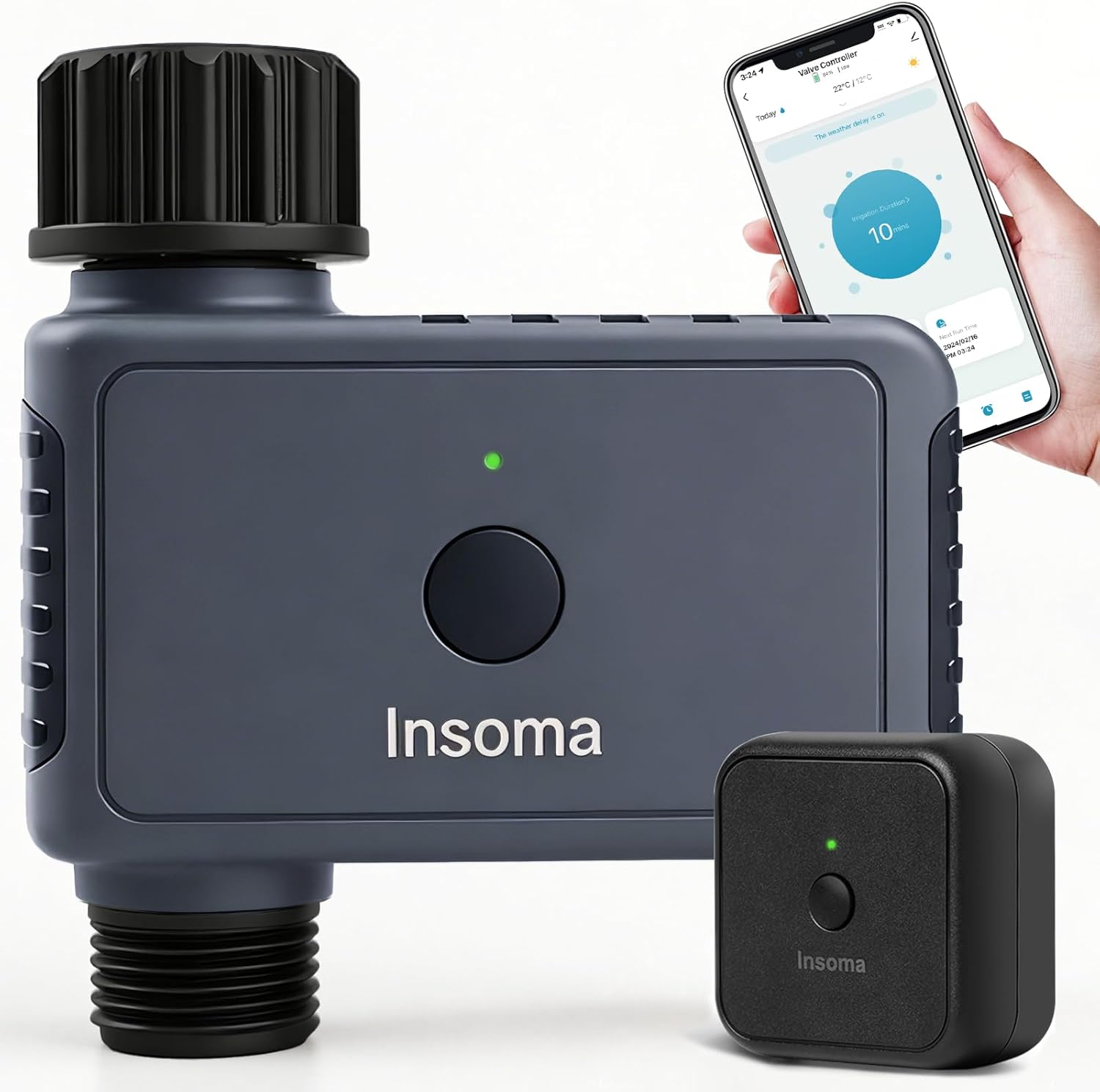
Insoma WiFi Hose Timer with Hub Support and Bluetooth
| Number of settings | 20 |
|---|---|
| Material Type | Plastic |
| Manufacturer Warranty Description | 1 year manufacturer. |
The Insoma WiFi hose timer is a compact smart watering controller designed to attach to a standard outdoor faucet and automate garden or lawn irrigation. It pairs with a 2.4 GHz WiFi hub to enable remote scheduling and voice control through Alexa or Google Assistant, while also offering direct Bluetooth control if the hub is unavailable. The unit supports up to 20 distinct irrigation programs, two irrigation modes for flexible timing, and a rain delay feature (24, 48, 72 hours) plus manual watering for on-demand use. Practical benefits include the ability to manage multiple timers from a single hub and share access with family members, which makes scaling a small smart system straightforward. Expect an easy mobile setup with the Smart Life app, though it requires a 2.4 GHz network and the hub for full-range WiFi functionality. The timer is plastic-bodied and lightweight, so it is convenient to handle but may feel less rugged than higher-end metal models. For gardeners on a budget who want basic smart scheduling and voice control, this delivers strong value, but those needing heavy-duty outdoor durability or advanced commercial features should look elsewhere.
Best for: Smart gardening beginners and budget-minded homeowners who want reliable app and voice-controlled irrigation for small to medium gardens without paying for premium commercial controllers.
Less Ideal for: Large properties or users who need industrial-grade weatherproofing, advanced zone control, or controllers that work on 5 GHz networks or without a proprietary hub.
- WiFi hub support plus Bluetooth fallback lets you control schedules remotely and locally
- Supports up to 20 separate irrigation schedules and two irrigation modes for flexible programming
- Compatible with Alexa and Google Assistant for voice commands
- Expandable system: one hub can manage up to 32 timers and share control with family members
- Requires a 2.4 GHz WiFi network and hub for full remote functionality
- Plastic construction is lightweight but less robust than metal housings
Verdict: A cost-conscious smart hose timer that gives reliable app and voice-controlled scheduling with Bluetooth backup, making it a practical choice for budget-focused home gardeners.
Hunter Pro‑C P2C400 4‑Zone Irrigation Controller

| Stations (base) | 4 stations |
|---|---|
| Expandable to | Up to 23 stations (standard wiring) / up to 32 with EZ Decoder hybrid |
| Power | Prewired 120V plug |
| Programs | Up to 6 programs with multiple start times |
| Certification | EPA WaterSense certified |
The Hunter Pro‑C P2C400 is a professional-grade irrigation controller built to deliver dependable zone scheduling for residential and light commercial landscapes. It ships as a 4‑station unit that can be expanded via conventional wiring up to 23 stations or configured with Hunter’s EZ Decoder system for larger installations, giving contractors and serious homeowners room to grow. The unit is weather‑resistant, arrives prewired with a 120V plug for easy installation, and uses a large backlit display and simple controls for fast programming. It supports multiple programs and start times, optional second‑level timing for fine control, and integrates with Hunter accessories like SmartPort, ROAM remotes, and Hydrawise smart scheduling (panel upgrade required). EPA WaterSense certification and compatibility with remote monitoring help reduce water use. The main compromises are that advanced smart features require an additional panel or modules and full two‑wire decoder capacity depends on system configuration, so larger smart installations may need extra hardware and planning.
Best for: Homeowners who value a reliable, contractor‑grade controller that can be installed quickly and expanded as their irrigation needs grow, and who may add smart features later.
Less Ideal for: Casual users who want built‑in Wi‑Fi and app control out of the box or those who prefer a simple plug‑and‑play 2‑zone/3‑zone timer for very small gardens.
- Professional build with weather‑resistant cabinet suitable for indoor or outdoor installation
- Expandable from 4 stations to up to 23 with standard wiring or up to 32 with EZ Decoder hybrid setup
- Large backlit display and intuitive controls make programming quick for installers and homeowners
- Compatible with Hunter SmartPort accessories and Hydrawise smart scheduling for remote management and water savings
- EPA WaterSense certification supports efficient watering and potential utility savings
- Smart Wi‑Fi features require a separate Hydrawise face panel or modules rather than being built in
- Full decoder station counts depend on wiring configuration which can complicate larger upgrades
Verdict: Choose the Pro‑C P2C400 when you want a tough, expandable controller that delivers professional reliability today and room to upgrade to smart irrigation later.
Rachio 3 Smart Sprinkler Controller, 8-Zone

| Item Highlight | 8 Zones, App Control, Rain Skips, Local Weather Scheduling |
|---|---|
| Voltage | 120 volts |
| Display Type | LED |
| Operating Temperature | 4 °F |
The Rachio 3 Smart Sprinkler Controller gives you app-first control of an existing 8-zone irrigation system and uses local weather data to adjust watering automatically. You set schedules in the Rachio app for iOS or Android, then let the controller skip runs for rain, freeze, wind or saturated soil and make seasonal adjustments so you do not overwater. Typical use is straightforward: mount the indoor unit, wire it to zone valves, connect Wi-Fi and configure zones in the app; Quick Run buttons let you manually water a zone from the controller when needed. Notable features include dual-band Wi-Fi, compatibility with Alexa, Google Home and IFTTT, LED status display and grow-in scheduling for new lawns. Practical benefits are reduced water use, simpler remote management, and easier setup compared with legacy dial timers. Limitations: the unit is indoor rated so outdoor installs require a weatherproof enclosure and some advanced setups such as well systems may need a pump for proper pressure. The controller also relies on the app for detailed schedule edits rather than full on-device programming.
Best for: Homeowners who want to reduce water use and move away from manual dial timers, and who prefer a proven smart-home controller with easy app-based setup and integrations.
Less Ideal for: People who need a fully outdoor-rated controller without adding an enclosure or who want complete on-device programming without using a smartphone app.
- Weather Intelligence automatically skips watering for rain, freeze, wind and saturation
- App-based scheduling with Quick Run and grow-in options simplifies remote control
- Works with voice assistants and IFTTT for smart-home integration
- Fast DIY install that fits most existing 8-zone systems
- Indoor-rated unit requires a separate weatherproof enclosure for outdoor mounting
- Relies on the mobile app for most scheduling tasks rather than full on-device controls
Verdict: Choose the Rachio 3 if you want a reliable, app-driven 8-zone controller that cuts wasted watering with automatic weather-aware schedules.
Rachio 3 Smart Sprinkler Controller, 16-Zone

| Zones supported | 16 |
|---|---|
| Voltage | 110 volts AC |
| Display type | LED |
| Operating temperature | 15 °C |
The Rachio 3 is a WiFi-enabled sprinkler controller designed to replace conventional dial timers and automate watering across up to 16 zones. It is typically wall-mounted indoors or placed in a weatherproof enclosure outdoors and is set up through the Rachio mobile app, which walks you through wiring, zone naming, and schedule creation. Key features include patented Weather Intelligence that skips runs for rain, freeze, wind and soil saturation, grow-in schedules for new grass, Quick Run buttons for manual zone activation, and compatibility with Alexa, Google Home and IFTTT. In practice this delivers consistent, hands-off watering, fewer unnecessary runs, and easier seasonal adjustments compared with manual timers. Installation is straightforward for anyone comfortable with basic wiring and the app makes troubleshooting and remote control simple. Limitations are that scheduling is primarily app-driven so basic on-device customization is limited, and systems on well pumps may need an additional pump start relay to work reliably. The controller is indoor rated unless you buy a separate weatherproof enclosure.
Best for: Homeowners who want a reliable, low-maintenance irrigation controller that reduces wasted water and simplifies seasonal scheduling without constant manual intervention.
Less Ideal for: Users who need full control from the device itself or who prefer a completely offline mechanical timer; those with specialized commercial irrigation needs should consider professional controllers.
- Local Weather Intelligence automatically adjusts and skips watering for rain, freeze, wind and saturation
- Supports large systems with up to 16 zones for flexible yard layouts
- Dual-band WiFi and wide smart-home compatibility for remote control and voice assistants
- Quick Run manual buttons let you run zones on demand without the app
- App-guided setup and grow-in schedules simplify installation and establishing new turf
- Most scheduling and advanced controls require the mobile app rather than on-device menus
- Indoor-rated unit requires a separate weatherproof enclosure for outdoor mounting
- May need an external pump start relay for some well systems
Verdict: If you want dependable, water-saving automatic irrigation for a typical home landscape, the Rachio 3 delivers smart weather-driven schedules and easy app control for up to 16 zones.
Choosing the Right Wireless Sprinkler System: Key Factors to Consider
Zone Coverage and Spray Options
How a system distributes water determines whether you get even coverage without overwatering. Zone coverage matters because lawns, flower beds, shrubs, and trees often need different run times and spray patterns. A wireless system should let you adjust individual heads or zones so you can use sprays, rotors, or drip adaptors where they fit best.
Think about head spacing, arc adjustments, and the ability to mix head types on a single controller. Poor coverage forces longer run times or extra zones, which reduces efficiency and complicates scheduling.
Installation Requirements and Layout Planning
One main advantage of wireless systems is reduced trenching, but you still need to plan head placement, node positions, and valve access. Consider how many nodes or wireless valves the system supports and whether they require mounting close to a power source or a hub.
Good layout planning reduces later adjustments. Map your sprinklers before installation, check line-of-sight for wireless signals if applicable, and leave space for service access. Systems with clear installation guides and simple mounting hardware save time and headaches.
Power Management and Battery Longevity
Battery life is a practical constraint for wireless valves and controllers outdoors. Frequent battery changes become a maintenance chore on large properties. Check whether devices use standard replaceable batteries, rechargeable packs, or offer a low-voltage hardwired option for critical locations.
Also consider battery-level alerts, power-saving modes, and whether the system allows staggered wake cycles for nodes to conserve energy. Good systems make battery checks straightforward and minimize service visits.
Signal Range and Reliability
Wireless communication can fail if nodes are too distant or face interference from structures, trees, or metal fences. Evaluate the effective range under typical yard conditions and whether the system supports repeaters or mesh networking to bridge larger properties.
Reliability also depends on firmware stability and how the system recovers from dropped connections. Systems that keep local programs running when the central hub is unreachable reduce the risk of missed waterings.
Scheduling, Smart Controls, and Sensor Integration
Flexible scheduling lets you tailor watering to plant needs and local restrictions. Look for controllers that offer custom daily schedules, cycle-and-soak options to reduce runoff, and seasonal adjustments to shorten run times in cooler months.
Integration with moisture sensors, rain sensors, or weather services improves water efficiency. The best wireless systems let you override schedules easily, run manual cycles remotely, and adapt to temporary conditions like a newly seeded lawn.
Durability and Outdoor Protection
Outdoor irrigation gear must stand up to sun, rain, and temperature swings. Valve boxes, wireless modules, and controllers should be rated for outdoor exposure and provide secure seals against moisture and insects.
Consider housing materials, UV resistance, and how easy it is to access components for maintenance. Robust packaging reduces the chance of electrical problems and prolongs component life in the landscape.
Planning Your Yard Zones for Wireless Control
Start by sketching your yard and marking areas with different watering needs. Separate turf, perennial beds, shrubs, and newly planted trees into distinct zones so run times can match root depth and soil type.
- Measure head-to-head spacing and plan for overlap to avoid dry patches.
- Place wireless nodes or valves where they have clear line-of-sight to the central hub or a repeater.
- Account for slopes and runoff by using cycle-and-soak schedules in steeper zones.
Placement Tips to Maximize Signal and Access
Position wireless modules so they are protected from direct sun and debris but not buried in a tight box that blocks radio signals. Elevated mounting on a post or side of a shed can improve reliability while keeping the module accessible for battery changes and resets.
- Avoid metal enclosures that can block radio communication.
- Maintain a clear path between repeaters and nodes where possible.
- Label components and keep a simple map of node locations for maintenance.
Adapting Wireless Systems to Small or Irregular Yards
Small urban yards and irregular-shaped landscapes benefit from flexible zone sizing. You can often use shorter runs and fewer heads per zone, which reduces the load on each wireless node and extends battery life. In tight spaces, adjust spray patterns to prevent overspray onto sidewalks or structures.
- Use low-radius spray heads or micro-sprays near beds and containers.
- Mix drip for focused watering with sprays for turf.
- Consider a system that allows many small zones rather than a few large ones.
Maintaining Wireless Irrigation Hardware
Create a seasonal checklist for battery inspection, valve box clearing, and head alignment. Clean screens and filters in spring and inspect for winter damage after freeze events. Regular checks catch small leaks or clogged nozzles before they waste water or cause uneven coverage.
- Replace batteries before the start of heavy watering season.
- Record firmware updates and apply them during low-use periods.
- Flush and winterize lines according to local climate needs.
How We Chose the Best Wireless Sprinkler System
We focused on real-world gardener needs for wireless sprinkler systems and applied concrete filters to narrow the field. First, we prioritized systems that support multiple controllable zones and flexible spray or rotor patterns so coverage can be tailored to lawns, beds, and trees. We favored controllers and node hardware designed for outdoor conditions with clear battery or power options and straightforward replacement paths. Installation complexity was a key filter. We selected systems with minimal trenching, clear wiring or wireless node placement guidance, and user-friendly setup steps. Water distribution accuracy and scheduling capability were weighted heavily; systems with fine-grained run-time control, seasonal adjustments, and moisture-sensing compatibility scored higher. Reliability factors such as signal range, weatherproofing, and firmware update support were considered. We excluded products that require extensive site-specific wiring, lack multi-zone control, or do not document power/battery expectations. We also excluded systems with poor documentation about frost or freeze protection where relevant. The resulting shortlist focuses on systems that balance coverage, ease of installation, energy management, and durable outdoor operation.
FAQ
How far can wireless sprinkler nodes communicate from the controller?
Range depends on the system and yard conditions; typical outdoor ranges work across a medium-sized property but drop with walls, trees, or metal obstacles. Systems that offer repeaters or mesh networking extend coverage for larger sites and improve reliability in obstructed yards.
Do wireless systems save water compared with wired controllers?
Wireless systems can save water if they enable more precise zoning, integrate with moisture sensors, and support cycle-and-soak scheduling. The communication method itself does not guarantee savings; efficiency comes from proper setup and use of sensor-based adjustments.
What maintenance do wireless valves and nodes need?
Regular checks include battery replacement, ensuring seals and housings remain watertight, and testing signal strength. Valve boxes should be kept clear of debris and inspected for insect ingress. Seasonal start-up checks reduce the risk of missed watering.
Can I mix drip irrigation and spray heads on a wireless system?
Most systems support mixed head types as long as zones and valve capacities are planned correctly. Group drip lines with similar flow requirements on the same zone and avoid combining high-flow rotors with low-flow drip on a single valve.
Will a wireless system work in freezing climates?
Wireless communication works in cold climates, but frost protection and winterization remain important. Remove batteries or follow manufacturer guidance for cold storage if temperatures risk damaging electronics, and winterize lines to prevent freeze damage.
How do I know if I need repeaters or extra nodes?
If nodes near the far edge of your property show weak signal indicators or missed run events, adding repeaters can strengthen the network. A simple site test during installation helps identify weak spots before the system is fully commissioned.
Final Verdict
Choosing a wireless sprinkler system comes down to matching coverage needs, installation realities, and ongoing power management. Prioritize systems that let you break the yard into logical zones, offer clear signal planning or repeaters for your site, and provide battery or power options that fit your maintenance routine. Balance the convenience of wireless placement against the extra attention required for battery life and weatherproofing. Focus on scheduling features and sensor integration to maximize water efficiency and you will get the most reliable, low-maintenance operation for your landscape.
