

Note: This article contains affiliate links. If you click on these links and make a purchase, I may earn a small commission at no extra cost to you. This helps support my research and content. Read my full affiliate disclosure here.
A do-it-yourself irrigation setup can save time and give you more control over how water reaches lawns, beds, and borders. Choosing the right self install sprinkler system matters because pipe type, head selection, and control hardware determine how evenly your yard is watered, how often you need to service components, and how much water you actually use. This guide covers five shortlisted self install sprinkler systems suited to a range of yards and budgets. We focus on real garden outcomes: coverage uniformity, freeze and clog resistance, ease of winterization, and parts availability. Below you will find practical evaluation points to help you pick a system that fits your yard layout and maintenance preferences, followed by the product shortlist and deeper guidance on installation and upkeep.
Top Picks at a Glance
| Best Overall The best all-around choice for most situations | Rain Bird 32ETI DIY In-Ground Automatic Sprinkler System Kit |  |
| Best Quality Built to a higher standard if you want something more solid | Rain Bird OtO Smart Sprinkler — Solar-Powered App-Controlled Irrigation (up to 5,000 sq ft) |  |
| Best Value The sweet spot between price and what you get | Eden Flex-Design Above-Ground Garden Sprinkler System (4-Head Kit) |  |
| Best Budget The cheapest option that still gets the job done reliably | LZMYIVE 50 ft 360° Adjustable Drip Irrigation System Kit with 15 Copper Nozzles |  |
| Highest Rated A top-rated pick with lots of positive feedback | NWSTESLE 2026 Upgrade Drip Irrigation System 100 ft with 20 Brass 360° Adjustable Nozzles |  |
Rain Bird 32ETI DIY In-Ground Automatic Sprinkler System Kit

| Included components | 6 pop-up rotary sprinklers, 125' 1/2" tubing, hose-end timer, fittings, drain valves |
|---|---|
| Coverage | 1,000 to 3,000 sq. ft. |
| Maximum Pressure | 70 psi |
| Maximum Flow Rate | 12 gpm |
The Rain Bird 32ETI is a self-install in-ground sprinkler kit designed to water medium lawns (about 1,000 to 3,000 sq ft) without running irrigation piping from a tap. The kit includes six pop-up rotary rotors with adjustable nozzles, 125 feet of 1/2" distribution tubing, a professional hose-end electronic timer, fittings, drain valves and basic installation tools so you can complete the job in a single weekend. In use the 32SA rotors deliver a rotating curtain of large droplets to resist wind drift and offer arc and distance adjustments to keep water off sidewalks or buildings. The hose-end timer lets you schedule up to two daily runs, set rain delays and comply with local watering rules, and it runs on two AA batteries. Practical benefits are straightforward: automatic, evenly distributed coverage for medium lawns and a tidy pop-up profile for mowing. Limitations are that the system relies on a hose faucet supply and 1/2" tubing so it is best for typical residential pressure and flow; heavier commercial flows or much larger properties will need a more robust hard-plumbed system.
Best for: Homeowners who want an affordable, do-it-yourself in-ground sprinkler that automates watering for a medium-sized lawn and avoids digging trenches or installing a permanent irrigation manifold.
Less Ideal for: Large properties, commercial sites, or users who require a high-flow hard-plumbed irrigation system or multi-zone controller integration.
- Complete DIY kit with rotors, tubing, fittings and installation tools for one-afternoon setup
- Professional-grade pop-up rotors with adjustable nozzles and 4" pop-up height for even coverage and reduced wind drift
- Includes a programmable hose-end electronic timer with rain delay and flexible scheduling
- Automatic drain valves and drain adapters simplify winterizing and protect components from freeze damage
- Designed to run from an outdoor faucet with 1/2" distribution tubing so it is not suitable for high-demand or large-scale irrigation needs
Verdict: A complete, weekend-install DIY sprinkler kit that automates watering for medium residential lawns without permanent plumbing.
Rain Bird OtO Smart Sprinkler — Solar-Powered App-Controlled Irrigation (up to 5,000 sq ft)
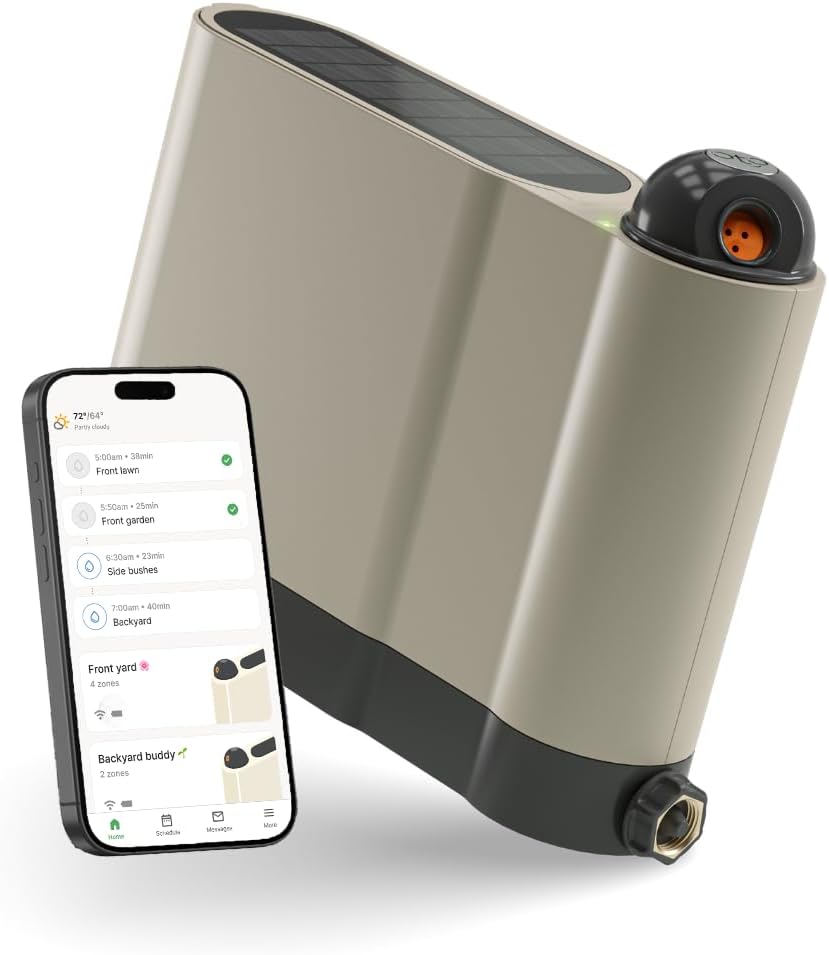
| Coverage | Up to 5,000 sq ft per unit |
|---|---|
| Power source | Solar powered |
| Weather features | Weather-intelligent scheduling (rain and wind skip) |
| Construction | UV-resistant body with brass fittings |
The OtO Smart Sprinkler is a self-install irrigation device that turns a garden hose into a weather‑aware, app‑controlled sprinkler. You attach it to a hose, connect to Wi‑Fi via the OtO app, then draw custom spray zones in the map interface to target lawns, beds, trees, or pots without digging trenches. It is solar powered so it runs without batteries or hard wiring and includes UV-resistant housing and brass fittings for outdoor durability. The unit checks local forecasts and skips cycles when conditions make watering unnecessary, and multiple units can be daisy-chained to expand coverage across a yard. Practical benefits are precise coverage that reduces overspray and runoff, simple DIY setup for homeowners who want to avoid contractors, and remote control for schedule tweaks while away. Limitations are dependency on a stable Wi‑Fi connection and sunlight for power, and achieving truly uniform coverage across complex landscapes may require several units and some trial-and-error placement.
Best for: Homeowners who want a high-performance, DIY sprinkler that delivers precise, automated watering without installing underground irrigation and who prioritize efficiency and remote control.
Less Ideal for: People with very limited or no Wi‑Fi coverage, properties that lack consistent sunlight, or those who need a simple single-spray hammer for occasional spot watering.
- Solar powered operation removes the need for batteries or wiring
- App-based mapping creates customizable precision spray zones
- Weather-intelligent scheduling skips watering in rain or high wind
- Durable build with UV-resistant housing and brass fittings for outdoor use
- Requires reliable Wi‑Fi and adequate sunlight to operate optimally
Verdict: For a performance-focused DIY install, OtO delivers precision, weather-aware, solar-powered watering without trenching, making it an efficient alternative to traditional in-ground systems.
Eden Flex-Design Above-Ground Garden Sprinkler System (4-Head Kit)

| Maximum Pressure | 50 psi |
|---|---|
| Inlet Connection Size | 0.5 inches |
| Number of Items | 4 |
| Included Components | sprinklers, extensions, 50 ft hose, 3-way connector, connectors, hose mender |
The Eden Flex-Design sprinkler system is a DIY above-ground irrigation kit that makes it easy to set up targeted watering without digging or permanent installation. It includes four adjustable spike sprinklers, four riser extensions, a 50 ft 1/2" hose, a 3-way connector and hose fittings so you can position heads around beds, raised planters or lawns and adjust spray angle and flow on each head. The modular connectors let you split water to different zones and extend reach up to 50 ft, and the ABS plastic components keep the kit lightweight and simple to move. Practical benefits include tool-free assembly, the ability to raise spray over taller plants with risers, and combined coverage suitable for small to medium landscapes. Limitations are typical for above-ground systems: plastic parts are less durable than buried lines, performance depends on faucet pressure (max 50 psi), and long-term layouts can be vulnerable to accidental displacement or freezing temperatures. For a homeowner who wants a no-fuss, reconfigurable sprinkler layout this kit speeds installation and tuning but it is not a substitute for a permanent in-ground irrigation system.
Best for: Home gardeners who want a fast, reconfigurable irrigation solution they can install themselves and adjust as beds or plantings change.
Less Ideal for: People seeking a permanent, hard-wired in-ground irrigation system or those who need commercial-grade durability and freeze-resistant piping.
- Modular kit includes four adjustable sprinklers, risers, connectors and a 50 ft hose for immediate setup
- Adjustable spray angle and flow on each head lets you fine-tune coverage for irregular garden shapes
- Riser extensions let you water over taller plants and dense vegetation
- No tools required for assembly and connectors allow splitting the line for two channels
- Plastic ABS components are less rugged than permanent underground systems and can be damaged by impacts or UV over time
- System performance depends on faucet pressure and may need a timer or higher pressure for optimal coverage
Verdict: A ready-to-use, flexible above-ground sprinkler kit that lets DIYers quickly install and tune coverage for small to medium gardens.
LZMYIVE 50 ft 360° Adjustable Drip Irrigation System Kit with 15 Copper Nozzles

| Size | 50 feet |
|---|---|
| Number of Pieces | 28 |
| Power Source | Water Pressure Driven |
| Special Features | 360° Adjustable Nozzles |
| Material | Copper |
This LZMYIVE kit provides a practical, low-cost way to set up targeted irrigation for raised beds and small garden plots. The kit includes a 50 foot hose, 15 copper nozzles with 360 degree adjustment and a range of snap-in connectors, nails and ties so you can run lines along bed edges, hang them in a greenhouse, or position emitters beside individual plants. No electricity or complex plumbing is needed because it runs on normal water pressure and the brass nozzles let you choose drip, spray or mist patterns and finely tune flow by the faucet. Installation is straightforward with the provided quick-connect tees, hose cutter and tape, and the metal nozzles should hold up better than plastic options. Limitations are that the kit is sized for small to medium beds only and you may need additional tubing or connectors for larger layouts, and water pressure at your spigot will affect reach and uniformity.
Best for: Gardeners on a tight budget who want an easy, no-fuss irrigation solution for small to medium raised beds or greenhouse benches and prefer durable metal nozzles over inexpensive plastic.
Less Ideal for: Those planning large multi-bed installations or drip systems requiring precise pressure regulation and professional-grade flow control should consider more scalable irrigation systems.
- 360° adjustable copper nozzles let you direct water precisely to plants
- Runs on household water pressure so no electricity or pumps required
- Comes with snap-in connectors, nails, ties and hose cutter for quick installation
- Includes multiple nozzle modes (drip, spray, mist) to match different plant needs
- 50 foot kit may be too short for larger raised-bed layouts without extra tubing
- Performance depends on household water pressure which can limit spray distance
Verdict: A budget-friendly, ready-to-install 50 ft kit that delivers targeted, adjustable watering for small raised beds using durable copper nozzles.
NWSTESLE 2026 Upgrade Drip Irrigation System 100 ft with 20 Brass 360° Adjustable Nozzles

| Hose Length | 100 feet |
|---|---|
| Number of Pieces | 195 |
| Special Features | 360° Adjustable Brass Nozzles; 4 Watering Modes; Quick Connect Fittings |
| Fit Type | Quick Connect |
This NWSTESLE 2026 Upgrade kit is a self-install drip irrigation system intended to automate watering for raised beds, potted plants, patios, and greenhouses. It includes 100 feet of 1/4" tubing, quick-connect T and tri-elbow fittings, flexible stake rods, and 20 solid brass 360° adjustable nozzles that switch between mist, shower, stream, and drip modes. In practice the brass nozzles and improved quick-connects reduce leaks and withstand outdoor exposure better than typical plastic parts, which makes the system more dependable for scheduled use with a standard hose timer. Installation is tool-free and modular, so you can route lines around obstacles and target individual plants or narrow bed corners. Expect solid water-conservation compared with a hose, and easy customization of flow for seedlings through shrubs. The main limitations are that the kit is built for light to medium duty residential use and depends on sufficient household water pressure and a separate timer for full automation, so it is not a plug-and-play powered controller solution.
Best for: Gardeners who prioritize a durable, low-maintenance DIY solution for reliably automating watering across raised beds, containers, and patios and who want hardware that resists leaks and weathering.
Less Ideal for: People who want an integrated electronic controller or systems sized for large commercial plots should consider a different product.
- Solid brass 360° adjustable nozzles resist rust and handle higher pressure than plastic emitters
- Quick-connect fittings designed to lock tightly and reduce common leak points
- Four watering modes (mist, shower, stream, drip) let you tailor flow to seedlings, pots, lawns, and deep roots
- Flexible stake rods and included tri-elbows make routing around pots and tight bed corners easy
- 100 ft of 1/4" tubing provides coverage for medium-sized gardens or multiple container groupings
- Requires an external hose timer for automatic scheduling because no controller is included
- Designed for residential light to medium duty use and may not suit large-scale or commercial irrigation needs
Verdict: A leak-resistant, brass-nozzle DIY drip kit that lets you set up a reliable, customizable automatic watering system for medium residential gardens.
Choosing the Right Self Install Sprinkler System: Key Factors to Consider
Coverage and Zone Design
How the system distributes water across different landscape areas is the single biggest factor affecting plant health. Consider how many distinct zones you need based on sun exposure, plant type, and slope. Turf typically needs large-radius pop-up rotors or spray patterns, while beds and shrubs often perform better with low-flow drip or microspray heads.
A system with flexible nozzle options and adjustable arc settings lets you tune coverage to irregular beds and tight corners. Poorly matched head choice leads to runoff, dry spots, or overwatering. Also plan for future expansions so pipe sizing and manifold layout can accommodate added zones without major rework.
Water Pressure and Flow Requirements
Your household water pressure and available flow rate directly influence which heads and valves will work effectively. High-pressure sites can drive rotors for large lawns, but high nozzle flow can exceed available gallons per minute and cause poor performance across zones. Conversely, low-pressure situations may need pressure-compensating nozzles or pumped booster solutions.
Measure static and dynamic pressure and calculate combined GPM for heads in each zone. Choosing heads and pipe diameters to match flow prevents problems like uneven spray patterns, misting, and premature valve cycling. Properly matched systems also reduce the chance of cavitation and wear on valves and pumps.
Material Longevity and UV Resistance
Pipes, fittings, and sprinkler head bodies are exposed to sunlight, temperature swings, and occasional physical impacts. Rigid PVC and polyethylene each have tradeoffs: PVC is stiff and durable under pressure but can crack if exposed or poorly supported; polyethylene is more impact resistant but may creep under load.
Check UV resistance and recommended burial depth for the materials you pick. Valves and solenoids should be rated for outdoor enclosures if you plan an exposed manifold. Longer-lived materials reduce repair frequency and the need to dig to replace brittle components in a few seasons.
Control Options and Automation
Controller choice shapes how convenient daily and seasonal irrigation will be. Basic mechanical or battery timers work for simple schedules, but modern electric controllers offer multiple programs, zone-level runtimes, and integration with moisture or rain sensors. Smart controllers can adapt to weather and reduce unnecessary watering, which is helpful where water use is restricted.
Consider whether you want remote adjustments, app control, or sensor integration. Also plan for power availability at the controller location and for wiring runs to each valve. Simpler timer choices can reduce upfront complexity, but may increase manual intervention during seasonal changes.
Repairability and Parts Availability
A DIY-friendly system uses common fittings and widely available replacement parts. Standardized thread sizes, common valve bodies, and nozzle families make it easy to swap broken parts without waiting for special orders. Systems that rely on proprietary cartridges or unusual fasteners can add frustration when a head fails mid-season.
Think about local supplier support and whether components can be serviced with basic hand tools. Ease of obtaining replacement diaphragms, solenoids, and nozzles influences long-term ownership costs and downtime.
Planning Your Layout Before You Dig
Start by mapping your yard and identifying distinct water-use areas: lawn, flower beds, vegetable rows, and newly planted trees. Sketch existing hardscapes and note slopes and drainage paths. This upfront planning reduces the chance of moving buried pipe later and helps you size zones by matching heads with the intended coverage area.
- Walk the area with a hose to observe spray distances and overlap needs
- Measure GPM at an outdoor faucet to estimate available flow
- Group plants with similar water needs into the same zone to avoid over- or under-watering
Picking the Right Heads for the Job
Choose heads according to distance and application. Fixed spray heads work well for small lawn pockets and beds close to a water source. Rotors and gear-driven sprinklers cover larger areas with fewer heads. For beds, consider low-angle microsprays or drip lines to reduce evaporation and direct moisture into the root zone.
- Match nozzle flow to system pressure for consistent patterns
- Use adjustable nozzles for odd-shaped beds
- Select pressure-compensating emitters where pressure varies across long runs
Trenching, Pipe Choices, and Connections
Trench depth influences freeze protection and protection from lawn work. Use a consistent slope away from foundations and avoid low spots where water can collect. Decide on pipe type based on flexibility needs and local code: rigid pipe simplifies fittings for manifolds while flexible pipe can be easier around trees and curves.
- Support pipe on firm bedding to avoid stress points
- Use solvent-welded joints for PVC runs and barbed fittings with clamps for polyethylene
- Label underground valve boxes and keep accessible manifold locations for service
Controller Placement and Wiring Best Practices
Place the controller near a protected power source and where it is easy to access for seasonal programming. Keep the controller within reasonable wiring distance to valves; long runs may need thicker wire to avoid voltage drop. Protect connections in a weatherproof box and use color-coded wires or cable labels for each zone.
- Plan a dedicated conduit path for future expansions
- Install a master valve if you need additional flow control for pumps
- Include a manual shutoff and a clear schematic near the controller for future reference
Winterizing and Seasonal Maintenance
Have a seasonal plan for draining or blowing out the system if you face freezing weather. Even in mild climates, flushing debris from lines and checking nozzles in spring prevents clogging and uneven coverage. Regularly inspect valve boxes for standing water and replace worn diaphragms before they fail mid-season.
- Flush laterals before installing sprinkler heads to remove grit
- Keep a maintenance log for valve replacements and controller changes
- Inspect emitters annually for root intrusion or mineral buildup
How We Chose the Best Self Install Sprinkler System
We prioritized systems that balance straightforward homeowner installation with long-term reliability in typical yard and garden settings. Editorial filters favored clear documentation, common fittings and pipe sizes, and components that perform well under domestic water pressures. We also looked for designs that simplify seasonal maintenance and repairs, since many DIY installers manage systems on their own. Evaluation criteria focused on practical dimensions: hydraulic coverage and spray uniformity, durability of pipes and heads against sun and abrasion, compatibility with common valves and timers, and ease of flushing, winterizing, and replacing parts. Simplicity of layout and availability of repair parts were weighted heavily because they affect post-install maintenance and longevity. We excluded systems that required specialized contractors for core assembly, nonstandard proprietary fittings that limit repairs, or designs that need unusual tools for routine service. The final list emphasizes systems that a confident homeowner can install with basic tools, while still meeting professional performance expectations for residential landscapes.
FAQ
Can I install a self install sprinkler system without digging trenches by hand?
Yes. Trenching machines and narrow trenchers are commonly rented and can speed the job, but you still need to plan lines carefully and watch for underground utilities. Pop-up heads and shallow lines work for some yards, but deeper burial increases durability.
How do I size zones if my home has low water pressure?
Measure your household flow in GPM and calculate the total for heads planned in a zone. Use lower-flow heads, pressure-compensating nozzles, or more zones with fewer heads each to keep per-zone demand within available flow. In some cases, a booster pump is an option but adds complexity.
What is the best way to prevent clogging from local well water or hard water?
Install appropriate filtration or a screen filter on the supply side, and use emitters and nozzles with larger orifice sizes when mineral content is high. Periodic flushing of laterals and replacement of small nozzles reduces buildup. For heavy mineral issues, professional water treatment ahead of the irrigation system is worth considering.
Should I use a smart controller or a simple timer for a small yard?
Smart controllers offer adaptive schedules and can reduce water waste, which is helpful if you want hands-off operation. For small, simple yards a basic multi-program timer is often sufficient and easier to install. Consider whether you need remote control or sensor integration before committing.
How deep should I bury pipes in areas with freezing winters?
Depth recommendations vary by climate, but deeper burial below frost lines reduces freeze risk. Additionally, insulating valve boxes, using freeze-resistant valve models, and draining or blowing water from the system each winter are standard practices to avoid freeze damage.
Final Verdict
Prioritize a system that matches your yard layout, water pressure, and maintenance appetite. Coverage uniformity and correct head selection determine daily performance, while materials and parts availability dictate how easy the system is to keep running over years. Tradeoffs are inevitable: simpler controllers and fewer zones reduce complexity but may cost water efficiency, while higher-spec materials and smart controllers increase upfront work but lower long-term maintenance. Choose the configuration that balances easier installation with parts you can service locally. With a clear plan, matching heads and pipe sizes to measured pressure, and attention to seasonal maintenance, you can install a self install sprinkler system that reliably keeps your landscape healthy for seasons to come.
