

Note: This article contains affiliate links. If you click on these links and make a purchase, I may earn a small commission at no extra cost to you. This helps support my research and content. Read my full affiliate disclosure here.
Picking the right smart water sprinkler system changes how you manage a lawn or landscape. A smart controller that meters water by weather and a reliable set of valves and heads that match your yard layout can cut waste, keep plants healthier, and shrink maintenance time. This guide covers seven shortlisted smart water sprinkler systems chosen for real-garden performance, from small urban yards to larger suburban lawns. We evaluate coverage reliability, water-efficiency features, ease of installation, and day-to-day usability so you can match a system to your irrigation needs and site constraints. Read on for practical guidance and the top options that met our editorial filters before the detailed product summaries.
Top Picks at a Glance
| Best Overall The best all-around choice for most situations | ImoLaza ET Master 8-Zone Wi‑Fi Smart Sprinkler Controller |  |
| Best Quality Built to a higher standard if you want something more solid | Hunter PRO‑HC WiFi Smart Sprinkler Controller, 12‑Zone |  |
| Best Value The sweet spot between price and what you get | Orbit B-hyve XD 4-Port Smart Hose Watering Timer | 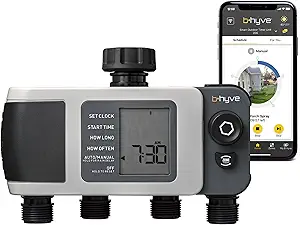 |
| Best Budget The cheapest option that still gets the job done reliably | HiOazo Smart Sprinkler Controller (4-Zone, App-Controlled) |  |
| Highest Rated A top-rated pick with lots of positive feedback | Rachio 3 Smart Sprinkler Controller, 8-Zone |  |
| Most Popular A crowd favorite that many people choose with confidence | Orbit B-hyve Smart 6-Zone Indoor/Outdoor Sprinkler Controller |  |
| Best Seller A high-volume bestseller chosen again and again | Rachio 3 Smart Sprinkler Controller, 16-Zone |  |
ImoLaza ET Master 8-Zone Wi‑Fi Smart Sprinkler Controller

| Zones | 8 |
|---|---|
| Voltage | 120 volts |
| Connectivity | 2.4 GHz Wi‑Fi |
| Operating Temperature | -13°F to 140°F |
| Included | Controller, power adapter, wall screws, screwdriver |
The ImoLaza ET Master 8‑zone controller replaces a conventional timer with a connected unit that automatically adjusts watering using real‑time evapotranspiration and local weather intelligence. Installation is designed for DIY: mount the unit, transfer pre‑labeled wires and connect to the ImoLaza app over built‑in 2.4 GHz Wi‑Fi. Once set up you can choose Smart ET, fixed cycle, or a New Grass schedule with many start times for seeding or sod. The system skips watering for rain, high wind, freeze or saturated soil days and sends fault and leak alerts when abnormal flow or electrical issues are detected. The controller supports remote app control plus Alexa and Google Assistant voice commands and receives OTA firmware upgrades so algorithms improve over time without extra cost. Practical benefits include potential water savings and convenience for managing multiple zones remotely, but truly outdoor mounting requires a separate waterproof case and very advanced claims about savings depend on correct setup and local conditions.
Best for: Homeowners who want an easy DIY upgrade from a mechanical timer to an intelligent, water‑saving controller and who value remote control plus automated weather‑based adjustments.
Less Ideal for: People who need a factory‑rated outdoor enclosure included or those who prefer completely standalone, nonconnected controllers without app dependence.
- Real‑time ET and hyperlocal weather data automatically adjust schedules to save water
- Built‑in 2.4 GHz Wi‑Fi with app control and Alexa/Google Assistant voice integration
- Multiple program options including a high‑frequency New Grass schedule for seeding or sod
- Fault detection and leak/flow alerts reduce risk of unnoticed failures or water waste
- OTA updates keep features and algorithms evolving without buying new hardware
- Not rated for permanent outdoor wall mounting without buying a separate waterproof enclosure
- Claims about up to 60% water savings will vary by landscape and require correct configuration
Verdict: A feature‑rich, app‑controlled 8‑zone controller that modernizes irrigation with real‑time ET and automated weather skips for hands‑off water savings.
Hunter PRO‑HC WiFi Smart Sprinkler Controller, 12‑Zone

| Zones | 12 station |
|---|---|
| Connectivity | WiFi (Hydrawise) |
| Display | Full‑color touchscreen |
| Sensor support | Rain, flow meter, sensor inputs |
The Hunter PRO‑HC is a professional‑grade 12‑zone irrigation controller aimed at homeowners or property managers who want precise, water‑saving automation. It pairs a full‑color touchscreen for fast on‑site setup with WiFi and the Hydrawise app for remote scheduling, alerts, and system monitoring. The controller uses predictive weather‑based adjustments that factor in rainfall, temperature, wind, and humidity so run times are reduced when conditions require less water. It also supports sensors, a flow meter, master valve output, and built‑in wire fault detection for more reliable operation and proactive maintenance. Typical use is mounting outdoors or indoors near the irrigation manifold, programming zones locally or in the app, then letting Hydrawise fine‑tune durations daily. The main limitations are that it is optimized for users who want a robust, expandable system rather than a minimal plug‑and‑play timer and installation typically requires basic wiring familiarity or contractor help for more complex setups.
Best for: Buyers who want a reliable, water‑saving smart controller that can manage a full yard or small commercial landscape and who value remote management and expandability.
Less Ideal for: People who need a very simple plug‑and‑play sprinkler timer for one or two zones or who prefer a basic mechanical controller without WiFi features.
- Smart, weather‑based scheduling that adjusts run times using local forecast and conditions
- WiFi with Hydrawise app for remote control, alerts, and monitoring
- Full‑color touchscreen for easy local programming without the app
- Supports flow meters, sensors, and master valve output for expanded monitoring and safety
- Installation and wiring for multi‑zone systems can be complex for novice DIYers
Verdict: Choose the PRO‑HC if you want a 12‑zone, app‑driven controller that saves water with predictive weather scheduling and professional expansion options.
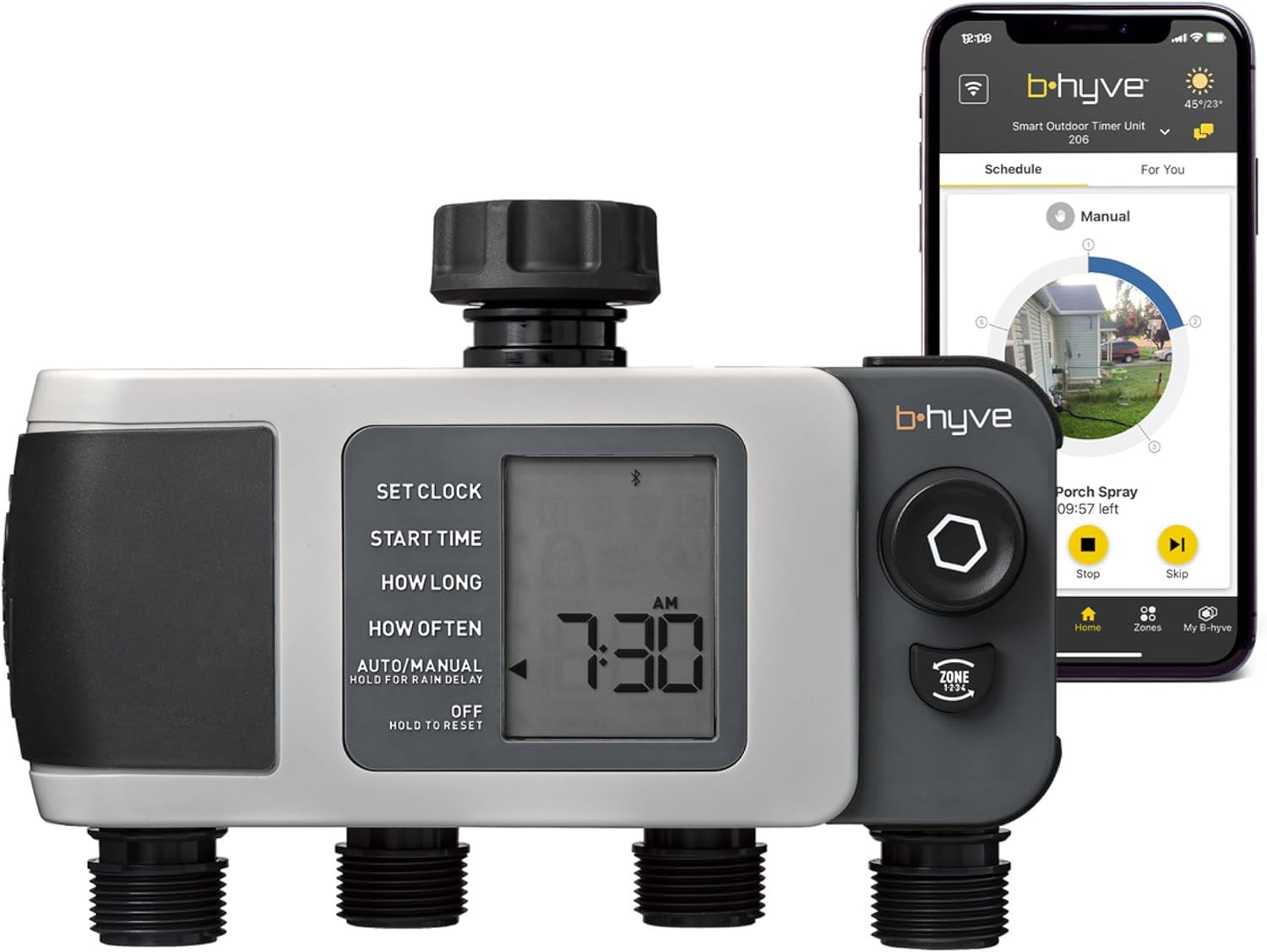
Orbit B-hyve XD 4-Port Smart Hose Watering Timer
| Brand Name | Orbit |
|---|---|
| Item Type Name | Sprinkler Timer |
| Number of settings | 6 |
| Material Type | Plastic |
The Orbit B-hyve XD 4-Port Smart Hose Watering Timer turns a single outdoor faucet into a four-zone irrigation hub that is aimed at homeowners who want reliable, automated watering without constant fuss. Each of the four outlets can be scheduled independently using the B-hyve mobile app over Bluetooth, and the device supports remote smart functions when paired with an optional Wi-Fi hub. WeatherSense automatically adjusts watering based on local conditions and drought alerts so the system reduces overwatering during rainy or cool periods. The unit is rated IPX-5 for outdoor durability and includes a simple on-device interface for local programming when a phone is not handy. Practical benefits include consolidated control of multiple garden areas, water savings from weather-based adjustments, and straightforward Bluetooth setup for nearby control. Limitations to note are the dependency on a Wi-Fi hub for full remote/Wi-Fi features and that more advanced networked automation requires that additional accessory. For risk-averse buyers the proven brand, WeatherSense automation, and weatherproof design provide reassuring reliability for a smart sprinkler solution.
Best for: Homeowners who want a low-maintenance, dependable smart sprinkler that automates multiple garden zones and prioritizes water-efficient schedules and simplicity.
Less Ideal for: Users who need full cloud-based remote control out of the box or who require integration with wider smart-home systems without adding the Wi‑Fi hub.
- Four independently programmable outlets for separate zones
- WeatherSense adjusts schedules automatically using local weather data
- Bluetooth control with on-device programming for local access
- IPX-5 rated for outdoor use so it tolerates typical yard conditions
- Full remote Wi-Fi control requires purchasing and pairing a separate Wi‑Fi hub
Verdict: Buy this if you want a durable, water‑saving four-port smart hose timer that automates multiple zones with reliable weather-based scheduling.
HiOazo Smart Sprinkler Controller (4-Zone, App-Controlled)

| Zones | 4 |
|---|---|
| Watering Plans | Up to 16 |
| Connectivity | 2.4 GHz WiFi |
| Power | 24VAC |
The HiOazo Smart Sprinkler Controller connects to 2.4 GHz WiFi and lets you run up to four zones from the companion app, with space for 16 distinct watering plans. It is designed for DIY replacement of an existing controller and claims a quick install in about 10 minutes using the included screws, wire connectors, and power adapter. The app-led display and schedule editor make daily, intermittent, or soak irrigation simple to set up, and automatic skip logic for rain, freeze, and high wind helps reduce wasted water. Practical benefits include remote control of schedules, multiple program presets for different plant needs, and weather-adaptive watering that can lower runoff and overwatering. Limitations are the 4-zone capacity, which is small for larger yards, and reliance on 2.4 GHz WiFi so homes with only 5 GHz networks will need a compatible router or extender; advanced users may miss granular flow or evapotranspiration integration. Overall this is a straightforward, budget-friendly smart controller for typical residential landscapes that need basic weather-aware automation.
Best for: Homeowners who want an inexpensive, easy-to-install smart controller to automate a small to medium yard and prioritize simple water savings and remote control.
Less Ideal for: Large properties with many irrigation zones or users who need advanced ET-based or flow-monitoring features should consider controllers with higher zone counts and more irrigation telemetry.
- App-based control for remote scheduling and real-time monitoring
- Automatic weather-based skip for rain, frost, and wind to conserve water
- Supports up to 16 distinct watering plans for flexible programming
- Quick DIY installation with included hardware and wide controller compatibility
- Only controls four zones which may be insufficient for larger properties
- Requires a 2.4 GHz WiFi network so it may need network adjustments in some homes
Verdict: A straightforward, budget-friendly 4-zone smart controller that adds remote app control and weather-aware watering to typical residential irrigation systems.
Rachio 3 Smart Sprinkler Controller, 8-Zone

| Item Highlight | 8 Zones, App Control, Rain Skips, Local Weather Scheduling |
|---|---|
| Voltage | 120 volts |
| Display Type | LED |
| Operating Temperature | 4 °F |
The Rachio 3 Smart Sprinkler Controller gives you app-first control of an existing 8-zone irrigation system and uses local weather data to adjust watering automatically. You set schedules in the Rachio app for iOS or Android, then let the controller skip runs for rain, freeze, wind or saturated soil and make seasonal adjustments so you do not overwater. Typical use is straightforward: mount the indoor unit, wire it to zone valves, connect Wi-Fi and configure zones in the app; Quick Run buttons let you manually water a zone from the controller when needed. Notable features include dual-band Wi-Fi, compatibility with Alexa, Google Home and IFTTT, LED status display and grow-in scheduling for new lawns. Practical benefits are reduced water use, simpler remote management, and easier setup compared with legacy dial timers. Limitations: the unit is indoor rated so outdoor installs require a weatherproof enclosure and some advanced setups such as well systems may need a pump for proper pressure. The controller also relies on the app for detailed schedule edits rather than full on-device programming.
Best for: Homeowners who want to reduce water use and move away from manual dial timers, and who prefer a proven smart-home controller with easy app-based setup and integrations.
Less Ideal for: People who need a fully outdoor-rated controller without adding an enclosure or who want complete on-device programming without using a smartphone app.
- Weather Intelligence automatically skips watering for rain, freeze, wind and saturation
- App-based scheduling with Quick Run and grow-in options simplifies remote control
- Works with voice assistants and IFTTT for smart-home integration
- Fast DIY install that fits most existing 8-zone systems
- Indoor-rated unit requires a separate weatherproof enclosure for outdoor mounting
- Relies on the mobile app for most scheduling tasks rather than full on-device controls
Verdict: Choose the Rachio 3 if you want a reliable, app-driven 8-zone controller that cuts wasted watering with automatic weather-aware schedules.
Orbit B-hyve Smart 6-Zone Indoor/Outdoor Sprinkler Controller

| Item Type Name | B-hyve Smart 6-Zone Indoor/Outdoor Sprinkler Controller |
|---|---|
| Display Type | LCD or LED |
| Voltage | 110 volts |
| Operating Temperature | 75 °C |
The Orbit B-hyve Smart 6-Zone controller automates landscape watering for small to medium yards by letting you program schedules from a waterproof wall-mounted panel or the mobile app. It supports zone-by-zone scheduling so lawns, flower beds, and drip lines can have tailored run times, and its WeatherSense feature automatically adjusts watering based on local weather so you do not overwater after rain or under-water during dry spells. Setup is typical for an indoor/outdoor timer and connects to 2.4 GHz Wi-Fi for remote control and voice commands through smart assistants. Practical benefits include clear on-unit display, app access to start/stop or edit programs from anywhere, and multi-zone flexibility that improves water efficiency. Limitations are that it is a 6-zone model so larger systems will need a higher-zone controller or multiple units, and full smart features require a stable home Wi-Fi connection. For homeowners who want reliable automated watering without complex professional systems, the B-hyve is a straightforward, water-saving option.
Best for: Homeowners who want to optimize water use and simplify routine irrigation for a small to medium yard using automation and weather-based adjustments.
Less Ideal for: Owners of large properties with many irrigation zones or users who need a controller that works offline without Wi-Fi connectivity.
- WeatherSense automatically adjusts schedules based on local weather to reduce overwatering
- App and on-unit control allow remote scheduling and zone management
- Waterproof wall-mounted enclosure supports indoor or outdoor installation
- Zone-based programming for tailored irrigation across up to six zones
- Only supports six zones, which may be insufficient for larger properties
- Requires reliable 2.4 GHz Wi-Fi for full remote and smart features
Verdict: If you want a practical, weather-adaptive smart controller to cut wasted watering and manage a small to medium yard remotely, the Orbit B-hyve 6-zone delivers that capability simply and reliably.
Rachio 3 Smart Sprinkler Controller, 16-Zone

| Zones supported | 16 |
|---|---|
| Voltage | 110 volts AC |
| Display type | LED |
| Operating temperature | 15 °C |
The Rachio 3 is a WiFi-enabled sprinkler controller designed to replace conventional dial timers and automate watering across up to 16 zones. It is typically wall-mounted indoors or placed in a weatherproof enclosure outdoors and is set up through the Rachio mobile app, which walks you through wiring, zone naming, and schedule creation. Key features include patented Weather Intelligence that skips runs for rain, freeze, wind and soil saturation, grow-in schedules for new grass, Quick Run buttons for manual zone activation, and compatibility with Alexa, Google Home and IFTTT. In practice this delivers consistent, hands-off watering, fewer unnecessary runs, and easier seasonal adjustments compared with manual timers. Installation is straightforward for anyone comfortable with basic wiring and the app makes troubleshooting and remote control simple. Limitations are that scheduling is primarily app-driven so basic on-device customization is limited, and systems on well pumps may need an additional pump start relay to work reliably. The controller is indoor rated unless you buy a separate weatherproof enclosure.
Best for: Homeowners who want a reliable, low-maintenance irrigation controller that reduces wasted water and simplifies seasonal scheduling without constant manual intervention.
Less Ideal for: Users who need full control from the device itself or who prefer a completely offline mechanical timer; those with specialized commercial irrigation needs should consider professional controllers.
- Local Weather Intelligence automatically adjusts and skips watering for rain, freeze, wind and saturation
- Supports large systems with up to 16 zones for flexible yard layouts
- Dual-band WiFi and wide smart-home compatibility for remote control and voice assistants
- Quick Run manual buttons let you run zones on demand without the app
- App-guided setup and grow-in schedules simplify installation and establishing new turf
- Most scheduling and advanced controls require the mobile app rather than on-device menus
- Indoor-rated unit requires a separate weatherproof enclosure for outdoor mounting
- May need an external pump start relay for some well systems
Verdict: If you want dependable, water-saving automatic irrigation for a typical home landscape, the Rachio 3 delivers smart weather-driven schedules and easy app control for up to 16 zones.
Choosing the Right Smart Water Sprinkler System: Key Factors to Consider
Zoning and Coverage Needs
Match the system to how your yard is divided. A property with multiple microclimates, slopes, or mixed planting areas benefits from many independent zones so run times and head types can be tailored.
Zone count affects controller choice and valve layout. Underestimating zones forces compromises like overwatering sun areas to satisfy shade beds. Think about future changes such as adding a new bed or lawn section and choose a system that scales without major rewiring.
Water Efficiency and Weather Adaptation
Smart features that adjust schedules based on local weather, evapotranspiration, or soil moisture sensors directly reduce waste. Systems tied to live weather data will skip cycles before rain and cut run times during cool, cloudy stretches.
Consider whether the controller supports external soil moisture or rain sensors for spots that dry at different rates. Efficiency functions matter most in regions with seasonal rainfall or tight water budgets because they produce measurable savings over a season.
Hydraulic Compatibility and Head Types
Ensure the controller and valves you choose work with your existing sprinkler heads and available water pressure. Rotors, sprays, drip lines, and micro-sprays each need appropriate pressure and flow. Mismatched components lead to uneven coverage and wasted water.
Plan for pressure regulation, zone sizing, and whether the system will integrate with drip irrigation for planting beds. Good hydraulic design reduces water runoff and prevents misting that evaporates before plants can use it.
Installation Requirements and Skill Level
Assess whether you want a plug-and-play controller or a system that needs pro-level wiring and valve placement. DIY-friendly systems minimize trenching, have clear wiring diagrams, and offer simple valve-box access.
Think about access to the controller for winterization and whether the system allows partial DIY installation with optional professional hookup. Ease of installation lowers upfront labor and reduces mistakes that affect long-term reliability.
Connectivity and App Functionality
The mobile app or web interface is where you schedule, monitor, and tweak irrigation. Look for responsive apps with clear zone maps, simple overrides, and reliable cloud connectivity. Poorly designed apps create ongoing frustration even if the hardware is capable.
Also consider local control fallback when internet is down and whether the controller supports multiple user accounts for household members or a landscape pro.
Durability and Maintenance
Outdoor electronics and buried valves face moisture, temperature swings, and occasional impact. Weatherproof housings, replaceable modules, and widely available spare parts extend useful life.
Evaluate how easy it is to access wiring terminals, replace a sensor, or swap a controller without digging out large sections of pipe. Low-maintenance systems reduce seasonal service calls and keep irrigation reliable over years.
Assessing Site Water Supply and Pressure
Before selecting a smart system, measure your available flow and static pressure. Many smart controllers focus on timing and data, but they cannot compensate for insufficient flow or extreme pressure swings. A simple flow test using a bucket and a stopwatch gives a rough liters-per-minute or gallons-per-minute figure to share with an installer or to use when sizing zones.
If pressure is high, you may need a pressure regulator or pressure-compensating heads. Low pressure often means fewer simultaneous zones or swapping to low-flow heads. Planning the hydraulic side first prevents poor coverage and frequent adjustments later.
- Perform a flow test at the irrigation connection point
- Check for pressure regulators, backflow devices, and existing valves
- Map out current head types and approximate spacing
Weather Data Sources and Sensor Options
Smart controllers pull weather data from different sources: local weather stations, municipal networks, or on-site sensors. On-site sensors and soil probes provide the most directly relevant information but require placement and occasional calibration.
Decide whether you want automated rain shutoff, soil moisture-based scheduling, or simple evapotranspiration adjustments. Each adds complexity but yields better water use when correctly configured.
- Local weather station feeds are low-maintenance but may not reflect garden microclimates
- Soil moisture sensors reduce guesswork in mixed planting areas
- Rain sensors are inexpensive safeguards against unnecessary cycles
Integration With Existing Landscape Systems
Consider whether the smart controller needs to dovetail with an irrigation timer already wired into a central valve manifold, or if a full replacement is planned. Many retrofit installations keep existing valves and swap only the controller, while some upgrades replace controllers and modernize valve boxes.
Integration also includes compatibility with drip irrigation, frost protection valves, or pump controllers. Confirm electrical compatibility and whether the smart system can trigger auxiliary equipment like a booster pump.
- Retrofitting controllers typically keeps existing valves and heads
- Full system upgrades allow optimization of head types and zone layout
- Check for relay outputs or auxiliary terminals for pumps and sensors
Scheduling Strategies for Different Landscapes
Lawns, shrubs, and flowering beds have different root depths and water uptake rates. Smart systems let you create distinct schedules so turf receives short, frequent cycles while beds get deeper, less frequent soakings. Staggering zones to match root needs improves plant health and reduces runoff.
Use seasonal adjustments rather than manual weekly edits. Set baseline schedules for each zone type and allow weather-adaptive features to trim or add minutes automatically through the season.
- Group zones by plant type and sun exposure
- Use cycle-and-soak for slopes and compacted soils
- Adjust schedules seasonally rather than manually tweaking daily
Maintenance and Winterization Tips
Regular winterization, valve box checks, and verifying sensor calibration keep a smart system reliable. Before freeze seasons, drain or blow out lines if necessary and move delicate sensors to dry storage. Check wiring for corrosion and replace batteries in wireless sensors annually.
Schedule a mid-season inspection to confirm head alignment, check for leaks, and verify that app-reported run times match actual operation. Small fixes early prevent larger water waste or bare patches later.
- Perform a spring startup and fall winterization every year
- Inspect pop-up heads for clogging and alignment
- Calibrate or reposition soil sensors after planting or major landscape changes
How We Chose the Best Smart Water Sprinkler System
We prioritized systems that demonstrably improve irrigation accuracy and reduce unnecessary watering. Evaluation focused on real-garden metrics rather than marketing claims: weather-adaptive scheduling and sensor integration, zone coverage flexibility and hydraulic compatibility, ease of installation for typical DIYers and pros, and the reliability of app and connectivity features. We also considered durability of control components and the accessibility of replacement parts for long-term upkeep. Products were excluded if they lacked documented compatibility with common valve hardware or if they offered only rudimentary scheduling without weather or sensor inputs. We filtered out systems that demand complex proprietary plumbing changes that most homeowners would not reasonably undertake. The final picks score well across the dimensions that matter in everyday yard use: consistent zone coverage, measurable water savings, installer-friendly setup, intuitive remote control, and robust electronics that tolerate outdoor conditions.
FAQ
Will a smart sprinkler controller actually save water in my yard?
Often it will. Controllers that adjust for local weather or soil moisture can reduce unnecessary cycles, especially in regions with variable rainfall. Actual savings depend on irrigation habits, system design, and whether the zones are properly sized.
Can I install a smart controller myself if I already have valves?
Usually yes. Many smart controllers are designed for retrofit and use existing wiring to valve solenoids. Basic electrical comfort and following manufacturer wiring diagrams are necessary. Turn off power and take photos before changing connections.
Do soil moisture sensors make a big difference?
They often do in heterogeneous landscapes. Sensors that read root-zone moisture prevent overwatering in beds that hold moisture longer and help tailor schedules for areas with different soil types. Placement and occasional calibration are important for accurate readings.
What happens if my Wi-Fi goes out?
Most smart controllers retain local schedules and continue running previously programmed cycles when cloud connectivity is lost. However, remote adjustments and weather-based automatic updates will pause until connectivity returns. Check for a local manual control option.
Are smart controllers compatible with drip irrigation?
Yes, many controllers support drip lines but you must size zones and run times for low-flow drip emitters. Some systems offer dedicated low-flow programming or specific drip zone settings to avoid frequent short cycles that can lead to salt buildup in the soil.
How often should I check and maintain the system?
Inspect irrigation heads and valve boxes at least twice a season and test sensors annually. Seasonal start and winterization procedures are essential in climates with freezes. Regular checks catch leaks, misaligned heads, and sensor drift before they cause plant stress.
Final Verdict
Choosing a smart water sprinkler system comes down to matching features to site needs. Prioritize accurate zone control and weather- or sensor-adaptive scheduling if water efficiency is a top concern. If you are retrofitting, favor controllers that work with existing valves and offer straightforward installation. Balance app convenience against proven durability and ease of maintenance. A system that reduces run time while delivering even coverage will pay off in healthier plants and lower water use, so focus on coverage flexibility, hydraulic compatibility, and dependable controls when you decide.
