

Note: This article contains affiliate links. If you click on these links and make a purchase, I may earn a small commission at no extra cost to you. This helps support my research and content. Read my full affiliate disclosure here.
Gypsy moth caterpillars can strip leaves quickly, weakening trees and changing the look of a yard or landscape. Choosing the right insecticide for gypsy moth caterpillars matters because timing, application method, and environmental safety determine how well you stop an outbreak without harming pollinators or beneficial insects. This guide covers six carefully shortlisted insecticides suited to controlling these caterpillars across common yard and small-acreage situations. We evaluated products for how they are applied, how selective they are, and how they fit into an integrated pest management plan. Below are the top options followed by practical guidance on choosing and using insecticides for gypsy moth caterpillars.
Top Picks at a Glance
| Best Overall The best all-around choice for most situations | Bonide Thuricide BT Concentrate, 16 oz Ready-to-Mix |  |
| Best Quality Built to a higher standard if you want something more solid | Southern Ag Thuricide BT Caterpillar Control Concentrate, 16 oz |  |
| Best Value The sweet spot between price and what you get | Monterey BT Concentrate — 16 oz Bacillus thuringiensis for Caterpillar and Worm Control |  |
| Best Budget The cheapest option that still gets the job done reliably | Southern Ag Thuricide HPC Concentrate 8 oz (Bacillus thuringiensis) |  |
| Highest Rated A top-rated pick with lots of positive feedback | Monterey Bacillus Thuringiensis (B.T.) Concentrate, 32 oz |  |
| Most Popular A crowd favorite that many people choose with confidence | Bonide Captain Jack's Bt Thuricide Ready-to-Use Spray, 32 oz |  |
Bonide Thuricide BT Concentrate, 16 oz Ready-to-Mix

| Unit Count | 16 Ounce |
|---|---|
| Item Form | Spray |
| Target Species | Worm & Caterpillar |
| Active Ingredients | Bacillus thuringiensis |
Bonide Thuricide is a BT-based liquid concentrate intended for spot and broadcast spraying to control caterpillars, cutworms, and other worm pests on vegetables, ornamentals, and fruiting plants. You mix the concentrate with water in a garden sprayer (label suggests 1 to 4 teaspoons per gallon) and apply to foliage when larvae are actively feeding, making sure to coat leaf undersides. Because it is Bacillus thuringiensis it works by ingestion, so treated insects stop feeding and die over a few days rather than immediately. The product is approved for organic gardening and is described as harmless to birds, earthworms, and many beneficial insects when used as directed. Practical benefits include suitability for use up to the day of harvest on many vegetables and a familiar, well-established active ingredient gardeners trust. Limitations are that control requires thorough coverage and correctly timed applications, and results are slower than fast-acting contact insecticides so repeated applications may be needed for heavy infestations.
Best for: Gardeners who want an organic-approved, targeted way to manage cutworms and caterpillars on vegetables and ornamentals and who are willing to apply treatments carefully and on schedule.
Less Ideal for: Users seeking immediate knockdown of heavy infestations or a single-application cure; those who prefer broad-spectrum contact insecticides for instant results should consider other options.
- Contains Bacillus thuringiensis, an organic-approved active ingredient effective against caterpillars and worms
- Ready-to-mix liquid concentrate lets you adjust dilution rate for spot treatments or larger areas
- Safe for use up to the day of harvest on many vegetables when label directions are followed
- Low impact on birds, earthworms, and many beneficial insects when applied correctly
- Requires ingestion by pests so control is slower and depends on larvae actively feeding
- Needs thorough coverage and potentially multiple applications for heavy infestations
Verdict: A trusted BT concentrate for gardeners who want an organic, low-impact way to control cutworms and caterpillars with correctly timed, thorough applications.
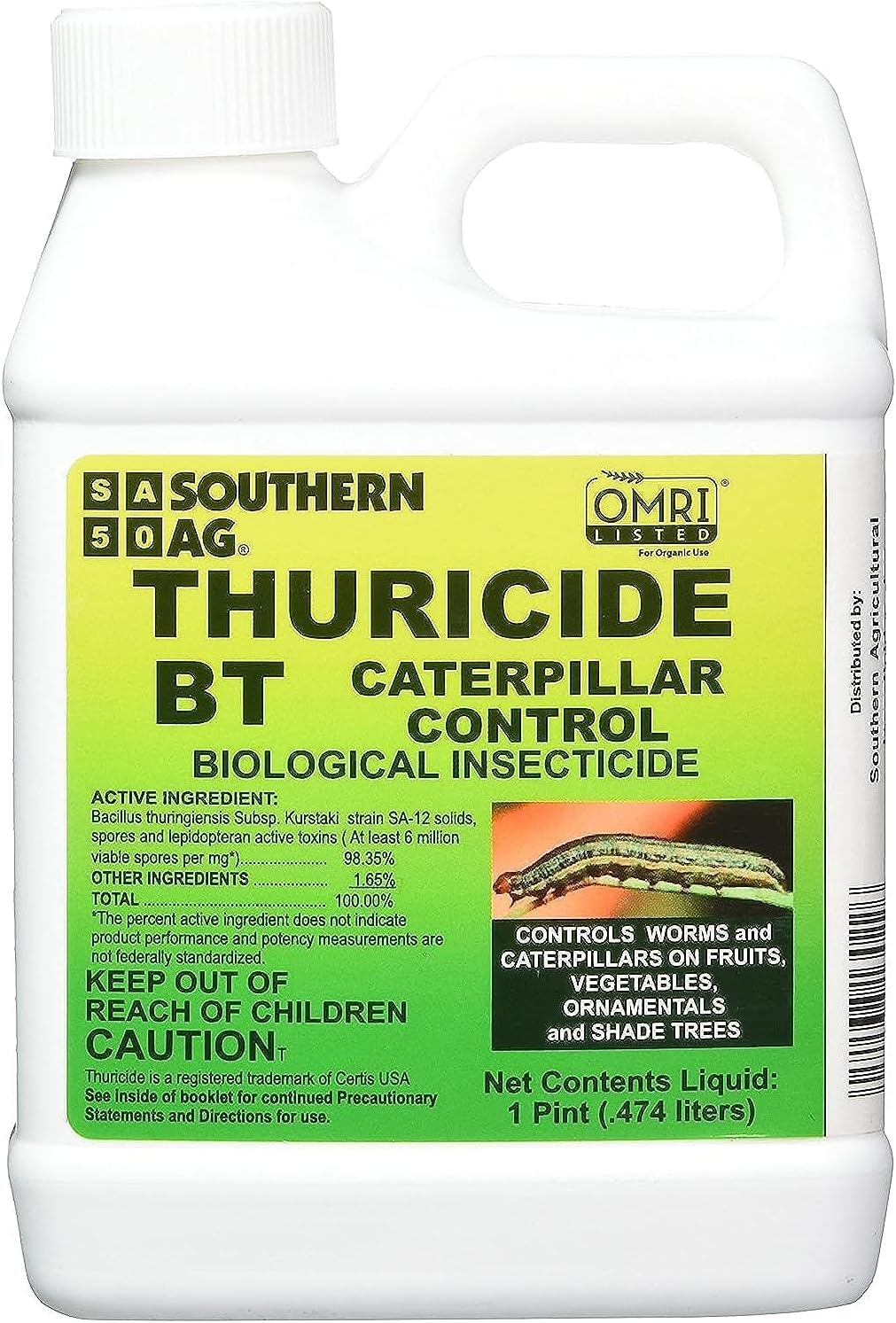
Southern Ag Thuricide BT Caterpillar Control Concentrate, 16 oz
| Item Form | Liquid |
|---|---|
| Target Species | Caterpillar |
| Liquid Volume | 16 fluid ounces |
| Specification Met | OMRI |
| Active Ingredients | Bacillus Thuringiensis Subsp Kurstaki |
Southern Ag Thuricide is a concentrated, biological caterpillar control that uses Bacillus thuringiensis kurstaki (BTk) to target lepidopteran larvae while sparing most beneficial insects when applied correctly. You mix 2 to 4 teaspoons per gallon, add a spreader-sticker and spray thoroughly over foliage of vegetables, citrus, nuts, shrubs and trees. Its low toxicity to people and pets and OMRI listing make it suitable for organic gardens and for situations where pollinator safety is a priority. Because BT acts only when larvae eat treated foliage it works best when applied at first signs of caterpillar damage or on young instars and requires reapplication after rain or as new foliage emerges. It will not control non-lepidopteran pests and needs careful timing and thorough coverage to be effective. For growers wanting a targeted, bee-safer option against worms and loopers, Thuricide delivers predictable biological control when used as part of a monitoring and spray schedule.
Best for: Gardeners and small-scale growers who prioritize effective, targeted caterpillar control while minimizing harm to people, pets and pollinators and who are willing to monitor pests and time applications.
Less Ideal for: Those needing a fast-contact broad-spectrum insecticide or control of non-caterpillar pests should choose a different product.
- OMRI-approved biological active ingredient effective against caterpillars
- Low toxicity to humans and pets, suitable for organic use
- Concentrated liquid that allows adjustable mixing rates for coverage
- Works on a wide range of lepidopteran larvae across vegetables, fruit trees and ornamentals
- Must be ingested by larvae so requires early application and good coverage
- Breaks down after rain and may need frequent reapplication
Verdict: Buy this if you want a proven, bee-safer biological concentrate specifically for controlling caterpillars in organic and pollinator-conscious gardens.
Monterey BT Concentrate — 16 oz Bacillus thuringiensis for Caterpillar and Worm Control

| Unit Count | 16 Fluid Ounces |
|---|---|
| Item Form | Oil |
| Target Species | Insects |
| Liquid Volume | 16 fluid ounces |
Monterey BT concentrate provides a lab-proven biological insecticide specifically aimed at caterpillars and worm-type pests such as gypsy moth, cabbage looper, and bagworm. You mix the concentrate with water and apply it with a trigger spray bottle or pressure tank sprayer to foliage; the active bacteria must be ingested by larvae to work, so coverage on leaves is critical. Notable features include OMRI listing for organic gardening and label guidance that it is safe for bees and earthworms when used as directed, which makes it suitable for food crops and mixed plantings. The product is straightforward to use for routine preventative sprays or targeted spot treatments during caterpillar outbreaks. Important limitations are that BT only affects susceptible larvae stages and provides no residual control for other insect types, and it requires accurate application timing and repeat treatments while larvae are feeding. Protective clothing and careful handling are recommended when mixing and applying the concentrate.
Best for: Gardeners who prioritize practical, low-impact solutions for recurring caterpillar outbreaks and want an organic‑approved product they can apply themselves to food crops and landscape plants.
Less Ideal for: Those who need a broad-spectrum or long-residual insecticide or who want a single-application fix for mixed pest problems should consider alternative products or integrated tactics.
- Targets caterpillars and worm-type pests with a biological mode of action.
- OMRI listed and labeled safe for bees and earthworms when used as directed, suitable for organic gardens.
- Concentrate mixes instantly with water for use in common sprayers, allowing flexible coverage of vegetables and ornamentals.
- Clear label directions and wide crop listing including vegetables, ornamentals, and shade trees.
- Only effective when larvae ingest treated foliage so timing and thorough coverage are essential.
- No control over non-susceptible insects or later life stages such as pupae or adult moths.
Verdict: Choose this Monterey BT concentrate if you want an effective, OMRI-listed biological spray specifically for controlling gypsy moth and other caterpillar larvae in organic gardens.
Southern Ag Thuricide HPC Concentrate 8 oz (Bacillus thuringiensis)

| Item Form | Liquid |
|---|---|
| Liquid Volume | 8 fluid ounces |
| Target Species | Insects |
| Specification Met | USDA |
Southern Ag Thuricide HPC is a concentrated biological insecticide based on Bacillus thuringiensis designed to control caterpillars and worm pests on vegetable gardens, fruit trees, shrubs and ornamentals. You mix 2 to 4 teaspoons per gallon of water, add a spreader-sticker if desired, and apply as a thorough cover spray to foliage where larvae feed. Its OMRI-friendly formulation and low toxicity to people and animals make it suitable for organic or more cautious applications. Because it targets lepidopteran larvae specifically, it is effective against caterpillars such as cabbage loopers and imported cabbageworms but will not control non-lepidopteran pests. As a concentrate, a single 8 oz bottle stretches to multiple gallons of spray, which is cost-efficient for treating small to medium plots. Limitations include the need for correct timing and coverage since Bt must be eaten by larvae to work, and repeated applications may be required during active infestations or heavy rain periods.
Best for: Gardeners who need an affordable, organic-compatible solution for caterpillars and similar larvae and prefer a low-toxicity product that can be mixed to treat multiple beds or trees.
Less Ideal for: People who need a broad-spectrum insecticide for aphids, beetles, or other non-lepidopteran pests or those wanting an immediate knockdown contact spray.
- Biological active ingredient (Bacillus thuringiensis) safe for use around people and animals when used as directed
- OMRI-approved formulation suitable for organic gardening
- Concentrated 8 oz bottle covers many gallons of spray, making it economical for repeated treatments
- Clear labeled use on vegetables, citrus, nuts, shrubs, trees and flowering plants
- Only targets lepidopteran larvae so it will not affect non-caterpillar pests
- Requires ingestion by larvae and good spray coverage for effectiveness
Verdict: Buy this if you want a budget-friendly, organic-compatible concentrate that reliably controls caterpillars in vegetable and ornamental plantings.
Monterey Bacillus Thuringiensis (B.T.) Concentrate, 32 oz

| Item Form | Spray |
|---|---|
| Target Species | Insects |
| Liquid Volume | 16 |
This Monterey B.T. concentrate is a microbial spray designed specifically to target caterpillars and worm-type insects on a wide range of plants from vegetables to ornamentals and shade trees. It mixes instantly with water and can be applied with a trigger sprayer or a pressure tank sprayer, making it adaptable for small beds and larger landscape treatments. The active biology attacks caterpillar digestive systems while leaving birds, earthworms, bees, and ladybugs unharmed, which makes it suitable for integrated pest management and organic gardens. OMRI listing confirms it meets organic program standards. Practical benefits include rapid activity on target pests, broad plant compatibility, and straightforward mixing and application. Limitations are that effectiveness depends on thorough coverage and timing since it must be ingested by larvae to work, and it will not control non-lepidopteran pests or provide long residual control between treatments.
Best for: Gardeners who prioritize dependable, low-impact control of caterpillars in vegetable beds and ornamentals and who prefer products compatible with organic practices and integrated pest management.
Less Ideal for: People who need a fast-contact broad-spectrum insect killer for beetles, aphids, or long-term residual control should consider different chemistries or additional products.
- Targets caterpillars and similar leaf-eating larvae while sparing beneficial insects and wildlife
- OMRI listed for use in certified organic gardening
- Concentrate mixes instantly with water and works with common sprayer types
- Suitable for a wide range of plants including vegetables, ornamentals, and shade trees
- Requires larvae to ingest the product so full coverage and correct timing are critical
- Does not control non-lepidopteran pests and has limited residual activity
Verdict: Choose this OMRI-listed B.T. concentrate when you want a reliable, organic-compatible solution specifically for controlling caterpillars with minimal impact on beneficials.
Bonide Captain Jack's Bt Thuricide Ready-to-Use Spray, 32 oz

| Unit Count | 32 Ounce |
|---|---|
| Item Form | Spray |
| Target Species | Insects |
| Active Ingredients | Bacillus Thuringiensi,Lapidapteran Active Toxins |
Bonide Captain Jack's Bt Thuricide is a ready-to-use biological spray that delivers Bacillus thuringiensis (Bt) to control caterpillars and worm-stage insects. You apply it with the trigger sprayer directly to the tops and undersides of leaves when you first see feeding damage; it is labeled for use on vegetables, fruit, shade trees and ornamentals and can be used up to the day of harvest on edibles. Because it kills by ingestion, treated pests stop feeding within a couple of days while birds, earthworms and many beneficial insects are largely unharmed. The product is convenient for small-to-medium infestations since it needs thorough coverage and repeat applications for new larvae. It is approved for organic gardening and comes in a 32-ounce bottle that is easier to use than concentrates for spot treatments, but using a ready-to-use bottle across a large property can become time consuming compared with hose-end or pressurized sprayers.
Best for: Gardeners who prioritize proven, low-risk biological control and want an easy spray for spot treating caterpillars on edible and ornamental plants; ideal for those who value safety around beneficials and pets.
Less Ideal for: People needing fast-contact knockdown for a large-scale outbreak or who must treat many acres quickly should consider concentrates or professional application methods instead.
- Targets caterpillars and worm-stage pests with a proven Bt active ingredient
- Safe for use on edible plants up to day of harvest when label directions are followed
- Ready-to-use trigger bottle requires no mixing for quick spot treatments
- Labeled for a wide range of plants including vegetables, ornamentals and shade trees
- Requires insects to ingest product so results are not immediate and depend on good spray coverage
- Ready-to-use bottle is less efficient for treating large areas compared with concentrates or hose-end applicators
Verdict: A convenient, organic-ready Bt spray that reliably controls caterpillars and worm pests while protecting beneficials, ideal for careful gardeners treating spot infestations.
Choosing the Right Insecticide for Gypsy Moth Caterpillars: Key Factors to Consider
Active Ingredient and Mode of Action
Knowing the active ingredient is central because it determines how the chemical affects gypsy moth caterpillars. Some act as stomach poisons that must be eaten by feeding larvae, while others work through contact or neurotoxic effects. Matching mode of action to the expected caterpillar stage improves control because younger larvae may be more susceptible to certain mechanisms.
Rotation of different modes of action helps reduce the chance of resistance developing in local populations. Also consider labels that specify effectiveness against lepidopteran larvae, as that indicates testing against caterpillar pests rather than only broad-spectrum general pests.
Application Method and Coverage
Application format matters for real-world control. Foliar sprays require good coverage on leaves where caterpillars feed, while soil drenches or systemic options move into plant tissues and protect new growth. For taller trees, you'll need a formulation that can be applied from the ground with a high-volume sprayer or a product labeled for trunk injection where appropriate.
Coverage determines whether early instar larvae encounter a lethal dose. Products that cling to leaves or include spreader stickers can improve efficacy. Consider the practicality of mixing and delivery: homeowners often rely on handheld or backpack sprayers, whereas larger properties may use truck-mounted or professional equipment.
Timing and Residual Activity
Gypsy moth control is highly timing-dependent. Treatments applied too late will not prevent the bulk of defoliation because older larvae consume more foliage and are harder to control. Look for residual activity that aligns with the local hatch period: short residuals work if you can time an application precisely, while longer residuals provide extended protection but may increase exposure to non-target organisms.
Consider local phenology and monitoring tools such as pheromone traps or egg mass surveys to match treatment timing to peak larval activity. Reapplication intervals stated on labels dictate how long protection lasts and when retreatment is permitted.
Impact on Pollinators and Beneficial Insects
Protecting pollinators and beneficial predators is important in home landscapes and natural areas. Some insecticides are highly toxic to bees and should not be applied when flowers are open or during peak foraging times. Other products are more selective and have lower risk to non-target species when used according to label directions.
Plan treatments to avoid bloom periods, choose application methods that limit drift, and favor products with minimal residual toxicity to pollinators. Read label restrictions on applications near water and nesting sites for beneficial insects.
Tree Size and Plant Sensitivity
The size and species of trees you are protecting affect product choice. Small ornamental trees may tolerate foliar sprays, but large street trees can be difficult to cover adequately from the ground. Some formulations list specific tree species sensitivities or phytotoxicity risks; follow those instructions to avoid leaf burn or other damage.
For large trees, systemic options or professionally applied treatments may be more practical. Also consider whether the product is labeled for ornamental versus timber trees, and whether follow-up treatments are feasible given tree height and access.
Safety, Reentry, and Environmental Restrictions
Labels provide critical information on personal protective equipment, reentry intervals, and restrictions near water bodies. These rules determine when it is safe to enter treated areas and whether applications are allowed near streams, ponds, or wetlands. For home gardeners, shorter reentry intervals and clear PPE guidance make a product easier to use safely.
Also check for buffer zone requirements and specific disposal instructions. Compliance with label restrictions protects human health and reduces runoff risk to aquatic organisms.
When to Treat During the Season
Timing is the single most important decision for effective control of gypsy moth caterpillars. Start monitoring in spring for egg hatch and early instars. Treating when larvae are small substantially improves control because they ingest more treated foliage relative to their size and are easier to kill.
If monitoring shows a prolonged hatch, you may need two treatments spaced according to label directions. Avoid late-season broad spraying once most larvae are fully grown because damage is already done and larger caterpillars are harder to control.
- Watch local extension alerts or use pheromone traps to estimate hatch.
- Target early instars for stomach-acting options and broader timing for contact treatments.
- Reapply only as label permits if you face multiple waves of hatch.
Application Techniques for Trees and Shrubs
Effective application is about getting adequate coverage on leaves and the understory where caterpillars feed. For small trees and shrubs, use a handheld or backpack sprayer and spray until leaves are wet but not dripping. For larger trees, high-volume spraying from the ground or professional equipment may be necessary to reach the canopy.
Consider adjuvants that improve spray adhesion for foliar sprays, and always follow label guidance on mixing rates and tank-mix compatibility. Avoid spraying on windy days to minimize drift and potential harm to adjacent plants and pollinators.
- Spray in early morning or evening to reduce bee exposure.
- Use appropriate nozzle types for canopy penetration.
- Calibrate sprayers to deliver the recommended volume per canopy size.
Integrating Nonchemical Methods
Insecticides work best as part of an integrated plan. Physical removal of egg masses, regular pruning of heavily infested branches, and banding trunks to intercept early-stage caterpillars can reduce population pressure. Encouraging natural enemies and maintaining tree vigor through proper watering and fertilization helps trees withstand partial defoliation.
Combine monitoring and targeted treatments to minimize applications and reduce impacts on beneficial organisms. Use insecticides as a targeted tool rather than a first resort, especially when beneficial insect activity is high.
- Scrape and dispose of visible egg masses in winter.
- Apply sticky bands or burlap traps for early instars when feasible.
- Promote bird and predator habitat to increase natural control.
Safety and Legal Considerations
Always read and follow the product label; it is the legal document that governs use, rates, personal protective equipment, and reentry intervals. Labels also list environmental precautions and restricted-use conditions. Incorrect use can harm non-target species and violate local regulations.
Wear recommended PPE, avoid applying near water unless label allows it, and observe buffer zone instructions. Keep children and pets out of treated areas until the reentry interval has passed.
- Check for restrictions on applications near aquatic habitats.
- Follow disposal instructions for leftover product and containers.
- Record treatment dates and locations for future reference.
Monitoring Results and Planning Follow-Up
After application, continue monitoring to assess effectiveness and determine if follow-up treatment is necessary. Look for decreased feeding, moribund caterpillars, and reduced numbers on foliage. Remember that some products act slowly and you may see dead caterpillars on leaves several days after treatment.
If significant feeding continues after the stated interval on the label, consult the product label for permitted reapplication rates and timing. Persistent problems across seasons may require a more integrated landscape-level approach.
- Inspect treated trees weekly during active larval periods.
- Use visual checks and simple counts to track population trends.
- Plan next season's preventive actions based on this season's outcomes.
How We Chose the Best Insecticide for Gypsy Moth Caterpillars
We prioritized options that match how gardeners actually fight gypsy moth caterpillars: effective caterpillar control during the susceptible larval stages, application formats that work on trees and shrubs, and formulations that reduce harm to pollinators and other beneficials. Evaluation criteria included active ingredient mode of action, timing and speed of control, application method and coverage, impact on non-target organisms, and label guidance for treating trees of different sizes. We excluded products labeled only for indoor pests or those without explicit labeling for caterpillar stages on woody plants. We also filtered out formulations that require commercial licensing for application. Practical considerations such as ease of mixing, tank compatibility for backyard sprayers, and clear reentry intervals influenced the selection. The resulting shortlist favors products that are realistic for homeowners and small-plot managers to use within an integrated approach that includes timing, monitoring, and manual removal when feasible.
FAQ
When is the best time to apply insecticide for gypsy moth caterpillars?
The best time is during early larval stages shortly after egg hatch. Young caterpillars are more susceptible and small enough that foliar residues or ingested toxins are effective. Monitor local hatch timing and treat when most larvae are in the early instars.
Will treating once stop an outbreak of gypsy moth caterpillars?
One treatment can substantially reduce numbers if timed correctly, but multiple waves of hatch or heavy infestations may require follow-up applications. Continued monitoring and combining nonchemical methods improve long-term control.
How can I minimize harm to bees when using insecticide?
Avoid spraying during bloom and apply in the evening or early morning when bees are less active. Choose products and application methods with lower risk to pollinators and follow label restrictions about flowering plants.
Are systemic insecticides better for large trees?
Systemic options can protect new foliage and are useful for large trees where achieving full foliar coverage is difficult. However, systemic treatments have different timing and uptake requirements and may have restrictions; always follow label directions.
Can I use the same product on ornamental shrubs and hardwood trees?
Some products are labeled for both ornamentals and trees, while others are limited to specific plant types. Check the label for listed species and any phytotoxicity warnings before treating different plant types.
What precautions should I take when applying insecticide near water?
Use products labeled for aquatic proximity and follow buffer zone requirements. Avoid applications that allow runoff, and never apply directly to water unless the product label permits it.
Final Verdict
Choosing the right insecticide for gypsy moth caterpillars depends on timing, application practicality, and protecting non-targets. Prioritize options that match the larval stage you are targeting and the size of the trees you need to treat, while minimizing pollinator exposure and following label safety rules. Ultimately, integrate monitoring and nonchemical controls with targeted insecticide use. That approach reduces unnecessary applications and gives you a clear path to manage outbreaks while protecting the broader landscape.
